

Sublimation, DTG, and Reactive Printing: Key Differences for Fashion Teams
Quick Answer
Sublimation, direct-to-garment (DTG), and reactive printing are all digital textile-printing methods, but they solve different production problems.
Sublimation is primarily suited to polyester and polyester-rich textiles. In the common transfer process, artwork is printed onto transfer paper and moved into the textile with heat. It works especially well for sportswear, activewear, swimwear, and other polyester products where all-over color, gradients, and a minimal change in fabric handfeel are desirable.
DTG prints artwork directly onto an already-made garment. Cotton and cotton-rich garments are common applications, although equipment and pretreatment systems increasingly support some polyester products. DTG is particularly useful for T-shirts, sweatshirts, customized apparel, ecommerce merchandise, and print-on-demand production.
Reactive digital printing is primarily a fabric-printing process for compatible cellulosic and other fibers such as cotton, viscose/rayon, linen or hemp, and some silk applications. It usually requires pretreatment, printing, steaming, washing, and drying, making its production workflow more involved than DTG or transfer sublimation.
The practical choice therefore starts with fiber composition and product format, not simply which print technology appears newest or cheapest.
Why These Three Technologies Should Not Be Treated as Interchangeable
A fashion team can send exactly the same artwork to three digital printers and receive three very different products.
The difference begins with what happens to the colorant.
In sublimation, suitable disperse dye is transferred into polyester under heat. With commonly used DTG systems, pigment ink is deposited onto a finished garment and then fixed through heat, with pretreatment often required—especially when white ink is used. In reactive printing, reactive dyes penetrate compatible fibers and are subsequently fixed, commonly through steaming, before unfixed dye and processing chemicals are washed away.
Those are not minor technical variations. They change:
- which fibers can realistically be printed,
- whether printing occurs before or after garment construction,
- how dark substrates are handled,
- what the print feels like,
- what equipment surrounds the printer,
- how much wet processing is required,
- how production is scheduled,
- how samples are approved,
- and what actually drives cost.
The broader digital-printing workflow is explained in Digital Textile Printing Explained for Fashion and Apparel Production. Here, the more useful question is narrower: when should a fashion team choose sublimation, DTG, or reactive printing?
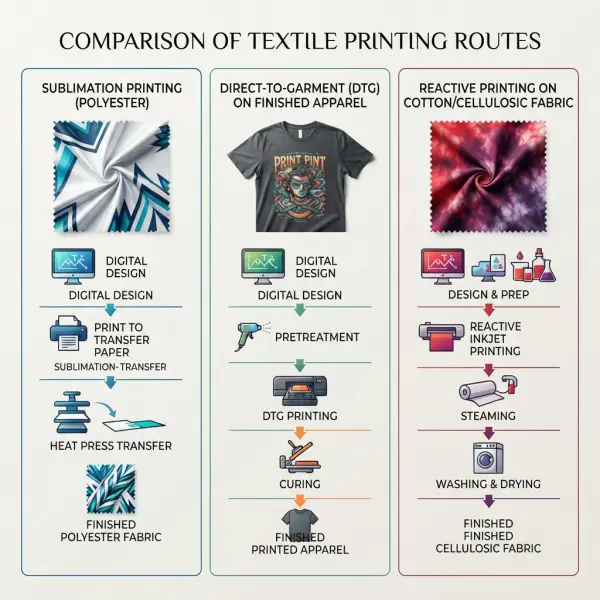
Sublimation vs DTG vs Reactive Printing at a Glance
For an initial sourcing decision, the differences can be summarized this way:
|
Decision factor |
Sublimation |
DTG |
Reactive digital printing |
|
Typical substrate |
Polyester and polyester-rich textiles |
Finished garments, commonly cotton and cotton-rich products |
Cotton, viscose/rayon, hemp/linen-type cellulosics, and selected silk applications |
|
Product stage |
Fabric, cut panels, or polyester garment depending on workflow |
Finished garment |
Usually fabric before cutting and sewing |
|
Main color mechanism |
Disperse dye transferred or fixed into polyester |
Commonly pigment ink fixed onto garment surface/fibers |
Reactive dye bonds with compatible fiber |
|
Dark fabric suitability |
Limited in conventional sublimation because there is normally no white ink |
Possible using white ink and appropriate pretreatment |
Fabric can be printed in many color systems, but workflow differs from printing opaque graphics over a dark finished garment |
|
Pretreatment |
Depends on direct vs transfer workflow and substrate |
Commonly required for white ink; requirements vary by garment and system |
Generally required as part of fabric preparation |
|
Fixation |
Heat |
Heat curing |
Typically steaming |
|
Washing after printing |
Usually not part of transfer sublimation fixation |
Normally not a production wash-off stage |
Normally required to remove unfixed dye and processing auxiliaries |
|
Print hand |
Usually minimal change on polyester |
Can be perceptible depending on ink coverage, white underbase, garment, and process |
Often retains a textile-dyed character because dye reacts with fiber |
|
Strong use cases |
Sportswear, activewear, swimwear, polyester fashion |
T-shirts, sweatshirts, merch, customization, POD |
Printed cotton/viscose fashion fabrics, dresses, shirts, scarves, premium yardage |
|
Main operational advantage |
Detailed full-color polyester decoration |
Print finished garments individually |
High-quality coloration of compatible fibers |
|
Main operational challenge |
Polyester dependency and light substrate preference |
Pretreatment, platen loading, curing, garment variability |
Longer chemical and wet-processing workflow |
This table is a starting point rather than a substitute for testing.
A garment's actual behavior depends on the exact textile, ink set, pretreatment, color profile, curing or fixation settings, construction, finishing, and required end-use performance.
What Is Sublimation Printing?
Sublimation printing is a digital printing process that uses heat to transfer or fix disperse dye into compatible polyester material. In a common transfer workflow, the design is first printed in reverse onto transfer paper and then transferred onto polyester using heat and pressure.
Epson's current dye-sublimation guidance describes the same basic sequence: create the artwork, print it onto sublimation transfer paper, and heat-press it onto a polyester or polymer-coated substrate. Epson also recommends white or light-colored polyester for conventional dye-sublimation because the process does not provide a white ink layer.
Why polyester matters
The key limitation is chemical compatibility.
Sublimation should not be understood as a universal heat-transfer method for every textile. Conventional dye-sublimation is fundamentally associated with polyester and compatible polymer surfaces.
Higher polyester content generally produces stronger sublimation results than a fabric containing only a small polyester percentage. If a designer substitutes a cotton jersey because the handfeel is preferable, the same sublimation production route should not be expected to reproduce the original result.
This is one reason fashion product development should lock fiber composition before final print approval.
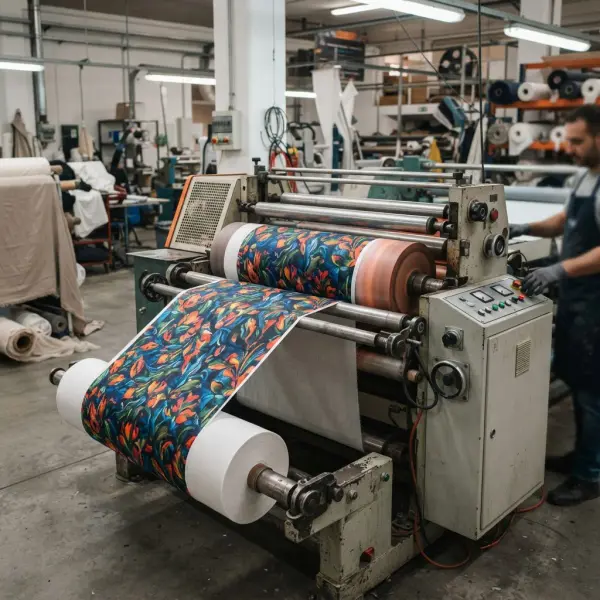

Why sublimation feels different from many garment prints
Sublimation usually produces little additional surface layer on suitable polyester because the coloration process does not depend on building a thick opaque print film on top of the garment.
That makes it particularly attractive for performance apparel where maintaining lightweight fabric character can matter.
A running jersey containing a large photographic graphic, for example, can be sublimated across most of the surface without creating the same type of localized ink layer associated with some opaque garment-print systems.
The exact handfeel still depends on the base textile and finishing. The point is not that sublimation makes fabric softer; it is that the print process itself generally introduces relatively little additional surface texture on appropriate polyester. Epson similarly notes that dye sublimation can preserve the fabric feel in polyester applications.
Where sublimation performs particularly well
Sublimation is commonly considered for:
- cycling jerseys,
- running apparel,
- football and teamwear,
- leggings,
- polyester dresses and tops,
- swim-related polyester products where the textile specification supports the process,
- scarves and accessories made from suitable synthetics,
- all-over print garments,
- and engineered sportswear panels.
These categories benefit from a combination of polyester compatibility, detailed color reproduction, and the ability to print artwork across large areas.
For engineered garments, the designer can also place graphics around individual pattern pieces before sewing. This is common in teamwear, where numbers, sponsor graphics, panel colors, and decorative elements may be integrated into the printed piece rather than added as separate decorations later.
Where Sublimation Becomes Less Suitable
The most obvious limitation appears when the product is not polyester.
A brand building a collection around cotton poplin, linen-look cellulosics, viscose dresses, or cotton jersey should not choose conventional sublimation simply because a supplier offers inexpensive full-color printing.
The substrate is part of the technology.
Dark materials introduce another constraint. Conventional sublimation does not normally print an opaque white base, which is why white or light polyester is generally preferred. A dark navy polyester shirt cannot simply receive a pale yellow sublimation graphic with the same visual logic as a DTG printer laying white ink beneath the yellow. Epson explicitly advises white or light polyester for best conventional sublimation results.
This distinction is easy to overlook when teams compare only artwork samples rather than the complete substrate system.
What Is Direct-to-Garment Printing?
Direct-to-garment printing, or DTG, is a digital process that prints artwork directly onto an already manufactured garment.
Instead of printing several meters of fabric first and then cutting it, DTG commonly begins with a blank T-shirt, sweatshirt, tote, or another printable product. The garment is positioned on a platen, printed, and then the ink is cured.
Commercial DTG equipment commonly uses textile pigment inks. Epson, for example, identifies its current UltraChrome DG2 system as pigment ink optimized for textile printing. Its F1070 specification supports cotton and cotton-polyester products while requiring pretreatment under defined conditions.
That finished-garment workflow gives DTG a very different commercial role from reactive roll-to-roll textile printing.
DTG fits late-stage product differentiation
Imagine an ecommerce brand selling one heavyweight cotton T-shirt in ten graphic designs.
With traditional finished-goods production, the company could order inventory for every combination:
10 graphics × 5 sizes × multiple units.
DTG creates another option. The business can potentially hold a smaller pool of blank T-shirts and apply graphics later, according to forecasted or confirmed demand.
Printing is therefore moved closer to the customer order.
That does not eliminate inventory. The company still needs blanks in the correct sizes, colors, and styles. But design-specific inventory can potentially be postponed.
This distinction becomes particularly important in print-on-demand operations, which will be discussed more deeply in How Digital Printing Supports Small-Batch Fashion Production.
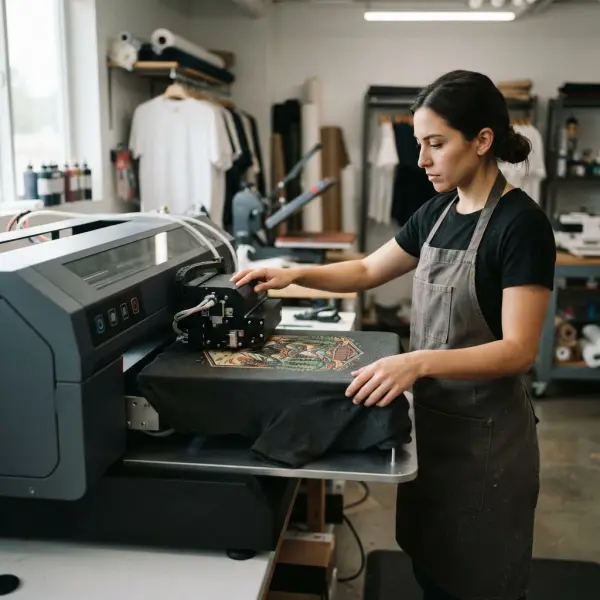
Why DTG pretreatment matters
Pretreatment is especially important when printing white ink.
On dark garments, white ink commonly creates an underbase so that colored inks remain visible against the darker textile. The pretreatment helps control how that white ink behaves on the garment.
Brother's technical guidance for its GTX systems states that pretreatment is required when white ink is used and explains that the treatment helps keep the white underbase from being absorbed excessively into the textile fibers. The pretreated garment is cured before printing; the finished ink is then cured again.
This is operationally significant.
A print shop cannot treat pretreatment as an invisible consumable with no influence on quality. Too much, too little, uneven application, inappropriate dilution, incompatible fabric dye, or incorrect pressing can affect:
- image sharpness,
- color vibrancy,
- staining,
- garment appearance,
- wash durability,
- and production consistency.
The blank garment is therefore part of the print specification.
Two “100% cotton black T-shirts” from different suppliers can behave differently because yarn, knit structure, fabric finishing, garment dye, surface hairiness, and pretreatment response are not necessarily identical.
Is DTG only for cotton?
No, but this requires nuance.
Cotton and cotton-rich textiles remain natural DTG applications because many current garment-printing systems are designed around those substrates. Current equipment can also support certain polyester and blended garments when the correct pretreatment, print settings, and testing are used.
For example, Epson's current DTG documentation supports cotton-polyester blends and selected polyester workflows with specific pretreatment requirements, while Brother notes that polyester and blends require different handling and do not necessarily deliver the same result as cotton-rich garments.
This does not make DTG and sublimation interchangeable for polyester.
A polyester sports jersey intended for all-over printing may still be far more naturally suited to sublimation. DTG becomes relevant when the product requirement is different—for example, applying a localized graphic to a finished garment.
Technology should follow the product architecture.
What Is Reactive Digital Printing?
Reactive digital printing uses reactive dyes to digitally print compatible textiles, particularly cellulosic materials such as cotton and viscose/rayon.
Unlike a pigment print that is mainly held using binder chemistry, a reactive dye forms chemical bonds with compatible fibers during fixation. Mimaki describes its reactive systems for materials including cotton, hemp, silk, and rayon and identifies fiber-dye bonding as central to the coloration mechanism.
For fashion teams, however, the chemistry is only half the story.
The other half is the production line required to make that chemistry work.
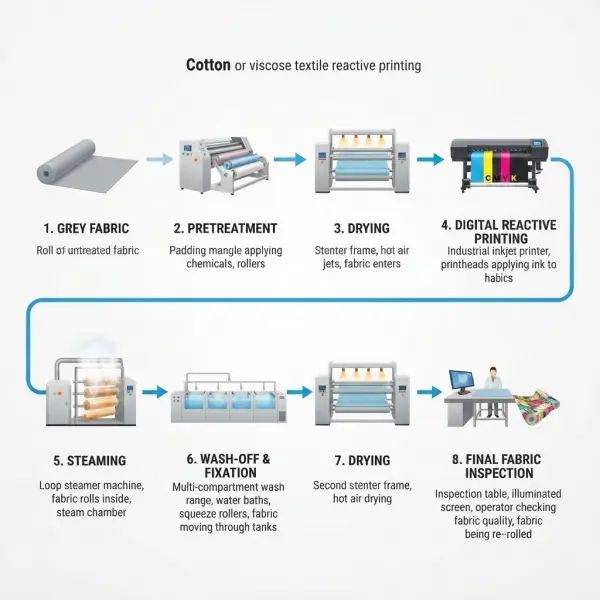
Reactive printing is not simply “print and cure”
A typical reactive digital textile workflow can include:
- preparing or pretreating the fabric,
- drying the prepared textile,
- digitally printing the artwork,
- drying after printing where required,
- steaming to fix the dye,
- washing to remove unfixed dye and processing chemicals,
- drying,
- finishing,
- and quality inspection.
EFI Reggiani's published reactive ink process, for example, specifies preparation, digital printing, drying, steaming, and wash-off. Mimaki likewise identifies steaming and washing as necessary post-processing for its reactive printing workflow.
That production sequence makes reactive printing operationally very different from loading a T-shirt onto a DTG platen.
Why fashion brands still choose the longer process
The extra steps are not pointless overhead.
Reactive printing is selected because it provides a route to digitally colored cotton and other compatible textiles where the dye becomes part of the fiber coloration system.
That makes it highly relevant for fashion products where the brand wants the character of a dyed textile rather than a localized surface graphic.
Think of:
- printed cotton voile,
- poplin shirts,
- viscose dresses,
- cotton lawn,
- printed scarves,
- lightweight fashion yardage,
- patterned sleepwear,
- and other cut-and-sew products.
The product begins as printed fabric rather than as a blank finished garment awaiting decoration.
This changes sourcing, sampling, marker planning, cutting, sewing, and replenishment.
Sublimation vs DTG vs Reactive Printing: The Material Difference
Material selection is the fastest way to eliminate unsuitable options.
For polyester: start by evaluating sublimation
If the garment is primarily polyester and the objective is full-color, large-area, or all-over printing, sublimation is often the logical first technology to investigate.
The process is particularly compatible with white or light polyester because conventional sublimation does not provide white ink.
For a cycling jersey containing complex gradients across the front, back, and sleeves, sublimation can integrate the artwork into the polyester panels before construction.
A small chest logo on an already manufactured garment, by contrast, creates a different question. Depending on the blank, performance requirement, and production setup, DTG or another garment-decoration method may be considered.
For cotton finished garments: DTG is often the practical starting point
If the product already exists as a T-shirt or sweatshirt and the job is to add a graphic, DTG provides a straightforward digital architecture.
There is no need to digitally print an entire roll of cotton jersey, cut the printed fabric, and manufacture a shirt merely to add a front graphic.
That would solve a different production problem.
DTG lets a team decorate the finished garment directly.
For printed cotton or viscose yardage: reactive becomes more relevant
Suppose a brand is developing a viscose midi dress covered in a botanical print.
The artwork needs to appear continuously across several pattern pieces, and the fashion team wants the visual and tactile character of printed yardage.
That is not a natural DTG problem.
Reactive roll-to-roll digital printing is much closer to the intended product architecture, assuming the specific fiber, fabric, dye system, and supplier process are compatible.
This is the key sourcing discipline:
Do not ask which printer is best until the material and product format are known.
Which Method Produces the Best Print Feel?
There is no universal winner because the technologies create color differently.
Sublimation generally introduces very little additional surface feel on polyester. The dye is transferred into the compatible polymer rather than relying on a thick opaque layer sitting on the textile.
Reactive printing can likewise retain a fabric-like hand because the reactive dye colors compatible fibers rather than forming an opaque film over the surface.
DTG print feel varies more visibly with artwork and process.
A small CMYK graphic on a light cotton T-shirt may feel relatively subtle. A large print on a black shirt can require pretreatment, white ink underbase, and higher total ink deposition, which may create a more noticeable printed area.
This does not mean DTG inherently feels poor.
Artwork coverage, ink settings, blank quality, pretreatment, curing, and printer chemistry all matter.
For fashion teams, “soft handfeel” should therefore be converted into a sample requirement rather than left as a subjective supplier promise.
Approve the actual garment.
Which Technology Handles Dark Colors Best?
This question needs two interpretations: dark artwork and dark substrate.
All three technologies can produce dark colors in appropriate applications.
Printing onto a dark base textile is different.
Conventional sublimation has a clear limitation because its inks do not provide an opaque white layer. A dark polyester substrate remains visible beneath lighter dye colors, which is why white and light polyester are the standard starting point.
DTG can print onto dark garments by using white ink as an underbase, provided the garment is correctly pretreated and the printer supports that workflow. Brother specifically identifies pretreatment as essential for white-ink printing in its GTX process.
Reactive printing approaches color differently. Fashion fabric may begin from an appropriately prepared substrate and receive the pattern through dye coloration. It should not be interpreted as an equivalent method for placing an opaque light graphic over an arbitrary dark finished garment.
This is an excellent example of why visual similarity in a catalog does not imply process interchangeability.
Which Printing Method Is More Durable?
Durability should be specified by the performance required, not by assigning one technology a blanket ranking.
A well-controlled sublimation print on suitable polyester can perform strongly because the disperse dye colors the polymer rather than sitting as a peelable transfer film.
A correctly processed reactive print can also deliver strong textile fastness because the dye bonds with compatible fiber.
A properly pretreated and cured DTG pigment print can withstand repeated laundering, but its performance depends heavily on garment surface, pretreatment, ink deposition, curing, care conditions, and system chemistry. Brother specifically warns that insufficient curing can lead to premature cracking or flaking and recommends wash testing to verify the result.
The operational lesson is simple:
Do not purchase “durability.” Purchase a tested specification.
Depending on the garment, brands may need to evaluate:
- colorfastness to laundering,
- dry and wet rubbing,
- perspiration,
- water,
- light,
- chlorinated water,
- or other product-specific exposures.
ISO 105-X12, for example, specifies dry and wet rubbing tests for textile coloration, while ISO 105-C06 covers resistance to domestic and commercial laundering.
A fashion tee, swim product, work uniform, and decorative scarf should not automatically share the same acceptance criteria.
Which Method Is Cheaper?
None of the three is universally cheapest.
The cost structure differs so much that a single “price per print” comparison can be misleading.
Sublimation costs are shaped by polyester, ink, transfer, and heat
Transfer sublimation may require:
- polyester fabric or garments,
- sublimation ink,
- transfer paper,
- printing equipment,
- heat press or calendar equipment,
- operator time,
- electricity,
- and production waste from transfer or cutting.
For all-over garments, printing fabric or engineered panels is only part of the garment cost. Cutting, sewing, matching, and yield still matter.
DTG shifts cost toward the individual garment
A DTG job may involve:
- blank garment cost,
- pretreatment,
- pretreatment application,
- pretreatment curing,
- white and CMYK ink,
- printer time,
- operator loading and unloading,
- final curing,
- maintenance,
- failed prints,
- and fulfillment.
Artwork with a large white underbase can have a different ink cost from a small CMYK-only graphic.
Garment loading also matters. A printer's theoretical speed is not the same as completed retail-ready garments per hour.
Reactive printing includes a longer processing chain
Reactive production may require:
- prepared fabric,
- pretreatment chemistry,
- digital ink,
- printing,
- drying,
- steaming,
- washing,
- water,
- wastewater handling,
- drying again,
- finishing,
- and quality control.
That makes reactive printing look operationally heavier—and it is.
But if the product requires premium printed cotton or viscose yardage, comparing it with a DTG T-shirt price is commercially meaningless. They are not producing the same thing.
The relevant costing question is:
What is the lowest-risk production route that achieves the required product specification at the intended volume?
Which Technology Is Better for Small Orders?
All three can support relatively short digital runs, but “small order” means different things in each system.
With DTG, a small order may literally mean one finished garment.
With sublimation, a print shop may produce one customized polyester jersey, while another supplier may operate roll-to-roll equipment where the commercially sensible minimum is measured in meters.
Reactive digital printing removes physical screen-making requirements, but pretreatment, steaming, washing, machine setup, fabric handling, and finishing do not disappear. A supplier may therefore impose a practical minimum even when the printer itself could technically print a few meters.
This distinction matters.
Digital printing reduces some setup constraints. It does not eliminate every minimum economical production quantity.
Fashion startups should ask suppliers separately for:
- sampling MOQ,
- production MOQ,
- minimum meters per design,
- minimum meters per colorway,
- setup charges,
- strike-off charges,
- and replenishment minimums.
The operational implications of these smaller production lots are covered more deeply in How Digital Printing Supports Small-Batch Fashion Production.
Sustainability: Which Method Has the Lower Impact?
No credible answer can rank sublimation, DTG, and reactive printing from “most sustainable” to “least sustainable” without defining the material, equipment, production conditions, energy source, chemicals, waste, product lifetime, and system boundary.
The processes are structurally different.
Reactive printing commonly includes wet processing after printing. Sublimation avoids the reactive wash-off route but transfer sublimation consumes transfer media and thermal energy. DTG generally eliminates long roll-to-roll washing lines but still uses ink, pretreatment where required, curing energy, cleaning fluids, and blank garments.
There is also a second issue: inventory.
A DTG print-on-demand model may reduce finished graphic inventory if production genuinely occurs after demand is known. Digital sublimation can support short runs of customized polyester designs. Reactive digital printing can make multiple printed fabric designs possible without separate screen sets.
But digital capability does not guarantee lower inventory.
A brand can digitally print 20,000 garments that nobody wants.
Sustainability claims should therefore distinguish process efficiency from commercial behavior.
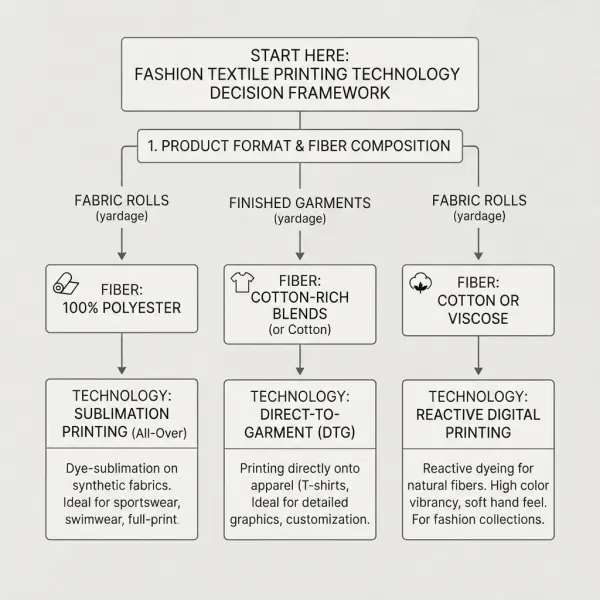
How Fashion Teams Should Choose Between Sublimation, DTG, and Reactive Printing
A useful sourcing decision can be made in a relatively disciplined order.
Step 1: Confirm the fiber
Start with actual fiber composition, not a marketing fabric name.
“Performance jersey” does not tell the printer whether the textile is polyester, nylon, a polyester-elastane blend, or something else.
Likewise, “silky fabric” does not establish whether the textile is silk, polyester satin, viscose, acetate, or a blend.
Fiber chemistry can eliminate technologies immediately.
Step 2: Decide when the print enters production
Ask whether the design needs to be printed:
- onto fabric before cutting,
- onto engineered garment panels,
- or onto a finished garment.
This one decision often separates DTG from roll-to-roll reactive printing.
Step 3: Define the visual requirement
Does the product need:
- an all-over print,
- a photographic gradient,
- a small chest graphic,
- an opaque image on a dark garment,
- continuous yardage,
- personalized names,
- or artwork aligned with pattern pieces?
A print method that works technically may still be inefficient for the required image architecture.
Step 4: Define touch and performance
Do not specify only “high quality.”
Specify what quality means.
A buyer may need:
- minimal change in handfeel,
- no visible cracking,
- high wash fastness,
- consistent black,
- controlled wet rubbing,
- precise repeat,
- stretch compatibility,
- or color matching across reorders.
Then test those requirements.
Step 5: Model production economics
Compare the complete production route.
For a made-to-order graphic T-shirt, the relevant economics may center on garment blanks, print time, ink coverage, pretreatment, and fulfillment.
For reactive yardage, cost may be driven by fabric, preparation, printing, steam fixation, wash-off, finishing, minimum meters, and yield.
For sublimated sportswear, the calculation may include polyester fabric, transfer paper, ink, heat transfer, engineered panel layout, cutting, and sewing.
The cheapest printer quote does not necessarily create the lowest finished-garment cost.
Step 6: Test the actual production substrate
This is where many comparison charts become dangerously simplistic.
Do not assume that because “cotton works with DTG,” every cotton garment will print identically.
Do not assume every polyester fabric will sublimate equally.
Do not assume every viscose fabric will behave identically in reactive printing.
Run the chosen artwork on the actual or fully qualified substrate, process it through the intended production route, then test the finished result.
Common Mistakes Fashion Teams Make
Mistake 1: Choosing by artwork rather than fiber
A designer sees a beautifully sublimated photographic print and requests the same process for a cotton dress.
The problem is not artwork quality. It is substrate compatibility.
A better approach is to establish the fabric platform first, then identify the digital-print system that can realistically deliver the required visual result.
Mistake 2: Assuming DTG is simply “sublimation for cotton”
It is not.
The processes use different color systems, different substrate logic, and different production workflows.
DTG typically decorates a finished garment. Sublimation can be used on polyester fabric, panels, or compatible finished items through a dye-transfer process.
Treating them as substitutes creates unrealistic expectations about print feel, dark garments, color behavior, cost, and scalability.
Mistake 3: Ignoring reactive post-processing
A reactive-print quotation can look expensive compared with a simple digital-print quote because the supplier is not only running an inkjet printer.
Proper production may include pretreatment, steaming, washing, drying, and finishing.
If a competing quotation omits those steps, the buyer should first verify whether the offers are technically equivalent.
Mistake 4: Using one sample to approve every fabric color
This is particularly risky in DTG.
A black garment and a pastel garment may require different ink and pretreatment behavior. Different garment dyes can also respond differently to pressing and pretreatment.
Likewise, sublimation appearance changes with base fabric color because the process lacks an opaque white layer.
Approve representative substrates and colors rather than treating one sample as universal.
Mistake 5: Believing the highest printer resolution guarantees the best garment
Print resolution is only one variable.
A fashion customer experiences the final textile through color, touch, wash durability, comfort, fit, appearance, and consistency.
Poor pretreatment can undermine a high-resolution DTG printer. Incorrect steaming or washing can undermine reactive printing. Weak heat-transfer control can undermine sublimation.
The complete process produces the garment.
What Should Brands Verify Before Approving Production?
Before choosing a supplier or print technology, fashion teams should verify five groups of information.
Substrate compatibility: exact fiber percentages, construction, weight, stretch, base color, surface finishing, and heat sensitivity.
Process: ink or dye chemistry, pretreatment, printing method, fixation, curing, washing, drying, and final finishing.
Appearance: approved strike-off or garment sample, color reference, repeat accuracy, print placement, handfeel, and acceptable variation.
Performance: relevant wash, rubbing, stretch, perspiration, light, or other testing based on intended use.
Commercial conditions: MOQ, sampling cost, setup charges, production lead time, reorder consistency, usable width, yield, rejects, and capacity.
A supplier who can explain these variables clearly is generally more useful than one whose main sales argument is the model number of the printer.
Frequently Asked Questions
Is sublimation better than DTG?
Neither is universally better.
Sublimation is generally the stronger starting point for all-over or large-area printing on suitable polyester, particularly sportswear and performance apparel. DTG is generally more practical when graphics need to be printed directly onto finished cotton or cotton-rich garments.
A polyester cycling jersey and a heavyweight cotton streetwear T-shirt therefore create different technology decisions.
Choose according to fiber, garment construction, print placement, handfeel, color requirement, order model, and required durability rather than ranking the machines themselves.
What is the main difference between DTG and reactive printing?
DTG typically prints a finished garment, while reactive digital printing typically creates printed fabric before the garment is cut and sewn.
The color chemistry also differs. Commercial DTG commonly uses pigment-based garment inks that are heat-cured. Reactive printing uses reactive dyes that bond with compatible fibers during fixation and normally requires steaming and wash-off.
A printed cotton T-shirt graphic is therefore a natural DTG application, while continuous printed cotton or viscose yardage for dresses or shirts is more naturally associated with reactive textile printing.





Comments 0
Leave a CommentSend Comment
Anda harus Login terlebih dahulu untuk dapat memberikan komentar.