

Sleeve Construction Explained for Better Garment Fit
Quick Answer
Sleeve construction is the way a sleeve pattern, armhole, seam structure, ease, grain direction, and fabric behavior are coordinated so the sleeve fits the body and allows the intended amount of movement. A well-constructed sleeve is not simply one that looks smooth when the wearer stands still. It should also sit correctly at the shoulder, provide appropriate room around the upper arm, hang in the intended direction, and allow movement without excessive pulling through the sleeve or bodice.
The sleeve and armhole should therefore be treated as one pattern system rather than two independent pieces. Armhole depth and shape, sleeve-cap height and length, bicep width, sleeve pitch, fabric stretch, and construction method all affect the final result.
For fashion businesses, this relationship matters during pattern development, sample fitting, grading, sewing, pressing, and quality control. A sleeve that is technically sewn correctly can still fit poorly if the underlying pattern relationship is wrong. Conversely, some folds or ease may be intentional because mobility and silhouette sometimes require fabric that is not perfectly smooth in every body position.
What Is Sleeve Construction?
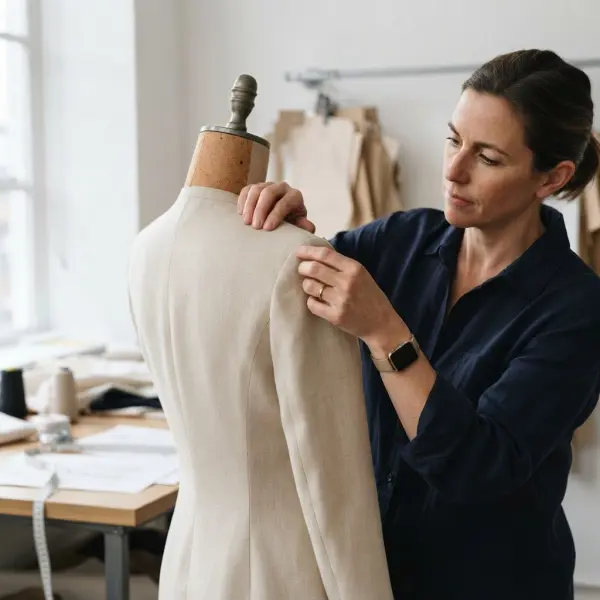
Sleeve construction is the coordinated design and assembly of the sleeve, armhole, and associated seams so that the garment achieves its intended silhouette, fit, and range of movement. In a conventional set-in construction, for example, the curved sleeve cap must correspond to the bodice armhole while accommodating the three-dimensional shape of the shoulder and upper arm. Other sleeve types solve that relationship differently, which is why a raglan or dolman sleeve cannot be evaluated by exactly the same visual criteria as a tailored set-in sleeve.
The distinction matters because the sleeve is attached near one of the body's most mobile joints. Unlike a straight side seam, the sleeve-to-body connection must accommodate changes in direction as the arm moves forward, backward, outward, and upward. The pattern therefore needs to balance appearance at rest with movement, available fabric, and the intended silhouette.
New Mexico State University's Cooperative Extension guidance on sleeve construction notes that a plain set-in sleeve should fit smoothly over the shoulder, while the sleeve grain should remain properly oriented when worn. Its guidance also describes the controlled easing used to shape many set-in sleeve caps into the armhole. New Mexico State University guide to sewing sleeves
That does not mean every sleeve should contain the same amount of cap ease—or any visible fullness. Shirt-style sleeves, knit sleeves, tailored jacket sleeves, and highly relaxed sleeves may use substantially different drafting and construction logic.
Why Does Sleeve Construction Matter So Much for Garment Fit?
A sleeve influences more than the fit of the arm itself. Because it joins the bodice around the armhole, an incorrect sleeve can change how the shoulder, upper chest, back, and even side seam appear when the garment is worn. Pulling that seems to originate in the sleeve may actually result from the bodice armhole, shoulder slope, or upper-back fit.
This is why professional fitting should examine the bodice before treating every sleeve wrinkle as a sleeve-pattern problem. If the shoulder point is misplaced, the armhole is too deep, or the bodice is too restrictive across the back, repeatedly altering the sleeve may only compensate for the symptom.
Sleeves and armholes are also drafted as interacting shapes. Changing one can change the seam length, orientation, or mobility requirements of the other. Simply transferring a sleeve from another pattern without checking the corresponding armhole can therefore produce mismatched cap length, bicep ease, sleeve pitch, or armhole depth. Pattern-development guidance from Seamwork similarly emphasizes that sleeves and armholes need to be considered as a coordinated pair when sleeves are substituted or altered. Sleeve and armhole pattern relationship guidance
The Anatomy of a Better-Fitting Sleeve
Several pattern variables work together to determine how a sleeve behaves. Looking at only sleeve circumference or sleeve length is rarely enough.
Sleeve Cap and Armhole Relationship
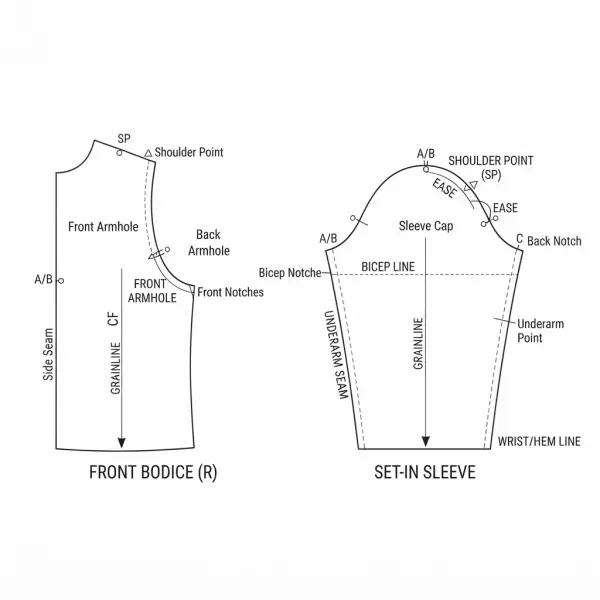
The sleeve cap is the curved upper section of a set-in sleeve that joins the armhole, or armscye. Its geometry helps translate a relatively flat piece of fabric into a three-dimensional form around the shoulder.
Many conventional woven set-in sleeves include some difference between the sleeve-cap seam length and the corresponding armhole seam length. That additional length may be eased into selected portions of the armhole rather than gathered visibly. Proper easing helps create shape without obvious puckers or pleats.
The amount is not universal. Fabric behavior, cap geometry, garment style, manufacturing method, and intended silhouette all matter. A tailored wool jacket can accommodate a construction approach very different from a lightweight shirt or knitted T-shirt.
A shirt-style set-in sleeve, for example, typically has a flatter cap and may have little cap ease. This flatter geometry can also make it suitable for sewing into the armhole while the sleeve and garment side seams are still open—a construction method common in casual apparel.
Upper-Arm Ease Is About More Than Circumference
The sleeve must provide sufficient room around the bicep and upper arm for the intended fit and activity. Too little room can create tension, restrict bending or lifting, and transfer pulling into the armhole or bodice. Too much ease may create excess volume that no longer matches the intended silhouette.
The appropriate amount depends on the garment. A fitted woven blouse, tailored coat, oversized shirt, stretch jersey top, and performance garment do not require identical relationships between body measurement and finished sleeve measurement.
The University of Kentucky's sleeve-fitting guidance specifically identifies adequate upper-arm ease, a non-binding armhole, sleeve grain orientation, and freedom of arm movement as characteristics to evaluate when assessing set-in sleeves. University of Kentucky Sleeve Savvy fitting guidance
Grainline and Sleeve Pitch Control How the Sleeve Hangs
A sleeve does not simply point straight down from the shoulder. Its orientation must correspond reasonably well with the natural position of the wearer's arm and with the garment's intended posture.
Sleeve pitch refers to the rotational orientation of the sleeve in the armhole. When the pitch is inappropriate, the sleeve can rotate forward or backward and produce diagonal tension lines even when its circumference is sufficient. This is one reason accurate front and back notches matter: they help preserve the intended orientation during assembly.
Grain direction adds another diagnostic clue. In a conventional fitted set-in sleeve standing in its intended position, distorted grain can indicate that the sleeve is being pulled away from the balance intended by the pattern. Grain behavior should still be interpreted alongside design, fabric, posture, and movement rather than treated as an isolated rule.
Elbow Shaping and Lower-Sleeve Geometry Still Matter
Long sleeves introduce another problem: the arm bends. Depending on the garment and sleeve design, shaping can come from sleeve seams, darts, controlled ease, additional circumference, two-piece construction, stretch, or combinations of these.
A narrow long sleeve that looks elegant with the arm straight may become uncomfortable when the elbow bends unless enough length and circumference are available in the relevant areas. Tailored two-piece sleeves can provide more precise shaping, while casual sleeves often rely on simpler geometry and additional wearing ease.
This is an important reminder that good sleeve fit is three-dimensional and dynamic. Measurements taken while the body is static are only part of the evaluation.
Sleeve Cap Height, Ease, and Mobility Are a Trade-Off
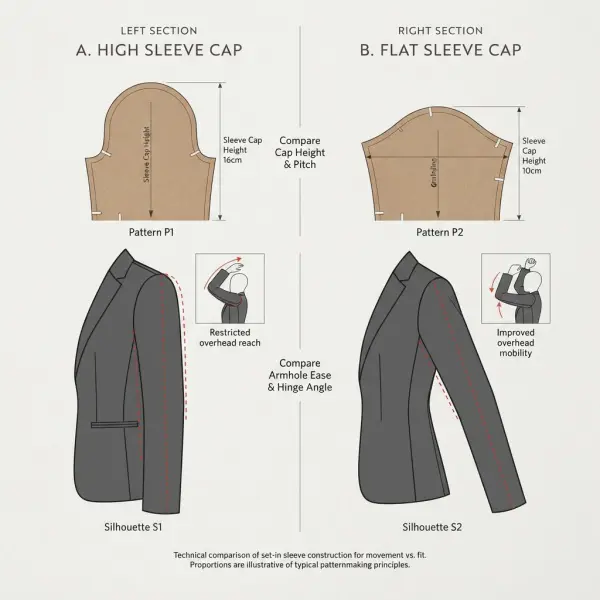
Sleeve-cap height influences how a set-in sleeve sits around the shoulder and how it behaves when the wearer raises an arm. In general, a relatively high, fitted cap can create a cleaner fitted appearance with the arm lowered, while a flatter cap can provide a more relaxed relationship between sleeve and body movement. The complete result, however, also depends on armhole depth, bicep width, fabric characteristics, and overall bodice ease.
This explains why eliminating every fold from a sleeve is not automatically evidence of superior fit. Some casual sleeves are deliberately drafted with flatter caps and greater mobility, accepting folds under or around the arm when it hangs naturally. Conversely, formal tailoring may prioritize a clean shoulder line and controlled sleeve head while accepting a different range of unrestricted movement.
A useful way to interpret the trade-off is:
|
Pattern factor |
Possible effect |
What should be checked |
|
Higher sleeve cap |
Can support a more shaped, fitted sleeve appearance |
Mobility, cap ease, shoulder alignment |
|
Flatter sleeve cap |
Can support easier arm lift and casual construction |
Underarm folds, sleeve angle, silhouette |
|
More bicep ease |
Gives more room around the upper arm |
Excess volume versus intended fit |
|
Less bicep ease |
Creates a closer silhouette |
Strain, mobility, fabric stretch |
|
Deeper armhole |
Changes the relationship between body and sleeve movement |
Garment lift, comfort, silhouette |
|
Higher armhole |
Can allow a closer relationship to the body's movement when properly fitted |
Underarm comfort and adequate circumference |
The relationships are interconnected rather than formulaic. Seamwork's pattern-fitting guidance, for example, notes that altering sleeve-cap height affects movement as well as the sleeve-to-armhole relationship. Guidance on sleeve cap height and arm mobility
For product developers, the practical lesson is not to optimize one variable in isolation. The sleeve should be tested as part of the complete garment.
Fabric Changes the Sleeve Construction Logic
Pattern geometry cannot be separated from fabric behavior. A sleeve developed in firm non-stretch cotton may behave differently when cut in a fluid rayon fabric, dense wool coating, stretch woven, rib knit, or lightweight jersey—even if the nominal pattern dimensions remain unchanged.
Stretch is only one factor. Recovery, thickness, compressibility, surface friction, drape, bias behavior, and susceptibility to puckering can all affect how easily a curved sleeve seam is assembled and how the finished sleeve hangs. A fabric that compresses and responds well to careful pressing may accommodate sleeve-cap shaping differently from a crisp fabric that readily shows small puckers.
Knit garments often use different sleeve and armhole relationships from traditional tailored woven garments. Stretch can supply some of the mobility that must otherwise come from pattern ease, and flatter sleeve caps are common in casual knit construction. Many knit or casual shirt sleeves are also inserted while the garment is still flat, with the side seam and underarm sleeve seam sewn afterward in one operation.
For production teams, substituting fabric therefore deserves more than a color or handfeel check. When the replacement fabric has materially different stretch, recovery, thickness, or drape, the team should reassess the sleeve in a physical sample rather than assuming the existing pattern remains optimal.

From Pattern Drafting to Production: Where Sleeve Fit Is Won or Lost
A good sleeve on paper can still fail during manufacturing. Pattern accuracy, cutting, marking, sewing, pressing, and quality control all affect whether the intended sleeve geometry survives production.
Notches deserve particular attention. Front, back, shoulder, and other balance markings provide assembly references and help operators distribute the sleeve correctly. If these markings are missing, inaccurate, or ignored, a sleeve may be rotated or its cap ease distributed in the wrong region even though the underlying pattern was sound.
For a traditionally constructed set-in sleeve with cap ease, the operator typically aligns key reference points and controls the additional cap length between designated areas without creating unintended gathers. NMSU describes the use of ease stitching and corresponding pattern markings to shape a plain set-in sleeve smoothly into its armhole. NMSU Publications
Pressing is also part of construction rather than merely cosmetic finishing. Curved seams and sleeve-cap shaping may require appropriate pressing equipment and technique so that fullness is shaped rather than flattened indiscriminately or left as puckering.
Production method should nevertheless follow the garment design. A factory should not impose a traditional tailored set-in sequence on every sleeve type simply because it is familiar. Shirt sleeves, knit sleeves, raglan sleeves, lined jackets, and specialty constructions may require different assembly logic.
What Should Fashion Businesses Control During Sleeve Development?
For brands and manufacturers, sleeve quality becomes easier to manage when fit expectations are translated into measurable and observable criteria rather than left as comments such as "sleeve looks wrong."
During product development, the technical team should define and verify the relevant variables:
- Armhole shape and depth should correspond to the intended silhouette and mobility.
- Sleeve-cap shape and seam length should be checked against the corresponding front and back armhole.
- Bicep circumference should provide the intended amount of wearing ease for the fabric and product category.
- Sleeve pitch and balance markings should be preserved from pattern through production.
- Sleeve length, elbow position, cuff or opening circumference, and hem treatment should be checked on long sleeves.
- Fabric stretch, recovery, drape, thickness, and pressing behavior should be considered before approving construction.
- Fit should be evaluated in movement as well as in a neutral standing position.
These controls become especially useful when a style moves from development into grading and bulk production. A base-size sleeve may look correct while problems emerge at larger or smaller sizes if the grading rules change sleeve, armhole, or bicep dimensions in ways that disturb their relationship.
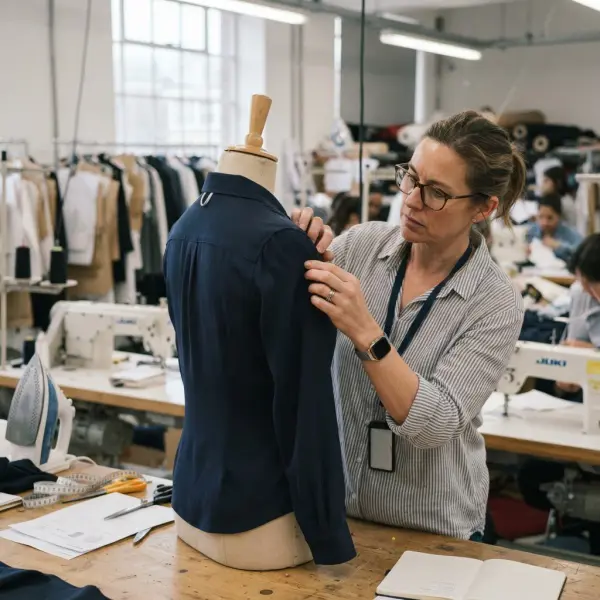
A Sample-Fitting Process Should Include Movement
A garment can look excellent on a stationary mannequin and still perform poorly on a person. Sleeve approval should therefore include controlled movement appropriate to the product's intended use.
For an everyday shirt or blouse, a fitter might first observe the garment with the arms relaxed. The wearer can then move the arms forward, reach outward, bend the elbows, and raise the arms to a reasonable position. The goal is not to make the bodice completely motionless—most garments move when the body moves—but to identify excessive restriction, abnormal garment displacement, or tension inconsistent with the design.
The assessment should also distinguish temporary folds from persistent fit symptoms. Fabric naturally forms folds as a joint moves. Wrinkles that consistently point toward the same area when the wearer is in the intended resting position, however, may indicate a pattern-balance or fit issue worth investigating.
Detailed diagnosis of pulling, twisting, and recurring wrinkle patterns deserves its own discussion. See common sleeve problems and how to prevent pulling, twisting, and wrinkles for a more problem-specific fitting framework.
Common Sleeve Construction Mistakes
Treating the Sleeve as an Independent Pattern Piece
One of the most consequential mistakes is altering the sleeve without reviewing the armhole. A designer may widen, raise, lower, or replace a sleeve and then expect the original armhole relationship to remain unchanged. Because sleeve-cap length, cap height, armhole depth, shoulder position, and bicep ease interact, seemingly small changes can introduce new fitting or sewing problems.
A better approach is to document the original sleeve-to-armhole relationship before alteration and recheck both components after the change. This is particularly important when combining elements from different pattern blocks.
Assuming a Wrinkle-Free Sleeve Is Always Better
A perfectly smooth sleeve photographed with the wearer's arms hanging straight down can be visually appealing, but it is not the only criterion for fit. Some pattern geometries deliberately carry fabric that becomes visible as folds at rest because that fabric contributes to movement when the arm is raised.
Trying to eliminate every fold can lead a development team to remove useful ease or change sleeve geometry in ways that make the garment less comfortable. Fit approval should therefore consider the design intent and expected movement, not a static photograph alone.
Ignoring Sleeve Pitch
If a sleeve is rotated relative to the wearer's natural arm position, increasing its circumference may not solve the problem. Diagonal wrinkles or apparent twisting can remain because the sleeve is hanging in the wrong orientation.
Pattern notches and sample fitting should therefore be used to verify front-to-back balance before the team repeatedly adds width. This distinction can save unnecessary pattern revisions and prevent a fit issue from being disguised rather than corrected.
Forcing Excess Cap Ease Into an Unsuitable Fabric
More sleeve-cap ease is not automatically a sign of better drafting. If the amount of excess seam length exceeds what the fabric and construction can accommodate smoothly, the operator may struggle with puckering, tiny tucks, inconsistent sewing, or excessive manipulation during pressing.
The solution is not simply stronger easing. Pattern geometry, fabric behavior, seam construction, and desired shoulder shape should be reconsidered together. The correct relationship is style- and material-dependent.
Approving Only the Base Size
Grading can change sleeve fit even when the base-size sample is excellent. The armhole, shoulder, chest, sleeve cap, bicep, and sleeve length may all increase at different rates across the size range.
Brands selling broad size ranges should therefore validate critical graded sizes rather than assuming that mathematically graded pieces automatically preserve the same fit experience. Which sizes require physical samples depends on the brand's grading strategy, product complexity, fabric, and production risk.
Important Technical Caveats
Sleeve fit does not have one universal ideal. A tailored jacket, oversized sweatshirt, fitted dress, protective uniform, T-shirt, and performance top solve different problems. Their acceptable armhole depth, cap shape, circumference, wrinkles, and movement characteristics can legitimately differ.
Body variation matters as well. Shoulder slope, arm posture, upper-arm circumference, muscular development, posture, and asymmetry can influence how one standard pattern fits different wearers. This is why a garment can meet its technical specification while producing different visual results across customers.
Construction terminology also varies between patternmaking systems and regions. "Sleeve cap ease," for example, should not be interpreted as a fixed numerical requirement. Some sleeves contain obvious positive cap ease; other constructions may use very little or effectively none. The fabric and drafting system determine what is appropriate.
Finally, sleeve style changes the entire relationship. Set-in, raglan, and dolman sleeves distribute seams, shaping, and mobility differently. A deeper comparison is available in set-in sleeves, raglan sleeves, and dolman sleeves.
How Can Fashion Brands Apply Better Sleeve Construction Strategically?
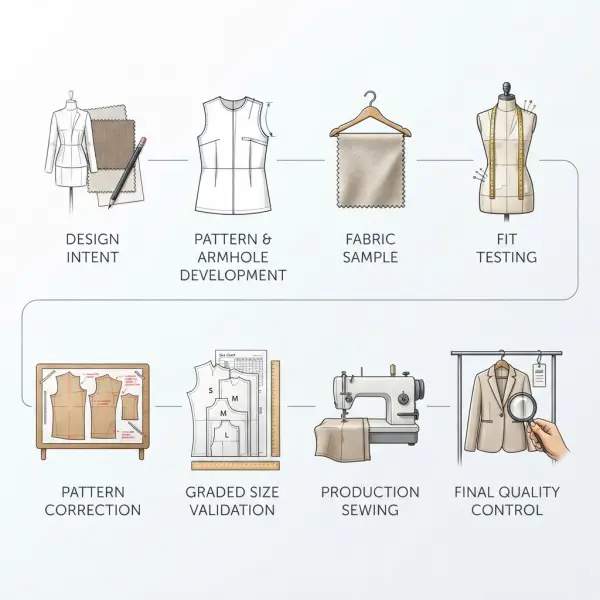
For a small fashion brand, the most valuable improvement is often not adopting more complicated patternmaking. It is creating a repeatable sleeve-development process that connects design intent, pattern specifications, fitting, fabric approval, factory instructions, and quality control.
The process can begin with clearer fit language. Instead of asking a supplier to make the sleeve "more comfortable," the development team can identify whether the concern involves upper-arm circumference, armhole depth, sleeve pitch, range of motion, sleeve length, or another measurable area. That makes revisions easier to reproduce.
Technical packs and pattern documentation should preserve important sleeve balance information. Notches, grainlines, seam allowances, measurement points, and construction instructions should be clear enough that the intended pattern is not gradually reinterpreted across sampling rounds or factories.
Fit models should also be asked to move. A sample can then be assessed under realistic conditions rather than only while standing in a neutral pose.
At scale, this consistency helps distinguish three different categories of problem: pattern problems, sewing problems, and body-to-size variation. Those categories require different responses. Redrafting a correct pattern will not solve inconsistent sleeve insertion on the sewing line, while operator retraining will not correct a poorly balanced armhole.
What Does a Better-Fitting Sleeve Look and Feel Like?
A better-fitting sleeve supports the intended garment silhouette while giving the wearer the movement expected from that product category. In a conventional fitted set-in sleeve, the shoulder area should normally appear controlled, the sleeve should hang in its intended orientation, and the upper arm should have appropriate room without obvious unintended strain. University of Kentucky guidance similarly identifies smooth sleeve-cap shaping, adequate upper-arm ease, proper armhole fit, grain alignment, and absence of unintended diagonal wrinkles among useful evaluation points. University of Kentucky
The key phrase is intended garment silhouette. A relaxed shirt may show folds that would be undesirable in a tailored jacket. A stretch athletic garment may fit much closer than a woven blouse. An oversized style may deliberately drop the shoulder seam beyond the anatomical shoulder.
Good fit should therefore be judged against design intent, fabric mechanics, size strategy, construction quality, and movement—not against a single visual rule.
Frequently Asked Questions About Sleeve Construction
Does a sleeve cap always need to be longer than the armhole?
No. Many traditional woven set-in sleeves use additional sleeve-cap length that is eased into the armhole, but the amount varies and some sleeve constructions use little or no positive cap ease. Shirt-style sleeves frequently have flatter caps, while knit garments can use different relationships because fabric stretch contributes to movement and fit. The correct relationship depends on sleeve geometry, armhole shape, fabric, desired silhouette, and sewing method. A development team should therefore measure and test the actual sleeve-and-armhole combination rather than applying one universal ease formula.
Why can a sleeve feel tight even when the bicep measurement seems large enough?
Bicep circumference is only one part of sleeve mobility. A sleeve can have adequate nominal width but still feel restrictive because of armhole depth, bodice fit, sleeve pitch, cap geometry, shoulder width, fabric stretch, or the distribution of ease. Restrictions across the chest or upper back may also become noticeable when the arms move. For that reason, fit diagnosis should examine the complete bodice-and-sleeve system before simply adding more sleeve width.
Should a good sleeve have no wrinkles?
Not necessarily. Some wrinkles are a natural consequence of fitting fabric around a moving joint, and certain sleeve geometries intentionally allow folds in one position to provide mobility in another. What matters is whether the folds are consistent with the design and whether persistent tension, twisting, or imbalance indicates an underlying fit issue. Casual low-cap sleeves, for example, may show more underarm folding when the arm hangs down than a tailored high-cap sleeve. Evaluating wrinkles without considering sleeve type can therefore lead to unnecessary alterations.
Can a brand use the same sleeve with several different bodice patterns?
Only after verifying compatibility. A sleeve and armhole are developed as a related system, so transferring the sleeve to another bodice can change the relationship between cap length, armhole length, cap height, shoulder location, armhole depth, and sleeve pitch. Even if the seam lengths appear similar, the curves and orientation may differ. For commercial pattern development, the safer process is to compare seamlines and balance points, create a sample in the intended fabric, and fit the complete garment before approving the combination.
Why are sleeve notches important in garment production?
Sleeve notches identify how specific points on the sleeve correspond to the armhole and help operators preserve front-to-back orientation and distribute any intended ease correctly. Removing or shifting them can allow a technically correct sleeve pattern to be inserted incorrectly. NMSU's sleeve-construction guidance specifically uses matching notches, dots, and seam references as part of the set-in process. NMSU Publications For manufacturers, reliable markings also reduce dependence on operator interpretation, which becomes increasingly important when the same style is produced across several sizes or production lines.
Is a higher sleeve cap always more fitted?
A higher cap is often associated with a more shaped set-in sleeve, but cap height alone does not determine fit. Armhole depth, shoulder position, bicep width, sleeve pitch, fabric, and the amount and distribution of cap ease all interact with it. Increasing cap height without reconsidering the corresponding armhole can create a seam-length mismatch or alter movement. Patternmakers should therefore treat cap height as one variable within a complete sleeve system rather than as a standalone indicator of quality.
What should a fashion brand check before approving a sleeve for production?
The brand should first confirm that the sleeve matches the intended silhouette and product use. Then it should assess shoulder and armhole positioning, upper-arm ease, sleeve orientation, length, movement, fabric behavior, seam quality, pressing, and relevant graded sizes. Fit should be checked both at rest and during realistic movement. For styles with controlled sleeve-cap ease, production teams should also confirm that balance marks and ease distribution are reproducible on the sewing line. The objective is not merely to approve an attractive sample, but to approve a construction that can be repeated consistently.
Conclusion
Sleeve construction works best when the sleeve is treated as part of a complete garment system. The armhole, shoulder, sleeve cap, bicep area, sleeve pitch, grain direction, fabric, and construction sequence all influence one another. Changing one variable can improve a specific symptom while creating a new problem elsewhere.
For fashion businesses, this makes sleeve development a product-engineering issue as much as a sewing detail. A sound workflow connects pattern development with fabric testing, movement-based sample fitting, grading, factory instructions, pressing, and quality control.
The most useful standard is therefore not "perfectly smooth." It is whether the sleeve delivers the silhouette, comfort, mobility, manufacturability, and consistency intended for that garment. Once that principle is clear, more specific decisions—such as choosing between set-in, raglan, and dolman construction or diagnosing pulling and twisting—become much easier to evaluate systematically.





Comments 0
Leave a CommentSend Comment
Anda harus Login terlebih dahulu untuk dapat memberikan komentar.