

Darts Explained: How Simple Shaping Improves Garment Fit
A well-fitted garment does not necessarily require complicated seams, elaborate pattern pieces, or advanced tailoring techniques. Sometimes, a small stitched fold makes a substantial difference in how fabric follows the body.
Darts are among the most fundamental shaping methods in garment construction. They help transform flat fabric into clothing that accommodates natural body contours, creating a more controlled relationship between the garment's measurements, silhouette, and intended fit.
For fashion designers, patternmakers, and apparel manufacturers, understanding darts is useful beyond learning a basic sewing technique. Dart construction influences how garments are developed, how samples are fitted, and how consistently a design can be reproduced during production.
Quick Answer: What Are Darts in Sewing?
Darts are tapered folds of fabric that are stitched to create three-dimensional shaping in a garment. They work by taking in a controlled amount of fabric and gradually reducing that intake toward a point, allowing a flat garment panel to follow body contours more closely.
Darts are commonly used in blouses, dresses, skirts, trousers, and tailored garments. Their purpose is not simply to make clothing tighter. They help distribute fabric where the body needs room while controlling excess material in adjacent areas.
For example, a fitted blouse may need sufficient volume across the bust while remaining relatively close to the waist. A dart helps establish that shape without requiring the entire garment to be cut into additional panels.
The effectiveness of a dart depends on its placement, length, intake, stitching accuracy, and relationship to the wearer's proportions. Fabric properties and pressing methods also affect the finished result.
For fashion businesses, properly developed darts contribute to consistent garment fit, cleaner silhouettes, and more reliable pattern specifications. They are a relatively simple construction feature, but their performance depends on careful pattern development and production control.

What Is a Dart in Garment Construction?
A dart is a stitched shaping feature created by folding a designated section of fabric and sewing along a tapered line. In flat patternmaking, the dart is usually represented by a wedge-shaped area bounded by two dart legs that converge toward a point.
When the dart legs are brought together and stitched, the surrounding fabric assumes a curved, three-dimensional form. This allows the garment panel to accommodate differences in body circumference and projection without relying entirely on side seams or multiple pattern pieces.
Utah State University Extension describes darts as wedge-shaped tucks that help flat fabric conform to body contours in its technical explanation of sewing darts.
Although darts are frequently associated with fitted womenswear, the technique is not limited to a particular gender or garment category. Darts can also appear in tailored jackets, trousers, structured shirts, and other garments where controlled shaping is required.
The important distinction is that darts provide localized shaping. Their effectiveness depends on how the surrounding pattern has been drafted, not simply on the presence of a stitched fold.
Understanding Dart Anatomy
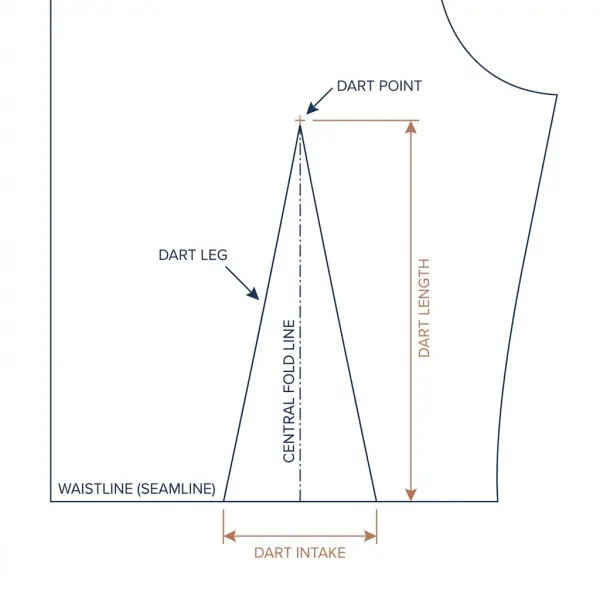
A dart contains several components that determine how much fabric is taken in and how smoothly the resulting shape follows the body.
Dart legs are the two lines that define the wedge-shaped intake. They are brought together when the dart is folded for stitching.
The dart point is the narrow end where the stitching tapers to meet the folded fabric. In many fitted garments, the sewn point stops before the fullest projection of the body rather than ending directly on it.
Dart intake is the amount of fabric controlled by the dart, commonly measured as the distance between its legs at a specified seamline or reference position. In a symmetrical folded dart, the folded depth at that position is approximately half the full intake.
The dart centerline indicates the fold axis used to align the dart legs.
Dart length describes the distance between the wider portion and the dart point, while dart direction describes how the dart is oriented toward the area requiring shaping.
These measurements are related, but they are not interchangeable. A longer dart does not automatically remove more fabric, and a wider dart does not necessarily produce a better fit.
How Do Darts Turn Flat Fabric Into a Three-Dimensional Shape?
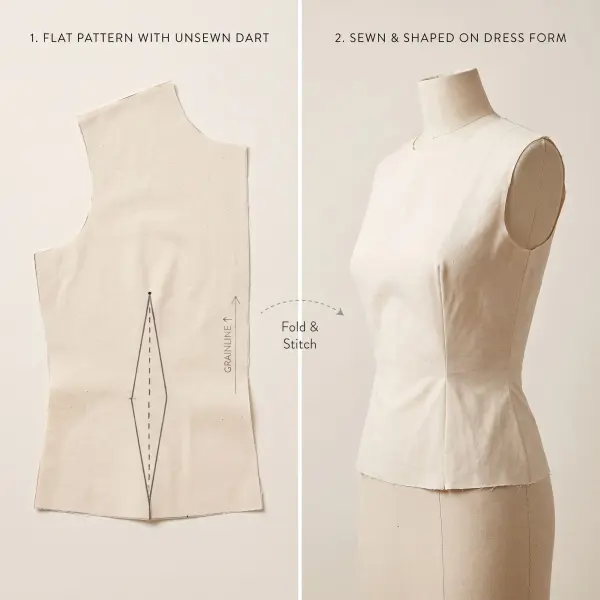
Darts create three-dimensional garment shaping by changing the relationship between fabric width and the space available around a body contour. When the dart is sewn, some fabric is folded into the dart allowance, reducing the effective width at the wider end while allowing the surrounding panel to curve.
Imagine placing a flat sheet of paper around a rounded object. The paper cannot follow the surface closely without overlapping, bending, or being divided into smaller sections. Bringing the edges of a wedge together creates a change in shape that resembles what happens when a dart is sewn into fabric.
Textiles behave more flexibly than paper, so the resulting curve depends on fabric structure, weight, and drape. Nevertheless, the underlying patternmaking principle is similar: controlled intake produces localized shaping.
Fabric Intake Versus Fabric Fullness
A common misunderstanding is that darts create additional fabric around a body curve.
They do not inherently add material. Instead, they control where fabric is taken in and where the remaining fullness is available.
Consider a blouse designed to follow the bust and waist. If the front panel is cut with enough width to accommodate the bust, some fabric may remain loose below or beside that area. A correctly positioned dart takes in part of this excess while preserving the necessary room around the bust.
The outcome is a more intentional silhouette rather than a uniformly tighter garment.
In practical patternmaking, this distinction matters because reducing the overall garment circumference is not equivalent to adjusting dart intake. Changing one measurement can affect the balance of the entire garment.

Why Dart Placement Changes the Result
The same general amount of shaping can be introduced from different locations around a fitted pattern block.
In flat pattern development, designers may relocate a dart by pivoting or by using a slash-and-spread method. The technique transfers a shaping wedge from one position to another while preserving the intended contour, provided the manipulation is performed correctly.
The dart manipulation principles explained by Dresspatternmaking illustrate how dart positions can change while maintaining the underlying shaping requirements.
However, relocation is not completely free of practical consequences. Grain direction, seam geometry, fabric behavior, and the visual appearance of the new dart may influence the finished garment.
A pattern that is mathematically consistent may still require a physical sample to confirm that the transferred dart behaves as intended.
Why Darts Improve Garment Fit
A garment fits well when its dimensions, shape, ease, and construction work together with the intended wearer and design. Darts contribute to this process by allowing fabric to be controlled at specific locations rather than uniformly around the body.
Their contribution is particularly noticeable in structured woven garments, where the fabric has limited stretch and must obtain much of its shape through pattern geometry.
They Help Control Excess Fabric
An important function of darts is managing fullness that would otherwise accumulate in unwanted areas.
For example, a skirt that fits across the hips may contain more fabric than necessary around the waist. Waist shaping can be distributed between darts and side seams, allowing the waistline to follow the intended contour without substantially changing the hip measurement.
Similarly, in a fitted shirt or blouse, darts can reduce excessive looseness without requiring large changes to the side seam.
This does not mean every wrinkle should be eliminated. Clothing needs appropriate wearing ease, and the amount of shaping should match the desired silhouette.
A relaxed garment may intentionally retain fullness that a tailored design would control.
They Improve the Relationship Between Fit and Silhouette
Fit and silhouette are related but different concepts.
Fit concerns how a garment accommodates the body, including its dimensions, balance, ease, and movement. Silhouette describes the overall visible shape of the garment.
Darts can influence both.
In a fitted dress, carefully positioned darts may support a defined waist and smoother torso shaping. In tailored trousers, darts can help distribute the difference between the waist and hip measurements while maintaining the intended leg shape.
However, darts do not determine the entire silhouette on their own. Fabric stiffness, seam placement, garment length, cut, interfacing, and other construction choices all contribute to the finished appearance.
A well-designed dart can refine a silhouette, but it cannot compensate for a fundamentally unsuitable base pattern.
They Support More Consistent Fit Across Garment Sizes
During apparel product development, patternmakers must translate an approved fit into multiple sizes.
Darts are part of this process because changes in body measurements can alter where shaping is needed and how much intake is appropriate. Simply enlarging every pattern dimension by the same amount may not preserve the intended proportions.
For example, a dart that sits correctly on the base-size sample may need its position or dimensions reviewed for other sizes. This is particularly relevant when size ranges cover substantial changes in body shape.
Accurate grading therefore involves more than maintaining an identical-looking dart across all pattern pieces.
Production teams should evaluate whether the resulting garments still place shaping correctly on the target body measurements.
Where Darts Are Used in Clothing Design
Darts can be found in several garment categories, although their function and visual importance vary according to the product.
|
Garment category |
Typical shaping purpose |
Design consideration |
|
Blouses and fitted shirts |
Control torso fullness and accommodate bust or back contours |
Dart placement should support the intended fit without creating unwanted pulling |
|
Dresses |
Shape the bust, waist, and torso |
Dart construction must work with the overall silhouette and fabric |
|
Skirts |
Manage the difference between waist and hip measurements |
Waist shaping should remain balanced with side-seam geometry |
|
Tailored trousers |
Refine the waist and upper hip or seat area |
Dart placement must work with waistband and rise construction |
|
Tailored jackets |
Support body contour and structured shaping |
Darts may be integrated with panel seams and tailoring features |
|
Structured garments |
Create controlled volume in specific areas |
Fabric thickness and seam finishing may limit suitable dart designs |
The location and purpose of a dart are more important than memorizing one standard construction for every garment.
For a detailed look at how different dart positions serve particular anatomical areas, see bust darts, waist darts, and shoulder darts.
Darts in Fitted Versus Relaxed Garments
Darts are particularly useful when a designer wants localized shaping without introducing many visible seams.
A fitted woven blouse, for example, may depend on accurately developed darts because the fabric cannot stretch enough to accommodate pronounced body contours by itself.
A relaxed oversized shirt has different requirements. Its generous ease may reduce or eliminate the need for certain shaping darts, although decorative or functional darts can still be incorporated.
This illustrates an important design principle: a garment without darts is not necessarily poorly fitted.
What matters is whether its construction supports the intended silhouette, wearing ease, and movement.
How Are Darts Sewn Into a Garment?
Dart sewing begins with accurate markings and ends with controlled pressing. Although the stitching operation is relatively straightforward, its effectiveness depends on alignment, tapering, and the consistency of the fabric's response.
The basic process for a conventional single-point dart involves transferring the pattern markings, folding the fabric, bringing the dart legs together, stitching toward the point, securing the thread, and pressing the finished shape.
Pattern Marking and Preparation
Dart information should be transferred from the approved pattern to the fabric before sewing.
Markings may include the dart legs, dart point, centerline, and reference notches. The marking method should suit the material, since some chalks, inks, or tracing tools can leave visible marks or damage delicate fabric.
After marking, the fabric is generally folded with right sides together, aligning the dart legs and the point.
Incorrect alignment can change the actual intake or twist the dart, even when the stitching itself appears neat.
Stitching the Tapered Shape
For a conventional dart that begins at a fabric edge, stitching usually proceeds from the wider end toward the point.
The stitching line gradually approaches the fabric fold, producing a smooth taper. A sudden change in direction near the point can create a visible bump or unwanted tension.
The point is normally secured without a bulky reverse-stitch cluster. One common method is to leave thread tails and tie them securely, although the exact finishing procedure depends on the construction method and production requirements.
The established sewing reference Darts Build Shape into a Garment, published by Threads, emphasizes careful marking, controlled stitching, and appropriate pressing.
Pressing the Dart Without Flattening Its Shape
Pressing is not merely a cosmetic finishing step. It helps the stitched fabric settle into the intended contour.
Darts are commonly pressed in a direction specified by the pattern or garment construction instructions. A tailor's ham or another suitable curved pressing surface can help maintain the three-dimensional shape.
Pressing temperature, steam, and pressure must be compatible with the fabric and its finishing treatments.
A heavyweight woven material, a lightweight synthetic fabric, and a delicate sheer textile may require different approaches.
Excessive pressing can create an unwanted crease beyond the dart point or cause the dart allowance to show through on the garment's right side.
Darts Compared With Other Garment Shaping Techniques
Darts are one method of achieving garment shape, but they are not the only option.
Patternmakers can also use curved seams, gathers, pleats, shaping through side seams, and the stretch properties of particular materials.
The choice depends on how much shaping is required, how visible the construction should be, and how the fabric is expected to behave.
|
Technique |
How it controls fabric |
Typical design effect |
|
Darts |
Stitches a tapered intake into a garment panel |
Localized shaping with relatively discreet construction |
|
Princess seams |
Divides a garment into shaped panels joined by curved or contoured seams |
Continuous shaping across a larger area |
|
Gathers |
Draws fabric into a shorter length along a seam or edge |
Distributed fullness and visible texture |
|
Pleats |
Folds fabric into structured sections |
Controlled fullness, sometimes with decorative structure |
|
Side-seam shaping |
Changes garment width through outer panel boundaries |
Adjusts the overall contour without introducing an internal dart |
|
Stretch-based shaping |
Uses fabric extension and recovery together with pattern dimensions |
Body-conforming fit that depends on material performance |
These methods are not necessarily interchangeable.
A princess seam, for example, can distribute shaping over a longer line and may be useful when a single dart produces excessive intake or an undesirable appearance. Gathers, on the other hand, usually retain visible fullness rather than producing the same smooth surface as a pressed dart.
Designers frequently combine several shaping methods within one garment.
The decision should reflect the desired silhouette, fabric performance, construction complexity, and customer expectations.
How Fabric Properties Affect Dart Construction
A dart that performs well in one fabric may produce a noticeably different result in another.
Fabric behavior influences how smoothly the material folds, how easily the dart can be stitched, and how effectively the finished shape can be pressed.
Lightweight Woven Fabrics
Lightweight woven materials can produce relatively discreet darts when the stitch line is accurately tapered.
However, some lightweight fabrics are sensitive to puckering, marking, or pressing damage.
For example, a fine woven blouse fabric may show thread tension irregularities more clearly than a heavier suiting material. Sheer fabrics can also reveal the folded allowance beneath the surface.
Pattern and sewing decisions should therefore account for the visibility of the construction.
Medium-Weight and Structured Fabrics
Medium-weight woven materials often respond well to conventional dart construction, provided the pattern and pressing method are suitable.
Structured cottons, dressmaking fabrics, and some suiting materials can support defined garment shaping.
Nevertheless, stiffness may create a visible ridge when the dart intake is large.
In these situations, a patternmaker may distribute shaping across multiple smaller darts, use another construction method, or modify the dart allowance to reduce bulk.
Thick or Bulky Materials
Bulky fabrics can make wide darts difficult to finish neatly.
The folded allowance may create thickness that is visible on the garment exterior or uncomfortable in a close-fitting area.
Depending on fabric structure and construction requirements, the allowance may need to be graded, trimmed, opened, or otherwise managed. These modifications should be evaluated carefully because cutting into a dart allowance changes the finishing requirements.
The objective is to maintain the shaping function without creating unnecessary bulk or weakening the construction.
Knitted and Stretch Fabrics
Stretch fabrics may require fewer conventional darts because their elasticity allows the material to accommodate certain body contours.
However, stretch does not eliminate the need for pattern shaping.
A fitted knit garment may still use darts when the design requires localized contouring, while another garment may achieve the intended fit through stretch, negative ease, seam placement, and suitable fabric recovery.
The material's stretch percentage, direction, recovery, weight, and intended wearing ease should be assessed before removing darts from a pattern.
How Fashion Businesses Can Apply Dart Construction More Effectively
For apparel businesses, the value of dart construction extends into pattern development, sampling, costing, production, and quality assurance.
A dart should not be treated as an isolated sewing detail. It is part of a broader specification that determines how consistently a garment can be produced.
Start With Accurate Pattern Development
The first priority is ensuring that the dart corresponds to the intended size specifications, body proportions, and garment silhouette.
A patternmaker should evaluate the dart alongside the garment's ease, seam positions, grain direction, and overall balance.
For example, when developing a fitted woven dress, increasing dart intake may improve waist shaping but also alter how the garment sits across the surrounding torso. Adjusting the dart without reviewing adjacent construction can introduce new fitting problems.
A physical sample helps reveal these relationships before production begins.
Use Sample Fitting to Evaluate the Whole Garment
Fit evaluation should consider more than the appearance of an individual dart.
During sampling, teams can examine whether the garment hangs correctly, provides sufficient movement, and positions shaping where intended.
Important evaluation points include:
- Whether the dart points toward the appropriate body contour and ends at a suitable position.
- Whether the garment maintains the intended ease around the bust, waist, hips, or back.
- Whether the left and right sides are balanced for a symmetrical design.
- Whether the fabric remains smooth without unwanted tension around the dart.
- Whether sitting, reaching, bending, and other relevant movements remain comfortable.
These observations help distinguish a poorly constructed dart from a broader pattern-fitting issue.
A neat dart cannot compensate for insufficient garment ease, and an accurately measured garment may still fit poorly if its shaping is incorrectly positioned.
Translate Approved Samples Into Production Specifications
After sample approval, dart construction should be documented in the technical package.
Relevant information may include pattern reference points, dart dimensions, stitch requirements, pressing direction, and the approved garment appearance.
Specifications should be sufficiently clear for patternmaking, cutting, sewing, and quality control teams to interpret them consistently.
This becomes particularly relevant when production is outsourced to several facilities or repeated across different orders.
A garment sample may look correct because an experienced sample maker adjusted the construction manually. If those adjustments are not transferred into the approved pattern and technical instructions, bulk production can reproduce an earlier problem.
Consider Construction Time and Manufacturing Complexity
Darts can be an efficient way to add shaping, but they still require accurate handling and sewing operations.
A garment with several darts may involve additional marking, alignment, stitching, pressing, and inspection compared with a simpler construction.
The actual production impact depends on the number of darts, fabric handling characteristics, machinery, workforce capability, and production volume.
Removing darts solely to reduce sewing operations can also create trade-offs. The resulting pattern may need more seams, additional ease, or a less fitted silhouette.
The commercial decision should therefore compare the complete construction method rather than assume that fewer darts automatically mean lower manufacturing cost.
Common Dart Construction Mistakes That Affect Fit
Dart-related problems can originate during patternmaking, marking, stitching, or pressing. Identifying the source matters because correcting a sewing operation will not necessarily resolve an inaccurate pattern.
Treating Dart Intake as a Simple Tightening Adjustment
One misconception is that increasing dart intake will automatically improve garment fit.
This may reduce excess fabric in one area, but it also changes the garment's effective dimensions and shape. If the underlying problem involves insufficient ease or an incorrectly positioned body contour, increasing intake can make the fit worse.
For apparel teams, the better approach is to check the complete pattern and assess whether the intended change requires a dart adjustment, seam alteration, or another fitting correction.
Using Dart Placement Without Checking Body Proportions
A dart can be sewn accurately and still create an undesirable result when its location does not match the intended body proportions.
For example, a bust-shaping dart that finishes too close to the bust apex may produce an unwanted pointed appearance. A dart positioned too far from the required shaping area may leave excess fabric elsewhere.
This makes fitting and approved pattern measurements essential, particularly when adapting designs for different sizes or customer groups.
Creating Uneven or Abrupt Stitching
A dart should normally transition smoothly toward its point.
Abrupt stitching, inconsistent folding, or uneven alignment can create puckering, twisting, or an irregular surface. Such defects may remain visible even after pressing.
Factories can reduce these risks through reliable fabric marking, appropriate machine settings, sewing operator training, and comparison with an approved construction sample.
Pressing Without Respecting the Fabric
Pressing a three-dimensional dart against a completely flat surface can sometimes distort the intended shape.
Similarly, excessive heat or pressure can damage sensitive fabrics or make the dart allowance visible from the outside.
The pressing method should be tested on the actual production fabric and documented where consistency is required.
A more detailed discussion of construction defects and garment imbalance belongs in common dart sewing mistakes that affect garment balance.
Important Technical Caveats Before Adjusting Darts
Dart adjustments should be evaluated in the context of the complete garment rather than treated as independent corrections.
Several technical limitations deserve attention.
Darts do not replace correct garment measurements. They redistribute and control fabric, but cannot independently resolve errors in overall circumference, length, shoulder slope, or wearing ease.
Dart dimensions are not universal. The appropriate intake, length, and position depend on the pattern block, body proportions, fabric, and intended silhouette. General sewing guidelines can provide starting points, but they should not override fitting evidence.
Dart manipulation is not automatically fit-neutral in production. A correctly performed transfer can preserve the intended shaping geometry, but changes in grain orientation, seam relationships, fabric behavior, or manufacturing accuracy may affect the actual result.
Symmetry depends on design intent. Many conventional garments require balanced left and right dart construction. Deliberately asymmetric garments may use different shaping arrangements.
A visually smooth dart is not proof of overall garment quality. Fit, comfort, mobility, seam strength, and construction durability must also be considered.
These caveats are particularly relevant when a pattern is being graded, converted between fabrics, or adapted from a sample into a commercial size range.
Frequently Asked Questions About Darts
1. What is the main purpose of a dart in clothing?
The main purpose of a dart is to create localized shaping by taking in a tapered section of fabric. This helps a flat garment panel accommodate body contours such as the bust, waist, hips, or back.
Darts are especially useful in woven clothing because many woven fabrics cannot stretch sufficiently to follow pronounced body curves without deliberate shaping. However, darts are not intended to eliminate all looseness. Garments still need appropriate ease for comfort and movement.
For fashion businesses, successful dart construction means achieving the approved silhouette and fit, not simply producing the tightest possible garment.
2. Do all fitted garments need darts?
No. Fitted garments can achieve shaping through darts, curved seams, panel construction, stretch fabrics, or combinations of these methods.
A fitted dress with princess seams, for example, can obtain much of its torso shaping through the curved seams connecting the panels. Some stretch garments can follow body contours through their material properties and pattern dimensions.
The choice depends on the design's appearance, fabric behavior, fit requirements, and manufacturing considerations.
Darts are useful because they provide a relatively discreet shaping method, but their absence does not indicate poor patternmaking. A garment should be evaluated according to its complete construction and intended fit.
3. What is the difference between a dart and a seam?
A dart is a tapered stitched intake within a garment panel, while a conventional seam joins separate fabric edges or sections.
Both can shape clothing, but they do so through different constructions. A dart generally narrows toward a point, whereas a panel seam can extend continuously across a garment and accommodate a more complex shaping line.
Princess seams are a common example of shaping incorporated into panel construction.
From a manufacturing perspective, darts may reduce the need for additional pattern panels, but they still require marking, stitching, and pressing. The most suitable method depends on the design and production requirements rather than on a universal cost or quality advantage.
4. Can an existing dart be moved to another position?
Yes. In flat patternmaking, dart manipulation allows shaping to be transferred from one location to another through techniques such as pivoting or slash-and-spread.
For example, shaping in a bodice block can sometimes be transferred between the side seam, shoulder, or waist while maintaining the underlying volume requirements.
However, the relocated dart must be redrawn and evaluated correctly. Its apparent width and length may change because the distance from the shaping apex to the new pattern edge differs.
The finished garment should also be sampled to assess fabric behavior, seam relationships, and visual balance. Dart relocation is a design tool, not a guarantee of identical results in every material.
5. How can you tell whether a garment dart fits correctly?
A correctly fitted dart generally produces smooth shaping toward the intended body contour without creating unwanted pointing, pulling, or excess fabric.
The garment should also maintain appropriate ease, balanced seam positions, and reasonable movement for its intended use.
An effective evaluation involves examining the garment on the target wearer or an appropriate fit model rather than judging the dart in isolation.
For instance, a smooth-looking bust dart may still be incorrectly positioned if the garment pulls across the chest or shifts during movement. Fit assessment should consider both appearance and function, including whether the pattern matches the intended customer measurements.
6. Are darts suitable for mass-produced clothing?
Yes. Darts are a well-established construction technique that can be used in mass-produced garments when the pattern, sewing operation, and quality criteria are adequately controlled.
The main production concerns are accurate marking, repeatable stitching, appropriate pressing, and consistency with the approved sample.
Different fabrics and designs may require different production methods. A simple dart in stable woven fabric may be straightforward to reproduce, while a dart in delicate or bulky material can require additional handling.
Apparel manufacturers should assess the complete operation during sampling and production planning rather than assuming that all dart constructions have the same labor requirements or defect risks.
7. Can darts improve clothing comfort as well as appearance?
Darts can contribute to comfort when they help place fabric fullness where the body requires it while controlling excess material elsewhere.
For instance, properly developed torso shaping may allow a fitted garment to sit more naturally instead of relying on excessive tightness around one area. However, comfort also depends on wearing ease, fabric flexibility, garment balance, lining, seam placement, and the activities for which the clothing is designed.
A dart that is too deep or incorrectly positioned can restrict movement or create pressure rather than improve comfort.
The practical objective is to coordinate shaping with body measurements and garment use, not to assume that a closer silhouette is automatically more comfortable.
Conclusion: Small Construction Details Can Make a Meaningful Difference
Darts demonstrate how a relatively small sewing feature can influence the fit and appearance of an entire garment.
Their value comes from controlled shaping. By managing fabric intake in specific locations, darts help designers translate flat pattern pieces into garments that accommodate three-dimensional body contours while supporting the intended silhouette.
For apparel businesses, this makes dart construction relevant to more than sewing technique. It affects pattern development, sample fitting, fabric selection, production consistency, and quality control.
The best results come from considering darts as part of the complete garment system. Their position, intake, stitching, and pressing should work with the fabric and the broader pattern rather than compensate for unresolved fitting problems.
As brands develop more varied silhouettes and size ranges, understanding fundamental shaping principles remains useful. Precise garment construction begins with knowing how individual pattern features affect the finished product.





Comments 0
Leave a CommentSend Comment
Anda harus Login terlebih dahulu untuk dapat memberikan komentar.