
Why Embroidery Technology Supports Custom and Premium Fashion Products
Quick Answer
Embroidery technology supports custom and premium fashion products because it combines repeatable machine production with a decoration method that can still be varied by name, initials, motif, color, placement, scale, and garment type. Digital embroidery systems make it practical to produce a consistent brand logo across a collection while also creating individual variants such as monograms, team names, limited-edition motifs, or made-to-order details.
Modern embroidery software and commercial machines increasingly support this type of variable production. Wilcom, for example, provides workflows for generating multiple personalized names from a list, while Tajima offers software and machines specifically intended for monograms, name embroidery, retail personalization, and e-commerce-to-production workflows.
However, embroidery does not automatically make a product premium. Premium positioning depends on the quality of the garment, design restraint, thread choice, digitizing, placement, stitch quality, finishing, customer experience, and overall brand context. Poorly executed embroidery can make an expensive product look less refined rather than more valuable.
For fashion businesses, the opportunity is therefore not simply to “add embroidery,” but to use embroidery technology deliberately as part of product design, customization, brand identity, and production strategy.
Why Embroidery Works Well for Product Differentiation
Fashion products often compete within categories where the basic garment format is already familiar. A sweatshirt, polo shirt, cap, tote bag, overshirt, uniform, or cotton dress may use a relatively conventional construction, which means differentiation has to come from material, fit, color, finishing, branding, surface design, or customer experience.
Embroidery offers one additional layer because it physically changes the surface of the product rather than merely placing flat color on top of it. Thread creates direction, texture, relief, light reflection, and in some cases dimensional effects. Even a small chest emblem can therefore behave differently from a printed logo of the same dimensions.
That does not make embroidery inherently superior to printing. Screen printing, direct-to-garment printing, heat transfer, appliqué, woven labels, jacquard construction, and other techniques can all be more appropriate depending on the design and product. The useful difference is that embroidery gives brands another material vocabulary.
For a minimalist label, the value might come from a restrained tonal monogram that is visible only at close range. A sportswear business may require durable-looking team names and numbers. A streetwear brand could use large embroidery as the main graphic feature. A corporate apparel supplier may prioritize repeatable logos and employee names.
The technology is the same broad category, but the strategic role is very different.
Customization Is Different From Simply Offering More Designs
Customization does not necessarily mean creating an entirely new product for every customer.
In embroidery, customization can happen within a controlled design system. The garment, embroidery location, font, motif library, thread palette, and maximum dimensions can remain standardized while selected variables change for each order.
A customer might choose:
- initials within an approved monogram layout;
- a personal name;
- one of several thread colors;
- a predefined icon or motif;
- a number or short phrase;
- an approved embroidery location;
- one design from a limited customization library.
This distinction matters operationally. Completely unrestricted customization creates unpredictable artwork, digitizing, approval, and production requirements. Controlled personalization keeps variation within boundaries that the brand has already tested.
Commercial embroidery software increasingly supports this model. Wilcom's Team Names functionality can import a list of names and generate individual production files without manually building every name variation, while its monogram tools allow defined layouts to be personalized. Wilcom commercial embroidery personalization tools
Tajima's Autograph software follows a similar principle for in-store personalization: registered designs can be combined with customer names and standardized templates before being sent to connected embroidery equipment. Tajima Autograph personalization software
The business lesson is straightforward: scalable customization generally works better when the customer is given meaningful choices inside a controlled production framework.
How Digital Embroidery Makes Variable Production Possible
Traditional decorative production becomes difficult when every item requires a unique setup. Digital embroidery reduces part of that friction because design information can be stored, modified, duplicated, and sent to compatible machines without rebuilding the physical production method from scratch for every item.
Names are a good example.
Imagine a fashion or uniform supplier producing 200 polo shirts with the same company logo but a different employee name on each garment. The base logo does not change. Only one variable field changes between pieces.
Embroidery software can be structured around this logic. Wilcom currently supports batch team-name generation from a list, while its Embroidery Web API can programmatically create variable lettering and monograms and convert designs into machine formats.
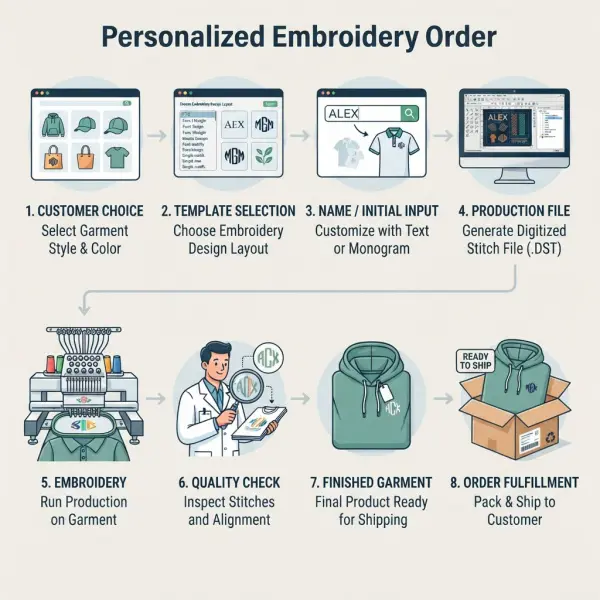
This capability can also support online customization workflows. A customer may enter text through an e-commerce interface, choose an approved option, preview the concept, and generate production data further downstream.
The important caveat is that embroidery still has physical constraints. Wilcom's documentation for production-ready online lettering emphasizes that density, underlay, pull compensation, minimum stitch length, and other parameters need to suit the fabric rather than relying solely on the customer's text entry. Wilcom guidance on production-ready personalized embroidery
Personalization can therefore become digitally automated without making textile engineering irrelevant.
For a deeper explanation of how design data becomes machine-readable stitching, see how digital embroidery files turn designs into stitched motifs.
Why Embroidery Fits Small-Batch and Made-to-Order Fashion
Embroidery is particularly useful when a business wants to decorate relatively small quantities without creating a new physical mold, printing screen, woven label production run, or fabric construction for each variation.
That does not mean embroidery has no setup cost. Designs may require digitizing, test stitching, thread preparation, framing, garment loading, stabilization, and machine setup. These costs can be significant, especially for complicated artwork.
Once a suitable embroidery design has been prepared, however, producing another variation can sometimes involve changing data or thread choices rather than rebuilding the entire decoration process.
This creates several commercially useful scenarios:
- limited collections with one embroidered motif;
- personalized gifts;
- monogrammed accessories;
- small brand merchandise programs;
- staff uniforms with individual names;
- creator or community merchandise;
- event-specific products;
- customer-selected initials;
- small runs intended to test market demand.
Single-head commercial embroidery machines are especially relevant to these workflows because individual items can be changed without requiring every machine head to stitch the same design. Tajima specifically positions its single-head systems for name embroidery, uniforms, hats, bags, and in-store processing. Tajima TMEZ-SC single-head embroidery machine
For larger repeat orders, multi-head equipment may make more operational sense. This is why embroidery can support both customization and scale—but usually through different machine configurations and workflows.
Custom Production Does Not Mean Mass Customization Is Easy
The phrase mass customization can make personalized manufacturing sound almost frictionless. In practice, variable production creates new operational complexity.
Every personalized order introduces data that must be correct.
Names can be misspelled. Customers may select unsupported characters. A phrase can be too long for the intended embroidery field. A thread color may create poor contrast with the garment. An initial may look awkward in a specific monogram layout. A design that works on a T-shirt may not stitch correctly on a thick cap.
Personalization therefore moves some of the production risk upstream into order capture and validation.
A robust system needs rules such as:
- maximum character count;
- supported fonts and symbols;
- minimum and maximum lettering size;
- approved thread palettes;
- allowed placement options;
- preview limitations;
- fabric-specific embroidery templates;
- confirmation rules for personalized spelling;
- procedures for products that cannot be returned after customization, subject to applicable law and retailer policy.
The automation layer should prevent invalid choices before they become production problems.
This is where customization becomes a systems-design challenge rather than simply a creative feature.
Why Embroidery Can Support Premium Positioning
Embroidery can support premium positioning because it adds physical texture, visible stitch work, and an additional production operation to the garment. When executed carefully, these details can contribute to a perception of deliberate construction and differentiation.
The wording can support is important.
Embroidery itself is not proof of quality.
A basic garment with poorly positioned, excessively dense, or badly digitized embroidery does not become premium simply because thread was added. Likewise, an inexpensive promotional cap and a luxury fashion jacket may both contain machine embroidery while occupying completely different market positions.
Premium perception emerges from the complete product system.
For embroidery, that may include:
- clean edges and consistent coverage;
- thread colors that complement the base fabric;
- stitch direction chosen intentionally;
- appropriate scale;
- balanced placement;
- no unnecessary puckering;
- controlled backing or finishing;
- lettering that remains legible;
- motifs that suit the garment construction;
- consistent execution from one product to another.
Restraint can matter as much as complexity. A small tonal motif may communicate a very different brand language from a large multicolor embroidered graphic.
The correct treatment depends on who the customer is and why the product exists.
Premium Embroidery Is Usually About Integration, Not Ornament Quantity
One of the easiest mistakes in premium product development is assuming that more decoration creates more value.
Dense embroidery, metallic thread, 3D effects, large motifs, multiple colors, appliqué, and specialty stitches can all create interesting products. Using several of them simultaneously, however, does not guarantee a more refined result.
For many fashion products, embroidery works best when it is integrated into the garment design.
A motif placed near a pocket may echo the construction line. An emblem on the back yoke may relate to the proportions of the jacket. Tonal lettering can support a minimalist collection. A repeated motif along a border may function almost like a textile pattern.
In each case, the embroidery has a relationship with the garment rather than appearing to have been added afterward.
This also affects product development timing. If embroidery is decided only after the garment has been fully designed, teams may discover that seams, linings, pockets, zippers, or narrow components interfere with the intended placement.
Planning embroidery earlier allows the pattern, panel shape, backing access, and construction sequence to accommodate it.

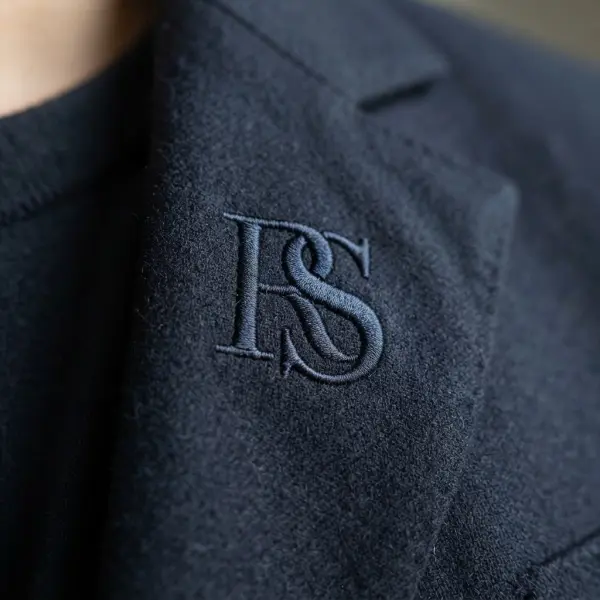
Monograms Turn Standard Products Into Individual Products
A monogram is one of the clearest examples of controlled personalization.
The underlying product may remain identical across hundreds of orders. The customization layer changes only a few letters, their arrangement, or surrounding ornamentation.
This model works especially well for products where ownership and gifting matter: shirts, robes, towels, bags, travel accessories, caps, jackets, baby products, uniforms, and certain fashion accessories.
Professional embroidery software contains dedicated monogramming functions precisely because monograms require more than typing letters into ordinary graphic software. Letter orientation, layout, font design, spacing, and stitch construction all affect the final result. Wilcom's current embroidery tools include dedicated monogram layouts and fonts intended for stitched output. Wilcom monogram lettering documentation
From a brand perspective, this allows one standardized product to carry an identity specific to the customer without redesigning the complete garment.
The strategic value lies in that balance between standardization and individuality.
Personalized Lettering Can Become a Repeatable Product System
Names and initials are operationally simpler than fully custom graphics because they can be constrained by typography.
A brand may create an embroidery program with:
- three approved fonts;
- six thread colors;
- two placement areas;
- a maximum of ten characters;
- several tested garment materials.
The customer still experiences customization, but the manufacturer operates within a finite number of proven production conditions.
Wilcom's commercial software illustrates this type of workflow through Team Names and reusable lettering systems, including the ability to create individual name designs from an imported list rather than manually typing every variation.
This can be particularly relevant to uniforms, sportswear, schools, clubs, events, hospitality garments, workwear, and community merchandise. Fashion brands can adapt the same principle to consumer personalization.
The operational discipline is similar: design the customization system first, then allow variations inside it.
Embroidery Can Also Support Limited Editions
Not every form of exclusivity needs to be personalized by customer name.
Embroidery technology can support limited-edition fashion by allowing brands to modify motifs, thread combinations, positions, dates, numbers, or collection-specific details while maintaining a consistent base product.
A brand could produce one sweatshirt pattern in several deliberately small embroidered editions. Each version might use a different motif or color sequence while sharing the same fabric, fit, construction, and supply chain.
This is commercially different from producing an entirely different garment for each edition.
It allows the creative variation to occur primarily at the decoration stage.
That can reduce some development complexity, although embroidery sampling and quality approval are still required for each materially different treatment.
For small brands in particular, this can be useful when the goal is to introduce variety without multiplying garment patterns, fabrics, and trims unnecessarily.
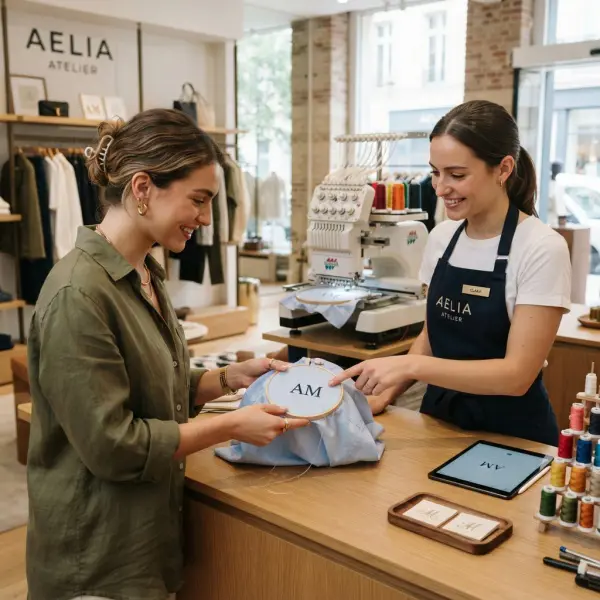
In-Store Embroidery Changes the Customer Experience
Computerized embroidery can also move decoration closer to the point of sale.
Compact commercial machines and personalization software make it possible for certain retailers to embroider products in stores or at events rather than sending every item through a distant centralized decoration facility.
Tajima currently markets compact single-head equipment and software specifically for in-store personalization and retail applications. Its retail solution includes live personalization workflows, while Autograph allows names to be combined with predefined templates and sent to connected machines.
The strategic appeal is not only faster decoration.
The embroidery process itself can become visible.
A customer can choose a design, see their product prepared, and watch part of the production process. For a brand, that can turn an otherwise hidden manufacturing step into part of the retail experience.
However, in-store embroidery adds practical constraints. Machine noise, operator training, queue management, floor space, safety, thread inventory, garment preparation, and expected turnaround time all need to be considered.
A live customization station is therefore both a production unit and a customer-service operation.
E-Commerce Personalization Requires More Than a Text Box
Online customization can look simple from the customer's side.
Choose a garment. Enter initials. Select a thread color. Add to cart.
Behind that interface, the production system needs considerably more logic.
The entered text has to become an embroidery design compatible with the specific garment. Font size may need adjustment. The selected material may require particular density, underlay, or compensation settings. Unsupported characters need to be caught. The embroidery must fit within the designated area.
Wilcom's Embroidery Web API is specifically designed to let external web systems create and edit lettering, team names, monograms, previews, and common machine formats programmatically.
Its production-ready lettering guidance also illustrates an important limitation: the same lettering may need different stitch settings on fleece, wool, silk, or poly-cotton, so fabric-specific embroidery parameters should be built into the workflow rather than left to a generic automatic conversion.
For fashion e-commerce, this means personalization should connect product configuration, production rules, and fulfillment, not just the front-end interface.
How Embroidery Affects Pricing
Embroidery pricing should account for production complexity rather than only the physical size of the design.
A small dense logo can contain more stitches than a larger open motif. Frequent trims, multiple color changes, difficult garment placements, personalized names, specialty thread, or time-consuming hooping can add labor and machine time.
Typical cost drivers include:
- digitizing or design preparation;
- stitch count;
- machine running time;
- number of colors;
- thread changes;
- trims and jumps;
- stabilizer or backing;
- garment handling;
- hooping complexity;
- finishing;
- personalization data management;
- sampling;
- quality control;
- rejected or damaged garments.
Customization can also change the cost structure because garments may no longer be processed as one uninterrupted batch.
If 100 identical logos are embroidered, setup can be repeated efficiently. If 100 garments contain 100 different names, the equipment may still operate efficiently, but order identification and handling become more important.
Pricing needs to reflect that operational reality.
The Economics of Custom Embroidery Depend on Order Structure
Whether personalized embroidery is commercially attractive depends less on the word “custom” and more on the structure of the customization.
Consider three examples.
A monogrammed bag where only two initials change is relatively controlled. Most design and production parameters remain fixed.
A custom company uniform program with one logo plus individual employee names involves more data but can still use a template-based system.
A customer uploading any illustration they want is far more complex. Artwork may need review, digitizing, resizing, copyright screening where applicable, sampling, and individual approval.
All three could be marketed as customized embroidery, but their cost structures are radically different.
For this reason, brands should calculate customization profitability by variation type, not simply compare personalized versus non-personalized products.
Embroidery Can Help Brands Delay Final Product Differentiation
One strategically useful production model is to keep a relatively standardized base product and introduce differentiation later.
Suppose a company holds undecorated caps, sweatshirts, shirts, or bags in inventory. Specific logos, names, or motifs can then be embroidered after the customer or wholesale order is known.
This is sometimes described more broadly in manufacturing as postponement: delaying part of product differentiation until demand becomes clearer.
Embroidery can support this approach because decoration may be applied to finished products when garment construction and equipment access allow it.
It does not eliminate inventory risk. The business still owns the blank products, sizes, and colors.
It can, however, reduce the need to pre-stock every possible embroidered variation.
Instead of carrying:
blue cap + motif A
blue cap + motif B
blue cap + motif C
the business may hold the same undecorated blue cap and apply the selected motif later.
The model becomes especially useful when there are many possible personalization combinations but relatively few underlying garment styles.
Where Postponement Becomes Difficult
Late-stage decoration does not work equally well for every fashion product.
Some embroidery is easier before assembly because the garment panel can lie flat and the reverse side is accessible. Large decorative motifs, narrow garment areas, lined pieces, waterproof constructions, or embroidery positioned near structural seams may be difficult or impossible to process cleanly after the garment is finished.
Machine configuration also matters.
As discussed in computerized embroidery for fashion and apparel decoration, commercial systems include both flat and cylinder-type equipment because unfinished panels and finished garments require different handling approaches.
The product-development team should therefore decide early whether embroidery occurs:
- before garment assembly;
- during assembly;
- after the garment is completed;
- after a customer order is received.
That decision can change inventory strategy, lead time, quality control, and customization flexibility.
Embroidery Can Reinforce Brand Identity Without Large Logos
Branding through embroidery does not have to depend on conspicuous logo placement.
Thread can be used more subtly.
A recurring motif can appear inside a cuff. A small symbol can sit beside a pocket. A signature stitch treatment can be used across several product categories. A tonal wordmark may be nearly invisible from a distance while becoming obvious at close range.
These choices can build recognition without turning every product into advertising space.
For premium or design-led brands, this can be particularly useful because the decoration can become part of a recognizable design language rather than merely displaying the company name.
The important requirement is consistency. If the same embroidered identity is used across seasons, brands should maintain approved source artwork, digital embroidery masters, thread references, dimensions, placement specifications, and physical quality standards.
Digital embroidery makes repetition easier, but brand consistency still needs governance.
Thread Choice Changes the Perception of the Same Design
A digital embroidery design does not determine the entire visual outcome.
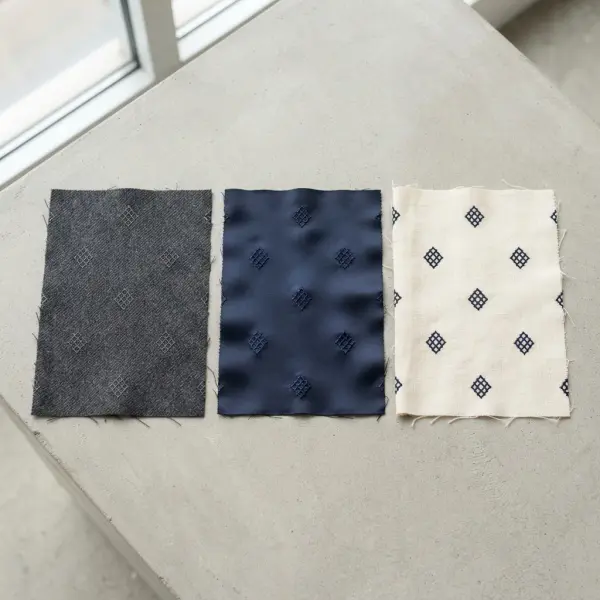
Thread contributes color, sheen, texture, thickness, and surface character. A tonal matte-looking treatment can appear understated, while lustrous thread may make the same motif more visually prominent. Metallic or specialty threads create additional possibilities but can also introduce more demanding production conditions.
The base fabric changes the effect further.
Embroidery on washed denim looks different from the same design on smooth shirting, fleece, velvet-like surfaces, performance knit, or leather-like material. The surrounding textile affects contrast and how prominently stitches sit above the surface.
For premium positioning, thread should therefore be selected as a material component, not merely matched approximately to an RGB or screen color.
Physical sampling remains important because screens cannot fully represent thread sheen, texture, or interaction with the fabric.
Quality Control Becomes More Important With Personalization
A defect in standard production may affect one unit. A mistake in personalization can also make that unit impossible to redirect to another customer.
If the name “Alexandra” is embroidered incorrectly, the business may not be able to resell the garment as ordinary stock.
Personalized production therefore needs tighter verification before stitching begins.
Useful controls include:
- automated validation of customer text;
- clear order identification;
- barcode or job-number tracking where production volume justifies it;
- confirmation of garment size and color before embroidery;
- thread-color verification;
- position templates;
- digital production previews;
- first-piece inspection;
- spelling verification;
- final order-to-garment reconciliation.
Not every small embroidery studio needs sophisticated software infrastructure. The level of control should match order volume and complexity.
But the underlying principle remains the same: the more individualized the product, the more important accurate order-to-production data becomes.
Customization Can Add Value Without Eliminating Standardization
One of the most useful characteristics of digital embroidery is that personalization can sit on top of standardized manufacturing.
The garment may still be cut and sewn in conventional batches.
The fabric may remain standardized.
The trims, sizing, labeling, and packaging may remain standardized.
Only the embroidery changes.
This separation can allow a business to offer more visible customer choice without rebuilding its full apparel supply chain around individual orders.
The model is especially attractive when the base garment has broad appeal and the customization element carries much of the emotional or functional specificity.
Uniforms provide a straightforward example: the shirt construction is standardized while employee names differ.
Fashion brands can use the same production logic more creatively through initials, dates, symbols, locality-specific motifs, small edition numbers, or selected color combinations.
Common Mistakes When Using Embroidery for Premium or Customized Products
Assuming embroidery automatically justifies a higher price
Adding embroidery increases production activity, but additional cost and additional customer value are not the same thing. A poorly chosen motif may raise the cost without making the product more desirable. Brands should evaluate whether the embroidery strengthens identity, personalization, material richness, or product relevance rather than treating the technique itself as a premium label.
Offering unlimited customization too early
Allowing customers to choose any font, color, image, text length, position, and motif creates substantial production complexity. What appears flexible on the storefront can become a sequence of manual exceptions in the workshop. Starting with a controlled option set allows a brand to understand demand, production time, and failure points before expanding choices.
Designing customization only from the website interface
A beautiful product configurator does not guarantee manufacturable embroidery. The available selections should be based on stitch-tested fonts, supported dimensions, validated character sets, fabric-specific templates, and actual embroidery fields. The production logic should define the user interface, not the other way around.
Ignoring the economics of one-off handling
Variable embroidery may be technically easy while order handling remains expensive. Finding the correct garment, confirming a unique name, loading the individual job, checking placement, finishing it, and matching it back to the customer all consume operational time. Brands need to measure the whole workflow rather than machine stitching time alone.
Using decorative complexity as a substitute for design quality
High stitch counts and multiple effects can make a product expensive without making it refined. Premium embroidery often depends on proportion, placement, clean execution, thread choice, and integration with the garment. More stitching is not automatically more valuable.
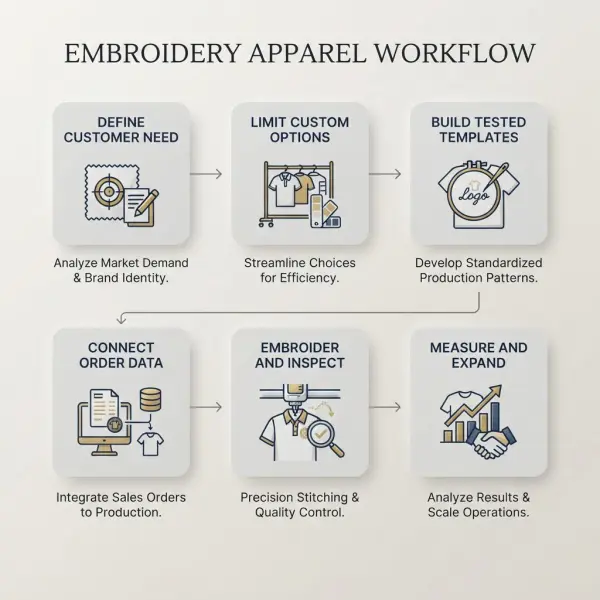
How Fashion Businesses Can Build a Practical Embroidery Customization Program
A successful embroidery program should begin with the product and customer need rather than the machine.
First, define why customization exists. Is the goal gifting, identity, team membership, premium service, limited editions, uniform identification, community merchandise, or creative self-expression? The answer determines which variables are actually useful.
Next, restrict the initial option set.
A small fashion brand might begin with one garment, two embroidery positions, three fonts, five thread colors, and a ten-character name limit. That may sound less exciting than unlimited customization, but it is easier to sample, price, train, explain, and control.
Then create production templates for the specific materials involved. This is particularly important for online personalization because stitch parameters should be appropriate to the garment substrate rather than generated generically. Wilcom's production-ready lettering guidance explicitly recommends fabric-specific embroidery templates for this purpose.
After that, test the complete workflow—not just the stitch quality.
Place a test order through the same interface the customer will use. Check how information moves to production. Confirm spelling, garment variant, thread color, placement, file generation, embroidery, finishing, packing, and dispatch.
Only then should the business expand the customization matrix.
What Brands Should Measure
A customized embroidery program should be evaluated as a business process, not only as a creative feature.
Useful metrics include:
- customization take rate;
- average embroidery revenue per personalized order;
- incremental production cost;
- order preparation time;
- embroidery machine time;
- remake rate;
- spelling or configuration error rate;
- rejection rate;
- average fulfillment time;
- most-selected fonts, motifs, colors, and placements;
- percentage of options that are rarely used;
- customer-service contacts related to personalization.
These figures help identify whether customization is genuinely adding profitable choice or merely adding complexity.
If customers overwhelmingly choose two thread colors out of twenty, the palette may be unnecessarily broad. If one placement causes repeated quality issues, removing it can improve the offer rather than weaken it.
The best customization system is not necessarily the one with the largest number of choices. It is the one that gives customers options they value while remaining operationally controlled.
What Brands Should Verify Before Investing in Embroidery Technology
Buying an embroidery machine is not automatically the right first step.
A brand that uses embroidery occasionally may be better served by a reliable specialist supplier. Machine ownership brings additional responsibilities including operators, digitizing capability, workspace, consumables, thread inventory, needles, stabilizers, maintenance, machine utilization, quality control, and workflow management.
Before investing, evaluate:
- current annual embroidery volume;
- expected customization volume;
- outsourcing cost and lead time;
- required turnaround speed;
- percentage of one-off versus repeat designs;
- product types and embroidery placements;
- operator availability;
- digitizing resources;
- available floor space;
- machine utilization;
- maintenance support;
- whether production needs single-head or multi-head capacity.
Tajima's current product range itself illustrates that commercial embroidery requirements vary considerably: the company offers compact and standard single-head systems as well as multi-head and flat-machine configurations for different production environments.
Equipment should follow the business model rather than define it.
Important Technical and Commercial Caveats
Embroidery supports customization, but not every garment is a good candidate. Delicate materials, difficult seams, waterproof constructions, inaccessible garment areas, very small details, and highly elastic substrates may require modification or a different decoration method.
Likewise, digital personalization does not eliminate sampling. Variable text may be generated automatically, but the underlying font, size, fabric template, and stitch settings still need to be validated before they are offered to customers.
Premium positioning also remains subjective and market-dependent. There is no technical rule stating that an embroidered product is premium. Embroidery becomes commercially valuable when its appearance, craftsmanship cues, customization, product story, and execution support the expectations of the intended customer.
Finally, vendor claims about improved efficiency should be read within the specific equipment context. Manufacturers increasingly offer automation for tension management, fabric handling, file generation, and order integration, but actual throughput still depends on the garment, stitch count, design complexity, operator workflow, and production environment.
Technology can reduce friction. It does not remove production management.
Frequently Asked Questions
Is embroidered clothing always more premium than printed clothing?
No. Embroidery and printing create different visual and material effects, but neither technique is universally more premium. Embroidery can provide texture, thread sheen, relief, and visible stitch construction, which may suit certain premium product concepts. Printing may be more appropriate for detailed artwork, large graphics, gradients, lightweight garments, or designs where a smooth surface is desirable. Product quality depends on how well the decoration method fits the garment, design, customer, and price positioning.
Can embroidery be used for one-off personalized products?
Yes. Single-head computerized embroidery systems are particularly suitable for one-at-a-time products such as names, monograms, logos, and personalized accessories. Tajima currently markets several single-head machines specifically for name embroidery, retail services, and custom finished products. The economics still depend on digitizing, handling, embroidery time, and order processing, so technical capability does not automatically mean every one-off design will be profitable.
Can customers personalize embroidery directly through an online store?
Yes, if the e-commerce interface is connected to a system capable of translating approved choices into production-ready embroidery data. Wilcom's Embroidery Web API, for example, supports variable lettering, team names, monograms, previews, and file-format conversion for integration with external applications. The brand still needs manufacturing rules controlling fonts, dimensions, fabric settings, placements, and unsupported customer inputs.
Is personalized embroidery suitable for small fashion brands?
It can be, particularly when the brand begins with a controlled customization model or outsources production rather than immediately investing in machinery. A small business might offer initials on one product category and only a few tested thread colors. This allows demand to be evaluated before adding more garments, fonts, placements, or equipment. Profitability depends on pricing, order volume, fulfillment labor, digitizing requirements, error rates, and production utilization.
What products are easiest to personalize with embroidery?
Products with accessible, relatively stable embroidery areas are often operationally easier than garments with complex seams, delicate construction, or difficult-to-frame sections. Common applications include polos, shirts, sweatshirts, jackets, caps, bags, uniforms, towels, and selected accessories. Machine configuration matters as well: commercial cylinder systems are designed to handle many finished products, while flat systems may be more suitable for panels before garment assembly.
Does customized embroidery reduce inventory risk?
It can reduce the number of pre-decorated variants a business needs to hold when products can be embroidered after an order is placed. A brand might stock one undecorated garment and create several motif or name variations later. However, the business still carries inventory risk in the underlying blank garment, including sizes, colors, and styles. Late-stage embroidery changes the structure of inventory risk rather than eliminating it.
What is the best way to start an embroidery personalization service?
Start with a narrow offer that can be fully tested. Choose one or a small number of products, define approved fonts and motifs, restrict thread colors and placement, create fabric-specific embroidery settings, calculate total fulfillment cost, and test the complete order-to-production workflow. Expand only after the operational data shows which choices customers use and where production errors occur. A small controlled system is usually easier to scale than an unlimited custom-design service built before the workflow is understood.
Conclusion
Computerized embroidery gives fashion businesses an unusual combination: standardized production and visible individuality can exist in the same product system.
A base garment can remain consistent while names, initials, motifs, thread colors, placements, or limited-edition details change from one order to another. Digital files and modern embroidery software make these variations easier to manage, while single-head and multi-head equipment allow businesses to choose between flexible customization and repeated production.
That flexibility is valuable, but embroidery should not be treated as an automatic shortcut to premium positioning.




Comments 0
Leave a CommentSend Comment
Anda harus Login terlebih dahulu untuk dapat memberikan komentar.