
Common Collar Types and Where They Work Best
Collars do much more than finish the top edge of a garment. They influence how a shirt reads as formal or casual, how a coat frames the face, how much structure a blouse appears to have, and even how easily a garment can be manufactured consistently.
Yet collar terminology can become confusing quickly. A Peter Pan collar and sailor collar may look completely different, but both belong broadly to the flat-collar family. A Mandarin collar stands around the neck without a conventional fall. A business-shirt collar combines stand and fall, while a shawl collar is integrated much more closely with the garment front and lapel architecture.
For product-development teams, the useful question is therefore not simply “Which collar looks best?”
It is:
Which collar structure produces the intended silhouette, works with the chosen fabric, fits the garment opening and construction method, and can be produced consistently at the target price point?
This guide explains the major collar families and the common styles within them, with particular attention to where each works well in commercial apparel.
Quick Answer: What Are the Main Types of Collars?
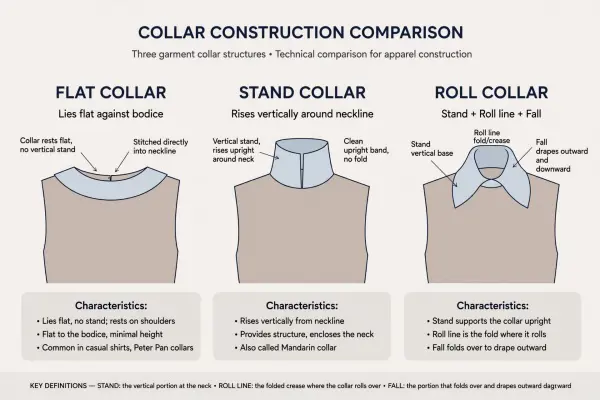
Most collar designs can be understood through three basic structural families: flat collars, stand collars, and roll or turnover collars. Fashion and patternmaking systems then develop these foundations into recognizable styles such as Peter Pan, sailor, Mandarin, shirt, camp, shawl, and tailored collar-and-lapel constructions.
Educational material from IGNOU's eGyanKosh describes stand, flat, and roll collars as three fundamental collar types. A stand collar rises from the neckline without a conventional fall; a flat collar lies close to the garment; and a roll collar combines elevation around the neck with a portion that turns or falls outward.
In practice, fashion teams also need to distinguish convertible collars, which can open away from the neck, and lapel-integrated systems, such as shawl and notched jacket collars. These categories describe how the collar behaves rather than merely what its outer edge looks like.
The best collar therefore depends on garment category, desired formality, fabric weight and drape, required support, wearer comfort, styling intent, and manufacturing complexity.
What Actually Defines a Collar Type?
It is tempting to classify collars only by visible shape: pointed, rounded, square, wide, narrow, high, or low. Those descriptions matter aesthetically, but they do not explain how the collar behaves.
A more useful classification starts with the relationship between the neckline edge, stand, roll line, and fall.
The neckline edge is the part attached to the garment. A collar stand raises some or all of the collar above the neckline. The roll line is where a collar turns over. The fall is the part extending outward or downward after that roll.
Recent Bharat Skills training material similarly defines the neckline edge, collar edge, collar stand, and roll line as core collar elements and emphasizes that collars can be developed close to or away from the neckline.
That structural logic is more valuable to a product developer than style names alone.
Two collars can have pointed tips but behave very differently because one lies almost flat while the other rises on a substantial stand. Likewise, changing only the stand height of a shirt collar can noticeably alter the way it frames the neck even if the collar points remain identical.
For a deeper explanation of how those parts are engineered and assembled, see collar and neckline construction.
A Practical Overview of Common Collar Types
Collar terminology varies somewhat between patternmaking systems and regions, so not every design fits perfectly into one label. The following framework focuses on the categories most useful to fashion product teams.
|
Collar type |
Structural behavior |
Common garment applications |
Typical material direction |
|
Peter Pan |
Flat, rounded |
Dresses, blouses, childrenswear |
Light to medium woven fabrics |
|
Sailor |
Flat, broad, often V-shaped front |
Dresses, blouses, uniforms, fashion tops |
Fabrics with enough body to hold broad shape |
|
Mandarin / band |
Standing, little or no fall |
Shirts, jackets, dresses, uniforms |
Wovens from lightweight shirting to structured fabrics |
|
Shirt collar with stand |
Stand plus turnover fall |
Dress shirts, casual shirts, uniforms |
Shirting fabrics, often interfaced |
|
One-piece / convertible collar |
Rolls and can open away from neck |
Casual shirts, blouses, overshirts |
Soft to medium wovens |
|
Camp / resort collar |
Open, relatively soft convertible collar |
Resort shirts, casual shirts, summer apparel |
Linen, rayon/viscose, cotton, lightweight blends |
|
Rib-knit collar |
Stretch collar attached to knit garment |
Polo shirts, sportswear, casualwear |
Rib structures with suitable recovery |
|
Turtleneck / roll-neck |
High knit collar that stands and may fold |
Knit tops, sweaters, base layers |
Stretch knits |
|
Shawl collar |
Continuous collar-lapel roll |
Jackets, cardigans, robes, occasionwear |
Drapey to structured fabrics depending application |
|
Notched collar/lapel |
Separate collar meeting lapel at notch |
Blazers, suits, coats |
Tailoring fabrics with internal support |
|
Peaked collar/lapel system |
Collar with upward-pointing lapel architecture |
Formal jackets, suits, coats |
Structured tailoring materials |
The table is deliberately based on construction behavior and practical application, not a claim that any collar belongs exclusively to one product category.
Fashion routinely moves collars between categories. A Mandarin collar can appear on a silk evening dress, denim jacket, work uniform, or lightweight shirt. What changes is the material and engineering around it.
Flat Collars: When You Want Shape Without Much Neck Height
A flat collar lies relatively close to the garment around the neckline rather than standing prominently against the neck. IGNOU training material identifies the Peter Pan collar as a representative flat collar.
Flat collars are useful when the design needs a visible framing element without the more upright architecture of a shirt or Mandarin collar.
Their apparent simplicity can be deceptive. Because much of the collar is visible across the upper chest, shoulders, or back, asymmetry and distorted outer curves are easy to see.
Peter Pan Collar
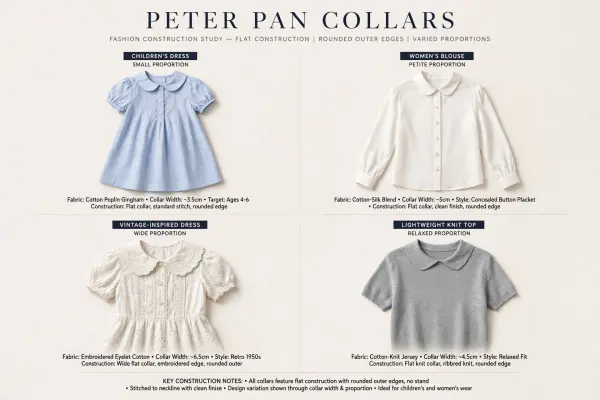
The Peter Pan collar is recognized by its flat construction and characteristically rounded outer edges. Bharat Skills materials describe the round or Peter Pan collar as a style commonly used in children's dresses, although contemporary fashion also applies it to adult blouses, dresses, knit tops, jackets, and fashion shirts.
Where it works well: garments where the designer wants softness, a rounded frame around the neckline, or a visibly decorative collar without significant stand height.
Typical applications include:
- children's dresses and blouses;
- women's blouses and dresses;
- school-inspired fashion;
- vintage-influenced apparel;
- lightweight jackets or knit tops using a contrasting collar.
Its character changes dramatically with proportion. A narrow rounded collar can be restrained; an oversized version becomes a dominant design feature.
Fabric choice matters as well. Crisp cotton poplin can create a clean graphic outline, while lightweight viscose or silk-like fabrics create a softer collar that may drape rather than hold a perfect circular shape.
The key business consideration is whether the collar's visual identity matches the brand. On some garments it communicates refinement or nostalgia; on others, especially oversized versions, it becomes deliberately fashion-led.
Sailor Collar
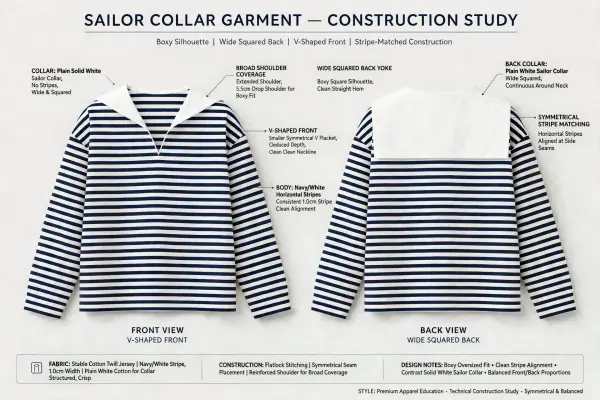
The sailor collar is another flat-collar form, traditionally recognizable by a relatively broad area across the shoulders, a V-shaped front arrangement, and a squared or broad back treatment. Bharat Skills describes it as a flat turned-down collar with a V shape at the front and square form at the back.
The style originated in naval uniform traditions but has long been adapted into civilian dress.
Where it works well: garments where the collar itself is intended to create a strong graphic silhouette.
It appears in:
- dresses;
- blouses;
- childrenswear;
- school- or uniform-inspired apparel;
- marine-inspired collections;
- fashion knitwear.
Compared with a Peter Pan collar, the sailor collar normally occupies much more visual area. That creates an immediate design statement, but also makes pattern placement, symmetry, stripe alignment, edge finishing, and fabric stability more important.
Stand Collars: Clean Vertical Structure Around the Neck
A stand collar rises upward from the neckline instead of developing a large fold-over fall.
This family is useful when the designer wants a clean vertical neckline, reduced collar spread, or a visually controlled neck opening.
The most widely recognized example is the Mandarin collar.
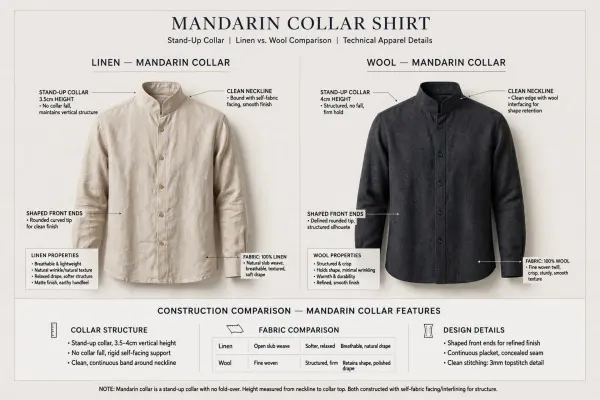
Mandarin Collar
A Mandarin collar is a stand-up collar with no conventional large fall. Bharat Skills describes it as a collar composed essentially of stand without fall, while its sewing-technology material notes that the style can be developed close to or farther from the neck and with different front-end shapes.
Depending on market, pattern system, and design context, closely related terms such as band collar, stand collar, Chinese collar, or Nehru-style collar may also be encountered. These terms should not always be treated as perfectly interchangeable, particularly when historical or cultural design references matter.
Where it works well: designs that benefit from an uncluttered neckline and moderate vertical structure.
Common uses include:
- woven shirts;
- tunics;
- dresses;
- lightweight jackets;
- hospitality and service uniforms;
- fashion outerwear;
- traditional- or heritage-influenced garments.
A Mandarin-style collar can work in linen for a relaxed summer shirt or in wool for a much more architectural jacket. The silhouette is similar in principle, but the support strategy is not.
High stand collars also require careful fit. Increasing height without considering neck circumference, posture, fabric stiffness, and collar shaping can create discomfort or make the collar flare away from the neck.
For brands, the most useful insight is that minimal appearance does not mean minimal engineering.
Because there is no large fall hiding the neckline seam, uneven stand height, asymmetric front ends, and poor attachment can be highly visible.
Wing Collar
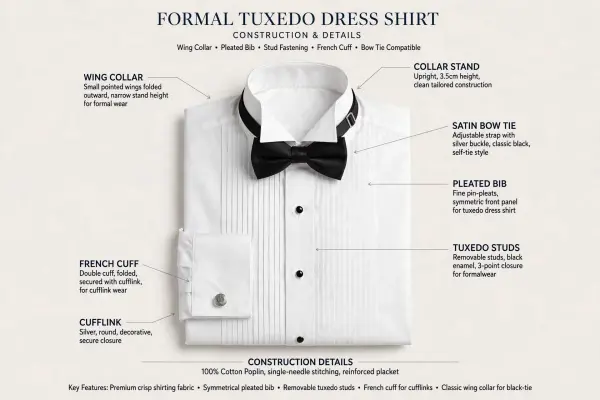
A wing collar is a specialized standing collar, generally associated with formal shirting. Its front corners fold outward into small “wings” while the rest of the collar remains upright.
It is substantially narrower in application than a Mandarin collar.
Where it works best: formal dress shirts designed for specific eveningwear combinations.
For mainstream casual collections, the wing collar usually offers little functional advantage. It makes more sense when the brand is intentionally developing formalwear or occasionwear and understands the styling conventions around the product.
This is an important commercial distinction: not every technically interesting collar deserves space in a broad assortment.
Shirt Collars: The Workhorse of Woven Apparel
The conventional shirt collar combines a collar fall with a stand, either as separate pattern pieces or within another engineered construction.
Bharat Skills describes the shirt collar as commonly consisting of a collar and separate band or stand and notes its use across men's, women's, and children's shirts.
This architecture is extraordinarily adaptable.
The difference between a formal business collar and a relaxed casual collar may come from relatively small changes in:
- point length;
- collar spread;
- stand height;
- collar depth;
- interfacing;
- roll behavior;
- topstitching;
- fabric;
- front opening construction.
Point Collar
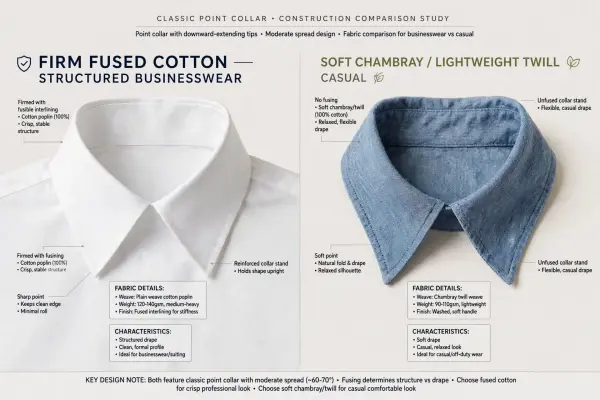
The point collar has collar tips that extend downward with a relatively moderate spread between them.
Where it works well: general-purpose woven shirts, uniforms, business-casual products, and classic menswear-inspired womenswear.
It is commercially useful because it is visually familiar and adaptable. A brand can adjust proportions without reinventing the entire collar architecture.
A firm fused cotton version may read as businesswear. A softer version on washed chambray or lightweight twill can become casual.
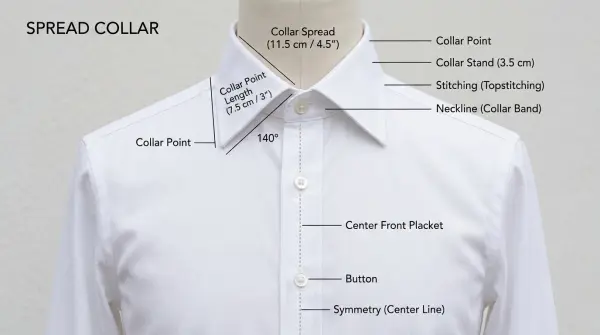
Spread Collar
A spread collar opens the collar points farther away from the centre front than a conventional narrow point collar.
Where it works well: tailored shirts where the neckline and styling are intended to feel more open or formal.
Spread width should be evaluated together with collar stand, point length, front opening, and intended styling rather than treated as an isolated measurement.
Very wide spreads also demand good left-right symmetry. Small sewing differences become more apparent because the points create a strong horizontal visual relationship.
Button-Down Collar
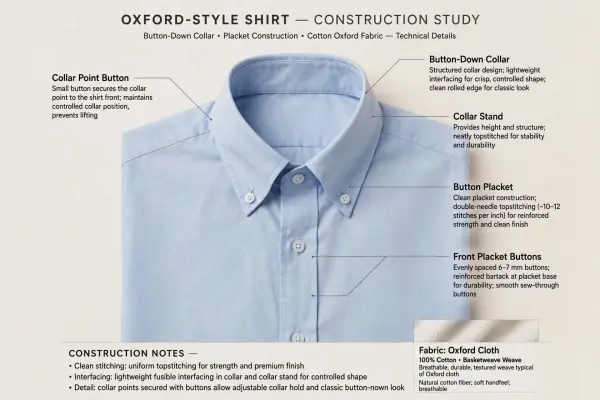
A button-down collar uses small buttons or another fastening arrangement to secure the collar points to the shirt front.
Structurally, it remains related to the shirt-collar family, but the fastening changes both appearance and behavior.
Where it works well: casual shirts, business-casual products, Oxford-style shirts, and garments where the designer wants collar points to remain controlled.
The style also demonstrates an important principle: collar selection cannot be separated from garment closures and other construction details. Readers working on full shirt architecture may also find garment closures and fastening construction relevant.
One-Piece Shirt Collar
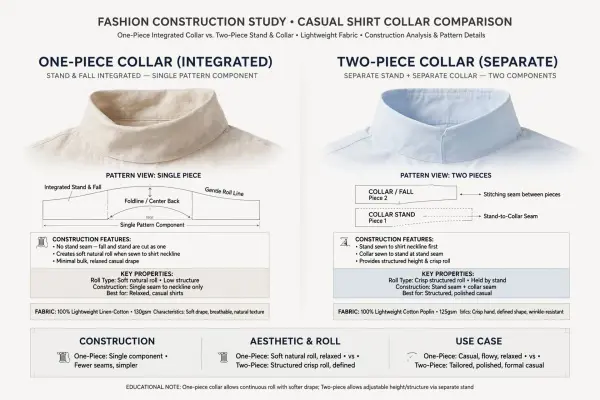
Some shirt collars integrate the stand and fall into one pattern component rather than constructing them as two fully separate pieces.
That can produce a softer and less segmented appearance, depending on the pattern and fabric.
Where it works well: casual shirts, lightweight blouses, fashion shirting, or products where a softer collar roll is preferred.
A separate stand, however, usually provides more direct control over stand shape and collar positioning. The choice is therefore partly aesthetic and partly operational.
Convertible and Camp Collars: Built to Open More Naturally
A useful technical distinction is whether a collar is convertible or nonconvertible.
Bharat Skills training material explains that a convertible collar uses neckline geometry that allows the collar to spring or open away when unbuttoned, while a nonconvertible collar follows the neckline more closely and tends to stay in its designed position.
Cornell University's draping material on the one-piece convertible collar similarly demonstrates how neckline shaping affects whether the collar stands around the neck and then opens toward the front. Cornell University convertible collar draping guide
This behavior is particularly valuable in casual apparel.
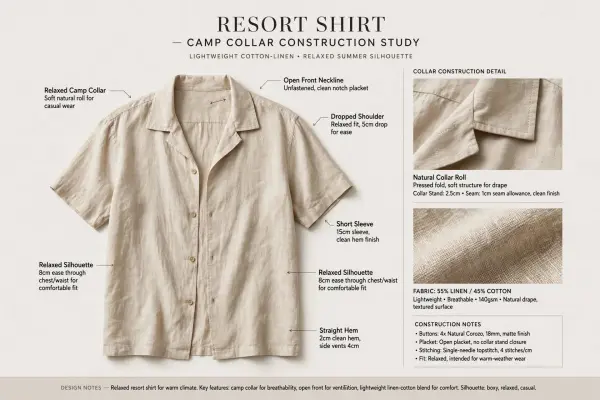
Camp or Resort Collar
The camp collar—also frequently called a resort or open collar—is usually designed to lie open at the front rather than close tightly around the neck.
It is strongly associated with casual shirts, especially warm-weather and resort products.
Where it works well:
- summer shirts;
- resortwear;
- printed fashion shirts;
- short-sleeve casual shirting;
- relaxed womenswear;
- matching vacation or leisure sets.
Soft fabrics often complement this collar because the style typically benefits from a relaxed roll. Cotton, linen, rayon/viscose constructions, Tencel-branded lyocell fabrics, and blends may all be used depending on weight and desired hand.
However, a very limp fabric can make the collar collapse, while heavy interfacing can destroy the relaxed appearance.
This is a good example of why fabric and collar architecture must be developed together.
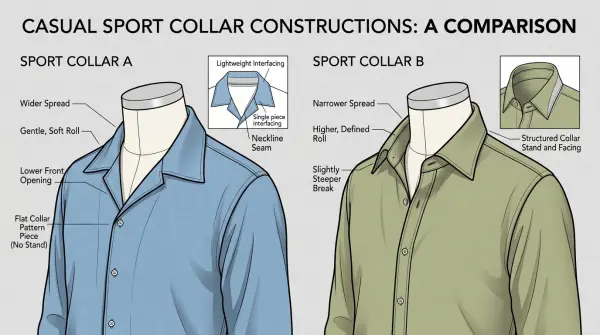
Sport Collar
“Sport collar” is used somewhat differently across patternmaking systems, but it usually describes a more casual open or convertible collar rather than a high, formal shirt collar.
Patternmaking references classify sport and convertible collars within shirt or rolled-collar groups.
For commercial teams, precise tech-pack drawings are therefore more reliable than style terminology alone.
If a supplier receives only the instruction “sport collar,” different patternmakers may interpret it differently.
Knit Collars Require Stretch and Recovery, Not Just Shape
Collar discussions often focus heavily on woven shirts, but knit products create a different set of requirements.
A knit collar may need to stretch during dressing and then recover closely enough to maintain its intended appearance. The collar material therefore contributes mechanically to the neckline rather than acting only as decoration.
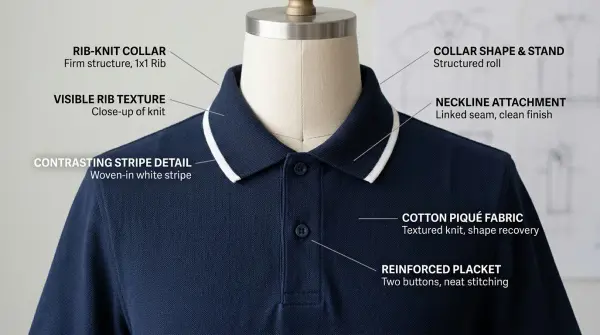
Rib-Knit Polo Collar
The knitted polo collar is widely used on polo shirts and some sportswear, schoolwear, uniforms, and casual tops.
Unlike many woven collars, the collar itself may be knitted as a shaped or rectangular component with engineered ribs, edges, stripes, or jacquard details.
Where it works well:
- polo shirts;
- school uniforms;
- corporate casualwear;
- sports-inspired apparel;
- knitted casual tops.
Its success depends on compatibility between collar dimensions, neckline geometry, rib structure, recovery, garment fabric, and attachment method.
A collar that stretches easily but recovers poorly may become visibly loose after wear.
Turtleneck or Roll-Neck Collar
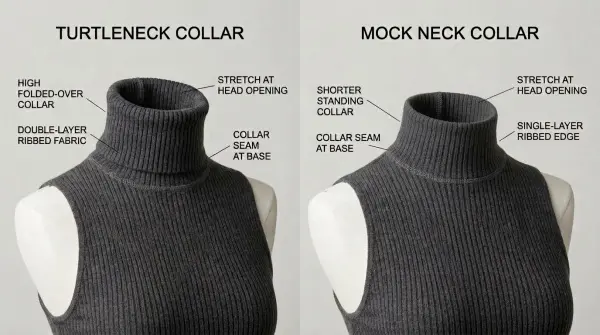
A turtleneck uses a high neck extension or collar that typically folds over itself. A mock neck creates a similar high neckline but normally has less height and does not require the same fold-over behavior.
University teaching material describes turtleneck constructions as high rounded necklines finished with a wide knit section that may be folded over, while mock-turtle versions use a narrower standing construction.
Where they work well:
- sweaters;
- knit tops;
- base layers;
- cold-weather apparel;
- minimalist fashion collections.
The biggest technical question is not whether the shape can be sewn. It is whether the opening stretches sufficiently for dressing while recovering afterward.
Head-opening requirements, fabric elasticity, seam extensibility, and wearer comfort therefore need to be evaluated as one system.
Shawl Collars: When Collar and Lapel Become One Continuous Line
A shawl collar differs fundamentally from a small collar attached around a neckline.
The collar rolls continuously into the garment front, creating a smooth line rather than a separate collar meeting a lapel at a visible notch. Indian vocational training material describes the shawl collar as a design where the collar can be developed as an extension of the front bodice and rolls back to create the lapel effect.
Where it works well:
- robes and dressing gowns;
- cardigans;
- evening jackets;
- tuxedo-inspired garments;
- women's jackets;
- soft tailoring;
- coats.
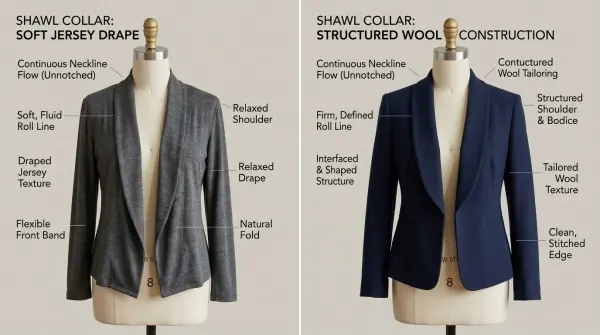
The shawl collar can move from extremely soft to highly structured depending on material and support.
A jersey cardigan may use a broad shawl collar that drapes naturally. An evening jacket may require internal shaping and careful pressing to produce a refined roll.
That versatility is one reason the style appears across categories, but it also makes simplistic construction specifications risky.
A shawl collar in fluid satin cannot simply inherit the same interfacing and pressing specifications as one in wool coating.
Notched and Peaked Collar-Lapel Systems: Tailoring Territory
Blazers, suits, coats, and tailored jackets introduce a more complex relationship between collar and garment front.
Patternmaking resources commonly classify notched, peaked, and shawl designs under a broader lapel-collar group.
Technically, it is more accurate to treat many of these as collar-and-lapel systems rather than isolated collars.
Notched Collar and Lapel
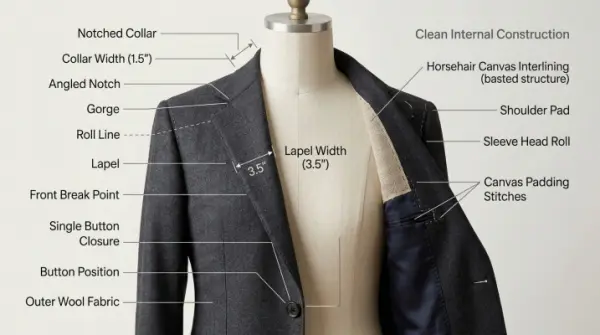
A notched system creates a visible angular break where the collar meets the lapel.
It is one of the most familiar tailored-jacket constructions.
Where it works well:
- business suits;
- blazers;
- casual tailoring;
- tailored coats;
- school or corporate uniform jackets.
The proportions of the notch, gorge, lapel width, collar width, roll line, and button position interact visually. Changing one can affect the balance of the whole jacket front.
This construction usually demands more internal engineering than a simple blouse collar because the collar works with facings, lapels, interfacing, roll lines, and pressing.
Peaked Lapel System
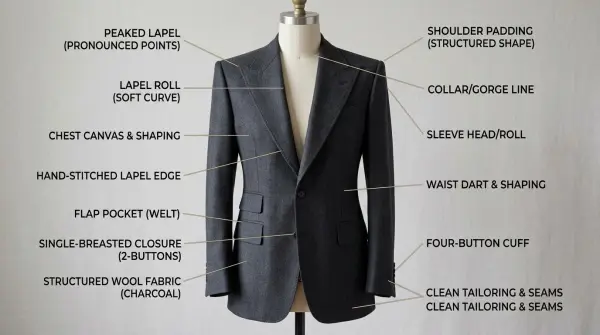
A peaked lapel extends upward toward the shoulder in a more pronounced point than a conventional notched lapel.
Where it works well:
- formal suits;
- double-breasted jackets;
- statement tailoring;
- eveningwear;
- structured coats.
The design creates a strong directional visual line. That makes pattern accuracy and left-right symmetry particularly important.
From a manufacturing perspective, fashion brands should recognize that tailoring details can add pattern pieces, internal support, pressing requirements, skill dependence, and inspection time.
A more dramatic collar is not merely a styling decision. It can change cost.
Shawl vs Notched vs Peaked
For buyers and product teams, these three tailored systems can be differentiated simply:
|
System |
Visual character |
Strong applications |
Construction implication |
|
Shawl |
Continuous curved roll |
Evening jackets, robes, soft jackets |
Collar and front roll work as continuous shape |
|
Notched |
Defined angular notch |
Business suits, blazers, coats |
Precise collar-lapel junction required |
|
Peaked |
Upward-pointing lapel |
Formal or statement tailoring |
Strong symmetry and precise shaping required |
No option is universally more premium.
Quality depends on whether the chosen construction is appropriate to the garment and executed well.
How Fabric Changes Which Collar Works Best
Collar selection should never happen independently from material selection.
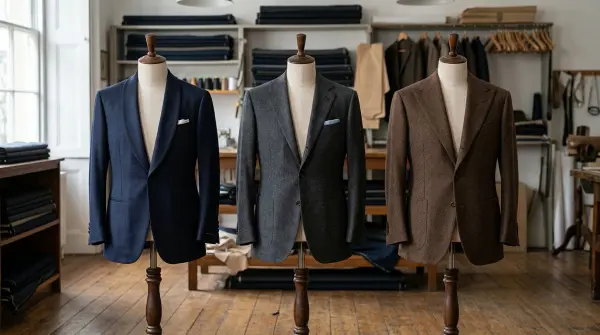
The same pattern geometry can produce noticeably different outcomes in crisp cotton, washed linen, silk crepe, boiled wool, denim, stretch jersey, or rib knit.
Crisp woven shirtings
Cotton poplin, broadcloth, Oxford cloth, and similar woven shirtings can support defined points and structured collar edges.
They are natural candidates for:
- point collars;
- spread collars;
- button-down collars;
- Mandarin collars;
- structured convertible collars.
Interfacing can further control shape, although the appropriate support depends on fabric weight and intended handfeel.
Lightweight fluid fabrics
Viscose/rayon constructions, silk fabrics, lightweight lyocell, and fluid synthetic blends often work well with collars where softness is intentional.
Suitable directions may include:
- camp collars;
- soft Peter Pan collars;
- convertible collars;
- soft shawl collars;
- draped or fashion collars.
The trade-off is reduced geometric sharpness.
If a designer wants extremely crisp points from a very fluid fabric, the construction may require more internal support—and that support may change the hand of the garment.
Structured medium- and heavyweight fabrics
Wool suiting, coating, firm twill, denim, and similarly substantial materials can support more architectural forms.
They are frequently suitable for:
- tailored collar-lapel systems;
- coat collars;
- structured stand collars;
- heavier shirt-style collars;
- outerwear variations.
Bulk becomes a major consideration as thickness increases.
Seam allowances, undercollars, interfacing, facings, and lapel structures can quickly create excessive thickness if they are not engineered appropriately.
Stretch knits
Jersey, interlock, rib structures, and sweater knits introduce stretch and recovery requirements.
Common collar directions include:
- rib-knit polo collars;
- mock necks;
- turtlenecks;
- knit bands;
- soft fashion collars.
The material needs to recover sufficiently for the intended construction, particularly where the garment is pulled over the head.
This is why copying the dimensions of a woven stand collar into a stretch knit product rarely constitutes adequate development.
How Should a Fashion Brand Choose a Collar?
A collar should be chosen through a combination of visual intent, garment function, material behavior, product positioning, and production capability.
Start with the product rather than the collar catalogue.
A resort shirt needs a different solution from a formal uniform shirt even if both use lightweight woven fabric. A child's dress may need a collar that is soft and comfortable, while a blazer collar has to participate in the jacket's tailored roll and lapel structure.
A practical decision sequence is:
1. Define the garment's visual language.
Should it read formal, relaxed, tailored, playful, utilitarian, minimal, or decorative?
2. Decide how much vertical structure is needed.
Flat collars frame the garment differently from upright stands or shirt collars.
3. Evaluate fabric behavior.
Test thickness, drape, stretch, recovery, surface sensitivity, and compatibility with support materials.
4. Consider the garment opening.
A button front, zipper, pullover opening, lapel, or partial placket changes what collar constructions are practical.
5. Define wearer requirements.
Check neck comfort, ease of dressing, movement, heat, layering, and intended use.
6. Calculate production complexity.
Collar stands, interfacings, precise points, lapels, undercollars, multiple pressing stages, and pattern matching all affect manufacturing.
7. Approve the collar on the actual garment.
A collar should be evaluated in three dimensions, not only as a pattern piece.
This process generally produces better decisions than choosing a collar because it appears attractive in an isolated reference image.
Matching Collar Type to Garment Category
Although fashion design encourages experimentation, certain collar structures repeatedly work well because they solve the functional and visual requirements of particular categories.
Formal and business shirts
Useful directions include point collars, spread collars, button-down variants where appropriate, and other shirt collars with controlled stands.
The priority is normally repeatable shape, clean symmetry, appropriate neck fit, and compatibility with intended styling.
Casual and resort shirts
Camp, convertible, soft one-piece, button-down, and relaxed shirt collars can work particularly well.
Fabric hand becomes central. A deliberately relaxed collar should still look intentional rather than simply unsupported.
Dresses and blouses
This category allows broad experimentation.
Peter Pan, Mandarin, sailor, convertible, shirt, tie-inspired, shawl, and fashion collars can all be appropriate depending on silhouette.
Here, collar scale often matters as much as collar family. An oversized collar can dominate the garment while a narrow version functions primarily as framing.
Tailoring and outerwear
Notched, peaked, shawl, stand, shirt-inspired, and specialized coat collars are common choices.
Fabric thickness, interfacing, undercollar construction, roll lines, and pressing capability become more important as structure increases.
Knitwear and sportswear
Rib collars, polo collars, stand knits, mock necks, and roll necks are natural choices because they can exploit stretch and recovery.
The product-development team should verify the collar component and body fabric together rather than approving them independently.
Uniforms
Uniform collars often need to balance appearance with repeatability, durability, wearer comfort, laundering, and production cost.
Shirt collars, Mandarin collars, polo collars, and tailored collars may all be appropriate depending on occupation and brand standards.
For high-volume programs, a subtle reduction in construction complexity can have a greater commercial impact than it would in a small fashion run.




Comments 0
Leave a CommentSend Comment
Anda harus Login terlebih dahulu untuk dapat memberikan komentar.