

Optimizing Your Fashion Business Profile for Better Visibility Across Google, AI Platforms, and Local Search
Quick Answer
A fashion business profile is not just a digital listing. It is a public trust asset that helps customers, search engines, AI systems, and local discovery platforms understand what a fashion business does, where it operates, what it offers, and why it is credible.
For boutiques, tailoring studios, fashion schools, textile shops, showrooms, garment service providers, and local fashion retailers, business profile optimization should start with accurate business information, clear categories, updated opening hours, strong photos, useful service descriptions, review management, location consistency, and links to relevant website pages. Google states that local results are mainly based on relevance, distance, and prominence, so a profile should help Google and customers understand how well the business matches a search, where it is located, and how credible or well-known it appears online; see Google Business Profile local ranking guidance.
In the AI search era, the profile should also support brand entity clarity. A business profile that clearly describes the brand, product categories, services, location, photos, reviews, and website connections gives AI-powered systems more reliable information to interpret.

What Is a Fashion Business Profile?
A fashion business profile is the structured public information about a fashion-related business across platforms such as Google Business Profile, Google Maps, search results, social platforms, marketplace profiles, directories, and AI-indexed web sources. It typically includes the business name, category, address or service area, opening hours, website, phone number, photos, reviews, products, services, and short business description.
For a fashion business, this profile carries more weight than many owners realize. It may be the first thing a customer sees before visiting a boutique, booking a fitting, joining a sewing class, contacting a garment service provider, or checking whether a textile shop carries the right kind of fabric.
A weak profile creates friction. If the business category is vague, photos are outdated, opening hours are missing, and reviews are unmanaged, customers may hesitate even before reaching the website. A strong profile reduces uncertainty. It shows what the business offers, where it is located, whether it looks credible, and what previous customers have experienced.
For fashion businesses, profile visibility is especially important because the decision is often visual and trust-based. Customers want to see the store environment, garment quality, product range, consultation space, classroom setup, tailoring results, or fabric selection before taking action.
Why Business Profile Visibility Matters in the AI Search Era
Business profile visibility matters because AI-powered search experiences increasingly depend on structured, consistent, and trustworthy information. When a customer searches for “bridal alteration studio near me,” “best sewing class for beginners,” “modest fashion boutique in Jakarta,” or “fabric store with linen materials,” the search system needs to understand business category, location, service relevance, reviews, and available information.
Google’s guidance for generative AI features states that foundational SEO practices still matter for AI search experiences, and that products such as Google Business Profiles and Merchant Center can help products and services appear in AI responses and other Google Search results; see Google’s guide to optimizing for generative AI features.
This does not mean every optimized profile will appear in AI responses. Visibility is never guaranteed. But it does mean that incomplete, inconsistent, or unclear business information is a liability.
For fashion companies, the profile is part of the brand entity. It helps answer questions such as:
- What kind of fashion business is this?
- Where is it located or what area does it serve?
- Does it sell products, provide services, offer classes, or manufacture garments?
- Is it open now?
- Do customers trust it?
- What does the store, studio, showroom, or product environment look like?
- Is there a website or booking page for deeper information?
The clearer the profile, the easier it becomes for both customers and digital systems to interpret the business.
Profile Optimization Is Not the Same as Posting More Content
Many fashion businesses assume profile optimization means uploading more photos or posting more updates. Photos and updates can help, but they are not the foundation. The foundation is accuracy, relevance, consistency, and proof.
Google explains that local results are mainly based on relevance, distance, and prominence. Relevance refers to how well a business profile matches the search, distance considers how far the business is from the searcher or searched location, and prominence reflects how well-known the business may be based on information Google has about it; see Google Business Profile local ranking factors.
This is why a fashion business cannot optimize its way around every factor. A boutique cannot make itself physically closer to a searcher. A new tailoring studio cannot instantly become as prominent as a long-established shop with years of mentions and reviews. But it can improve relevance, clarity, credibility, and completeness.
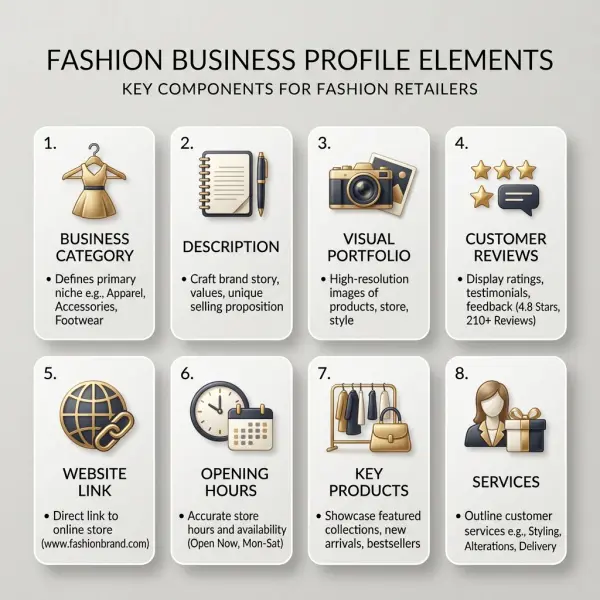
A strong profile should answer the basic discovery questions before the customer has to ask.
|
Profile Element |
Why It Matters |
Fashion Business Example |
|
Business category |
Helps match search intent |
Boutique, tailor, fashion designer, sewing school, fabric store |
|
Business description |
Explains positioning and services |
Custom bridal alterations, modest womenswear, beginner sewing classes |
|
Photos |
Builds visual trust |
Storefront, garment racks, fitting area, classroom, fabric shelves |
|
Reviews |
Supports credibility |
Fit accuracy, service quality, product range, delivery experience |
|
Website link |
Connects profile to deeper content |
Product pages, booking page, course page, service page |
|
Opening hours |
Reduces visit friction |
Updated holiday hours, appointment-only rules |
|
Products or services |
Clarifies commercial offering |
Alterations, dressmaking, textile retail, styling consultation |
The goal is not just to look active. The goal is to become understandable.
Start With Category and Business Identity
The business category is one of the most important profile fields because it tells platforms what kind of business the profile represents. A fashion company should choose the category that best reflects its real primary activity, not the category that sounds broadest or most promotional.
A fashion boutique, sewing school, textile shop, tailoring studio, bridal shop, garment manufacturer, fashion designer, and alterations service may all belong to the fashion ecosystem, but they answer different customer intents. A user searching for a “fabric store” does not want a fashion school. A user searching for “bridal alterations” may not want a ready-to-wear boutique.
The business description should reinforce this identity with clear language. Avoid writing only: “We are a modern fashion business offering high-quality products and excellent service.” That sentence could apply to almost anyone.
A stronger description might say:
“Fit & Form Studio is a women’s tailoring and alteration studio specializing in bridal gown adjustments, eveningwear fitting, and custom formalwear consultations by appointment.”
This description gives category, audience, service scope, garment type, and booking context. It is short, but useful.
For fashion businesses with multiple activities, clarity becomes even more important. If a boutique also offers styling appointments, say so. If a fashion school also sells digital courses, separate the services clearly. If a garment studio handles both sampling and small-batch production, explain which clients it serves and what inquiry information is needed.
Make Location and Service Area Information Accurate
Location information is critical for local fashion discovery. A customer looking for a nearby boutique, tailor, sewing course, or fabric store usually has practical intent. They may want to visit today, book this week, check parking, compare distance, or call before coming.
Google allows verified business owners to edit profile information such as address, hours, contact information, and photos to keep business information accurate and up to date; see Google Business Profile editing guidance.
Fashion businesses should be especially careful with the distinction between a storefront, studio, showroom, office, and service-area business. A boutique with walk-in shopping has different customer expectations from an appointment-only design studio. A garment service provider working from a production office may not want walk-in retail customers. A stylist may serve clients across a city without having a public retail location.
Practical details should be explicit:
- Is the business open for walk-ins?
- Is appointment required?
- Is the address a retail store, showroom, office, studio, or workshop?
- Are fittings available on-site?
- Does the business serve customers at home, online, or within a defined service area?
- Are hours different during holidays, pop-up events, or collection launches?
This is not only about ranking. It prevents customer disappointment. A profile that brings the wrong customer to the wrong place is not successful visibility.
Use Photos as Evidence, Not Decoration
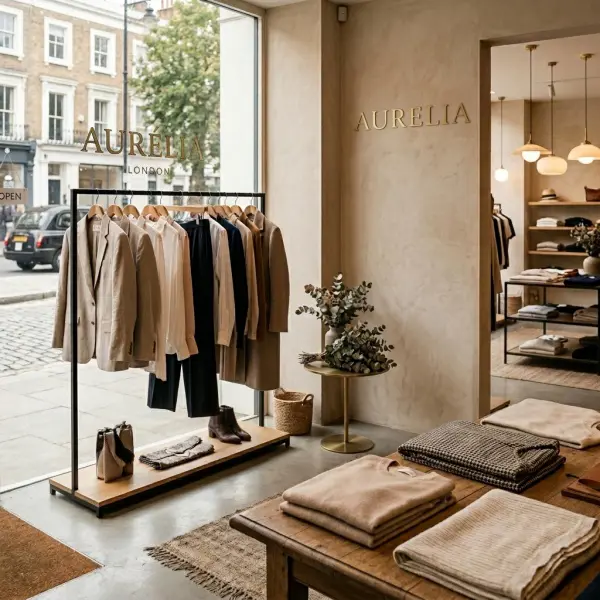
Fashion business photos should show what customers need to trust. A profile with generic brand visuals may look polished, but profile photos should also answer practical questions: What does the store look like? What product categories are available? Is the tailoring space professional? Are the garments well finished? Is the classroom clean and equipped? Does the fabric selection look relevant?
Google recommends posting photos and videos of the business and its products or services and collecting and responding to reviews from customers; see Google Business Profile getting started guidance.
For a fashion business, useful profile photos may include:
- Storefront or studio entrance, so customers can recognize the location.
- Interior view, showing product range or consultation environment.
- Garment racks, displays, or fabric shelves.
- Product close-ups showing texture, finishing, or construction.
- Fitting room, sewing classroom, or consultation table when relevant.
- Team or work process photos where appropriate.
- Seasonal collection, workshop, or event images.
The mistake is treating the profile like a mood board. Mood matters, but customers also need orientation. A beautiful close-up of fabric texture may support brand perception, but a customer still needs to know whether the shop is easy to find, whether the fitting space exists, and whether the product range matches their needs.
Reviews Should Support Real Customer Decision-Making
Reviews are not just social proof. They are decision data. For fashion customers, reviews can answer questions that product descriptions often miss: Does the sizing run small? Was the alteration done on time? Did the fabric feel as expected? Was the staff helpful? Did the course suit beginners? Was the custom order communication clear?
Google says more reviews and positive ratings can improve a business’s local ranking, and responding to reviews shows that the business values customers and their feedback; see Google local ranking guidance.
For fashion businesses, review management should be thoughtful rather than defensive. A short “Thank you” is polite, but a more useful response can reinforce service identity. For example:
“Thank you for trusting us with your dress alteration. We are glad the fitting schedule worked well before your event.”
That response is human, specific, and useful to future customers. It signals the type of service provided without keyword stuffing.
Fashion businesses should also avoid manipulating reviews. Do not fabricate customer feedback, pressure customers into positive wording, or post fake reviews. Beyond platform policy risks, fake reviews damage trust if customers sense inconsistency between online claims and real service.
Connect the Profile to Strong Website Pages
A business profile should not carry the full burden of explaining the business. It should connect to website pages that provide deeper answers.
For a boutique, the profile may link to a homepage or collection page. For a tailoring studio, it may link to a booking or alteration service page. For a fashion school, it may link to course pages. For a garment service provider, it may link to capability pages, inquiry forms, or sample development information.
Google’s AI optimization guidance notes that generative AI features rely on Search systems and that eligible pages generally need to be indexed and eligible for snippets. It also notes that Google Business Profiles and Merchant Center can help products and services be visible in AI responses and other Search results; see Google generative AI search optimization guidance.
The practical implication is that the profile and website should reinforce each other. The profile gives quick trust and local context. The website gives depth.
A strong profile-to-website pathway might look like this:
|
Business Type |
Profile Link Should Lead To |
Why |
|
Fashion boutique |
Collection or store visit page |
Helps customers see products before visiting |
|
Tailoring studio |
Alteration service or booking page |
Explains process, pricing range, and appointment rules |
|
Sewing school |
Course category page |
Helps learners compare levels and schedules |
|
Textile shop |
Fabric category or catalog page |
Helps customers check material availability |
|
Garment manufacturer |
Capability or inquiry page |
Helps buyers evaluate services and requirements |
|
Fashion showroom |
Appointment or lookbook page |
Supports professional buyer inquiries |
A profile link to a generic homepage is acceptable, but a link to the most relevant decision page is often more useful.
Use LocalBusiness Structured Data on the Website
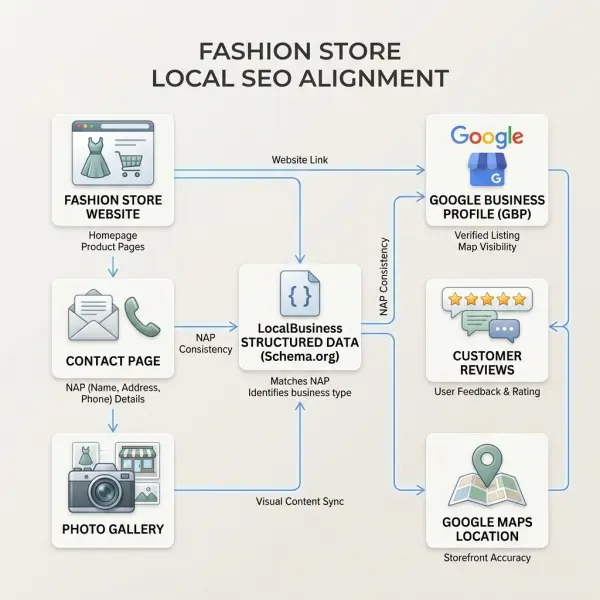
LocalBusiness structured data helps provide explicit clues about a business to Google. Google’s LocalBusiness structured data documentation says businesses can use it to tell Google about details such as opening hours, departments, and reviews where applicable; see Google LocalBusiness structured data guidance.
For fashion businesses with physical locations, LocalBusiness schema can support entity clarity when implemented accurately. It does not replace a Google Business Profile, and it does not guarantee local ranking. But it can help align the website with the business profile.
Useful LocalBusiness-related information may include:
- Official business name.
- Address or service area where appropriate.
- Opening hours.
- Phone number.
- Website URL.
- Logo.
- Business category or type.
- SameAs links to official social profiles.
- Department information for larger stores or institutions.
- Appointment or booking links where relevant.
Google’s structured data introduction defines structured data as a standardized format for providing information about a page and classifying page content; see Google structured data introduction. The most important rule is accuracy. The markup should reflect real, visible business information.
For a fashion business, this means the profile, website footer, contact page, location page, and structured data should not contradict one another.
Optimize for AI Platforms Through Consistency, Not Tricks
AI platforms do not all work the same way. Some answer from web search, some use indexed sources, some rely on partnerships, some cite pages, and some summarize available information. A fashion business cannot control every AI system. It can control how consistently and clearly its information appears across the open web.
This is why business profile optimization should extend beyond Google. The same core identity should appear consistently across:
- Official website.
- Google Business Profile.
- Social profiles.
- Marketplace or stockist pages.
- Local directories.
- Fashion directories.
- Event pages.
- Press mentions.
- Partner or supplier pages.
- Review platforms.
- Course or booking platforms where relevant.
This is especially important for businesses with similar names. A fashion boutique called “Luna Studio,” for example, may be confused with photography studios, design agencies, beauty salons, or other boutiques unless its entity signals are clear. The phrase “Luna Studio is a womenswear boutique and styling studio in Bandung” is more useful than “Luna Studio is a creative lifestyle brand.”
The best AI visibility strategy for profiles is not a hidden file, special phrase, or artificial keyword trick. It is consistent public information supported by credible proof.
This connects directly to the broader article How Fashion Businesses Can Build Online Visibility in the Age of AI Search, which explains visibility as a full digital stack, and to AEO for Fashion Brands: How to Become the Answer Customers Find First, which focuses on answer-ready content.
Practical Profile Optimization Checklist for Fashion Businesses
A fashion business profile should be reviewed at least quarterly, and more often during collection launches, business relocations, seasonal campaigns, new course enrollment periods, or service changes.
Use the checklist below as a practical profile audit:
- Business name matches official branding.
- Primary category reflects the real core business.
- Secondary categories are relevant, not excessive.
- Address or service area is accurate.
- Opening hours and holiday hours are updated.
- Website link points to the most useful page.
- Phone number and messaging options are current.
- Business description clearly explains product or service focus.
- Photos show storefront, interior, products, service environment, and current offerings.
- Reviews are monitored and answered professionally.
- Products or services are listed where available.
- Appointment, booking, or inquiry path is clear.
- Profile information matches website and social profiles.
- LocalBusiness structured data is implemented correctly where relevant.
- Customer-facing claims are specific and supportable.
This checklist is not a one-time setup task. Fashion businesses change often: new collections, seasonal hours, pop-up events, new instructors, expanded services, updated store interiors, changed product categories, and revised appointment rules. Profile accuracy should follow those changes.
Common Mistakes Fashion Businesses Make With Profiles
Mistake 1: Using a vague business category
A vague category weakens relevance. A business that primarily provides bridal alterations should not describe itself only as a fashion company. A textile shop should not rely on a broad retail label if a more specific category is available. Category accuracy helps match the business to the right search intent.
Mistake 2: Treating photos as branding only
Beautiful campaign images are useful, but local discovery needs practical visuals too. Customers want to recognize the storefront, understand the store layout, see product categories, and evaluate whether the environment fits their expectations.
Mistake 3: Ignoring reviews until there is a problem
Review management should not begin only after a negative review appears. Regular, professional responses show that the business is active and attentive. For fashion services such as alterations, custom dressmaking, and sewing classes, review responses can also clarify what the business does well.
Mistake 4: Linking to weak or generic website pages
A business profile may generate interest, but the website must continue the decision journey. A tailoring studio should not send customers to a homepage with no alteration details. A fashion school should not send learners to a page that does not explain course levels, schedules, or outcomes.
Mistake 5: Inconsistent names and descriptions across platforms
Inconsistency weakens entity clarity. If the business name, category, address, or service description varies across the website, Google profile, Instagram bio, marketplace page, and directories, customers and systems may struggle to connect the signals.
What Fashion Businesses Should Verify Before Acting
Before optimizing a profile aggressively, fashion businesses should verify the accuracy of all public information. Visibility that attracts the wrong customer can create operational problems.
A boutique should not imply that all online products are available in-store if inventory differs. A tailoring studio should not suggest walk-ins are accepted if appointments are required. A garment service provider should not list manufacturing services that it cannot consistently deliver. A fashion school should not promote course outcomes that are not realistic.
Profile claims should be checked against actual operations:
- Are opening hours staffed reliably?
- Are listed services currently available?
- Are product categories accurate?
- Are photos recent enough to represent the business?
- Does the website page match the profile promise?
- Are reviews being handled professionally?
- Are sustainability, custom, handmade, or premium claims specific enough?
- Does structured data match visible website content?
Good profile optimization makes a business easier to trust. Over-optimization makes a business easier to question.
FAQ
What is the most important part of a fashion business profile?
The most important part is accurate and specific business identity. Customers and search systems need to understand what the business is, where it operates, and what it offers. A boutique, tailor, fashion school, textile shop, showroom, and garment service provider should not describe themselves in the same generic way. Category accuracy, location clarity, service details, photos, reviews, and website links all support that identity.
Can Google Business Profile help fashion businesses appear in AI search?
It may help, especially when the business has local or product/service relevance. Google’s guidance on generative AI search says Google Business Profiles and Merchant Center can help products and services be visible in AI responses and other Search results. This does not guarantee inclusion, but it makes accurate profile information more important for businesses that depend on local discovery, store visits, appointments, or service inquiries.
How often should a fashion business update its profile?
A fashion business should update its profile whenever practical customer-facing information changes. This includes opening hours, holiday schedules, location, phone number, services, appointment rules, product categories, course schedules, and major visual changes to the store or studio. At minimum, a quarterly review is useful. Businesses with seasonal collections, pop-ups, or frequent events may need more frequent updates.
Do photos affect fashion business profile visibility?
Photos can support profile quality and customer trust, although they should not be treated as a ranking guarantee. Google recommends posting photos and videos of the business and its products or services. For fashion businesses, photos are especially valuable because customers want to evaluate product range, store environment, garment quality, fitting areas, fabric selection, or classroom setup before visiting or booking.
Should fashion businesses use LocalBusiness schema?
Fashion businesses with physical locations or local services should consider LocalBusiness structured data on their websites when it accurately reflects visible business information. It can help search engines understand business details such as name, address, opening hours, phone number, and related information. It should support, not replace, a complete Google Business Profile and clear website content.
What is the difference between local SEO and business profile optimization?
Local SEO is the broader process of improving visibility for location-based searches across the website, business profiles, reviews, local content, citations, and technical SEO. Business profile optimization is one part of local SEO. It focuses specifically on improving the public profile information that appears in search and map-based discovery environments.
What should a fashion business avoid in profile optimization?
Avoid vague categories, outdated photos, incorrect hours, fake reviews, keyword-stuffed business names, misleading service claims, and inconsistent information across platforms. A profile should help the right customer make a confident decision. If optimization makes the business look more visible but less accurate, it creates trust and operational risks.
Conclusion
A fashion business profile is no longer a passive listing. It is a visibility, trust, and entity signal that connects the business to customers across Google Search, Maps, AI-powered discovery, and local decision journeys.
The strongest profile strategy is practical. Choose accurate categories. Write a clear business description. Keep location and hours updated. Use photos that prove what the business offers. Respond to reviews with professionalism. Connect the profile to useful website pages. Align profile information with structured data and consistent brand identity across the web.
For fashion businesses, visibility should not attract random attention. It should help the right customer understand the business faster. A boutique needs customers who recognize its style and product range. A tailor needs clients who understand appointment and fitting requirements. A sewing school needs learners who can choose the right level. A garment service provider needs buyers who understand its capabilities.
In the AI search era, clarity is not only good marketing. It is infrastructure.





Comments 0
Leave a CommentSend Comment
Anda harus Login terlebih dahulu untuk dapat memberikan komentar.