
AI Fashion Model Photography Explained for Ecommerce Content
Fashion ecommerce depends heavily on how well customers can understand a garment without physically touching or trying it on. A simple product photograph may communicate color and construction, but an image of someone wearing the garment provides additional context about styling, silhouette, proportions, and intended use.
Producing these images traditionally requires models, photographers, stylists, physical samples, studio facilities, and coordinated production schedules. For fashion businesses managing extensive catalogs, frequent product launches, or multiple sales channels, maintaining a consistent supply of visual content can become operationally demanding.
Artificial intelligence (AI) introduces another approach to producing fashion imagery. Instead of organizing a new photoshoot for every visual variation, businesses can use generative AI to create model-based product images from existing garment photographs, digital references, and creative instructions.
The commercial opportunity is substantial, but so is the responsibility. Fashion imagery must do more than look attractive. It must help customers develop realistic expectations about the products they purchase.
Quick Answer
AI fashion model photography is a digital content production method that uses artificial intelligence to generate or modify images of people wearing clothing for ecommerce catalogs, fashion campaigns, product listings, and other commercial applications.
Unlike conventional photography, which captures a physical garment on a person through a camera, AI-generated photography synthesizes some or all of the visual content using garment references, model images, and creative instructions. Depending on the technology, businesses can create entirely synthetic fashion models, digitally dress existing model images, or develop authorized digital replicas of real people.
For fashion ecommerce businesses, this approach can support faster content production, more flexible styling options, consistent visual presentation, and the creation of additional marketing assets without arranging a separate physical photoshoot for every image.
However, AI-generated images do not automatically reproduce garment characteristics accurately. Fabric texture, color, construction details, proportions, and apparent fit may differ from the physical product.
The most commercially responsible approach is to treat AI fashion photography as a controlled extension of product content production, supported by authentic garment references, human quality review, appropriate usage rights, and clear customer communication.
What Is AI Fashion Model Photography?
AI fashion model photography is the application of generative artificial intelligence and image-editing technologies to create commercial fashion imagery featuring digitally generated or digitally modified human models.
The objective is generally to present clothing in a visually realistic context without requiring every final image to be captured during a physical photoshoot. Depending on the production method, the resulting photograph may combine real garment imagery, synthetic human features, digitally generated backgrounds, and computer-generated lighting or styling.
The term photography is used here to describe the commercial visual format rather than the image creation mechanism. An AI-generated photograph may resemble a camera-captured image, even though some or all of its visual elements have been synthesized computationally.
For ecommerce, the distinction matters because a convincing photograph does not necessarily constitute direct photographic evidence of the physical product.
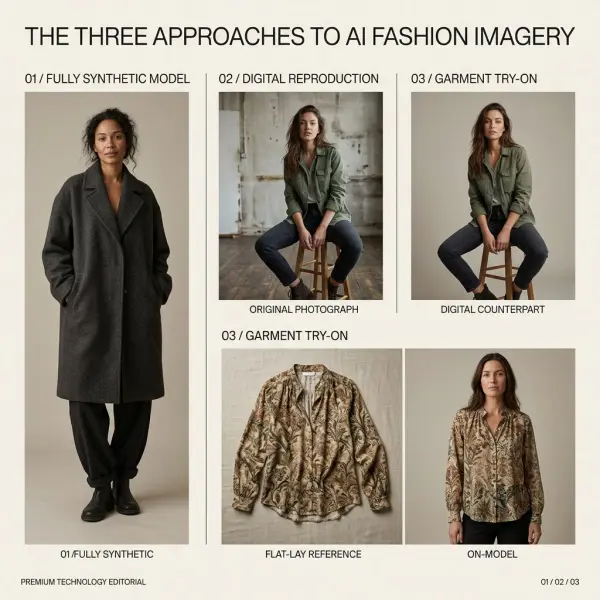
AI-Generated Fashion Models
An AI-generated fashion model is a synthetic human representation created through artificial intelligence. The model may be designed with specific visual characteristics, such as body proportions, hairstyle, skin tone, facial appearance, pose, or styling.
Fashion businesses can use synthetic models to establish a consistent catalog aesthetic or create images for different creative directions. A brand specializing in minimalist workwear, for example, might generate models photographed against neutral studio backgrounds, while a resortwear business may prefer relaxed outdoor settings.
These models do not necessarily represent real people. Nevertheless, businesses should evaluate whether the generated appearance unintentionally resembles an identifiable individual and whether its commercial use complies with applicable rights and platform terms.
Digital Replicas of Real Fashion Models
A digital replica, sometimes described as a digital twin in fashion imagery, is a digitally created representation of an existing person. Unlike an entirely synthetic model, its identity is based on a real human subject.
In July 2025, H&M introduced campaign imagery featuring digital twins of fashion models as part of its exploration of generative AI in fashion communication.
This approach can provide creative continuity between conventional and AI-assisted content. It also introduces contractual considerations involving consent, compensation, permitted modifications, and the continued use of a model's likeness.
An ordinary photography agreement should not automatically be assumed to authorize the creation of a reusable digital replica.
AI-Assisted Garment Visualization
Some AI fashion photography systems focus less on generating an entirely new person and more on digitally placing a garment onto a selected model image.
These systems may use an existing product photograph, a reference model, and information about pose or garment placement to generate a new image. The objective is to preserve the appearance of the clothing while adapting it to the selected human representation.
Research presented at the European Conference on Computer Vision in 2024, including IDM-VTON research on authentic virtual try-on, illustrates how generative image models can be developed specifically to improve garment detail preservation.
Such capabilities are particularly relevant to ecommerce, where clothing identity matters more than unrestricted creative freedom. Even specialized systems, however, require verification before their output is used as commercial product imagery.
How Does AI Fashion Model Photography Work?
AI fashion model photography generally works by combining visual references and creative instructions within an image generation or image-editing system. The system produces an image that attempts to satisfy those inputs while maintaining visual realism.
Many contemporary image generation systems use diffusion-based methods, which learn to construct images through an iterative process of reducing noise. Depending on the system, generation can be guided by text descriptions, garment photographs, model references, masks, or pose information.
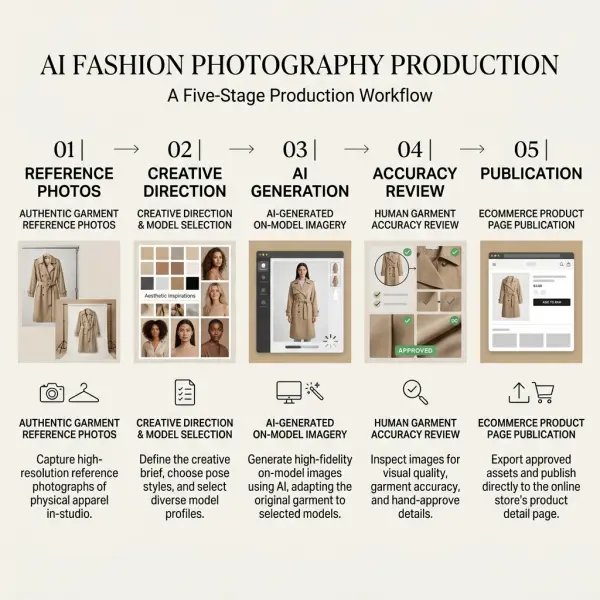
A commercial fashion workflow typically involves several connected stages.
Preparing Garment References
The process should begin with reliable visual documentation of the physical product. Depending on garment complexity, reference materials may include front and back photographs, flat-lay images, ghost mannequin photography, close-up construction details, and fabric photographs.
A plain cotton T-shirt may be sufficiently documented through relatively simple product imagery. A tailored jacket with decorative buttons, contrasting lining, structured shoulders, and unusual lapel construction requires more comprehensive references.
The objective is to provide enough visual information to constrain the AI system. A product description alone cannot reliably communicate every construction detail of an existing garment.
Defining the Creative Direction
Fashion teams establish the intended model appearance, pose, background, lighting, styling, framing, and image composition.
These decisions should reflect the brand's existing visual identity rather than the full range of possibilities offered by the technology. For ecommerce catalogs, consistency across product categories may be more valuable than generating dramatically different images for every garment.
A defined creative template also makes it easier to evaluate whether new images meet established brand standards.
Generating the Model-Based Images
The AI system combines the available inputs to create candidate images. Some tools generate a complete photograph, while others modify specific areas of an existing image using techniques such as masking and inpainting.
Inpainting allows selected regions to be replaced or reconstructed while attempting to retain surrounding visual content. A fashion business might use this technique to modify a background or digitally replace a garment within an authorized model photograph.
Generation may require several iterations before an image satisfies both visual and commercial requirements.
Reviewing and Publishing the Images
Generated images should be compared against authentic product references before they enter the ecommerce content library.
This review is not limited to image aesthetics. It includes product identity, color, garment construction, apparent fit, model representation, commercial rights, and relevant publication requirements.
Approved images can then be assigned to the appropriate product records and distributed through ecommerce websites, marketing campaigns, or other sales channels.
Where Is AI Fashion Photography Used in Ecommerce?
AI-generated model imagery can support several ecommerce content requirements, although its suitability depends on how customers use the image to make purchasing decisions.
A homepage campaign photograph serves a different purpose from a close-up image showing garment stitching. The first primarily communicates brand identity and lifestyle, while the second may provide evidence about product construction.
Fashion businesses should therefore distinguish between visual content designed to inspire customers and content intended to communicate verifiable product attributes.
Product Detail Pages and Online Catalogs
A product detail page (PDP) is the ecommerce page where customers review an individual product, its images, description, available sizes, pricing, and purchasing options.
AI-generated model imagery can supplement these pages by presenting garments within additional styling contexts or providing an on-model view when only basic product photography is available.
For example, a fashion startup selling linen shirts might retain authentic flat-lay and detail photographs while adding generated images that illustrate different outfit combinations.
This approach gives customers additional visual context without making synthetic imagery the only available representation of the product.
Seasonal Campaigns and Digital Lookbooks
Campaign imagery often requires a wider creative range than standard catalog photography. Seasonal collections may need different environments, lighting conditions, poses, and styling concepts.
Generative AI can help businesses explore these visual directions without organizing a separate location shoot for each concept.
In May 2025, Zalando reported its use of AI-generated editorial campaign assets and exploration of digital model replicas. The example demonstrates how generative AI can become part of a larger fashion content production strategy rather than functioning solely as an experimental design tool.
Campaign imagery still requires oversight, particularly when customers can directly purchase the garments shown.
Social Commerce and Digital Advertising
Fashion brands frequently need visual variations for social media campaigns, paid advertising, promotional banners, and marketplace content.
An existing garment image may be adapted into several compositions for different campaign formats or audiences. For a small fashion business, this can provide additional creative material without requiring every variation to be photographed independently.
The main challenge is maintaining continuity. If different advertisements depict noticeably different versions of the same garment, customers may become uncertain about what the brand actually sells.
Wholesale and Collection Presentations
AI-generated model photography can also support business-to-business fashion communication, including digital line sheets, preliminary collection presentations, and wholesale catalogs.
A garment manufacturer may use generated imagery to help prospective buyers visualize styling possibilities for an existing product range.
Where the imagery represents an unproduced garment or an early design concept, it should be clearly distinguished from photography of approved physical samples. Wholesale buyers may otherwise interpret a conceptual visualization as confirmation that the product has already been developed and manufactured.
|
Ecommerce application |
Primary purpose |
Recommended use of AI imagery |
|
Product detail pages |
Communicate product appearance |
Supplement verified product photographs |
|
Collection lookbooks |
Present coordinated fashion styles |
Generate additional editorial compositions |
|
Digital advertising |
Attract attention and communicate offers |
Create approved campaign variations |
|
Social commerce |
Support discovery and styling inspiration |
Develop channel-specific visual content |
|
Wholesale catalogs |
Present products to retail buyers |
Illustrate verified products or clearly identified concepts |
|
Homepage banners |
Communicate brand and collection identity |
Explore controlled lifestyle imagery |
Why AI Fashion Photography Matters for Fashion Businesses
The primary business value of AI fashion model photography lies in content production flexibility. It can help fashion businesses generate additional visual assets from existing product documentation, provided that the output remains accurate enough for its intended commercial use.
This is particularly relevant when the demand for ecommerce imagery exceeds the capacity of a conventional photography workflow.
Expanding Content Production Capacity
Consider a fashion retailer introducing 100 new stock keeping units (SKUs) across multiple product categories. Each SKU may require a primary product photograph, several supporting images, and additional promotional assets.
As the catalog expands, the workload involves more than photography itself. Product samples must be organized, images must be reviewed and edited, and approved assets must be assigned to the correct product records.
AI can help expand the number of visual assets produced from a limited set of source photographs. The actual efficiency gain depends on how much manual correction, regeneration, and quality verification each image requires.
Supporting Smaller Fashion Businesses
Independent fashion brands often operate with tighter content production budgets than established retailers. Hiring a model, photographer, stylist, and studio for every minor collection update may be commercially impractical.
AI-assisted photography offers an additional production option between basic product photography and a fully organized campaign shoot.
It does not eliminate the need for strong visual references or creative expertise. Instead, it can allow a smaller team to allocate its photography budget toward essential product documentation while using generative tools to extend the resulting content.
Maintaining Visual Consistency Across Collections
Fashion ecommerce catalogs benefit from consistent lighting, framing, image dimensions, background treatments, and model presentation.
AI systems can support this objective when businesses use established visual templates and controlled creative instructions. A retailer might standardize catalog poses and background colors, for example, while allowing greater creative variation in campaign imagery.
Consistency is not an automatic feature of generative AI. Without suitable reference controls and review procedures, independently generated images may introduce inconsistent model identities, garment proportions, or photographic aesthetics.
Reducing Dependence on Repeated Physical Production
Traditional photoshoots remain valuable for documenting actual garments, capturing fabric behavior, and establishing authentic brand imagery. Nevertheless, not every subsequent visual variation necessarily requires another full production session.
A hybrid workflow allows businesses to retain original photography while using AI to develop approved derivatives or additional creative compositions.
The broader operational and financial trade-offs are explored in Virtual Fashion Models vs Traditional Photoshoots.
Building an AI-Assisted Fashion Content Workflow
For most fashion businesses, successful implementation requires more than subscribing to an image generation platform. The technology needs to fit into the existing relationship between product development, merchandising, creative production, and ecommerce operations.
A useful starting point is a hybrid production model in which authentic product documentation remains the foundation.
Establish an Authoritative Product Image Library
Every product should have an identifiable set of approved source materials.
These may include original photography, garment specifications, color references, fabric close-ups, and sample approval documentation. Product teams should ensure that these references correspond to the actual version being offered for sale.
This becomes especially important when a garment undergoes changes between sampling and bulk production. AI-generated content based on an earlier prototype may communicate details that no longer exist in the finished product.
Classify Images by Commercial Purpose
Not all fashion images require the same level of visual control. Businesses can organize their content into three broad categories.
|
Image category |
Commercial purpose |
Production recommendation |
|
Product evidence |
Show verifiable garment attributes |
Prioritize authentic photography |
|
Supplementary visualization |
Illustrate styling and wearing possibilities |
Use AI with product-level verification |
|
Creative campaign content |
Communicate mood, lifestyle, and brand direction |
Allow broader creative freedom within approved boundaries |
This distinction prevents marketing objectives from overriding product accuracy. A creative campaign may allow flexibility in its background and composition, but it should not introduce misleading characteristics into a garment that customers can purchase.
Introduce a Formal Approval Process
AI-generated content should pass through an approval process before publication, just as conventional fashion photography normally undergoes selection, editing, and merchandising review.
The approval team should include someone familiar with the physical garment. A creative professional may recognize composition problems but overlook a missing dart, altered pocket opening, or inaccurate collar construction.
The level of review should reflect the complexity of the product and the commercial importance of the image.
Connect Approved Images to Product Information Systems
Fashion businesses managing larger catalogs may benefit from connecting AI-generated imagery with existing Product Information Management (PIM) or Digital Asset Management (DAM) systems.
A PIM system organizes product information, while a DAM system manages digital assets such as photographs, graphics, and videos.
Within this workflow, businesses can associate generated images with the correct SKU, colorway, product version, approval status, and usage restrictions. Maintaining these associations helps prevent an approved image from being accidentally assigned to the wrong garment.
What Are the Limitations of AI Fashion Model Photography?
AI fashion model photography can produce convincing images, but visual realism should not be confused with physical accuracy. Generative systems may reconstruct garment details based on learned visual patterns rather than reproduce the actual characteristics of a specific product.
Research into faithful latent diffusion models for virtual try-on identifies the preservation of garment characteristics, including patterns, style, and text, as a technical challenge in image generation.
For ecommerce businesses, the most important limitations include the following:
- Garment construction: Seams, buttons, pockets, closures, and decorative elements may be altered or omitted.
- Fabric appearance: Surface texture, transparency, sheen, and apparent material weight may differ from the actual garment.
- Fit and proportions: A generated image may present a more flattering or differently proportioned silhouette than the physical product.
- Visual continuity: Separately generated images may depict inconsistent garment or model characteristics.
- Product color: Generated lighting and image processing may introduce changes that are not present in the approved colorway.
These limitations do not make AI imagery unsuitable for ecommerce. They establish the need for appropriate production controls and clear boundaries between creative visualization and verified product representation.
A detailed garment-specific review approach is discussed in How Fashion Brands Can Maintain Product Accuracy in AI-Generated Images.
AI-Generated Images Are Not Physical Fit Tests
An AI-generated photograph may illustrate how clothing could appear on a selected body shape, but it does not necessarily establish how the actual garment will fit a customer.
Physical fit depends on garment measurements, ease allowances, fabric stretch, body dimensions, pattern construction, and individual wearing preferences.
Even specialized virtual try-on systems have limitations. Google's virtual try-on documentation explicitly distinguishes generated clothing visualization from a determination or guarantee of actual garment fit.
Fashion businesses should retain reliable size charts, garment measurements, fit descriptions, and physical sample testing independently of generated model imagery.
Commercial Rights, Transparency, and Customer Trust
AI fashion photography introduces commercial responsibilities involving both the garment being represented and the people depicted in the image.
Fashion businesses should not assume that access to an image generation tool automatically grants unrestricted rights to every generated asset. Commercial usage may depend on the provider's terms, the source imagery, contractual permissions, and applicable intellectual property or personality rights.
Model Consent and Image Usage Rights
When AI imagery is based on a real person, the business should obtain appropriate authorization for the intended digital use.
Relevant contractual considerations may include:
- Permission to create and modify digital representations.
- Authorized product categories and advertising contexts.
- Usage duration, geographic territories, and sales channels.
- Compensation arrangements and restrictions on reuse.
- Procedures for handling withdrawal or expiration of rights.
A digital model can potentially be reused across campaigns in ways that differ significantly from an ordinary photoshoot. Contracts should therefore address these additional capabilities explicitly rather than relying on assumptions about conventional photography rights.
AI Disclosure and Platform Requirements
Disclosure requirements can vary according to jurisdiction, sales channel, and the nature of the generated content.
For example, Google Merchant Center's AI-generated content requirements specify that images created using generative AI must include appropriate digital source metadata, including the relevant International Press Telecommunications Council (IPTC) classification.
Businesses distributing content through multiple ecommerce platforms should verify the requirements of each destination. Image processing and export workflows should also be checked to ensure that required metadata is not inadvertently removed.
Disclosure, however, is not a substitute for product accuracy. Identifying an image as AI-generated does not make a materially misleading representation acceptable.
Responsible Representation of Fashion Customers
Generative AI allows businesses to explore different model appearances, body types, age groups, and styling directions. Used thoughtfully, this can broaden the range of people represented in fashion communication.
The underlying product offering must support that representation. Showing a garment on a wider range of body types should not imply that corresponding sizes or fit characteristics are available when they have not been developed or verified.
Inclusive imagery is most credible when it reflects genuine product accessibility, appropriate sizing, and realistic garment behavior.
Common Mistakes Fashion Businesses Make with AI Model Photography
Mistaking Photorealism for Product Accuracy
A generated photograph may appear professional while depicting a garment that differs from the original product. This happens because generative systems can prioritize a visually coherent image over exact reconstruction of commercial product details.
Publishing such imagery without product review can create inaccurate customer expectations. Approval should therefore depend on both photographic quality and correspondence with the physical garment.
Generating Product Images from Text Alone
Text prompts can describe a garment category, color, and general style, but they rarely capture every detail of a specific commercial product.
A prompt describing a white cotton blouse may generate an attractive blouse that contains different buttons, seams, sleeve proportions, or neckline construction from the item being sold. Businesses should use authentic product references whenever the image is intended to represent an existing SKU.
Replacing Authentic Product Photography Entirely
Some businesses may be tempted to eliminate conventional photography because AI-generated images appear sufficient for online presentation.
This creates difficulties when customers need to examine material details, construction features, or the actual appearance of the finished garment. Without authentic reference photographs, internal teams also lose an important basis for evaluating generated content.
A hybrid approach preserves reliable product documentation while allowing AI to expand the available visual assets.
Failing to Establish Brand-Specific Visual Standards
Generating images independently for each product can produce inconsistent backgrounds, model appearances, lighting, and photographic styles.
The resulting catalog may lack the visual continuity expected from a recognizable fashion brand. Establishing approved templates, creative guidelines, and model representation standards helps maintain consistency as content production expands.
Measuring Efficiency Only by Image Generation Speed
An AI tool may generate an image quickly, but production efficiency must include the entire workflow.
Reference preparation, rejected outputs, manual correction, commercial rights review, image approval, and publication can all contribute to the final production cost. Businesses should measure the cost and time required per approved, commercially usable image rather than focusing exclusively on generation speed.
How Fashion Brands Can Introduce AI Photography Strategically
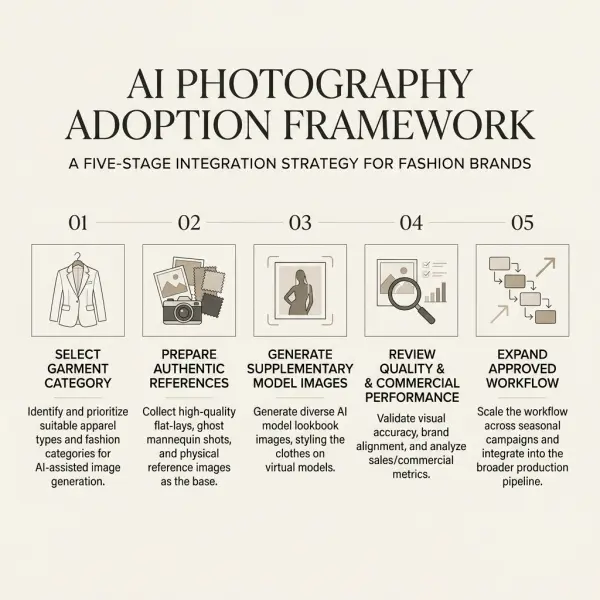
Fashion businesses do not need to adopt AI-generated model imagery across their entire catalog immediately. A controlled pilot provides a more reliable basis for evaluating whether the technology supports existing commercial objectives.
Begin with a relatively straightforward product category, such as basic T-shirts or simple shirts, for which the business already has reliable product photography and specifications. Generate a limited number of supplementary model images and compare the results with the established content production workflow.
Useful performance indicators include:
- Production time per approved image.
- Total cost per approved image, including review and correction.
- Percentage of generated images accepted without significant revision.
- Consistency across products and colorways.
- Customer feedback about product representation.
- Conversion rates and returns associated with appearance or fit expectations.
Conversion and return metrics should be interpreted carefully. Pricing, promotions, product availability, seasonality, and customer acquisition sources can influence these outcomes independently of product imagery.
Where practical, controlled A/B testing can help assess the contribution of different image formats. Businesses should expand implementation only when the generated content meets established quality standards and provides a measurable operational or commercial benefit.
Frequently Asked Questions
Can AI fashion photography be created without a physical garment sample?
Yes, generative AI can create conceptual fashion images without a physical sample, provided that sufficient visual or descriptive instructions are available. Fashion designers may use this capability during early collection development to explore silhouettes, color combinations, and campaign directions.
The limitation arises when the image is presented as an existing commercial product. Without a physical sample or other validated product information, there is no reliable basis for confirming construction details, material appearance, or fit. Conceptual AI imagery is therefore better suited to creative development and clearly identified preliminary presentations than to definitive product listings.
Is AI fashion model photography the same as virtual try-on?
No. AI fashion model photography primarily produces visual assets for commercial communication, while virtual try-on focuses on helping users visualize clothing on a selected model or their own image. Some technologies overlap because both involve digitally representing garments on human bodies.
Their business purposes differ. Fashion photography supports catalogs, campaigns, and merchandising, whereas virtual try-on supports product exploration and individualized visualization. An ecommerce business may use both capabilities, but neither should be assumed to provide a verified physical fit assessment unless the underlying system has been specifically designed and validated for that purpose.
Can AI generate the same fashion model across an entire collection?
Yes, some AI systems support recurring model identities through reference-based generation, identity controls, customized models, or digital replicas. These capabilities can help fashion brands establish greater visual continuity across catalogs and seasonal collections.
Maintaining identity across different poses, lighting conditions, clothing categories, and image compositions remains a production challenge that varies between technologies. Fashion businesses should test consistency across representative products before committing to a recurring model. When the recurring identity is based on a real individual, the company should also ensure that its authorization covers repeated generation and the intended commercial applications.
Is AI fashion photography suitable for luxury fashion brands?
AI photography can be suitable for selected luxury fashion applications, particularly creative exploration, digital campaign concepts, and supplementary editorial imagery. Its suitability depends on the brand's positioning, aesthetic standards, customer expectations, and ability to preserve product characteristics.
Luxury garments may feature distinctive embroidery, proprietary patterns, specialist tailoring, or materials whose appearance contributes significantly to their value. These characteristics can be difficult to reproduce faithfully through generative systems. Luxury brands should therefore apply particularly careful product and creative review when synthetic imagery depicts merchandise being offered for sale, rather than assuming that visual sophistication establishes commercial suitability.
Can AI-generated fashion photography reduce product returns?
AI-generated photography may contribute to lower returns if it provides customers with additional accurate information about a garment. However, there is no universal guarantee that adopting this technology will reduce return rates.
If generated imagery creates unrealistic expectations about fit, fabric, color, or garment proportions, it could instead contribute to customer dissatisfaction. The effect should be evaluated through actual business data, with attention to return reasons such as incorrect size, unexpected appearance, and product quality concerns. Fashion retailers should assess these outcomes alongside conversion performance rather than treating increased engagement as sufficient evidence of success.
What should fashion businesses look for in an AI photography platform?
Fashion businesses should prioritize garment reference controls, image consistency, commercial usage terms, editing capabilities, and the quality of outputs generated from their own product categories.
A platform demonstration featuring simple clothing may not reveal how the system handles patterned fabrics, transparent materials, decorative trims, or structured tailoring. Businesses should test representative garments and evaluate the frequency of corrections and rejected images. Other relevant considerations include source image confidentiality, data retention policies, export quality, metadata preservation, and integration with existing content management systems. The strongest platform for a particular business is the one that reliably supports its actual production requirements.
Conclusion
AI fashion model photography offers fashion ecommerce businesses another way to produce commercially useful visual content. Its value lies in the ability to extend existing product imagery, explore creative directions, and develop supplementary assets without requiring a separate physical production session for every visual variation.
The technology is most useful when businesses maintain a clear distinction between verified product documentation and generated visualization. Authentic garment references, appropriate commercial rights, consistent creative standards, and human quality review remain essential components of a responsible production workflow.
For fashion brands, the objective should not simply be to generate more images at greater speed. It should be to produce visual content that helps customers understand products, supports purchasing decisions, and strengthens confidence in the brand.
As generative imaging technologies develop, the ability to combine creative flexibility with reliable product representation is likely to become an increasingly valuable capability within fashion ecommerce operations.


Comments 0
Leave a CommentSend Comment
Anda harus Login terlebih dahulu untuk dapat memberikan komentar.