
Why Personal Style Matters More Than Fashion Trends
Quick Answer
Personal style matters more than fashion trends because it creates continuity, clarity, and relevance beyond a single season. Trends are useful signals. They show what is gaining visibility in the market, what consumers are noticing, and how fashion culture is moving. But trends do not automatically translate into meaningful wardrobe value.
Personal style works differently. It connects clothing choices to identity, lifestyle, comfort, confidence, culture, and practical use. A trend may attract attention, but personal style determines whether a garment becomes part of someone’s real wardrobe. This is why a customer may admire a trend online but never buy it, or buy it once and rarely wear it.
For fashion businesses, the strategic lesson is not to ignore trends. It is to filter them through the customer’s personal style needs. Brands that understand personal style can build stronger assortments, clearer merchandising, better product relevance, and deeper customer trust. Trends create movement. Personal style creates meaning. The strongest fashion businesses know how to work with both, without allowing trend noise to replace brand clarity.
Personal Style and Fashion Trends Are Not Opposites
The phrase “personal style matters more than fashion trends” can easily be misunderstood. It does not mean trends are irrelevant. Fashion has always moved through cycles of novelty, imitation, reinterpretation, resistance, and revival. Trends help create energy in the market. They can introduce new silhouettes, refresh familiar categories, and give consumers a reason to look again.
The problem begins when trends become the entire strategy.
Personal style and trends serve different roles. Trends are external signals. Personal style is an internal filter. A trend may suggest that red accessories, sheer layering, oversized tailoring, metallic finishes, or ballet-inspired details are gaining attention. Personal style determines whether those ideas belong in a person’s wardrobe or a brand’s assortment.
For consumers, this filter protects against impulse buying. For brands, it protects against scattered product development. A trend that looks compelling in social content may not fit the brand’s customer, price point, climate, modesty needs, quality expectations, or wardrobe habits. Without a personal style filter, trend adoption can become reactive rather than strategic.
The earlier article, how personal style evolves over time, explains how style changes through life stages and identity shifts. The second article, building a signature style without following every trend, focuses on creating a recognizable style direction. This article completes the cluster by explaining why that style clarity often creates more durable value than trend-chasing alone.
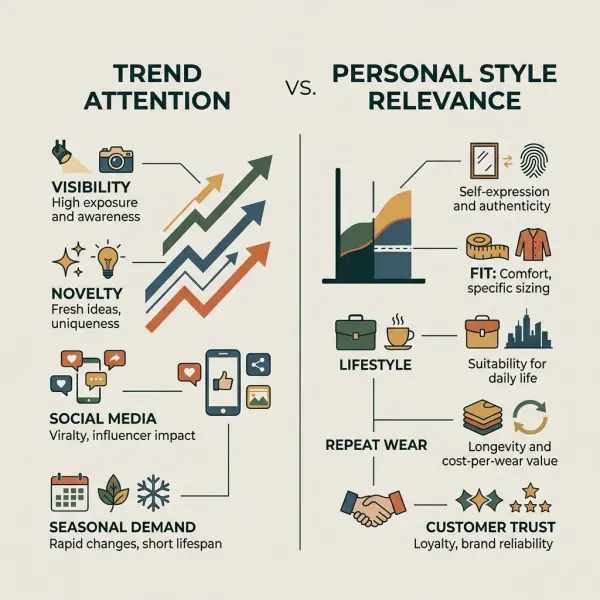
Why Trends Attract Attention but Personal Style Builds Relevance
Trends are powerful because they are visible. They appear in runway coverage, retail edits, creator content, celebrity dressing, street style, search behavior, and social media recommendations. This visibility can make a trend feel urgent, even when its actual relevance to a specific customer is limited.
Personal style is quieter, but it has a stronger relationship with long-term wardrobe behavior. A customer may be drawn to a trend because it feels current, but she is more likely to keep wearing a garment when it fits her proportions, lifestyle, confidence, and identity. This difference matters commercially. Attention can create traffic. Relevance creates repeat use.
Academic discussion of personal clothing style and self-concept supports the idea that clothing style is connected to self-expression and how people understand themselves. That does not mean every outfit is a deep psychological statement. Many clothing choices are practical, routine, or budget-driven. Still, personal style often carries meaning beyond surface aesthetics.
For brands, this means the most commercially useful question is not simply, “What is trending?” A better question is: “Which trend, if any, helps our customer dress more like herself in the life she actually lives?”
That shift changes the quality of fashion decision-making.
Personal Style Helps Customers Make Better Wardrobe Decisions
A strong sense of personal style reduces decision fatigue. When customers understand what works for them, they can evaluate new products more clearly. They know which colors they actually wear, which silhouettes make dressing easier, which fabrics feel right, and which details do not fit their lifestyle.
This does not make fashion less creative. It makes creativity more usable.
A customer with personal style clarity may still experiment, but the experimentation becomes more selective. She may try a new proportion while keeping her preferred color palette. She may adopt a statement accessory without changing her whole wardrobe. She may explore a trend through one piece that integrates with items she already owns.
This is where personal style creates practical wardrobe intelligence. It helps customers avoid three common problems: buying for fantasy life, buying for temporary pressure, and buying items that do not connect with anything else in the closet.
For fashion businesses, this has direct implications for product communication. Instead of presenting every product as a must-have trend, brands can help customers understand how a garment fits into existing wardrobes. A product page, editorial article, email campaign, or retail display can explain:
- what kind of wardrobe the piece supports;
- which existing pieces it pairs with;
- how it changes an outfit without requiring a full aesthetic reset;
- which lifestyle contexts it suits best;
- what type of customer may find it useful;
- when the trend interpretation may not be practical.
This kind of communication respects the customer’s judgment. It also reduces the gap between inspiration and real use.
Personal Style Creates Stronger Brand Trust
For fashion brands, personal style matters because trust is often built through consistency. Customers return to brands that help them feel understood. They may trust a brand because the fit is reliable, the styling language is familiar, the colors integrate with previous purchases, or the brand consistently solves a wardrobe problem.
Trend-led brands can generate excitement, but excitement alone is difficult to sustain. If the brand changes identity too often, customers may enjoy the content but hesitate to buy. They may wonder whether the product will still feel relevant next season. They may also struggle to understand what the brand stands for.
A personal-style-led brand creates a clearer relationship. It does not need to be boring, minimalist, or classic. It simply needs a coherent point of view. A romantic brand can have personal style clarity. A maximalist brand can have it. A streetwear brand can have it. A modest fashion brand can have it. A luxury tailoring brand can have it.
The commercial value comes from recognition. When customers can recognize the brand’s style logic, they can more easily decide whether it belongs in their own lives.
This is especially important in crowded markets. Many brands can sell a trend. Fewer brands can make that trend feel specific, wearable, and emotionally aligned with a defined customer.
Trend-Chasing Can Create Operational Risk
Trend-chasing is not only a creative risk. It is an operational risk.
When a fashion business reacts too quickly to every visible trend, it may increase assortment complexity, sampling pressure, production uncertainty, markdown exposure, and inventory fragmentation. A trend that looks strong in social media content may not justify deep inventory if it does not align with customer demand, size curves, climate, occasion needs, or price expectations.
This does not mean brands should move slowly. In some categories, speed is commercially important. But speed without a clear filter can create waste, confusion, and unnecessary cost.
A trend-led assortment may create several operational problems:
- too many small product stories competing for attention;
- inconsistent fit and quality because development is rushed;
- unclear visual merchandising because the assortment lacks cohesion;
- higher return risk when trend imagery overpromises real-life wearability;
- markdown pressure when trend demand peaks quickly;
- weaker customer retention because the brand lacks continuity.
These risks vary by business model. A fast-fashion retailer, contemporary label, boutique brand, modestwear company, manufacturer, or multi-brand retailer will not manage trends in the same way. The point is not to reject trend participation. The point is to match trend adoption to operational capability and customer relevance.
Personal style creates discipline. It helps a brand decide which trends are worth developing, which should be interpreted lightly, and which should be left alone.
Personal Style Supports Better Product Development
Product development becomes stronger when teams design for real wardrobes, not only visual moments.
A trend may provide the starting point, but personal style should shape the final product. That means design teams need to ask how a garment will be worn, repeated, layered, cared for, and combined with existing items. A dramatic piece may work beautifully for campaign imagery but fail commercially if customers cannot integrate it into their lives.
This is where personal style becomes technical. It affects fabric selection, fit blocks, garment construction, color planning, trim decisions, and size inclusivity. A brand serving refined everyday dressing may need fabrics that hold shape but remain comfortable. A brand serving modest fashion may need coverage, opacity, breathability, and layering logic. A brand serving travel wardrobes may need wrinkle resistance, versatility, and easy care. These are product realities, not abstract style ideas.
A product can still feel current without being trend-dependent. For example, a brand may update a core trouser through a slightly wider leg, a seasonal color, or a new fabric texture. The piece feels fresh, but it still belongs to the customer’s wardrobe logic.
That is the difference between trend decoration and style-driven development.

Personal Style Makes Merchandising More Useful
Merchandising often fails when it presents products as isolated items. Customers rarely dress that way. They think in outfits, occasions, moods, comfort needs, and social situations. Personal style helps merchandising become more useful because it organizes products around how people actually dress.
A trend-focused merchandising story may say: “These are the season’s key pieces.” A personal-style-focused story goes further: “Here is how these pieces fit into your wardrobe, your workday, your weekend, your climate, your existing color palette, or your preferred level of expression.”
This is a more editorial form of selling. It is also more service-oriented.
For example, a retailer selling a trending satin skirt could present it as a seasonal must-have. But a stronger approach might show different personal style interpretations: polished office styling with a knit and blazer, relaxed weekend styling with a cotton shirt, modest styling with long layers, evening styling with a refined top, or travel styling with flat shoes and a lightweight jacket.
The product stays the same. The relevance changes.
This approach also supports AI search and guided shopping because it answers intent-rich questions. Customers are increasingly searching and browsing through contextual needs: how to style, what to wear to, what works with, how to build, how to choose. Personal style content gives brands more meaningful language than trend labels alone.
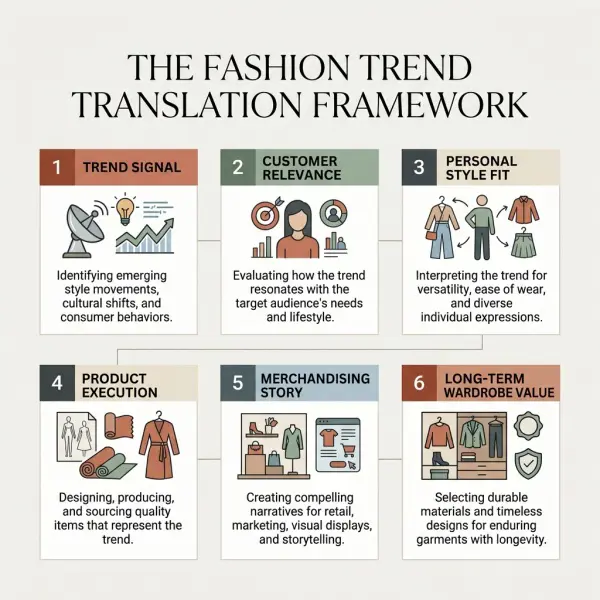
Trends Still Matter, but They Need Translation
Trends matter because they reflect movement in the fashion conversation. They can point to changing aesthetics, consumer curiosity, cultural mood, and emerging demand. A brand that ignores trends completely may become disconnected from market energy.
The issue is that trends need translation.
A runway trend, a TikTok aesthetic, a celebrity look, a street style detail, and a retail bestseller are not the same thing. They operate at different levels of influence. Some trends remain editorial. Some become social media moments. Some translate into commercial categories. Some only work in specific climates, price points, age groups, or cultural settings.
A disciplined brand should classify trends before acting on them:
- Signal trend: useful for observing cultural direction, but not yet product-ready.
- Styling trend: useful for content, merchandising, or campaign styling.
- Detail trend: useful as trim, color, print, finish, or accessory update.
- Category trend: strong enough to influence buying or production.
- Core shift: a deeper change in silhouette, lifestyle, or wardrobe behavior.
This distinction prevents overreaction. Not every trend needs inventory. Some trends are better handled through styling. Some can update core products. Others should remain inspiration only.
Personal style gives the translation process a center. Without it, the brand may chase visibility without building value.
Personal Style Has Emotional and Psychological Value
Personal style also matters because clothing can influence how people feel in social and professional situations. This should be discussed carefully. A garment does not guarantee confidence, authority, beauty, success, or belonging. Those claims would be exaggerated. But clothing can contribute to how people prepare themselves, present themselves, and experience certain roles.
The concept of enclothed cognition suggests that clothes may affect psychological processes through both symbolic meaning and the physical experience of wearing them. This does not mean every clothing effect is universal. Cultural meaning, personal association, garment comfort, and context all matter.
Research on fashion as self-expression also supports the idea that fashion can function as a vehicle for expressing self-concept, brand affinity, and social meaning. For industry readers, the practical takeaway is simple: customers often buy more than fabric and shape. They buy alignment.
A blazer may feel like preparedness. A flowing dress may feel like ease. A sharp shoe may feel like authority. A familiar neutral palette may feel calm. A bold accessory may feel like visibility. These meanings are not fixed for every person, but they are commercially important because they influence what customers keep reaching for.
Trends can provide novelty. Personal style provides emotional continuity.
Common Mistakes Brands Make When Prioritizing Trends Over Style
One mistake is assuming that trend visibility equals customer demand. A trend may dominate feeds and still convert poorly for a specific customer base. Visibility can be inflated by creators, editorial coverage, celebrity moments, or algorithmic repetition. Brands need to test whether the trend fits their own audience before committing deeply.
Another mistake is treating every trend as a product opportunity. Some trends are better expressed through styling, content, visual merchandising, or accessories. Turning every visible aesthetic into inventory can make assortments noisy and difficult to manage.
A third mistake is weakening brand codes to appear current. When a brand abandons its recognizable style language too quickly, it may attract temporary attention while confusing loyal customers. This is especially risky for brands built around trust, fit, modesty, quality, or wardrobe reliability.
Brands also make the mistake of using trend language when customers need style guidance. A customer may not care that a silhouette is “on trend.” She may care whether it works for her body, whether it pairs with her existing wardrobe, whether it is appropriate for work, and whether it can be worn more than once.
The better approach is not anti-trend. It is style-first. Trends are evaluated through customer relevance, brand identity, product capability, and long-term wardrobe use.
What This Does Not Mean
Saying personal style matters more than fashion trends does not mean every brand should become timeless, minimalist, slow, or neutral. That would be a shallow interpretation.
Some customers love high novelty. Some brands are built around experimentation. Some fashion categories depend on rapid aesthetic shifts. Occasionwear, youth fashion, streetwear, creator-led labels, and accessories can all benefit from trend responsiveness. In these markets, trends may be a major driver of discovery and sales.
The point is context. Even highly trend-responsive brands need a point of view. Otherwise, they become interchangeable.
Personal style also does not mean ignoring culture. A style that never absorbs new influence can become stale. Customers evolve, markets shift, and visual language changes. The strongest style strategies allow movement while keeping identity intact.
For businesses, this means personal style should be treated as a strategic filter, not a rigid rulebook. It helps brands decide what to adopt, what to reinterpret, what to delay, and what to reject.
How Fashion Businesses Can Apply This Strategically
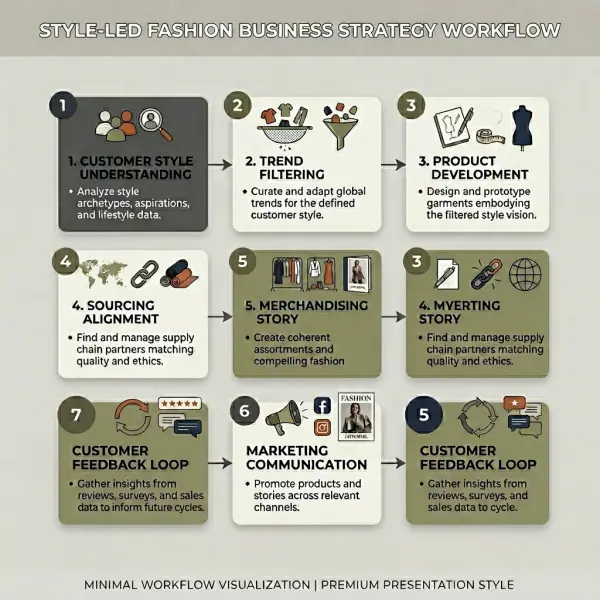
Fashion businesses can apply this insight by shifting from trend reaction to style-led decision-making. The goal is not to remove trend analysis. The goal is to make trend analysis more useful.
A practical process begins with defining the customer’s style world. This includes not only age or price point, but lifestyle, occasion needs, fit expectations, cultural context, comfort boundaries, aesthetic preferences, and emotional drivers. A brand selling to professional women, modest dressers, creative entrepreneurs, students, or mature consumers will filter trends differently.
From there, teams can connect personal style to business operations:
- Product development: design trend updates that fit the customer’s wardrobe logic.
- Sourcing: select materials that support actual use, not only campaign appearance.
- Manufacturing: protect fit, construction, and quality consistency in repeat categories.
- Retail merchandising: build outfit stories around customer needs and style transitions.
- Marketing: explain how products support identity, lifestyle, and confidence without exaggerated promises.
- CRM: recommend products based on style continuity and wardrobe compatibility.
- Risk management: avoid overbuying short-cycle trends that do not match customer behavior.
- Content strategy: publish style education, not just trend announcements.
This approach helps brands become more useful. A customer does not only need to know what is new. She needs to know what is worth adding, how to wear it, and whether it belongs in her life.
What Brands Should Verify Before Acting
Before shifting strategy, brands should verify whether personal style is actually driving customer behavior in their category. Not every purchase is deeply identity-based. Some are driven by price, urgency, availability, weather, occasion, or promotion. A responsible strategy should account for this.
Brands should examine customer behavior across several signals:
- repeat purchase patterns;
- return reasons;
- products with low return rates and high repeat styling;
- customer reviews mentioning fit, confidence, comfort, versatility, or identity;
- styling questions from shoppers;
- wishlists and saved items;
- abandoned carts for trend-led products;
- performance differences between campaign-led and wardrobe-led merchandising;
- customer interviews or retail associate feedback.
These signals help separate real personal style relevance from assumptions. A brand may believe customers love bold seasonal pieces, but data may show that core wardrobe items drive loyalty. Another brand may assume customers want basics, while social engagement and sell-through show demand for expressive styling.
The best decisions come from combining creative judgment, customer insight, and operational data. Personal style is qualitative, but it can still be studied through behavior.
FAQ
Why does personal style matter more than fashion trends?
Personal style matters more because it determines whether clothing becomes useful, meaningful, and repeatable in real life. Trends can create attention, but personal style shapes actual wardrobe adoption. A customer may notice a trend online but only buy or keep it if it fits her identity, lifestyle, body, comfort level, and existing wardrobe. For brands, this means personal style is often more relevant to retention and trust than trend participation alone. Trends can support discovery, but style creates continuity.
Should fashion brands stop following trends?
No. Fashion brands should not ignore trends. Trends provide useful information about cultural mood, market visibility, consumer curiosity, and product opportunities. The issue is how trends are used. A brand should filter trends through its customer, brand identity, price point, product capability, and merchandising strategy. Some trends deserve product development. Others are better used in styling, content, accessories, or visual storytelling. The strongest brands usually translate trends rather than copy them directly.
How does personal style affect buying behavior?
Personal style affects buying behavior by shaping what customers consider relevant. It influences which colors feel wearable, which silhouettes feel natural, which fabrics feel comfortable, and which products seem worth the investment. It also affects repeat wear. A customer may buy a trend once, but she is more likely to return to products that support her personal style consistently. For businesses, this means product relevance should be measured beyond first purchase. Repeat use, low returns, and customer satisfaction often reveal stronger style alignment.
Is personal style only important for premium fashion brands?
No. Personal style matters across price levels, although it appears differently by segment. In premium fashion, it may involve quality, fit, design codes, and long-term wardrobe value. In mass-market fashion, it may involve accessible styling, trend filtering, size availability, and outfit guidance. In modest fashion, it may involve coverage, layering, fabric opacity, and elegance. In streetwear, it may involve cultural identity and subcultural belonging. Personal style is not limited to luxury. It is about relevance.
Can trend-led brands still build customer loyalty?
Yes, but they need a recognizable point of view. A trend-led brand can build loyalty if customers understand its taste, energy, styling language, and product promise. The risk comes when the brand changes direction so often that it becomes interchangeable. Even brands that move quickly need consistency in fit, quality, attitude, visual identity, or community connection. Loyalty does not require timeless design, but it does require a reason for customers to return beyond whatever trend is currently visible.
How can brands balance trends and personal style?
Brands can balance trends and personal style by treating trends as inputs, not instructions. First, they need to define the customer’s style world. Then they can evaluate whether a trend supports that world. A trend may be adapted through color, proportion, fabric, accessory styling, or one key category instead of a full collection shift. The goal is to keep the brand current without making it feel unstable. Good trend adoption should make the customer’s style feel refreshed, not replaced.
What is the biggest risk of prioritizing trends over personal style?
The biggest risk is losing relevance after the initial attention fades. A trend-first product may attract clicks or social engagement, but if it does not fit the customer’s real wardrobe, it may lead to low repeat wear, returns, markdowns, or weak loyalty. For brands, over-prioritizing trends can also fragment assortment planning and dilute brand identity. The better strategy is to use trends selectively and connect them to clear customer needs, product quality, and long-term style value.
Conclusion
Personal style matters more than fashion trends because it is closer to how people actually live with clothing. Trends create signals. Personal style creates selection. Trends bring freshness. Personal style brings coherence. Trends can start desire, but personal style often decides whether that desire becomes a meaningful purchase.
For fashion businesses, this distinction is not philosophical. It is operational. It affects product development, sourcing, merchandising, marketing, inventory planning, customer retention, and brand positioning. A trend may help a brand enter the conversation, but personal style helps it stay useful in the customer’s life.
The strongest fashion strategies do not reject trends. They translate them. They understand the customer deeply enough to know which fashion signals deserve attention and which are only noise. That is where long-term style value is built: not in chasing every new look, but in helping customers dress with more clarity, confidence, and relevance.




Comments 0
Leave a CommentSend Comment
Anda harus Login terlebih dahulu untuk dapat memberikan komentar.