

Fashion PLM Software Explained for Apparel Businesses
Quick Answer
Fashion Product Lifecycle Management software, commonly called fashion PLM software, is a digital system that organizes product information, workflows, responsibilities, and decisions throughout apparel development. It typically connects collection briefs, style records, technical drawings, bills of materials, colorways, measurements, costing, samples, approvals, supplier communication, and production handoffs in one structured environment.
The central value of PLM is not simply storing files. It is controlling which product information is current, who may change it, what still requires approval, and how a decision affects the rest of the development process. For an apparel company managing many styles, variants, suppliers, or seasonal deadlines, this structure can reduce version confusion and repetitive data entry.
PLM does not replace Enterprise Resource Planning, Product Information Management, creative judgment, or supplier relationships. Its usefulness depends on data quality, process discipline, integration, user adoption, and whether the platform matches the company’s actual product-development model. A smaller brand with a limited assortment may still work effectively with disciplined templates, while a growing business may need PLM once spreadsheets and email no longer provide adequate control.
IBM describes Product Lifecycle Management as an approach that integrates people, product data, processes, and business systems across the product lifecycle. Fashion-specific platforms adapt that principle to the way apparel, footwear, and accessories are designed, sourced, sampled, costed, approved, and prepared for production. IBM’s overview of Product Lifecycle Management

What Is Fashion PLM Software?
Fashion PLM software is a category of business technology designed to manage apparel-related product information and development processes from early concept through production readiness and, depending on the platform, later lifecycle activities.
The word “lifecycle” can be misleading when interpreted too literally. In many apparel businesses, the most intensively used part of PLM is the pre-production lifecycle: planning a range, developing a style, selecting materials, building the technical specification, reviewing samples, confirming cost, and releasing approved information to suppliers or operational systems.
Fashion PLM therefore sits between creative development and commercial execution. It translates a designer’s concept into structured information that product developers, technical designers, merchandisers, sourcing teams, suppliers, quality teams, and production personnel can act upon.
A general manufacturing PLM system may organize engineering drawings, configurations, parts, and change orders. A fashion-oriented system must additionally understand entities such as:
- Seasons, drops, capsules, and collections
- Styles, colorways, and size ranges
- Fabrics, trims, labels, packaging, and components
- Technical sketches and garment construction details
- Bills of materials
- Points of measurement and graded specifications
- Sample stages, fit comments, and approval status
- Target cost, quoted cost, and margin assumptions
- Supplier, factory, and sourcing information
- Critical-path dates and development milestones
Fashion PLM providers commonly describe these systems as centralized environments for managing collection development, technical specifications, materials, costing, workflows, and collaboration. The exact scope varies considerably between products, however. A platform marketed as “PLM” may range from a relatively focused tech-pack tool to a complex enterprise suite connected to planning, sourcing, quality, and commerce systems. Business System, Not Just a Software Repository
A shared drive can store an Illustrator file. A project-management platform can assign a deadline. A spreadsheet can record fabric consumption. Email can transmit fit comments.
PLM is intended to connect those pieces to a controlled product record.
For example, when a fabric is replaced, the change may affect the bill of materials, color availability, supplier quotation, product cost, sample status, testing requirements, delivery risk, and technical package. A functioning PLM environment makes those relationships more visible and provides a defined route for updating and approving the affected information.
This is why PLM implementation is partly a process-design project. Installing the application without agreeing on naming conventions, ownership, approval rules, product hierarchies, and system responsibilities usually creates a more expensive version of the company’s existing disorder.
Why Apparel Businesses Use PLM
Apparel development generates a surprising amount of changing information. Even a basic shirt may involve multiple colors, sizes, fabric specifications, trims, construction details, packaging requirements, supplier quotations, sample iterations, testing records, and target delivery dates.
The difficulty increases when a business develops several collections simultaneously or sources from factories in different locations. Teams may begin with one spreadsheet, then create regional copies, supplier copies, revised costing files, production versions, and separate presentation documents. Each file may appear correct while containing slightly different information.
PLM addresses this problem by creating a governed product-information backbone. The aim is to give authorized users access to an agreed current version while preserving a record of changes and approvals. This concept is also central to broader PLM practice, where product data, processes, and people are connected rather than managed in isolated documents. tical reasons apparel companies consider PLM include:
- Product data has become scattered across too many files.
- Employees repeatedly re-enter the same specifications.
- Teams cannot easily identify the latest approved version.
- Sample comments are separated from the relevant style record.
- Material substitutions are not reflected consistently.
- Collection calendars are difficult to monitor across departments.
- Supplier communication depends heavily on individual employees.
- Management lacks an accurate overview of development status.
- Growth is increasing the number of styles, markets, or participants.
These signals do not automatically prove that a business needs enterprise PLM. They indicate that the current operating model is losing control. The appropriate response may be process standardization, a lightweight fashion product-development platform, or a larger PLM implementation depending on scale and complexity.
How Fashion PLM Works Across the Product-Development Lifecycle
A PLM system normally creates a structured digital record for each product and connects that record to the stages, documents, decisions, and people involved in development.
The workflow is rarely identical across companies. A luxury atelier, sportswear brand, uniform supplier, footwear company, and private-label manufacturer may all define products differently. Nevertheless, the following stages illustrate a common apparel PLM flow.
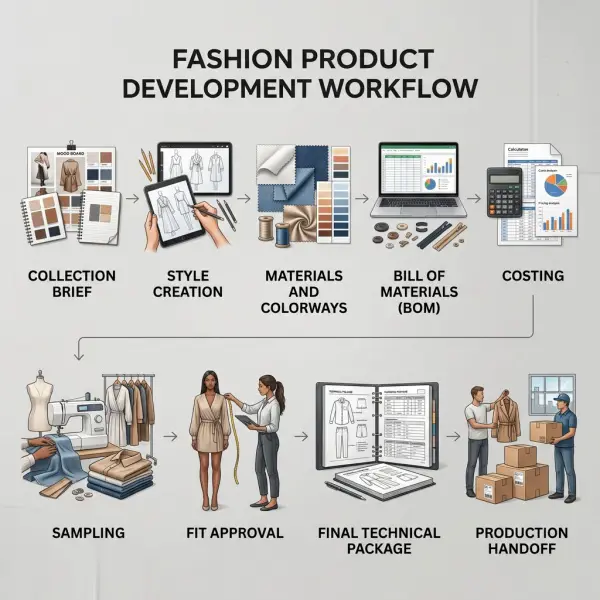
1. Collection and Product Briefing
The process may begin with a collection brief that defines product category, consumer segment, intended price position, delivery period, channel, design direction, and commercial expectations.
PLM can connect individual styles to the relevant season, collection, range plan, or product family. It may also store attributes such as gender category, silhouette, product type, intended market, launch window, or target price.
Line planning and assortment control can become substantial disciplines in their own right. Their deeper role in balancing product counts, colorways, timing, and collection structure is explored in why PLM systems help brands manage collections more efficiently.

2. Style Creation and Technical Design
Once a concept becomes a proposed product, the team creates a style record. This becomes the main reference point for information such as product name, style code, category, sketches, intended construction, materials, colorways, dimensions, and responsible team members.
Rather than treating each technical drawing or worksheet as an independent file, PLM associates them with the product record. Some platforms also connect with Computer-Aided Design tools, Adobe applications, pattern-development software, or three-dimensional design systems.
The creative file remains important, but PLM adds context: which version is approved, which collection it belongs to, which colorways are active, and what downstream information depends on it.
3. Materials, Colors, and Component Management
Material libraries allow teams to create reusable records for fabrics, linings, interlinings, threads, buttons, zippers, labels, packaging, and other components. A material record may contain supplier details, composition, construction, weight, width, color availability, price, lead time, minimum order requirements, test information, certificates, or status.
The strategic benefit is reuse. When a business develops another product with the same approved fabric, the team can reference an existing record rather than rebuilding the information from memory.
That does not mean every field is permanently reliable. Prices, lead times, availability, compliance documents, and supplier capability can change. Material master data therefore needs ownership and periodic review.
4. Bill of Materials Development
The Bill of Materials, or BOM, identifies the materials and components required to make the product. In apparel, it may include the shell fabric, lining, rib, zipper, buttons, labels, sewing thread, packaging, and other elements, often with placement, quantity, color, supplier, or consumption information.
A BOM is commercially important because it connects design intent with sourcing, costing, and production preparation. Centric Software’s tech-pack guidance identifies BOMs, artwork, product briefs, technical documents, and design files as key elements of the information manufacturers need to interpret a product. Centric Software’s guide to apparel tech packs and BOM management e PLM should not be treated as a decorative checklist. Incorrect material codes, missing consumption data, ambiguous color references, or unapproved substitutions can affect quotation accuracy and production execution.
5. Costing and Commercial Review
Many fashion PLM platforms provide costing functions that combine materials, consumption, labor or construction assumptions, packaging, freight-related inputs, duties, overhead, and supplier quotations. The level of detail varies by platform and company.
PLM can make costing more traceable by linking it to the actual materials and specifications under development. If a fabric price or consumption value changes, the team can examine the effect on estimated cost and margin rather than maintaining an unrelated costing file.
Costing remains an estimate until the assumptions are verified. PLM cannot determine a commercially sound cost when material consumption, supplier prices, order quantities, exchange rates, duties, or production methods are unreliable.
6. Sampling, Fit Review, and Approval
Apparel products commonly move through several sample stages, although the names and sequence differ by company and product category. Teams may review development samples, fit samples, size sets, sales samples, pre-production samples, or other prototypes.
PLM can record:
- Which sample was requested
- When it was sent and received
- Which specification version it represents
- Measurements and deviations
- Construction or workmanship comments
- Images and annotations
- Approval, rejection, or resubmission status
- The next required action
- Who made the decision
The important principle is traceability. A comment such as “reduce sleeve opening by one centimetre” has limited value when the team cannot determine which sample, size, specification version, or measurement point it refers to.

7. Production-Ready Handoff
Once design, materials, measurements, construction, costing, testing, and approvals reach the required status, the approved product definition can be released to suppliers, manufacturing teams, sourcing systems, or ERP.
A production handoff should make clear which information is final and which remains open. It should also control subsequent changes. A last-minute trim substitution, for example, may require a new cost, revised BOM, color approval, test check, and updated supplier instruction.
This is where version control becomes operationally valuable. The objective is not to prevent every late change. It is to ensure that a change is documented, assessed, approved, and communicated to the people affected by it.
Core Features of Fashion PLM Software
Feature lists can make competing platforms appear almost identical. The meaningful question is not whether a system says it supports “product development,” but how well its data structure and workflows reflect the company’s real products.
Product and Style Data Management
The system should maintain a structured style record rather than treating the product as a folder containing unrelated attachments. It should support the hierarchy the business actually uses, such as collection, category, style, color, and size.
Complexity appears quickly. One jacket may use different shell fabrics by color, regional labeling by market, and separate specifications for extended sizing. The system needs to represent those variants without creating uncontrolled duplicate records.
Tech Packs and Specification Management
A fashion tech pack converts design intent into manufacturing instructions. Depending on the product, it may contain technical flats, construction callouts, BOM information, measurement specifications, artwork, labeling, packaging, color references, and revision notes.
PLM can help teams generate, update, and distribute tech-pack information from structured data. The real benefit comes when the tech pack reflects the current approved product record rather than being exported once and then edited independently elsewhere.
Material and Color Libraries
Shared libraries can reduce duplicate material records and help teams reuse approved fabrics, trims, and colors. They may also support supplier references, test results, lead times, costs, and documentation.
The system should still distinguish between a reference record and current commercial reality. An approved fabric from a previous season may no longer be available at the same price or minimum quantity.
Workflow, Calendar, and Approval Management
PLM workflows define tasks, dependencies, deadlines, owners, and approval gates. A development calendar may track milestones such as design freeze, material selection, sample submission, fit approval, costing confirmation, testing, and production release.
A workflow is useful when it reflects actual decision rights. Automating an unclear process simply allows confusion to move faster.
Supplier Access and Communication
Some platforms allow suppliers or factories to view selected product information, respond to requests, submit quotations, upload documents, or receive comments.
Access should be controlled carefully. A supplier does not necessarily need visibility into the full collection, internal margin expectations, other suppliers’ prices, or confidential design information. Role-based permissions and clear information-sharing policies are essential.
Reporting and Development Visibility
Dashboards can show late activities, incomplete specifications, sample status, cost variance, approval bottlenecks, or styles at risk. The value depends on data being updated consistently.
A polished dashboard built on stale records can be more dangerous than a basic spreadsheet because it creates unwarranted confidence.
Integrations and Data Exchange
A PLM platform may exchange information with CAD, patternmaking, three-dimensional design, ERP, sourcing, planning, quality, Product Information Management, digital asset management, or e-commerce systems.
Integration is not a secondary technical detail. It determines whether employees can maintain one controlled product definition or must continue re-entering information across applications.
How Is PLM Different from ERP, PIM, and Project-Management Software?
PLM, ERP, PIM, and project-management platforms can all contain product-related information, but they serve different operational purposes.
|
System |
Primary role |
Typical fashion information |
Main users |
|
PLM |
Manages the definition and development of products |
Styles, colorways, materials, BOMs, specifications, samples, costing, approvals |
Design, product development, technical, sourcing, merchandising |
|
ERP |
Manages business resources and transactions |
Purchase orders, inventory, production orders, invoices, financial records |
Operations, finance, procurement, production, logistics |
|
PIM |
Prepares and distributes customer-facing product information |
Product descriptions, channel attributes, localized content, selling data |
E-commerce, marketing, sales, content teams |
|
Project-management software |
Coordinates tasks and deadlines |
Owners, due dates, comments, project status |
Cross-functional teams |
|
DAM |
Stores and distributes digital media assets |
Campaign photography, product images, video, brand assets |
Creative, marketing, e-commerce |
PLM usually governs what the product is supposed to be before and during development. ERP generally handles the transactions and resources required to buy, produce, store, and account for it. PIM prepares approved product information for sales and marketing channels.
PTC describes PLM as managing product development and lifecycle information, while ERP concentrates more heavily on enterprise operations and transactions. Centric Software similarly distinguishes PLM’s product-development focus from PIM’s role in marketing and selling products. PTC’s explanation of PLM and ERP responsibilities are not universal. Some fashion suites combine PLM, sourcing, planning, PIM, or ERP functions. Before selecting software, a company should define which application will own each data field and which systems will receive it.
What Business Value Can PLM Create?
PLM may improve apparel operations by reducing the friction involved in finding, confirming, updating, and communicating product information.
The word “may” matters. Software does not automatically shorten development time, improve quality, reduce sampling, or protect margin. Those outcomes depend on the quality of the process implemented around the system.
More Reliable Product Information
When teams work from controlled product records, they are less likely to rely on obsolete attachments or locally saved files. Version control can make it clearer which specification, BOM, drawing, or approval is current.
This is particularly useful when one change affects several functions. Replacing a zipper is not merely a design edit; it can influence price, color matching, supplier availability, testing, lead time, and manufacturing instruction.
Less Repetitive Data Entry
Structured records can allow approved information to be reused across styles, seasons, or downstream systems. A fabric composition, care requirement, supplier code, or trim specification may be entered once and referenced where appropriate.
The efficiency disappears when employees still maintain shadow spreadsheets because they do not trust the system. Eliminating duplicate work therefore requires both technical capability and operational confidence.
Earlier Visibility of Development Risk
A well-configured workflow can show which styles are missing cost approval, awaiting samples, using unconfirmed materials, or falling behind the critical path.
That visibility supports exception management: teams can concentrate on the products or activities that require intervention instead of repeatedly checking every item.
Better Organizational Memory
Product development knowledge often sits with experienced employees. When a technical designer, developer, or sourcing manager leaves, the company may lose the history behind material choices, fit changes, supplier decisions, and construction solutions.
PLM can retain some of that knowledge in product records and revision histories. It cannot capture judgment that was never documented, but it reduces dependence on personal inboxes and memory.
More Controlled Supplier Handoffs
Factories work more effectively when they receive complete, consistent, and approved instructions. PLM can help create that structure, particularly when specifications and changes are connected to the product record.
It cannot compensate for weak factory capability, unclear commercial agreements, unrealistic deadlines, or poor relationship management. Those remain business and sourcing responsibilities.
The collaborative effects of shared product information are examined more deeply in how Product Lifecycle Management improves fashion team collaboration.
When Does an Apparel Business Need PLM?
A company does not need PLM simply because PLM exists. The decision should be based on operational complexity, control requirements, and the cost of the current problems.
A small label producing a few stable styles with one close supplier may be able to operate with disciplined templates and shared cloud storage. A business developing hundreds of styles across multiple seasons, teams, categories, suppliers, and markets faces a different information-management problem.
PLM becomes more relevant when several of the following conditions appear:
- The business develops many styles, colorways, or variants.
- Several teams update the same product information.
- Product development spans multiple locations or time zones.
- Supplier communication is difficult to audit.
- Technical packages are frequently inconsistent.
- Materials and components are duplicated across files.
- Sampling rounds are not clearly traceable.
- Collection milestones are routinely missed.
- Management cannot see the current development status.
- Employees spend substantial time reconciling spreadsheets.
- Product information must move into ERP, PIM, sourcing, or commerce systems.
- Compliance and documentation requirements are becoming more complex.
The strongest business case usually comes from specific process pain rather than a broad desire for “digital transformation.” A company should quantify where time, rework, delay, error, or risk is being created before evaluating platforms.
When PLM May Be Premature
PLM may be premature when a business has not yet standardized basic product-development practices.
Warning signs include undefined style codes, inconsistent BOM formats, unclear approval authority, unreliable material records, and no agreement about when a product is ready for production. These issues should be addressed as part of implementation, but a software vendor cannot make the underlying decisions for the company.
A full PLM platform may also be disproportionate when:
- The assortment is small and operationally simple.
- Only one or two people develop products.
- Product specifications rarely change.
- There is no need for cross-system integration.
- The team cannot allocate an internal implementation owner.
- Subscription and implementation costs exceed the measurable problem.
- A narrower tech-pack or workflow tool would solve the immediate need.
A sensible technology roadmap can begin with standard templates, naming conventions, material records, and approval rules. PLM becomes easier to implement once the business knows what it is trying to control.
How Apparel Businesses Should Evaluate PLM Software
A polished demonstration can make every system appear intuitive. Selection should instead be based on realistic product scenarios, representative users, and the full cost of implementation.

Verify the Fashion Data Model
The system should support the way the company defines products. Ask vendors to demonstrate real examples involving styles, colorways, sizes, regional variants, material substitutions, packaging differences, and carryover products.
A generic product record may be insufficient for a fashion company that manages complex color-size combinations or repeated seasonal adaptations.
Test the Complete Workflow
Do not evaluate only style creation. Follow one realistic product from brief through:
- Style setup
- Material assignment
- BOM creation
- Cost calculation
- Sample request
- Fit comments
- Revision
- Approval
- Technical package generation
- ERP or supplier handoff
This reveals whether the platform connects the lifecycle or merely provides isolated modules.
Examine Configuration Versus Customization
Configuration uses supported settings, templates, fields, roles, and workflows. Customization changes or extends the software through bespoke development.
Some customization may be justified, but excessive modification increases implementation cost, testing requirements, upgrade complexity, and dependence on specialist support. A company should distinguish genuine competitive requirements from old habits that users simply want to preserve.
Confirm Integration Responsibility
Ask which integrations are prebuilt, which require middleware or custom development, and who maintains them after implementation.
The evaluation should define:
- Which system owns each product attribute
- When data transfers occur
- How errors are detected
- How duplicate records are prevented
- What happens when a field changes
- Who supports failed synchronization
- Whether data can be exported in a usable format
An integration diagram is more informative than a slide displaying application logos.
Assess Supplier Participation
Supplier portals sound attractive, but their value depends on supplier capability, connectivity, language, process maturity, and willingness to adopt the workflow.
The company should test whether suppliers can perform required tasks without gaining inappropriate access to confidential information. It should also decide what happens when a strategic factory cannot or will not use the platform.
Review Security, Data Ownership, and Continuity
Fashion PLM may contain unreleased designs, target costs, supplier prices, material information, and product strategy. Buyers should examine role-based access, authentication, logging, backups, business continuity, encryption, data location, subcontractors, incident processes, and contractual rights.
They should also confirm:
- Who owns uploaded and generated data
- How data can be retrieved at contract termination
- Whether complete revision history can be exported
- How long backups are retained
- How inactive supplier accounts are removed
- What support is available during an outage
A security certification can be useful evidence of management controls, but it should not replace review of the service configuration, contract, and responsibilities relevant to the buyer.
Calculate Total Cost, Not Subscription Price Alone
PLM cost may include licenses, implementation consulting, configuration, data migration, integrations, user training, supplier onboarding, internal project time, ongoing support, and future changes.
The lowest license price is not necessarily the lowest operating cost. Equally, a feature-rich enterprise platform may be financially excessive when the company will use only a small part of it.
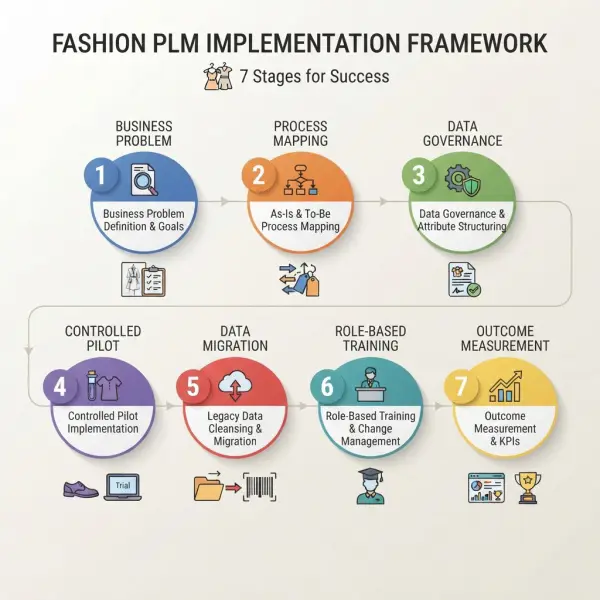
A Practical PLM Implementation Roadmap
Successful PLM adoption requires narrower priorities than many initial project plans suggest. Trying to redesign every product process, migrate every historic record, connect every system, and onboard every supplier simultaneously creates avoidable risk.
Phase 1: Define the Business Problem
Begin with measurable operational problems. Examples include time spent reconciling specifications, delayed sample approvals, inaccurate BOM versions, duplicate material records, or late costing decisions.
The implementation team should establish baseline indicators before changing the process. Otherwise, later claims of improvement will be difficult to validate.
Phase 2: Map the Current and Target Process
Document how a product actually moves through the business—not how the official procedure says it should move.
Identify who creates, reviews, changes, approves, and consumes each important data element. Then design a target workflow that removes unnecessary duplication while preserving necessary controls.
Phase 3: Establish Data Governance
Define naming conventions, product hierarchies, required fields, status definitions, material ownership, style-code rules, and approval authority.
Data governance should answer practical questions:
- Who may create a new material?
- Who can approve a BOM?
- When is a style considered production-ready?
- Which changes require reapproval?
- Who closes obsolete colorways?
- Which system is authoritative for cost, inventory, and selling data?
Without these rules, users will interpret the system differently.
Phase 4: Configure a Controlled Pilot
Use representative products rather than only the easiest styles. The pilot should include at least one product with realistic complexity, such as multiple colorways, revised materials, sample comments, costing changes, and a supplier handoff.
Testing should involve actual users from design, technical development, merchandising, sourcing, and operations.
Phase 5: Clean and Migrate Relevant Data
Historic data should not be migrated simply because it exists. Duplicate materials, inconsistent codes, obsolete suppliers, and incomplete records can undermine trust in the new platform.
Many businesses benefit from migrating active styles, approved core materials, carryover products, and selected historical references while archiving the rest separately.
Phase 6: Train by Role and Scenario
Generic software demonstrations are rarely sufficient. Designers, merchandisers, technical developers, sourcing teams, administrators, and suppliers need training based on their actual decisions.
Training should explain not only which button to press, but why a field matters and what downstream process depends on it.
Phase 7: Measure Operational Outcomes
User logins indicate activity, not business value. Better measures include:
- Time required to create or revise a specification
- Percentage of styles with complete BOMs by milestone
- Sample approval cycle time
- Number of late development tasks
- Frequency of duplicate material records
- Cost changes identified before production commitment
- Specification errors reported by suppliers
- Time spent preparing cross-functional status reports
Measurement should account for seasonality and product complexity. Comparing a simple carryover collection with a highly experimental range may produce misleading conclusions.
Common Fashion PLM Implementation Mistakes
Buying Software Before Defining the Process
This happens when management treats PLM as a ready-made solution to operational confusion. Vendors demonstrate attractive functionality, but the company has not agreed on its own stages, responsibilities, or approval rules.
The consequence is prolonged configuration and competing user requirements. A better approach is to map a few critical workflows before final selection and test them during vendor demonstrations.
Reproducing Every Spreadsheet Inside PLM
Teams often request every familiar column, tab, and exception from their old spreadsheets. Some fields are necessary; others exist only because the old process was fragmented.
Recreating everything can make the new system cumbersome and preserve unnecessary work. Each field should have a purpose, owner, user, and downstream consequence.
Migrating Poor-Quality Data
Duplicate fabric names, incomplete supplier records, inconsistent style codes, and old prices do not become reliable when imported into modern software.
Migration should include cleansing, deduplication, validation, and clear decisions about what not to move.
Treating PLM as an IT Department Project
Technology specialists are essential for architecture, security, integration, and support. They cannot independently define fit approval, BOM ownership, costing responsibility, or product-release criteria.
PLM needs active business ownership from the departments that create and use product information.
Over-Customizing Too Early
Customization often begins when users compare the platform with every detail of the previous process before they have learned the standard workflow.
A more cautious approach is to implement essential requirements, operate through a real development cycle, and customize only where a documented business gap remains.
Ignoring Change Management
PLM changes visibility and accountability. Tasks that were previously handled through private messages become trackable. Employees may perceive this as additional administration or loss of autonomy.
Leaders need to explain which problems the system is solving, remove redundant work, provide adequate training, and respond when the configured process is genuinely impractical.
Assuming PLM Will Fix Every Development Delay
PLM can expose a late material decision or overdue sample. It cannot make an unavailable fabric arrive, improve an incapable supplier, resolve an unclear brand strategy, or create additional technical-design capacity.
The system helps teams manage decisions. It does not remove the physical, commercial, and human constraints of apparel production.
Important Technical and Commercial Caveats
“Single Source of Truth” Requires Governance
A PLM platform is often described as a single source of truth, but that status is earned rather than installed. Users must know which system owns each category of information, and duplicate offline records must be controlled.
When employees continue updating local spreadsheets after entering data into PLM, the organization has created another source rather than a single source.
PLM Does Not Replace ERP or PIM
PLM typically manages product definition and development. ERP manages transactions, resources, purchasing, production, inventory, and finance. PIM manages customer-facing product information for commercial channels.
An integrated architecture may connect all three, but using the terms interchangeably creates ownership and data-quality problems.
Sustainability Data Needs Evidence
Some PLM systems provide fields for material composition, certifications, supplier documentation, environmental indicators, or traceability information. Recording a claim does not prove it.
A brand must still verify the methodology, scope, validity period, chain of custody, supplier evidence, and regulatory relevance of sustainability-related information. PLM can organize evidence; it cannot make weak evidence reliable.
Artificial Intelligence Features Need Operational Review
PLM vendors increasingly describe AI-assisted capabilities such as search, recommendations, automation, image analysis, data completion, or forecasting. Their usefulness depends on the specific model, training data, permissions, integration, and human-review process.
Buyers should test AI features with representative data and examine how confidential product information is processed. Generated suggestions should not be treated as approved product decisions without review.
Implementation Benefits Are Context-Dependent
Vendor case studies can illustrate how a system was used, but they do not guarantee the same result for another company. Baseline maturity, assortment complexity, implementation scope, leadership, integrations, and user adoption all influence outcomes.
The most credible business case is based on the company’s own current costs and bottlenecks.
How Different Fashion Businesses Can Apply PLM
Small and Emerging Apparel Brands
A small brand should first determine whether it needs full PLM or a lighter product-development solution. The most valuable early capabilities are often structured style records, repeatable tech packs, material libraries, sample comments, and basic costing.
The priority should be building reliable habits without introducing an administrative burden that exceeds the team’s capacity.
Growing Direct-to-Consumer Brands
Growth can make product information difficult to coordinate across design, development, sourcing, e-commerce, and operations. These businesses may benefit from PLM when expanding categories, increasing collection frequency, adding suppliers, or operating in several markets.
Integration with ERP and PIM becomes more important because product attributes must move from development into purchasing, inventory, and digital commerce.
Apparel Manufacturers and Private-Label Suppliers
Manufacturers may use PLM to receive buyer specifications, manage development samples, record materials, control revisions, prepare costing, and coordinate technical information.
The platform must reflect whether the manufacturer develops products independently, works from buyer-issued tech packs, or operates both models. Buyer-specific data segregation and permission control can be particularly important.
Multi-Brand and Multi-Market Organizations
Larger organizations often need consistent product governance while allowing different brands, regions, or categories to maintain appropriate workflows.
The challenge is balancing standardization with genuine operational differences. Too little control fragments data; too much centralization can force unsuitable processes onto specialist product teams.
Retailers Developing Private-Label Collections
Private-label retailers can use PLM to connect range planning, product briefs, supplier development, costing, quality requirements, and commercial deadlines.
PLM should complement rather than duplicate fashion inventory management and retail stock planning. Product development determines what will be created; inventory systems govern how much is ordered, received, allocated, and sold.





Comments 0
Leave a CommentSend Comment
Anda harus Login terlebih dahulu untuk dapat memberikan komentar.