
AI for Fashion Content Production: What Builds Trust vs What Breaks It
Introduction
Artificial intelligence has quietly become embedded in how fashion brands produce content—whether it’s product descriptions, campaign visuals, social media captions, or even trend forecasting. For many fashion businesses, especially startups and garment manufacturers, AI promises speed, cost efficiency, and scalability. What once required a full creative team can now be initiated with a few well-structured prompts.

But there’s a tension that’s becoming impossible to ignore: while AI accelerates content production, it also introduces a new layer of risk—trust erosion. In fashion, where brand perception, authenticity, and emotional connection are critical, the wrong use of AI can damage credibility faster than it builds reach.
This is no longer a technical discussion. It’s a strategic one. The real question is not whether to use AI—but how to use it without compromising brand trust.
This article breaks down the landscape clearly: which AI practices are safe and strengthen your brand, and which ones quietly undermine your positioning in the market.
The Role of AI in Modern Fashion Content Production
AI in fashion content production refers to the use of machine learning tools to generate, assist, or optimize content across various touchpoints—product pages, marketing campaigns, visual assets, and even internal documentation. It spans text generation, image creation, video scripting, and data-driven personalization.
At a deeper level, AI is not just a tool—it’s becoming a content infrastructure layer. Instead of manually producing each piece of content, brands now design systems that can generate consistent outputs at scale. This is especially relevant for fashion businesses managing hundreds of SKUs, seasonal collections, and omnichannel marketing demands.
From a business perspective, the impact is immediate. A fashion startup launching 50 new products can generate descriptions, social captions, and campaign drafts within hours instead of weeks. A garment manufacturer can produce technical documentation and client-facing materials faster, reducing time-to-market.
Consider a practical scenario: a mid-sized fashion brand preparing a Ramadan collection. Using AI, they generate product descriptions, email campaigns, and Instagram captions in a single workflow. The speed advantage allows them to launch earlier than competitors. However, if not carefully managed, the content risks sounding generic—losing the cultural nuance essential for the campaign.
The key takeaway here is that AI is not inherently good or bad. It is a multiplier. It amplifies both strengths and weaknesses in your content strategy. If your brand already has a strong voice and clear positioning, AI can scale it. If not, AI will simply scale inconsistency.
“Safe AI” — Practices That Strengthen Brand Trust
Safe AI usage in fashion content production is defined by one principle: AI supports human judgment, not replaces it. When AI is used as an augmentation layer—enhancing clarity, consistency, and efficiency—it can actually strengthen brand trust.
One of the safest applications is AI-assisted editing and refinement. Instead of generating content from scratch, brands use AI to improve existing drafts—adjusting tone, simplifying language, or optimizing for SEO. This ensures that the core message remains human-driven while benefiting from AI efficiency.

Another strong use case is structured content generation. For example, generating product descriptions based on standardized inputs such as fabric type, fit, and usage context. This works particularly well for garment businesses with large inventories, where consistency is more important than creativity.
From a business standpoint, these practices reduce operational friction without compromising authenticity. Teams can focus on strategic storytelling while AI handles repetitive layers of production. This is especially valuable for growing brands that cannot yet afford large content teams.
Imagine a fashion brand using AI to standardize its product descriptions across 300 SKUs. Each description follows a consistent structure—fabric, fit, styling suggestions—while still being reviewed and refined by a human editor. The result is a clean, professional catalog that builds trust with customers.
The insight here is clear: trust is maintained when AI is invisible to the audience. When customers cannot distinguish between AI-assisted and fully human content, it means the brand has successfully integrated AI without sacrificing authenticity.
“Risky AI” — Practices That Erode Trust
On the opposite side, risky AI usage occurs when brands prioritize speed over substance—allowing AI to generate content without sufficient oversight. This often leads to content that feels generic, inconsistent, or even misleading.
One of the most common pitfalls is fully automated content generation without brand alignment. AI tools, by default, produce average outputs based on generalized data. Without clear brand guidelines, the result is content that lacks identity—something particularly damaging in fashion, where differentiation is key.
Another major risk is AI-generated visuals that misrepresent products. With the rise of AI image generators, some brands create visuals that look appealing but do not accurately reflect the actual product. This creates a disconnect between expectation and reality, leading to customer dissatisfaction and returns.
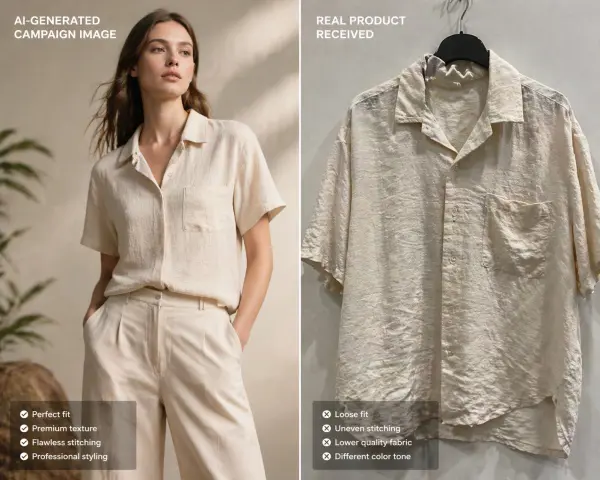
From a business perspective, the cost of this mistake is significant. Short-term gains in content speed are offset by long-term losses in customer trust, increased return rates, and negative brand perception.
Consider a scenario where a startup uses AI to generate lifestyle images for a new clothing line. The images look premium and polished—but the actual product quality does not match. Customers feel misled, and the brand quickly gains a reputation for being “overhyped.”
The core insight is that trust is fragile in the age of AI. Once customers suspect that content is misleading or inauthentic, it becomes difficult to rebuild credibility. AI, when misused, accelerates not just growth—but also reputational damage.
The “Trust Gap” — Where Most Brands Fail
The most dangerous zone is not clearly “safe” or “risky”—it’s the gray area where brands believe they are using AI effectively, but are actually creating subtle trust gaps. This is where most fashion businesses struggle.
This gap often appears in tone inconsistency. For example, a brand’s Instagram captions feel warm and personal, but product descriptions feel robotic. Customers may not consciously identify the issue, but they sense a lack of coherence.
Another common issue is over-optimization for SEO at the expense of readability. AI-generated content can easily become keyword-heavy and unnatural, especially when brands focus too much on ranking rather than user experience.

From a business perspective, this inconsistency weakens brand equity. Fashion brands are not just selling products—they are selling identity. When the content feels fragmented, the brand itself feels fragmented.
Imagine a garment business that uses AI to generate blog content targeting search traffic. The articles rank well, but the tone does not match the brand’s premium positioning. Visitors arrive with one expectation and leave with another, reducing conversion rates.
The takeaway is that trust is built through consistency, not just quality. AI can produce high-quality outputs, but without a unified strategy, it cannot maintain a consistent brand experience.
Building a Trust-Safe AI Content Strategy
To use AI effectively in fashion content production, brands need to shift from a tool-based mindset to a system-based strategy. This means defining clear roles for AI within the content workflow.
The foundation is a strong brand framework—tone of voice, visual identity, and content guidelines. AI should be trained or guided based on these parameters. Without this foundation, even the most advanced AI tools will produce inconsistent results.
Next is human-in-the-loop validation. Every AI-generated output should pass through a human layer—whether it’s editing, approval, or contextual adjustment. This is not about slowing down production, but about ensuring alignment.

From a business standpoint, this approach balances efficiency and control. Brands can scale content production while maintaining quality standards. It also reduces the risk of reputational damage caused by inaccurate or misleading content.
A practical example: a fashion startup builds a content pipeline where AI generates first drafts, editors refine tone and messaging, and brand managers approve final outputs. Over time, the AI system is improved based on feedback, creating a more aligned workflow.
The key insight is that AI should operate within a controlled system, not as an independent creator. Brands that understand this will gain a sustainable advantage—producing content faster without sacrificing trust.
Conclusion
AI is not a threat to fashion content—it’s a powerful enabler. But like any tool, its impact depends entirely on how it is used.
The brands that win will not be those that use AI the most aggressively, but those that use it the most intelligently. They will treat AI as a system component, not a shortcut. They will prioritize consistency over speed, and authenticity over automation.
In a market where consumers are increasingly sensitive to authenticity, trust becomes the ultimate differentiator. AI can help you scale—but only if you protect what makes your brand believable in the first place.
FAQ
1. Is it safe to use AI for product descriptions in fashion?
Yes, as long as AI is used to assist and standardize content, and outputs are reviewed by humans to ensure accuracy and tone consistency.
2. Can AI-generated images be used for fashion marketing?
They can be used carefully, but should not misrepresent the actual product. Transparency and alignment with real product quality are critical.
3. What is the biggest risk of using AI in fashion content?
The biggest risk is loss of brand identity and trust due to generic, inconsistent, or misleading content.
4. How can small fashion brands use AI effectively?
By focusing on AI-assisted workflows—using AI for drafts and structure, while maintaining human control over final outputs.
5. Does AI improve SEO for fashion brands?
AI can support SEO by generating optimized content, but it must be balanced with readability and user experience to be effective.




Comments 0
Leave a CommentSend Comment
Anda harus Login terlebih dahulu untuk dapat memberikan komentar.