

AEO for Fashion Brands: How to Become the Answer Customers Find First
Quick Answer
Answer Engine Optimization, or AEO, helps fashion brands create content and digital information that can directly answer customer questions across search engines, AI assistants, featured snippets, voice search, and AI-powered discovery experiences. For fashion brands, AEO is not about replacing SEO. It is about making product details, brand expertise, service information, sizing, materials, styling guidance, and business proof easier to extract, summarize, and trust.
Google’s 2026 guidance says that terms like AEO and GEO are commonly used to describe AI search visibility work, but from Google Search’s perspective, optimizing for generative AI search is still part of search optimization; see Google’s guide to optimizing for generative AI features.
For fashion brands, the practical implication is clear: do not chase “AI visibility” with vague tricks. Build answer-ready content that explains what the brand sells, who it serves, how products fit, what materials are used, where the business operates, what makes the product credible, and what customers should know before buying. The brands most likely to be understood by answer engines are the brands that explain themselves clearly.

What Is AEO for Fashion Brands?
AEO for fashion brands is the process of structuring brand, product, service, and educational content so answer-based systems can understand and present it as a useful response to customer questions. It focuses on clear answers, entity clarity, factual accuracy, structured information, and practical usefulness.
The category matters because fashion decisions are full of questions. A customer does not only search for “black blazer.” They may ask whether an oversized blazer works for petite women, what fabric is best for humid weather, how to style a linen shirt for work, whether a brand offers inclusive sizing, or whether a local boutique has eveningwear available nearby. A buyer may ask which garment manufacturer can handle small-batch production. A fashion student may ask which sewing course is suitable for beginners.
Traditional SEO often begins with keywords. AEO begins with questions and decisions.
That does not mean keywords disappear. It means they sit inside a richer information structure. A product page still needs relevant terms such as “linen dress,” “wide-leg trousers,” or “bridal alterations,” but an answer-ready page also explains fit, use case, fabric behavior, care limitations, delivery, returns, sizing, and styling context. This gives both people and machines a more complete understanding of the page.
Why AEO Matters in the AI Search Era
AEO matters because search behavior is becoming more conversational, comparative, and decision-oriented. Customers increasingly expect direct answers rather than only a list of links. AI-powered search experiences can summarize information, compare options, and cite sources, which changes how brands need to present themselves.
OpenAI describes ChatGPT Search as a way to get timely answers with links to relevant web sources, not just a separate traditional search results page; see OpenAI’s introduction to ChatGPT Search. Google also explains that AI features in Search, including AI Overviews and AI Mode, still rely on content that is crawlable, indexable, and eligible for search features; see Google AI features and your website.
For fashion businesses, this creates a visibility challenge. If a brand does not explain its products clearly, an answer engine may not understand when to surface it. If a product page says “premium sustainable dress” but gives no material detail, no care information, no sizing guidance, and no evidence for the sustainability claim, the page is weak as an answer source. It may look polished to a shopper, but it is thin as information.
AEO pushes fashion brands to answer the questions that influence purchase decisions, not just publish attractive brand language.
AEO Is Not a Shortcut Around SEO
AEO should be built on SEO fundamentals. A page still needs to be crawlable, indexable, technically stable, internally linked, useful, and aligned with search intent. Google’s guidance on AI features tells site owners to continue following SEO best practices for Search, including making content crawlable and indexable and allowing snippets where appropriate.
This is important because some fashion brands treat AEO as a new trick. They add FAQ sections to every page, write question-style headings, or publish AI-generated explainers without improving the real quality of their product and brand information. That approach misses the point.
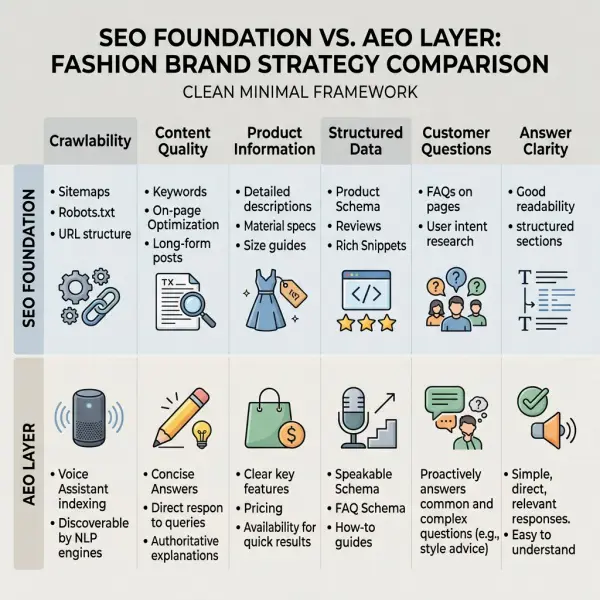
AEO works best when it adds clarity to already useful pages:
|
SEO Foundation |
AEO Layer |
Fashion Brand Example |
|
Crawlable product page |
Direct product answers |
Explain fit, fabric, care, occasion, and sizing |
|
Category page |
Buyer decision guidance |
Compare silhouettes, materials, and use cases |
|
Blog article |
Answer-first structure |
Begin major sections with direct, useful answers |
|
Brand page |
Entity clarity |
Explain brand category, location, values, proof, and product scope |
|
Internal links |
Guided decision path |
Link fabric guides to products and sizing guides |
|
Structured data |
Machine-readable context |
Use Product, Organization, Breadcrumb, and Article markup accurately |
AEO does not replace SEO. It sharpens the content so the page is more useful as an answer.
Start With the Questions Customers Actually Ask
The strongest AEO strategy begins with real customer questions, not abstract keyword lists. A fashion brand should identify what people need to know before they trust, compare, visit, or buy.
For a fashion brand, these questions usually fall into several practical groups:
- Product questions: What is the garment made from? Is it lined? Is it sheer? Does it stretch? Is it suitable for hot weather?
- Fit questions: Is it true to size? Does it suit petite bodies? Is the waist elastic? Is the cut relaxed or structured?
- Styling questions: Can it be worn to work? How do I style it for travel? What shoes work with this silhouette?
- Trust questions: Where is it made? What does the brand mean by sustainable? Are reviews available?
- Purchase questions: What is the return policy? How long does shipping take? Is the item available locally?
- Service questions: Does the brand offer alterations, custom sizing, appointments, wholesale, or made-to-order?
These are not only FAQ opportunities. They should shape the whole website. A product description can answer material and fit questions. A category page can answer comparison questions. A blog article can answer styling or education questions. A business profile can answer local discovery questions. A brand page can answer trust questions.
AEO becomes stronger when answers live where the question naturally arises.
Build Answer-Ready Product Pages
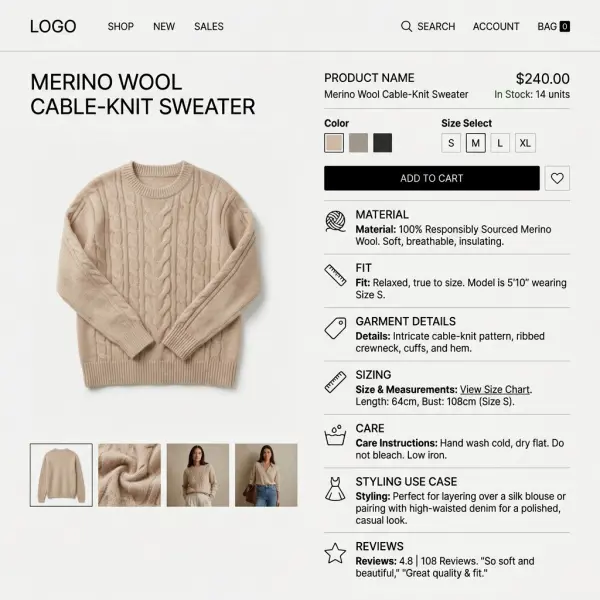
A fashion product page should be more than a sales card. It should answer the most important pre-purchase questions in a way that is clear to both shoppers and search systems.
For example, a weak product page might say: “A timeless linen dress designed for effortless elegance.” That sounds pleasant, but it does not answer much. A stronger page explains the linen blend or composition, opacity, fit, silhouette, lining, suitable occasions, care instructions, body measurement guidance, model size reference, and styling use cases.
This does not make the page less elegant. It makes it more useful.
A practical answer-ready product page should include:
|
Product Detail |
Why It Matters for AEO |
Fashion Example |
|
Material composition |
Helps answer fabric and comfort queries |
100% linen, cotton poplin, wool blend, recycled polyester |
|
Fit description |
Helps customers evaluate size and silhouette |
Relaxed fit, structured shoulder, high waist, ankle length |
|
Garment construction |
Supports quality and performance claims |
Lined bodice, French seams, reinforced button placket |
|
Care guidance |
Answers ownership and maintenance questions |
Hand wash, dry clean, machine wash cold, avoid tumble drying |
|
Use case |
Connects product to customer intent |
Workwear, resortwear, modest styling, travel, eveningwear |
|
Size guidance |
Reduces uncertainty and return risk |
Model measurements, garment measurements, fit notes |
|
Availability data |
Helps search and shopping systems |
Price, stock status, color, size, shipping region |
Google’s ecommerce documentation says structured data is a standardized machine-readable format that can improve the accuracy of Google’s understanding of ecommerce content; see Google ecommerce structured data guidance. For fashion brands, this means visible product information and structured product data should work together.
The visible page helps people decide. Structured data helps systems understand.
Use Question-Based Content Without Sounding Robotic
Question-based headings can help AEO, but they should not turn the article into a stiff FAQ machine. The goal is not to make every heading begin with “what,” “why,” or “how.” The goal is to answer real questions naturally.
A strong fashion article may combine editorial headings with question headings. For example, an article about linen workwear might include “Why Linen Works Differently in Office Dressing” alongside “Is Linen Suitable for Professional Outfits?” This creates a more natural reading rhythm while still giving answer engines clear extraction points.
The first sentences after a question heading matter. They should answer directly before moving into nuance.
Poor answer pattern:
“Linen is a popular material that has been used for many years and is loved by many people because of its comfort and style.”
Better answer pattern:
“Linen can work for professional outfits when the garment has enough structure, opacity, and clean finishing. A softly wrinkled linen shirt may feel too relaxed for formal offices, while a lined linen-blend blazer or tailored dress can look polished in warmer climates.”
The second version gives an answer, a caveat, and a practical distinction. That is far more useful for AEO.
Make Brand Claims Specific Enough to Be Trusted
Fashion brands often rely on beautiful but vague claims: sustainable, ethical, premium, timeless, inclusive, artisanal, high quality, slow fashion. These words may be part of the brand voice, but they are weak as answer signals unless they are explained.
AEO favors specificity because answer systems need to understand what a claim means. “Sustainable dress” can mean many things. It could refer to organic cotton, recycled polyester, deadstock fabric, made-to-order production, repairability, resale, local manufacturing, certified suppliers, lower-impact dyeing, or reduced packaging. These are not interchangeable.
A stronger brand explanation might say:
“Our made-to-order dresses are produced after purchase to reduce unsold inventory. The current collection uses deadstock viscose and cotton-linen blends sourced from existing supplier stock, but availability varies by batch and color.”
That sentence is less glamorous than “conscious luxury,” but it is more credible. It gives a clear practice, a limitation, and a context.
Google’s helpful content guidance emphasizes creating content for people, showing first-hand expertise, and making readers feel they have learned enough to achieve their goal; see Google helpful content guidance. For fashion brands, helpfulness often means explaining the trade-offs behind attractive claims.
Strengthen Entity Clarity Across the Brand Website
AEO is not only page-level optimization. It also depends on whether the brand itself is easy to identify and categorize.
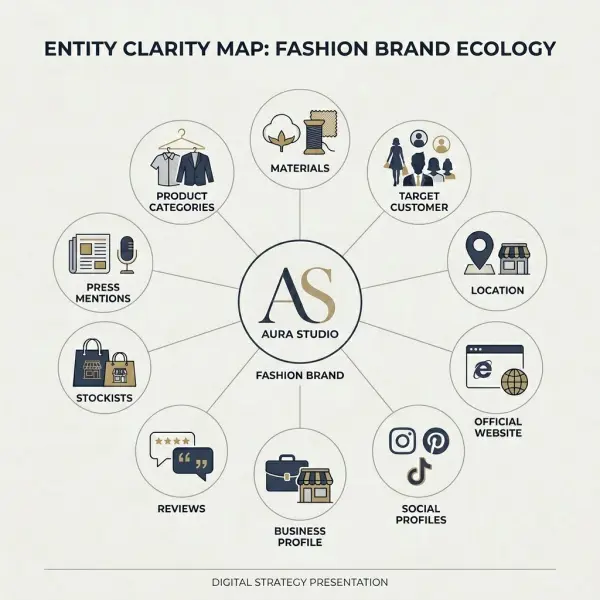
A fashion brand should make its entity signals consistent across the website: homepage, About page, product pages, category pages, lookbooks, press page, stockist page, business profile, social profiles, and marketplace listings. The brand should be described in a way that is specific enough for machines and meaningful enough for customers.
A strong entity description might include:
- Brand name and official spelling.
- Product category, such as womenswear, bridalwear, modest fashion, workwear, activewear, accessories, or made-to-order clothing.
- Target customer or use case.
- Geographic base or relevant service region.
- Product philosophy, material focus, or production model.
- Proof points such as stockists, reviews, founder background, press mentions, or production capabilities.
- Official channels and consistent profile links.
A brand that sells handmade leather bags from Yogyakarta, a performance activewear label in Singapore, and a small-batch linen resortwear brand in Bali should not describe themselves with the same generic phrase: “modern fashion brand.” Their entity profiles should be different because their businesses are different.
This is also where the first article in this cluster matters. A broader strategy for building online visibility in the age of AI search should establish the full visibility foundation, while this article focuses specifically on becoming answer-ready.
Use Structured Data to Support Answers, Not Replace Them
Structured data can help search systems understand products, articles, business entities, breadcrumbs, videos, and other page elements. For fashion brands, it is especially useful on product pages, editorial articles, organization pages, and local retail pages.
Google’s Product structured data documentation explains that merchant listing structured data can support product information such as price, availability, shipping, and returns when properly implemented; see Google merchant listing structured data guidance. Google also provides Product snippet structured data guidance for product review and informational product pages; see Google product snippet structured data guidance.
But structured data must be accurate. It should reflect visible page content. If a page does not clearly show price, stock status, or reviews, the markup should not pretend otherwise. Schema abuse may create technical and compliance problems rather than visibility gains.
For fashion brands, useful structured data may include:
- Product for ecommerce product pages.
- Organization for brand identity.
- LocalBusiness for boutiques, showrooms, studios, or local retail locations.
- Article for editorial content.
- BreadcrumbList for page hierarchy.
- ImageObject or VideoObject where visuals are meaningful.
- FAQPage only when the FAQ is genuinely visible and useful.
The rule is simple: write the answer clearly for people, then mark it up accurately for machines.
Build AEO Content Around Decision Moments
The best AEO content is not built around random questions. It is built around decision moments. A customer is trying to decide whether to buy, compare, trust, visit, inquire, or learn.
A fashion brand should map its content to these decision moments:
|
Decision Moment |
Customer Question |
Best Content Format |
|
Discovery |
What kind of brand is this? |
Homepage, About page, brand story, category pages |
|
Product evaluation |
Will this fit my body and lifestyle? |
Product page, size guide, fit notes, styling guide |
|
Material evaluation |
Is this fabric suitable for my climate or use case? |
Fabric guide, product details, care guide |
|
Trust evaluation |
Can I believe this claim? |
Sustainability page, production page, reviews, certificates if applicable |
|
Purchase readiness |
What happens after I order? |
Shipping, returns, care, alteration, appointment pages |
|
Post-purchase support |
How do I wear or maintain it? |
Styling articles, care articles, repair instructions |
This framework prevents content waste. Instead of publishing broad articles such as “10 Fashion Tips for Women,” a brand can publish content that supports actual product and brand decisions: “How to Choose Linen Dresses for Humid Weather,” “What to Check Before Buying a Wool Coat Online,” or “How Our Made-to-Order Sizing Works.”
AEO is strongest when content solves a specific uncertainty.
Create Direct Answers Without Losing Editorial Quality
One concern many fashion editors have is that answer-first writing may feel flat. It can, if handled mechanically. But direct answers do not have to sound robotic. They simply need to respect the reader’s intent.
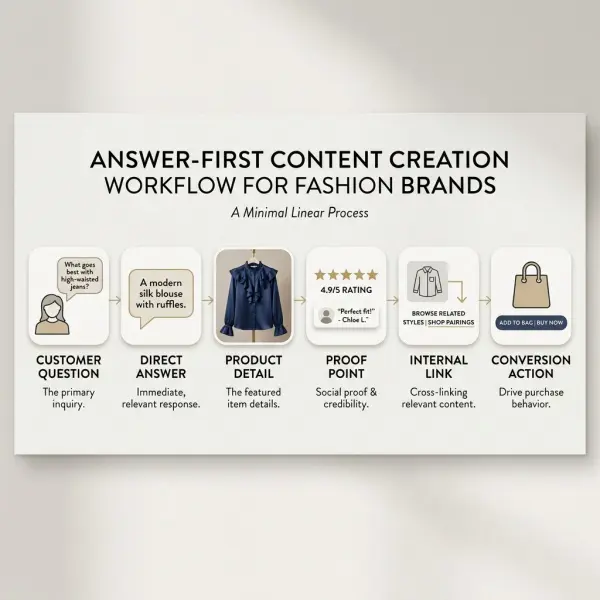
A good pattern is:
Direct answer → practical explanation → fashion-specific nuance → business or buying implication.
For example:
“Cotton poplin is usually better for crisp shirts than soft draped dresses because it has a cleaner structure and smoother surface. The final result still depends on yarn quality, fabric weight, finishing, and pattern design, but poplin is often chosen when a brand wants a neat, polished shirt silhouette.”
This paragraph is answer-ready, but still editorial. It gives the answer, explains why, adds a caveat, and connects the information to product design.
Fashion brands can use this pattern across:
- Product descriptions.
- Fabric explainers.
- Fit guides.
- Size guides.
- Styling articles.
- Manufacturing or sourcing content.
- Sustainability pages.
- Customer service pages.
- Business profile descriptions.
The point is not to oversimplify. The point is to answer clearly before adding depth.
Common AEO Mistakes Fashion Brands Should Avoid
Mistake 1: Adding FAQ sections without improving the page
FAQ sections can help readers, but they cannot rescue a weak product page. If the main product description is vague, the size information is unclear, and the material details are missing, adding five FAQ questions at the bottom will not solve the core problem.
A better approach is to improve the main content first. The FAQ should handle remaining questions, not carry the whole page.
Mistake 2: Publishing generic AI-written content at scale
AI can help organize drafts, create outlines, and generate variations, but unmanaged AI content can become generic very quickly. In fashion, this is risky because details matter. Fabric performance, fit, construction, care, production, and sustainability claims need human review.
Google has stated that using automation, including AI, is not automatically against its guidelines, but content created primarily to manipulate search rankings is a problem; see Google guidance about AI-generated content.
For fashion brands, the practical standard should be higher than “not penalized.” The content should be useful enough that a customer, buyer, stylist, or editor would trust it.
Mistake 3: Treating “sustainability” as a single answer
Sustainability is not one claim. It is a set of practices and trade-offs. A product may use lower-impact material but still have long-distance shipping. A made-to-order model may reduce excess stock but increase waiting time. Recycled synthetic fibers may reduce virgin material use but still raise questions around microfibers and end-of-life handling.
AEO content should avoid compressing this into simple promotional language. A better page explains what the brand does, what evidence supports the claim, and what limitations remain.
Mistake 4: Ignoring internal links between answers
AEO works better when related answers connect logically. A product page about a silk blouse should link to a silk care guide. A wool coat page should link to a fit guide and care instructions. A garment manufacturer’s sampling page should link to production planning and quality control articles.
Internal links help users continue their decision journey and help search systems understand topical relationships.
Mistake 5: Optimizing only blog content
Many fashion brands treat blogs as the only place for SEO and AEO. That is a mistake. Product pages, collection pages, About pages, business profiles, size guides, shipping pages, return pages, and store location pages are often closer to conversion and should also be answer-ready.
A customer deciding whether to buy does not want to search through a blog to find basic fit or care information. The answer should be on the product page.
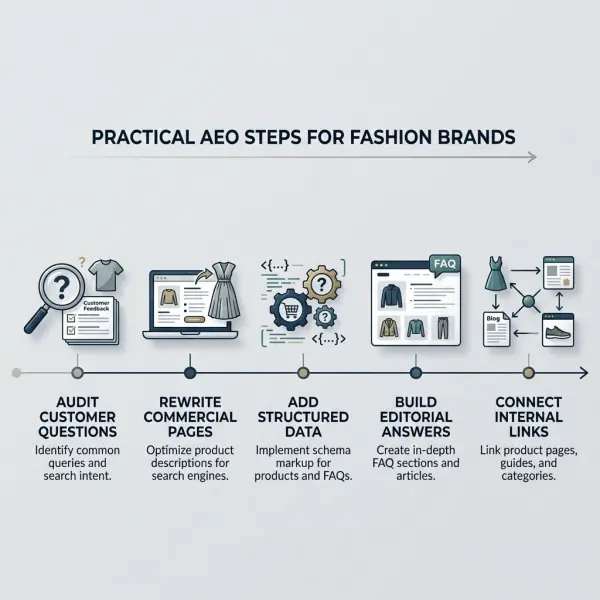
How Fashion Brands Can Apply AEO in Practice
AEO implementation should start with pages that influence revenue and trust. For most fashion brands, this means product pages, category pages, About pages, business profile descriptions, and customer support pages before large-scale editorial expansion.
Step 1: Audit real customer questions
Collect questions from customer service chats, Instagram DMs, store staff, comments, product returns, sales consultations, wholesale inquiries, and search data. Look for repeated uncertainty. Are customers asking about sizing? Fabric transparency? Shipping? Alterations? Styling? Care? Material origin?
These questions reveal where your content is not clear enough.
Step 2: Rewrite commercial pages with direct answers
Update product and category pages so they answer the questions that affect purchase decisions. For each important product category, explain fit, fabric, use case, care, styling, and comparison points. Avoid turning the page into a technical manual, but do not hide essential information behind poetic copy.
Step 3: Add structured data accurately
Once visible information is clear, add relevant structured data. For ecommerce brands, Product schema should match the actual product page. For editorial pages, Article schema can support content understanding. For local boutiques, LocalBusiness schema may support business identity and location clarity.
Step 4: Build supporting editorial content
Create guides that answer broader questions around your product category. A modest fashion brand might publish guides on layering, fabric opacity, office styling, and occasion dressing. A denim brand might publish content on fit, rise, wash, stretch, care, and alteration. A bridal brand might answer timeline, fittings, silhouettes, fabric choice, and customization questions.
Step 5: Link answers into a decision path
AEO is not only about being quoted by an answer engine. It should also help customers move forward. Link from educational articles to product categories, from product pages to care guides, from size guides to relevant collections, and from business profile pages to booking or store visit pages.
For the next article in this cluster, the deeper focus will be optimizing your fashion business profile for better visibility across Google, AI platforms, and local search, which is especially relevant for boutiques, showrooms, studios, and fashion service providers.
What Fashion Brands Should Verify Before Acting
Fashion brands should verify that their AEO work is accurate, useful, and commercially aligned before publishing. Answer engines may compress information, so unclear or exaggerated claims can become more misleading when summarized.
Before acting, check:
- Are product claims supported by actual material, construction, or supplier information?
- Are sustainability claims specific and evidence-based?
- Are fit and sizing notes based on real garment measurements?
- Are structured data fields accurate and visible on the page?
- Are FAQ answers genuinely helpful, or just keyword variations?
- Are internal links relevant to the customer’s next decision?
- Is AI-assisted content reviewed by someone who understands fashion products?
- Does the page help a real shopper make a better decision?
AEO should make the brand clearer, not louder. If the content becomes more inflated but not more useful, the strategy is moving in the wrong direction.
FAQ
What does AEO mean for fashion brands?
AEO means Answer Engine Optimization. For fashion brands, it means creating content that directly answers customer questions about products, fit, materials, styling, care, shipping, sustainability, availability, and brand credibility. It helps search engines and AI assistants understand the brand’s information more clearly. AEO is most effective when it is built on strong SEO, accurate product data, useful content, and consistent brand identity.
Is AEO the same as GEO?
AEO and GEO overlap but are not exactly the same. AEO focuses on becoming a clear answer for question-based systems, featured snippets, voice search, and AI assistants. GEO, or Generative Engine Optimization, is often used to describe visibility in generative AI search experiences. Google’s 2026 guidance notes that both terms are used in the industry, but from Google Search’s perspective, optimization for generative AI search is still part of search optimization.
Do fashion brands need FAQ pages for AEO?
FAQ pages can help, but they are not enough by themselves. AEO should be built into product pages, category pages, size guides, care guides, About pages, business profiles, and editorial content. The best answers should appear where the customer naturally needs them. A product fit question belongs on the product page, not only in a separate FAQ section.
Can AEO help fashion ecommerce sales?
AEO can support ecommerce sales by reducing uncertainty before purchase. When customers clearly understand size, fit, fabric, care, styling use, availability, and return conditions, they can make more confident decisions. AEO is not a direct sales guarantee, but it can improve the quality of product information and make pages more useful for both search systems and shoppers.
What pages should a fashion brand optimize first for AEO?
Start with pages closest to purchase or inquiry: product pages, category pages, size guides, care guides, About pages, location pages, and business profile descriptions. After that, build supporting editorial content around fabric education, styling advice, product comparison, sustainability explanation, and post-purchase care. This sequence helps the brand improve commercial clarity before expanding content volume.
Is AI-generated content safe for fashion brand SEO and AEO?
AI-assisted content can be useful when reviewed carefully, but publishing generic AI-generated content at scale is risky. Fashion content often involves specific product, material, fit, construction, and sustainability details. If those details are inaccurate or vague, trust can suffer. Google’s guidance says automation is not automatically against its rules, but using automation mainly to manipulate rankings is problematic.
How can small fashion brands compete in answer engines?
Small fashion brands can compete by being more specific than larger competitors. A clear niche, strong product detail, useful customer answers, authentic proof, complete business profile, and consistent brand identity can make a small brand easier to understand. Instead of trying to answer every fashion topic, small brands should answer the questions most relevant to their products, customers, location, and buying journey.
Conclusion
AEO is not a magic layer added after SEO. It is a discipline of clarity. For fashion brands, that clarity must show up in product pages, material explanations, fit guidance, styling content, brand claims, business profiles, structured data, and customer support information.
The brands that benefit most from AEO will not necessarily be those that publish the most content. They will be the brands that answer better: with specific product information, honest caveats, credible proof, and content that helps customers make real decisions.
In fashion, visibility has always depended on taste, trust, and timing. In the AI search era, it also depends on whether the internet can understand the brand clearly enough to present it as a useful answer.




Comments 0
Leave a CommentSend Comment
Anda harus Login terlebih dahulu untuk dapat memberikan komentar.