

Supply Chain Digitization Trends Fashion Brands Should Know
Quick Answer
Supply chain digitization in fashion is the use of connected digital systems, standardized product data, automation, analytics, and traceability tools to manage apparel sourcing, production, inventory, logistics, compliance, and product lifecycle information more accurately. The most important trends are not only about adopting new software. They are about making supply chain data cleaner, more connected, and more useful for decisions.
For fashion brands, the key digitization trends include product data governance, PLM and ERP integration, supplier collaboration platforms, RFID and item-level visibility, AI-assisted demand planning, Digital Product Passport readiness, traceability systems, circular inventory management, and risk dashboards for sourcing disruption.
The caveat is that digitization does not automatically create a smarter supply chain. If product codes, supplier records, material information, inventory data, and workflow ownership are weak, technology may simply make poor processes move faster. The best fashion brands treat digitization as an operating model: define the data, connect the workflow, train suppliers and teams, then use technology to make decisions earlier and with less guesswork.

What Is Supply Chain Digitization in Fashion?
Supply chain digitization in fashion is the process of converting fragmented product, sourcing, production, inventory, logistics, and compliance workflows into structured digital systems that can be shared, updated, analyzed, and acted on across the apparel value chain. It is not only the move from paper to software. It is the move from disconnected information to operational visibility.
A fashion brand may already use digital tools: spreadsheets, e-commerce dashboards, warehouse systems, accounting software, supplier emails, and cloud folders. But that does not always mean the supply chain is truly digitized. If the merchandising team uses one product code, the warehouse uses another, the supplier updates production status by message, and the sustainability team stores certificates separately, the business still has a fragmented supply chain.
True digitization connects the logic of the business. A product record should link to its fabric, trims, supplier, purchase order, production status, shipment, inventory, sales channel, return flow, compliance documents, and, where relevant, customer-facing product information. This is why digitization sits directly above fashion supply chain visibility. Visibility tells the business what it can see. Digitization determines whether the information can move through systems reliably.
Why Fashion Supply Chain Digitization Is Becoming More Urgent
Fashion supply chains are under pressure from shorter selling windows, volatile sourcing conditions, tighter margins, sustainability regulation, and more complex retail channels. A brand that sells through stores, e-commerce, marketplaces, wholesale, pop-ups, and resale cannot rely on slow manual updates and still expect accurate inventory, delivery promises, or product claims.
Recent policy developments are also pushing fashion companies toward more structured product data. The European Commission’s textile strategy includes actions to introduce a Digital Product Passport, set design requirements for longer-lasting and more repairable textiles, and create harmonized Extended Producer Responsibility rules for textiles. In April 2025, the Commission described the Digital Product Passport as a key innovation under the 2024 Ecodesign for Sustainable Products Regulation, designed to store and share product data on sustainability, durability, and other environmental aspects.
This matters even for brands outside Europe if they sell into EU markets, supply EU retailers, or work with global buyers that expect structured data. A supplier in Asia, for example, may eventually need to provide more consistent material, production, and compliance data because a European client needs it for reporting or product disclosure.
Digitization is also becoming a resilience issue. Vogue Business reported in January 2026 that fashion supply chains are being shaped by climate disruption, shifting tariffs, legislation, and the need for stronger traceability and supplier collaboration. These pressures do not make technology a magic solution, but they make slow and scattered information more expensive.
Trend 1: Product Data Governance Becomes the Foundation
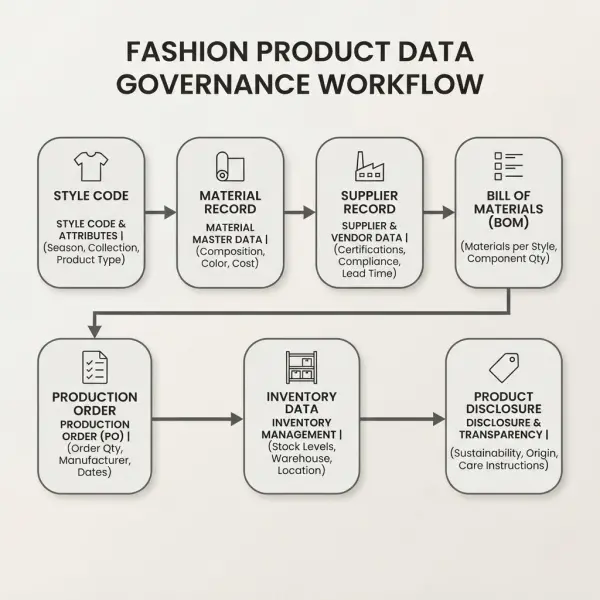
The first major digitization trend is not glamorous: fashion brands are paying more attention to product data governance. This means defining how product information is created, named, approved, updated, and shared.
In apparel, product data is unusually complex. A single garment may include a style code, color code, size matrix, fabric composition, bill of materials, trim references, care instruction, fit specification, supplier assignment, factory location, packaging detail, sustainability documentation, pricing data, product imagery, and channel-specific descriptions. If those records are inconsistent, every digital system built on top of them becomes weaker.
Good product data governance answers practical questions:
- Who owns the master product record?
- Which system is the source of truth for style, color, and size?
- How are fabric composition changes approved?
- Which fields are mandatory before purchase orders are issued?
- How are supplier documents linked to products?
- How is old data archived without confusing current production?
This trend matters because many brands want AI, dashboards, traceability, or Digital Product Passports, but the foundation is often missing. If the same fabric appears under three names in three systems, a traceability platform may not know whether those records refer to the same material. If care labels are updated after sampling but not connected to final production data, product information becomes unreliable.
For most brands, product data governance is the cheapest and most powerful first step. It reduces confusion before the business spends heavily on advanced tools.

Trend 2: PLM, ERP, and Inventory Systems Are Moving Closer Together
Fashion companies are increasingly trying to connect product lifecycle management, enterprise resource planning, warehouse, retail, and e-commerce systems. The goal is not to own more software. The goal is to reduce the gap between product development, sourcing, production, stock, and sales.
A product lifecycle management system may manage tech packs, sampling, materials, and product approvals. An ERP may manage purchase orders, supplier records, inventory, costing, and financial controls. A warehouse system manages receiving, picking, packing, and stock movement. An e-commerce platform displays availability to customers. If these systems do not talk to each other, teams still need manual reconciliation.
The practical benefit of integration is timing. If production is delayed, retail allocation can adjust earlier. If a fabric is substituted, costing and labelling teams can review the impact before goods ship. If sell-through is stronger than expected, replenishment can be evaluated against actual production capacity rather than gut instinct.
The risk is over-integration without process clarity. Connecting systems before defining clean workflows can create expensive confusion. Fashion brands should map the decision flow first: which data is created where, which system owns it, who can edit it, and which teams depend on it.
Trend 3: Supplier Portals Are Replacing Informal Updates
Supplier portals and collaborative sourcing platforms are becoming more important because supply chain visibility depends on supplier participation. A brand cannot digitize production if factories, mills, trim suppliers, inspection teams, and logistics partners still send critical updates through scattered messages and PDFs.
A supplier portal can support production milestone updates, document uploads, sample comments, corrective actions, shipment confirmations, and compliance evidence. It helps turn supplier communication into structured data.
This is especially useful when a brand works with multiple sourcing regions. A delay in fabric dyeing, trim approval, or final inspection may affect the entire launch calendar. If the update arrives late, the brand may have fewer options. If the update enters a shared system early, the brand can adjust allocation, marketing, customer communication, or delivery priorities.
The key is usability. Suppliers are often under administrative pressure, especially smaller factories. A complicated portal that adds work without helping the supplier may be ignored or updated only when chased. The best supplier systems fit real production routines: clear milestone fields, simple document requirements, mobile access where useful, and escalation rules that both sides understand.

Trend 4: RFID and Item-Level Tracking Are Becoming More Strategic
RFID is one of the clearest examples of digitization moving from back-office theory to practical retail operations. In fashion, RFID can help track garments, cartons, samples, stockroom items, and store inventory at a more granular level.
The main reason RFID matters is SKU complexity. Fashion retailers need to know not only that a product exists, but whether the right size, color, and style is actually available in the right location. This is difficult when products move between warehouse, store, stockroom, fitting room, return desk, online order queue, and markdown area.
RFID can support faster stock counts, item-level inventory accuracy, omnichannel fulfillment, and loss visibility. The deeper discussion belongs in RFID in fashion industry applications and benefits, but its role in digitization is straightforward: RFID improves the quality and frequency of physical product data.
The limitation is also clear. RFID does not solve weak product data, poor store discipline, or supplier inconsistency by itself. It works best when connected to product identifiers, inventory systems, warehouse workflows, and staff routines.
Trend 5: AI Is Moving Into Demand Planning, Allocation, and Exception Management
AI is becoming more visible in fashion supply chain digitization, especially in forecasting, allocation, replenishment, pricing, product recommendations, and exception detection. The strongest use cases are often decision-support rather than full automation.
Fashion buying and merchandising have always combined numbers with taste. AI can process larger sets of signals—sales, search behavior, click patterns, product metadata, location differences, and past performance—but it still needs human judgment. Vogue Business reported in April 2026 that fashion buyers and merchandisers are using AI to refine assortments, analyze real-time signals, and improve allocation, while human teams still interpret trend context and cultural relevance.
In supply chain terms, AI can help answer questions such as:
- Which products are likely to stock out before replenishment arrives?
- Which stores are overstocked in specific sizes?
- Which supplier delays are becoming recurring patterns?
- Which purchase orders are exposed to tariff, climate, or logistics risk?
- Which returns patterns indicate fit, quality, or description problems?
The danger is treating AI as a substitute for operational truth. AI models depend on the quality of historical data, product metadata, inventory records, and business assumptions. If past sales underrepresented plus sizes, certain regions, or new customer segments, a model may reinforce those blind spots. If stock data is inaccurate, demand forecasts may be distorted.
For fashion brands, the practical approach is to use AI where data is strong and repeatable, such as core replenishment or inventory exception alerts, while preserving human judgment for trend-led products, new categories, creative direction, and brand positioning.

Trend 6: Digital Product Passport Readiness Is Becoming a Data Project
Digital Product Passport readiness is one of the most important digitization trends for fashion brands selling into Europe or working with European buyers. The DPP is not just a consumer-facing QR code. It is a structured product data system that may require reliable information about materials, durability, repairability, circularity, environmental aspects, and compliance-related records.
The European Commission states that technical preparation for the DPP rollout includes rules on identifiers and data carriers, access rights to DPP information, and the establishment of a DPP registry and web portal. This means brands should not wait until final textile-specific details are fully operational before improving their product data systems.
The practical preparation areas include:
- Product identifiers and digital carriers, such as QR codes, data matrix codes, RFID, or other approved methods.
- Material composition records connected to actual production, not only sampling.
- Supplier and factory information at the required level of granularity.
- Evidence for product claims, such as recycled content, certification, or performance attributes.
- Care, repair, reuse, and recycling information where relevant.
- Data access controls, because not all information should be public.
The most common mistake is assuming DPP readiness can be handled at the marketing stage. It cannot. If product records, material documentation, supplier evidence, and lifecycle data are not collected during development and production, the brand may struggle to assemble reliable information later.
Useful external references include the European Commission consultation on the Digital Product Passport, the EU Strategy for Sustainable and Circular Textiles, and the Ecodesign for Sustainable Products Regulation implementation page.

Trend 7: Traceability Is Shifting From Marketing Claim to Operational Control
Traceability has often been discussed as a sustainability or transparency tool, but it is increasingly becoming an operational control system. Fashion brands need to know where products and materials come from not only to tell a better story, but to manage compliance, sourcing risk, supplier exposure, and product claims.
UNECE has worked on traceability and transparency for sustainable value chains in the garment and footwear sector, including a normative framework and technical standard for value chain traceability. The broader direction is clear: supply chain data is becoming more structured, more shareable, and more tied to verification.
For fashion brands, traceability is most useful when it answers specific questions:
- Which supplier, mill, or processor handled this product?
- What material batch was used?
- Which certification or document supports this claim?
- Which purchase orders are affected if a supplier risk appears?
- Can the brand prove origin, composition, or compliance if challenged?
Blockchain may still be used in some traceability projects, but the larger trend is not “blockchain for fashion.” The larger trend is verifiable, interoperable, and permissioned data. A blockchain record does not make false data true. If incorrect supplier information is entered, the technology may preserve the error. Verification, evidence quality, and governance still matter.
Trend 8: Circular Inventory and Unsold Stock Data Are Becoming More Important
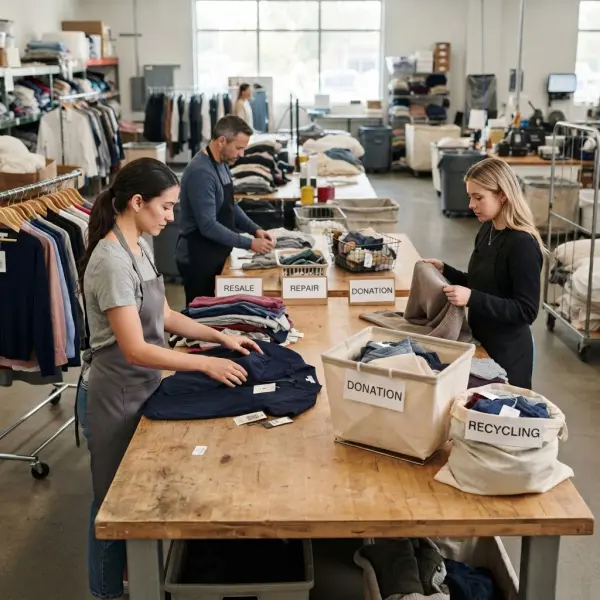
Fashion digitization is also moving into circular inventory management: returns, resale, repair, rental, donations, recycling, and unsold stock. This trend is being driven by margin pressure, consumer interest in secondhand models, sustainability expectations, and regulation.
In February 2026, the European Commission adopted measures under the ESPR to prevent the destruction of unsold apparel, clothing accessories, and footwear. The Commission stated that large companies will be subject to the ban from 19 July 2026, while medium-sized companies are expected to follow in 2030, and it introduced standardized disclosure for discarded unsold consumer goods.
That changes the data problem. Brands need to know what happened to unsold goods, not only what was sold. Were items transferred, discounted, repaired, donated, resold, recycled, or discarded? Which products repeatedly create excess stock? Which categories have high returns because of fit, quality, color mismatch, or misleading product descriptions?
The revised Waste Framework Directive, which entered into force in October 2025, also introduced common rules for Extended Producer Responsibility schemes for textiles and footwear in EU Member States. This makes end-of-life data more commercially relevant.
Circularity cannot be managed only through sustainability reports. It needs product-level and inventory-level systems that connect design, buying, production, returns, resale, repair, and waste management.
Trend 9: Risk Dashboards Are Becoming Part of Sourcing Strategy
Fashion sourcing used to be heavily driven by cost, capacity, lead time, and supplier relationship. Those factors still matter, but risk visibility is becoming more central. Tariffs, climate events, port disruption, political instability, material shortages, factory compliance issues, and regulatory changes can all affect production and landed cost.
A risk dashboard does not predict everything. Its value is to consolidate signals and make exposure visible. A brand may need to know which purchase orders depend on one region, which supplier has repeated delays, which materials come from climate-exposed areas, or which products lack required compliance evidence.
This trend is especially relevant for brands that source across multiple countries. When disruption happens, the question is not only “What happened?” It is “Which products, orders, margins, customers, and launch dates are affected?” A digitized supply chain can answer that faster.
The better systems combine supplier data, production status, shipment information, inventory exposure, and compliance documentation. The best teams then use that data in sourcing strategy, not only crisis response.
What These Trends Mean in Practice
For fashion brands, the central shift is from document-based supply chains to data-based supply chains. The old model stores information in files, emails, and people’s memory. The new model treats product and supply chain data as an operational asset.
This changes how teams work. Designers need to understand that material choices affect data requirements. Sourcing teams need to collect supplier evidence earlier. Merchandisers need to trust stock and allocation data. Sustainability teams need access to product-level records, not just annual summaries. Retail teams need inventory visibility that reflects physical reality.
A practical implementation path may look like this:
|
Priority |
What It Means |
Why It Matters |
|
Product data foundation |
Standardize style codes, materials, sizes, suppliers, and product records |
Prevents confusion across PLM, ERP, inventory, and compliance systems |
|
Supplier data workflow |
Move supplier updates into structured portals or shared systems |
Reduces late discovery of delays and missing documents |
|
Inventory digitization |
Improve barcode, RFID, warehouse, and store stock accuracy |
Supports omnichannel, allocation, and markdown control |
|
Product disclosure readiness |
Prepare product data for DPP, claims, and compliance needs |
Reduces future reporting pressure and supports transparency |
|
Analytics and AI |
Use dashboards and models for forecasting, exceptions, and risk |
Helps teams act earlier, but depends on reliable data |
This sequence is intentionally practical. A brand does not need to implement everything at once. It needs to build the layers in the right order.
Common Mistakes Fashion Brands Make With Digitization
Mistake 1: Digitizing Broken Processes
Many brands try to digitize workflows before fixing them. They move messy spreadsheets into software, keep unclear approval rules, and expect the system to create discipline. The result is often more screens, not better decisions.
The better approach is to simplify the workflow first. Define what must be tracked, who owns the data, which approval points matter, and which exceptions need escalation. Then choose tools that support that workflow.
Mistake 2: Treating Compliance Data as a Separate Sustainability Task
Compliance and sustainability data are often handled by a separate team after products are already developed. This creates a scramble when buyers, regulators, or marketplaces ask for evidence.
The better approach is to collect evidence during product development and sourcing. Material composition, supplier documentation, restricted substance testing, certification records, and repair information should be linked to product records early. This is especially important as DPP and EPR requirements develop.
Mistake 3: Building Dashboards Without Decision Rules
A dashboard can display attractive charts while failing to change behavior. If no one knows what to do when a metric turns red, the dashboard is decoration.
A useful dashboard should answer action-oriented questions: which order is at risk, which supplier needs escalation, which product lacks data, which store has stock mismatch, which item should be transferred, which return reason requires product correction.
Mistake 4: Overestimating AI and Underestimating Data Quality
AI can help fashion teams process signals faster, but it is not a substitute for clean data, buyer judgment, supplier relationships, or product expertise. If historical data is biased, incomplete, or distorted by stockouts and markdown timing, AI outputs may be misleading.
The better approach is to start with narrow AI use cases where the data is strong: core replenishment, anomaly detection, demand sensing for stable categories, supplier delay alerts, or inventory exception management. Trend-led fashion still needs human interpretation.
What Brands Should Verify Before Following a Digitization Trend
Fashion businesses should evaluate digitization trends through operational fit, not hype. A tool may be useful for a global retailer but unnecessary for a small brand with limited SKUs and one warehouse. Another tool may seem expensive today but become necessary if the brand sells into regulated markets.
Before investing, brands should verify:
- Which specific decision the technology will improve.
- Whether product and supplier data are clean enough to support the tool.
- Whether suppliers can participate without excessive administrative burden.
- Whether the system integrates with existing PLM, ERP, WMS, POS, or e-commerce platforms.
- Whether the brand needs carton-level, batch-level, or item-level visibility.
- Whether compliance or product disclosure requirements apply to current or future markets.
- Whether staff have time and training to maintain data quality.
- Whether data privacy, confidentiality, and access rights are clearly managed.
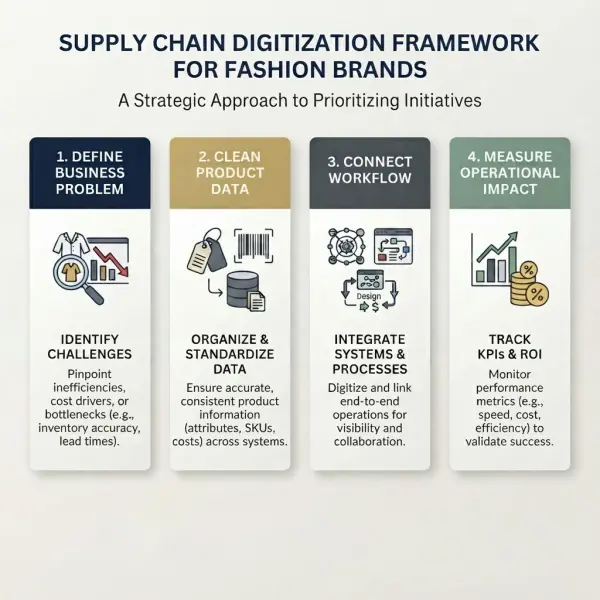
The best digitization projects usually start with one painful operational question. Where are we losing margin because information arrives too late? That question is often more useful than asking which technology is trending.
FAQ
What is supply chain digitization in fashion?
Supply chain digitization in fashion means using connected digital systems and structured data to manage product development, sourcing, production, inventory, logistics, compliance, and product lifecycle information. It goes beyond replacing paper with software. The goal is to make supply chain information accurate, shared, searchable, and useful for decisions. For fashion brands, this may include PLM, ERP, supplier portals, RFID, inventory systems, Digital Product Passport data, traceability platforms, and analytics dashboards.
What is the most important first step in fashion supply chain digitization?
The most important first step is usually product data governance. Brands need consistent style codes, color names, size structures, material records, supplier references, bills of materials, and approval workflows before advanced tools can work properly. Without this foundation, PLM, ERP, AI forecasting, RFID, and traceability systems may produce unreliable results. Clean data is not the most exciting part of digitization, but it is often the part that determines whether the project succeeds.
How does digitization improve sourcing decisions?
Digitization improves sourcing decisions by making supplier performance, production milestones, material readiness, documentation, and risk exposure easier to compare. Instead of relying only on memory or informal updates, sourcing teams can see which suppliers deliver reliably, which materials often cause delays, which regions carry risk, and which purchase orders need attention. This helps brands balance cost with reliability, quality, compliance, and lead time. It does not replace supplier relationships, but it gives teams better evidence.
Is AI necessary for fashion supply chain digitization?
AI is not necessary at the beginning. Many fashion brands should first improve product data, inventory accuracy, supplier communication, and system integration. AI becomes more useful when the brand already has reliable data and repeatable decisions to support, such as replenishment, allocation, forecasting, anomaly detection, or risk alerts. AI can process large volumes of data faster than humans, but it can also amplify bad assumptions if the underlying data is weak.
How does the Digital Product Passport affect fashion brands?
The Digital Product Passport affects fashion brands by increasing the need for structured product data on materials, durability, sustainability-related information, repairability, circularity, and compliance. The exact requirements for textile products continue to develop, so brands should avoid overclaiming readiness. However, they can prepare by improving product identifiers, supplier documentation, material records, evidence management, and data access controls. DPP readiness is mainly a product data and supply chain governance project, not just a QR code project.
What is the difference between traceability and digitization?
Digitization is the broader process of converting supply chain workflows into structured digital systems. Traceability is a specific capability within that system: the ability to follow products, materials, or components through the value chain. A fashion brand can digitize inventory or purchase orders without full traceability. But strong traceability usually requires digitized product records, supplier data, material documentation, and event tracking.
Can digitization make fashion supply chains more sustainable?
Digitization can support sustainability, but it does not automatically make a supply chain sustainable. It can help brands measure inventory waste, track materials, support repair or resale, reduce avoidable overproduction, and document product claims. But sustainability improvements still depend on design choices, sourcing decisions, production methods, logistics, pricing models, and consumer behavior. A digital record can improve accountability, but the business must still act on what the data shows.
Should small fashion brands invest in supply chain digitization?
Small fashion brands should invest selectively. They do not need the same system stack as a global retailer. A realistic starting point may be standardized product records, clean purchase order tracking, basic inventory software, barcode discipline, and structured supplier updates. RFID, AI, advanced traceability, and Digital Product Passport platforms may become relevant later, especially if the brand grows into wholesale, multiple stores, resale, regulated markets, or complex sourcing.
Conclusion
Supply chain digitization is becoming one of the most important operating shifts in fashion. Not because every brand needs the newest software, but because apparel businesses can no longer afford to manage complex product, supplier, inventory, compliance, and circularity data through fragmented systems.
The strongest trends are practical: cleaner product data, better supplier collaboration, connected PLM and ERP systems, item-level inventory visibility, AI-assisted decision support, traceability, Digital Product Passport readiness, circular inventory management, and risk dashboards. Each trend is useful only when it supports a real business decision.
For fashion brands, the best strategy is to digitize with sequence and discipline. Start with the product data foundation. Connect the workflows that create the most operational pain. Train suppliers and teams. Use dashboards and AI only where the data is reliable enough to guide decisions. Prepare for product disclosure requirements before they become urgent.
The future of fashion supply chains will not be won by brands that collect the most data. It will be won by brands that know which data matters, can trust it, and can act on it faster than their competitors.





Comments 0
Leave a CommentSend Comment
Anda harus Login terlebih dahulu untuk dapat memberikan komentar.