

Why PLM Systems Help Brands Manage Collections More Efficiently
Quick Answer
PLM systems help fashion brands manage collections more efficiently by connecting every proposed style, colorway, material, cost, sample, deadline, and approval to a structured collection record. This gives product teams a clearer view of what is being developed, what has changed, which products are commercially viable, and which styles are not ready to move forward.
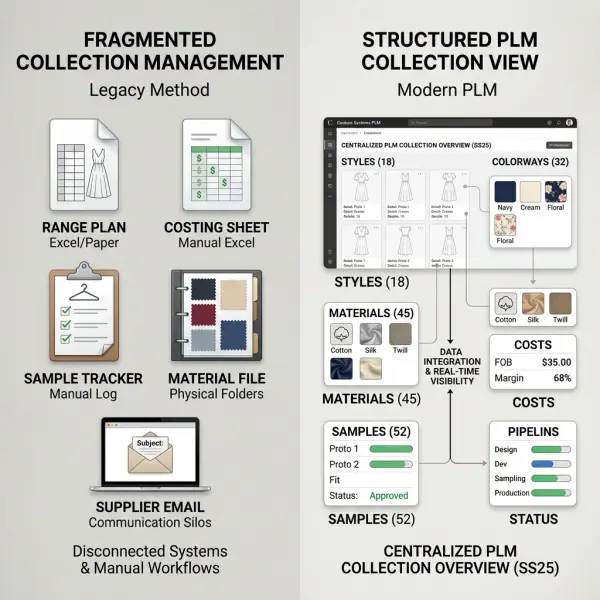
Without that structure, collection decisions are often spread across design boards, range-plan spreadsheets, costing files, sample trackers, supplier emails, and meeting presentations. Each document may show part of the collection, but no single view reliably explains its current status.
Fashion PLM can reduce this fragmentation by linking collection architecture with product-development detail. Teams can compare planned and active styles, reuse approved materials, monitor target costs, identify duplicate products, control colorway changes, and track readiness against key milestones.
PLM does not determine which collection will sell. Demand forecasting, buying quantities, allocation, pricing, and inventory management usually require additional planning and operational systems. Its primary role is to make the developing collection more visible, consistent, and controllable before commercial commitments become difficult to reverse.

What Does Collection Management Mean in Fashion PLM?
Collection management in fashion PLM is the structured organization and control of products being developed for a season, drop, capsule, category, customer group, or delivery period. It connects collection-level objectives with detailed product records so teams can assess the range as a coordinated commercial offer rather than as a series of unrelated garments.
The term “collection” does not mean exactly the same thing in every fashion business. A luxury brand may organize two major seasonal collections supported by pre-collections and capsules. A direct-to-consumer brand may work through monthly drops. A uniform manufacturer may manage customer programs rather than trend-driven seasons. A footwear company may build ranges around product families, activities, and gender categories.
A PLM system needs to accommodate the hierarchy the business actually uses. That hierarchy may include:
- Brand
- Market or region
- Season
- Collection
- Drop or delivery window
- Product division
- Category
- Product family
- Style
- Colorway
- Size range
- Market-specific version
At its broadest level, Product Lifecycle Management connects people, product information, processes, and business systems across a product’s lifecycle. IBM describes PLM as an information backbone for managing products and product portfolios from concept through later lifecycle stages. IBM’s overview of Product Lifecycle Management
Fashion-oriented PLM applies that foundation to styles, colorways, materials, Bills of Materials, technical specifications, samples, costs, suppliers, and development calendars. Readers who need the broader software explanation can begin with fashion PLM software explained for apparel businesses.
Collection management is a more specific question: how does the brand use those connected product records to shape, review, approve, and release a coherent range?
Why Fashion Collections Become Difficult to Control
A collection can look straightforward in an early design presentation. It may contain a clear theme, a defined color palette, several key silhouettes, and an apparently balanced mix of products.
The complexity appears when each concept becomes a live development project.
One proposed dress may expand into five colorways, two fabric options, a broad size range, three sample rounds, alternative suppliers, and several cost scenarios. A knitwear style may be removed from one delivery period and moved into another. A jacket may be retained visually while its construction, fabric, price, and delivery date continue to change.
Soon, the business is no longer managing 60 sketches. It is managing hundreds of connected decisions.
Several recurring conditions make collection control difficult.
Product Information Lives in Separate Files
Design may maintain a visual line sheet. Merchandising has a range-plan spreadsheet. Product development uses a sample tracker. Sourcing keeps quotation files, while management reviews a presentation prepared before the most recent changes.
Each view may be valid for its function, but the collection can no longer be assessed reliably without reconciling several sources.
Style Counts Change Throughout Development
A planned collection rarely moves unchanged from concept to production.
Styles are added, combined, delayed, cancelled, or carried over. Some colorways are dropped because of minimum order quantities, fabric availability, cost, or weak range differentiation. Other products remain in development despite unresolved technical issues because nobody has made a formal go-or-stop decision.
Without controlled status definitions, the collection can appear larger and more complete than it really is.
Product Variants Multiply Quietly
A style count alone can hide substantial operational complexity.
A collection of 80 styles may involve 320 colorways. Those colorways may use 120 materials, multiple trim combinations, several packaging formats, and market-specific labels. One additional colorway can create new sourcing, sample, testing, costing, photography, and inventory implications.
PLM helps teams see the relationships behind the headline style count.
Commercial Decisions Arrive Too Late
Design teams may invest substantial effort in products before sourcing confirms lead time, merchandising confirms price architecture, or technical teams confirm feasibility.
When commercial or manufacturing constraints are identified late, the brand must either absorb additional cost, compromise the product, delay delivery, or cancel development work that has already consumed time.
The issue is not that every constraint must be known at concept stage. The issue is whether the workflow introduces each decision early enough to remain useful.

Collection Reviews Depend on Manual Preparation
Many businesses prepare collection reviews by copying data into a new presentation. This creates an attractive meeting document but also a timing problem: the information begins becoming outdated as soon as it is exported.
Employees then spend the meeting debating whether the numbers, colors, costs, or style status are current.
A PLM-supported review can draw from the live product records, although the system must still be updated consistently for that view to be trusted.
How PLM Makes Collection Management More Efficient
It Connects the Collection Plan to Individual Style Records
A collection plan may define the number and type of products the business intends to develop. The plan could specify categories, target prices, delivery dates, consumer segments, product roles, or intended color balance.
PLM connects those collection-level intentions to the product records that must deliver them.
A merchandising team may plan:
- Ten dresses
- Eight woven tops
- Six knit tops
- Five trousers
- Four skirts
- Three jackets
- Two statement pieces
As styles are created, developed, cancelled, or moved, the collection view can show whether the range still reflects that structure.
This matters because the collection can drift during development. Ten dress concepts may become fourteen active dresses while the outerwear category remains underdeveloped. Without a live comparison, the imbalance may not become obvious until a formal review.
It Creates a More Reliable Style and Colorway Count
Style counts often become a source of disagreement because teams count different things.
Design may count every sketch. Merchandising counts commercially approved styles. Product development counts products with active tech packs. Sourcing counts styles sent for quotation. Operations counts production-ready Stock Keeping Units.
PLM can reduce this ambiguity by defining product statuses and allowing reports to distinguish between:
- Proposed styles
- Active development styles
- Approved styles
- On-hold styles
- Cancelled styles
- Production-ready styles
- Carryover products
- Archived products
The same principle applies to colorways. A color shown on an early concept board should not necessarily be counted as an approved commercial option.
Clear status definitions make collection reviews more meaningful. They also prevent teams from presenting aspirational product counts as committed output.
It Makes Collection Gaps and Duplication Easier to See
A fashion range can become repetitive even when individual styles appear attractive.
Three tops may use slightly different necklines but compete for the same customer, occasion, price point, and delivery window. Meanwhile, the collection may lack an entry-price product or a versatile layering piece.
PLM cannot judge the collection’s aesthetic quality independently. It can make relevant attributes available for comparison.
Teams may filter or group styles by:
- Category
- Silhouette
- Product role
- Price band
- Fabric
- Color family
- Delivery period
- Consumer segment
- Supplier
- Development status
- Target margin
- Carryover versus newness
This supports a more disciplined range review. The team still makes the decision, but it can examine the collection through more than a visual impression.
It Controls Colorways More Deliberately
Colorways can create disproportionate complexity.
Adding a color may require another laboratory dip, print strike-off, trim combination, sample, material commitment, photography asset, product description, Stock Keeping Unit structure, and inventory allocation. The commercial value of the additional option therefore needs to justify more than the visual appeal of the color itself.
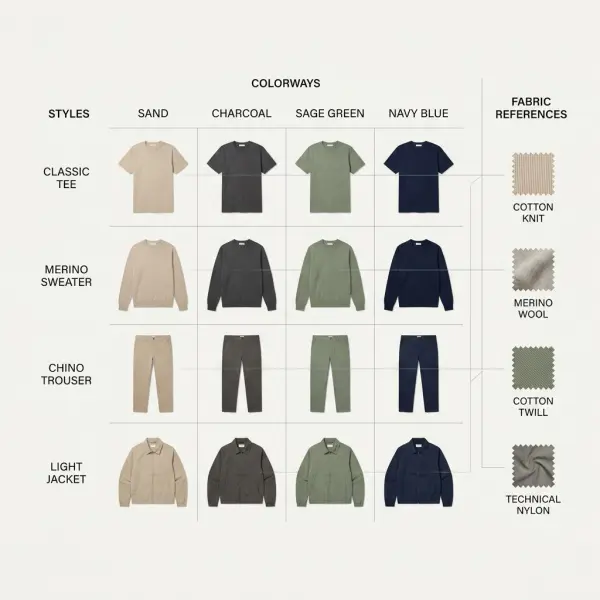
PLM can link each colorway to its materials, status, cost, supplier, sample requirements, and target market. Teams can see whether a proposed option uses an existing approved palette or introduces entirely new development work.
This makes it easier to separate:
- Concept colors
- Development colors
- Approved colors
- Market-specific colors
- Dropped colors
- Carryover colors
The system does not determine the optimal number of colorways. That depends on customer demand, channel, price, minimum quantities, production capability, and inventory strategy.
It Encourages Material and Component Reuse
Material reuse is not simply a sustainability issue. It is also a product-development and commercial consideration.
Using an existing approved fabric across several styles may reduce duplicate development, simplify color coordination, support larger aggregate orders, and make supplier communication more consistent. Whether it improves cost or lead time depends on order quantities, supplier terms, availability, and the final product specifications.
A material library can help teams identify where the same fabric, trim, label, or packaging component is already being used. Before creating a new record, users can search for approved options with relevant characteristics.
The collection view can then show concentration and dependency. If 40 percent of a collection relies on one fabric that has not yet been approved, the issue becomes a collection-level risk rather than an isolated material task.
It Connects Costing to the Evolving Range
Collection profitability cannot be assessed accurately by looking only at one style at a time.
A few products may exceed their target cost but play an important role in brand image or category credibility. Other products may need to deliver stronger margin to support the overall range. The appropriate decision depends on the business model and pricing strategy.
PLM can connect target cost, estimated cost, supplier quotation, material choices, and style status. This allows teams to identify:
- Styles above target cost
- Products with no confirmed quotation
- Categories concentrated in one price band
- Colorways that create separate material commitments
- Designs whose cost changed after sample revision
- Products with insufficient margin assumptions
- Styles awaiting a value-engineering decision
The system provides visibility, not certainty. Cost estimates remain sensitive to material consumption, order quantity, exchange rates, freight, duties, labor assumptions, supplier negotiation, and production location.
It Makes Development Readiness Visible
A style should not move forward simply because the sketch has been approved.
Production readiness may depend on technical specification, BOM completion, material confirmation, fit approval, cost approval, testing requirements, artwork, labeling, packaging, and supplier capacity.
PLM can represent these requirements as milestones or approval gates. A collection review can therefore distinguish between products that look finished and products that are operationally ready.
Oracle describes PLM as standardizing and structuring the data and processes used to innovate, develop, and commercialize products. That principle is relevant to collection control because a range becomes manageable only when products move through consistently defined stages. Oracle’s Product Lifecycle Management overview
It Helps Teams Manage the Critical Path
Fashion collection calendars contain dependencies.
A final cost cannot be confirmed until materials and construction are sufficiently defined. A pre-production sample should not be approved using an obsolete specification. Photography may depend on approved sales samples. Production booking may depend on material lead time and purchase commitment.
PLM workflows can link tasks, owners, dates, and status to each product. Teams can identify which delayed activities are likely to affect later milestones.
The most useful view is not a long list of overdue tasks. It is a view of the tasks that materially threaten the collection.
For example, a one-day delay in uploading an inspiration image may have little operational impact. A one-day delay in approving a custom fabric before a mill booking deadline may be significant.
It Supports Earlier Go, Hold, Revise, or Cancel Decisions
One of the most expensive collection-management habits is allowing weak or unresolved styles to continue indefinitely.
A product may remain active because design likes the concept, sourcing expects a better quotation, or merchandising hopes the cost will improve. Meanwhile, sampling and development continue.
PLM can make the unresolved conditions visible:
- Target cost has not been achieved.
- Material is not confirmed.
- Required minimum quantity is excessive.
- Fit approval has missed two milestones.
- Supplier capacity is unavailable.
- The style duplicates another product.
- The delivery window is no longer realistic.
Management can then make a defined decision: continue, revise, hold, move to another delivery, or cancel.
Cancelling a style is not automatically evidence of failure. An early, evidence-based cancellation can protect resources for stronger products. The greater problem is allowing an unviable style to consume attention without a formal decision.
It Makes Carryover Products Easier to Govern
Carryover products are styles retained from an earlier season or period, usually because they remain commercially relevant or form part of a core range.
They may appear simple because the product already exists. In practice, several details may need review:
- Is the same material still available?
- Has the supplier price changed?
- Are measurements and construction still current?
- Have labeling requirements changed?
- Is the color being repeated exactly?
- Does the previous artwork remain valid?
- Is the product moving to a new factory?
- Are existing photographs and descriptions reusable?
PLM can copy or reference approved records while preserving a distinction between inherited data and newly verified information.
A carryover should not be treated as “no development required.” It is better understood as reduced development with specific verification points.
From Collection Brief to Production Release
An efficient PLM-supported collection process does not need to be perfectly linear. Fashion development often requires iteration. It does, however, need clear decision points.
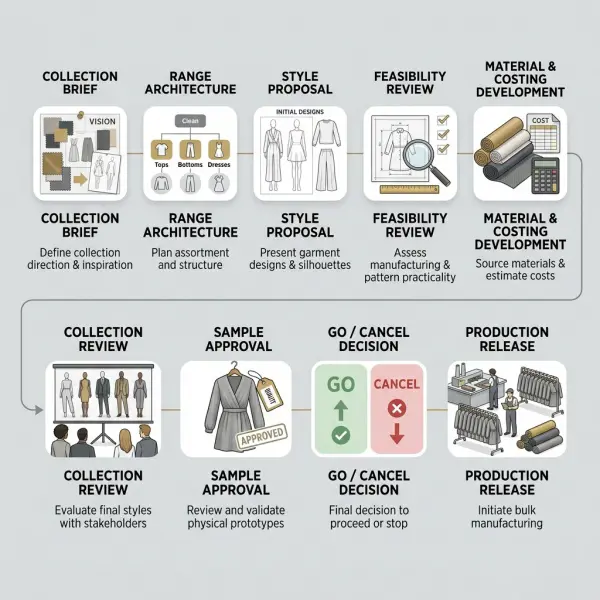
Stage 1: Define the Collection Architecture
Before individual products multiply, the business should define the commercial frame.
This may include:
- Intended customer
- Product categories
- Planned style count
- Delivery windows
- Price architecture
- Newness versus carryover balance
- Core and statement products
- Material direction
- Color strategy
- Channel or regional requirements
These are planning assumptions, not permanent truths. They provide a baseline against which later development can be assessed.
Stage 2: Create and Classify Product Proposals
Each proposed product should be linked to the collection and classified using consistent attributes.
The record may identify category, silhouette, product role, target price, delivery, color direction, responsible developer, and initial material concept.
At this stage, the business should distinguish an idea from a committed product. Otherwise early concepts inflate the apparent size of the collection.
Stage 3: Test Feasibility
As product definitions become clearer, teams examine technical, sourcing, cost, supplier, quality, and calendar feasibility.
The objective is not to eliminate creative risk. It is to identify whether the product can be developed under the intended commercial and operational conditions.
A design can remain ambitious while the team is honest about what it requires.
Stage 4: Review the Range as a Whole
Collection review should not be reduced to individual style approval.
Teams need to ask:
- Is the category balance still appropriate?
- Are too many products competing in the same price band?
- Does the color offer remain coherent?
- Is the collection overly dependent on one supplier or material?
- Are enough styles likely to meet the delivery window?
- Is newness concentrated in commercially risky products?
- Are carryovers still relevant?
- Which styles lack a clear customer or product role?
PLM helps by making comparable product attributes and status available in one environment.
Stage 5: Make Development Commitments
At defined points, the business may commit to materials, supplier capacity, samples, sales presentation, or production preparation.
The closer the collection moves to these commitments, the more controlled changes need to become.
A late colorway addition may appear minor creatively but may create new minimum quantities, approvals, testing, photography, and inventory complexity.
Stage 6: Release Approved Product Information
Products that meet the required criteria can move into downstream sourcing, ERP, purchasing, production, Product Information Management, or e-commerce processes.
PLM should make clear which product definition is approved and which information remains subject to change.
A Practical Collection Review Example
Consider a mid-sized apparel brand developing an 80-style women’s collection across three delivery periods.
At the beginning of the season, the plan appears balanced:
|
Category |
Planned styles |
|
Dresses |
16 |
|
Woven tops |
14 |
|
Knit tops |
12 |
|
Trousers |
10 |
|
Skirts |
8 |
|
Knitwear |
8 |
|
Jackets |
7 |
|
Accessories |
5 |
|
Total |
80 |
Six weeks later, the active development data tells a different story.
Design has added six dresses and four woven tops. Two jackets have not progressed beyond concept because the selected fabric is unavailable. Three knitwear styles exceed target cost. Several accessories were never assigned to a developer.
A presentation based on the original plan still shows 80 styles. A design board may show 90. Product development reports 78 active records, while sourcing has received only 61 styles for quotation.
A PLM-supported review can separate these numbers.
|
Product status |
Number of styles |
Management implication |
|
Initial collection plan |
80 |
Baseline only |
|
Product concepts created |
90 |
Includes unapproved additions |
|
Active development |
78 |
Current workload |
|
Cost reviewed |
61 |
Commercial visibility incomplete |
|
Material confirmed |
54 |
Significant sourcing dependency remains |
|
Sample approved |
33 |
Production readiness still limited |
|
On hold |
7 |
Requires decision or revised milestone |
|
Cancelled |
5 |
Should no longer appear as active |
|
Production-ready |
26 |
Current confirmed output |
The purpose of this view is not to punish teams for failing to preserve the original plan. Collections evolve. The purpose is to distinguish what was intended, what is being developed, and what is genuinely ready.
The team can then decide whether to accelerate underrepresented categories, cancel duplicative dresses, move selected jackets to another delivery, or reduce colorways where material commitment is becoming excessive.
PLM Is Not the Same as Assortment Planning or Inventory Management
This distinction is essential.
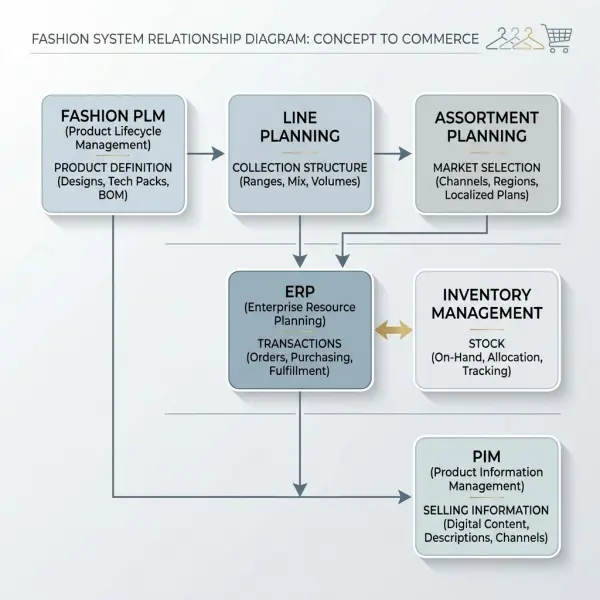
PLM helps define and develop products. Assortment planning helps determine which products and quantities should be offered by channel, store, region, or customer segment. Inventory systems track the stock that has been ordered, received, allocated, sold, transferred, or returned.
These areas interact, but they are not interchangeable.
|
System or discipline |
Main decision |
Typical information |
|
Fashion PLM |
What is the product, and is it ready? |
Styles, colorways, materials, BOMs, samples, specifications, cost estimates, approvals |
|
Line or range planning |
What should the collection contain? |
Product roles, categories, target counts, price bands, delivery periods |
|
Assortment planning |
Which products should be offered in each market or channel? |
Store or channel demand, breadth, depth, localization, planned sales |
|
ERP |
What resources and transactions must be managed? |
Purchase orders, production orders, inventory, invoices, suppliers, finance |
|
Inventory management |
How much stock exists and how is it moving? |
Stock on hand, receipts, allocation, sell-through, transfers, replenishment |
|
PIM |
How will approved product information be distributed commercially? |
Product descriptions, attributes, localization, digital-channel content |
Centric Software’s explanation of line planning and assortment planning notes that aligning these activities may require numerical, textual, and visual data from PLM, ERP, and retail-planning systems. As vendor documentation, it is useful for understanding the intended system relationship, although the exact boundaries depend on each company’s technology architecture. Centric Software’s comparison of line planning and assortment planning
A PLM system may contain range-planning features, and some software suites combine PLM with merchandise planning or pricing applications. Buyers should still determine which module performs each function and which data is shared between them.
The inventory consequences of collection decisions are explored more deeply in fashion inventory management explained for retail businesses.
Which Collection Decisions PLM Can Support
PLM becomes commercially useful when it helps teams make specific decisions rather than merely storing product records.
Whether to Add Another Style
Before adding a style, teams can review whether it fills a genuine category, price, customer, or occasion gap.
A visually appealing product may still duplicate an existing item. PLM provides comparative data, but the team must interpret its creative and commercial value.
Whether to Add or Remove a Colorway
The decision should consider more than palette balance.
Teams may need to review minimum quantities, trim coordination, sample requirements, target market, material availability, and inventory implications. PLM can expose these dependencies before approval.
Whether to Reuse a Material
Material reuse may simplify development, but suitability depends on garment function, weight, stretch, opacity, drape, care, construction, price, and availability.
A fabric that performs well in a loose blouse may not be appropriate for a fitted dress even when the visual direction is similar.
Whether to Continue an Over-Cost Style
A style above target cost may be revised, repositioned, retained strategically, or cancelled.
The correct response depends on price elasticity, brand role, margin structure, competitive context, and whether the cost issue can be addressed without damaging the product.
PLM helps ensure that the decision uses the current specification and cost assumptions.
Whether to Move a Product to a Later Delivery
A delayed product may still be commercially viable in another drop. The team should examine seasonality, material availability, marketing timing, supplier capacity, and whether the product remains relevant to the revised collection.
Moving the style should update the collection relationship, calendar, and downstream requirements rather than being treated as a calendar edit alone.
Whether to Carry a Product Forward
A carryover decision should review previous performance alongside current development feasibility.
PLM may provide the product definition and history, while sales and inventory information generally comes from planning, business-intelligence, or ERP systems. Integration or disciplined data exchange is therefore important.
How Different Fashion Businesses Can Use PLM for Collections
Emerging Fashion Brands
A young brand may not need enterprise-level collection software, but it still benefits from defining style status, collection hierarchy, material records, and approval rules.
The main risk for a small team is overdevelopment. Founders can become attached to too many concepts and continue sampling products that have no clear price, customer, or launch role.
A lightweight PLM or structured product-development platform can help create decision discipline before the assortment becomes large.
Direct-to-Consumer Brands
Direct-to-consumer brands may work through frequent drops and shorter planning cycles. Their collection structure may be less seasonal but more operationally continuous.
PLM can help distinguish core products, tests, capsules, collaborations, replenishable styles, and limited releases. Integration with sales and inventory data is especially important because the brand may need to apply recent performance signals to future product decisions.
Multi-Brand Fashion Groups
A multi-brand company needs enough standardization to compare collections while preserving brand-specific product logic.
Shared definitions for status, cost, materials, suppliers, and milestones can improve group visibility. However, forcing identical workflows onto luxury tailoring, sportswear, accessories, and basic apparel may create unnecessary friction.
The governance model should standardize what needs comparison and allow variation where product development genuinely differs.
Apparel Manufacturers
Manufacturers developing products for several buyers may organize collections by customer program, delivery, product category, or sales sample range.
PLM can help separate customer-specific information, track which specifications belong to each buyer, and manage repeated materials or constructions.
Permissions are critical. One customer should not gain access to another customer’s designs, costs, or product-development records.
Private-Label Retailers
Private-label retailers can connect range architecture with buyer briefs, supplier development, cost targets, quality requirements, and launch dates.
Their main challenge is often scale. Similar product categories may be managed by several buying teams, creating duplicate materials, inconsistent terminology, and uneven supplier instructions.
PLM can provide a shared structure while assortment and inventory systems manage channel demand and stock commitments.
Uniform and Workwear Businesses
Uniform collections may be less trend-driven but more complex in terms of customer-specific branding, fabrics, fit options, compliance requirements, replenishment, and long product lifecycles.
PLM can support controlled product families and customer variants. Collection efficiency in this context means maintaining consistency over time rather than delivering frequent fashion newness.
A Practical Strategy for Applying PLM to Collection Management
Start with Collection Definitions
Agree on what the business means by season, collection, drop, style, option, colorway, carryover, cancelled, approved, and production-ready.
These definitions sound basic, but reporting becomes unreliable when teams interpret them differently.
Define Mandatory Product Attributes
Not every field needs to be completed at concept stage. Required information should increase as the product advances.
For example:
|
Development stage |
Minimum required information |
|
Concept |
Category, product role, target price, delivery, owner |
|
Feasibility |
Initial material, supplier option, cost estimate, technical risk |
|
Development |
BOM, colorways, specifications, sample status, milestone dates |
|
Approval |
Confirmed cost, approved materials, fit status, compliance requirements |
|
Release |
Final BOM, current specification, supplier, packaging, effective revision |
This staged approach prevents teams from entering production-level detail too early while still protecting downstream decisions.
Establish Collection Review Gates
Instead of allowing continuous development without decision points, create formal review gates.
Typical questions may include:
- Does the product fill a defined collection need?
- Is the target cost credible?
- Is the material feasible?
- Is the delivery achievable?
- Does the product duplicate another style?
- Are the proposed colorways commercially justified?
- Should the style continue, change, move, or stop?
The gates should be proportionate. A repeat core T-shirt may require a different review path from a technically complex outerwear product.
Build Exception-Based Dashboards
Management does not need to review every complete field.
A useful dashboard should highlight exceptions such as:
- Styles with no owner
- Missing target cost
- Materials without approval
- Overdue samples
- Duplicate colorways
- Products above cost tolerance
- Styles with no supplier
- Delivery dates at risk
- Products approaching a gate with incomplete data
- Cancelled styles still appearing in active reports
This directs attention toward decisions rather than administration.
Connect PLM to Planning and Operational Data
Collection development becomes more useful when product information can be compared with sales, inventory, margin, supplier, and market data.
The integration does not need to place every data point inside PLM. It needs a controlled way to bring relevant signals into collection decisions.
The organization should define:
- Which system owns each field
- How often information is updated
- Whether updates are automated or manual
- How mismatches are identified
- Who resolves incorrect or missing records
- Which historical data is comparable
Review Adoption by Decision Quality
System usage should not be measured only by login frequency.
A collection-management implementation is more credible when it helps the company answer questions earlier and with less manual reconciliation.





Comments 0
Leave a CommentSend Comment
Anda harus Login terlebih dahulu untuk dapat memberikan komentar.