
Streetwear Culture Explained for Modern Fashion
Quick Answer
Streetwear culture is a community-driven fashion ecosystem shaped by youth subcultures, music, skateboarding, surfing, sports, art, and everyday urban life. It is commonly associated with T-shirts, hoodies, sneakers, denim, workwear, caps, and relaxed silhouettes, but those products alone do not define streetwear. What matters is the cultural context surrounding them: who creates the style, which community adopts it, how products are distributed, and what identity the clothing communicates.
Unlike conventional fashion systems that historically moved trends from designers and runways toward consumers, streetwear often develops from the ground up. Local communities, musicians, skaters, artists, independent retailers, and collectors establish the codes before larger fashion businesses adopt them.
For modern fashion brands, streetwear matters because it changed how products are launched, communities are built, collaborations are structured, and cultural relevance is measured. Limited releases, direct-to-consumer distribution, graphic storytelling, sneaker culture, and creator-led branding all owe part of their commercial significance to streetwear. However, copying these visible tactics without a credible cultural position can make a brand appear manufactured rather than authentic.

What Is Streetwear Culture?
Streetwear culture is a decentralized fashion culture in which casual clothing, footwear, graphics, music, art, community participation, and local identity interact to create recognizable styles and brands. Its meaning depends not only on garment design but also on cultural credibility, distribution, communication, and the people who choose to wear it.
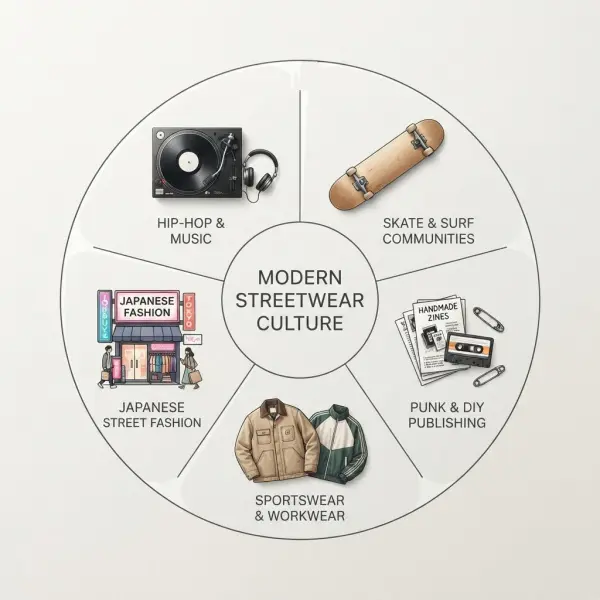
The word “streetwear” is useful, but imperfect. It brings together several overlapping histories rather than describing a single design movement with one founder, one birthplace, or one fixed aesthetic. Southern California surf culture, skateboarding, New York hip-hop, punk’s do-it-yourself attitude, sports uniforms, military clothing, workwear, sneaker collecting, club culture, and Japanese street fashion have all contributed to what the industry now groups under the term.
This explains why two brands can sell similar heavyweight T-shirts yet occupy entirely different positions. One may have grown from a local skate shop, music collective, or independent art scene. The other may simply have applied large graphics to blank garments after noticing a commercial trend. The products might appear similar in a photograph, but their cultural meaning is not the same.
That distinction is central to understanding streetwear.
Streetwear Is Not Just a Clothing Category
A hoodie is not automatically streetwear. Neither is a sneaker, graphic T-shirt, baseball cap, or oversized jacket. These are product formats that can appear in streetwear, sportswear, workwear, promotional merchandise, luxury fashion, or mass-market casualwear.
Streetwear becomes culturally distinct when several elements operate together:
- Clothing functions as a marker of community, taste, knowledge, or affiliation.
- Products reference a credible cultural context rather than an invented lifestyle.
- The audience participates in deciding what becomes desirable.
- Distribution and communication reinforce belonging or discovery.
- Styling allows personal interpretation rather than prescribing one complete look.
- The brand maintains a recognizable point of view across products and interactions.
This is why streetwear is better understood as a cultural and commercial system than as a simple product category.
Streetwear Versus Street Style
Streetwear and street style are related but not interchangeable.
|
Concept |
Practical meaning |
|
Streetwear |
A fashion and cultural ecosystem associated with subcultures, casual garments, community identity, independent brands, sneakers, graphics, and specific distribution practices |
|
Street style |
A broad term for clothing worn and photographed in public spaces, including tailoring, luxury fashion, vintage clothing, traditional dress, uniforms, and streetwear |
|
Casualwear |
Clothing designed for informal everyday use, regardless of whether it has a subcultural connection |
|
Sportswear |
Clothing influenced by athletic performance or leisure dressing; the meaning can vary by market and historical context |
|
Athleisure |
Clothing combining athletic references with everyday lifestyle use, often emphasizing comfort and versatility |
A tailored suit seen outside a fashion show may be part of street style, but it is not necessarily streetwear. Likewise, a basic sweatshirt sold by a conventional retailer is casualwear but may have no meaningful relationship with streetwear culture.
Where Did Streetwear Culture Come From?
Streetwear did not emerge from one clean historical sequence. It developed through exchanges among different communities, cities, creative industries, and forms of everyday dress.
Hip-hop communities in New York transformed sportswear, sneakers, jewelry, leather jackets, tracksuits, workwear, and luxury references into powerful forms of identity. The Museum at the Fashion Institute of Technology notes that hip-hop artists and audiences helped popularize streetwear, athleisure, logo-focused dressing, customization, and the mixing of luxury products with casual sportswear. Its account also emphasizes that these styles originated substantially within Black and Brown working-class communities whose contributions were often stereotyped before being absorbed into mainstream fashion. Readers can explore the Museum at FIT’s history of hip-hop style.
On the United States’ West Coast, surf and skate communities developed their own visual language around practical casual clothing, board graphics, T-shirts, shorts, sneakers, and independent retail. Stüssy’s official history describes the label as emerging from Southern California surf culture during the late 1980s and early 1990s before influencing the wider ideology of casualwear. This is one important strand of streetwear history, although it should not be treated as the movement’s only origin.
Skateboarding added more than loose clothing and durable footwear. It created networks of shops, photographers, filmmakers, magazines, graphic artists, crews, and local spaces. The Design Museum’s historical treatment of skateboard design similarly presents skateboarding as a story in which objects, performance, design, and communities progressed together. The Design Museum’s skateboard archive provides useful context for this relationship.
Punk and independent music scenes contributed another important principle: people did not need permission from established institutions to produce graphics, publish zines, customize clothing, organize events, or build small labels. This do-it-yourself mindset remains visible in many streetwear businesses, even when the final products are professionally manufactured.
Japan later became a major center for interpreting and developing streetwear through detailed product construction, selective retail, vintage Americana, local youth scenes, music, and distinctive brand worlds. The Design Museum identifies NIGO as one of the creatives who connected Japanese streetwear with global luxury fashion, illustrating how Tokyo’s street culture became an active producer of ideas rather than merely a recipient of Western influences.
A fuller examination of this transition belongs in how streetwear moved from subculture to everyday style. For the present discussion, the essential point is that streetwear grew through cultural exchange rather than through a conventional top-down fashion cycle.
What Makes Streetwear Culturally Distinct?
The visible garments change, but several underlying principles repeatedly appear across credible streetwear movements.
Cultural Authority Often Starts Outside the Fashion Establishment
Traditional fashion authority has frequently been concentrated among fashion houses, editors, buyers, department stores, and seasonal runway systems. Streetwear rearranged that hierarchy. A local shop, musician, skateboarder, photographer, stylist, DJ, graphic artist, or tightly connected customer group could create influence without first receiving institutional approval.
This does not mean streetwear exists outside commerce. Many important streetwear businesses are commercially sophisticated. The difference is that their original legitimacy often comes from participation in a community rather than from recognition by an established fashion institution.
For a brand, this changes the central question. Instead of asking only, “What product is trending?”, it must ask, “Why would this audience trust us to make it?”
Clothing Works as a Social Signal
Streetwear allows wearers to communicate cultural knowledge through relatively ordinary garments. A particular shoe model, graphic reference, collaboration, fit, fabric, or older collection can signal familiarity to people who understand its context.
The signal may communicate:
- Membership in a local or creative community.
- Knowledge of music, art, skating, sport, or design.
- Support for a particular independent label.
- Access to a limited or difficult-to-find product.
- Appreciation of a specific era, archive, or design reference.
- Personal skill in combining common garments in an uncommon way.
Not every customer interprets these signals identically. A product may carry deep meaning for one community and function as a fashionable object for another. That ambiguity is part of streetwear’s commercial reach, but it can also create tension when cultural symbols are separated from their origins.
Remixing Is Often More Important Than Inventing a New Garment
Streetwear rarely depends on creating completely unfamiliar garment categories. Its creativity frequently comes from reinterpreting existing objects: a work jacket in an unexpected fabric, a sports jersey with new graphics, a military silhouette adjusted for everyday wear, or a familiar sneaker connected to a different cultural story.
This process involves selection, proportion, styling, context, and association. A designer may alter the weight of a jersey, change the shoulder line, crop the body, enlarge a pocket, modify a wash, or combine references that were previously kept apart.
The garment may look simple. The judgment behind it is not.
Community Participation Shapes Value
In streetwear, customers are often more than end users. They photograph products, discuss releases, trade older pieces, attend events, create styling references, produce reviews, and help determine which items retain cultural relevance.
That participation can provide brands with valuable feedback, but it also limits managerial control. A company cannot simply declare itself culturally important. Its positioning must be accepted, interpreted, and repeated by other people.
This is where strong fashion brand storytelling becomes useful. The story must be reflected in the founder’s behavior, product choices, collaborations, service, retail environment, and long-term consistency. A polished campaign cannot compensate for contradictions across the rest of the business.
Which Products and Design Codes Are Associated With Streetwear?
Streetwear has no mandatory uniform. Nevertheless, certain product families appear repeatedly because they support movement, layering, customization, visual communication, and everyday use.
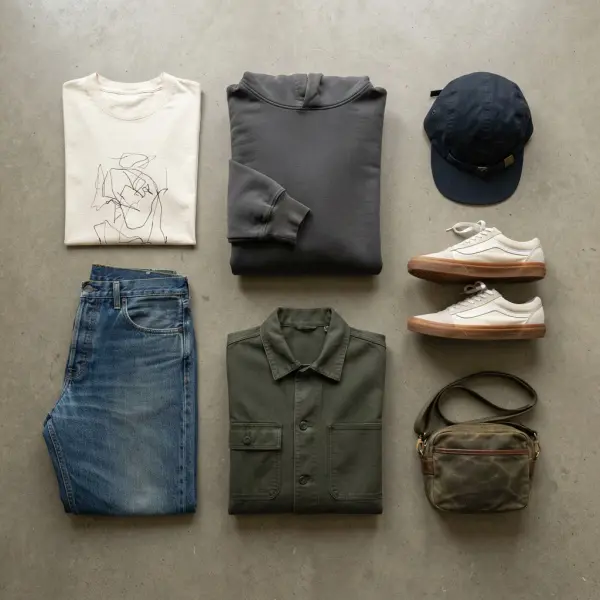
Common categories include:
|
Product or design code |
Why it appears frequently |
|
Graphic T-shirts |
Provide an accessible surface for artwork, identity, commentary, and collaboration |
|
Hoodies and sweatshirts |
Support comfort, layering, unisex positioning, and visible graphics |
|
Sneakers |
Connect fashion with sport, collecting, music, technology, and collaboration |
|
Workwear jackets and trousers |
Offer practical construction, recognizable utility details, and durability references |
|
Denim |
Provides styling flexibility and responds visibly to washing, wear, distressing, and customization |
|
Caps and beanies |
Function as accessible identity markers and styling components |
|
Track jackets and jerseys |
Carry associations with sport, teams, music, and regional identity |
|
Cargo or utility garments |
Add storage, structure, military references, and visual detail |
|
Statement accessories |
Allow wearers to personalize otherwise simple outfits |
|
Limited graphic objects |
Extend the brand world into boards, bags, books, toys, homeware, or collectible items |
These products are not culturally meaningful by default. Their significance depends on design quality, origin, styling, communication, and audience interpretation.
Fit and Proportion Carry Meaning
Streetwear is sometimes reduced to oversized clothing, but its relationship with fit is more sophisticated. Loose silhouettes may support movement, layering, visual presence, or a specific music and youth reference. Other streetwear traditions use cropped jackets, straight trousers, fitted caps, narrow denim, or carefully controlled proportions.
A brand must therefore develop fit intentionally rather than simply grading a conventional garment several sizes larger. An oversized T-shirt may require changes to shoulder width, sleeve opening, body length, neckline rib, and fabric weight. Without those adjustments, the garment can look incorrectly sized rather than deliberately proportioned.
Fit consistency is also commercially important. Customers who purchase through limited online releases may have little opportunity to try a product before checkout. Clear measurements, fit photographs, model information, and stable grading can reduce uncertainty and avoidable returns.
Graphics Need More Than Visual Impact
Graphics are one of streetwear’s most visible tools, but strong graphic design does more than fill a blank surface. It can establish a visual vocabulary, document a community, reinterpret an archive, introduce an artist, or connect a product to an event.
Brands should also distinguish original cultural commentary from careless reproduction. Logos, photographs, music imagery, team identities, characters, and artworks may be protected by intellectual property rights. Commercial use may require licensing, permission, attribution, or contractual agreements.
A design can feel culturally informal while still carrying formal legal obligations.
Construction Quality Still Matters
Streetwear’s casual appearance does not remove normal apparel quality requirements. Fabric stability, shrinkage, colorfastness, seam strength, print durability, zipper performance, embroidery backing, and measurement consistency all affect customer satisfaction.
Heavy fabric is not automatically high quality. A very dense hoodie may photograph well but feel uncomfortable in warm climates. An oversized screen print may crack if the ink system, curing process, fabric stretch, and washing conditions are poorly matched. A structured cap can lose shape when interfacing and storage methods are inadequate.
The brand must evaluate the actual use case, not only the visual impression.
How Does Streetwear Affect Modern Fashion Businesses?
Streetwear has influenced the fashion business by showing that cultural relevance, product access, community participation, and communication can be as important as conventional seasonal merchandising.
Its influence can be seen in direct-to-consumer launches, capsule collections, limited releases, creator collaborations, branded communities, sneaker partnerships, pop-up retail, archive reissues, and the growing importance of lifestyle content. These practices are no longer limited to companies formally described as streetwear brands.
Yet adopting the practice without understanding its purpose can produce weak results. Limited supply, for example, may help a small label test demand or protect cash flow. Artificially restricting a generic product solely to manufacture urgency is a different strategy, and customers may eventually recognize the difference.
Product Development Becomes More Focused
Many streetwear labels build recognition through a relatively narrow product architecture. Instead of designing a large collection immediately, they may establish a few repeatable forms: one T-shirt block, one hoodie fit, one trouser silhouette, a cap, and selected outerwear.
This can create operational advantages:
- Development effort can concentrate on fit and fabric refinement.
- Core patterns can be reused across graphic or material variations.
- Minimum order quantities can be allocated to fewer constructions.
- Customers can learn what to expect from recurring silhouettes.
- New collaborations can work within a stable product framework.
The limitation is creative repetition. If every release depends on changing only the front graphic, customers may eventually perceive the product as merchandise rather than considered fashion. Sustainable growth usually requires gradual development in construction, materials, styling, or category depth.
The Release Calendar Can Replace the Traditional Season
Streetwear businesses often communicate through drops, capsules, collaborations, or event-linked releases rather than relying exclusively on spring–summer and autumn–winter collections.
A release-based model can help a brand create clear communication moments and purchase materials in smaller stages. It may also suit direct-to-consumer operations better than delivering a complete wholesale collection at once.
However, frequent drops create their own workload. Every launch may require samples, photography, product descriptions, inventory setup, packaging, customer support, fulfillment preparation, and post-launch analysis. A business that releases too often can exhaust both its team and audience.
The correct cadence depends on production capacity, product complexity, cash flow, and whether each release has a credible reason to exist.
Retail Becomes a Cultural Environment
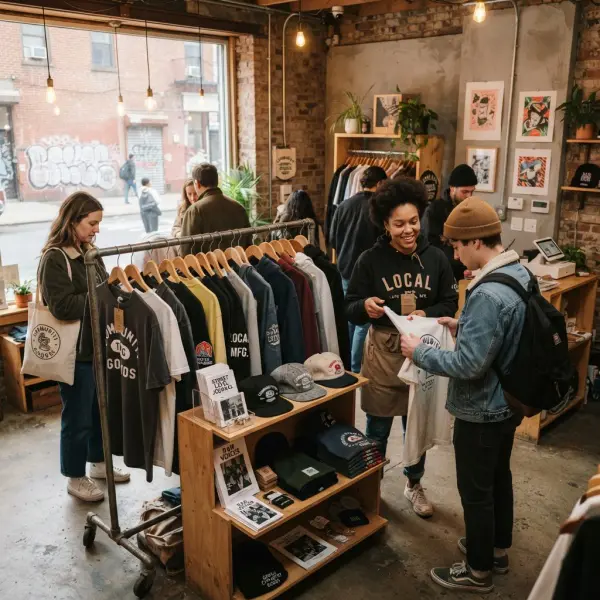
A strong streetwear store is rarely treated as neutral shelving. The music, staff knowledge, neighborhood, fixtures, product selection, events, and surrounding creative community all influence how customers understand the brand.
The same principle applies online. Product pages may complete the transaction, but editorials, interviews, videos, playlists, lookbooks, founder notes, and community documentation explain the wider cultural world.
This does not require expensive content. A small independent brand may benefit more from honest documentation of its process and local relationships than from a highly polished campaign that resembles every other fashion advertisement.
Collaboration Becomes a Business and Cultural Tool
Streetwear helped establish collaboration as a recurring method of product development and audience exchange. A collaboration can unite a brand with an artist, musician, sports organization, retailer, manufacturer, cultural institution, or another label.
Commercially, collaboration may provide:
- Access to a complementary audience.
- New design knowledge or production capability.
- Shared communication and launch costs.
- A reason to explore a product outside the normal range.
- Stronger credibility in a specific community.
The partnership still needs strategic logic. Combining two recognizable names is not enough. Customers should be able to understand what each party contributed and why the relationship belongs in the product.
Streetwear Is a Business of Identity, Not Only Scarcity
Limited availability is strongly associated with streetwear, but scarcity is frequently misunderstood.
A small release can result from practical constraints: limited capital, specialist materials, local production, experimental demand, or an artist agreement. In these cases, the production quantity follows the realities of the project.
Scarcity can also be deliberately used to concentrate attention and reduce broad market exposure. That strategy may work when customers already value the product. It cannot create lasting desirability for a brand that has no distinctive design, community, or product quality.
Resale prices are similarly imperfect indicators of brand health. A high aftermarket price may show that supply is below short-term demand, but it does not necessarily indicate customer satisfaction, stable revenue, accessible products, or long-term cultural relevance.
For many growing brands, a healthier model combines:
- Reliable core products that customers can purchase without difficulty.
- Selected limited items with a genuine design or production rationale.
- Controlled experimentation in new categories.
- Transparent communication about availability.
- Replenishment decisions based on demand and operational capacity.
Scarcity should support the brand’s positioning. It should not substitute for one.
How Can Fashion Brands Apply Streetwear Principles Strategically?
A fashion business does not need to call itself a streetwear label to learn from streetwear culture. The most useful principles are community proximity, product clarity, cultural specificity, disciplined distribution, and consistent identity.
Start With a Credible Cultural Position
Before developing products, the business should define the community and context it genuinely understands.
That context could be a local skate scene, music network, creative profession, university community, modest fashion audience, cycling culture, regional sports community, digital art movement, or another identifiable lifestyle. The relationship should be real enough that the team understands the audience’s language, routines, constraints, references, and purchasing behavior.
This does not mean founders must represent every customer personally. It means they should work with relevant people rather than treating a community as a visual mood board.
Build a Recognizable Product Architecture
A new brand usually benefits from a small group of products it can execute consistently. Product architecture should define:
- Core silhouettes and fit specifications.
- Fabric weights and performance expectations.
- Permanent versus seasonal colors.
- Graphic placement rules.
- Price hierarchy.
- Replenishable versus limited products.
- Packaging and labeling standards.
- Categories that will not yet be developed.
This discipline makes the collection easier to manufacture, communicate, and evaluate. It also prevents the business from spending limited cash on unrelated experiments.

Separate Community Building From Audience Extraction
Community should not mean collecting followers and repeatedly asking them to buy. Strong communities also receive value through information, events, recognition, access, creative opportunity, useful products, or genuine social connection.
A brand might document local artists, sponsor a small event, offer space for a workshop, publish a thoughtful interview, or collaborate with a practitioner under a fair commercial agreement. The activity should fit the brand’s actual resources and relationships.
The purpose is not to disguise marketing. It is to participate meaningfully in the environment from which the brand expects cultural relevance.
Adapt Products to the Market and Climate
Global streetwear imagery often emphasizes layering, heavy fleece, jackets, boots, and cold-weather styling. Those products may not perform equally well in tropical or humid markets.
Brands serving warmer regions may need to reconsider:
- Jersey weight and breathability.
- Garment width relative to body length.
- Lining and pocket construction.
- Moisture management.
- Print coverage and stiffness.
- Drying time.
- Colorfastness under strong sunlight.
- The practicality of layering.
Local adaptation does not weaken streetwear credibility. It can strengthen it by showing that the brand understands how its customers actually live.
Match Distribution to Operational Capacity
A high-traffic release can fail even when the product sells out. Oversold inventory, payment errors, delayed fulfillment, unclear sizing, poor packaging, and slow customer support can damage trust quickly.
Before promoting a release, the business should verify:
- Finished inventory and quality-control status.
- Stock synchronization across channels.
- Payment and checkout capacity.
- Packaging materials and staffing.
- Realistic fulfillment deadlines.
- Return and exchange procedures.
- Customer service scripts.
- Contingency plans for damaged or missing parcels.
Cultural excitement attracts attention. Operations determine whether customers return.
Common Streetwear Strategy Mistakes
Copying Surface-Level Codes
The most common mistake is imitating oversized silhouettes, graffiti-style typography, aggressive graphics, or limited drops without developing a clear cultural position.
This happens because visible design features are easier to reproduce than relationships, knowledge, or credibility. The result may look familiar enough to generate temporary attention but remain indistinguishable from hundreds of similar labels.
A better approach is to begin with a specific audience, product problem, local reference, or creative discipline and allow the visual language to develop from that foundation.
Treating Every Product as a Limited Edition
Constant limitation can frustrate customers who simply want to buy and wear the product. It can also prevent the brand from learning how a successful item performs through replenishment.
Not every release requires artificial rarity. Core items can provide stable revenue, while genuinely limited products can support experimentation, collaboration, or specialist production.
The distinction should be deliberate.
Prioritizing Graphics Over Garment Quality
A powerful image cannot correct a twisting side seam, unstable neckline, inconsistent sizing, weak rib, or print that deteriorates after several washes.
This mistake often occurs when founders come from branding or graphic design rather than apparel development. The solution is not to reduce creative ambition, but to give construction, testing, and supplier communication equal attention.
Customers may purchase the first item because of the design. Product performance influences whether they purchase again.
Borrowing From Communities Without Proper Participation
Streetwear frequently draws from music, sport, art, local language, traditional symbols, political movements, and marginalized communities. Using these references without context, permission, compensation, or credit can create reputational and ethical problems.
Brands should identify who created the reference, what it means, whether commercial rights are involved, and how the originating community participates in the value created.
A collaboration contract is often more appropriate than informal “inspiration.”
Confusing Hype With Durable Demand
A queue, viral post, celebrity appearance, or resale spike may produce a strong launch. It does not confirm that the brand has stable product-market fit.
Management should examine repeat purchase, return rates, full-price sell-through, customer acquisition cost, contribution margin, delivery performance, and demand across multiple releases. These measures provide a more complete picture than social visibility alone.
What Streetwear Culture Does Not Mean
Streetwear is not one universal aesthetic. It changes across cities, communities, climates, generations, genders, and price segments.
It is also not exclusively menswear, although parts of its commercial history have often been marketed through male-dominated communities and sizing systems. Women, gender-diverse consumers, designers, stylists, musicians, athletes, and artists have long shaped street fashion and streetwear, even when conventional industry narratives gave them less attention.
Streetwear is not automatically sustainable because products are released in small quantities. Limited production may reduce initial inventory exposure, but environmental impact still depends on fibers, dyeing, printing, manufacturing, transport, packaging, durability, use, and end-of-life handling.
Nor is streetwear automatically authentic because it is independent. A small company can exploit cultural references, while a large company can sometimes form a credible partnership with communities and creators. Scale matters, but conduct matters more.
Finally, streetwear is not “dead” simply because a particular logo, resale market, sneaker silhouette, or luxury collaboration loses momentum. The label may become less fashionable within industry commentary while the deeper practices—casual identity, community-led influence, product drops, cultural collaboration, and creator-driven brands—continue in other forms. Contemporary fashion commentary similarly describes streetwear as an evolving and contested category rather than a stable set of garments.
The continuing influence of casual identity on younger consumers is examined more closely in why casual identity still shapes youth fashion trends.
Frequently Asked Questions
What is the simplest definition of streetwear?
Streetwear is community-influenced casual fashion shaped by subcultures such as hip-hop, skateboarding, surfing, music, sport, art, and local urban scenes. It commonly uses familiar products—including T-shirts, hoodies, sneakers, denim, caps, and workwear—but gives them meaning through graphics, styling, cultural references, distribution, and community participation.
The definition should not be reduced to oversized clothing or limited releases. A product becomes relevant to streetwear through its context and the relationships surrounding it, not merely through its silhouette.
Is streetwear the same as urban fashion?
The terms sometimes overlap, but they are not exact synonyms. “Urban fashion” has been used inconsistently to describe clothing connected with city life, hip-hop, Black culture, youth consumers, or casual sportswear. In some commercial contexts, the term has also reduced diverse communities to a broad marketing category.
Streetwear is usually a more useful term when discussing the interaction among independent brands, skate and music cultures, sneakers, graphics, workwear, selective retail, and community-driven influence. Even so, streetwear is also broad and should be used with cultural and regional context.
Can a luxury brand produce authentic streetwear?
A luxury brand can create a credible streetwear-related product or collaboration, but premium pricing and designer status do not automatically provide cultural legitimacy. Credibility depends on what the brand contributes, whom it works with, how partners are compensated and credited, and whether the product respects the communities and references involved.
Luxury construction, specialist materials, and distribution can add value. Problems arise when a company extracts recognizable visual codes while excluding the creators who developed them. The partnership should demonstrate more than logo placement.
Does a streetwear brand need limited drops?
No. Limited drops are one possible distribution method, not a requirement. They can be useful when production capacity is small, materials are restricted, demand is uncertain, or a collaboration has a fixed quantity.
A brand may also benefit from permanently available core products. Reliable availability can improve revenue stability, fit confidence, customer access, and production planning. The most practical model for many independent labels combines replenishable essentials with selected limited projects rather than making every item intentionally difficult to purchase.
What materials are commonly used in streetwear?
Common materials include cotton jersey, fleece, denim, canvas, nylon, twill, ripstop, leather, knitted rib, and technical synthetic fabrics. The correct material depends on the garment, climate, price, construction, and intended performance.
A heavyweight cotton jersey may suit a structured T-shirt but feel uncomfortable in hot, humid conditions. Nylon can provide low weight and weather resistance, although its performance depends on construction and finishing. Brands should evaluate handfeel, shrinkage, colorfastness, abrasion, print compatibility, care requirements, and supplier consistency rather than selecting materials by trend alone.
How can a small streetwear brand compete without celebrity endorsements?
A small label can compete through product specificity, local relevance, consistent fit, credible relationships, disciplined storytelling, and reliable service. It does not need the same reach as a global company if it becomes meaningful to a clearly defined audience.
A practical strategy may involve one strong garment block, a distinctive visual system, documentation of the design process, collaboration with relevant local creators, and direct engagement with early customers. The objective is not to look artificially large. It is to become recognizably valuable within a community the business can genuinely serve.
Is streetwear mainly aimed at young consumers?
Streetwear has strong links with youth culture, but its audience is no longer limited to teenagers or young adults. People who participated in skate, hip-hop, sneaker, club, and streetwear communities in earlier decades may continue wearing related products as they age.
What often changes is the preferred expression. Some consumers move from prominent graphics toward better fabrics, subtle references, refined outerwear, or archive-inspired pieces. Brands should therefore segment customers by lifestyle, fit, price expectations, and cultural behavior rather than assuming that all streetwear buyers belong to one age group.
Conclusion
Streetwear culture cannot be explained adequately through a list of garments. Its importance comes from the relationship among clothing, community, identity, creative participation, and commerce.
Hip-hop, skating, surfing, punk, sport, workwear, club culture, and Japanese street fashion contributed different elements to the wider ecosystem. Their influence can be seen in how modern brands design products, build audiences, organize releases, form collaborations, and communicate cultural meaning.
For fashion businesses, the strongest lesson is not that every collection needs a hoodie, sneaker partnership, or limited drop. It is that cultural relevance must be earned through specific products, credible participation, consistent behavior, and sound operations.
Streetwear made casual clothing commercially powerful because communities turned everyday objects into meaningful signals. Brands can learn from that process. They should be careful, however, not to confuse its most visible outcomes with the cultural work that produced them.




Comments 0
Leave a CommentSend Comment
Anda harus Login terlebih dahulu untuk dapat memberikan komentar.