
How Interlining Improves Garment Shape, Stability, and Finish
A garment can use an attractive shell fabric, accurate pattern, and clean stitching yet still look unfinished if critical areas lack the right internal support.
A jacket front may collapse around the chest. A shirt collar may curl rather than stand cleanly. A waistband can distort during wear. Pocket openings may stretch out of shape, and a lapel that looked controlled during sampling can lose its intended roll after repeated use.
Interlining helps manage these problems by changing the mechanical behavior of selected garment components.
The important word is selected. Interlining is not intended to make an entire garment uniformly stiff. Its value comes from introducing different levels of support where the construction needs them while allowing other areas to retain softness, flexibility, stretch, or fluid drape.
For fashion businesses, this makes interlining part of silhouette engineering rather than simply a hidden trim. Its effect can influence how a garment hangs in a showroom, how consistent bulk production looks, how well key areas withstand deformation, and even how customers perceive quality when they try the garment on.
Quick Answer
Interlining improves garment shape, stability, and finish by modifying the mechanical behavior of selected areas of the shell fabric. Depending on its construction and application, it can increase bending resistance, limit unwanted stretch or distortion, reinforce edges, support three-dimensional form, improve shape retention, and help garment components maintain a cleaner appearance through wear and care.
Research on fusible interlining shows that bonding interlining to outer fabric can significantly change bending rigidity, shear stiffness, tensile behavior, drape, and fabric handle. These changes can help create the intended garment shape, but excessive or poorly matched reinforcement can also make a garment too stiff, reduce elasticity, or alter drape.
The objective is therefore not maximum structure. It is controlled structure: enough reinforcement to support the design while preserving the intended movement, comfort, surface appearance, and character of the garment.
Interlining Changes the Fabric System, Not Just Its Thickness
The simplest way to misunderstand interlining is to think of it as an extra layer that merely makes fabric thicker.
Once interlining is incorporated into a garment—particularly when it is fused to the shell—the resulting textile system can behave quite differently from either material on its own.
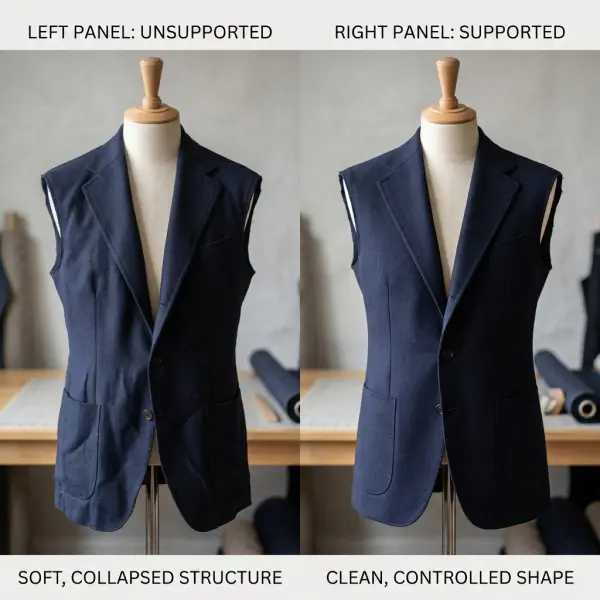
A lightweight suiting fabric, for example, may bend easily and deform readily when unsupported. Once bonded to an appropriate interlining, resistance to bending can increase, the fabric may become less prone to collapsing under its own weight, and certain areas can hold a designed contour more reliably.
Scientific reviews of fusible interlining describe measurable changes in tensile behavior, bending rigidity, shear stiffness, drape, handle, and dimensional behavior after interlining is applied.
Those changes are precisely why interlining is useful.
They are also why specification errors matter.
If reinforcement changes the shell more than expected, a garment that was intended to feel relaxed can become rigid. If support is insufficient, the same garment may look weak, stretched, or poorly resolved.
Interlining should therefore be evaluated as part of a shell–interlining–construction system, not as an isolated accessory.
How Does Interlining Improve Garment Shape?
Garment shape depends partly on pattern geometry and sewing, but fabric mechanics determine whether that geometry can maintain the intended three-dimensional form.
Some fabrics naturally hold shape better than others.
A dense coating wool may provide enough body for certain areas with relatively modest reinforcement. A lightweight viscose blend or soft tropical suiting can behave very differently. Even when two fabrics are cut from the same pattern, their finished silhouettes may not look identical because their resistance to bending, stretching, and shearing differs.
Interlining gives technical teams another variable to control.
By increasing resistance to certain types of deformation in targeted areas, it can help a garment maintain:
- a cleaner jacket front;
- a more defined lapel;
- a controlled collar roll;
- a stable waistband;
- straighter pocket openings;
- sharper cuffs and plackets;
- better-supported facings and edges.
The concept is especially important in tailored garments. Freudenberg describes apparel interlinings as structural materials intended to support garment shape and shape retention across applications ranging from suiting to lightweight leisurewear.
Yet the designer usually does not want every one of those areas to behave identically.
A lapel needs enough support to create a controlled roll. The chest may require structure without appearing flat. A front edge needs stability, while the body may still need to move naturally.
This is why well-developed garments can use several interlining specifications within one style.
Bending Rigidity: Why Some Garments Hold Their Form Better
One of the most relevant mechanical properties in understanding interlining is bending rigidity.
Bending rigidity describes how strongly a textile resists bending. A fabric with greater bending rigidity generally requires more force to curve than a highly flexible material.
Interlining often increases the bending rigidity of the combined fabric system. Research summarized in the journal Polymers reports that fused interlinings can significantly increase bending resistance, contributing to garment shape retention.
This becomes visible in everyday products.
Consider the front edge of a blazer. If the fabric bends and collapses too readily, the edge may not hang cleanly. Increasing controlled bending resistance can help maintain a more deliberate vertical line.
A shirt collar demonstrates the same principle on a smaller scale. Without sufficient bending resistance, the collar may collapse. Too much reinforcement, however, creates an excessively rigid collar that feels disconnected from the shirt body.
So bending rigidity has an optimum range for a particular design.
More is not automatically better.
Drape and Structure Are Closely Connected
Drape describes how fabric falls and forms folds under gravity.
Designers commonly think about drape when choosing shell fabrics, but interlining can alter that drape considerably.
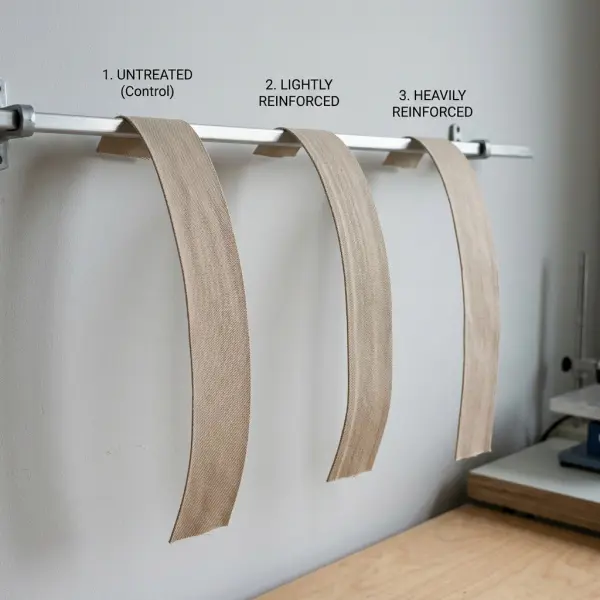
The reason is mechanical. Drape is influenced by properties including bending and shear behavior. Classic textile research established a relationship between fabric drape and both bending and shear stiffness, while more recent garment-package research continues to show that adding adhesive inserts changes bending rigidity and drape behavior.
This creates an important development trade-off.
Imagine a lightweight blazer intended to have a softly tailored silhouette.
The shell may drape beautifully on its own, but some reinforcement is required around the front, lapel, pockets, and edges. If the chosen interlining is too rigid, the garment may retain shape but lose the softness that defined the original concept.
A better interlining provides enough support without overwhelming the shell.
The same principle applies to dresses and blouses. Current interlining ranges for these categories include lightweight and flexible constructions specifically intended to support shape while preserving fluidity rather than converting the garment into a rigid structure.
For product developers, the implication is straightforward:
Never approve an interlining solely because it makes the component look more stable. Also ask whether the resulting drape still belongs to the garment being designed.
What Does Interlining Mean for Dimensional Stability?
Dimensional stability is the ability of a textile or garment component to resist unwanted changes in dimensions during manufacturing, wear, storage, or care.
Certain garment zones are particularly vulnerable to distortion.
Bias areas can stretch. Pocket openings can elongate. Necklines may grow during handling. Waistbands undergo repeated tension. Jacket edges can become wavy. Buttonholes and plackets need localized reinforcement so repeated use does not rapidly distort the surrounding fabric.
Interlining can help control these areas by restricting deformation or distributing stress across a more stable textile system.
That does not mean interlining eliminates dimensional change.
The interlining itself also responds to heat, moisture, tension, washing, dry cleaning, and mechanical action. If the shell and reinforcement shrink or recover differently, the combined structure may distort rather than stabilize.
This is particularly important for fusible systems, where shell and interlining behave as a bonded composite.
As discussed in Fusible vs Sew-In Interlining: What Fashion Teams Should Know, compatibility and process validation matter as much as the nominal strength of the interlining.
A stable garment therefore depends on compatible dimensional behavior, not simply on adding a supposedly stable backing.
Shear Stiffness Matters More Than Many Product Teams Realize
Garment fabrics do not only stretch lengthwise or bend.
They also deform through shear, where yarn directions change relative to each other without necessarily undergoing major yarn elongation.
This behavior is important because fabrics need to conform around three-dimensional body shapes. Shear helps a flat textile adapt around curves such as the chest, shoulder, hip, elbow, or seat.
Interlining can increase shear stiffness. Research summarized in the technical literature shows significant changes in shear behavior after fusible interlining is applied.
That can be beneficial when uncontrolled deformation needs to be limited.
It can also create problems if the garment becomes too resistant to the shaping needed around the body.
This is particularly relevant to tailoring. A jacket front needs enough structural control to maintain its design while still conforming to a three-dimensional torso.
The correct interlining therefore needs to balance resistance with formability.
This is another reason specifications based only on fabric weight are inadequate. Two interlinings at similar grams per square meter can create different bending and shear responses once combined with the shell.
How Interlining Improves Edge Definition
Many quality cues in clothing occur along edges.
Collars, cuffs, front openings, waistband edges, pocket flaps, lapels, facings, hems, and button areas are visually prominent because the eye easily notices when these lines become uneven.
A soft shell may not provide enough resistance to maintain a clean edge on its own.
Interlining supports edge definition by adding local stability so that cutting, sewing, turning, pressing, and later handling do not distort the component as easily.
Consider a tailored pocket flap.
The shell may need a soft hand to match the jacket, yet the finished flap is expected to retain a clean rectangular or shaped outline. Appropriate reinforcement helps reconcile those two requirements.
The same principle is visible in a shirt cuff. A customer may never think about the interlining inside it, but a cuff that folds unevenly, twists, or collapses quickly can make the entire shirt feel poorly constructed.
Small internal details therefore have disproportionate influence on perceived finishing quality.
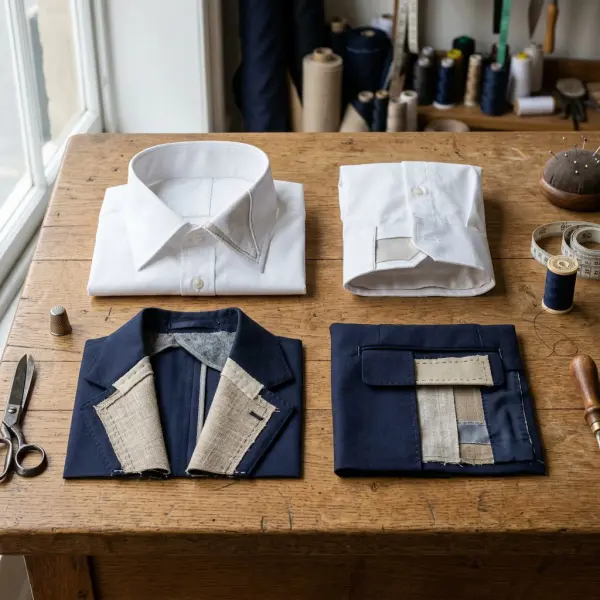
Surface Smoothness Can Improve—or Deteriorate
One reason interlining is used in jacket fronts and other broad garment areas is to help create a controlled surface.
Proper support can reduce unwanted collapse and help the outer layer present a cleaner visual plane.
But this is one area where poor interlining selection becomes particularly visible.
If the shell and interlining are incompatible, the surface can develop bubbling, localized distortion, excessive rigidity, adhesive strike-through, or differences in shrinkage. These problems may be subtle immediately after production and become more obvious following cleaning or repeated wear.
The quality of the finished surface therefore depends on more than whether the interlining successfully sticks to the shell.
Teams need to consider:
Bond uniformity. Inconsistent fusing can create areas that behave differently within the same panel.
Mechanical compatibility. Shell and interlining should respond appropriately to bending, stretching, and shearing.
Dimensional compatibility. Large differences in shrinkage can disturb the surface.
Appropriate adhesive penetration. Too little can weaken bonding; excessive penetration can affect surface appearance or handle.
Pressing sensitivity. Certain shell fabrics can become flattened, glazed, marked, or otherwise altered by inappropriate heat and pressure.
A fused panel that is technically bonded but visually unacceptable has still failed.
Interlining Can Improve Shape Retention Through Wear
Garments are repeatedly deformed during use.
A waistband stretches when someone sits. A jacket bends around elbows and shoulders. Collars fold. Pocket openings experience pulling. Stretch garments repeatedly extend and recover around the body.
Interlining can help selected areas resist permanent deformation and recover toward their intended shape.
Manufacturers develop specific interlinings around this requirement. Freudenberg, for example, describes shape-retention and recovery properties in both conventional apparel and highly elastic applications. Its elastic interlining range is designed to allow substantial movement while helping supported garment areas recover their shape after stretching.
The nuance matters.
Shape retention does not always require restricting movement.
In a formal waistband, greater stabilization may be desirable. In activewear, an interlining that prevents extension entirely would conflict with the garment's purpose. Instead, the required performance may be controlled elasticity plus recovery.
Different garment categories therefore define "stability" differently.
Garment Stability Is Often Local, Not Global
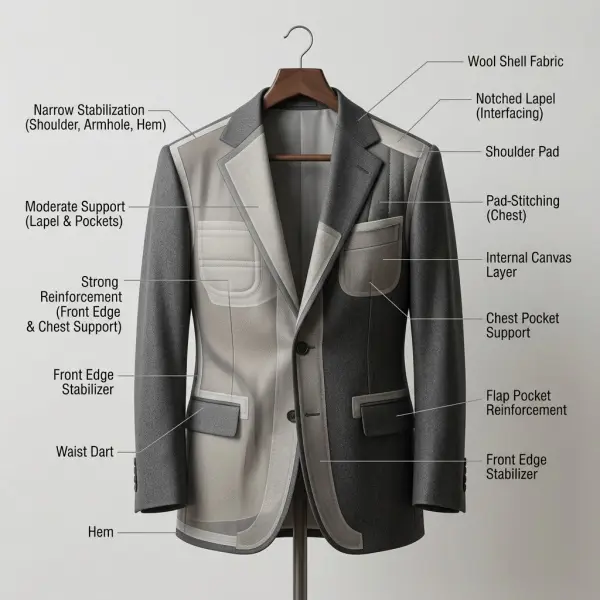
One of the most useful ways to think about interlining is through zonal engineering.
A garment does not need one level of stability.
A tailored jacket illustrates this particularly well.
The front edge needs control. The lapel needs formability and roll. The chest may require support and volume. Pocket areas need reinforcement. The shoulder may require a different structural solution. Meanwhile, the back or lower body may need considerably more freedom.
A single interlining specification across the entire garment may therefore produce unnecessary stiffness.
Instead, product engineers can use:
- different interlining weights;
- different textile constructions;
- different stretch properties;
- partial rather than full-area reinforcement;
- narrow stabilization tapes;
- fusible and sew-in combinations;
- multiple layers in highly structured areas.
Research on fusible interlining design notes that different garment zones can require different rigidity levels, and that adding reinforcement indiscriminately can increase weight and reduce desirable textile properties.
The design problem is therefore closer to mapping support than choosing one material.
Does Interlining Make Clothing More Durable?
It can improve durability in specific garment areas, but "durability" needs to be defined carefully.
Interlining can reinforce regions exposed to repeated mechanical stress and help maintain shape through wear. Suppliers commonly use it for areas such as collars, cuffs, plackets, waistbands, jacket fronts, and reinforcement zones where dimensional control is required. Freudenberg currently describes shape retention through repeated wear or washing as a performance objective in several apparel interlining ranges.
But interlining does not automatically make the entire garment more durable.
A garment can still fail because of weak seams, poor abrasion resistance, inadequate colorfastness, zipper failure, fabric pilling, or other unrelated factors.
Interlining can also create its own durability problem if the wrong fusible system delaminates or if shell and reinforcement shrink differently.
A more accurate statement is:
Appropriate interlining can improve structural durability and shape retention in the garment areas it is designed to support, provided the complete material system remains compatible through expected wear and care.
How Interlining Influences Perceived Garment Quality
Customers rarely ask what interlining is inside a garment.
They do notice its consequences.
When trying on a jacket, they may respond to the way the front hangs, how the lapel rolls, whether the collar sits cleanly, whether pocket edges remain flat, or whether the garment feels structured without becoming uncomfortable.
These impressions contribute to perceived quality even when the wearer cannot identify the technical reason.
This makes interlining commercially significant in categories where construction is part of the product proposition.
A premium shirt with a collapsing collar can undermine its positioning. A blazer with unevenly fused fronts can look inexpensive regardless of shell-fabric cost. Conversely, adding excessive internal structure to a casual unconstructed jacket may make the product feel less sophisticated because it contradicts the intended design.
Quality is therefore contextual.
The best interlining is usually the one the customer barely notices because the garment simply behaves as expected.
Handfeel Creates the Most Important Trade-Off
Interlining can improve structure while simultaneously changing how a garment feels in the hand and on the body.
The concept of hand encompasses subjective sensations such as softness, stiffness, fullness, smoothness, flexibility, and resilience. These perceptions are influenced by measurable mechanical properties but ultimately experienced by the wearer.
Fusing changes those properties because two textile layers and an adhesive system begin behaving together.
The Polymers review notes that interlining can significantly alter fabric handle as well as bending, tensile, shear, and drape characteristics.
That creates a familiar development tension:
support versus softness.
A product developer may solve a waviness problem by specifying a stronger interlining, only to discover that the garment now feels overly rigid.
The next iteration might use:
- a lighter interlining;
- a different substrate;
- a lower adhesive mass;
- more elastic reinforcement;
- smaller coverage area;
- zonal reinforcement;
- a different attachment method.
This is why garment development requires physical prototypes. Specifications can narrow the options, but tactile judgment still matters.
Stretch Garments Require a Different Definition of Stability
Traditional reinforcement logic can be counterproductive in elastic apparel.
Suppose a fitted stretch blazer is made from a shell containing elastane. The garment needs enough stability around edges and openings to prevent distortion, but the reinforced areas must still move with the body.
A rigid interlining may technically stabilize the garment while destroying the stretch performance that justified using the shell fabric in the first place.
Modern elastic interlinings are engineered to address that tension. Commercial solutions include lightweight elastic and super-elastic constructions designed to preserve movement while providing recovery and shape support.
For stretch products, teams should therefore evaluate at least three characteristics together:
- extension;
- recovery;
- directional behavior.
A material that stretches easily but fails to recover may not provide useful long-term stability.
Likewise, an interlining that stretches only in one direction may be unsuitable if the garment requires multidirectional movement.
Interlining Also Affects Comfort
Structural performance should not be evaluated independently from wearer comfort.
Adding another material layer can alter:
- thickness;
- stiffness;
- breathability;
- stretch;
- moisture transport;
- thermal perception;
- local flexibility.
Research reviewed in Polymers reports that fusible interlining can reduce air permeability in certain wool fabric systems, illustrating that reinforcement can influence comfort-related properties as well as structure.
This does not mean interlining inherently makes garments uncomfortable.
Many products use lightweight, open, elastic, or specialized constructions designed to minimize unwanted changes. The point is that comfort should be part of the approval process whenever reinforcement covers a substantial garment area or sits close to the body.
A waistband interlining, jacket front, sports bra support zone, and collar all create different comfort considerations.
Again, context determines the correct specification.
What Fashion Teams Should Evaluate During Sampling
Interlining should be assessed through the finished component or garment, not only as a roll material.
A useful evaluation starts by comparing the unsupported shell with one or more candidate reinforced constructions.
Product teams should examine several dimensions together:
|
Evaluation area |
What to inspect |
Why it matters |
|
Shape |
Does the component hold the intended three-dimensional form? |
Determines whether reinforcement supports the design |
|
Drape |
Does the fabric still fall naturally? |
Prevents excessive rigidity |
|
Hand |
Does the supported area feel appropriate beside the rest of the garment? |
Influences perceived quality and comfort |
|
Edge stability |
Are collars, pockets, fronts, cuffs, and waistbands controlled? |
Affects visible finishing |
|
Surface |
Any bubbling, marking, strike-through, or distortion? |
Reveals compatibility or process problems |
|
Stretch |
Does the reinforced area retain the required movement? |
Critical for elastic products |
|
Recovery |
Does it return toward its original shape after deformation? |
Supports long-term shape retention |
|
Dimensional behavior |
Do shell and reinforcement react compatibly to care? |
Helps prevent post-wash distortion |
|
Comfort |
Has structure created excessive stiffness, heat, or restriction? |
Connects technical performance to wearer experience |
This assessment should happen before the specification is frozen.
Once bulk material has been ordered and thousands of panels have been cut, changing interlining becomes much more expensive.
Common Mistakes When Engineering Garment Support
Treating Stiffness as the Same Thing as Stability
A stiffer garment can appear more stable, but excessive stiffness may reduce drape, movement, comfort, and recovery.
Stability should mean controlled resistance to unwanted deformation, not maximum resistance to all deformation.
Testing Interlining Without the Shell Fabric
An interlining's behavior in isolation does not predict exactly how the final composite will behave.
Shell construction, adhesive interaction, pressing conditions, fabric finish, stretch, and weight all affect the result.
Always evaluate the real combination.
Using One Interlining Across Every Garment Zone
This may simplify purchasing, but it can create poor garment engineering.
Different components have different mechanical requirements. The collar, lapel, pocket opening, chest, and waistband should not automatically receive identical reinforcement.
Solving Appearance Problems With Heavier Interlining
If a jacket front looks unstable, simply moving to a heavier interlining may hide the symptom while introducing excessive stiffness.
The real cause could be pattern balance, incompatible adhesive, pressing, shell instability, cutting distortion, or poor fusing.
Diagnosis should come before specification escalation.
Ignoring Garment Care
A garment can look excellent immediately after production and deteriorate after washing or dry cleaning.
Approval should reflect the intended care cycle, especially when shape retention is part of the product promise.
Evaluating Appearance but Not Movement
A garment displayed on a mannequin is only part of the test.
The wearer sits, bends, reaches, stretches, and repeatedly deforms the clothing.
Garments should therefore be evaluated both statically and in motion.
Practical Application for Fashion Businesses
Interlining management becomes increasingly important as a brand scales.
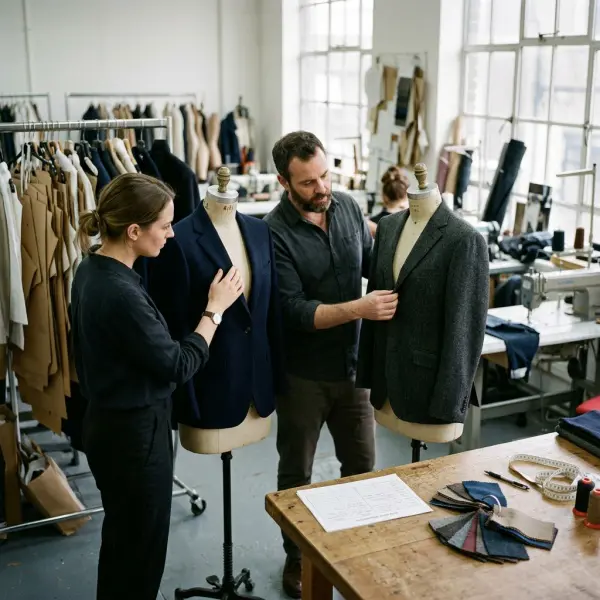
A founder working directly with one sample maker may be able to approve garment feel informally. Once production involves several factories, fabric mills, trim vendors, and product categories, those judgments need to become reproducible specifications.
Product Development
Define the desired behavior of each reinforced area before selecting the material.
Instead of writing "medium fusible," describe what the component needs to achieve: soft roll, crisp edge, stretch recovery, controlled body, lightweight stabilization, or firm waistband support.
Sourcing
Keep approved supplier references and acceptable alternatives.
If substitution is necessary, evaluate the new interlining on the actual shell rather than approving it from supplier specifications alone.
Manufacturing
Ensure that cutting direction, placement, fusing parameters, sewing construction, and pressing match the approved method.
A correct material processed incorrectly can produce an incorrect garment.
Quality Control
Use an approved garment or component as a physical reference.
Compare bulk output for hand, shape, surface appearance, bond quality, symmetry, and dimensional behavior.
Cost Management
Avoid both under-specification and over-engineering.
The cheapest interlining may increase rejects or compromise garment quality. An unnecessarily sophisticated material may increase cost without meaningful customer benefit.
The goal is the lowest-cost construction that reliably meets the product requirement, not the lowest interlining price.
A Simple Framework for Choosing the Right Level of Support
A practical way to specify interlining is to work backward from the garment's intended behavior.
1. Start with silhouette.
Is the garment sharply tailored, softly structured, fluid, fitted, relaxed, or elastic?
2. Identify unstable zones.
Determine which areas could stretch, collapse, curl, wrinkle, or lose definition without reinforcement.
3. Define movement requirements.
Decide which areas should resist deformation and which must remain flexible.
4. Evaluate shell mechanics.
Consider fabric weight, drape, stretch, shear behavior, thickness, texture, and recovery.
5. Select candidate reinforcement.
Choose construction, weight, elasticity, adhesive system, and coverage based on the function.
6. Test complete components.
Assess structure, surface, hand, drape, stretch, and care performance.
7. Reduce unnecessary reinforcement.
If the same design performance can be achieved with lighter or more localized support, the garment may gain comfort and material efficiency.
This process prevents teams from treating interlining as a generic recipe copied from previous styles.
Important Technical Caveats
Interlining does not independently determine garment shape.
Final appearance results from the interaction of:
- shell fabric;
- pattern geometry;
- interlining;
- adhesive or sewing method;
- seam construction;
- pressing and molding;
- lining;
- shoulder and chest components where applicable;
- garment finishing;
- wearer body shape.
Research on garment packages also shows that seam construction and the sequence of bonding and sewing can affect bending rigidity and drape, meaning laboratory measurements of flat fabric-interlining composites do not describe every aspect of a completed garment.
Similarly, higher bending rigidity should not automatically be interpreted as superior shape retention in every product. A highly rigid system may hold one geometry effectively but provide poor drape, flexibility, or wearer comfort.
Technical data should therefore support prototype evaluation—not replace it.
Interlining and Sustainability: Avoid Simplistic Claims
It can be tempting to argue that interlining is sustainable because it may extend shape retention and garment life.
That conclusion is too broad without evidence.
Better structural durability may help a garment maintain its appearance for longer, but the total environmental impact depends on many factors, including shell material, interlining composition, adhesive chemistry, processing energy, manufacturing waste, laundering, actual product lifetime, and end-of-life pathways.
Additional bonded materials can also complicate textile separation or recycling depending on the recycling process and garment construction.
Conversely, newer interlining ranges increasingly incorporate recycled-content substrates or lower-temperature bonding technologies. These developments may improve particular environmental attributes, but they do not by themselves prove that the finished garment is environmentally preferable.
Fashion businesses should therefore communicate specific attributes rather than making broad "eco-friendly interlining" claims.
Why the Best Interlining Often Goes Unnoticed
A successful interlining should rarely become the visual story of the garment.
Its contribution is indirect.
The collar stays where it belongs. The lapel rolls naturally. The jacket front hangs cleanly. The waistband remains controlled. Stretch areas recover. Pocket openings retain their shape. The garment keeps enough body to look intentional but still moves in the way the designer intended.
That balance is difficult precisely because the best result often looks effortless.
The technical team knows how many variables were involved. The customer simply sees a garment that feels well made.
For a foundational explanation of the different textile constructions behind this effect, see Interlining Fabric Explained for Garment Structure and Support. For the manufacturing decision between adhesive bonding and sewn structural systems, see Fusible vs Sew-In Interlining: What Fashion Teams Should Know.
Frequently Asked Questions
Does interlining always make fabric stiffer?
No. Interlining usually modifies the mechanical behavior of the supported fabric, and fusible systems often increase bending or shear stiffness, but the degree of change varies significantly by material.
Very lightweight or elastic interlinings can provide stabilization while preserving substantial flexibility. Some modern products are specifically engineered for stretch garments where movement must be retained.
The practical question is therefore not whether interlining increases stiffness at all, but whether it produces the right amount and direction of support for the garment.
How does interlining affect garment drape?
Interlining can change drape by altering bending resistance, shear behavior, weight, thickness, and the interaction between textile layers.
Research shows that fabric drape is related to bending and shear properties and that adding adhesive inserts can measurably change both bending rigidity and drape behavior.
The effect may be desirable in a structured jacket but undesirable in a fluid blouse if reinforcement is excessive. Product teams should therefore judge drape on the fused or sewn garment component rather than assuming the shell fabric's original drape will remain unchanged.
Which garment areas benefit most from interlining?
Areas requiring local shape control or reinforcement commonly benefit most. Examples include collars, cuffs, lapels, jacket fronts, plackets, waistbands, facings, pocket openings, pocket flaps, and selected edges.
The exact requirement depends on shell stability and design intent. A casual shirt may require much less collar support than a formal dress shirt, while an unstructured blazer may intentionally use less reinforcement than a conventional tailored jacket.
The correct approach is to identify functional zones rather than automatically reinforcing every possible garment component.
Can too much interlining damage the appearance of a garment?
Yes. Excessive or poorly matched reinforcement can create an overly rigid silhouette, unnatural drape, visible transition lines, bulky construction, surface distortion, or a handfeel that does not match the design.
Additional interlining layers can also increase garment weight and reduce some comfort-related properties. Research discussing multi-layer fusible structures notes that added rigidity and polymer content can have trade-offs including greater weight and reduced air permeability.
Stronger reinforcement should therefore only be added when it solves a defined performance requirement.
Does heavier interlining provide better shape retention?
Not necessarily.
Greater interlining weight can increase bending rigidity in many material systems, and recent research on adhesive inserts found that heavier inserts generally produced stiffer garment packages.
But shape retention also depends on substrate construction, adhesive characteristics, elasticity, recovery, shell compatibility, garment geometry, and care conditions.
A heavier product can become counterproductive if it makes the garment overly rigid or creates a mechanical mismatch with the shell.
How should brands test shape retention?
Start with the actual shell-interlining combination and evaluate it both before and after representative wear or care simulations.
For relevant garments, teams may examine dimensional change, recovery after stretching or bending, surface smoothness, lapel or collar form, edge stability, and changes after washing or dry cleaning.
There is no single universal test sufficient for every product. A sports bra, jacket, washable uniform, and formal shirt impose different deformation and care conditions.
Testing should therefore replicate the garment's realistic use as closely as practical.
Can interlining help stretch garments recover their shape?
Yes, if the reinforcement is designed with compatible elasticity and recovery.
Elastic interlining can stabilize areas that need support while still allowing extension. Commercial products for sportswear and stretch apparel are specifically engineered around high elasticity and recovery rather than maximum rigidity.
Compatibility remains essential. If the interlining stretches substantially less than the shell, it may restrict fit or movement. If recovery is insufficient, it may not provide the intended shape-control benefit.
Is garment quality visible from the type of interlining used?
Not reliably.
A particular interlining category—woven, knitted, nonwoven, fusible, or sew-in—does not by itself establish garment quality.
Quality depends on whether the material is appropriate for the shell and design, whether construction is accurate, whether processing is controlled, and whether the finished garment performs through wear and care.





Comments 0
Leave a CommentSend Comment
Anda harus Login terlebih dahulu untuk dapat memberikan komentar.