

Poplin vs Oxford Fabric: Key Differences for Shirts and Uniforms
Poplin and Oxford are both established shirting fabrics, but they create noticeably different garments. Poplin usually presents a smoother, flatter, and more refined surface, while traditional Oxford cloth has a more visible texture and generally feels more substantial. Those differences begin with the weave structure, but the final performance also depends on yarn size, fiber composition, fabric density, weight, finishing, and garment construction.
For fashion brands and uniform buyers, choosing between them should therefore go beyond deciding whether a shirt needs to look “formal” or “casual.” A corporate uniform worn five days a week may need durability, wash stability, opacity, easy maintenance, and comfortable movement. A premium dress shirt may prioritize surface smoothness, crisp collar definition, fine yarn appearance, and compatibility with tailored construction.
The practical comparison is not about declaring one fabric universally better. It is about understanding what each construction tends to do well, where the differences matter in production and wear, and which specifications should be verified before bulk sourcing.
Quick Answer: What Is the Difference Between Poplin and Oxford Fabric?
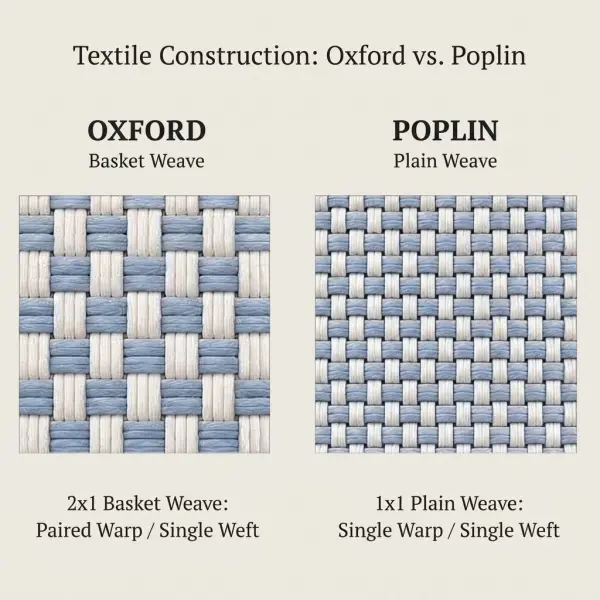
Poplin is typically a closely constructed plain-weave fabric, while traditional Oxford cloth uses an Oxford weave, a derivative of plain weave commonly described as a 2 × 1 basket construction. In Oxford weave, two warp ends work together over and under individual filling yarns, producing more visible surface texture than the simple 1/1 interlacing associated with plain-woven shirting. CottonWorks identifies Oxford as a common shirting construction and notes that basic Oxford fabrics commonly use finer warp yarns with heavier filling yarns.
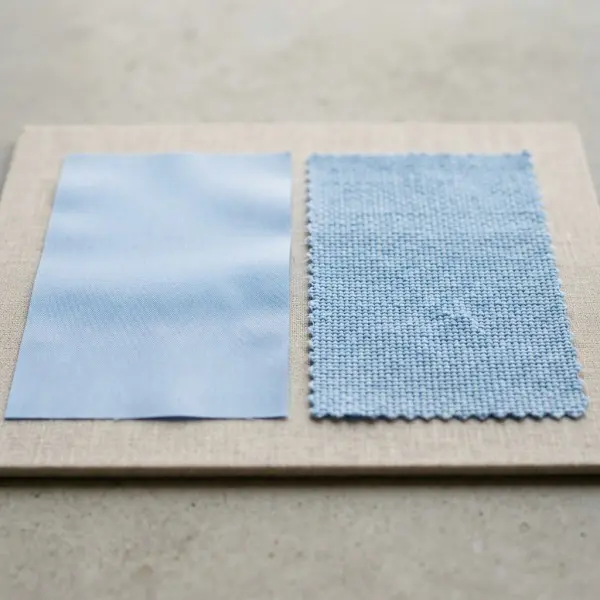
In practical garment terms, poplin usually creates a cleaner, flatter, and crisper appearance. Oxford generally looks more textured and often feels more substantial, which makes it familiar in casual shirts, schoolwear, uniforms, and smart-casual apparel.
Neither name defines fiber composition, GSM, durability, breathability, wrinkle behavior, or quality by itself. A lightweight Oxford can differ greatly from a heavy Oxford, just as one cotton poplin can perform differently from another. Buyers should compare the actual fabric specifications and garment requirements rather than sourcing by construction name alone.
The Main Difference Starts With the Weave
The easiest way to understand poplin versus Oxford is to look at how the yarns interlace.
A conventional plain weave alternates each warp yarn over one weft yarn and under the next. The adjacent warp yarn follows the opposite sequence. This 1/1 structure creates a high number of crossover points and generally produces a stable, relatively flat fabric surface. CottonWorks describes plain weave as the simplest woven construction and notes that its numerous interlacings contribute to structural stability.
Oxford is a derivative of that basic system rather than a completely unrelated weave. In a typical 2 × 1 Oxford construction, two warp ends behave as a pair and weave over and under individual filling yarns. CottonWorks notes that many basic Oxford fabrics use approximately twice as many ends per inch as picks per inch, with finer warp yarns and a heavier filling yarn.
That change in interlacing alters what the eye and hand perceive. Instead of poplin's relatively uniform surface, Oxford typically displays a clearer grain or basket-like texture.
Why does Oxford look more textured?
The texture comes from grouping yarns and from the relationship between finer warp yarns and heavier filling yarns in many traditional constructions. Individual Oxford fabrics can vary, but the weave allows yarn groupings to remain more visually apparent than they usually do in fine plain-woven poplin.
This distinction becomes especially visible in light colors such as white, pale blue, or pastel shirtings. Under directional lighting, Oxford may show small surface variations and subtle color mixing, particularly when dyed warp yarns are combined with undyed or contrasting filling yarns.
Poplin generally reflects light more evenly across a flatter surface, producing a cleaner visual effect.
Poplin vs Oxford at a Glance
The following comparison describes typical tendencies, not guaranteed characteristics of every fabric carrying these names.
|
Factor |
Poplin |
Oxford |
|
Basic structure |
Usually plain weave |
Plain-weave derivative, commonly 2 × 1 Oxford basket weave |
|
Surface |
Smooth and relatively flat |
More visibly textured |
|
Visual character |
Clean, refined, crisp |
Textured, substantial, relaxed |
|
Typical shirt positioning |
Formal to everyday |
Casual to smart casual |
|
Fabric body |
Often light to medium |
Often medium or more substantial |
|
Drape |
Usually clean and controlled |
Often slightly fuller or softer depending on construction |
|
Detail visibility |
Sharp collars, cuffs, plackets, prints |
Texture adds visual character |
|
Opacity |
Can be low in fine light-colored versions |
Often appears more substantial, but must still be checked |
|
Wrinkle appearance |
Fine smooth surfaces may make creasing more visible |
Texture can visually disguise some minor creasing |
|
Uniform suitability |
Strong for refined corporate and lightweight uniforms |
Strong for casual, school, service, and more substantial shirt applications |
|
Fiber composition |
Commonly cotton or blends |
Commonly cotton or blends |
|
Stretch |
Limited unless engineered |
Limited unless engineered |
|
Quality level |
Can range from basic to premium |
Can range from basic to premium |
The key point is that construction influences character, but it does not determine the full performance profile. Weight, yarn count, density, finishing, fiber content, laundering, and seam engineering can easily change how two fabrics compare.
How Do Poplin and Oxford Feel Different?
Poplin usually feels smoother and cleaner against the hand, particularly when made from fine yarns. Oxford normally provides more tactile texture because its yarn groupings and heavier filling structure are easier to feel.
That difference can influence perceived garment quality, but not in a simple “smooth equals premium” hierarchy. A finely woven premium Oxford may use excellent yarns and sophisticated finishing, while an inexpensive poplin can feel harsh or overly synthetic. The handfeel needs to be judged within the intended product category.
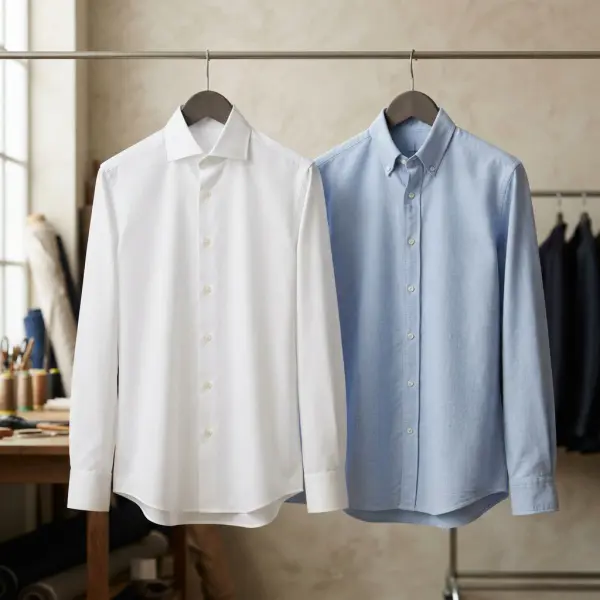
For a tailored white business shirt, smoothness may reinforce the desired aesthetic. For an Oxford button-down intended to be worn open at the collar with chinos or denim, visible texture may be part of the appeal rather than a defect.
Is Oxford always heavier than poplin?
No. Oxford is often offered in more substantial shirting constructions, but fabric weight is not defined solely by weave name. Yarn size, ends and picks per unit area, fiber density, finishing, and moisture content all influence fabric mass.
A lightweight Oxford and a heavier poplin can therefore overlap in GSM.
This matters commercially because buyers sometimes use the names as shortcuts: “Oxford is thick” or “poplin is thin.” Those shortcuts may work when describing a familiar supplier range, but they are unreliable when comparing fabrics from different mills.
Which Looks More Formal: Poplin or Oxford?
Poplin usually supports a more formal visual language because its flatter surface allows collars, cuffs, plackets, seams, and pressed details to appear particularly clean. Fine poplin is consequently common in business shirts, formal shirting, uniforms, and blouses where a polished surface is desirable.
Traditional Oxford cloth usually reads as more relaxed. The pronounced texture adds visual depth and reduces the almost paper-clean appearance of fine poplin. This is one reason Oxford button-down shirts have become associated with casual and smart-casual wardrobes.
That distinction is useful, but it is not absolute. Pinpoint Oxford uses much finer yarns than basic Oxford and creates a finer surface that can move considerably closer to dress-shirt territory. CottonWorks specifically distinguishes pinpoint Oxford from basic Oxford, noting the use of finer yarns and yarns of similar size in warp and filling.
Color, collar design, fit, buttons, finishing, pattern, and styling also influence formality. A dark navy poplin work shirt may look less formal than a finely tailored white pinpoint Oxford shirt.
Poplin vs Oxford for Business Shirts
For a conventional formal or office shirt, poplin is often the more natural starting point when the brief prioritizes smoothness, crispness, and visual refinement. A fine fabric surface works particularly well with sharp collars, concealed plackets, French cuffs, clean stripes, and other details associated with tailored shirting.
Its smooth surface can also make printed patterns and fine yarn-dyed stripes appear precise. On the other hand, that same visual cleanliness makes certain problems easier to see. Seam puckering, shade differences, wrinkling, needle marks, and poor pressing may be more obvious on a plain smooth fabric.
Oxford offers a different office proposition. It works well where business dress has become less rigid or where a company wants uniforms to feel approachable rather than ceremonial. A soft Oxford button-down worn with tailored trousers can sit comfortably between formal shirting and weekend casualwear.
The decision should therefore reflect the organization's dress language. A luxury hotel reception, legal office, technology startup, private school, café chain, and logistics company may all use collared shirts, but they do not necessarily need the same textile character.
Which Fabric Works Better for Uniforms?
There is no universal winner. Poplin and Oxford can both work effectively for uniforms, but they serve different visual and functional priorities.
Poplin is especially useful when a uniform program needs a smooth, polished surface and consistent corporate appearance. It can suit hospitality, office administration, retail, front-desk personnel, healthcare support roles, and other environments where the shirt needs to look visually controlled.
Oxford becomes attractive when the uniform can carry more texture and body. School shirts, casual hospitality uniforms, service teams, retail environments, and workplace programs with a smart-casual identity may benefit from Oxford's more substantial appearance.
The final decision should be based on tested fabric rather than aesthetic assumption.
What matters more than the weave name in uniform programs?
Uniforms are often washed and worn far more frequently than ordinary fashion shirts. This changes the purchasing priorities considerably.
A uniform buyer should usually pay attention to:
- dimensional change after laundering;
- colorfastness across the expected care process;
- seam strength and potential seam slippage;
- opacity, especially for pale colors;
- pilling or surface deterioration where relevant;
- crease and appearance retention;
- drying and ironing requirements;
- resistance to repeated abrasion at collars, cuffs, elbows, and pockets;
- shade consistency across production lots;
- replacement consistency for long-running uniform programs.
AATCC TM135 provides a standardized method for assessing dimensional changes of fabrics after home laundering, using specified washing and drying procedures. The current AATCC listing identifies TM135-2025 for this purpose.
For sewn performance, ASTM D1683/D1683M addresses failure in sewn seams of woven fabrics and explains that seam strength depends on the interaction between fabric, sewing thread, stitch type, seam type, and stitch density. The standard also notes that it does not itself predict actual wear performance.
AATCC TM135 dimensional-change method and ASTM D1683/D1683M woven seam test method are useful references when developing performance specifications.
Does Oxford Last Longer Than Poplin?
Not necessarily. Oxford's more substantial construction may create the impression of greater robustness, but weave name alone cannot establish garment durability.
Durability depends on fiber strength, yarn quality, yarn size, fabric density, weight, finishing, abrasion exposure, laundering, seam engineering, garment fit, and construction details. A lightweight low-density Oxford can perform worse than a carefully engineered poplin, while a dense Oxford developed for heavy uniform use may outperform a delicate fashion poplin.
Weave construction can influence stability. CottonWorks notes that simple plain weave has many crossover points and is generally structurally stable, while basket-weave derivatives have more texture and somewhat greater yarn mobility. But translating that structural observation into a claim such as “poplin lasts longer” or “Oxford is tougher” would ignore too many other variables.
For uniforms, actual performance testing and wash trials are more meaningful than fabric reputation.
Which Is More Breathable?
Neither fabric is automatically more breathable.
Air permeability is heavily affected by how tightly the yarns are packed, yarn size, fabric thickness, porosity, fiber type, and finishing. Oxford's visible structure does not guarantee greater airflow, just as lightweight poplin should not automatically be described as highly breathable.
A loosely constructed lightweight Oxford might allow relatively easy air movement. A dense Oxford may not. The same principle applies to poplin.
Garment design matters as well. A slightly heavier shirt with adequate ease around the chest, back, and underarm can sometimes feel more comfortable in motion than a very lightweight fabric cut too closely to the body.
For warm-climate uniforms, buyers should evaluate fabric weight, air permeability where necessary, moisture behavior, garment ease, sleeve design, color, and the actual work environment together rather than searching for a single “most breathable” weave.
Does Poplin Wrinkle More Than Oxford?
Cotton-rich poplin can show wrinkles clearly because its flat, smooth surface provides little visual texture to disguise creases. Oxford's texture may make minor wrinkling less visually dominant, but this does not mean Oxford inherently resists wrinkling.
Wrinkle behavior depends on fiber composition, yarn characteristics, fabric construction, finishing, laundering, drying, and pressing. Polyester-cotton versions of either fabric can behave differently from comparable 100% cotton products, and easy-care finishing can further change recovery.
This distinction matters particularly for uniforms. A fabric that looks attractive when freshly pressed but becomes visibly untidy after several hours may not suit customer-facing staff. Wear trials can reveal this better than a flat fabric swatch.
Poplin vs Oxford for Printing, Embroidery, and Branding
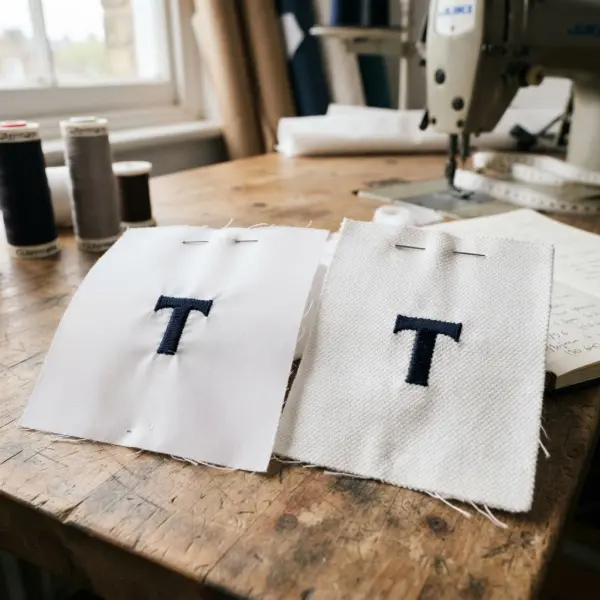
Poplin's smooth surface can be advantageous for detailed printing, fine logos, and clean visual branding. When a design depends on precise printed lines or small graphic elements, a flatter textile surface generally presents fewer topographical interruptions.
Oxford can still be printed and embroidered successfully, but its texture becomes part of the visual result. Very fine printed detail may look different when it crosses raised yarn structures, and dense embroidery on lighter Oxford should be sampled carefully to avoid distortion.
For embroidered uniforms, weave name is only one variable. Stabilizer, stitch density, thread, needle size, embroidery frame tension, logo dimensions, fabric weight, and location all influence the finished result.
A brand should therefore test the actual logo application on production fabric before approving the uniform program. Digital artwork alone cannot predict how a small embroidered wordmark will behave on a particular shirt.
Manufacturing Differences: What Sewing Teams May Notice
Both fabrics are usually manageable woven shirtings, but their surfaces can behave differently during cutting and sewing.
Fine poplin often rewards precise construction. Because the surface is flat, misaligned plackets, uneven topstitching, puckered seams, and tension problems can become visually obvious. Lightweight versions may also show needle holes or distortion more readily if needle size, thread, or stitch density is inappropriate.
Traditional Oxford tends to have more surface body and texture. The textile can visually absorb some minor surface irregularities, but heavier yarns may require adjustments to needle choice, seam bulk, buttonhole settings, collar construction, and pressing.
Factories should not standardize sewing parameters purely from the fabric name. ASTM's seam-testing guidance reinforces this principle by treating sewing thread, stitch type, seam type, and stitch density as interacting variables when evaluating sewn woven structures.
For high-volume uniform manufacturing, a short pre-production sewing trial is usually more useful than assuming settings that worked for the previous shirting fabric will transfer unchanged.
How Do They Affect Collar and Cuff Construction?
Poplin can produce very clean collars and cuffs because its flat surface and relatively controlled structure work well with interlining. Fine dress-shirt poplin, however, needs the correct fusible weight; overly rigid interlining can make the collar feel disconnected from the shirt body.
Oxford already brings more visual and tactile body to the garment. A heavily structured collar combined with substantial Oxford may become unnecessarily stiff, particularly in casual button-down designs where some softness is desirable.
This is a good example of why fabric cannot be selected independently from the pattern and trims. The garment system includes outer fabric, interlining, seam construction, pressing, collar geometry, button placement, and finishing.
A mill swatch may look excellent on a table but still produce the wrong collar once these components interact.
For readers focusing specifically on material construction, Poplin Fabric Explained: Structure, Feel, and Common Uses provides the material foundation, while Why Shirting Fabrics Matter in Everyday and Professional Apparel explores the wider role of shirting selection.
Cotton Poplin vs Cotton Oxford: Does Fiber Equality Make Them Similar?
Using the same fiber does not erase structural differences. A 100% cotton poplin and a 100% cotton Oxford may share characteristics associated with cotton, but the weave, yarn sizes, density, finishing, and weight can still create very different products.
This is important in sourcing because buyers sometimes compare fiber composition as if it were the strongest indicator of feel. Two fabrics labeled “100% cotton” may differ dramatically in surface smoothness, drape, opacity, stiffness, thickness, air permeability, and wash appearance.
Fiber tells you what the yarn is made from. Weave tells you how yarns are organized into fabric. Yarn and finishing specifications describe further layers of the textile system.
A professional fabric comparison should look at all of them.
What About Polyester-Cotton Poplin and Oxford?
Polyester-cotton blends are common in uniform markets because they can be engineered toward different combinations of care performance, durability, cost, drying behavior, and wrinkle recovery. But the term “poly-cotton” still covers a very broad range of materials.
Blend ratio matters. So do yarn construction and whether different fibers are blended within the yarn or strategically positioned in separate yarn systems. Finishing can further change handfeel and appearance.
A 65/35 polyester-cotton Oxford should therefore not automatically be expected to behave like every other fabric with the same nominal composition. Nor should a polyester-rich poplin automatically be assumed to outperform cotton in every uniform environment.
The relevant question is whether the submitted material meets the program's performance specification and wearer expectations.
Poplin vs Oxford for Different Shirt Categories
Different end uses change which characteristics deserve priority.
Formal corporate shirt
Poplin is often the stronger starting point when the brand wants a smooth surface, crisp collar, clean presentation, and compatibility with suits or formal trousers. Fine yarns and controlled finishing can reinforce a refined corporate identity.
Oxford can still work, particularly in less formal organizations, but the texture changes the visual message.
Smart-casual office shirt
Both can work effectively. Poplin produces a sharper look, while Oxford provides more tactile character and a slightly more relaxed identity.
This category is where pinpoint Oxford can become particularly relevant because it offers a finer Oxford construction without completely losing the weave's distinctive character.
School uniform
Either fabric may be appropriate. Poplin can provide a neat, lightweight appearance, while Oxford can offer a more substantial visual character.
Schoolwear decisions should put heavy emphasis on opacity, repeated laundering, shade consistency, ease of ironing, wearer comfort, replacement availability, and total cost rather than deciding only from the initial fabric feel.
Hospitality uniform
The working environment matters. A luxury hotel front desk may prioritize refined poplin, while a café or casual restaurant may deliberately choose Oxford to communicate a more relaxed brand personality.
In both cases, laundering frequency, stain exposure, movement, heat, branding application, and replacement cycles should influence the specification.
Retail and service uniform
Poplin works well where the uniform is expected to look highly controlled, while Oxford can complement lifestyle retail, casual footwear, outdoor, homeware, and other brand environments where texture feels appropriate.
The uniform should support the retail concept without creating unnecessary maintenance for staff.
Casual fashion shirt
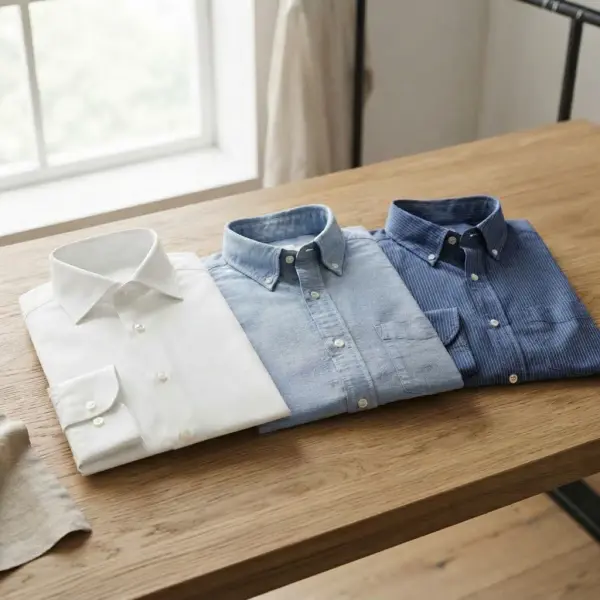
Oxford is a natural candidate when texture is part of the design. Button-down collars, chest pockets, garment washing, rolled sleeves, and relaxed fits work naturally with traditional Oxford character.
Poplin remains useful for minimal, clean casual shirts where the design relies on silhouette or print rather than weave texture.
A Practical Decision Framework for Buyers
Instead of asking “Which is better, poplin or Oxford?”, start with the garment brief.
If the garment requires a smooth, clean, refined surface, poplin deserves early consideration. If the garment benefits from visible texture, more visual depth, and a somewhat more casual character, Oxford may align better.
Then evaluate the actual fabric.
A practical decision sequence is:
- Define the appearance. Decide whether the shirt needs to read as formal, smart casual, casual, uniformed, premium, utilitarian, or relaxed.
- Define wearer conditions. Consider climate, movement, shift duration, laundering frequency, occupational environment, and layering.
- Approve fabric hand and weight. Evaluate real swatches rather than relying on fabric names.
- Check opacity and color. Pale shirts often behave differently under strong light and body tension.
- Prototype the garment. Include the intended interlining, thread, buttons, embroidery, print, and finishing.
- Test care and performance. Use relevant laboratory methods and realistic laundering or wear trials.
- Evaluate bulk repeatability. Confirm shade, finish, weight, width, and performance tolerances with the supplier.
- Assess total operating cost. Consider ironing, replacement frequency, laundry requirements, alteration, and inventory management—not only fabric price per meter.
This process is particularly important for uniform contracts where a seemingly small fabric decision can be multiplied across hundreds or thousands of garments.
Cost: Is Poplin or Oxford More Expensive?
Neither fabric is inherently more expensive.
Price is shaped by fiber type, yarn quality, yarn count, spinning method, fabric density, width, dyeing, finishing, certification requirements, order volume, mill capability, geography, and commercial terms.
A premium long-staple cotton poplin can cost substantially more than a basic blended Oxford. The reverse can also occur when Oxford uses fine yarns, complex coloration, specialty finishing, or premium cotton.
Fashion businesses should therefore avoid using construction name as a proxy for sourcing tier.
When comparing supplier quotations, make sure the fabrics are actually comparable. A lower price may reflect a different width, weight, composition, finishing package, colorfastness target, inspection level, or minimum order requirement.
What Should Brands Specify Before Ordering Either Fabric?
The same basic sourcing discipline should apply to both materials.
A useful fabric specification can include:
- weave or construction;
- fiber composition and permitted tolerance;
- fabric weight and tolerance;
- usable width;
- yarn count or yarn specification where relevant;
- ends and picks or agreed construction data where necessary;
- approved handfeel standard;
- shade or color standard;
- shrinkage tolerance;
- colorfastness requirements;
- seam performance requirements where relevant;
- stretch and recovery if applicable;
- opacity requirement;
- finishing or easy-care treatment;
- appearance after agreed laundering cycles;
- defect acceptance standard;
- packaging and roll identification requirements.
The required detail depends on business scale and product risk. A small fashion label developing a 200-piece capsule may not need the same documentation system as a national school-uniform contract, but both benefit from having an approved physical reference and clear performance expectations.

Common Mistakes When Choosing Between Poplin and Oxford
Mistake 1: Assuming Oxford is automatically stronger
Oxford often looks more substantial, but appearance does not establish tensile strength, tear performance, abrasion resistance, or seam durability. Those properties depend on the whole construction.
The better approach is to establish performance requirements based on the garment's end use and test representative production fabric. This is especially important for uniforms where repeated wear can expose weaknesses that are not visible in a showroom sample.
Mistake 2: Assuming poplin is always thin
Many commercial poplins are lightweight, but poplin can be manufactured across different weights and densities. Treating the fabric name as a GSM classification can eliminate suitable options or create inaccurate supplier communication.
Specify the weight range you need rather than asking for “thick Oxford” or “thin poplin” without measurable criteria.
Mistake 3: Choosing based only on formality
Appearance matters, but uniform fabric also needs to survive its operating environment. A polished poplin may look perfect for a restaurant team on launch day yet become problematic if the selected article shows stains easily, requires intensive ironing, or loses dimensions during commercial care.
Similarly, choosing Oxford because it “looks durable” does not prove its actual service life.
Mistake 4: Comparing fabrics with different fiber contents as though weave were the only variable
A 100% cotton poplin and a polyester-rich Oxford differ in both construction and fiber composition. If one dries faster or wrinkles differently, the result cannot be attributed solely to poplin versus Oxford.
When evaluating weave behavior, compare fabrics with reasonably controlled specifications or clearly document the other variables.
Mistake 5: Ignoring garment construction
A fabric that works well for one shirt pattern may behave differently in another. Collar shape, fit ease, sleeve construction, seam type, interlining, embroidery, and washing can all change the result.
Fabric comparison should therefore include garment prototyping rather than stopping at swatch approval.
Important Technical Caveats
Several distinctions help prevent oversimplification.
Oxford is not one single fabric specification. Basic Oxford, pinpoint Oxford, and other commercial Oxford variants can use different yarn sizes and produce noticeably different surfaces. CottonWorks specifically distinguishes basic and pinpoint Oxford constructions.
Poplin is not synonymous with “formal cotton.” It can be produced from different fibers and at different weights for casual apparel, dresses, uniforms, or other products.
Texture does not equal durability. Oxford's visible structure may create a rugged appearance, but durability must be demonstrated through construction and performance.
Smoothness does not equal higher quality. A flat poplin surface and a textured Oxford surface are design characteristics, not quality grades.
Laboratory tests answer specific questions. For example, ASTM D1683/D1683M can assess sewn seam behavior, but the standard itself states that it does not predict actual wear performance. Laboratory data, production trials, laundering, and wearer experience should therefore be interpreted together.
FAQ: Poplin vs Oxford Fabric
Which is better for a formal shirt, poplin or Oxford?
Poplin is usually the more conventional choice for a formal shirt because its smooth, flat surface supports crisp collars, cuffs, plackets, and fine tailoring. It can create a particularly clean appearance in white, pale blue, stripes, and other classic business-shirt designs.
Oxford is usually more textured and therefore reads as less formal, although finer constructions such as pinpoint Oxford can work well for smart business clothing. The final level of formality also depends on collar style, garment fit, color, buttons, finishing, and styling rather than fabric alone.
Which is better for school uniforms?
Either can work, depending on the specification. Poplin can provide a lighter, clean-looking school shirt, while Oxford can deliver more visible body and texture.
For schoolwear, the more important criteria are often opacity, wash stability, colorfastness, seam performance, wearer comfort, ease of maintenance, and the ability to reproduce the same fabric over multiple purchasing cycles. A well-tested poplin can outperform a poorly specified Oxford, and vice versa.
Is Oxford fabric hotter than poplin?
Not necessarily. Oxford is often sold in more substantial constructions, so some Oxford shirts may feel warmer than lightweight poplin shirts, but weave name alone cannot establish thermal comfort.
Fabric thickness, weight, yarn density, porosity, fiber content, finishing, garment fit, humidity, air movement, and activity all matter. For warm-weather uniforms, comparing actual fabrics or air-permeability data is more reliable than assuming all Oxford is hot and all poplin is cool.
Does Oxford wrinkle less than poplin?
Oxford's texture can make minor creases less visually obvious, but it is not automatically more wrinkle-resistant. Wrinkle recovery depends strongly on fiber composition, yarn construction, finishing, laundering, and pressing.
A polyester-cotton poplin with appropriate easy-care finishing may maintain a smoother appearance than an untreated 100% cotton Oxford. Likewise, a carefully finished Oxford may outperform an untreated cotton poplin. Buyers should evaluate appearance after realistic washing and wearing conditions rather than relying on the weave name.
Which is better for embroidered uniforms?
Both can work. Poplin provides a smooth background that can make fine embroidery look very clean, while Oxford's texture can complement bolder logos and more casual uniform programs.
The embroidery must be tested on the actual fabric because stitch density, stabilizer, needle size, thread, logo dimensions, and fabric weight affect puckering and distortion. Lightweight versions of either material may need additional stabilization.
Is Oxford always thicker than poplin?
No. Traditional Oxford is commonly associated with a more substantial hand, but neither term specifies a fixed thickness or GSM.
A mill can produce lightweight Oxford and relatively substantial poplin. Buyers should therefore request actual weight, thickness where relevant, construction data, and a physical sample rather than assuming fabric body from the commercial name.
Which fabric is easier to iron?
There is no universal answer. Fiber content and finishing often have more influence on easy-care behavior than whether the fabric is poplin or Oxford.
Smooth cotton poplin can display wrinkles clearly and may need careful pressing for a formal appearance. Oxford's texture may visually conceal minor creasing, but untreated cotton Oxford can still wrinkle. For uniforms where ironing effort matters, evaluate post-laundering appearance and specify the required care performance.
Can a brand use both poplin and Oxford in the same collection?
Yes, and the two fabrics can serve complementary roles. A brand might use smooth poplin for formal and minimalist shirts while reserving Oxford for button-downs, overshirts, casual uniforms, or textured seasonal styles.
Using both works best when the product architecture is deliberate. The fabrics should represent different wearing occasions or aesthetic functions rather than creating nearly identical shirts that confuse customers about why one version exists.
Conclusion
Poplin and Oxford occupy the same broad shirting ecosystem, but their structures create distinct visual and tactile starting points. Poplin's plain-weave character usually gives it a smoother, cleaner surface that works naturally for refined shirts and polished uniforms. Oxford's basket-derived structure introduces more visible texture and frequently supports casual, smart-casual, school, service, and relaxed professional apparel.
That difference is useful, but it should never substitute for a real fabric specification.
Neither weave guarantees durability, breathability, easy care, comfort, or quality. Fiber composition, yarns, density, weight, finishing, laundering behavior, seam construction, interlining, and garment design determine whether the finished shirt actually performs.
For fashion brands and uniform buyers, the strongest question is therefore not “Is poplin better than Oxford?” It is “Which construction creates the right appearance and meets the measurable performance requirements of this particular shirt?”
Once sourcing is approached that way, poplin and Oxford stop being competing fabric names and become two distinct tools for building the right product.




Comments 0
Leave a CommentSend Comment
Anda harus Login terlebih dahulu untuk dapat memberikan komentar.