
Why Shirting Fabrics Matter in Everyday and Professional Apparel
A shirt may look simple compared with a tailored jacket or technical outerwear, but the fabric behind it has to solve several problems at once. It sits close to the body, moves continuously through the shoulders and arms, frames the face through the collar, carries visible details such as plackets and cuffs, and is often expected to survive frequent laundering without quickly losing its appearance.
That makes shirting fabric selection more consequential than choosing between a few familiar material names. Poplin, Oxford, broadcloth, twill, chambray, and other woven fabrics can all appear in shirts, but each construction creates a different balance of texture, drape, body, wrinkle behavior, opacity, sewing performance, and visual formality. Fiber composition and finishing introduce another layer of variation.
For fashion brands, uniform programs, and garment manufacturers, the fabric choice therefore influences much more than aesthetics. It affects fit, comfort, production efficiency, care expectations, durability, product positioning, and ultimately whether the shirt continues to satisfy the wearer after repeated use.
Quick Answer: Why Do Shirting Fabrics Matter?
Shirting fabrics matter because the fabric determines much of how a shirt looks, feels, moves, sews, washes, and ages. Weave structure, fiber composition, yarn size, density, weight, and finishing can change a shirt's smoothness, texture, drape, breathability, opacity, wrinkle appearance, durability, and ease of care.
A fine poplin can support a crisp business shirt. Oxford can create a more textured and relaxed appearance. Twill may provide different drape and surface character. Blends and finishes can modify wrinkle recovery, stretch, moisture behavior, and maintenance requirements.
For professional apparel, these differences can affect whether a uniform remains presentable through repeated shifts and laundering. For everyday clothing, they influence comfort, styling versatility, and how often customers actually want to wear the garment.
The most effective sourcing approach is therefore not to ask which shirting fabric is universally “best.” It is to define the garment's required appearance, comfort, care, manufacturing, and service conditions, then select and test a fabric that meets those requirements.
What Are Shirting Fabrics?
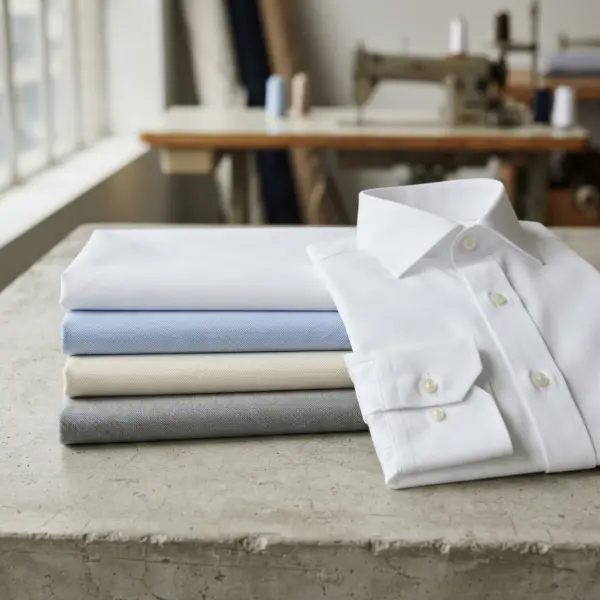
Shirting fabrics are textile constructions selected or engineered for making shirts and shirt-like garments. The term describes an end-use category rather than one specific weave, fiber, weight, or technical specification.
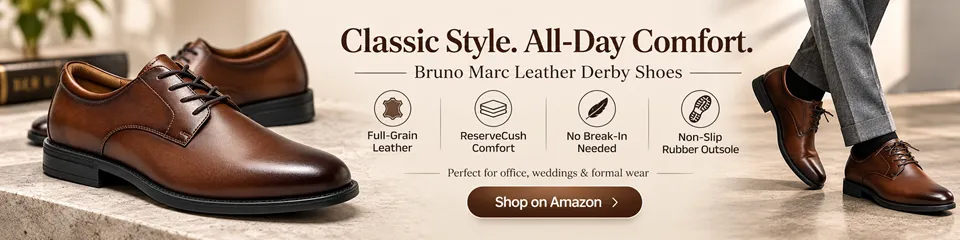
Many shirtings are woven fabrics because woven structures can provide the dimensional stability and shape definition needed for collars, plackets, cuffs, pockets, buttonholes, and tailored seams. In woven textiles, warp yarns run in the length direction and weft—or filling—yarns run across the width, with the interlacing pattern determining the weave structure. CottonWorks identifies plain, twill, and satin as the three fundamental woven designs from which many other constructions are developed.
Within shirting, different weave structures create different visual and physical characteristics. Plain weave has frequent interlacings and tends to be structurally stable. Oxford is a derivative of plain weave in which paired warp ends commonly weave over and under individual filling yarns. Twill is recognized by its diagonal weave line.
Those structural categories are only the beginning. A shirt fabric also reflects fiber composition, yarn size and quality, yarn density, fabric weight, coloration, finishing, and sometimes engineered stretch or moisture-management technology.
The Fabric Is Part of the Shirt's Design, Not Just Its Raw Material
When product teams treat fabric as something chosen after the silhouette has already been finalized, problems often appear later in sampling. A pattern developed around a crisp woven fabric may collapse when transferred to a softer construction. A narrow fitted shirt that works in a stretch woven may become restrictive when made in a stable non-stretch fabric. A dramatic gathered sleeve may require more body than a very fluid shirting can provide.
The fabric and pattern therefore need to be considered as a system.
A shirt with a structured point collar, sharp cuffs, straight front placket, and tailored body generally benefits from a fabric that can support those shapes. A relaxed overshirt may need greater body and a softer collar construction. A loose summer blouse can benefit from reduced stiffness, but too little stability may make plackets and buttonholes harder to control.
Even apparently minor design choices—pocket size, button diameter, seam allowance, topstitching distance, interfacing weight—can behave differently when the fabric changes.
That is why fabric substitution should never be treated as purely cosmetic.
Six Variables That Shape Shirting Performance
Shirting performance is easier to understand when the fabric is broken into its main technical layers.
|
Variable |
What It Changes |
Why It Matters in a Shirt |
|
Fiber composition |
Moisture interaction, touch, care, recovery, strength characteristics |
Influences wearer comfort, maintenance and performance |
|
Weave |
Surface, stability, texture, drape |
Helps determine whether the shirt looks crisp, textured, soft or substantial |
|
Yarn |
Smoothness, fineness, irregularity, strength |
Influences perceived quality and fabric surface |
|
Density |
Compactness, cover, airflow and stability |
Affects opacity, structure and comfort |
|
Weight/thickness |
Body, drape, thermal feel and opacity |
Changes seasonality and garment silhouette |
|
Finishing |
Handfeel, wrinkle behavior, shrinkage, moisture or repellency characteristics |
Can materially change performance without changing the basic weave |
These factors interact. Two fabrics with the same fiber composition and weave can still behave differently if one uses finer yarns, higher density, lower weight, or a different finishing package.
For sourcing teams, this means the commercial fabric name should be treated as a starting classification, not as the final specification.
How Weave Structure Changes the Shirt
Weave structure is one of the clearest reasons two shirts made from “cotton fabric” can look and feel very different.
Plain weaves create clean, stable surfaces
Plain weave follows a 1/1 interlacing in which each warp yarn alternates over and under successive weft yarns. Because this construction contains many crossover points, CottonWorks notes that plain-weave fabrics tend to be structurally stable and generally have less drape than structures with longer floats.
Many familiar fine shirtings—including fabrics commercially described as poplin or broadcloth depending on market terminology—use plain-weave structures. Their relatively flat surfaces can make collars, plackets, prints, fine stripes, and topstitching appear especially clean.
A deeper explanation of one important plain-woven shirting category is available in Poplin Fabric Explained: Structure, Feel, and Common Uses.
Oxford adds visible texture
Oxford weave modifies the plain-weave system. CottonWorks describes basic Oxford as a 2 × 1 basket-weave derivative in which two warp ends work together over and under individual filling yarns. Basic Oxford often combines finer warp yarns with heavier filling yarns, while pinpoint Oxford uses finer yarns and produces a finer structure.
That texture gives Oxford shirts a different visual identity from smooth poplin. The distinction affects styling as much as technical construction, which is why Poplin vs Oxford Fabric: Key Differences for Shirts and Uniforms deserves a dedicated comparison rather than being reduced to “formal versus casual.”
Twill changes drape and surface direction
Twill weaves create diagonal lines by shifting the interlacing sequence across successive yarns. Longer yarn floats than plain weave can alter flexibility, surface character, and drape, although the actual result still depends on yarn and density.
Twill shirtings can work particularly well when a designer wants more visible surface depth or a fabric that feels different from crisp plain weave. The weave should still be evaluated as part of the complete construction rather than assumed to have one fixed performance profile.
Why Shirting Fabric Matters for Comfort
Comfort in a shirt is not determined by fiber content alone. The wearer experiences the finished textile system: fiber, yarn, fabric construction, finishing, garment fit, and environmental conditions together.
A lightweight shirt may feel comfortable in warm conditions because it places less material around the body, but low weight does not automatically guarantee high air permeability. Dense yarn packing can restrict airflow. Conversely, a somewhat heavier but more open construction may permit more air movement.
Moisture adds another dimension. CottonWorks defines moisture management in textile testing as the inherent or engineered transport of liquid and vapor water associated with comfort, and textile technologies can alter how woven fabrics move moisture without necessarily changing their basic category.
This is why generic claims such as “cotton is breathable” or “polyester dries faster” can become too broad for sourcing decisions. Fiber chemistry matters, but fabric density, finishing, garment fit, humidity, activity level, and airflow all contribute to the experience.
Movement matters as much as touch
A fabric can feel pleasant in the hand yet become uncomfortable when incorporated into a poorly designed shirt. Shoulders, back width, armholes, sleeve pitch, and garment ease determine how much the fabric must move with the wearer.
Stable woven shirtings with little stretch require the pattern to provide sufficient mechanical ease. Stretch yarns or engineered stretch constructions can expand design possibilities, but stretch should be quantified rather than assumed from marketing language.
For professional apparel, this becomes especially important for workers who repeatedly reach, lift, bend, drive, serve customers, or work at a desk for long periods. A visually polished shirt that restricts movement is still a weak uniform solution.
Why Fabric Matters for Appearance and Professional Image
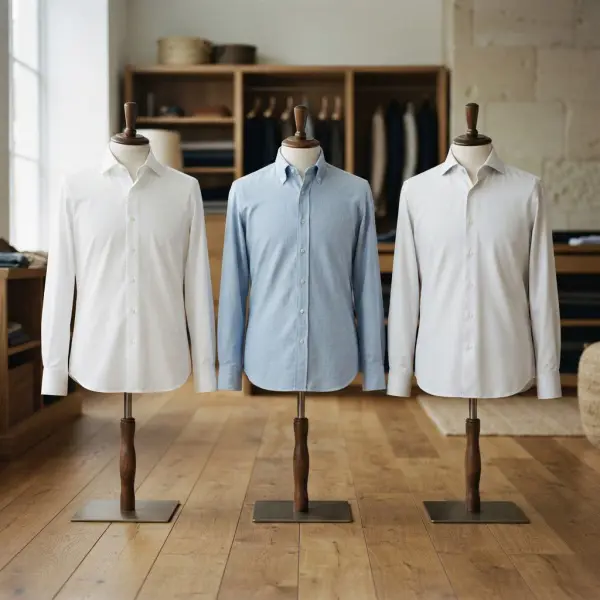
A shirt often occupies a large visible area of an outfit, particularly in professional clothing. Surface texture, opacity, wrinkle appearance, collar shape, and color consistency therefore affect how polished the entire uniform or wardrobe appears.
Smooth fabrics can create visual precision. Textured fabrics can soften the impression and make clothing feel less formal. Heavier constructions may communicate substance, while lightweight materials can appear sharper or more seasonal. None of these effects is inherently superior; the appropriate choice depends on the intended brand or dress context.
A formal finance office and a lifestyle retail store can both require collared shirts while communicating very different identities. Hospitality introduces another range: a luxury hotel front desk may need crisp refined shirting, while a casual restaurant may deliberately choose textured Oxford, chambray, or other relaxed woven fabrics.
The material becomes part of visual branding.
Opacity Is an Operational Issue, Not Merely an Aesthetic One
Opacity deserves more attention in shirting development because a fabric that looks sufficiently opaque as a folded swatch can behave differently when made into a garment.
White, pale blue, beige, and other light colors are particularly sensitive. Fabric may become more transparent when stretched across the chest, shoulders, or back, and differences between single-layer and double-layer areas can become visually obvious around pockets, facings, plackets, and seam allowances.
Fiber type alone does not solve this. Yarn fineness, fabric density, weight, coloration, finishing, garment ease, and lighting conditions all influence perceived cover.
For professional uniforms, unexpected transparency can create employee discomfort and force late-stage changes such as additional layers, larger pockets, heavier replacement fabric, or altered dress requirements. These are avoidable costs when opacity is assessed during development.
A practical approval should examine the fabric under realistic lighting, preferably in the intended garment color and fitted sample rather than only against a tabletop.
Wrinkle Behavior Can Change the Entire User Experience
Wrinkling is particularly visible in shirts because the garment repeatedly folds at elbows, waist, shoulder, and seating areas. A formal shirt may therefore be judged not only by how it looks after pressing but by how it appears several hours into wear.
Fiber composition contributes to wrinkle behavior, but construction and finishing can change the outcome substantially. AATCC TM66 is specifically designed to determine wrinkle recovery of woven fabrics by creating a controlled fold and measuring the recovery angle.
Wrinkle-resistant or durable-press finishing can further modify performance. CottonWorks describes wrinkle-resistant finishes as treatments intended to help fabrics retain a smoother appearance, shape, creases, or pleats after laundering, reducing the amount of ironing required.
AATCC TM66 wrinkle-recovery test provides a recognized testing framework when wrinkle performance is commercially important.
The relevant product question is not whether a fabric “wrinkles.” Almost every shirt fabric can crease under some conditions. The useful question is how much wrinkling the target customer considers acceptable, how easily the garment recovers, and how much maintenance the user is willing to perform.
Care Requirements Can Determine Whether a Shirt Is Truly Practical
An attractive shirt that demands more ironing, drying time, or specialized cleaning than the customer expects can create dissatisfaction even when the garment is technically well made.
Care becomes especially significant in professional apparel because uniforms may be washed far more frequently than fashion shirts. A hotel employee with five uniform shirts, a school student rotating garments through the week, or a healthcare worker laundering clothing after every shift creates a very different use profile from someone wearing a dress shirt twice a month.
Dimensional stability is one major consideration. AATCC TM135-2025 is intended to determine changes in fabric length and width following standardized home-laundering procedures, using defined combinations of washing and drying conditions.
Color retention is another. AATCC TM61 evaluates accelerated colorfastness to laundering and is specifically intended for textiles expected to withstand frequent washing.
AATCC TM135 dimensional-change method and AATCC TM61 colorfastness-to-laundering method illustrate why “machine washable” is not a complete performance specification.
For commercial sourcing, the buyer still needs acceptance criteria appropriate to the product.
Frequent Laundering Changes the Economics of Professional Apparel
Initial fabric cost is easy to see on a costing sheet. Long-term maintenance cost is less visible but can be more important for uniforms.
Consider two corporate shirtings. Fabric A costs slightly less per meter but requires more pressing and experiences noticeable dimensional change after repeated washing. Fabric B costs more but retains dimensions and appearance more consistently under the intended care cycle.
The cheaper fabric is not necessarily the lower-cost uniform program.
Replacement rates, laundry procedures, employee time, ironing requirements, alterations, color mismatch between old and replacement garments, inventory holdings, and complaint handling can all contribute to total cost.
This does not mean a more expensive fabric will automatically perform better. It means price per meter and cost in use are different metrics.
For institutional apparel, buyers should evaluate both.
Durability Is More Than Fabric Strength
When a shirt fails, the fabric itself is only one possible cause. The seam may open, yarns may slip around the stitching, a buttonhole may fray, the collar may abrade, color may fade, fusible interlining may delaminate, or the body fabric may shrink differently from another component.
ASTM D1683/D1683M-22 reflects this systems view. The standard evaluates sewn seam strength in woven fabrics and explicitly treats sewing thread, stitch type, seam type, and stitch density as interacting seam-engineering variables. It also cautions that the test does not itself predict actual wear performance.
That caveat matters. A single tensile or seam result cannot tell a brand exactly how long a shirt will survive in the field.
A durable product normally requires alignment among:
- appropriate fabric strength and stability;
- seam engineering suited to the construction;
- correct sewing needle and thread;
- reinforcement at stress points;
- suitable interlining;
- realistic garment fit;
- correct washing and finishing;
- quality-controlled production.
Laboratory testing narrows uncertainty. Wear trials add context.
Shirting Fabric Also Affects Manufacturing Efficiency
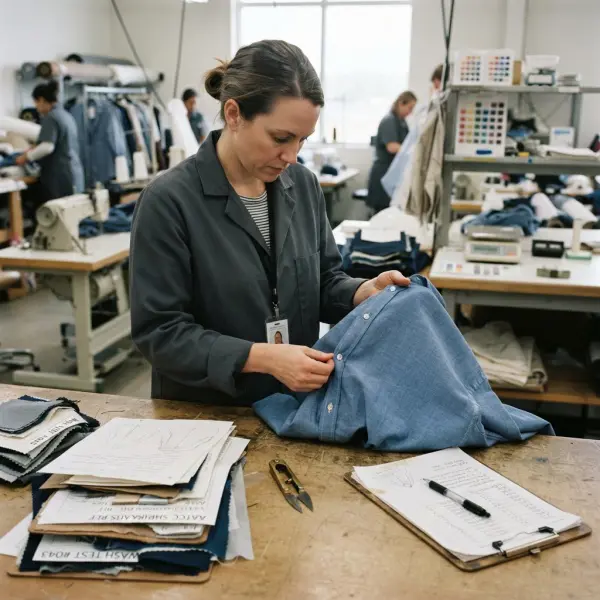
Factories experience fabric differently from customers. Customers notice comfort and appearance; production teams also notice spreading behavior, cutting stability, needle penetration, seam puckering, fusibility, pressing response, shrinkage, and defect visibility.
A stable plain woven shirting may be relatively straightforward to spread and cut, but very fine fabrics can expose sewing tension problems immediately. Dense fabrics may require different needle choices. Stretch wovens need careful handling to prevent distortion. Fabrics with visible directional texture require more attention during cutting and panel matching.
Even color affects production visibility. Needle damage or puckering may be easier to detect on certain smooth light-colored fabrics than on textured or patterned surfaces.
Manufacturing parameters should therefore be established during pre-production rather than copied automatically from another shirt style.
A fabric change that looks minor on the design board can require adjustments to:
- needle size or point;
- thread specification;
- stitch density;
- presser-foot pressure;
- seam construction;
- fusible interlining;
- fusing temperature, time, and pressure;
- pressing conditions;
- shrinkage allowance;
- cutting and handling procedures.
This is one reason material approval should involve production teams before bulk commitment.
Finishing Can Change a Familiar Shirting Fabric Dramatically
The same underlying weave can be finished for very different commercial objectives. Softening can change handfeel. Resin systems can modify wrinkle recovery. Mechanical finishing may affect surface appearance. Moisture-management treatments can change liquid transport. Stretch technologies can alter mobility.
CottonWorks' finishing resources illustrate how substantial this transformation can be. Its chemical-finishing guidance explains that wrinkle-resistant properties depend on chemistry and application conditions, while specific product technologies demonstrate that cotton wovens can be engineered for moisture management, stretch, water repellency, or easy-care performance.
These examples are useful because they challenge a common sourcing assumption: a fabric's fiber and weave do not reveal everything about its final performance.
They should not, however, be generalized into claims about untreated fabrics. If a supplier describes a shirting as moisture-wicking, wrinkle-resistant, stretch, stain-resistant, or water-repellent, the buyer should establish what treatment or construction creates the property, how it is tested, and whether performance remains after the required care cycles.
Why Shirting Fabrics Matter in Everyday Clothing
Everyday shirts face a different challenge from formal uniforms: they must earn their place in the wardrobe.
A consumer may appreciate a fabric in the fitting room but stop wearing the shirt if it wrinkles too easily for their routine, feels hot during commuting, becomes uncomfortable when seated, needs special ironing, loses shape after washing, or is too transparent for normal use.
These are textile decisions translated into consumer behavior.
For casual fashion, fabric character can also define the product. A textured Oxford button-down communicates something different from a fine poplin shirt even if the two share the same pattern. A lightweight chambray-style shirt can create another aesthetic. A soft twill shirt may move the garment closer to overshirt territory.
This makes fabric one of the most efficient ways to create differentiation within a shirt collection without completely changing garment architecture.
Why Shirting Fabrics Matter Even More in Professional Apparel
Professional apparel adds constraints that everyday fashion may not face simultaneously.
A uniform often needs to satisfy the organization, purchasing team, laundry process, garment manufacturer, and wearer at the same time. Management may prioritize brand consistency. Employees may prioritize comfort and movement. Procurement may focus on price and availability. Laundry operations care about dimensional stability and maintenance. Manufacturers need predictable sewing behavior.
A fabric that satisfies only one stakeholder can create problems elsewhere.
The strongest professional shirting specifications therefore begin with use conditions:
- How long is each shift?
- Is the environment air-conditioned, outdoor, humid, or temperature-variable?
- How physically active is the wearer?
- How often is the shirt washed?
- Is ironing realistic?
- Does the employee wear an undershirt, jacket, apron, or protective equipment?
- Is the fabric exposed to food, oils, chemicals, dust, or repeated abrasion?
- Must replacement garments match existing inventory?
- Is embroidery or heat-applied branding required?
- How formal should the uniform appear after several hours of wear?
These questions are more useful than beginning with “We want cotton poplin” before the operating requirements are understood.

Fabric Choice Can Support—or Undermine—Brand Positioning
Customers rarely describe shirt quality using weaving terminology, yet they respond to the resulting experience.
A premium shirt made from a rough, unstable, or excessively transparent fabric can contradict its price positioning. A rugged work-inspired shirt made from an extremely delicate construction may fail to deliver the tactile substance the design promises. A travel shirt marketed around convenience may disappoint if it requires careful ironing after every wash.
Material and brand promise need to align.
That does not require luxury fabrics. A value-oriented brand can build trust by using a modest but consistently specified textile that performs predictably. Conversely, expensive fiber content cannot compensate for poor fabric engineering, unsuitable finishing, or inconsistent manufacturing.
Material storytelling is strongest when it describes characteristics the customer can actually experience and the brand can substantiate.
Selecting Shirting by Product Requirement
Different shirt categories call for different priorities.
|
Product Type |
Fabric Priorities |
Important Checks |
|
Formal business shirt |
Smoothness, crisp appearance, controlled drape, refined surface |
Wrinkle appearance, opacity, collar compatibility, shrinkage |
|
Smart-casual shirt |
Texture, comfort, versatile body |
Drape, wash appearance, styling compatibility |
|
School uniform |
Durability, easy care, opacity, consistency |
Laundering, colorfastness, dimensional stability, repeat supply |
|
Hospitality uniform |
Professional appearance, comfort, maintenance |
Stain exposure, shift conditions, pressing, logo application |
|
Retail uniform |
Brand character, mobility, visual consistency |
Wear comfort, embroidery/printing, replacement matching |
|
Warm-weather shirt |
Low thermal burden, airflow, comfortable fit |
Weight, density, air permeability, opacity |
|
Overshirt |
Body, structure, abrasion tolerance |
Weight, seam bulk, layering comfort |
|
Travel shirt |
Appearance retention, comfort, maintenance |
Wrinkle recovery, drying behavior, movement |
These priorities can conflict. Lower fabric weight may improve one aspect of comfort but reduce opacity. Increased density may improve cover while affecting airflow. A softer finish may improve first touch while changing sewing or long-term appearance.
Good product development is therefore an exercise in trade-offs rather than maximizing every property.
A Practical Shirting Fabric Selection Framework
Fashion businesses can make fabric selection more repeatable by separating the process into decisions that can be evaluated.
1. Define the wearing scenario
Start with the customer's real use rather than the fabric catalogue. Identify climate, wearing duration, activity level, dress expectation, layering, laundering frequency, and likely care behavior.
A shirt designed for tropical restaurant staff needs a different balance from a shirt worn under a suit in a climate-controlled office.
2. Define the silhouette and visual language
Specify whether the shirt should appear sharp, soft, relaxed, textured, formal, utilitarian, premium, or casual.
Then identify fabrics capable of creating that silhouette. A weave that fights the intended pattern will create unnecessary sampling work.
3. Establish measurable fabric criteria
At minimum, important specifications may include composition, fabric weight, usable width, weave, stretch where relevant, dimensional-change tolerance, color requirements, and approved handfeel.
Higher-risk products may also require specific performance standards for seam behavior, abrasion, wrinkle recovery, opacity, pilling, or other properties.
4. Review the actual fabric, not only the data sheet
Numbers do not fully describe tactile behavior. Two materials with similar GSM and composition can have different surfaces and drape.
Keep an approved reference swatch and define which characteristics are objective tolerances and which are visual or tactile standards.
5. Make a real garment prototype
Use the actual collar, interlining, seams, buttons, branding, pressing process, and garment wash if applicable.
The fabric needs to prove itself as a shirt, not merely as yardage.
6. Launder and wear the sample
Observe shrinkage, twisting, color change, surface changes, collar and cuff appearance, wrinkle behavior, and wearer comfort.
For professional apparel, test conditions should represent likely care cycles as closely as practical.
7. Confirm repeat-order control
If a garment will remain in the range for several years, determine how the supplier will manage shade, handfeel, weight, width, finishing, and other tolerances between lots.
Continuity can be commercially more valuable than constantly changing to a slightly cheaper fabric.
Common Mistakes When Selecting Shirting Fabrics
Mistake 1: Choosing by fiber name alone
“100% cotton” describes composition, not the complete fabric. A fine dense poplin, loose textured Oxford, heavy twill, and lightweight plain weave can all be cotton yet deliver very different shirts.
The better approach is to evaluate composition together with weave, yarn, density, weight, finishing, and end-use performance.
Mistake 2: Treating GSM as a quality score
Fabric weight is useful but does not tell the buyer whether yarns are uniform, color is stable, seams will perform well, or the shirt will retain dimensions after laundering.
A higher GSM may simply mean more mass. Quality depends on whether the textile meets the intended product requirements.
Mistake 3: Optimizing the first touch instead of long-term performance
A soft showroom sample can be persuasive, but initial handfeel is only one moment in the product's life. Washing may change surface character, dimensions, wrinkle behavior, and structure.
Brands should compare the new fabric with its post-care condition before making final judgments.
Mistake 4: Using “breathable” as an unsupported universal claim
Comfort depends on more than fiber. Fabric density, thickness, porosity, moisture transport, finishing, fit, climate, and activity influence how the shirt behaves.
When breathability is commercially important, define what property is actually required and use appropriate testing rather than relying solely on general material reputation.
Mistake 5: Selecting uniform fabric like fashion fabric
Uniforms typically experience more repeated wear, laundering, and replacement cycles than many fashion garments. The visual swatch is therefore not enough.
Professional apparel selection should include care conditions, durability requirements, continuity, employee comfort, branding application, and operating cost.
Mistake 6: Changing fabric without re-validating garment construction
A replacement fabric can alter seam puckering, collar stiffness, fit perception, shrinkage, or pressing even when its composition appears similar.
Material substitutions should be sampled and tested in the garment before bulk production.
What Brands Should Verify Before Acting
Shirting terminology is useful for communication, but it is not standardized tightly enough to replace specifications.
A buyer should be careful about assuming that:
- all poplin has the same weight or smoothness;
- all Oxford is heavy or highly textured;
- all cotton shirting has the same comfort profile;
- all blends are automatically easy-care;
- higher thread count automatically means better quality;
- higher GSM automatically means greater durability;
- wrinkle-resistant claims describe permanent performance;
- fabric-level laboratory results predict complete garment life.
Performance claims should be tied to a defined construction, finish, testing method, care condition, and acceptance requirement.
The distinction between laboratory performance and real-world use is particularly important. ASTM D1683/D1683M, for example, can evaluate sewn seam behavior but explicitly states that it does not predict actual wear performance.
Technical data improves decision-making when it answers a specific question; it should not be treated as a substitute for garment trials and wear context.
FAQ: Shirting Fabrics
What is the best fabric for everyday shirts?
There is no single best fabric because everyday use varies. A lightweight poplin can suit someone who prefers a clean, crisp shirt, while Oxford may work better for people who like visible texture and a relaxed appearance. Twill or other woven constructions can provide different drape and body.
The strongest choice is a fabric that fits the climate, garment silhouette, laundering habits, desired formality, and expected durability. Comfort and maintenance should be assessed in the finished garment rather than inferred from the material name alone.
What fabric is best for professional uniforms?
The best uniform shirting is the one that meets the actual workplace requirements. Those can include comfort during long shifts, opacity, dimensional stability, colorfastness, seam performance, easy maintenance, branding compatibility, and the ability to reproduce the same shade across future orders.
Poplin, Oxford, twill, and blends can all work in professional applications. The selection should follow the dress code and operating environment rather than assuming one weave is universally more professional.
Is cotton always the most comfortable shirting fiber?
Not universally. Cotton is widely used in shirting and can provide a comfortable hand and useful moisture interaction, but comfort is influenced by much more than fiber chemistry.
Fabric density, weight, thickness, weave, finishing, stretch, garment ease, humidity, temperature, and wearer activity all affect the experience. A well-engineered blend may be more appropriate for one uniform program, while a fine cotton construction may be preferable for another. The decision should be based on the complete fabric and use case.
Why do two 100% cotton shirts feel completely different?
Because fiber composition is only one layer of the textile. The shirts may use different yarn counts, spinning systems, weave structures, yarn densities, weights, finishes, and fabric treatments.
One cotton shirt might use a fine compact plain weave and feel smooth and crisp. Another might use Oxford construction with heavier filling yarns and feel more textured. Finishing can then make either fabric softer, firmer, more wrinkle-resistant, or otherwise different.
“100% cotton” is therefore not a complete description of how a shirt will behave.
Does a heavier shirting fabric last longer?
Not automatically. Higher fabric mass may be useful in products requiring more body, but service life depends on yarn strength, construction, abrasion exposure, finishing, seam engineering, garment fit, laundering, and quality control.
A well-engineered lightweight fabric may remain serviceable longer than a heavier but poorly constructed one. For high-use uniforms, brands should identify likely failure modes and select relevant testing instead of relying on GSM as a durability proxy.
Should a fashion brand test every shirting fabric?
The amount of testing should be proportional to product risk, volume, claims, and end use. A small casual collection may rely on supplier data, internal wash tests, garment sampling, and targeted external testing, whereas large uniform or institutional orders can justify more formal laboratory requirements.
At minimum, brands should validate the characteristics most likely to affect customer satisfaction: dimensions after care, color, appearance, fit, seam quality, and relevant performance claims.
How can brands reduce inconsistency between repeat fabric orders?
Keep an approved fabric standard and define measurable tolerances with the supplier. Useful controls can include composition, weight, usable width, color standard, construction, finishing, dimensional stability, and agreed handfeel or appearance references.
Repeat-lot approval is particularly important for uniform and replenishment programs because small shade or texture differences become obvious when old and new garments are worn together. Supplier continuity and controlled specifications can therefore be as important as negotiating the lowest fabric price.
Can finishing make a basic shirting fabric perform like a technical fabric?
Finishing can add or enhance specific properties, but claims should be precise. Treatments and engineered constructions can modify wrinkle recovery, moisture movement, water repellency, stretch, softness, or other characteristics. CottonWorks documents examples of such technologies across woven cotton products.
That does not mean every treated shirt becomes broadly “technical.” Each feature should be evaluated according to its mechanism, test method, durability through laundering, cost, and relevance to the wearer.
Conclusion
Shirting fabrics matter because a shirt asks a textile to perform several jobs simultaneously. It must create the intended silhouette, feel acceptable against the body, move with the wearer, support collars and cuffs, survive sewing, withstand the expected care routine, and continue to represent the brand after repeated use.
The fabric name alone cannot guarantee those outcomes.
Poplin, Oxford, twill, and other shirtings offer different structural starting points, while fiber composition, yarn quality, density, weight, finishing, and garment construction refine the result. A fabric that succeeds in a formal business shirt may be wrong for a warm-weather hospitality uniform; a material that works beautifully in a casual Oxford button-down may not deliver the clean surface expected from premium dress shirting.
For everyday apparel, thoughtful fabric selection improves wearability and helps products earn repeat use. For professional apparel, the stakes are broader: comfort, maintenance, operational cost, employee appearance, supply continuity, and brand consistency can all be affected.
The strategic lesson is straightforward. Do not select shirting by reputation alone. Select it by the job the finished shirt has to perform—and verify that performance before committing to scale.




Comments 0
Leave a CommentSend Comment
Anda harus Login terlebih dahulu untuk dapat memberikan komentar.