

Optimizing Product Catalogs for AI Agents: The Data Structures That Make Brands “Invisible”
Introduction: Visibility Is No Longer About Humans Alone
In the past, product visibility depended heavily on how well your catalog appealed to human users—through design, copywriting, and visual merchandising. Today, that paradigm has shifted. Increasingly, AI agents, search algorithms, recommendation systems, and shopping assistants act as the first “viewer” of your product catalog.
This shift introduces a critical reality: If your catalog is not structured for AI understanding, your brand may become invisible—even if your products are excellent.

Fashion brands and startups often underestimate how data structure—not just content—determines discoverability. AI systems do not interpret catalogs the way humans do. They rely on structured, machine-readable signals such as attributes, taxonomy, consistency, and semantic clarity.
This article breaks down the most common structural mistakes that cause invisibility—and how to fix them with a scalable, AI-ready catalog strategy.
How AI Agents “See” Your Product Catalog
Before optimizing, you must understand how AI systems process your data.
AI agents (including search engines, marketplaces, and recommendation engines) rely on:
- Structured attributes (metadata)
- Taxonomy (category hierarchy)
- Semantic consistency (language patterns)
- Entity relationships (product → variant → collection)
Unlike humans, AI does not infer meaning from context easily. It depends on explicit signals.
Example:
Human interpretation:
“Elegant oversized linen shirt, perfect for summer.”
AI interpretation:
- Product Type: Shirt ❌ (missing or unclear)
- Material: Linen ✔️
- Fit: Oversized ✔️
- Season: Summer ✔️
If “shirt” is not explicitly tagged as a structured attribute, AI may fail to classify it correctly.
Key Insight:
AI visibility is not about how descriptive your content is—but how structured it is.
 ]
]
The #1 Cause of Invisibility — Missing Attribute Standardization
One of the most critical issues in fashion catalogs is inconsistent attribute naming.
Common Problems:
- “Color: Sky Blue” vs “Color: Light Blue” vs “Color: Baby Blue”
- “Material: Cotton Blend” vs “Cotton 70%”
- “Fit: Relaxed” vs “Loose Fit” vs “Oversized”
To humans, these are similar. To AI, they are different entities.
Why This Breaks Visibility:
AI systems group and rank products based on attribute similarity. If your data is inconsistent:
- Your products are fragmented into multiple clusters
- You lose ranking strength
- You reduce match probability in search and recommendations
Solution:
Implement controlled vocabularies:
|
Attribute |
Standardized Value Example |
|
Color |
Light Blue |
|
Fit |
Oversized |
|
Material |
Cotton |
Advanced Tip:
Create an internal attribute dictionary that all product entries must follow.
This alone can increase discoverability significantly—especially in marketplaces and AI-driven search.
Weak Product Taxonomy (Category Structure)
Many fashion startups treat categories as a UX element only. In reality, taxonomy is a core ranking signal for AI.
Common Mistakes:
- Overly broad categories: “Clothing”
- Flat structures: no hierarchy
- Mixing product types: “Tops & Dresses”
Why This Matters:
AI relies on taxonomy to:
- Understand product context
- Compare similar items
- Recommend alternatives
Poor Example:
- Clothing → Item
Strong Example:
- Women → Tops → Shirts → Linen Shirts
Impact:
With a strong taxonomy:
- AI can place your product in the right “cluster”
- Your products appear in more relevant queries
- Recommendation engines perform better
Key Principle:
The deeper and cleaner your taxonomy, the more “indexable” your catalog becomes.

Unstructured Product Descriptions (AI Can’t Parse Them)
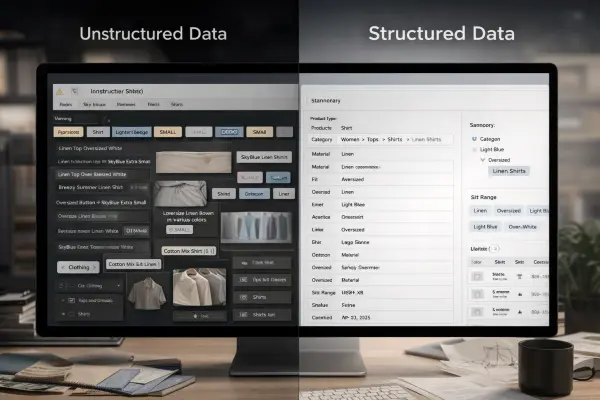
Many brands focus on storytelling—but neglect structure.
Problem:
Descriptions like:
“A timeless piece with modern elegance, crafted for everyday comfort.”
This is great for branding—but weak for AI extraction.
AI Needs:
- Clear attribute signals
- Predictable formatting
- Keyword alignment
Solution: Hybrid Description Structure
Use a layered format:
1. Structured Summary
- Product Type: Linen Shirt
- Fit: Oversized
- Material: Linen
- Occasion: Casual
2. Narrative Layer
- Add storytelling after structured data
Benefit:
- AI extracts attributes easily
- Humans still enjoy the content
Variant Chaos (Size, Color, SKU Issues)
Variants are often one of the most overlooked structural problems.
Common Issues:
- Each variant uploaded as a separate product
- Missing parent-child relationships
- Inconsistent SKU logic
Why This Is Critical:
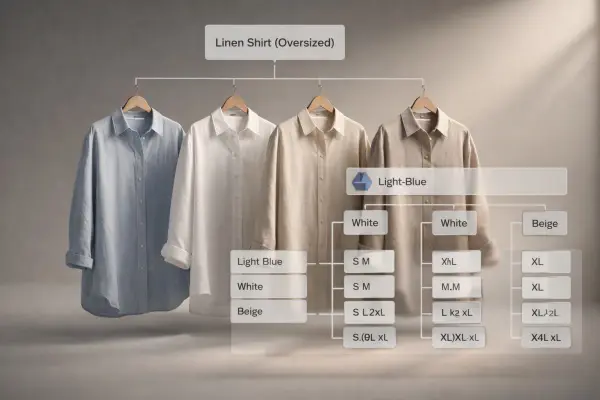
AI systems expect a clear product hierarchy:
- Parent Product (e.g., Linen Shirt)
o Variant 1: Size M, Blue
o Variant 2: Size L, White
If this structure is broken:
- AI treats variants as unrelated products
- Reviews, rankings, and data signals are split
Result:
Lower visibility and weaker performance.
Best Practice:
Use:
- Parent-child structure
- Consistent SKU system
- Unified product ID
Missing Contextual Signals (Occasion, Style, Use Case)
Fashion is contextual—but many catalogs lack structured context.
Missing Fields:
- Occasion (formal, casual, office)
- Style (minimalist, streetwear, modest)
- Season (summer, winter)
Why AI Needs This:
AI agents increasingly operate on intent-based search, such as:
- “Outfit for summer vacation”
- “Minimalist workwear”
Without contextual tags, your product:
- Won’t match these queries
- Won’t appear in AI recommendations
Solution:
Add context attributes systematically:
|
Attribute |
Example |
|
Occasion |
Casual |
|
Style |
Minimalist |
|
Season |
Summer |
Image Metadata Is Ignored (Big Mistake)
Most brands optimize images visually—but ignore metadata.
AI Uses:
- File names
- Alt text
- Embedded tags
Common Mistakes:
- IMG_12345.jpg
- No alt text
Optimized Example:
- File name: oversized-linen-shirt-light-blue.jpg
- Alt text: “Women oversized linen shirt light blue casual summer”
Impact:
- Better indexing in visual search
- Higher relevance in AI recommendation systems
Lack of Structured Data Markup (Schema)
Even if your catalog is clean internally, you must expose it properly.
Missing Element:
Structured data (Schema markup)
Why It Matters:
Search engines and AI agents rely on schema to:
- Understand product details
- Display rich results
- Feed AI shopping assistants
Key Schema Fields:
- Product name
- Price
- Availability
- Brand
- Reviews
Result:
Without schema → partial visibility
With schema → enhanced discoverability
Data Freshness and Update Signals
AI systems prioritize fresh and updated data.
Problem:
- Old inventory still listed
- Outdated descriptions
- No update timestamps
Impact:
- Lower ranking
- Reduced trust signals
Best Practice:
- Update product data regularly
- Sync inventory in real-time
- Include timestamps
The Future — AI-Native Catalog Strategy
The next evolution is not just optimization—but AI-native catalogs.
Characteristics:
- Fully structured data
- Consistent attribute systems
- Context-rich tagging
- API-ready architecture
Emerging Trend:
AI agents will:
- Automatically generate outfits
- Recommend bundles
- Personalize catalogs per user
If your data is not structured:
Your products won’t even enter the decision layer.
Conclusion: Visibility Is a Data Problem, Not a Marketing Problem
Many fashion brands assume low visibility is due to weak marketing, poor ads and low demand.
But in reality, a growing percentage of invisibility comes from:
Broken data structures that AI cannot interpret
To stay competitive, brands must shift from:
- “Beautiful catalog” → to → “Machine-readable catalog”
In the AI-driven commerce landscape, your catalog is no longer just a showcase—it is a data interface. Brands that understand this early will gain a disproportionate advantage. Because in the world of AI, visibility is not earned by design—it is earned by structure.
Frequently Asked Questions (FAQ)
1. Why do fashion product catalogs become invisible to AI agents?
Fashion product catalogs often become invisible because they lack structured, standardized data. AI agents rely on clear attributes, taxonomy, and metadata—not just descriptive text. If your catalog is inconsistent or unstructured, AI systems cannot properly classify or recommend your products.
2. What is the most important factor in optimizing a product catalog for AI?
The most important factor is attribute standardization. Consistent naming for attributes like color, material, and fit ensures AI can group and rank products correctly. Without this, your products are fragmented across multiple data clusters.
3. How does product taxonomy affect visibility in AI search?
Product taxonomy defines how items are categorized. A clear hierarchical structure (e.g., Women → Tops → Shirts) helps AI understand product context, improving indexing, ranking, and recommendation accuracy.
4. Are product descriptions still important in AI-driven search?
Yes, but only if they are structured properly. AI prioritizes descriptions that include extractable attributes (material, fit, use case). A hybrid format—structured data + storytelling—is the most effective approach.
5. How should fashion brands handle product variants for AI optimization?
Brands should use a parent-child structure, where one main product contains all variants (size, color). This prevents data fragmentation and allows AI to consolidate rankings, reviews, and performance signals.
6. What role does image metadata play in AI visibility?
Image metadata (file name, alt text) helps AI understand visual content. Optimized metadata improves performance in visual search and AI recommendation systems, especially in fashion e-commerce.
7. Do small fashion startups need structured data like big brands?
Yes—arguably even more. Startups rely heavily on discoverability, and structured data gives them a competitive advantage without large marketing budgets.
8. What is schema markup and why is it important?
Schema markup is structured data added to your website that helps search engines and AI systems understand your products. It enables rich results, better indexing, and integration with AI shopping assistants.
9. How often should product catalog data be updated?
Regular updates are essential. AI systems prioritize fresh, accurate data, including stock availability, pricing, and product details. Outdated catalogs can reduce ranking and trust signals.
10. What is an AI-native product catalog?
An AI-native catalog is designed from the ground up to be:
- Fully structured
- Context-rich
- API-ready
- Machine-readable
This type of catalog ensures maximum visibility across AI-driven platforms and future commerce ecosystems.





Comments 0
Leave a CommentSend Comment
Anda harus Login terlebih dahulu untuk dapat memberikan komentar.