

How Made-to-Order Technology Helps Reduce Overstock and Waste
Quick Answer
Made-to-order technology can reduce fashion overstock by delaying garment production until a customer order, preorder commitment, or other verified demand signal has been received. Instead of manufacturing every style, color, and size according to a seasonal forecast, brands use connected order, product, inventory, and production systems to determine what should be made and when.
The model may reduce the number of finished garments left unsold, particularly in categories where products can be printed, cut, assembled, or personalized in small quantities. It can also help brands test designs without committing to a full production run and maintain raw materials that can be used across several products.
However, made-to-order production does not eliminate waste. Fabric offcuts, defective garments, test prints, returned customized products, unused materials, packaging, and inefficient small production runs can still create environmental and financial losses.
Its strongest contribution is therefore not “zero waste.” It is better alignment between demand and production. The results depend on product design, material flexibility, data accuracy, supplier capability, order economics, quality control, and whether customers accept the required production lead time.
Why Does Fashion Overstock Happen?
Fashion overstock occurs when a business produces or purchases more finished products than it can sell at the intended price and within the intended selling period. The problem usually begins before manufacturing, when merchandising teams must estimate demand for a large number of combinations: style, color, size, region, channel, and launch date.
A forecast may correctly predict that a dress will be popular while still allocating the wrong quantities across sizes. A retailer may order enough black trousers overall but send too many small sizes to one location and too many large sizes to another. A trend may receive strong attention online but fail to convert into paid orders.
The difficulty is not simply estimating how many garments customers will buy. It is estimating exactly which product variants they will buy, where they will buy them, at what price, and when.
Fashion forecasting also operates within long supply-chain lead times. Fabric development, dyeing, printing, trims, sampling, manufacturing, inspection, international shipping, and customs clearance may require commitments months before the product reaches the customer. By the time weak demand becomes visible, much of the inventory has already been produced.
When stock does not sell as planned, businesses typically respond through:
- Promotional discounts
- Outlet or off-price channels
- Transfers between stores or regions
- Product bundling
- Wholesale liquidation
- Donation
- Repair, modification, or remanufacturing
- Storage for a later season
- Recycling or disposal
Each option has commercial and operational consequences. Discounting may protect cash flow but weaken margin and train customers to wait for sales. Storing products requires space and working capital. Moving inventory to another region adds handling and transport. Products that cannot be resold, reused, or recovered may eventually become waste.
The European Environment Agency estimates that approximately 4–9% of textile products placed on the European market are destroyed before being used for their intended purpose, although the agency notes that available data are fragmented. Its analysis places the estimated annual volume at between 264,000 and 594,000 tonnes.
These figures should not be treated as a universal global overstock rate. They do show that unsold and returned textiles are not merely an accounting issue. They represent materials, manufacturing work, energy, transport, and financial value invested in products that may never be worn.
What Is Made-to-Order Technology?
Made-to-order technology is the connected set of digital systems and production tools used to translate a confirmed order into manufacturing instructions, material allocation, production scheduling, quality control, and fulfillment.
The technology does not have to mean complete automation. A small brand might use an ecommerce platform, standardized digital patterns, barcode job tickets, and a local sewing unit. A larger operation may integrate product lifecycle management, enterprise resource planning, digital printing, automated cutting, production tracking, and warehouse systems.
What matters is that the order can move through production without repeatedly being rewritten, reinterpreted, or manually reconstructed.
A reliable system should answer several practical questions:
- What exactly did the customer order?
- Has the order been paid and approved?
- Which pattern, artwork, and specification apply?
- Are the required materials available?
- Which production processes are needed?
- When must the item be completed?
- How will the order be identified during production?
- Which quality checks must be performed?
- How will delays, defects, or missing information be handled?
Made-to-order technology therefore creates the information infrastructure required to produce later and in smaller quantities. The production model itself is explained more broadly in on-demand fashion production for modern apparel brands.
How Does Made-to-Order Technology Reduce Overstock?
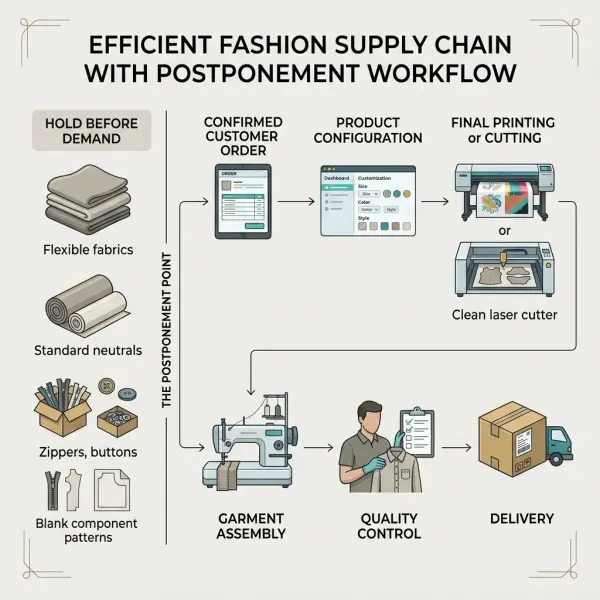
Made-to-order technology reduces overstock primarily through postponement. The business postpones the irreversible step of converting materials into a specific finished garment until demand becomes more certain.
Research on mass customization describes postponement as delaying activities such as labeling, packaging, assembly, or manufacturing until customer requirements are known. It also identifies product modularity, flexible processes, digital configuration, and supply-chain integration as important enablers. The same research warns that empirical evidence for sustainability outcomes remains limited and that implementation complexity can be substantial.

Production begins with a stronger demand signal
Under a conventional model, a merchandising forecast may trigger an order for 5,000 garments. Under a made-to-order model, production may begin after individual purchases or after a preorder campaign reaches a defined threshold.
A paid order is a stronger demand signal than a social media like, product-page visit, survey response, or retailer expression of interest. This does not make demand certain in every case—orders may still be cancelled or returned—but it reduces dependence on speculative volume.
The brand is no longer asking only, “How many units might sell?”
It is also asking, “Which orders are sufficiently confirmed to enter production?”
Product completion is delayed
A business does not always need to postpone the entire manufacturing process. It can postpone only the activities that create the greatest inventory risk.
For example:
- Blank T-shirts can be stocked and printed after purchase.
- Undyed fabric can be colored once demand for a color becomes clearer.
- Standard garment bodies can receive embroidery or personalization later.
- Core fabric can be shared across several silhouettes.
- Standard components can be assembled into different final configurations.
- Labels and market-specific packaging can be added after destination demand is known.
- A preorder can determine the final size ratio before cutting begins.
This approach is sometimes more practical than attempting true one-piece production from raw fiber to finished garment.
Design testing requires less finished inventory
A brand may want to test 30 graphic designs but cannot economically produce hundreds of finished garments for every design. Digital printing and configurable product systems can allow all 30 designs to be offered on a smaller number of standard garment bases.
Production occurs only for designs that receive orders. The business can then remove weak designs, continue producing steady sellers, and convert strong demand into larger or more efficient production runs.
This is particularly effective when the designs share:
- The same base garment
- The same fabric
- The same pattern
- The same printing process
- The same trims
- The same packaging
- Similar quality standards
The model is less effective when every design requires a unique fabric development, specialist trim, separate dye lot, extensive sampling, or different manufacturing partner.
Size allocation can follow actual orders
Size imbalance is one of the less visible forms of overstock. A style may appear commercially successful overall while leaving substantial quantities of particular sizes unsold.
Made-to-order systems can use actual size selections rather than relying entirely on a predicted size ratio. This may be valuable for extended-size ranges, niche fit requirements, uniforms, premium basics, and products serving markets where historical sizing data are limited.
The benefit depends on fit reliability. Producing the requested size does not reduce waste when the sizing information is confusing, the pattern is inconsistent, or the customer selects the wrong product dimensions.
Demand data can be connected directly to production planning
Order data becomes more useful when it is linked to materials and production capacity. An order-management system may show that 100 garments have been sold, but the factory needs to know which fabrics, sizes, prints, operations, and deadlines are involved.
A digital thread connects product-definition data with manufacturing and quality activities. The National Institute of Standards and Technology describes this broader manufacturing concept as the structured exchange of product information across design, production, inspection, and other lifecycle stages.
In apparel, this connection may involve:
- Ecommerce orders
- Product and variant codes
- Digital patterns
- Bills of materials
- Artwork files
- Fabric consumption
- Inventory availability
- Cutting instructions
- Sewing operations
- Quality requirements
- Shipping commitments
The result is not perfect forecasting. It is a more direct relationship between what has been ordered and what is released to production.
Which Technologies Support Inventory Reduction?
Ecommerce product configurators
A product configurator allows customers to select approved combinations of size, color, print, fabric, length, or personalization.
The configurator should prevent combinations the production team cannot reliably make. For example, it should not offer embroidery in an area blocked by a pocket construction or allow a fabric choice that is incompatible with the selected print method.
Well-designed configuration reduces manual interpretation and helps ensure that the demand recorded by the sales system is technically producible.
Preorder and demand-aggregation systems
Preorder systems collect demand before full production begins. A brand may set:
- A minimum number of orders
- A closing date
- A production window
- A maximum available quantity
- A deposit or full-payment requirement
- A cancellation policy
- A target delivery period
Preorders can reveal actual customer commitment while allowing the brand to consolidate production into a more efficient batch.
They must be communicated carefully. A preorder is not the same as an immediately available product. Customers should understand when manufacturing begins, what happens when the minimum is not reached, and whether the delivery date is guaranteed or estimated.
Product lifecycle management and product information systems
Product lifecycle management (PLM) and product information management systems help control product definitions, approved materials, patterns, measurements, artwork, revisions, costs, and supplier instructions.
Their contribution to waste reduction is indirect but important. Incorrect or outdated product data can produce unusable garments even when demand is genuine.
Examples include:
- Cutting from an obsolete pattern
- Printing the wrong artwork version
- Using an unapproved fabric
- Applying the wrong care label
- Producing an incorrect color combination
- Packing a personalized order for the wrong customer
A technically correct order created from incorrect master data still becomes a defective product.
Digital patternmaking and automated marker planning
Digital patterns allow approved garment pieces to be stored, graded, modified, and retrieved for individual orders or short production runs. Marker-planning software arranges pattern pieces within the available fabric width.
This can improve consistency and may support better material utilization than poorly planned manual layouts. Actual cutting efficiency still depends on garment shape, size mix, fabric direction, pattern matching, defects, shrinkage allowance, and whether multiple orders can be combined.
The relationship between pattern data and production accuracy is covered in more detail in digital pattern making for apparel production.
Digital textile and garment printing
Digital printing can make short runs commercially possible because designs can often be changed through digital files rather than preparing a separate physical screen for each artwork.
A print-on-demand operator may therefore stock a controlled range of blank garments and decorate each item only after purchase.
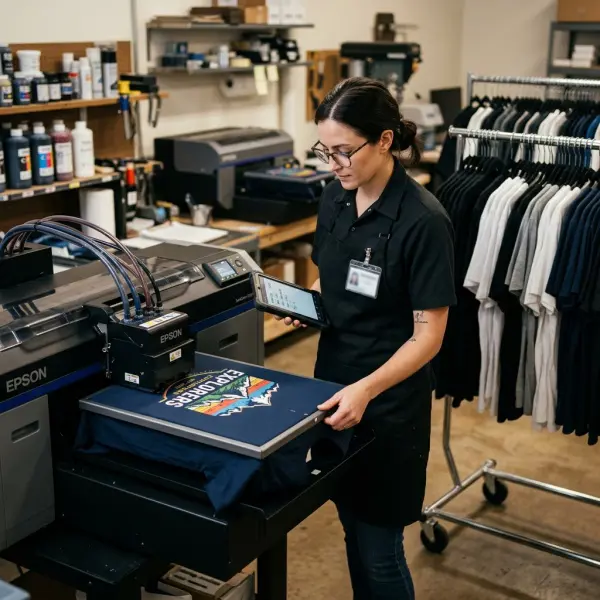
Digital printing does not eliminate process waste. Pretreatment errors, nozzle problems, color mismatch, curing failures, artwork defects, machine cleaning, and test printing can still produce waste.
The technology is most effective when machine maintenance, artwork preparation, color management, fabric compatibility, and quality testing are controlled.
Enterprise resource planning and inventory systems
Enterprise resource planning systems can connect orders with purchasing, material inventory, costing, production, finance, and fulfillment.
For made-to-order production, the inventory system should distinguish between:
- Available material
- Reserved material
- Material undergoing inspection
- Damaged material
- Work in progress
- Completed orders
- Returned products
- Remake requirements
Without accurate reservation, two orders may be accepted against the same remaining fabric. The system may show stock on hand even though it has already been allocated to another customer.
Manufacturing execution and order tracking
Manufacturing execution systems, production dashboards, barcode job tickets, or simpler tracking applications can record where each order is located in the process.
This helps teams avoid losing, mixing, or duplicating small orders. It can also reveal recurring delays in printing, cutting, sewing, inspection, or packing.
The appropriate level of technology depends on volume. A small workshop may use barcode labels and a controlled production board. A multi-site operation may need real-time system integration.
Demand analytics
Demand analytics can identify which variants are receiving orders, how demand changes over time, and where material or capacity constraints may occur.
Analytics should support decisions rather than automatically increase production based on a temporary spike.
A viral post may generate a brief surge followed by cancellations. An influencer campaign may shift demand toward one color while creating no lasting preference. A high-selling item may also have poor contribution margin or an expensive return rate.
Order volume must therefore be considered together with profitability, quality, returns, and operational capacity.
Which Types of Waste Can Be Reduced?
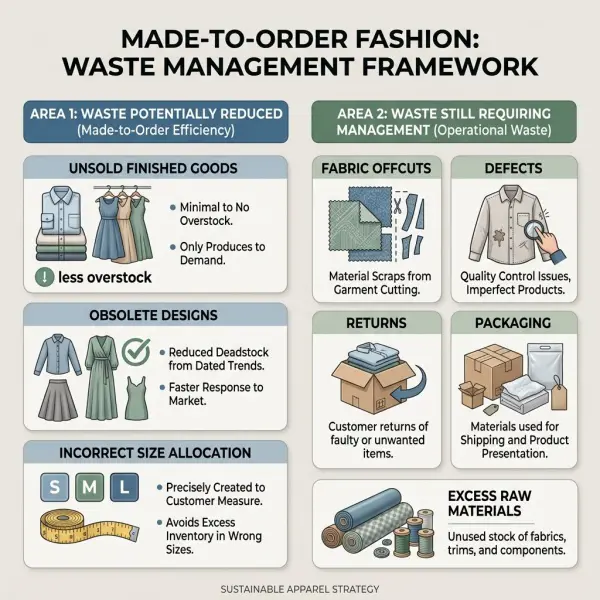
Made-to-order production affects several waste categories differently. Its strongest impact is usually on unsold finished goods, not every type of textile waste.
|
Waste or loss category |
Potential made-to-order impact |
Important limitation |
|
Unsold finished garments |
Can be significantly reduced when production follows confirmed orders |
Cancellations and returns may still create unsold products |
|
Wrong size allocation |
Can be reduced when actual size orders determine production |
Poor sizing information can increase remakes and returns |
|
Obsolete prints or colors |
Can be reduced through delayed decoration |
Blank garments and base materials may still become obsolete |
|
Sampling waste |
Can be reduced through digital development and controlled testing |
Physical fit and performance samples are still often necessary |
|
Cutting waste |
May improve through digital markers and consolidated orders |
One-piece cutting can be less efficient than optimized batch markers |
|
Printing waste |
May fall when only sold designs are printed |
Tests, errors, pretreatment, and cleaning waste remain |
|
Defective products |
Better data and tracking may reduce specification errors |
Small-batch production does not guarantee workmanship quality |
|
Packaging waste |
Production data may allow order-specific packing |
Individual shipping can require more packaging per garment |
|
Returns |
Better fit and configuration may reduce some returns |
Customized products can be harder to resell after return |
|
Unused raw materials |
Shared materials can improve flexibility |
Fabric and trim minimums may still create excess inputs |
The table highlights an important distinction: reducing finished-goods overstock does not automatically reduce total material consumption by the same proportion.
A brand might successfully avoid unsold printed T-shirts while still purchasing too many blank garments. Another may produce dresses only after purchase but hold fabric that eventually becomes obsolete.
The environmental benefit depends on where the inventory risk moves and what happens to the remaining materials.
How Can Made-to-Order Reduce Sample Waste?
Sampling is necessary for fit, construction, material performance, costing, and quality approval. The objective should not be to eliminate every physical sample but to reduce samples that do not contribute meaningful evidence.
Digital tools can support this by allowing teams to review:
- Silhouette and proportion
- Pattern balance
- Color combinations
- Print placement
- Design details
- Preliminary material drape
- Size grading
- Construction logic
Physical samples are still important when decisions depend on handfeel, stretch recovery, opacity, shrinkage, seam performance, wash results, colorfastness, comfort, or actual fit.
A digital image may make a sleeve appear correct while the real fabric restricts movement. A three-dimensional simulation may show an attractive drape based on inaccurate fabric parameters.
The practical strategy is selective sampling: use digital development to remove avoidable iterations, then reserve physical samples for decisions requiring real material or body interaction.
How Can Material Strategy Prevent Waste from Moving Upstream?
Made-to-order brands often reduce finished inventory by holding materials instead. This can be sensible when the materials are versatile, stable, and shared across several products.
A useful material platform may include:
- One core jersey used for multiple tops
- One woven fabric used across shirts, dresses, and skirts
- Standard threads and labels
- Common zippers or buttons
- A controlled blank-garment range
- Neutral base colors
- Undyed or greige material finished later
- Packaging shared across product categories
The more products that can use the same input, the lower the risk that a weak-selling style leaves a completely unusable material behind.
Material flexibility should not compromise technical suitability. A fabric used for multiple garments still needs the appropriate weight, stretch, opacity, durability, drape, and care performance for each application.
Brands should also examine supplier minimums. A made-to-order garment may require only two meters of fabric, but the mill may require a large production quantity for a custom color.
In that case, the finished garment is demand-led while the fabric commitment remains forecast-led.
Made-to-Order Versus Small-Batch Production
Made-to-order and small-batch production are often combined rather than treated as opposing strategies.
A pure made-to-order model may release every garment individually. A demand-aggregated model collects orders for several days and groups compatible products into a short production batch.
|
Factor |
Individual made-to-order |
Demand-aggregated small batch |
|
Production trigger |
Each confirmed order |
A group of confirmed orders |
|
Customer lead time |
Can begin immediately |
May wait until batch closes |
|
Cutting efficiency |
Potentially lower |
Size combinations can improve markers |
|
Machine changeovers |
More frequent |
Similar orders can be grouped |
|
Tracking complexity |
High at item level |
High, but more structured by batch |
|
Customization |
Easier to individualize |
Works best with controlled variation |
|
Unit cost |
Often higher |
May improve with consolidated processing |
|
Inventory risk |
Very low for finished stock |
Low when the batch is based on orders |
For many apparel businesses, demand aggregation creates a practical middle ground. The brand avoids producing an entire speculative collection but still captures some production efficiency.
The appropriate batch window depends on customer expectations. A premium customer may accept a two-week production cycle. A customer buying a basic T-shirt may compare delivery speed with immediately available alternatives.
Does Made-to-Order Production Support Circular Fashion?
Made-to-order production can support circularity when it reduces avoidable production and is combined with durable product design, responsible material choices, repair, reuse, resale, and material recovery.
It should not be presented as a complete circular system by itself.
UNEP’s roadmap for textile circularity identifies changes in consumption, improved practices, and infrastructure investment as interdependent priorities. This systems perspective matters because production quantity is only one part of the textile lifecycle.
A garment made after purchase may still follow a linear path when it is:
- Made from difficult-to-recycle material combinations
- Poorly constructed
- Worn only a few times
- Impossible to repair
- Shipped inefficiently
- Discarded without collection or recovery
- Produced under weak environmental or labor controls
Conversely, forecast-led production does not automatically mean that every product becomes waste. A well-planned batch of durable uniforms with predictable demand may achieve high utilization and low unsold inventory.
The more defensible claim is that made-to-order can reduce one major source of inefficiency: producing finished products without sufficiently reliable demand.
Why Regulation Is Increasing Attention on Unsold Fashion
Unsold goods are receiving greater regulatory attention, particularly in the European Union.
From July 19, 2026, large companies in the European Union are prohibited from destroying unsold apparel, clothing accessories, and footwear, except in specified circumstances. Medium-sized companies are scheduled to become subject to the prohibition in 2030, while small and microbusinesses are exempt from these particular requirements. Companies relying on permitted exceptions may need supporting documentation, while wider disclosure requirements apply under the Ecodesign for Sustainable Products Regulation framework.
Brands can review the European Commission guidance on the destruction of unsold clothing for current information.
The regulation does not require made-to-order production, nor does made-to-order automatically ensure compliance. Businesses may use a combination of inventory planning, resale, repair, donation, reuse, remanufacturing, recycling, and production-model changes.
The strategic signal is clear: companies need more visibility into why unsold goods exist, how many products are affected, and what happens to them.
How Fashion Businesses Can Apply the Model
Identify where overstock is concentrated
Do not begin with technology selection. Begin with historical inventory.
Analyze overstock by:
- Product category
- Style
- Size
- Color
- Sales channel
- Region
- Season
- Supplier
- Launch type
- Return reason
- Discount level
- Final disposition
The analysis may show that the problem is concentrated in a small part of the assortment. A brand may forecast core black products accurately but struggle with fashion colors. Another may sell most sizes well while repeatedly overproducing the smallest and largest sizes.
The pilot should target the specific source of uncertainty.
Choose the appropriate postponement point
Determine which production activity can be delayed without making customer lead times unacceptable.
Possible postponement points include:
- Final print or embroidery
- Fabric coloration
- Cutting
- Garment assembly
- Hemming or length adjustment
- Label application
- Packaging
- Market-specific finishing
The later the differentiation occurs, the more flexible the inventory may remain. However, some products cannot be completed quickly after demand appears.
Simplify the product architecture
Made-to-order production benefits from controlled components and repeatable processes.
Instead of offering every possible choice, a brand might define:
- Three approved fabrics
- Four colors
- Two lengths
- Five sizes
- Six print positions
- One packaging format
Customers still receive meaningful choice, while the production team works within tested parameters.
Connect orders with material consumption
Each product configuration should translate into material requirements. The system should know how much fabric, trim, ink, packaging, and labor an order is expected to consume.
This supports:
- Material reservation
- Purchasing
- Cost calculation
- Production scheduling
- Waste measurement
- Reorder decisions
- Capacity planning
Without this connection, the business may reduce finished inventory while losing control of raw-material availability.
Establish realistic production windows
The delivery promise should include:
- Order validation
- Artwork or measurement approval
- Material availability
- Production queue
- Cutting or printing
- Sewing and finishing
- Quality inspection
- Rework allowance
- Packing
- Carrier collection
A machine’s production speed is not the same as total customer lead time.
Test the model with a limited assortment
A practical pilot might include one product family with shared materials and a controlled number of options.
Measure the pilot for at least one complete order cycle, including returns and remakes. A product has not completed its economic lifecycle when it leaves the factory.
Metrics That Show Whether Overstock Is Actually Falling
A made-to-order initiative should be evaluated using operational, financial, inventory, and waste indicators.
|
Metric |
Why it matters |
|
Finished-goods sell-through |
Shows how much produced inventory converts into sales |
|
Unsold finished units |
Direct measure of overstock exposure |
|
Raw-material aging |
Reveals whether inventory risk has moved upstream |
|
Markdown rate |
Shows dependency on discounting |
|
Order cancellation rate |
Indicates how much “confirmed” demand disappears |
|
Return and remake rate |
Reveals fit, quality, or expectation failures |
|
First-pass quality rate |
Measures production accuracy |
|
Fabric utilization |
Tracks cutting efficiency |
|
Defect waste |
Measures material lost through production failure |
|
Production lead time |
Tests the customer promise |
|
Contribution margin per order |
Confirms commercial viability |
|
Inventory turnover |
Shows how efficiently inventory is used |
|
Waste per completed garment |
Allows comparison across production models |
The baseline matters. A business cannot credibly claim improvement when it has never measured unsold units, material waste, remakes, or final inventory disposition.
Waste metrics should also distinguish between materials that are reused internally, sold, donated, recycled, incinerated, or landfilled. Combining every outcome into one “waste reduction” figure can hide important differences.
Common Mistakes That Undermine Waste Reduction
Assuming every order should be produced individually
One-piece production may create frequent machine setup, inefficient cutting, and high handling costs. Grouping compatible confirmed orders can preserve demand alignment while improving operational efficiency.
Moving overstock from garments to fabric
A brand may celebrate having no finished stock while holding years of unused custom fabric. Raw-material aging should be tracked alongside finished inventory.
Offering too many combinations
Excessive choice complicates forecasting, material planning, quality control, photography, pricing, and customer decision-making.
A smaller, better-tested configuration space often creates more reliable production and clearer customer value.
Ignoring returns
A personalized garment may be harder to resell than a standard product. Returns caused by poor fit, misleading color representation, late delivery, or customization errors can offset some of the inventory benefit.
The European Environment Agency estimates that around 20% of clothing purchased online in Europe is returned, although rates vary considerably by product, retailer, market, and policy. Its briefing identifies fit and style as major return drivers.
Using sustainability claims that are too broad
“Made only after ordering” is a specific and verifiable description.
“Zero-waste fashion” is a much broader claim requiring evidence across product development, manufacturing, returns, packaging, use, and end-of-life treatment.
Brands should communicate the precise outcome they can substantiate, such as reducing unsold finished inventory for a defined product range.
Automating unreliable data
When product codes, patterns, materials, or artwork versions are inconsistent, automation can reproduce errors faster.
Product data must be standardized before orders are passed automatically into production.
Important Technical and Sustainability Caveats
Made-to-order production should be treated as an inventory and production strategy, not an environmental guarantee.
Its outcome depends on several trade-offs:
- Small-run efficiency: Individual production can use more labor, setup time, and machine changeovers per item.
- Cutting utilization: Single-size orders may produce less efficient markers than mixed-size batches.
- Shipping: Individual fulfillment may require more packaging or fragmented deliveries.
- Returns: Personalized garments may have limited resale potential.
- Materials: Supplier minimums can preserve upstream overstock.
- Quality: A remake requires additional material and production.
- Capacity: Long queues can cause late delivery and cancellations.
- Customer behavior: Producing after purchase does not guarantee that the garment will be used frequently or kept for a long time.
- Measurement: Waste reduction must be demonstrated using defined boundaries and consistent data.
Academic reviews of mass customization recognize potential reductions in overproduction and waste but also conclude that standardized metrics and broad empirical validation remain limited.
This is why brands should avoid presenting theoretical potential as proven performance.





Comments 0
Leave a CommentSend Comment
Anda harus Login terlebih dahulu untuk dapat memberikan komentar.