

Occasion Dressing Explained for Modern Consumers
Quick Answer
Occasion dressing is the practice of choosing clothing according to the social setting, expected level of formality, practical demands, cultural context, and personal role within an event. It is broader than simply buying a formal dress or suit. A wedding guest, conference speaker, graduation attendee, dinner host, religious ceremony participant, or awards-event guest may all need different combinations of polish, comfort, modesty, functionality, and self-expression.
For modern consumers, the most useful approach is not to memorize rigid outfit formulas. It is to interpret the occasion first: What is the event? Where and when is it happening? What does the invitation communicate? What will the wearer actually do there?
That distinction also matters commercially. Fashion businesses can treat occasion dressing as a customer problem to solve rather than a narrow product category. Useful assortments may include formalwear, dresses, tailoring, coordinated separates, elevated knitwear, footwear, accessories, and versatile pieces that move between several event types.
Dress codes still provide important signals, but they are only one part of the decision. Climate, venue, mobility, cultural expectations, personal style, garment fit, and the likelihood of rewearing the product can be just as influential.
What Is Occasion Dressing?
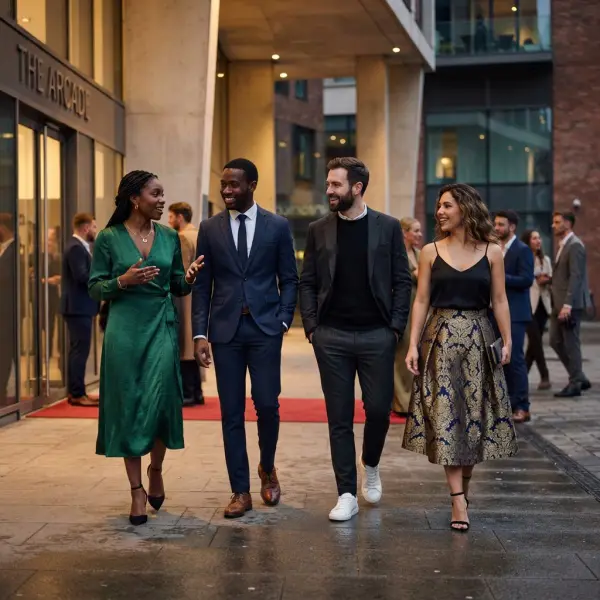
Occasion dressing is a context-based approach to selecting clothing that helps a person dress appropriately for a specific event while balancing formality, function, environment, cultural expectations, and personal expression.
The phrase can describe both a consumer behavior and a fashion retail category. From the consumer perspective, it is the process of answering a practical question: What should I wear to this particular event? From the industry perspective, it creates demand for products designed, merchandised, or styled around occasions such as weddings, celebrations, professional functions, ceremonies, dinners, parties, and formal gatherings.
That does not mean every occasion requires dedicated “occasionwear.”
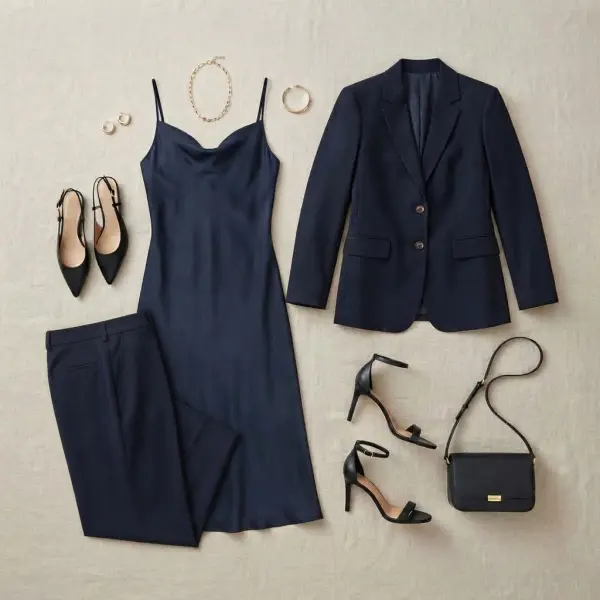
A sharply cut blazer already owned by the customer might become part of a gallery-opening outfit. A fluid midi dress sold as everyday fashion can work for a daytime wedding with different shoes and accessories. Tailored trousers may move from an office presentation to an evening dinner. Conversely, some events genuinely require more specialized products, such as evening gowns, tuxedos, ceremonial garments, or highly formal footwear.
This flexibility is one reason occasion dressing is more useful as a concept than as a single product classification.
Traditional etiquette frameworks still distinguish recognizable levels of formality. The Emily Post Institute, for example, describes semi-formal clothing as less formal than formal evening attire, places black tie above business dress, and treats white tie as the most formal category in its conventional Western dress-code hierarchy.
Those categories can provide a starting point, but they should not be mistaken for universal rules. Expectations vary by country, community, religion, generation, venue, profession, and the preferences of whoever is hosting the event.
For that reason, the deeper question of how invitation wording and specific dress codes influence fashion decisions deserves separate treatment in how dress codes influence fashion choices for events.
Occasion Dressing Is Really a Context Problem
Consumers sometimes begin with the wrong question: What kind of dress should I buy?
A better first question is: What conditions does this outfit need to handle?
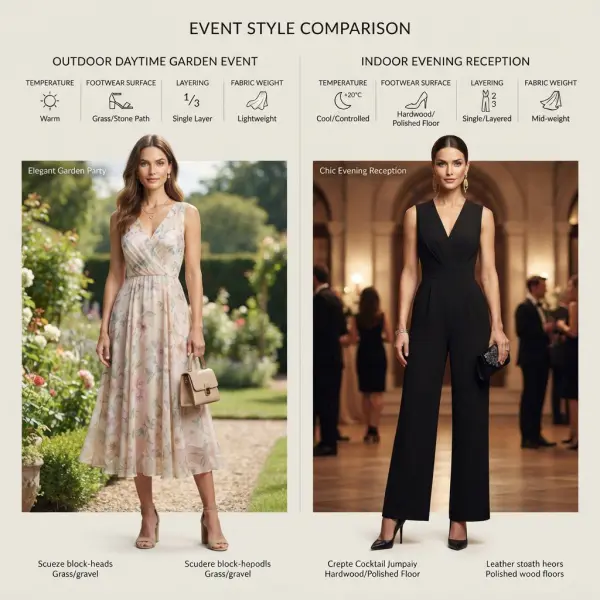
That reframing matters because two events with the same broad label can require very different clothing. A wedding held at noon in a tropical garden does not create the same wardrobe problem as an evening wedding in a luxury hotel ballroom. Both are weddings, but temperature, flooring, photography, ceremony expectations, travel, duration, and formality can alter the ideal outfit considerably.
Five variables usually shape the decision.
1. Expected Formality
Formality establishes the broad boundaries of what is likely to feel appropriate. A gala generally calls for a different level of finish than a backyard birthday lunch. An executive awards dinner may require more polish than an internal company gathering.
The invitation is usually the first source of information, but consumers also infer formality from the venue, host, time of day, purpose of the gathering, and social norms surrounding it.
Formal does not necessarily mean decorative. Minimal tailoring in an excellent fabric can appear more formal than a heavily embellished but casually constructed garment.
Construction therefore matters as much as visual drama. Fabric quality, lining, pressing, seam finish, proportion, drape, and fit can all influence whether clothing reads as polished.
2. What the Wearer Will Actually Do
Occasionwear is often evaluated in front of a mirror, yet it is experienced in motion.
A customer may need to sit through a two-hour ceremony, climb stairs, stand during a reception, dance, eat dinner, carry a phone, commute by public transport, or walk across grass. A garment that photographs beautifully but prevents comfortable sitting can become a poor product experience very quickly.
Practical requirements may include:
- enough mobility through the shoulder, hip, or skirt;
- secure closures;
- appropriate undergarment compatibility;
- manageable hem length;
- stable footwear;
- useful pockets or a practical bag;
- thermal comfort;
- fabrics that do not become uncomfortably restrictive during prolonged wear.
These details are rarely glamorous merchandising language, but they strongly affect whether customers are satisfied once the event begins.
3. Venue and Climate
Physical context changes what “appropriate” means.
Outdoor ceremonies introduce wind, sun, uneven surfaces, moisture, and temperature changes. Air-conditioned hotels may make a lightweight evening dress surprisingly cold. A destination event can add baggage limitations, garment wrinkling, and the need to travel with shoes or accessories.
Material choice therefore cannot be separated from location.
A heavy velvet outfit may look visually suitable for an evening event but be uncomfortable in hot, humid weather. A very lightweight fabric can work beautifully in warm conditions but may require thoughtful lining, opacity, and wind management.
This is where occasion dressing overlaps with broader wardrobe flexibility. Consumers dealing with changing temperatures can benefit from many of the same principles discussed in transitional dressing for changing weather and daily life, particularly layering and removable outer pieces.

4. Cultural and Social Expectations
Occasion dressing also communicates awareness of context.
Religious ceremonies may have expectations around coverage, color, footwear, head coverings, or gender-specific traditions. Weddings can involve culturally significant garments or colors. Graduation ceremonies may require clothing that works underneath academic dress. Professional functions may carry expectations different from private celebrations.
There is no globally uniform formula.
A retailer serving international consumers should therefore be cautious with universal claims such as “the perfect wedding guest dress” unless the intended market and event context are clear. Styling advice that works for one audience may be inappropriate for another.
The commercially safer approach is to help consumers evaluate context rather than pretending one styling rule applies everywhere.
5. Personal Role at the Event
Not everyone attending the same event is dressing for the same role.
At a wedding, the couple, wedding party, immediate family, photographer, event staff, and guests have different practical and symbolic requirements. At a business conference, a keynote speaker may make different wardrobe decisions from an attendee. At a product launch, a brand representative may need to visually align with the company while guests have far more freedom.
Role affects how much visibility, mobility, authority, and distinction the clothing needs to provide.
This is particularly useful for brands because occasion is not the only merchandising variable; role can also reveal customer intent.
Occasion Dressing vs Occasionwear: What Is the Difference?
Occasion dressing is the broader behavior. Occasionwear is a product category commonly associated with clothes designed or marketed for special events.
The distinction is commercially important.
|
Concept |
What It Means |
Typical Examples |
Business Implication |
|
Occasion dressing |
Choosing and styling clothes according to an event context |
Existing blazer styled for dinner, midi dress for a wedding, tailored separates for a presentation |
Can involve products from multiple categories |
|
Occasionwear |
Apparel positioned specifically for events or elevated social settings |
Evening gowns, cocktail dresses, formal jumpsuits, tuxedos, embellished separates |
Often requires dedicated merchandising and fit expectations |
|
Formalwear |
Clothing associated with relatively high levels of formality |
Tuxedos, evening gowns, formal suits |
Smaller but clearer use-case boundaries |
|
Versatile event dressing |
Products designed or styled across several occasions |
Slip dress with interchangeable layers, coordinated suit separates |
Can improve perceived usefulness and rewear potential |
This difference prevents an important merchandising mistake: assuming that consumers searching by occasion necessarily want highly specialized garments.
Someone typing “what to wear to an engagement dinner” may ultimately purchase a blazer, skirt, earrings, or pair of trousers already positioned elsewhere on the site.
Good occasion merchandising connects the customer's purpose with the products capable of solving it.
How Do Modern Consumers Choose an Outfit for an Event?
Most shoppers are solving several decisions simultaneously.
They want to look appropriate but not overdone. They may want something distinctive but still wearable again. They need the garment to fit, arrive on time, work with the accessories they own, and remain comfortable for the expected duration of the event.
That makes occasion purchasing unusually context-rich.
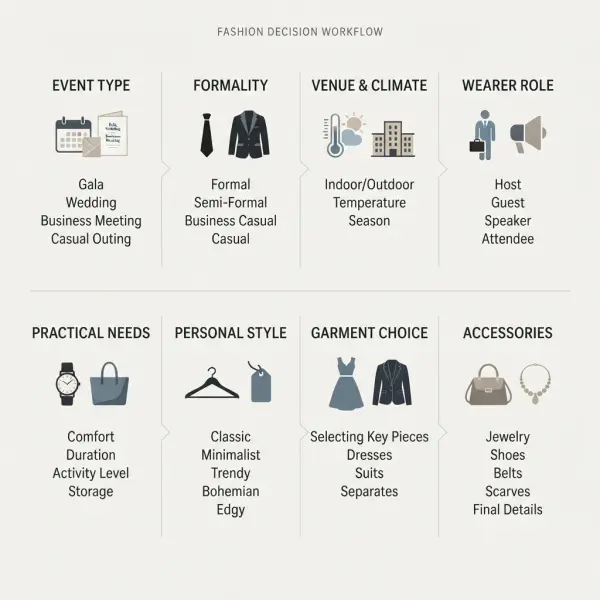
A useful decision sequence is:
event → formality → environment → role → practical needs → personal style → garment choice → accessories
Starting with trend or silhouette before resolving the first five steps can result in an outfit that looks attractive but performs poorly in context.
Personal Style Still Matters
Appropriateness should not require customers to erase their identity.
Two people can interpret the same level of formality through different silhouettes, colors, tailoring choices, modesty preferences, accessories, or footwear. Someone who rarely wears dresses should not automatically be pushed toward one simply because a retailer has labeled dresses as the default event category.
A well-designed assortment can provide equivalent levels of polish through multiple forms: dresses, suits, jumpsuits, skirt sets, trouser sets, tailoring, or culturally appropriate alternatives.
This is where occasion dressing becomes more interesting than prescriptive etiquette. The objective is not uniformity. It is contextual coherence.
Common Occasion Categories and What They Actually Require
Fashion retailers often organize occasion pages around labels such as wedding guest, party, work event, vacation evening, graduation, or formal dinner. The category names are useful, but effective merchandising goes one step further by identifying the underlying wardrobe problem.
|
Occasion |
Primary Dressing Priority |
Common Practical Issue |
Useful Product Direction |
|
Wedding guest |
Respect the event's formality and setting |
Long duration, photography, weather |
Dresses, tailoring, refined separates, layering |
|
Business event |
Professional credibility with contextual polish |
Sitting, networking, travel |
Tailoring, structured dresses, comfortable footwear |
|
Graduation |
Presentable clothing compatible with academic dress |
Heat, movement, photographs |
Lightweight polished separates or dresses |
|
Cocktail or dinner event |
Elevated appearance without excessive formality |
Moving between standing and seated activity |
Midi dresses, suits, jumpsuits, dressy separates |
|
Religious or ceremonial event |
Respect cultural and venue expectations |
Coverage, footwear, specific customs |
Modest silhouettes, adaptable layering, culturally appropriate options |
|
Gala or formal event |
Higher formal finish |
Longer wear, fit precision, specialist accessories |
Eveningwear, tuxedos, formal tailoring |
|
Outdoor celebration |
Event polish adapted to weather and terrain |
Heat, wind, grass, uneven surfaces |
Breathable fabrics, stable footwear, practical hems |
The table is deliberately based on decision factors rather than rigid prescriptions. A wedding can range from casual to highly formal; a business dinner can vary from conservative to creative; cultural ceremonies may operate under entirely different conventions.
The event label helps narrow the search. It does not provide the complete answer.
Why Fit Becomes More Important for Occasion Clothing
Poor fit is inconvenient in everyday apparel. In occasion dressing, it can become highly visible.
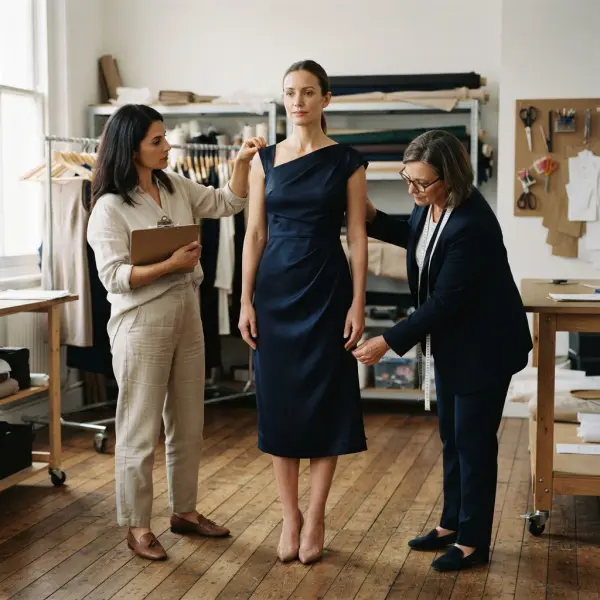
Event clothing is often photographed repeatedly, worn for several hours, and associated with a specific date. Customers may have limited time for exchanges or alteration before the event. They may also be purchasing unfamiliar silhouettes—structured tailoring, strapless dresses, long gowns, fitted jumpsuits—that demand more precise fit than familiar casual clothing.
This creates operational pressure on fashion businesses.
Product pages should provide enough information for customers to anticipate how the garment behaves, not merely how it looks on a model. Useful information can include garment measurements, model measurements, fabric stretch, silhouette description, closure type, lining, hem length, adjustable features, and fit notes.
A phrase such as “regular fit” is rarely sufficient for a fitted occasion dress.
A better description might explain that the bodice is close-fitting, the waist seam is fixed, the skirt has ease through the hip, and the woven fabric has minimal stretch. That information directly supports purchasing decisions.
Alteration Potential Can Be Part of Product Design
Higher-value occasion garments may also benefit from construction that makes common alterations practical.
Depending on garment architecture, this can include adequate seam allowance, adjustable straps, accessible hems, or construction that allows a tailor to make reasonable modifications without rebuilding the garment.
Not every garment needs alteration-friendly construction, and adding it may increase material or production cost. But brands serving customers who expect precise fit should consider the issue during product development rather than leaving it entirely to the consumer after purchase.
Comfort Is Not Separate From Formality
One persistent misunderstanding around occasion dressing is that greater formality naturally requires greater discomfort.
It does not.
Formal clothing may use structured silhouettes, specialist footwear, heavier fabrics, corsetry, tailoring, or other elements that feel different from everyday apparel. But unnecessary restriction, unstable closures, abrasive embellishment, poor breathability, or badly balanced garments are product problems rather than signs of sophistication.
For product developers, comfort needs to be considered at pattern and sample stage.
Questions worth testing include:
- Can the wearer sit comfortably?
- Is arm movement restricted?
- Does the neckline remain secure during movement?
- Does the lining pull independently of the outer shell?
- Do sequins, beads, or trims irritate exposed skin?
- Is the garment excessively heavy at the shoulder or waist?
- Can the wearer use the restroom without unreasonable difficulty?
- Does the fabric become noticeably transparent under strong light?
- Can the customer use common undergarments, or is specialist support required?
Those are mundane questions. They are also exactly the kind of questions that distinguish a garment designed for real events from one designed primarily for a photograph.
Why Occasion Dressing Matters to Fashion Businesses
Occasion dressing converts a product search into a use-case search.
That difference can influence collection planning, navigation, merchandising, content, paid acquisition, styling, and customer service.
A retailer does not necessarily need to manufacture a separate collection for every event. Often, the more effective strategy is to map products already in the assortment to the occasions they can realistically serve.
A satin midi skirt might appear under party dressing. A linen suit can appear in summer wedding edits. A black tailored jumpsuit might sit simultaneously within workwear, evening, and occasion categories.
This creates a richer relationship between product taxonomy and customer intent.
Occasion-Based Merchandising Can Reduce Choice Friction
Large fashion assortments create a discovery problem. Customers may face hundreds of technically suitable products but still struggle to determine what works for their event.
Occasion edits narrow the decision space.
Instead of forcing a customer to browse “all dresses,” a retailer might create pathways around:
- daytime celebrations;
- evening events;
- work functions;
- wedding guest dressing;
- formal occasions;
- graduation;
- holiday parties;
- modest occasion dressing;
- warm-weather events.
These categories should remain flexible. They are merchandising tools, not universal etiquette rules.
Strong filters can make them even more useful. Sleeve coverage, length, fabric weight, color family, fit, formality, weather suitability, and footwear compatibility may all help shoppers translate context into products.
Product Design for Occasion Dressing Requires Different Priorities
An attractive sketch is only the beginning.
Event garments face a particular combination of visibility, duration, movement, emotional significance, and fit expectations. Those pressures should influence product development.
Fabric Needs to Work Beyond the Studio
Fabric selection affects appearance, movement, thermal comfort, care, packing, durability, and photographs.
Highly reflective satin can behave very differently under direct flash than under soft studio lighting. Lightweight pale fabrics may require sufficient opacity. Delicate embellishment may catch on neighboring garments or seating. Natural fibers can provide desirable handle and breathability but may crease in ways that matter to a traveler attending a destination event.
There is no universally ideal occasion fabric.
Suitability depends on the garment, season, event, construction, price point, and customer expectation.
Construction Should Support the Silhouette
Structured eveningwear may require interfacing, boning, internal support, lining, or carefully controlled seam placement. Fluid styles may rely more heavily on drape, bias behavior, clean finishing, and stabilization at openings.
A beautiful external silhouette can fail if the internal construction cannot support it.
For manufacturers and sourcing teams, this means occasion products may need additional attention during sampling and quality control. Zipper performance, seam strength, lining stability, trim security, pressing, hem evenness, embellishment attachment, and dimensional consistency can have a disproportionate effect on the finished impression.
Rewear Potential Deserves Design Attention
Special-event purchases face a familiar tension: customers want the outfit to feel memorable, yet a highly specific design may be difficult to wear again.
Brands can address this without making every product plain.
Rewear can be supported through removable details, separates, restrained embellishment, adaptable lengths, jackets that work independently, reversible elements where technically appropriate, and colors that integrate into broader wardrobes.
Rewear is not automatic. A versatile product only delivers that benefit when customers actually use it again. Still, designing for multiple plausible styling contexts can improve the practical value proposition.
How Fashion Businesses Can Apply Occasion Dressing Strategically
The first step is not creating a giant “occasionwear” collection. It is identifying the events customers are already shopping for and determining where the existing range solves those needs well—or fails to.
A practical process can begin with five areas.
Build an Occasion Map
Map major customer use cases against existing categories.
For example, a contemporary womenswear brand might discover that its strongest opportunities are not black-tie gowns but wedding guest outfits, professional dinners, graduation, and elevated celebrations. A menswear brand may find greater demand around weddings, business functions, festive dressing, and smart destination events.
That mapping should reflect the actual customer, price level, climate, and market.
Audit the Existing Assortment
Identify which products already work across occasions.
Do not rely entirely on category names. Review garments from the customer's perspective: formality, fabric, coverage, mobility, layering, seasonality, footwear pairing, and ease of styling.
This can reveal commercial opportunities without adding new stock.
Fill Functional Gaps, Not Just Aesthetic Gaps
If customers have plenty of attractive dresses but consistently struggle to find sleeves, supportive construction, petite lengths, extended sizing, practical outerwear, or suitable shoes, releasing more similar dresses may not solve the real problem.
Occasion assortment planning works best when it addresses missing functions.
That can involve product, sizing, accessories, alteration guidance, styling content, or clearer information rather than simply increasing SKU count.
Merchandise Complete Solutions
Occasion customers commonly need several coordinated products.
A customer buying a dress may also need shoes, a bag, an outer layer, jewelry, shapewear, hosiery, or another undergarment solution. Cross-merchandising can therefore be genuinely useful rather than merely promotional when the recommendations address realistic needs.
The key is relevance.
Showing a heavy winter coat beside a lightweight destination-wedding dress because the products happen to share a color is not useful styling.
Give Customers Context, Not Just Product Claims
Editorial content can reduce uncertainty before purchase.
Instead of saying that a garment is “perfect for every occasion,” explain where it realistically works: an evening wedding, cocktail reception, graduation dinner, or formal business event depending on local expectations.
Specificity is more credible than universality.

Common Occasion Dressing Mistakes
Many occasion-dressing problems are not caused by bad taste. They come from solving the wrong problem.
Buying for the Photograph Instead of the Event
A highly dramatic outfit may look excellent in static imagery while becoming uncomfortable after several hours.
This happens when visual impact dominates product evaluation and mobility, temperature, seating, transport, or garment weight are ignored.
For consumers, the better test is to simulate the event: sit, walk, raise the arms, wear the intended shoes, test the bag, and check the garment under different lighting.
For brands, movement testing should happen before campaign imagery is approved.
Assuming the Event Name Determines the Dress Level
“Wedding,” “party,” and “dinner” are not dress codes.
The same event category can range from casual to highly formal. Customers who rely on the event name alone can easily over- or under-dress.
Brands should therefore avoid presenting one look as universally correct. A short explanation of venue, time, or formality is more useful.
Treating Occasionwear as Dresses Only
Dress-led merchandising can unintentionally exclude customers who prefer tailoring, trousers, jumpsuits, skirt sets, culturally specific garments, or other silhouettes.
The commercial consequence is straightforward: a retailer may have suitable products but fail to surface them during an occasion-led search.
Broadening the styling architecture is often more valuable than simply expanding the dress assortment.
Ignoring What Happens After the Event
A garment that works beautifully once can still feel poor value if the customer sees no way to wear it again.
This does not mean every formal gown needs to become everyday clothing. Specialized garments have legitimate roles. The mistake is assuming specialization is always what the customer wants.
Product descriptions and styling content can distinguish deliberately specialized pieces from adaptable ones.
Using Vague Occasion Labels Without Product Logic
Tags such as “party,” “occasion,” and “special event” become meaningless when nearly every attractive product receives them.
Useful occasion taxonomy requires criteria.
A retailer should know why a product has been placed in a particular edit: silhouette, level of formality, material, coverage, season, event context, or styling potential.
Otherwise the category simply recreates the same discovery problem under a different name.
What Brands Should Verify Before Acting
Occasion dressing is highly contextual, so fashion businesses should be careful about turning general styling conventions into universal customer rules.
Before building products, campaigns, or advice around an event category, verify:
- Target market: expectations in London, Jakarta, Dubai, New York, Seoul, or Mumbai may differ substantially.
- Customer segment: age, profession, community, climate, lifestyle, and personal style affect what feels appropriate.
- Event context: venue, time, formality, host expectations, and cultural customs matter.
- Fit requirements: formal silhouettes often need more precise fit information than relaxed clothing.
- Material behavior: check opacity, wrinkling, stretch, breathability, drape, abrasion, and care under realistic conditions.
- Product claims: avoid calling a garment universally suitable for weddings, ceremonies, or religious settings.
- Operational timing: occasion purchases can be date-sensitive, making stock availability, delivery estimates, exchanges, and alteration lead times particularly important.
This last point is easy to underestimate. A delayed everyday purchase is inconvenient. A garment that arrives after the wedding may have effectively lost its purpose.
Occasion Dressing Is Becoming More About Wardrobe Intelligence
The useful shift in modern occasion dressing is not the disappearance of formal clothing. It is the recognition that event suitability exists on a spectrum.
Some occasions genuinely require specialized garments. Others can be handled by styling versatile wardrobe pieces more deliberately. Many sit somewhere between those extremes.
This creates opportunities for businesses at multiple price points.
A luxury eveningwear label can focus on specialist construction and emotional impact. A contemporary brand can build adaptable event capsules. A mass retailer can improve occasion discovery across its existing assortment. An accessories business can solve the finishing layer of the outfit. Rental and resale businesses can serve customers who do not want to own highly specialized pieces, where those models are available and commercially viable.
None of these models is automatically superior.
The appropriate strategy depends on customer behavior, product category, margin structure, inventory risk, brand positioning, and how frequently the intended customer actually attends relevant events.
The wider cultural role of eventwear—and why people still value clothing that marks certain moments as different from everyday life—is explored further in why eventwear still matters in everyday fashion culture.
Frequently Asked Questions About Occasion Dressing
What does occasion dressing mean in fashion?
Occasion dressing means selecting clothing according to the requirements and expectations of a particular event. The decision can involve formality, venue, weather, cultural norms, the wearer's role, comfort, and personal style.
It is broader than formalwear. A professional conference, graduation, wedding, religious ceremony, dinner, or informal celebration may all involve occasion dressing even when no traditional formal garment is required. For fashion businesses, the concept is useful because it organizes products around customer intent rather than relying only on garment categories such as dresses, jackets, or trousers.
Is occasionwear the same as formalwear?
No. Formalwear is one part of occasionwear, while occasion dressing covers a much broader range of events and levels of formality.
A tuxedo or evening gown clearly belongs to formalwear. A tailored jumpsuit worn to a cocktail reception or a polished linen suit worn to a daytime celebration can also function as occasion clothing without reaching the same level of formality.
The distinction matters in retail because customers searching for an event outfit may not need formalwear at all. Merchandising should therefore account for context rather than treating every special event as a highly formal one.
Can casual clothing be used for occasion dressing?
Yes, when the event allows it and the overall styling fits the context.
Many modern wardrobes contain pieces that can move between everyday and event settings. A simple dress may become more polished through tailoring, footwear, jewelry, or outerwear. A shirt and trousers can shift considerably depending on fabric, fit, pressing, shoes, and accessories.
The limitation is context. Styling cannot turn every casual garment into appropriate formal clothing. When an invitation specifies a particular level of formality, customers should consider that guidance alongside venue and cultural expectations.
What makes an outfit appropriate for an occasion?
An appropriate outfit generally aligns with the event's expected formality while remaining functional for the environment and respectful of relevant social or cultural expectations.
That involves more than garment type. Fabric, silhouette, coverage, footwear, weather, movement, time of day, venue, and the wearer's role may all affect the decision.
There is rarely one universally correct outfit. A useful approach is to identify the event constraints first and then choose clothing that satisfies them without unnecessarily abandoning personal style.
Should fashion brands create separate occasionwear collections?
Not necessarily.
A dedicated collection makes sense when occasionwear is central to the customer proposition and requires specialized product development. For other brands, existing dresses, tailoring, separates, knitwear, footwear, and accessories may already address several occasion needs.
Before adding inventory, businesses should map customer occasions against the current assortment. The gap may turn out to be merchandising, fit information, styling content, size availability, or accessories rather than missing garments.
A smaller, well-defined occasion capsule can sometimes be more operationally sensible than a large standalone collection.
How can brands make occasion clothing easier to wear again?
Rewear potential can be increased by designing garments that work across multiple plausible settings rather than relying on one highly specific styling combination.
Useful approaches can include coordinated separates, restrained embellishment, adaptable layering, removable details, versatile colors, or tailoring that can be restyled independently.
That does not mean specialized formalwear should disappear. Some products are intentionally designed for rare, highly formal events. Brands should instead be clear about which pieces are specialist purchases and which provide broader wardrobe flexibility.
What information should an occasionwear product page include?
Customers generally need more than basic size and fabric information when an outfit is being purchased for a specific event.
Useful product information can include garment measurements, model measurements, fabric stretch, lining, closure type, garment length, fit through the bust, waist and hip, adjustable elements, opacity, care requirements, and relevant styling context.
For date-sensitive purchases, delivery timing and exchange information also become particularly important. If alterations may be needed, the customer should have enough time to assess fit before the event.
Conclusion
Occasion dressing is best understood as dressing for context rather than dressing according to a fixed list of special-event garments.
Formality matters, but so do venue, climate, mobility, culture, personal role, fit, comfort, and individual style. A strong outfit resolves those factors together. A strong fashion product does the same.
For consumers, this approach makes event dressing less about following a rigid formula and more about making informed choices. For fashion businesses, it opens a wider opportunity: collections do not have to be divided simply into “everyday” and “occasion.” Existing products can often serve multiple contexts when design, product information, navigation, and styling guidance make those possibilities visible.
The commercial challenge is therefore not simply producing more eventwear. It is understanding the moments customers are dressing for and removing the uncertainty between having an event to attend and knowing what will actually work there.
That is where occasion dressing becomes useful as both a wardrobe concept and a fashion business strategy.




Comments 0
Leave a CommentSend Comment
Anda harus Login terlebih dahulu untuk dapat memberikan komentar.