

How Dress Codes Influence Fashion Choices for Events
Quick Answer
Dress codes influence fashion choices by setting expectations about formality, garment type, styling, coverage, footwear, and overall presentation for a particular event. Terms such as black tie, semi-formal, cocktail, business formal, or smart casual act as social signals that help guests narrow an otherwise enormous range of clothing options.
They are not, however, universal outfit formulas. The same dress-code term can be interpreted differently depending on country, host, venue, time of day, climate, culture, and the nature of the event. A summer outdoor wedding labeled “cocktail,” for example, creates different practical requirements from an indoor corporate reception using the same term.
For consumers, the most reliable approach is to treat a dress code as a boundary rather than a uniform: identify the expected degree of formality first, then choose an outfit that fits the environment, personal style, cultural context, and activities involved.
For fashion businesses, dress codes are valuable search and merchandising signals. Customers frequently know the event requirement before they know which garment they need. Retailers that translate ambiguous dress-code terminology into realistic product choices can reduce uncertainty and make occasion shopping considerably easier.

What Is a Dress Code?
A dress code is a set of explicit or implied expectations about how people should dress within a particular social, professional, ceremonial, or institutional context.
For events, a dress code usually communicates the intended level of formality rather than specifying one exact outfit. “Black tie,” for instance, narrows the expected range much more strongly than “smart casual,” but even established formal categories can permit several garment choices.
The Emily Post Institute places white tie at the highest level of conventional Western formality and describes black tie as less formal than white tie but more formal than business attire. Its guidance for black tie includes tuxedo-based dressing for men and formal evening options for women, while black-tie optional permits a broader range that can include a dark suit rather than a tuxedo. Emily Post attire guide
Those classifications are useful reference points, particularly in contexts influenced by Western formalwear traditions. They are not global laws of dress.
Wedding customs, religious practices, national traditions, professional norms, climate, and host preferences can all modify or replace them. Some events use cultural dress rather than Western eveningwear as the appropriate expression of formality.
That distinction is important because the broader process of occasion dressing for modern consumers begins with context. Dress codes are one particularly influential part of that context.
Why Do Dress Codes Influence Fashion Choices So Strongly?
Dress codes reduce uncertainty.
Without one, a guest may have to infer appropriate clothing entirely from the venue, host, event type, social group, and time of day. A clearly communicated dress code creates a narrower decision space.
A consumer receiving a black-tie invitation immediately knows that ordinary office clothing or casual separates are unlikely to match the intended environment. Someone invited to a smart-casual lunch has considerably more flexibility.
That narrowing affects several fashion decisions simultaneously:
- garment category;
- silhouette;
- material and finish;
- color and pattern;
- footwear;
- accessories;
- grooming and styling;
- sometimes coverage or culturally specific garments.
The dress code therefore functions less like a shopping list and more like a filter applied to the wardrobe.
For fashion retailers, the same logic can be used in reverse. Instead of expecting customers to translate “semi-formal evening wedding” into product taxonomy themselves, the retailer can connect the requirement directly with suitable dresses, tailoring, jumpsuits, separates, footwear, and accessories.
Dress Codes Operate on a Spectrum of Formality
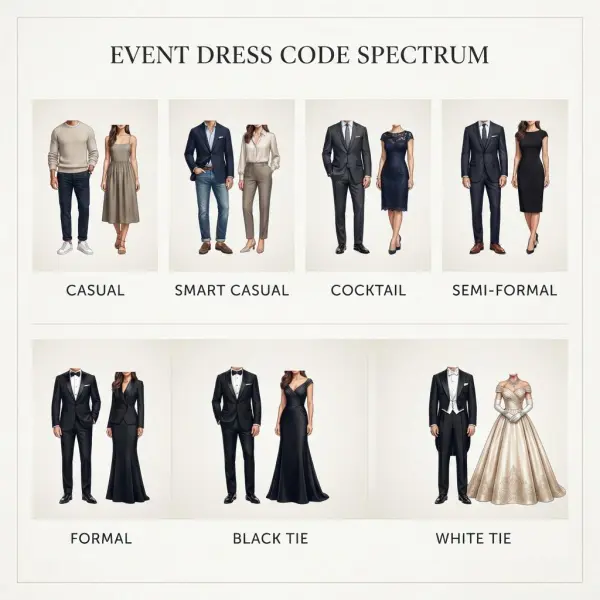
One of the easiest ways to misunderstand dress codes is to treat each term as an isolated category. In practice, many commonly used codes exist on a relative spectrum.
A simplified conventional Western hierarchy might look broadly like this:
|
Dress Code |
General Formality |
Typical Fashion Direction |
Degree of Interpretation |
|
White tie |
Extremely formal |
Full evening dress, ceremonial-level formalwear |
Very limited |
|
Black tie |
Highly formal |
Tuxedo, evening gown, highly polished formal options |
Limited |
|
Black-tie optional |
Formal |
Tuxedo or dark formal suit; evening dress or refined alternatives |
Moderate |
|
Formal / evening attire |
Formal, but context-dependent |
Long dresses, polished suits, elevated eveningwear |
Moderate |
|
Cocktail |
Elevated social dressing |
Cocktail dresses, refined jumpsuits, tailoring, dressy separates |
Moderate to broad |
|
Semi-formal |
Below formal, above ordinary business or casual dress |
Dresses, suits, sophisticated separates |
Broad |
|
Dressy casual |
Polished but relaxed |
Elevated separates, dresses, blazers, refined footwear |
Broad |
|
Smart casual |
Context-dependent polished casualwear |
Tailoring mixed with less formal pieces |
Very broad |
|
Casual |
Informal |
Relaxed everyday clothing appropriate to the setting |
Very broad |
This is intentionally a guide rather than a universal ranking.
Even established etiquette sources vary somewhat in terminology, and the labels used in North America, Britain, continental Europe, Asia, the Middle East, and other markets are not always interchangeable. Debrett's, for example, continues to use traditional British categories such as “lounge suit” alongside black tie and white tie. Debrett's event and dress-code guidance
For international fashion businesses, translating the level of formality is often safer than assuming every customer understands the same terminology.

How Should Consumers Interpret Common Dress Codes?
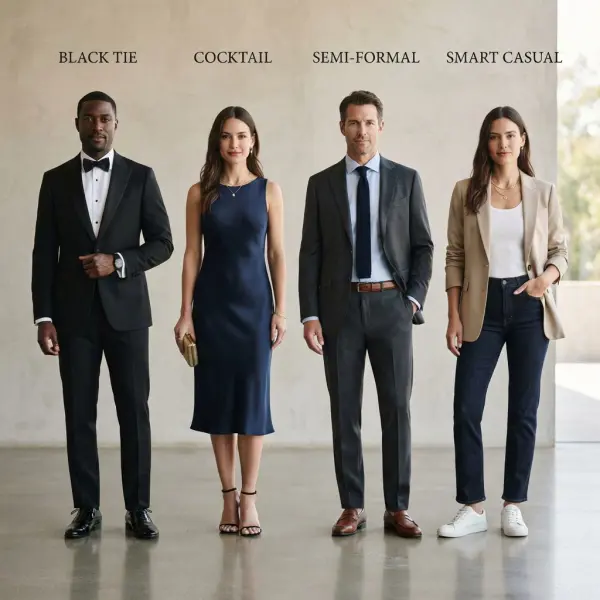
The best interpretation combines the stated dress code with evidence from the event itself.
Invitation wording is the strongest explicit signal, but venue, time, host, ceremony type, climate, and local customs can refine the meaning considerably.
Black Tie
Black tie is a high-formality evening dress code.
In conventional Western etiquette, tuxedo-based menswear is the standard reference point. For womenswear, formal gowns and other highly polished evening options are commonly associated with the category. Emily Post also recognizes certain dressy cocktail options within its guidance, illustrating that even a well-established term does not always dictate a single silhouette.
For fashion brands, black tie is one of the easier codes to merchandise because its level of formality is relatively narrow. Product details matter, however. Fabric quality, tailoring, length, internal construction, footwear, accessories, and overall finish all contribute to whether an outfit convincingly reaches the expected level.
A casual maxi dress is not automatically black tie because it is long.
Black-Tie Optional
Black-tie optional intentionally widens the choice.
The guest can generally remain within formal territory without necessarily wearing the most traditional black-tie option. Emily Post, for example, lists either a tuxedo or dark suit for men and allows several formal evening choices for women.
The important word is formal, not optional.
Consumers sometimes read “optional” as permission to dress casually. In practice, it usually means the host is providing flexibility within an elevated formal range.
For retailers, this is an excellent category for cross-merchandising because customers may be choosing between specialist eveningwear and garments with broader rewear potential.
Cocktail Attire
Cocktail attire sits in a more flexible middle ground.
It generally suggests clothing that is clearly elevated beyond everyday or office casualwear without necessarily requiring full evening formalwear. Dresses around knee, midi, or other refined lengths are common, but tailoring, polished jumpsuits, and sophisticated separates can also work depending on context.
Cocktail is precisely the kind of category where venue matters.
A luxury hotel cocktail reception, gallery event, rooftop celebration, and destination wedding may all use the same word while creating substantially different styling conditions.
Businesses should therefore avoid reducing cocktail dressing to “short party dresses.” Doing so unnecessarily narrows both consumer choice and commercial assortment.
Semi-Formal
Semi-formal is frequently misunderstood because the word “semi” sounds much more casual than the category historically implies.
Emily Post describes semi-formal as more formal than typical office clothing but below formal event attire. Its suggestions include cocktail or afternoon dresses, dressy separates, and dark suits.
The difficult part is that contemporary hosts do not always use the term with that level of precision.
A consumer should therefore consider the invitation alongside event type, time, venue, and host. If uncertainty remains and the event has meaningful ceremonial or cultural significance, asking the host can be more reliable than trying to decode the phrase from social media examples.
Smart Casual and Dressy Casual
These are among the widest dress-code categories.
Both generally imply more polish than ordinary casual dressing while preserving considerable freedom. Blazers, dresses, refined knitwear, tailored trousers, skirts, clean footwear, or carefully styled denim may work in some environments.
The problem is that the upper and lower boundaries vary dramatically.
Smart casual for a technology company reception may look quite different from smart casual at a luxury resort or members' club. Retailers serving these searches should therefore combine dress-code categories with context such as “work dinner,” “summer party,” or “restaurant event.”
The Invitation Is Only the First Layer of Information
Dress-code interpretation becomes much more reliable when consumers read the entire event rather than one phrase.
For weddings, Emily Post specifically recommends considering both invitation information and factors such as the ceremony's religious or cultural context and local custom.
That logic applies well beyond weddings.
Imagine two invitations marked “formal.”
The first is for a 2 p.m. garden ceremony in warm weather. The second is for an 8 p.m. fundraising dinner in a grand hotel ballroom.
A consumer would reasonably interpret fabric weight, footwear, layering, color, and degree of evening styling differently even if the same broad formality word appeared on both invitations.
A useful interpretation framework is:
dress code + event type + venue + time + climate + cultural context + guest role
No single variable should automatically override the rest unless the host has issued a highly specific requirement.
Why Time of Day Still Influences Event Dressing
Time of day remains a useful signal because clothing for daytime and evening events often differs in material, color, styling, and formality.
Traditional etiquette sources explicitly make some distinctions between daytime and evening dress. Emily Post's wedding guidance, for example, differentiates formal and semi-formal recommendations according to the time of the event.
Modern fashion does not require rigid adherence to historical daytime-versus-evening formulas. Still, the underlying logic is practical.
Daytime events often interact with natural light, outdoor temperatures, travel, and greater visual informality. Evening events may accommodate darker palettes, higher sheen, richer fabrics, more elaborate accessories, or higher formal intensity.
This is a tendency, not a rule.
A daytime state ceremony can be more formal than an evening birthday party. The event remains the primary context.
Climate Can Change How a Dress Code Is Executed
Formality and climate sometimes pull in opposite directions.
A highly structured wool suit, heavy lining, multiple layers, and closed formal shoes may be conventional in one climate yet uncomfortable at an outdoor event in extreme heat. Likewise, lightweight evening clothing can become impractical when an event moves between warm indoor spaces and cold outdoor conditions.
Even established black-tie traditions include climate adaptations. Emily Post notes the possibility of a white dinner jacket with black tuxedo trousers for summer, tropical, or cruise settings.
The larger business lesson is important: dress code determines the visual and social requirement; product engineering determines whether that requirement can be met comfortably in the actual environment.
Fabric weight, lining, breathability, layering, sleeve construction, and footwear therefore matter alongside styling.
For consumers navigating temperature changes around events, principles from layering for more flexible and practical outfits can also be useful.
Cultural Context Can Override Generic Dress-Code Advice
A globally published “what to wear” rule becomes unreliable when it ignores culture.
Events held in houses of worship, traditional ceremonies, diplomatic settings, family celebrations, or culturally specific weddings may involve requirements concerning modesty, head coverings, color, footwear, or traditional clothing.
Emily Post itself advises wedding guests to consider whether the religious or cultural context creates expectations such as head coverings or restrictions around exposed shoulders.
Those examples demonstrate the broader principle rather than establishing universal religious rules.
Businesses should not guess cultural requirements or flatten them into generic labels such as “modest.” If serving a specific community, guidance should be developed from credible knowledge of that context.
For an international retailer, it is often better to provide useful product attributes—sleeve length, neckline, garment length, opacity, layering capability—than to claim that a product is universally appropriate for a particular religion or culture.
Dress Codes Affect More Than the Main Garment
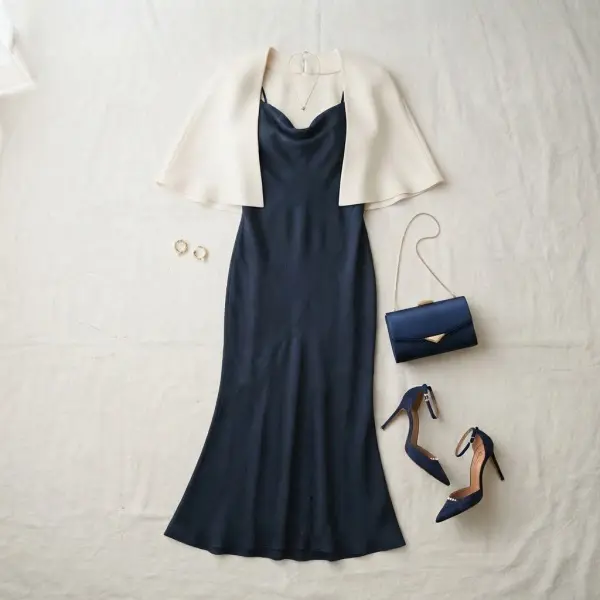
Customers often focus first on the dress, suit, or separates. Yet an outfit may still miss the intended level of formality because the supporting elements do not align.
Dress codes can influence:
- footwear construction and finish;
- handbag or briefcase choice;
- hosiery or socks;
- neckwear;
- jewelry;
- belts;
- outerwear;
- scarves or headwear;
- undergarment requirements;
- grooming and styling.
These details become increasingly important as formality rises.
The relationship is not simply “more accessories equals more formal.” A restrained black-tie look may use fewer visible accessories than an elaborate party outfit. The key is whether each component supports the same level and language of dress.
For retailers, this creates useful but easily abused cross-selling opportunities.
Recommendations should complete the customer's solution, not merely increase basket size.
How Dress Codes Shape Fashion Retail and Merchandising
Dress-code language provides fashion retailers with something extremely valuable: a direct clue about why the customer is shopping.
Traditional category navigation answers “What product do you want?”
Dress-code navigation can answer “What are you trying to dress for?”
A customer might not know whether a formal evening wedding requires a gown, cocktail dress, suit, jumpsuit, or coordinated separates. Asking them to select a product category before resolving the occasion transfers the interpretation burden back to the shopper.
Better merchandising can connect the two.
A retailer might allow a customer to move through:
Event → Dress Code → Climate or Season → Product Type → Fit or Style Preference
This model should not replace conventional navigation. It adds another discovery route.
Product Tags Need Real Criteria
A “black tie” tag should not be attached to every long dress.
A “cocktail” tag should not simply mean every short dress.
Merchandising criteria can account for:
- silhouette;
- fabrication;
- construction quality;
- level of embellishment;
- length;
- color;
- coverage;
- footwear compatibility;
- season;
- overall formality.
Without defined criteria, dress-code filters become marketing labels rather than useful navigation.
Search Content Should Explain, Then Sell
A consumer searching “what to wear to a semi-formal wedding” is usually seeking interpretation before purchase.
An effective landing page can answer the question briefly and then present products that match the explanation.
That is more useful than opening with dozens of SKUs.
For SEO, AEO, and customer experience, the information and the assortment should agree. If an article says semi-formal does not require floor-length eveningwear but the accompanying product grid contains only gowns, the retailer has created its own contradiction.
Product Development Can Respond to Dress-Code Needs Too
Dress codes are often treated as merchandising concepts, but they can also inform design decisions.
A brand serving formal events may need stronger internal structure, refined closures, higher-quality pressing, linings, specialist tailoring, or more exact fit tolerances than a casualwear-focused business.
A brand positioned around cocktail and flexible event dressing might prioritize different attributes: rewearable silhouettes, easy movement, adaptable styling, compact packing, and coordination with products already in the customer's wardrobe.
Neither strategy is inherently superior.
The product should reflect the actual occasion territory the brand intends to serve.
This can also influence range architecture. Instead of designing six dresses that all solve the same event problem, a brand might cover several levels of dress:
- one highly formal option;
- two cocktail-oriented silhouettes;
- a tailored set;
- an adaptable jumpsuit;
- one elevated but less formal dress.
The result may serve more customer scenarios without necessarily increasing SKU count.
Practical Framework: How Fashion Businesses Can Use Dress-Code Intent
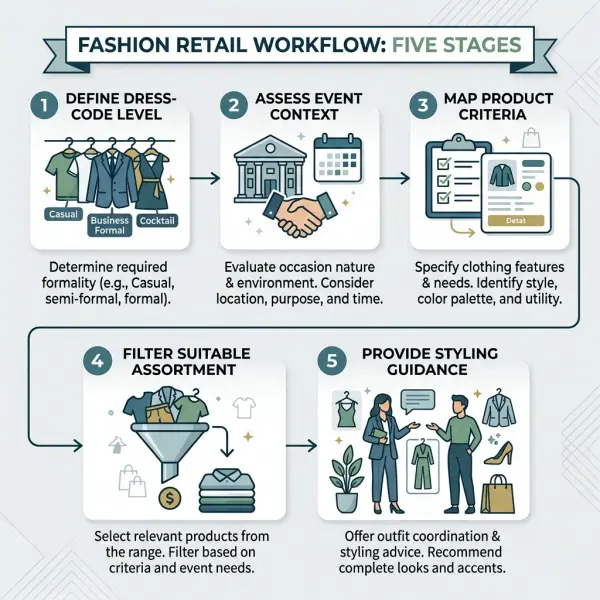
Brands do not need to become etiquette authorities to use dress-code information effectively. They do need a consistent interpretation framework.
1. Define the Dress-Code Territory the Brand Actually Serves
A casual lifestyle brand probably does not need a white-tie category simply because people search for it.
Identify where the existing product and customer proposition genuinely fit: smart casual, work events, cocktail, wedding guest, black-tie optional, formal eveningwear, or another segment.
2. Create Internal Merchandising Definitions
Document what qualifies a product for each category.
These criteria can include construction, length, material, styling, finish, and intended event context.
The objective is consistency across merchandising, editorial, customer service, and search.
3. Add Contextual Filters
Dress code alone may still be too broad.
Useful secondary dimensions can include season, venue, indoor versus outdoor use, sleeve length, hem length, footwear, color, modesty-related product attributes, and garment fit.
4. Train Customer-Facing Teams
Customer service teams often receive highly contextual questions:
“Is this formal enough for a 6 p.m. wedding?”
“Can this work for black-tie optional?”
“Will this suit work for an outdoor summer ceremony?”
They need guidance that acknowledges uncertainty rather than promising universal correctness.
5. Use Content to Explain Ambiguous Categories
Editorial pages, product notes, styling guides, and FAQs can translate confusing terminology before customers commit to a purchase.
The strongest content does not dictate a single outfit. It explains the boundaries and then offers several credible ways to work within them.
Common Dress-Code Mistakes Fashion Businesses Should Avoid
The biggest mistakes usually come from treating dress codes as fixed product labels rather than contextual signals.
Treating Similar Terms as Exact Synonyms
Cocktail, semi-formal, dressy casual, and smart casual overlap in some real-world usage, but they do not necessarily communicate the same formality.
Collapsing them into one category may simplify navigation while reducing usefulness.
A better approach is to acknowledge overlap and explain the relative position of each term.
Over-Prescribing Gendered Garment Types
Traditional etiquette guidance often separates clothing suggestions for men and women because historical formalwear systems developed around gendered conventions.
Retailers do not have to reproduce those categories rigidly.
The more useful commercial interpretation is often to describe the required level of polish, construction, silhouette, and formality, then provide multiple product options for customers who dress differently.
Assuming More Embellishment Means More Formal
Sequins, satin, velvet, embroidery, metallic surfaces, and embellishment can contribute to evening styling, but none automatically makes a garment formal.
A well-cut plain tuxedo can be much more formal than a heavily sequined party jacket.
Formality emerges from the entire outfit: construction, silhouette, textile, fit, footwear, accessories, and context.
Ignoring Geography and Culture
A US-based guide copied directly into a global retailer's content may create misleading advice.
Even common terms can travel imperfectly across markets.
Local merchandising teams should be able to adapt dress-code interpretation where customer expectations genuinely differ.
Promising That One Product Is “Perfect for Any Event”
Very few garments are appropriate for every event.
This language may sound commercially attractive, but it removes precisely the context that occasion shoppers need.
Specific positioning—such as “suitable for many cocktail receptions, evening weddings, and formal dinners depending on the stated dress code”—is more informative and more credible.
What Dress Codes Do Not Tell You
A dress code cannot answer every clothing question.
It usually does not tell you:
- exactly how warm or cold the venue will be;
- how much walking will be required;
- whether the ground is suitable for narrow heels;
- how conservative a particular religious venue may be;
- whether the host expects culturally specific attire;
- how long the event will last;
- whether a garment will photograph well;
- whether the wearer will feel comfortable in it.
This is why dress-code advice should never replace event context.
It also explains why two people can interpret the same dress code differently while both remaining appropriate.
The goal is not identical clothing. It is a sufficiently shared understanding of the occasion.
What Brands Should Verify Before Publishing Dress-Code Advice
Dress-code content can sound authoritative very easily, which makes factual restraint important.
Brands should verify whether a recommendation is based on:
- established etiquette convention;
- the host's explicit requirement;
- local or cultural practice;
- the brand's own styling interpretation;
- a current trend rather than a formal rule.
Those are not equivalent.
A retailer may reasonably say, “We would style this dress for a cocktail wedding.” It should be more cautious about saying, “This is what everyone must wear to a cocktail wedding.”
When cultural or religious expectations are involved, specific guidance should come from appropriate authoritative sources rather than assumption.
Fashion can interpret dress codes creatively. It should not invent the rules it claims to explain.
Dress Codes Create Boundaries, Not Uniforms
The enduring usefulness of dress codes lies in coordination.
An event works differently when guests understand whether the host expects relaxed clothing, polished social dressing, formal eveningwear, or ceremonial dress. That shared signal reduces uncertainty while helping create the visual and social atmosphere of the event.
Within those boundaries, fashion still has room to operate.
Color, silhouette, tailoring, texture, accessories, cultural dress, personal identity, and contemporary styling allow people to satisfy the same level of formality without looking identical.
That tension between shared expectation and individual expression is precisely why dress codes continue to matter commercially.
They create a problem consumers repeatedly need fashion to solve.
And although the rules surrounding event dressing evolve, clothing still performs a broader cultural role in marking certain moments as significant. That relationship between special-event clothing and everyday fashion culture is explored in why eventwear still matters in everyday fashion culture.
Frequently Asked Questions About Event Dress Codes
What should you do if an invitation has no dress code?
Start with the event itself: venue, time, purpose, host, cultural setting, and expected activities. An evening reception at a luxury hotel usually creates a different baseline from a daytime backyard celebration even without explicit attire instructions.
The invitation design or event website may provide additional clues, but visual style should not be treated as a formal rule. If the event is important and the level of dress remains unclear, asking the host or organizer is often the most reliable option.
For fashion retailers, “dress code not specified” is also a useful content scenario because many customers shop precisely when the invitation gives them too little information.
Is it better to overdress or underdress for an uncertain event?
There is no universal rule, but choosing an outfit slightly toward the more polished end of the plausible range can sometimes be easier to adjust than starting too casually.
The better strategy is adaptability. A blazer, refined outer layer, neckwear, jewelry, footwear, or accessory change may allow the outfit to move up or down in formality.
Extreme overdressing can feel just as out of context as underdressing, particularly at relaxed social events. The objective is therefore not “dress as formally as possible.” It is to identify the most likely formality range and choose a flexible position within it.
Does black tie always require a floor-length gown?
Not universally. Conventional etiquette sources commonly associate black tie with formal evening gowns, but some also recognize highly dressy cocktail options. Emily Post, for example, lists both floor-length gowns and dressy cocktail dresses among its black-tie guidance.
The host, venue, region, and type of event can narrow the appropriate choice further.
For retailers, that means black-tie merchandising should not be based on length alone. Fabrication, construction, silhouette, finish, accessories, and overall formality need to support the category.
Is cocktail attire more formal than semi-formal?
The terms can overlap, and real-world usage is inconsistent enough that a universal ranking can be misleading.
Cocktail typically refers to elevated social or evening dressing, while semi-formal traditionally describes a level below formal attire but above ordinary office or casual clothing. Depending on the event, their product choices may look quite similar.
Rather than deciding based only on terminology, consumers should consider the event type, venue, time, invitation, and host expectations.
For retailers, separate landing pages can still be useful if each explains where the categories overlap rather than pretending they have perfectly rigid boundaries.
Can traditional or cultural clothing satisfy a formal dress code?
It can, depending on the event and cultural context.
Western formalwear categories are not the only systems through which clothing communicates ceremony, prestige, respect, or formality. Traditional garments may be entirely appropriate—or specifically preferred—at cultural, national, religious, diplomatic, or family events.
There is no reliable global rule that can determine suitability without knowing the context. Guests should follow host or community guidance when relevant.
International fashion content should therefore avoid presenting tuxedos and evening gowns as the only possible expressions of formal dress across all cultures.
How should online retailers organize products by dress code?
Retailers should combine dress-code categories with objective product attributes and event context.
A useful system might connect “cocktail” with relevant dresses, tailoring, jumpsuits, footwear, and accessories, then allow filtering by season, length, sleeve, color, fit, price, and venue type.
Internal criteria should determine why each product qualifies. Simply tagging every long dress as formal or every embellished item as partywear produces weak recommendations.
Editorial explanations can then sit above or alongside the assortment so customers understand what the category means before selecting a garment.
Do dress codes restrict personal style?
They create boundaries, but they do not necessarily eliminate personal style.
Most dress codes specify a degree of formality rather than one exact combination of color, silhouette, textile, and accessory. Within that range, consumers can often express individual taste through tailoring, proportion, color, texture, jewelry, footwear, cultural garments, or styling.
The amount of freedom depends on the code. White tie has relatively narrow conventions, while smart casual is much more open to interpretation.
The practical goal is to preserve personal expression without making the outfit feel disconnected from the event.
Conclusion
Dress codes remain useful because events need a shared language of expectation.
A phrase such as black tie, cocktail, semi-formal, or smart casual helps guests estimate how polished their clothing should be and helps hosts shape the atmosphere they want to create. But the label is only the beginning of the decision.
Good event dressing combines the stated code with venue, time, climate, cultural context, activity, and personal role.
For fashion businesses, that complexity is not a problem to eliminate. It is an opportunity to provide better guidance.
Retailers that merely attach dress-code labels to products leave consumers to do most of the interpretation themselves. Businesses that explain the category, define realistic product criteria, provide contextual filters, and offer coherent styling choices solve a much more valuable problem.
The strongest dress-code strategy therefore does not tell every customer to look the same.
It helps them understand the boundaries—and then gives them credible ways to dress within them.





Comments 0
Leave a CommentSend Comment
Anda harus Login terlebih dahulu untuk dapat memberikan komentar.