

How Digital Garments Are Used in Marketing and Content Creation
Quick Answer
Digital garments are used in marketing and content creation as flexible visual assets that allow fashion brands to create campaign imagery, social media content, e-commerce visuals, virtual try-on experiences, digital lookbooks, avatar styling, and product launch materials without relying only on physical samples or traditional photoshoots.
For fashion businesses, the value is not simply that digital garments look futuristic. Their practical role is to make visual production more adaptable. A digital jacket, dress, sneaker, or accessory can be rendered in different colors, styled on different models or avatars, placed in campaign concepts, adapted for online retail, or used in interactive customer experiences.
However, digital garments work best when they support a clear marketing goal. They should not be treated as a shortcut for weak creative direction. Asset quality, realism, styling, usage rights, platform compatibility, and brand consistency all matter.
In marketing, digital garments are most effective when they help brands tell clearer product stories, produce content faster, test visual ideas, and connect with audiences who already engage with digital fashion formats.
Why Digital Garments Matter for Fashion Marketing
Fashion marketing has always depended on visual persuasion. A garment is not sold only through its technical features; it is sold through mood, styling, body language, aspiration, identity, and context. Traditionally, brands built that visual world through photoshoots, runway shows, catalogues, retail displays, campaign films, celebrity dressing, editorials, and lookbooks.
Digital garments add another layer to that system. They allow fashion products to be created, styled, rendered, and distributed as digital assets. Instead of waiting for every physical sample, every location, every shoot setup, and every product variation, a brand can use digital garments to explore visual possibilities earlier and more flexibly.
This does not make traditional photography irrelevant. Physical garments, real models, natural fabric movement, and human presence still matter deeply in fashion communication. But digital garments can support marketing teams in moments where speed, variation, experimentation, or platform-specific content is important.
The real shift is not from physical to digital. The shift is from one fixed production model to a more hybrid content system.

What Makes Digital Garments Useful as Marketing Assets
A digital garment is not just a picture of clothing. It is a reusable visual asset. Depending on how it is created, it may contain information about shape, silhouette, texture, color, trims, garment structure, and how the piece appears on a digital body or in a rendered environment.
That makes it different from a flat product photo. A product photo captures one moment. A strong digital garment asset can be adapted into many marketing outputs.
For example, a fashion brand may use one 3D-rendered dress to create campaign previews, e-commerce product views, short-form social content, a virtual lookbook, and internal sales material. A sneaker brand may use a digital shoe model for launch teasers, AR try-on, animated product details, retail screen content, and avatar-based collaborations. A handbag brand may use digital assets to test colorways before producing every physical version.
The marketing value usually comes from four capabilities:
- Variation: one garment can be shown in several colors, angles, styling concepts, or digital environments.
- Speed: visual ideas can be tested before final physical production is available.
- Adaptability: assets can be resized, reformatted, animated, or integrated into different platforms.
- Interactivity: customers may engage with the product through AR, virtual try-on, 3D viewers, or avatar styling.
These capabilities are useful only when the asset is built with the final use in mind. A digital garment made for internal design review may not be polished enough for a luxury campaign. A digital garment made for a game may not be suitable for realistic e-commerce visualization. Marketing teams need to define the channel before commissioning the asset.
Digital Garments in Campaign Storytelling
Campaign storytelling is one of the most visible uses of digital garments. Brands can use digital clothing to create visual narratives that would be expensive, difficult, or time-consuming to produce physically.
A campaign can show garments in surreal spaces, exaggerated scale, impossible locations, or highly controlled editorial environments. But strong digital fashion marketing does not have to look sci-fi. In many cases, the best use of digital garments is subtle: a realistic render, a clean product movement, a beautifully styled digital look, or a campaign image that feels believable but more flexible than a conventional shoot.
This is especially useful before a product launch. A brand may not yet have final samples in every colorway, but it may still need teaser visuals, wholesale presentations, social media previews, or landing page assets. Digital garments can help bridge that gap.
The risk is visual overproduction. If the digital look becomes more important than the product, the campaign may feel disconnected from the actual garment. For fashion marketing, the product must remain credible. Digital creativity should sharpen the product story, not hide weak merchandising.

Social Media Content and Short-Form Visuals
Social media has changed the rhythm of fashion content. Brands no longer produce only a few seasonal campaign images. They need launch teasers, product education, styling clips, behind-the-scenes content, paid ads, influencer-ready visuals, marketplace assets, and platform-native posts.
Digital garments can help marketing teams produce more visual variations without staging a full shoot each time. A single asset may be used to create a rotating product animation, a colorway reveal, a styling transition, a close-up texture video, or a campaign teaser.
For content teams, this matters because the pressure is constant. A fashion brand may need different content for Instagram, TikTok, YouTube Shorts, Pinterest, website banners, newsletters, retail partners, and paid media. Each channel has different aspect ratios, pacing, visual language, and audience behavior.
Digital garments can support this work in several ways:
- Product launch countdown visuals
- Colorway reveal animations
- Styling concept videos
- Digital lookbook reels
- Paid ad creative variations
- Product detail explainers
- Seasonal campaign teasers
- Creator collaboration assets
The strongest content still needs taste. Digital tools can multiply output, but they cannot replace creative judgment. Styling, pacing, model selection, sound, copywriting, product angle, and audience relevance still determine whether the content feels desirable.
E-Commerce Product Visualization
Digital garments are increasingly relevant for e-commerce because online shoppers need more confidence before buying. A flat product image may not fully communicate volume, drape, fit, texture, or styling potential. Digital assets can help fill some of that gap.
A brand may use digital garments to create 360-degree views, interactive product displays, virtual try-on experiences, or styling visualizations. In some cases, 3D garment assets can help customers understand how a product looks from multiple angles or how a silhouette behaves on a body.
This is particularly useful for products where shape and proportion are important: outerwear, dresses, structured tops, bags, shoes, and performance apparel. It can also help with colorway management. Instead of photographing every variation in every context, brands may use digital assets to present additional options more efficiently.
However, e-commerce accuracy is critical. A digital garment used for online retail must not misrepresent fit, opacity, color, fabric weight, or construction. If the digital image looks more flattering than the actual product, it may increase disappointment after purchase.
For e-commerce, the goal is not just visual beauty. The goal is useful product clarity.

Virtual Try-On and Customer Interaction
Virtual try-on is one of the most discussed consumer-facing uses of digital garments. The basic promise is simple: let customers see how an item may look on a body, avatar, image, or camera view before buying.
In practice, virtual try-on comes in several forms. Some tools apply garments onto uploaded photos. Others use live camera feeds, body measurement inputs, avatars, AR filters, or 3D product viewers. The quality varies widely depending on the technology, garment type, image data, body representation, and integration with the retail platform.
Virtual try-on can be useful in marketing because it turns product viewing into product interaction. The customer is no longer only watching a campaign; they are testing a look, sharing a visual, or imagining themselves in the product.
For fashion brands, this can support:
- Social sharing
- Product discovery
- Styling confidence
- Personalized engagement
- Online retail education
- Campaign interactivity
Still, virtual try-on should be positioned carefully. It can support decision-making, but it cannot fully replace physical try-on for fabric feel, comfort, movement, or precise fit. Brands should avoid presenting it as a perfect guarantee. It is better framed as an enhanced visualization tool.
Digital Garments for Influencer and Creator Campaigns
Influencer marketing depends on speed, visual novelty, and audience relevance. Digital garments can give creators new ways to participate in fashion campaigns without waiting for physical delivery, sample availability, or location-specific production.
A creator may receive a digital garment applied to their image or video. A brand may produce digital looks for multiple creators in different regions. A campaign may allow selected influencers to appear in digital pieces before the physical collection launches. This can be useful for teaser campaigns, limited drops, digital-first launches, or products that are not yet widely distributed.
The advantage is flexibility. A brand can create a shared campaign identity while adapting visuals to different creator styles. It can also reduce some logistical friction, especially for global campaigns.
But authenticity remains a concern. Influencer audiences are sensitive to content that feels artificial or disconnected. If the digital garment looks fake, over-edited, or inconsistent with the creator’s normal style, the campaign may feel less credible.
Digital garments work best in creator marketing when the concept is transparent and intentional. The audience should understand why the digital format is being used and how it adds to the story.

Digital Lookbooks and Virtual Showrooms
Digital garments can also support B2B fashion communication. Many brands use lookbooks, line sheets, showroom appointments, and buyer presentations to communicate collections before production or full sample availability.
A virtual showroom built with digital garments can help buyers review silhouettes, colorways, styling combinations, and seasonal themes more efficiently. This is especially useful for global teams, wholesale partners, remote buying appointments, and early-stage collection previews.
A digital lookbook can also be updated more easily than a printed or fixed photoshoot asset. If a colorway changes, a product is removed, or a styling direction is revised, digital assets may allow faster updates.
The limitation is buyer confidence. For high-value orders, buyers still need reliable product data, fabric references, fit notes, pricing, delivery timelines, and physical sample validation where necessary. Digital showrooms work best when they improve clarity, not when they remove essential product information.
In a strong workflow, digital garments become part of the sales conversation. They do not replace commercial discipline.
AR Filters, Gaming, and Avatar-Based Marketing
Some digital garment marketing happens in environments where users already express identity through digital appearance. This includes AR filters, gaming platforms, avatar systems, social apps, and virtual communities.
A branded digital jacket in a game, an AR accessory filter, or an avatar-ready sneaker can become a form of participation. The user is not only seeing the brand; they are wearing it digitally. That changes the relationship between audience and product.
This is why avatar fashion can be powerful for certain brands. It turns fashion into a shareable identity object. In gaming and social platforms, users often customize how they appear, and clothing becomes part of digital self-expression.
However, this channel requires cultural sensitivity. Platform communities have their own norms. A campaign that works on Instagram may not work in Roblox, Fortnite, Zepeto, Snapchat, or another digital environment. Brands need to understand the platform’s visual language, creator ecosystem, pricing norms, and user expectations.
The opportunity is not simply “put the brand into a game.” The opportunity is to create a digital fashion experience that feels native to the community.

How Digital Garments Change the Content Production Workflow
The traditional fashion content workflow often moves from physical sample to shoot to editing to distribution. Digital garments can change that sequence. Marketing teams may begin creating visuals before final samples arrive. Product teams may share digital files with creative teams earlier. E-commerce teams may request 3D assets during product development instead of after photography.
This can create a more connected workflow, but only if teams coordinate. A digital garment cannot support marketing properly if it is not built to the right quality, format, and usage requirement.
A practical workflow may look like this:
- Product team defines garment specifications
- Digital team builds or receives the 3D garment
- Marketing team defines campaign and channel needs
- Creative team develops styling, scene, and visual direction
- Assets are rendered, animated, or adapted by channel
- Legal and brand teams review usage rights and accuracy
- Content is published, tested, and optimized
This workflow sounds simple, but it requires governance. Without clear file naming, asset storage, version control, approval rules, and ownership standards, digital garment content can become messy quickly.
For larger brands, digital asset management becomes essential. For smaller brands, the same principle applies at a simpler scale: know which file is final, where it can be used, who approved it, and what it represents.
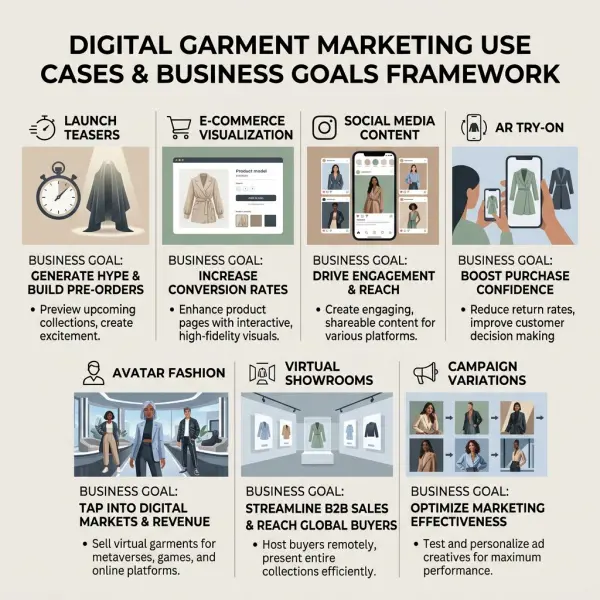
Practical Framework: Choosing the Right Marketing Use Case
Not every brand needs the same digital garment strategy. A luxury label, sportswear company, modest fashion brand, mass-market retailer, fashion school, and garment manufacturer may all use digital garments differently.
The best starting point is to match the use case with the marketing goal.
|
Marketing Goal |
Suitable Digital Garment Use |
Key Requirement |
|
Build launch anticipation |
Teaser visuals, animated product reveals |
Strong art direction |
|
Improve product understanding |
3D product views, close-up renders |
Visual accuracy |
|
Support social content |
Short-form videos, styling transitions |
Platform-native editing |
|
Enable interaction |
AR filters, virtual try-on |
Smooth user experience |
|
Reach digital communities |
Avatar fashion, gaming wearables |
Platform and culture fit |
|
Support wholesale |
Virtual showroom, digital lookbook |
Buyer-ready product data |
|
Reduce shoot dependency |
Rendered campaign variations |
High-quality digital assets |
This framework helps prevent overinvestment in the wrong format. A brand that needs better product clarity may not need a gaming partnership. A brand that wants cultural relevance with Gen Z may need platform-native digital fashion rather than a static 3D viewer.
Strategy comes before technology.
Common Mistakes in Digital Garment Marketing
- The first mistake is using digital garments only because they appear innovative. Novelty can attract attention once, but it does not build lasting marketing value. If the creative idea is weak, the technology will not save the campaign.
- The second mistake is ignoring realism when realism matters. For e-commerce, buyer presentations, and product education, the digital garment must be visually accurate. Fabric texture, proportion, color, opacity, silhouette, and styling should not mislead the customer.
- The third mistake is overcomplicating the content. Some brands try to combine AR, avatars, AI, gaming, virtual showrooms, NFTs, and cinematic CGI in one campaign. The result can feel confusing. A simpler idea, executed well, often performs better.
- The fourth mistake is treating digital garments as free content. Digital assets still require skilled labor: 3D artists, fashion designers, creative directors, technical reviewers, retouchers, animators, and platform specialists. The process may save time in some areas, but it still needs investment.
- The fifth mistake is forgetting legal and usage rights. Brands should clarify who owns the digital garment file, where it can be used, whether it includes licensed artwork, whether model likeness is involved, and whether the asset can be modified later.
A stronger approach is to treat digital garments as professional marketing assets, not experimental decorations.
What Brands Should Verify Before Producing Digital Garment Content
Before producing campaign assets with digital garments, brands should verify the strategic and technical requirements.
The core questions are practical:
- What marketing objective does this asset support?
- Which channels will use it?
- Does the asset need to look realistic, stylized, animated, or interactive?
- Is the digital garment based on a physical product or a digital-only concept?
- Who approves product accuracy?
- What file formats are required?
- Who owns the asset and derivative content?
- Can the asset be reused for future campaigns?
- How will performance be measured?
These questions are not administrative details. They determine whether the digital garment becomes a reusable business asset or a one-time visual experiment.
For brands planning broader digital asset strategies, these issues connect closely with opportunities and challenges of digital fashion assets.
Important Creative and Technical Caveats
Digital garment marketing must balance creativity with truthfulness. A rendered image can make a product look cleaner, sharper, more sculptural, or more dramatic than it appears in real life. This is useful for campaign fantasy, but risky for product-selling contexts.
The standard should depend on the channel. A surreal campaign teaser can be expressive. A product page image needs accuracy. A virtual try-on needs body and garment realism. A wholesale preview needs technical credibility. A gaming wearable needs platform compatibility and community relevance.
There are also limitations around fabric behavior. Some materials are difficult to simulate convincingly, especially when they involve transparency, shine, complex layering, embroidery, heavy texture, stretch, or fluid movement. Digital drape may not fully capture how a garment feels on a real body.
Brands should also be careful with AI-generated fashion visuals. AI can support ideation and content variation, but it may create unrealistic garment construction, inconsistent details, or designs that cannot be manufactured as shown. Human review remains essential, especially when the content represents a real product.
Digital garments can strengthen marketing, but only when creative imagination is supported by technical accuracy.
FAQ
What are digital garments in marketing?
Digital garments are clothing or accessories created as digital files and used for visual communication. In marketing, they may appear in campaign images, social media videos, product launch teasers, virtual try-on tools, e-commerce visuals, digital lookbooks, avatar outfits, or AR filters. Their value comes from flexibility: a single garment asset can often be adapted into multiple visual formats. However, quality and accuracy matter. A digital garment used for marketing should support the product story and not mislead customers about the real item.
Can digital garments replace fashion photoshoots?
Digital garments can reduce the need for some types of photography, but they do not fully replace photoshoots in most fashion businesses. Physical shoots still provide real human emotion, natural fabric movement, model presence, styling authenticity, and tactile credibility. Digital garments are more useful as a complementary tool: they can help create early campaign concepts, product animations, colorway variations, virtual lookbooks, and platform-specific content. The strongest content strategies often combine physical and digital production.
Are digital garments useful for small fashion brands?
Yes, but small brands should start with focused use cases. A small label may use digital garments to create product teasers, test colorways, build social media content, or prepare a digital lookbook before producing a full campaign shoot. The key is to avoid overspending on complex technology without a clear purpose. A simple, high-quality render or styling visualization may be more useful than an expensive virtual world project. The goal should be better content, not technology for its own sake.
How are digital garments used in social media content?
Digital garments can be used for short videos, animated product reveals, styling transitions, AR filters, creator campaigns, and campaign teasers. They help brands create variations quickly and adapt visuals for different platforms. For example, one digital jacket could be shown in multiple colors, styled in different looks, or animated for a product launch countdown. Social media success still depends on taste, pacing, relevance, and storytelling. Digital tools increase creative options, but they do not guarantee engagement.
What is the difference between digital garment content and AI fashion content?
Digital garment content usually starts with a garment asset built in 3D or digital fashion software. AI fashion content may be generated or edited using artificial intelligence tools, sometimes without a technically accurate garment file. The two can overlap, but they are not the same. For product marketing, digital garment assets are often more controllable because they can be tied to real product specifications. AI visuals may be useful for ideation, but they require careful review to avoid unrealistic construction or misleading product representation.
Can digital garments improve e-commerce conversion?
Digital garments may improve product understanding when they are used for clearer visualization, 3D views, styling context, or virtual try-on. However, conversion impact depends on execution quality, product category, customer behavior, website experience, pricing, trust, and return policies. Brands should test performance rather than assume automatic improvement. The safest claim is that digital garments can support better product communication when they are accurate, useful, and integrated well into the shopping journey.
What should brands avoid when using digital garments for marketing?
Brands should avoid using digital garments without a clear objective, overpromising sustainability, misrepresenting product fit or fabric, ignoring platform requirements, and failing to clarify asset ownership. They should also avoid content that looks visually impressive but disconnected from the brand’s real product identity. Digital garment marketing works best when it is strategically grounded, visually credible, and aligned with the customer’s expectations.
Conclusion
Digital garments are becoming a practical part of fashion marketing and content creation. Their value is not limited to futuristic campaigns or metaverse experiments. They can help brands create launch visuals, social content, e-commerce assets, digital lookbooks, virtual try-on experiences, creator collaborations, and avatar-based brand moments.
The strongest use cases are not necessarily the most complex. Often, the most valuable digital garment is the one that helps a brand communicate a product more clearly, produce content more efficiently, or build a more engaging customer experience.
For fashion businesses, the strategic challenge is to treat digital garments as marketing assets with purpose. They need creative direction, technical standards, channel planning, ownership clarity, and performance measurement.
Used well, digital garments do not replace the emotional power of physical fashion. They extend it into the digital spaces where audiences now discover, evaluate, share, and imagine style.





Comments 0
Leave a CommentSend Comment
Anda harus Login terlebih dahulu untuk dapat memberikan komentar.