

Why Fashion Brands Need to Understand Cost per Product Sold
Quick Answer
Cost per product sold helps a fashion brand understand how much economic cost is attached to the merchandise it actually sells. For apparel businesses, this figure should not automatically be confused with the factory quotation, purchase price, or even a simple production-cost estimate.
Depending on the business model, product cost can include direct materials, direct labor, manufacturing overhead, purchase costs, inbound freight, duties, and other costs required to bring inventory to its saleable condition and location. Under IAS 2, for example, inventory cost includes costs of purchase, costs of conversion, and other costs incurred in bringing inventory to its present location and condition.
Understanding this cost matters because nearly every commercial calculation built afterward—gross margin, contribution margin, discount tolerance, reorder economics, channel profitability, and break-even planning—depends on having a reliable product-cost foundation.
A garment that appears highly profitable when compared only with its factory price may look very different after freight, packaging, duties, manufacturing overhead, or other attributable inventory costs are recognized.
For small apparel brands, the goal is not to create the most complicated costing system possible. It is to build a consistent, decision-useful cost per product sold that reflects how the brand actually sources, produces, and sells merchandise without mixing product cost indiscriminately with marketing, fulfillment, and fixed operating expenses.

What Does Cost per Product Sold Mean in Fashion?
Cost per product sold is a managerial way of understanding the product-related cost associated with each unit of merchandise that generates a sale. The exact calculation depends on whether the brand manufactures products itself, purchases finished garments, imports merchandise, or works through a contract manufacturer.
It is important to distinguish this idea from several related terms. “Cost per product sold” is not itself a universal accounting-standard label with one mandatory formula. A fashion company may instead track manufacturing cost per unit, landed cost per unit, inventory cost, cost of goods sold (COGS), and managerial contribution cost. These figures overlap, but they answer different questions.
For a manufacturer, product cost typically begins with direct materials, direct labor, and manufacturing overhead. OpenStax describes these as the three major manufacturing-cost components and explains that these costs move through work in process and finished goods inventory before becoming cost of goods sold when the product is sold.
For a fashion brand that buys finished products from a supplier, there may be no internally incurred sewing labor or factory overhead to calculate separately. The supplier has already incorporated its own production economics into the purchase price. The brand's relevant inventory cost may instead begin with the supplier invoice and add qualifying costs required to bring the products to their present location and condition.
The most useful principle is therefore:
Do not ask only, “What did the factory charge?” Ask, “What does this saleable product actually cost us under a clearly defined costing method?”
That distinction provides the costing foundation for fashion unit economics.
Factory Price, Manufacturing Cost, Landed Cost, and Cost of Goods Sold Are Different
Fashion teams often use the word cost as though it refers to one number. In practice, several cost layers may exist between raw material and retail sale.
A factory quotation might tell a brand that a shirt costs $12 per piece. That can be useful for supplier negotiation, but it does not necessarily mean the shirt enters the brand's saleable inventory at exactly $12.
A clearer way to think about the cost stack is:
|
Cost layer |
What it generally represents |
Typical business use |
|
Factory or supplier price |
Amount charged by the supplier per unit |
Supplier comparison and purchasing |
|
Manufacturing cost |
Direct materials, direct labor, and manufacturing overhead for self-manufactured products |
Production management |
|
Landed cost |
Managerial view of product cost after bringing merchandise to the destination, potentially including freight and duties |
Sourcing and import decisions |
|
Inventory cost |
Costs capitalized into inventory under the applicable accounting framework |
Financial reporting and inventory valuation |
|
Cost of goods sold |
Inventory cost recognized as expense when merchandise is sold |
Gross profit reporting |
|
Contribution cost layer |
COGS plus relevant variable selling costs for managerial analysis |
Pricing, channel, promotion, and growth decisions |
These layers should not be treated as interchangeable.
IAS 2 states that inventory cost includes costs of purchase, conversion costs such as direct labor and production overhead, and other costs incurred in bringing inventory to its present location and condition. It also requires inventories to be measured at the lower of cost and net realizable value.
A managerial landed-cost calculation may resemble part of this accounting treatment, but brands should not assume that every expense they include in an internal landed-cost spreadsheet automatically belongs in inventory for statutory reporting. Accounting treatment depends on the applicable reporting framework and the nature of the cost.
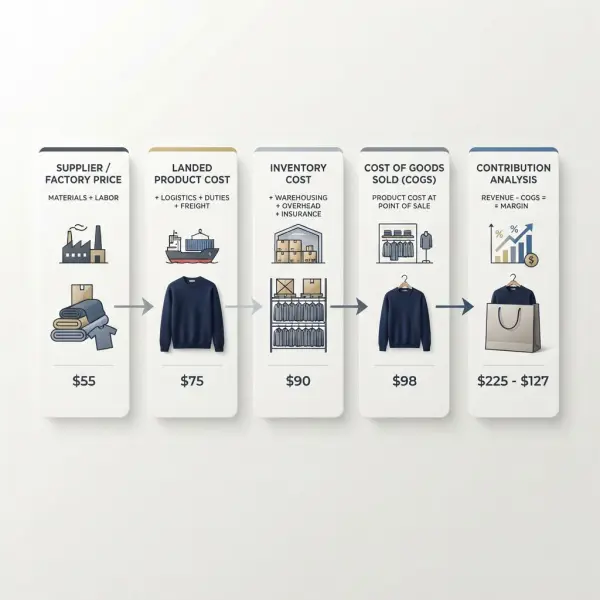
Why Factory Cost Alone Can Be Misleading
Suppose a brand buys 500 dresses from an overseas supplier for $20 each.
At first glance:
Supplier price per dress = $20
If the dress retails for $80, management might casually describe the product as having a $60 spread between selling price and cost.
But that interpretation can be premature.
The shipment may also require international freight, insurance, customs-related charges, import duties where applicable, domestic transport, and handling necessary to bring the merchandise into the brand's warehouse. The brand may also incur qualifying labeling or preparation costs before the inventory is ready for sale.
Assume, purely for illustration, that attributable inbound costs add another $4 per unit.
The relevant product cost becomes closer to:
$20 supplier price + $4 attributable inbound cost = $24 per unit
The apparent spread has already declined from $60 to $56 before payment processing, fulfillment, outbound shipping, discounts, returns, customer acquisition, and fixed operating expenses are considered.
That difference becomes substantial at scale.
On 10,000 units, a $4 costing omission represents $40,000.
This is why inaccurate product cost does not merely create a minor spreadsheet error. It propagates through pricing, gross-margin forecasts, purchase budgets, promotion planning, contribution analysis, and inventory decisions.
How Product Cost Works for Brands That Manufacture Their Own Garments
For a vertically integrated apparel company or small label producing garments in its own workshop, product cost requires more than adding fabric and sewing wages.
Traditional manufacturing product cost generally consists of:
Direct materials + direct labor + manufacturing overhead
OpenStax identifies these three categories as the fundamental manufacturing costs attached to products. Manufacturing overhead includes production costs that are not economically practical to trace directly to each unit, such as certain indirect materials, indirect labor, factory utilities, and depreciation associated with production equipment.
For an apparel producer, direct materials may include the main fabric, lining, buttons, zippers, elastic, labels, or other components that can reasonably be traced to the garment.
Direct labor might include cutting, sewing, finishing, or other production labor when those costs can be traced appropriately to the product.
Manufacturing overhead can include production-support costs that cannot be efficiently traced garment by garment.
This matters because a brand sewing a blouse internally for $8 of fabric and $5 of direct sewing labor does not necessarily have a $13 product cost. If the workshop requires supervisors, machinery, electricity, maintenance, quality-control support, and other production resources, those costs need an appropriate treatment in the manufacturing-cost system.
At the same time, allocating overhead badly can be almost as misleading as ignoring it.
Using the same overhead amount for a simple T-shirt and a construction-intensive tailored jacket may distort product economics if the products consume production resources very differently. Activity-based costing is one approach that allocates overhead using activities that drive those costs rather than relying solely on one broad allocation base.
A small fashion company may not need a sophisticated activity-based costing system, but it should recognize the underlying issue: different garments can consume indirect resources differently.

Purchased Finished Goods Require a Different Costing Logic
Many small fashion brands do not manufacture products themselves. They buy finished garments from contract manufacturers or suppliers.
In that model, the supplier price already incorporates the supplier's fabric, labor, overhead, and profit. The brand should not attempt to recreate the supplier's internal manufacturing cost unless there is a specific sourcing reason to do so.
Instead, the brand needs to understand its own acquisition cost.
For example:
Supplier purchase price
- attributable inbound freight
- non-recoverable duties or similar purchase-related costs, where applicable
- other qualifying costs required to bring inventory to its saleable location and condition
This gives a much more useful foundation for merchandise decisions than simply copying the factory quotation into a retail-pricing sheet.
The distinction is particularly important when comparing suppliers in different locations. Supplier A may quote $11.50 and Supplier B $12.20, yet Supplier B could still produce a lower delivered product cost if freight, duty exposure, minimum-order requirements, lead time, defect risk, or logistics costs are materially better.
The lowest quotation is not automatically the lowest economic product cost.
Cost per Unit Produced Is Not Always Cost per Unit Sold
Another important distinction appears once inventory begins moving through the business.
If 1,000 garments are produced at a total manufacturing cost of $20,000, the simplified production cost is:
$20,000 ÷ 1,000 = $20 per unit produced
But the business may not sell all 1,000 units in the same reporting period.
Suppose only 600 are sold. Under normal inventory accounting logic, the cost of unsold finished goods remains in inventory rather than immediately becoming cost of goods sold. Product cost moves from production into finished inventory and becomes expense as merchandise is sold. OpenStax illustrates this flow from raw materials through work in process, finished goods, and eventually cost of goods sold.
This means a fashion business should distinguish:
Cost per unit produced — useful for manufacturing and sourcing.
Inventory cost per unit — useful for inventory valuation and merchandise planning.
Cost per unit sold — useful for understanding merchandise cost associated with realized sales.
The distinction becomes more complicated when product costs differ between production batches, suppliers, or purchase dates. Applicable accounting methods such as specific identification, first-in first-out, or weighted average may affect how inventory costs are assigned depending on the nature of the inventory and accounting framework. IAS 2 identifies specific identification for certain non-interchangeable inventory and FIFO or weighted average for ordinarily interchangeable items.
For management purposes, SKU-level costing can provide even more detail, but it should reconcile sensibly with the accounting records rather than developing into an unrelated parallel system.
A Practical Apparel Costing Example
Consider a small brand placing an order for 1,000 hoodies. The figures below are illustrative rather than industry benchmarks.
|
Cost component |
Total |
Per hoodie |
|
Supplier merchandise cost |
$18,000 |
$18.00 |
|
Inbound freight |
$1,500 |
$1.50 |
|
Import-related duty |
$1,000 |
$1.00 |
|
Attributable inbound handling |
$300 |
$0.30 |
|
Illustrative product cost |
$20,800 |
$20.80 |
If management uses only the $18 supplier price, it understates this illustrative unit cost by $2.80.
Now suppose the hoodie sells for $60.
Using only supplier price:
$60 − $18 = $42
Using the fuller product-cost figure:
$60 − $20.80 = $39.20
That $2.80 difference may appear small on one hoodie. On 1,000 units it represents $2,800 of merchandise cost.
The next analytical layer should remain separate. Payment fees, ecommerce fulfillment, marketplace commission, outbound shipping subsidies, and customer acquisition costs may matter greatly to the profitability of the sale, but they should not automatically be pushed into inventory cost.
Instead, they can be added through a contribution analysis such as the framework described in how contribution margin shapes fashion business decisions.
Separating the layers preserves diagnostic value. If product economics deteriorate, management can see whether the problem comes from sourcing, logistics, channel fees, acquisition, returns, or operating overhead rather than hiding everything inside one all-purpose “cost” figure.

Why Cost per Product Sold Matters for Pricing
A retail price can only produce a meaningful margin calculation if the cost underneath it is reliable.
Suppose management wants a certain gross-margin structure and believes a garment costs $25. A pricing decision built on that number will be wrong if the actual attributable product cost is $31.
The problem becomes particularly important in fashion because retail prices often need to fit psychological thresholds or market expectations. A brand may discover that its intended price architecture cannot support the product specification it originally designed.
That realization is commercially useful.
If a dress must retail around $120 to fit the brand's market position but the developed product requires $60 of inventory cost, management may need to reconsider fabric, construction complexity, supplier, production quantity, or target margin.
The answer is not automatically to choose the cheapest material.
Product quality, fit, brand positioning, design differentiation, supplier reliability, and customer expectations matter. Cost information should make the trade-off visible rather than dictating product development in isolation.
This is why costing is most valuable before production quantities are finalized. Discovering that the economics do not work after 5,000 garments have been manufactured leaves far fewer options.
Cost Accuracy Determines Whether Gross Margin Is Real
Gross margin is only as reliable as the product cost used to calculate it.
At a simplified level:
Gross Profit = Net Sales − Cost of Goods Sold
and:
Gross Margin % = Gross Profit ÷ Net Sales × 100
If product cost is understated, gross margin is overstated.
This creates a dangerous management problem because the business may believe it has more room for marketing, discounting, commissions, fulfillment, salaries, and overhead than actually exists.
Consider two garments both retailing for $100.
Product A has a reliable product cost of $35.
Product B appears to cost $30 but actually costs $38 after costs omitted from the original calculation are recognized.
On paper, Product B initially looks more attractive. After the costing correction, Product A has the stronger merchandise economics.
The calculation has not changed the business. It has simply exposed what was already happening.
Cost per Product Sold Sets the Floor for Discount Decisions
Discounting is another area where incomplete costing can become expensive.
If a jacket retails for $120 and management believes the product cost is $40, a 40% markdown produces:
Discounted selling price = $72
The apparent spread above product cost is:
$72 − $40 = $32
But if the properly calculated product cost is actually $50:
$72 − $50 = $22
Once transaction and fulfillment costs are considered, the economic room becomes narrower again.
This does not mean a fashion brand should never sell below its normal margin target. Clearance can be rational when inventory is aging and the alternative is an even deeper markdown or eventual write-down.
IAS 2's requirement to measure inventory at the lower of cost and net realizable value reflects the broader accounting reality that inventory cost is not always fully recoverable when expected selling economics deteriorate.
For merchandising teams, the practical lesson is straightforward: markdown decisions need a trustworthy cost floor.
Without it, a promotion can appear commercially acceptable while destroying far more margin than management realizes.
Cost per Product Sold Improves Reorder Decisions
Reordering is usually treated as a demand question: the product sold quickly, so produce more.
Costing adds the other half of the decision.
A second production run may not have the same economics as the first.
Fabric prices can change. The reorder quantity may be smaller. Freight may be different. The supplier may charge a new price. Air shipment may be necessary to meet seasonal demand. Currency movements may change the local purchase cost for an importing brand.
Suppose a first batch costs $24 per unit and sells successfully at $70. The reorder looks attractive.
But a rushed second batch might cost:
$26 supplier price + $5 expedited freight and attributable inbound cost = $31
Management should evaluate the reorder using approximately $31 economics—not the historical $24 from the original purchase.
This sounds obvious, yet businesses often carry an old standard cost forward because it is already stored in the ecommerce or inventory system.
Accurate costing should therefore have a version or effective period where meaningful cost changes occur.
The same principle applies when comparing new suppliers. The team should compare the expected product economics for the next order, not just historical cost from the previous one.
Minimum Order Quantities Can Distort the Meaning of Cheap Unit Cost
Supplier quotations often become cheaper as production quantity increases.
That does not automatically mean the larger order creates better economics.
Suppose a supplier offers:
500 units at $18 each = $9,000
or:
1,000 units at $15 each = $15,000
The second option produces a lower production cost per garment, which looks attractive.
But the brand has committed another $6,000 of cash and must sell twice as many units.
If only 600 of the 1,000 units sell near full price and the remaining 400 require aggressive clearance, the larger purchase may create a worse overall collection result despite having the cheaper manufacturing cost per unit.
This is where product costing needs to connect with inventory planning.
Cost per unit tells management how efficiently products were acquired or manufactured. Sell-through, markdown exposure, inventory aging, and working capital reveal whether buying those units was actually a good business decision.
A low unit cost achieved through an excessive minimum order quantity can be false economy.
Small Production Runs Create a Different Cost Structure
The opposite problem appears when brands manufacture very small runs.
Short runs can reduce inventory exposure and allow a brand to test demand, but they may increase unit cost. Pattern development, grading, marker preparation, sampling, setup, quality-control activities, and other production resources may be spread across fewer saleable units.
Some costs are batch-level rather than strictly unit-level.
For example, if a production setup costs $300 whether a factory manufactures 100 or 1,000 pieces, the setup burden is:
$3.00 per unit at 100 pieces
but:
$0.30 per unit at 1,000 pieces
That does not mean the 1,000-piece order is automatically superior. The larger run introduces more inventory commitment.
The economic decision is therefore a balance between unit cost efficiency and inventory risk.
Small apparel brands should resist simplistic advice that either “small batches are always safer” or “larger MOQs always improve margin.” Both can be true under certain conditions. The correct choice depends on expected demand, selling window, cash capacity, supplier terms, replenishment speed, and markdown risk.
Defects and Production Yield Can Raise the Effective Cost of Saleable Units
Not every unit entering production necessarily becomes a saleable first-quality garment.
Fabric defects, sewing faults, measurement failures, staining, finishing problems, or damage can reduce usable output. How these losses are treated for accounting purposes depends on their nature and the applicable accounting framework, so brands should not casually capitalize every abnormal loss into inventory.
For managerial planning, however, yield still matters.
Imagine a production batch costing $20,000 that was intended to produce 1,000 saleable units.
Expected cost:
$20,000 ÷ 1,000 = $20 per intended unit
If only 950 first-quality units become commercially saleable, the production economics have changed. Depending on the accounting treatment and recoverability of defective units, management needs to understand the economic effect of that lost yield rather than continuing to assume all 1,000 units created normal saleable inventory.
OpenStax distinguishes spoilage as units that are not fit for sale because of breakage or imperfections, reinforcing why manufacturing output and saleable output are not always identical.
For apparel brands, quality data therefore belongs next to cost data. A supplier offering the cheapest quoted unit price may not remain cheapest if defect rates are materially higher.

Returns Should Not Be Hidden Inside Product Cost
Returns affect fashion economics substantially, but they should normally be modeled separately from original inventory cost when management wants to understand why profitability is changing.
A returned garment may create reverse freight, inspection, repacking, customer-support costs, refund processing, and potentially a reduction in resale value.
Those are real economic consequences.
But simply increasing the original product cost by a generic “return percentage” can make diagnosis harder. The team loses visibility into whether a product is expensive to make or simply expensive to sell because customers return it frequently.
This distinction is especially relevant online. The National Retail Federation and Happy Returns estimated that 19.3% of U.S. online sales would be returned in 2025, although this is a broad U.S. online-retail estimate rather than a global fashion benchmark.
A fashion brand should therefore use its own return data rather than applying a generic industry percentage.
A practical management view can preserve separate layers:
Product cost → gross margin → variable selling costs → return economics → contribution
This maintains clarity while still recognizing that returns affect the economics of products actually sold.
Cost per Product Sold Changes by Channel—But Product Cost May Not
The underlying inventory cost of a garment does not necessarily change just because the product is sold through another channel.
What changes is often the cost of selling it.
Suppose the same shirt has a $25 product cost.
On the brand's own website, the sale may create payment-processing fees, fulfillment costs, outbound shipping, and customer acquisition expenditure.
On a marketplace, it may create commission and marketplace fulfillment charges.
Through wholesale, the brand may receive a lower selling price while avoiding some direct-to-consumer transaction expenses.
If all of these costs are bundled together and called “product cost,” management can no longer see what each channel is doing.
A better structure is:
Layer 1: Product / inventory cost
Layer 2: Channel-specific variable selling cost
Layer 3: Contribution margin
That structure allows management to ask whether the product itself is poorly costed or whether a particular channel is too expensive.
The second article in this cluster, contribution margin for fashion business decisions, addresses that downstream layer in more depth.
A Practical Costing System for Small Fashion Brands
A small apparel company does not need enterprise-level costing software to begin. It needs a repeatable structure that records the same categories consistently.
At minimum, management should be able to move from purchase or manufacturing cost toward an identifiable inventory cost for each SKU or product family.
A practical workflow is:
- Identify the sourcing model. Determine whether the product is manufactured internally, produced by a contractor, or purchased as finished merchandise.
- Record direct product or supplier cost. Keep the underlying invoice or production data rather than relying on memory or an old price list.
- Allocate attributable inbound costs consistently. Freight, duties, and other qualifying costs need a repeatable allocation method where relevant.
- Calculate cost at SKU or variant level where material differences exist. Do not assume every color, fabric, or size carries identical economics when the underlying costs differ meaningfully.
- Keep production and inventory costs separate from selling costs. Payment fees, marketplace commissions, outbound fulfillment, acquisition, and returns can be layered later.
- Update costs when new purchase batches materially change economics. Historical cost should not silently become the forecast cost for future decisions.
- Reconcile the managerial model with accounting records periodically. Internal decision tools should explain the business more clearly, not create an entirely separate version of reality.
For small brands, consistency matters more than excessive precision.
A costing spreadsheet that is 95% accurate and updated on every production run is usually more useful for management than an elaborate model that nobody maintains.
Common Cost-per-Product Mistakes in Fashion Businesses
Using the Supplier Quote as the Final Product Cost
The supplier price is only one possible component of the cost of obtaining saleable inventory. Freight, duties, handling, conversion costs, or other attributable expenses may change the economics materially. Brands should preserve the supplier quotation as its own data point while separately calculating the broader cost required for management and accounting purposes.
Loading Every Business Expense Into the Garment Cost
The opposite mistake is treating every company expense as though it were part of the product. Digital advertising, founder salaries, office software, ecommerce apps, and general administration matter to profitability but do not automatically belong in inventory cost. Mixing them into the garment cost can make sourcing analysis difficult and blur the distinction between product economics and operating economics.
Allocating Freight Equally When Products Consume Logistics Differently
Dividing one freight invoice equally across every unit can be convenient but misleading when products vary greatly in weight, volume, or shipping requirements. Ten lightweight tops and ten bulky coats do not necessarily consume the same logistics resources. The allocation method should be practical but economically reasonable.
Keeping an Old Standard Cost After Supplier Economics Change
Fashion cost structures move. Supplier prices, freight, duties, exchange rates, materials, and production quantities can change between purchase orders. A margin report using last season's product cost may therefore describe economics that no longer exist. Forecasts and reorder decisions should use current expected cost assumptions.
Ignoring Unsold Inventory When Celebrating a Low Unit Cost
A large production run can lower manufacturing cost per unit while increasing cash tied up in inventory. If the additional units eventually require markdowns, the collection may underperform despite excellent initial unit costing. Product cost should therefore be evaluated alongside sell-through and inventory commitment.
Double Counting Costs
A brand may include inbound freight in landed cost and then subtract the same freight again in contribution analysis. The same problem can occur with packaging, commissions, or fulfillment. Every cost should have one clearly defined home unless management deliberately produces multiple analytical views and labels them accordingly.
What Fashion Brands Should Verify Before Trusting Their Product Cost
A product-cost number is useful only when everyone understands what it contains.
Management should be able to answer several questions without searching through multiple spreadsheets: Does the cost include inbound freight? Are import duties included where relevant? How is manufacturing overhead allocated? Which exchange rate is used for imported purchases? Is cost tracked by production batch? How are defective units treated? Does the ecommerce system store the same cost used by the finance team?
The answers do not have to follow one universal model, but they do need to be consistent.
Brands should also distinguish accounting cost from managerial economic analysis. IAS 2 provides rules governing inventory measurement for entities applying IFRS, but internal management may maintain additional analyses for pricing, supplier comparison, or contribution decisions. Those internal views should not be presented as though they redefine formal accounting requirements.
Another caution involves taxes and duties. Their treatment can vary by jurisdiction, recoverability, legal entity, and transaction structure. Fashion businesses operating internationally should verify these items with appropriate accounting, customs, or tax professionals instead of applying a generic global assumption.
Finally, do not confuse precision with accuracy. A spreadsheet showing product cost to four decimal places is not reliable if the freight allocation, production yield, or supplier cost underneath it is wrong.
Frequently Asked Questions About Cost per Product Sold
Is cost per product sold the same as COGS?
Not exactly. Cost of goods sold is an accounting expense associated with inventory that has been sold during a reporting period, while “cost per product sold” is often used as a managerial unit-level view. A company might calculate average COGS per unit, but an average can conceal differences between SKUs, purchase batches, materials, and product categories. For pricing or merchandising decisions, brands often need product-specific cost information in addition to total COGS reported in the financial statements.
Should inbound shipping be included in apparel product cost?
It can be, depending on the nature of the shipping cost and the applicable accounting framework. IAS 2 includes transport and other costs of purchase when they are incurred in bringing inventory to its present location and condition. For internal management, brands commonly want inbound freight reflected in landed product economics because it affects the real cost of acquiring inventory. The allocation method should be consistent and appropriate for differences in weight, volume, shipment structure, and product mix.
Should outbound shipping to the customer be included in product cost?
Usually it is more useful to keep outbound customer shipping in the selling or fulfillment layer rather than treating it as part of the original inventory cost. Doing so allows management to distinguish what the merchandise costs from what the transaction costs to fulfill. Exact accounting treatment can depend on the circumstances and reporting framework, but for managerial unit economics this separation often makes channel and shipping-policy decisions easier to analyze.
Should packaging be included in cost per product?
It depends on the packaging and its function. Packaging incorporated into the saleable product or required to bring inventory into its saleable condition may be treated differently from ecommerce shipping materials used only when an order is dispatched. A brand might therefore include branded product packaging in one cost layer while treating courier boxes and outbound protective packaging as fulfillment expenses. The important point is to establish a consistent policy rather than changing classification from product to product.
How should a brand allocate freight across several different garments?
The allocation method should reflect the factor that reasonably drives the freight cost. Equal allocation by unit can work when products are similar, but weight, volume, carton count, or purchase value may provide a better basis when products differ significantly. A shipment containing coats and lightweight accessories, for example, may be distorted by a simple unit-count allocation. Small brands do not need mathematically perfect allocations, but the method should avoid systematically understating the cost of logistics-intensive products.
Why can the same garment have different costs between production runs?
Material prices, labor rates, order quantities, supplier quotations, exchange rates, freight methods, duties, and production efficiency can all change. A small first batch may also carry higher setup cost per unit, while an urgent reorder may require expensive expedited shipping. For this reason, brands should avoid assuming that one historical unit cost represents the economics of every future batch. Reorder decisions should use the expected cost of the next purchase or production run.
Should customer acquisition cost be included in product cost?
Normally it is more useful to keep CAC separate. Customer acquisition cost belongs to the customer or marketing-acquisition level, whereas inventory cost belongs to the product level. A customer can purchase several products and may order repeatedly, so assigning the entire acquisition expense to one garment can distort SKU economics. Brands can first calculate reliable product cost and product contribution, then connect those figures with customer-level acquisition economics.
Can a cheap-to-produce fashion product still be financially unattractive?
Yes. Low manufacturing cost does not guarantee strong economics. A product may experience weak sell-through, high markdowns, expensive fulfillment, frequent returns, large customer-acquisition requirements, or excessive inventory commitment. Conversely, a higher-cost garment can perform well if customers accept the price, sell-through is strong, returns are controlled, and enough contribution remains after variable selling costs. Product cost is therefore a critical input, not a complete profitability verdict.
Conclusion
Understanding cost per product sold gives fashion brands a more reliable foundation for nearly every commercial decision that follows.
The first discipline is recognizing that “cost” has layers. A supplier quotation, manufacturing cost, landed cost, inventory cost, cost of goods sold, and contribution cost are related concepts, but they are not interchangeable.
For a small apparel business, the most damaging costing mistakes usually occur at the extremes. One brand treats the factory price as the entire economic cost of merchandise and overstates margin. Another tries to put marketing, salaries, software, fulfillment, and every other company expense into the garment cost and loses the ability to see where profitability is actually changing.
A stronger system separates the layers.
Product cost should explain what it takes to create or acquire saleable inventory. Selling-cost analysis should show what it takes to turn that inventory into a transaction. Contribution margin should show what remains after relevant variable costs. Fixed costs and cash-flow analysis then reveal whether the complete business model is sustainable.
Once those layers are clear, costing becomes more than an accounting exercise. It can influence supplier selection, product development, retail pricing, production quantity, markdown depth, reorder timing, assortment planning, and channel strategy.
That is why cost per product sold deserves attention even in very small fashion businesses. Accurate costing does not guarantee that every product will succeed. It does something more fundamental: it ensures that the brand is making decisions using the economics it actually has r





Comments 0
Leave a CommentSend Comment
Anda harus Login terlebih dahulu untuk dapat memberikan komentar.