

French Terry vs Fleece: What Makes Them Different?
Quick Answer
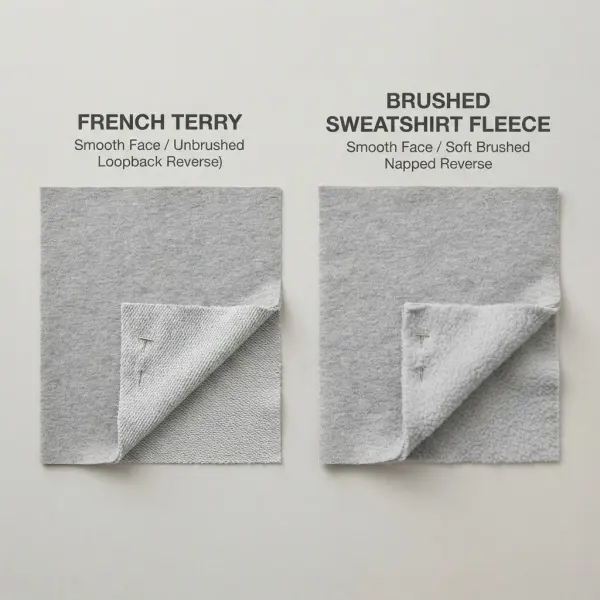
French terry and sweatshirt fleece can look almost identical from the outside, but their reverse surfaces are usually the key difference. French terry keeps its interior float loops un-napped, while conventional sweatshirt fleece has those back yarns brushed or napped into a soft raised surface. CottonWorks describes industry French terry as an un-napped fleece construction and explains that brushing or napping the interior yarns differentiates it from fleece.
That finishing difference changes how the materials feel and behave. French terry generally provides less loft and a more visible loopback interior, making it useful for transitional sweatshirts, joggers, shorts, and layering pieces. Brushed sweatshirt fleece tends to provide a softer, loftier inner surface and is commonly selected when the design calls for more tactile warmth.
The comparison requires one important caveat: “fleece” is a broad textile term. Sweatshirt fleece should not be confused with polar fleece or other synthetic pile fleeces used in outdoor clothing. Polartec, for example, describes its synthetic fleece as a knitted material transformed through surface finishing into a raised pile designed to trap air.
For fashion businesses, the practical decision is therefore not simply which fabric is “better.” It is whether an unbrushed loopback surface or a brushed fleece surface better matches the garment's climate, silhouette, handfeel, wash performance, positioning, and intended customer.
What Is the Main Difference Between French Terry and Fleece?
The most useful distinction is the treatment of the technical back of the fabric. In the sweatshirt-fabric context, French terry leaves the reverse yarn floats or loops intact, while fleece is normally napped so that those yarns form a fuzzy raised surface. The technical face can remain relatively smooth in both cases, which explains why two hoodies may appear similar until they are turned inside out.
CottonWorks provides an especially useful technical clarification. What the apparel industry commonly calls French terry is generally a two-end fleece construction that has not been napped; technically, the structures visible on the back are floats rather than loops formed by a true terry sinker. The same source notes that napping the back yarns creates the characteristic fleece surface while the underlying knit structure can remain the same. CottonWorks guide to single and double knits
That distinction matters because commercial textile terminology is not always as precise as laboratory terminology. Mills, garment suppliers, retailers, and regional markets may use French terry, loopback, unbrushed fleece, two-thread fleece, sweatshirt fleece, and related terms differently. Buyers should therefore inspect the actual fabric and specification rather than assuming that a familiar name guarantees one construction.
This article focuses specifically on French terry versus conventional brushed sweatshirt fleece. Polar fleece, microfleece, sherpa-style fleece, and technical outdoor fleece belong to a broader fleece ecosystem and should not be treated as interchangeable with the sweatshirt construction being compared here.
French Terry: The Loops Stay Intact
French terry typically presents a relatively smooth jersey-like technical face and visible floats or loop-like formations on the reverse. Because the reverse is left un-napped, the fabric retains a more defined knit structure instead of developing the fluffy interior associated with brushed sweatshirts.
CottonWorks notes that French terry comes in different weights and is used for garments such as sweatpants, sweatshirts, and sporty layering pieces. Its performance cannot be reduced to one standard GSM or one fiber blend; two French terries can differ substantially because of yarn size, stitch length, density, fiber composition, loop configuration, finishing, and weight.
This makes French terry particularly flexible for apparel development. A relatively lightweight version may work for shorts or transitional layers, while a dense heavyweight loopback can produce a substantial premium hoodie without requiring a fuzzy interior. The fabric name alone does not tell a buyer which end of that range is being offered.
The exposed reverse structure also gives French terry a distinctive visual identity. Some brands intentionally show loopback surfaces at raw edges, seam details, or reversible elements, while others value the fabric primarily because it provides sweatshirt-like body without the plush feel of brushed fleece.
Brushed Sweatshirt Fleece: The Reverse Surface Is Raised
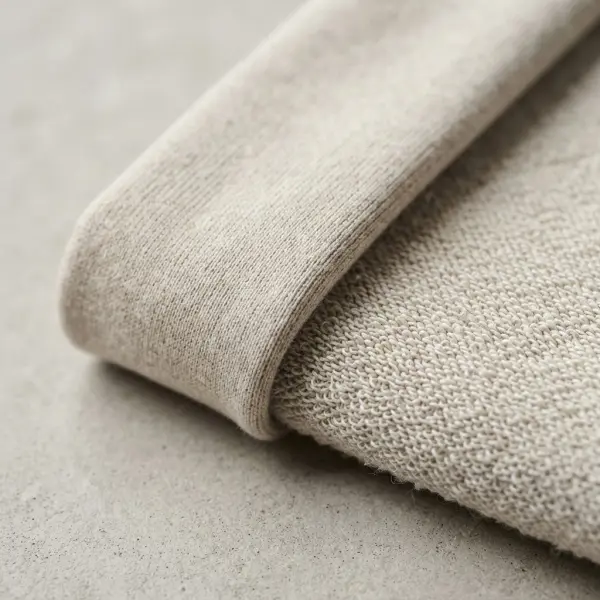
Conventional sweatshirt fleece takes a different finishing route. Yarn on the technical back is mechanically napped or brushed, raising fiber from the fabric and creating the familiar soft, fuzzy surface found inside many hoodies and crewneck sweatshirts.
Cotton Incorporated's technical material on napping explains that fleece is one of the most common knitted cotton constructions subjected to this process. Napping raises fibers from the fabric surface, and the yarn intended for the fleece side can be engineered to facilitate formation of the pile. Cotton Incorporated technical bulletin on fabric napping
The raised fibers create additional surface loft and air spaces. In practical garment terms, this often makes brushed fleece feel warmer and more enveloping than a comparable unbrushed loopback fabric. However, the word comparable matters: actual warmth also depends on fabric mass, thickness, density, fiber composition, pile height, moisture conditions, garment fit, and layering.
Brushing also changes the visual and tactile quality of the interior. The customer no longer encounters clearly defined loopback yarns but a more continuous soft nap. For brands selling cold-weather loungewear or soft-touch hoodies, that tactile difference may be central to the product proposition rather than a minor finishing detail.
French Terry vs Fleece: Side-by-Side Comparison
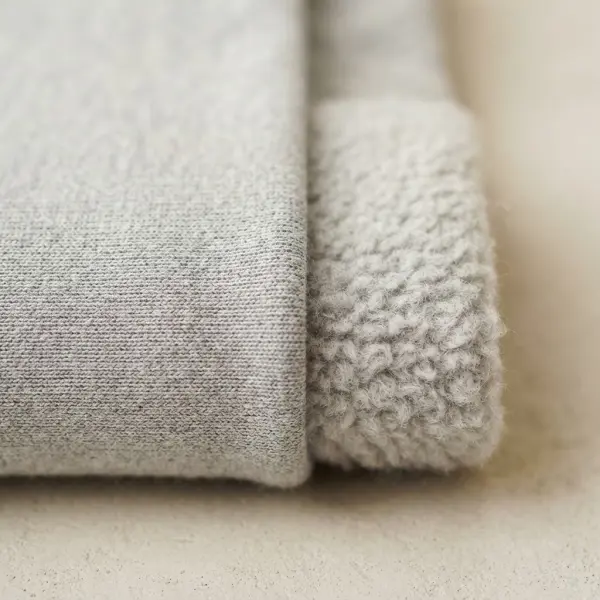
The simplest way to compare these fabrics is to separate characteristics that come directly from the reverse finish from characteristics that depend on the complete fabric specification.
|
Comparison point |
French terry |
Brushed sweatshirt fleece |
|
Reverse surface |
Visible un-napped floats or loopback structure |
Raised, brushed or napped surface |
|
Outer face |
Commonly relatively smooth |
Commonly relatively smooth |
|
Interior handfeel |
Textured, looped, less fluffy |
Soft, fuzzy, loftier |
|
Relative warmth |
Usually lower than a comparable brushed version |
Usually warmer when otherwise comparable |
|
Bulk |
Often less bulky |
Usually gains more surface loft |
|
Seasonal use |
Useful across transitional and moderate conditions |
Common in cooler-weather casualwear |
|
Visual identity |
Clearly visible loopback reverse |
More continuous plush inner surface |
|
Surface testing concern |
Loop stability, pilling and general appearance still matter |
Napped surface makes fuzzing, matting and pilling particularly relevant |
|
Typical garments |
Sweatshirts, joggers, shorts, lightweight hoodies, casual dresses |
Hoodies, crewnecks, sweatpants, cold-weather loungewear |
|
Fiber composition |
Cotton, blends, synthetics and other variants are possible |
Cotton, cotton blends and synthetic variants are possible |
This table should be read as a directional product-development comparison, not a performance guarantee. A heavyweight dense French terry can be warmer than a very light fleece, and a poorly engineered fleece may have less desirable recovery or surface durability than a high-quality loopback fabric. CottonWorks also notes that fleece constructions can be made in cotton, cotton-polyester blends, or synthetic fibers, reinforcing why construction and fiber content should be assessed separately.

Is Fleece Always Warmer Than French Terry?
Not automatically. Brushing generally gives a comparable sweatshirt fabric more loft and creates additional spaces where still air can be held, so conventional brushed fleece often feels warmer than its unbrushed counterpart. But warmth cannot be predicted reliably from the terms fleece and French terry alone.
Consider two sourcing samples. The first is a dense heavyweight French terry with substantial fabric mass and tight construction. The second is a lightweight brushed fleece designed primarily for softness rather than insulation. It would be misleading to assume that the second fabric must provide more thermal protection simply because its reverse is fuzzy.
A more accurate evaluation considers several variables together: fabric thickness, mass per unit area, fiber composition, knit density, surface loft, air permeability, garment fit, and how the product will be layered. Even within synthetic performance fleece, Polartec offers different weight and loft categories, illustrating how broadly thermal behavior can vary inside the fleece category itself.
For merchandising teams, the safer language is therefore “warmer in this specific construction” rather than “fleece is warm and terry is cool.” The latter sounds convenient for product copy but oversimplifies textile performance.
Which Fabric Feels Softer?
Brushed fleece usually creates a more immediately plush sensation because raised fibers form a soft nap against the skin. French terry has a different tactile character: the loopback surface can feel soft and cushioned, but it remains visibly and physically more structured.
This difference influences how customers interpret quality. In mass casualwear, a fuzzy interior is often associated with warmth and coziness. In premium streetwear, however, some brands deliberately choose dense heavyweight loopback fabric because the cleaner, less fluffy interior supports a firmer silhouette and may communicate quality through weight, construction, and drape rather than through plushness.
Softness should also be separated from durability. The softest fabric at first touch is not automatically the material that will retain the best appearance after repeated laundering. Napping changes the surface structure, so testing for fuzzing, pilling, and matting becomes important when long-term appearance is part of the product promise.
ISO 12945-3 specifically covers resistance to pilling, fuzzing, and matting and notes that the method is applicable to most woven and knitted fabrics, including napped fabrics such as fleeces. ISO 12945-3 pilling, fuzzing and matting test
Does French Terry Breathe Better Than Fleece?
French terry often feels less insulating and less enclosing than a comparable brushed sweatshirt fleece because it lacks the raised nap that adds loft to the reverse surface. That can make it attractive for garments intended for transitional weather, indoor-outdoor use, travel, or markets where a conventional winter fleece would feel excessive.
However, describing one fabric as categorically “more breathable” requires caution. Air permeability and moisture behavior depend on much more than brushing: stitch density, thickness, yarn size, fiber type, finishing, and fabric structure all influence how readily heat and moisture move through a textile.
A tightly constructed heavyweight French terry may therefore behave very differently from a lighter, more open version. Likewise, performance synthetic fleece can be deliberately engineered to balance warmth and air movement; Polartec, for example, markets specific fleece constructions around a combination of insulation and breathability rather than warmth alone.
For brands, climate positioning is more useful than generic breathability claims. A product description can accurately explain that an unbrushed loopback construction provides less interior loft than the brand's brushed fleece version if that statement is supported by the actual fabrics being sold.
Fabric Weight Does Not Settle the Comparison
GSM—grams per square meter—is frequently used during fabric sourcing because it provides a straightforward measure of fabric mass per unit area. It is valuable for specification control, yield calculations, costing, consistency, and comparisons between samples.
But GSM does not tell the full story. A 350 GSM French terry and a 350 GSM fleece do not necessarily have the same thickness, loft, stretch, drape, thermal behavior, or durability. Brushing redistributes fibers at the surface and changes the fabric's tactile and dimensional character without turning GSM into a universal performance score.
Construction matters as well. CottonWorks distinguishes two-end and three-end fleece structures, with three-end fleece using separate face, tie-in, and pile yarn systems to create a fuller and more stable fleece construction.
This is commercially relevant because buyers sometimes specify only composition and GSM—for example, “80% cotton, 20% polyester, 320 GSM”—and assume the rest of the product will follow automatically. That specification leaves unanswered questions about the knit construction, interior finish, usable width, stretch, shrinkage, surface quality, yarn character, and tolerances.
French Terry vs Fleece for Hoodies
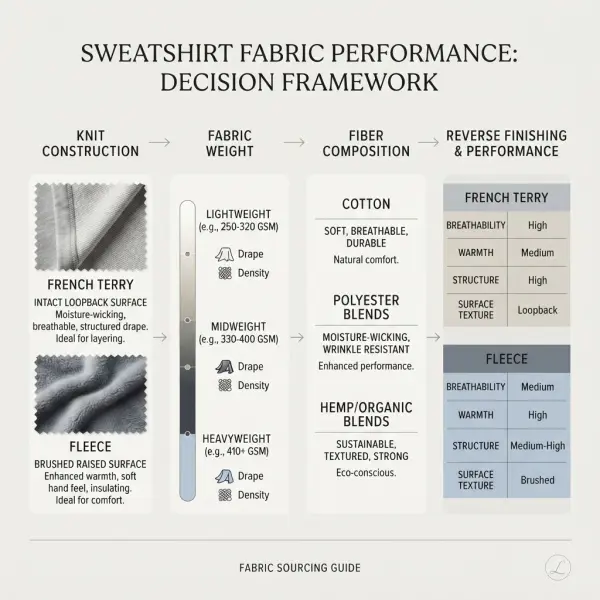
Both fabrics can produce excellent hoodies, but they create different product experiences. French terry is useful when a brand wants sweatshirt structure without a heavily plush interior, while brushed fleece is useful when softness and additional interior loft are central to the design.
A dense French terry hoodie can work particularly well for transitional collections, premium streetwear, resort evenings, travel clothing, or customers who prefer substantial garments without a strongly winterized feel. The loopback interior also makes the fabric visually distinct when exposed through design details.
Brushed fleece aligns naturally with cold-weather hoodies and comfort-led loungewear. A soft inner nap creates an immediate tactile signal when the customer tries the garment on, which can be commercially valuable in categories where “cozy” is part of the buying motivation.
Yet neither choice fixes the silhouette automatically. Fabric density, weight, recovery, rib quality, and pattern shape determine whether a hoodie feels structured, fluid, oversized, compact, or bulky. Product development should therefore begin with the desired garment result and work backward toward the material specification.
Readers who need the broader construction context can first review Fleece and Terry Fabrics Explained for Casual Apparel, which covers the wider textile family rather than this direct comparison.
French Terry vs Fleece for Joggers and Sweatpants
The same trade-off appears in bottoms, but recovery and surface wear become even more important. Joggers repeatedly flex at the knees, hips, seat, and waistband, so the selected material must provide an appropriate combination of stretch, recovery, dimensional stability, and abrasion resistance.
French terry can create joggers with a cleaner internal surface and moderate bulk. This can work well for travel sets, casual sportswear, warmer-season bottoms, and products intended to move between indoor and outdoor settings. A substantial loopback fabric can still feel heavy and premium without relying on brushing.
Brushed fleece shifts the product toward softness and cold-weather comfort. It may be appropriate for winter sweatpants, loungewear, campus clothing, or casual collections built around warmth. The trade-off is that the raised surface needs to maintain an acceptable appearance through friction and laundering, especially around areas that experience repeated movement.
Fit development should use the actual fabric whenever possible. Moving from French terry during sampling to a different fleece at bulk stage can change garment weight, stretch response, seam behavior, shrinkage, and the way the leg hangs. Even if the nominal GSM is similar, the final silhouette may not be.
What Changes During Manufacturing?
The fabrics can often be handled with similar knit-garment production systems, but their surfaces introduce different operational considerations. Brushed fleece generally creates more loose surface fiber during cutting and sewing, while bulky constructions may increase seam thickness. French terry exposes loop structures on the technical back, which need to be handled without excessive snagging or distortion.
Machine setup should therefore follow the actual fabric rather than a generic fabric-category recipe. Needle selection, presser-foot pressure, differential feed, seam type, thread, cutting method, and pressing conditions may all need adjustment depending on fabric thickness, stretch, fiber blend, and finish.
Garment washing adds another variable. Knitted fabrics can change dimensions after laundering, and that change needs to be understood before final garment measurements are approved. AATCC TM135-2025 is designed to determine length and width changes in fabrics subjected to standardized home laundering procedures. AATCC TM135 dimensional change testing
Brands should also examine how the reverse surface looks after the intended wash cycle. A fleece that initially feels exceptionally soft may compact, fuzz, or pill differently from an unbrushed terry. Conversely, loopback material may experience shrinkage or distortion that changes fit even if its surface remains visually clean.
What Changes for Decoration and Branding?
Both French terry and sweatshirt fleece often provide relatively smooth outer faces suitable for decoration, which is one reason they are so common in branded casualwear. Screen printing, embroidery, transfers, patches, appliqué, and other techniques can all be viable, but performance depends on the specific face construction and fiber blend.
The reverse finish can nevertheless affect production. Dense embroidery through heavyweight fleece, for example, may require different stabilization from a lighter French terry. Heavy seams and plush inner surfaces can also influence how garments sit on hoops or fixtures.
Garment dyeing and wash treatments deserve separate testing. Cotton-rich fabrics may respond differently from polyester-rich blends, and the combination of surface finishing, dye chemistry, temperature, mechanical action, and subsequent drying can change both appearance and dimensions.
For a brand developing matching sets, the most important discipline is consistency. Hoodie, jogger, and short fabrics that appear to belong to the same family should be checked for shade, face texture, shrinkage, and handfeel if they are sourced from different constructions or lots.
Which Fabric Is Better for Warmer Climates?
French terry is often the more practical starting point when a brand wants a sweatshirt-style fabric for moderate or warmer conditions because the unbrushed reverse generally provides less loft than conventional fleece. That makes loopback constructions useful for lighter hoodies, shorts, relaxed sweatshirts, and travel clothing.
The decision still depends on weight. A very heavy French terry may be uncomfortable in a hot humid environment, while a light brushed fleece could be acceptable in cooler indoor conditions or during specific seasons. Climate suitability should therefore be assessed at the finished-garment level, not only from the fabric family.
This distinction is commercially important for international brands. A hoodie program designed around winter conditions in Northern Europe may require a different fabric strategy from one marketed year-round in Southeast Asia. Using the same silhouette with different fabric constructions can sometimes extend a collection across climates without changing the brand's core visual language.
That broader consumer logic—the reason soft knit garments remain relevant beyond traditional winter sweatwear—is explored in Why Soft Knit Fabrics Remain Popular in Everyday Clothing.
Which Fabric Is More Durable?
Neither French terry nor fleece is inherently more durable in every situation. Durability can refer to several different things: resistance to holes, seam strength, dimensional stability, recovery, abrasion resistance, surface appearance, pilling, or the ability to retain acceptable handfeel after repeated laundering.
French terry's unbrushed reverse leaves fewer deliberately raised fibers at that surface, but this does not make every French terry resistant to pilling or wear. Yarn quality, fiber length, twist, knit construction, finishing, friction, and laundering still affect appearance.
Fleece introduces a raised surface specifically through napping, so surface maintenance becomes a particularly visible quality question. ISO's pilling standards include dedicated evaluation of fuzzing and matting because these changes can affect the appearance of textile surfaces even when the underlying fabric remains structurally intact.
The more useful sourcing question is therefore not “Which fabric lasts longer?” but “Which candidate fabric meets our durability requirement after the number and type of test cycles relevant to this product?” That converts a vague material comparison into a measurable quality decision.
How Fashion Businesses Should Choose Between French Terry and Fleece
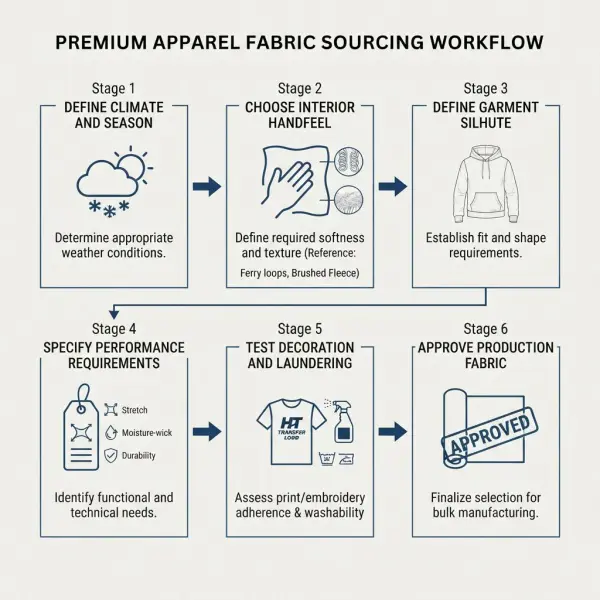
A brand should select between French terry and brushed fleece by starting with the product brief, then translating that brief into material requirements. The most common sourcing mistake is reversing this process—finding an attractive fabric first and then trying to make the product concept fit around it.
A useful decision sequence is:
- Define the climate and season. Decide whether the garment needs moderate comfort, transitional versatility, or stronger cold-weather positioning.
- Set the desired interior experience. Choose between visible loopback texture and a softer brushed nap.
- Define the silhouette. Establish whether the garment should drape, stand away from the body, feel dense, or remain relatively lightweight.
- Specify performance requirements. Include dimensional stability, stretch and recovery, pilling, colorfastness, and other relevant tests.
- Evaluate decoration and finishing. Check compatibility with prints, embroidery, garment washes, dye processes, or other treatments.
- Approve a physical standard. Retain an approved fabric or garment sample against which bulk production can be assessed.
This framework prevents an aesthetic preference—such as “we want soft fleece”—from becoming an incomplete sourcing specification. The result should be a defined fabric that delivers a repeatable garment experience rather than a collection of subjective adjectives.
Common Mistakes When Comparing French Terry and Fleece
Mistake 1: Assuming They Are Completely Different Fabric Families
French terry and sweatshirt fleece can be structurally very closely related. CottonWorks specifically explains that the knit structure of a two-end fleece can remain the same while napping the back differentiates fleece from un-napped French terry. Treating the materials as unrelated can make supplier communication unnecessarily confusing and can hide the importance of finishing.
The better approach is to ask how the fabric is constructed and finished. If the supplier calls something “fleece,” determine whether it is an unbrushed loopback, brushed sweatshirt fleece, polyester pile fleece, or another construction before comparing quotations.
Mistake 2: Assuming Every Fabric Called Fleece Is Brushed French Terry
The opposite simplification is equally problematic. Fleece covers more than sweatshirt fleece. Synthetic polar fleece uses a different material system and pile construction, and technical fleece products can be engineered around specific warmth, drying, breathability, stretch, or wind-resistance requirements. Polartec's synthetic fleece portfolio alone includes multiple structures and weight categories.
This is why a tech pack should not simply state “fleece fabric.” The construction and intended material category need to be clear enough that two suppliers interpret the specification in the same way.
Mistake 3: Treating Brushing as Only a Softness Treatment
Brushing changes more than handfeel. It modifies the surface geometry of the technical back by raising fibers, creating additional loft and changing how the fabric interacts with air, friction, skin, and laundering. The resulting fleece may feel softer and warmer, but its surface appearance also needs to be evaluated through wear and washing.
Brands that approve fleece entirely from a fresh hand sample can miss this operational consequence. A stronger approval process evaluates initial softness alongside appearance retention and the behavior of the finished garment after representative care cycles.
Mistake 4: Comparing Fabrics With Different GSM and Then Attributing Everything to Brushing
A lightweight French terry and heavyweight brushed fleece may differ dramatically, but the difference cannot all be credited to the nap. Fabric mass, density, yarn system, composition, and finishing are changing simultaneously.
When possible, product developers should compare materials with reasonably similar underlying specifications to understand what the reverse treatment actually contributes. Otherwise, the comparison may produce the right purchasing decision for the wrong technical reason, making future fabric substitutions harder to control.
Mistake 5: Selecting the Fabric Before Defining the Customer Use Case
A highly plush fleece can feel impressive during development but become uncomfortable in a product intended for warm-weather commuting. A lightweight French terry may look refined but fail to deliver the cozy winter experience promised by a cold-season campaign.
Material selection should therefore follow the usage scenario. Season, climate, layering, activity level, care expectations, price positioning, and intended garment lifespan provide a stronger basis for sourcing than tactile preference alone.
What Brands Should Verify Before Making a Final Decision
French terry and fleece should be compared as actual production fabrics, not abstract categories. A responsible sourcing decision requires enough information to separate differences caused by brushing from differences caused by composition, weight, structure, or finishing.
Before bulk approval, verify:
- fiber composition and allowed tolerance;
- knit construction and number of yarn systems where relevant;
- finished GSM and tolerance;
- usable fabric width;
- technical face and reverse specification;
- whether the reverse is un-napped, brushed, napped, sheared, or otherwise finished;
- stretch and recovery relevant to the pattern;
- dimensional change after the intended laundering procedure;
- skew or spirality where relevant to the construction;
- pilling, fuzzing, and matting expectations;
- colorfastness appropriate to the product;
- shade and handfeel consistency;
- compatibility with printing, embroidery, garment washing, or other finishing;
- finished-garment appearance after representative laundering.
Not every basic sweatshirt program requires the same laboratory package as a performance garment. The principle is proportionality: verify the characteristics whose failure would materially affect fit, appearance, comfort, customer expectation, or production consistency.
FAQ: French Terry vs Fleece
Is French Terry the Same as Fleece?
French terry and conventional sweatshirt fleece can share closely related knit structures, but they are not the same finished fabric. CottonWorks explains that industry French terry is essentially an un-napped fleece construction: the back floats remain visible instead of being brushed into a raised pile. In typical sweatshirt fleece, those back yarns are napped to create a fuzzy surface. The terminology can vary between suppliers, so buyers should still inspect the technical back and obtain a complete specification before ordering.
Is French Terry Just Unbrushed Fleece?
In the specific context of common sweatshirt knits, describing French terry as an un-napped or unbrushed fleece construction can be technically useful, and CottonWorks uses essentially this explanation. However, the wording should not be generalized to every textile sold as fleece. Polar fleece and many performance fleece materials represent different constructions. For sourcing, it is safer to specify the exact knit, surface finish, composition, and fabric standard than to assume every supplier uses unbrushed fleece and French terry as perfect synonyms.
Which Is Warmer, French Terry or Fleece?
A brushed sweatshirt fleece is generally warmer-feeling than a comparable unbrushed French terry because the raised surface creates more loft and can retain additional still air near the body. That does not mean any fleece will be warmer than any French terry. Fabric weight, thickness, density, composition, pile, fit, layering, and environmental conditions also matter. A heavyweight French terry could therefore provide more insulation than a light fleece. For product development, warmth should be evaluated from the actual candidate fabrics rather than inferred from their names.
Which Is Better for Summer or Transitional Weather?
French terry is often more suitable for transitional or moderately warm conditions because its reverse remains unbrushed and generally has less loft than conventional sweatshirt fleece. Lightweight French terry is frequently used for sweatshirts, joggers, shorts, and layering garments for precisely this reason. Still, fabric weight and density matter: a very heavy loopback garment can be too warm for summer. Brands serving hot climates should test the complete garment under realistic use conditions rather than assuming all French terry is lightweight.
Which Is Better for Premium Hoodies?
Either can support a premium hoodie. A dense heavyweight French terry can create a substantial, structured garment with a clean loopback interior, while high-quality brushed fleece can provide a softer and more insulating luxury experience. Premium positioning comes from the complete execution—yarn quality, construction, fabric consistency, dyeing, finishing, pattern, rib, sewing, shrinkage control, and long-term appearance—not from the presence or absence of brushing alone. Brands should define the intended premium experience before choosing the material.
Does Fleece Pill More Than French Terry?
Brushed fleece deserves particular attention to pilling, fuzzing, and matting because napping deliberately raises fibers at the surface. However, it would be inaccurate to say that every fleece pills more than every French terry. Fiber characteristics, yarn structure, knit density, finishing, abrasion, and laundering all influence pilling behavior. ISO 12945-3 explicitly includes napped fabrics such as fleeces within its scope for evaluating resistance to pilling, fuzzing, and matting. Testing the actual fabric is more reliable than predicting performance from the fabric name.
Can a Brand Use French Terry and Fleece in the Same Collection?
Yes, and doing so can create a coherent seasonal system when the fabrics are deliberately coordinated. A brand might use unbrushed French terry for shorts and transitional sweatshirts while reserving brushed fleece for winter hoodies and sweatpants. The challenge is maintaining consistent color, face appearance, shrinkage behavior, trims, and branding across different constructions. If garments are sold as matching sets, product teams should approve them together because fabrics with the same nominal color or composition can still differ visibly after dyeing and laundering.
Conclusion
French terry and sweatshirt fleece are separated by a deceptively simple technical difference: French terry generally retains an un-napped loopback reverse, while fleece uses brushing or napping to turn the technical back into a raised, softer surface. CottonWorks' construction guidance makes clear that the underlying knit structures can be closely related even though the finished materials deliver noticeably different garment experiences.
That surface treatment influences loft, tactile softness, visual character, and typical seasonal positioning, but it does not work in isolation. Fabric weight, fiber composition, yarn selection, density, stretch, recovery, dyeing, finishing, and garment construction still determine whether a particular French terry or fleece is appropriate for a hoodie, jogger, sweatshirt, short, or lounge set.
For sourcing teams, this removes the need to ask which fabric is universally better. The more useful question is: which construction creates the product experience this garment is supposed to deliver?
A transitional hoodie may benefit from an unbrushed loopback interior. A winter lounge set may justify a fuller brushed fleece. A heavyweight streetwear sweatshirt may use French terry precisely because the brand wants density without plushness. And a performance outdoor fleece may belong to an entirely different technical category.
Once those distinctions are clear, French terry versus fleece stops being a vague material preference and becomes a controllable product-development decision.




Comments 0
Leave a CommentSend Comment
Anda harus Login terlebih dahulu untuk dapat memberikan komentar.