
Fashion Wholesale Business Explained for Growing Brands
Quick Answer
A fashion wholesale business is a business-to-business sales model where a fashion brand sells products in bulk to retailers, boutiques, online stores, department stores, concept stores, distributors, or other professional buyers, usually at a lower wholesale price so those partners can resell the products to end customers.
For growing brands, wholesale can expand market reach faster than opening every sales channel alone. A brand can enter new cities, customer communities, retail environments, and online marketplaces through partners that already have shoppers and selling infrastructure. But wholesale is not simply “selling many units at a discount.” It requires clear pricing, reliable production, buyer-ready product information, delivery discipline, payment terms, and a realistic understanding of retail margin.
The strongest wholesale brands are usually not only the most creative. They are the ones buyers can trust: the collection is clear, the product data is accurate, the line sheet is easy to use, delivery windows are realistic, and reorder conversations are handled professionally.
What Is a Fashion Wholesale Business?
A fashion wholesale business is a B2B fashion sales model that allows brands, manufacturers, or distributors to sell apparel, accessories, footwear, or lifestyle products to retail partners in order to reach end customers through third-party sales channels.
In practical terms, wholesale sits between product creation and consumer-facing retail. A brand designs or produces the collection. A retail buyer selects the styles that fit their store or online audience. The buyer places an order at wholesale price. The retailer then sells those products to consumers at a retail price that covers operating costs, markdown risk, marketing, staff, logistics, and profit.
The basic flow looks simple:
Brand or manufacturer → Retail buyer → End customer
The business reality is less simple. Wholesale affects almost every part of a growing fashion brand: costing, production planning, inventory management, cash flow, product documentation, customer segmentation, and brand control. A small label that sells directly through Instagram or its own website may be able to manage orders manually. Once wholesale enters the picture, the brand needs a more structured system.
Wholesale is also broader than boutique selling. The United Nations statistical definition of wholesale trade covers resale to retailers, industrial, commercial, institutional, professional users, or other wholesalers; in fashion, that can include boutiques, department stores, online retailers, showrooms, distributors, franchise partners, uniform buyers, and specialty concept stores. UN wholesale trade classification context

Why Wholesale Matters for Growing Fashion Brands
Wholesale matters because it gives a fashion brand access to retail audiences, geographic reach, and order volume that may be difficult to build through direct-to-consumer channels alone.
A young brand may have a strong product but limited market access. Its website traffic may still be small. Its social media reach may fluctuate. Paid advertising may be expensive. A carefully chosen retail partner can introduce the brand to customers who already trust that store’s curation. This is especially useful for brands entering new cities, premium lifestyle communities, resort markets, niche fashion categories, or international retail environments.
Wholesale can also support production planning. When a buyer places a purchase order for multiple sizes and colors, the brand has clearer demand before production begins. This is different from producing inventory first and hoping individual customers buy later. For brands working with small factories or limited fabric runs, that visibility can be commercially useful.
But wholesale growth comes with trade-offs. A direct-to-consumer order may give the brand full retail margin, customer data, and control over storytelling. A wholesale order gives access and volume, but at a lower unit price and with less control over how the product is merchandised, discounted, or styled in-store.
For many growing brands, the strategic question is not “Should we do wholesale or DTC?” The better question is: which products, partners, markets, and seasons make sense for wholesale?
How Fashion Wholesale Works in Practice
Fashion wholesale usually begins before the collection reaches consumers. The brand prepares a collection, creates samples, builds a line sheet, sets wholesale prices, defines order terms, and presents the range to potential buyers. Buyers review the collection based on product fit, retail price, margin, delivery timing, customer demand, and how the styles sit within their existing assortment.
If the buyer is interested, they place a purchase order. The purchase order normally includes product names or SKU codes, quantities, sizes, colors, agreed prices, delivery date, shipping details, and payment terms. From there, the brand confirms production, allocates inventory, prepares invoices, manages packing, ships the order, and supports the buyer after delivery.
A simple wholesale cycle may include:
- Collection planning and costing
- Sample development
- Wholesale price and recommended retail price setup
- Line sheet and lookbook preparation
- Buyer outreach or showroom appointment
- Order negotiation and purchase order confirmation
- Production or inventory allocation
- Quality control, packing, and shipment
- Payment collection
- Sell-through review and reorder support
The last step is often overlooked. Wholesale does not end when the box leaves the warehouse. A buyer who sells through quickly may need replenishment. A buyer who struggles may need better product content, merchandising support, or a more suitable assortment next season.
Wholesale Price, Retail Price, and Margin: The Commercial Logic
Wholesale pricing works because the retailer needs enough margin to resell the product profitably. If the wholesale price is too close to the retail price, the buyer has little room to cover store rent, staff, logistics, marketing, returns, markdowns, payment fees, and profit.
For example, a brand may sell a dress to a boutique at $60. The boutique may sell it to consumers at $140. That difference is not simply “extra profit” for the retailer. It helps cover the cost of operating the retail business and the risk that some units may need to be discounted at the end of the season.
A growing fashion brand should calculate wholesale pricing before approaching buyers, not after. The product must work financially at both levels:
|
Pricing Element |
What It Means |
Why It Matters |
|
Product cost |
Fabric, trims, labor, packaging, quality control, overhead, and production-related costs |
Shows the real cost base before profit |
|
Wholesale price |
Price paid by the retailer or distributor |
Must protect brand margin while allowing buyer resale margin |
|
Recommended retail price |
Suggested consumer-facing price |
Helps maintain brand positioning and retail consistency |
|
Buyer margin |
Difference between wholesale cost and retail selling price |
Determines whether the product is commercially attractive to retailers |
|
Markdown room |
Space for seasonal discounting if needed |
Protects retailer risk without destroying brand value |
The exact margin structure varies by category, market, retailer type, and positioning. A luxury boutique, activewear retailer, children’s wear shop, or modest fashion distributor may each evaluate margin differently. What matters is that the brand understands the math before entering the conversation.
If a product only makes sense when sold at full direct-to-consumer margin, it may not be wholesale-ready yet. The brand may need to revise costing, simplify construction, adjust packaging, negotiate production cost, change the product mix, or reserve certain styles for direct sales.
Key Wholesale Terms Fashion Brands Should Understand
Wholesale has its own working language. A brand does not need to sound corporate, but it does need to use terms correctly. Buyers notice when a brand understands the commercial basics.
Wholesale Price
Wholesale price is the price a retailer, distributor, or other business buyer pays to purchase products from the brand. It is usually lower than the consumer-facing retail price because the buyer needs margin to resell the product.
Recommended Retail Price
Recommended retail price, sometimes called suggested retail price, is the consumer price a brand recommends to its retail partners. It helps maintain positioning across channels, although final pricing may depend on local taxes, import duties, currency, retail policy, and regional market conditions.
MOQ
MOQ means minimum order quantity. It defines the smallest quantity a buyer must purchase. In fashion, MOQ may apply per style, per color, per size set, per collection, or per total order value. MOQ protects production efficiency, but if it is too high for emerging buyers, it can block new partnerships.
Line Sheet
A line sheet is a concise wholesale sales document that helps buyers place orders. It usually includes product images, SKU codes, style names, colors, size range, fabric composition, wholesale price, recommended retail price, delivery window, order minimums, and contact details. Line sheets are commonly used in both printed and digital formats.
Lookbook
A lookbook presents the mood, styling, silhouette, and visual direction of the collection. It helps buyers understand the brand story. A line sheet helps buyers understand the order details. A strong wholesale presentation usually needs both, but they serve different purposes.
Purchase Order
A purchase order is a formal order document from the buyer. It confirms what the buyer wants to purchase and under what terms. Brands should review purchase orders carefully before confirming production or shipment.
Payment Terms
Payment terms define when the buyer pays. Some brands require full payment upfront, especially for new buyers. Others may use a deposit before production and balance before shipment. Net terms may be offered to trusted buyers, but they can create cash flow risk for small brands.

Wholesale vs Direct-to-Consumer: What Is the Difference?
Wholesale sells to business buyers who resell the product. Direct-to-consumer sells directly to the end customer through a brand’s own store, website, marketplace, social commerce, or pop-up.
The difference affects much more than sales channel. It changes margin, communication, fulfillment, inventory planning, customer data, and brand control.
|
Factor |
Wholesale |
Direct-to-Consumer |
|
Customer |
Retailer, boutique, distributor, online store, or professional buyer |
End consumer |
|
Price |
Lower wholesale price |
Full retail price |
|
Margin |
Lower per unit, often higher order volume |
Higher per unit, usually smaller order quantity |
|
Brand control |
Shared with retail partner |
Mostly controlled by brand |
|
Customer data |
Usually limited |
Direct access to customer behavior and feedback |
|
Operational focus |
Buyer terms, bulk orders, delivery windows, B2B documentation |
Consumer experience, marketing, returns, customer service |
|
Best use |
Market expansion, retail placement, volume planning |
Brand storytelling, margin capture, community building |
Neither model is automatically better. A premium fashion brand may use wholesale selectively to enter influential boutiques while using direct-to-consumer sales to build community and protect margin. A basic apparel brand may rely more heavily on wholesale if it has strong production capacity and price competitiveness. A designer label may reserve limited pieces for DTC and offer more commercially repeatable styles to buyers.
The healthiest model depends on product category, brand positioning, production capability, cash flow, and the type of customer the brand wants to reach.
Main Wholesale Channels in Fashion
Fashion wholesale can happen through several channels. The right channel depends on the brand’s maturity, price point, production capacity, and positioning.
Independent Boutiques
Independent boutiques are often a practical starting point for emerging brands. They may be more open to discovering new labels, especially when the product fits a specific customer lifestyle. Order quantities are usually smaller than department stores, but the relationship can be more personal and flexible.
A resortwear brand, for example, may work with selected boutiques in coastal cities before expanding nationally. A modest fashion label may begin with community-based retailers that understand local customer preferences. These partnerships can generate useful feedback before the brand scales.
Concept Stores
Concept stores buy based on curation, identity, and lifestyle fit. They may be interested in brands with a strong story, distinctive design language, or niche audience. For growing brands, concept stores can build credibility, but volume may be limited.
Department Stores
Department stores can provide visibility and larger order potential, but they usually require stronger operational readiness. Brands may need barcodes, packaging standards, strict delivery windows, vendor onboarding, insurance documentation, return policies, chargeback awareness, and more formal reporting.
This channel can be valuable, but it is rarely the easiest first step for a small brand.
Online Retailers
Online retailers need clean product data. The brand must provide images, product descriptions, size charts, fabric information, care instructions, and inventory details. If the product is difficult to understand online, sell-through may suffer even if the design is strong.
Sales Agents and Showrooms
A sales agent or showroom represents the brand to buyers, often in exchange for commission. This can help brands reach buyers they could not access alone. The trade-off is cost, dependency, and the need to manage expectations clearly.
Distributors
Distributors may buy products and resell them within a territory, or they may represent the brand through local retail networks. Distribution can help international expansion, but brands should be careful with exclusivity, sales targets, territory rights, pricing control, and payment responsibility.
Digital Wholesale Platforms
Digital wholesale platforms and online showrooms can help brands present collections, manage orders, and connect with buyers remotely. The shift toward digital wholesale has created useful discovery and ordering tools, but buyers still care about image quality, product details, fabric clarity, and the ability to assess fit and movement. Vogue Business has reported that digital wholesale brings both advantages and complications, including broader access, stronger digital tools, and the challenge of replacing tactile product review. digital wholesale buying tools and challenges

What Retail Buyers Look For Before Placing an Order
Retail buyers are not only looking for attractive products. They are looking for products that can sell within their specific retail environment.
A boutique buyer may ask whether the color palette fits their customer. A department store buyer may consider price architecture, delivery timing, category balance, and markdown risk. An online retailer may focus heavily on product imagery, size clarity, return risk, and search-friendly product data.
Most buyers evaluate a brand through several commercial questions:
- Does the product fit the store’s customer?
- Is the retail price believable for the quality and category?
- Is the margin healthy enough?
- Can the brand deliver on time?
- Is the product information complete?
- Is the size range clear and consistent?
- Does the brand have enough stock or production capacity?
- Can bestselling styles be reordered?
- Will the brand support the product with content, styling, or training?
This is why a wholesale-ready collection is not only a creative collection. It is a commercially legible collection. Buyers need to understand the role of each product: hero item, entry price item, core basic, seasonal statement, giftable accessory, replenishable style, or margin driver.
A beautiful collection with unclear prices, missing size details, vague delivery dates, or inconsistent product names creates friction. Buyers may still like the brand, but they may postpone the order because the risk feels too high.
How Wholesale Affects Product Development
Wholesale should influence product development early, not only after the collection is finished. If a brand wants to sell through retail partners, it needs products that buyers can explain, merchandise, and sell without the founder standing next to the rack.
This does not mean making everything basic. It means designing with commercial clarity. A collection can be creative and still have a clear price ladder, logical size range, suitable fabric choices, and repeatable production methods.
For example, a growing womenswear brand may separate its range into three levels:
- Commercial core styles that can be reordered
- Seasonal styles that create freshness and editorial interest
- Statement styles that communicate brand identity but may sell in smaller quantities
This kind of structure helps buyers build an assortment. It also helps the brand manage risk. If every piece is experimental, the buyer may love the lookbook but struggle to place a confident order. If every piece is too basic, the collection may lack distinction.
Wholesale also pressures brands to think about fit consistency. A boutique can forgive one complex style that runs small if the brand explains it clearly. But if sizing is unpredictable across the range, returns and customer dissatisfaction become the retailer’s problem. That damages trust.
How Wholesale Affects Production and Inventory
Wholesale turns production into a timing discipline. Retailers do not only want products; they want products within the right selling window.
A late summer delivery can miss the season. A holiday capsule that arrives after the retailer’s campaign launch may lose most of its commercial value. A collection that ships incomplete may create awkward merchandising gaps in-store.
For growing brands, this means wholesale planning should connect directly to production capacity, supplier reliability, material availability, quality control, and logistics. Fashion supply chains have faced repeated volatility from freight disruption, tariffs, climate risk, and changing compliance expectations, making visibility and planning more important for apparel businesses. fashion supply chain risks in 2026
A wholesale-ready brand should know:
- Which styles are made-to-order and which are stock-supported
- How long fabric purchasing takes
- How long cutting, sewing, finishing, and packing take
- Whether the factory can handle larger units without quality decline
- Which styles can be reordered
- Which materials may create lead-time risk
- Whether delivery promises include realistic buffers
Inventory also becomes more strategic. If the brand produces too little, it may miss reorder opportunities. If it produces too much, it may tie up cash in unsold stock. If it promises too much to wholesale buyers while also selling DTC, it may disappoint both channels.
How Fashion Brands Can Prepare for Wholesale
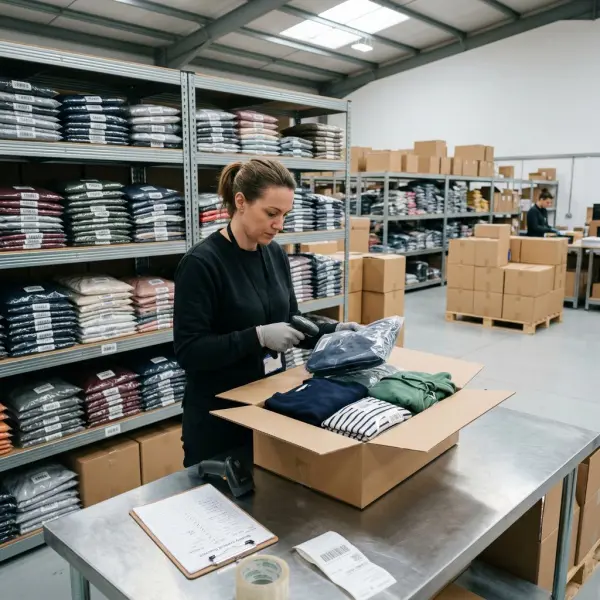
A fashion brand should prepare for wholesale by building the commercial and operational materials a buyer needs to evaluate, order, receive, and sell the collection.
The preparation should begin before outreach. Many brands contact buyers too early, then lose the opportunity because the buyer asks for a line sheet, delivery window, MOQ, or wholesale price and the brand is not ready.
Build a Buyer-Ready Product Range
A buyer-ready range has a clear assortment logic. It should show what the brand stands for, but it should also help the retailer decide what to buy. Each product should have a reason to exist in the line.
For example, a knitwear brand may include lightweight entry styles, higher-margin statement pieces, and replenishable core colors. A children’s wear brand may group items by age range, occasion, and fabric practicality. A handbag brand may organize by size, material, and price point.
Create a Clean Line Sheet
The line sheet should be practical, not decorative. Buyers need speed and clarity. Use consistent product names, accurate SKU codes, clear images, wholesale price, recommended retail price, size range, color options, MOQ, and delivery details.
A lookbook can sell the mood. The line sheet sells the order.
Define Order Rules
Order rules protect both sides. A brand should define minimum order value, minimum units per style, size pack requirements, delivery windows, payment schedule, shipping responsibility, return terms, and cancellation policy.
The rules should be firm enough to protect operations but realistic enough for the buyer type. A small boutique may not be able to meet the same minimum as a national retailer.
Prepare Product Content
Retailers need content to sell the product. This may include product descriptions, fabric composition, care instructions, size charts, model measurements, styling notes, product photos, and short brand story copy.
Online retailers especially need this material early. Weak product content can reduce conversion, increase customer questions, and raise return risk.
Plan Reorder Support
Wholesale growth often depends on reorders. If a buyer’s first order sells well but the brand cannot restock, the relationship may lose momentum. Brands do not need unlimited inventory, but they should know which styles are reorderable and which are seasonal one-time items.
Common Wholesale Mistakes Growing Brands Make
Wholesale mistakes often happen because a brand treats wholesale as a sales opportunity without preparing the operating system behind it.
The first common mistake is pricing too low. This usually happens when a brand calculates wholesale price by simply cutting the retail price in half without checking actual product cost, packaging, production overhead, sales commission, shipping support, and markdown pressure. The order may look exciting, but the margin may disappear.
The second mistake is accepting buyers that do not fit the brand. More doors are not always better. A premium brand placed in the wrong discount-heavy retail environment can damage positioning. A niche brand sold through a retailer with the wrong customer base may produce weak sell-through and poor reorder potential.
The third mistake is unclear delivery commitment. Buyers build seasonal calendars around delivery timing. If a brand gives optimistic dates to win the order and then ships late, the damage can last beyond one season.
The fourth mistake is treating all wholesale accounts the same. A boutique, marketplace retailer, showroom partner, and regional distributor may need different support. Some need staff training. Some need product data. Some need merchandising assets. Some need reliable replenishment.
The fifth mistake is scaling wholesale before production is stable. A brand that cannot maintain quality at higher volume should be careful. Wholesale can expose weak systems quickly because problems multiply across units, sizes, and retail locations.
This article introduces those risks only briefly. A deeper discussion belongs in common distribution mistakes that limit fashion brand growth, where distribution errors, channel conflict, retail mismatch, and operational gaps can be examined more fully.
What Brands Should Verify Before Starting Wholesale
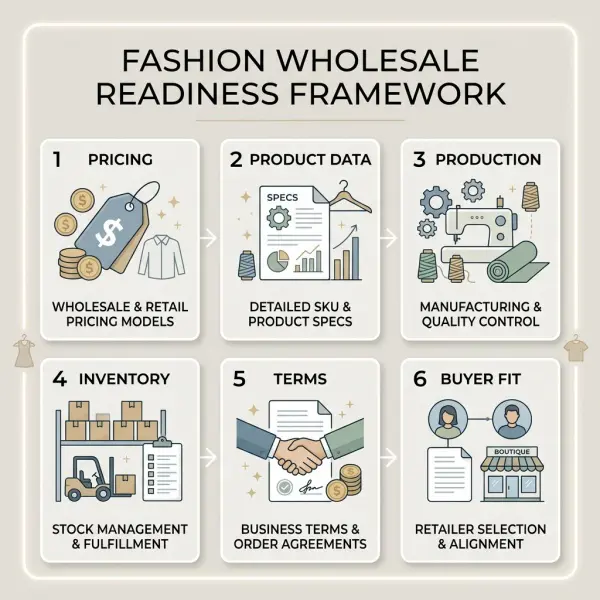
Before starting wholesale, a fashion brand should verify whether its pricing, production, product information, and buyer support system are ready for B2B sales.
This is the practical readiness check:
|
Area to Verify |
What to Check |
Risk If Ignored |
|
Costing |
True product cost, overhead, packaging, logistics, commission |
Wholesale orders may become unprofitable |
|
Pricing |
Wholesale price, retail price, margin, markdown room |
Buyers may reject the range or brand margin may collapse |
|
Production |
Capacity, lead time, supplier reliability, quality control |
Late delivery or inconsistent quality |
|
Product data |
SKU, size, color, material, care, images, descriptions |
Buyer confusion and operational delays |
|
Inventory |
Stock availability, reorder rules, allocation by channel |
Overselling or missed reorder opportunities |
|
Terms |
MOQ, payment, delivery, returns, cancellation |
Disputes and cash flow pressure |
|
Brand fit |
Retailer positioning, audience, location, pricing culture |
Weak sell-through or brand dilution |
The most important question is not whether the brand can get a wholesale order. It is whether the brand can fulfill the order profitably, professionally, and repeatedly.
How to Use Wholesale Strategically
Fashion brands can use wholesale strategically by selecting the right partners, protecting margin, learning from sell-through data, and balancing wholesale with direct-to-consumer channels.
A useful approach is selective wholesale. Instead of trying to enter as many stores as possible, a growing brand can begin with a focused group of retail partners that match the brand’s price point, customer lifestyle, and product category. That gives the brand cleaner feedback and reduces operational chaos.
A practical wholesale growth path may look like this:
- Prove product demand through DTC sales, pop-ups, small retail tests, or community sales.
- Identify the styles with repeat demand and clear margin.
- Build wholesale-ready pricing and order terms.
- Create a line sheet and buyer presentation.
- Approach selected retailers with audience fit.
- Start with manageable order quantities.
- Track sell-through, returns, customer comments, and reorder requests.
- Improve the range and operations before expanding to larger accounts.
Wholesale is also a learning channel. A good buyer can tell a brand which sizes move, which colors feel difficult, which price points are sensitive, and which products attract customers but do not convert. That feedback should inform product development, not just sales reporting.
The relationship side of this process deserves its own article. For a deeper look at outreach, trust-building, buyer meetings, follow-up, and long-term account care, see how fashion brands build relationships with retail buyers.
Wholesale as a Distribution Strategy, Not Just a Sales Channel
Wholesale becomes more powerful when a brand treats it as distribution strategy. A sales channel answers “where can we sell?” A distribution strategy answers “which partners help us reach the right customers, in the right markets, with the right level of control and profitability?”
That distinction matters. A brand may receive interest from many retailers, but not every retailer helps the brand grow in the right direction. A store with heavy discounting may generate short-term volume but weaken premium positioning. A distributor may offer international access but ask for exclusivity that limits future options. An online retailer may provide visibility but require content, stock depth, and return support the brand cannot yet manage.
Wholesale decisions should be connected to brand architecture. Which products should appear in premium stores? Which can be sold through broader distribution? Which should remain exclusive to DTC? Which markets need local partners? Which buyers can support storytelling rather than only price comparison?
For fashion brands that also manage merchandising strategy, wholesale can connect naturally with fashion merchandising explained for retail businesses, especially when product selection, assortment planning, pricing architecture, and retail presentation need to work together.
FAQ: Fashion Wholesale Business for Growing Brands
Is fashion wholesale only for large brands?
No. Fashion wholesale can work for small and growing brands, but the brand must be operationally ready. A small brand can start with independent boutiques, concept stores, or limited wholesale drops rather than large department stores. The key is to keep order quantities realistic, protect margin, and avoid promising delivery timelines that production cannot support. Small brands often succeed in wholesale when they offer a clear product identity, consistent quality, and easy ordering information.
What is a good MOQ for a fashion wholesale order?
A good MOQ depends on product cost, production method, fabric minimums, buyer type, and operational capacity. A small accessories brand may accept a lower unit MOQ than a garment brand that needs full-size production runs. Instead of copying another brand’s MOQ, calculate the minimum order that keeps production efficient and profitable. For emerging buyers, a minimum order value can sometimes be more flexible than a strict per-style quantity.
Do fashion brands need a line sheet before contacting buyers?
Yes, a line sheet is strongly recommended before serious buyer outreach. Buyers need quick access to product images, SKU codes, colors, sizes, wholesale prices, retail prices, delivery windows, and order terms. Without this information, the buyer may like the brand but delay the decision. A line sheet also makes the brand look organized, which matters because buyers are evaluating reliability as much as design.
Should a growing brand sell wholesale and direct-to-consumer at the same time?
Many growing brands use both, but they should define the role of each channel. Direct-to-consumer sales can protect margin, build community, and provide customer data. Wholesale can expand reach and create retail credibility. Problems appear when pricing, inventory, or discounting is not coordinated. A brand should avoid undercutting retail partners with constant online discounts unless the terms are clearly managed.
What do retail buyers care about most?
Retail buyers care about product fit, margin, delivery reliability, customer demand, quality, size clarity, reorder potential, and brand presentation. A strong design is important, but it is not enough. Buyers need to believe that the product will sell in their specific retail environment. They also need confidence that the brand can communicate clearly, ship on time, and support the product after delivery.
Is digital wholesale replacing physical showrooms?
Digital wholesale is not fully replacing physical showrooms. It is becoming part of a hybrid buying process. Digital tools can make discovery, catalog review, and order management more efficient, especially across regions. But fashion buyers still value physical product review for fabric handfeel, fit, drape, construction, and color accuracy. Brands should prepare strong digital assets while recognizing that samples and tactile review still matter in many categories.
What is the biggest risk in fashion wholesale?
The biggest risk is accepting growth that the brand cannot support profitably. A large wholesale order can look attractive, but it may create cash flow pressure, production delays, quality issues, or weak margins if the brand is not prepared. Wholesale should be scaled carefully, with clear terms, realistic lead times, and strong costing discipline.
Conclusion
Fashion wholesale business can help growing brands move beyond limited direct sales and enter broader retail networks. It can open new markets, build credibility, support larger order volume, and create valuable relationships with buyers who understand local customers.
But wholesale rewards preparation. A brand needs more than a good collection. It needs pricing that works, production that can deliver, product data that buyers can use, terms that protect cash flow, and retail partners that fit the brand’s positioning.
The best wholesale strategy is not to appear everywhere. It is to appear in the right places, with the right products, under terms the business can sustain. For growing fashion brands, wholesale becomes valuable when it is treated not as a shortcut to scale, but as a disciplined distribution system.




Comments 0
Leave a CommentSend Comment
Anda harus Login terlebih dahulu untuk dapat memberikan komentar.