

How Service Quality Influences Reviews, Repeat Sales, and Trust
Quick Answer
Service quality can influence fashion reviews, repeat sales, and customer trust because service interactions give shoppers evidence about how reliably a brand behaves when they need information, encounter uncertainty, or experience a problem. Accurate sizing guidance, clear delivery communication, fair returns, consistent policies, and effective problem resolution can strengthen confidence in a brand. Poor service can have the opposite effect, particularly when a customer has already experienced a product or fulfillment problem.
The relationship is not automatic. A helpful support interaction cannot compensate indefinitely for poor garment quality, inaccurate product descriptions, unreliable delivery, or uncompetitive pricing. Likewise, a positive review or repeat purchase may reflect several factors beyond service, including fit, product satisfaction, availability, price, design, and brand preference.
Research nevertheless supports an important connection. Studies of online retail and fashion ecommerce have found associations between e-service quality, satisfaction, trust, word-of-mouth behavior, and repurchase intention, while broader customer-experience research similarly shows stronger loyalty intentions among consumers satisfied with service interactions.
For fashion businesses, the practical lesson is to treat service quality as part of reputation and retention infrastructure rather than simply a cost center.

What Does Service Quality Mean in Fashion?
Service quality in fashion is the customer's assessment of how effectively and reliably a brand provides assistance throughout the shopping and post-purchase journey. It can include responsiveness, accuracy, fairness, accessibility, product knowledge, communication, consistency, problem resolution, and the ease of completing processes such as exchanges or returns.
That definition goes beyond whether an employee was polite. A customer may describe an interaction as friendly while still considering the service poor if the representative provided incorrect sizing information, failed to resolve a refund, or repeatedly asked for information the company already had. Conversely, an efficient service interaction may be perceived positively even without elaborate personalization if the customer receives an accurate answer and the issue is resolved with little unnecessary effort.
Fashion makes these judgments particularly sensitive because service frequently interacts with uncertainty around fit, appearance, material behavior, product availability, and delivery timing. A shopper deciding between two sizes may rely on customer service before ordering. Another customer may only contact the company after receiving a garment that looks different from what they expected. The quality of each interaction can affect how the customer interprets the brand as a whole.
This is why fashion customer service for online and retail brands should be understood as an operational system rather than simply a messaging function. Reviews, trust, and repeat behavior often emerge from what customers experience across that larger system.
How Does Service Quality Influence Customer Trust?
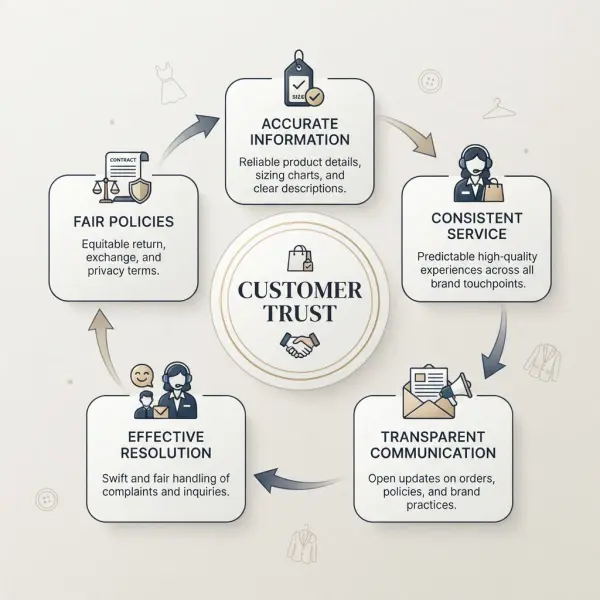
Service quality can build trust when it repeatedly demonstrates that a fashion brand is competent, predictable, transparent, and willing to handle problems fairly. Trust is not created by one friendly sentence; it develops when the customer's expectations and the brand's actual behavior remain sufficiently aligned over time.
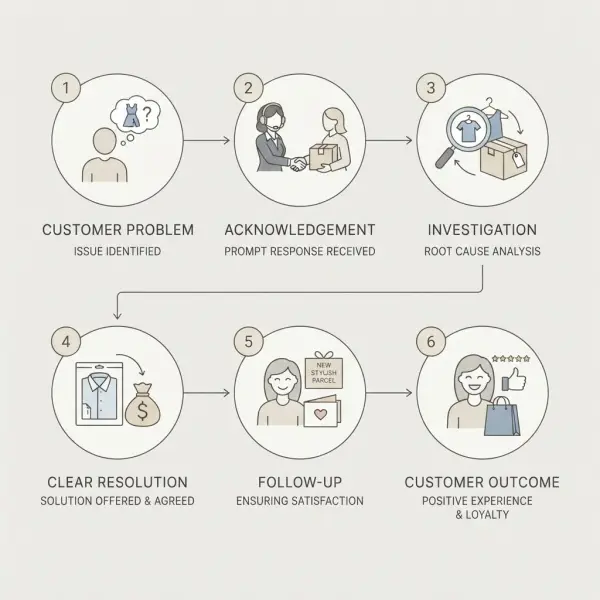
Consider an online customer who orders a coat and receives the wrong size. The mistake itself may weaken confidence, but what happens next provides new information. If the brand acknowledges the error, verifies stock quickly, arranges a replacement, explains the return procedure clearly, and follows through on the promised timeline, the customer sees evidence that the company can recover from a failure.
If the customer instead receives contradictory answers from different channels, waits repeatedly for updates, or discovers that the published returns policy is not being honored, the problem becomes larger than the incorrect item. The customer may begin questioning whether future orders will be safe or predictable.
This distinction matters because trust concerns future uncertainty. A customer cannot know in advance whether the next garment will fit perfectly or whether a courier will experience a delay. What the customer can evaluate is whether the brand appears capable of handling uncertainty responsibly.
Research outside fashion reinforces this mechanism. Qualtrics' 2025 contact-center research drew on more than 23,000 consumers globally and examined loyalty-related outcomes including trust, recommendation, and willingness to purchase more after service experiences. The report found a meaningful relationship between satisfaction with contact-center interactions and customer loyalty behaviors.
Trust grows through consistency, not occasional heroics
Brands sometimes focus on exceptional service recovery stories: the employee who personally rushes an item to a customer, grants an unusual refund, or solves an unusual problem. Those moments can be memorable, but they are difficult to scale.
For most fashion businesses, trust depends more heavily on boring consistency. Product information needs to be accurate. Store staff and online support should interpret policies similarly. Delivery promises should match operational capability. Refund timing should not change unpredictably from one customer to another without a legitimate reason.
Consistency lowers perceived risk because customers gradually learn what to expect. That matters particularly for repeat purchases where the shopper is deciding whether to place another order without reopening every uncertainty from the first transaction.
Why Trust Matters for Repeat Fashion Purchases
A repeat purchase involves another commitment of money, time, and expectation. Trust can reduce the perceived risk of making that commitment again.
The customer already has some evidence from the previous experience. They know whether the product arrived approximately when expected, whether the size information was useful, whether the package contained the correct item, and whether the brand responded appropriately if something went wrong. Those memories can make a second purchase feel easier—or make the customer reluctant to return.
Research on ecommerce supports the connection between service quality, trust, satisfaction, and repurchase intention. A study of 431 online marketplace customers in Indonesia found that e-service quality was associated with both customer satisfaction and trust, while satisfaction and trust were in turn associated with repurchase intention. The research should not be interpreted as proof that service alone causes repeat purchasing in every market, but it provides empirical support for the pathway.
A study specifically involving fashion ecommerce also examined 500 people who had previously shopped online for fashion brands. It found relationships between e-service quality and outcomes including electronic repurchase intention, reinforcing the relevance of service design within fashion online environments.
For fashion brands, the commercial implication is subtle but important. Customer service does not "create loyalty" in isolation. It helps remove reasons not to buy again.

Repeat Sales Depend on More Than Customer Service
Brands should resist turning every repeat-purchase problem into a service problem. A customer may receive excellent support and still never order again because the garment did not suit them, the price was too high, the next collection was unappealing, or a competitor offered a more relevant product.
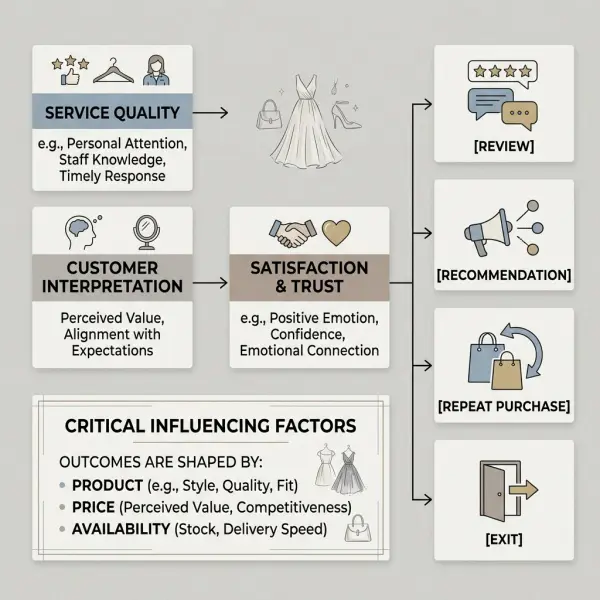
Repeat purchasing in fashion can be influenced by several interacting factors:
- Product satisfaction, including quality, fit, comfort, construction, and appearance.
- Availability of desirable styles, colors, and sizes when the customer wants to buy.
- Price and perceived value relative to alternatives.
- Delivery reliability and convenience.
- Returns and exchange experience.
- Brand identity and personal style alignment.
- Customer service before and after purchase.
- Promotions, loyalty incentives, or switching costs.
- Changes in the customer's own needs, income, lifestyle, or preferences.
Service quality should therefore be treated as one component of retention rather than a universal explanation for it.
This distinction protects managers from misreading metrics. If repeat purchase falls after a product range changes substantially, increasing customer-service staffing may do little. If customers abandon the brand after difficult exchanges despite liking the product, however, service operations deserve much closer investigation.
How Can Service Quality Influence Online Reviews?
Service quality can influence reviews because customer support often becomes part of the story customers tell about a transaction. A review that begins with the garment itself can quickly expand to include shipping communication, staff responsiveness, return handling, refund timing, or how a complaint was resolved.
This is especially relevant when something goes wrong. A defect, delivery delay, or sizing disappointment gives the brand an opportunity to alter the final experience. The original problem cannot always be erased, but the customer's judgment may differ depending on whether the business was responsive, dismissive, transparent, or difficult to deal with.
The relationship is not symmetrical or predictable. Not every satisfied customer leaves a positive review, and not every dissatisfied customer writes a negative one. Review behavior is self-selected, which means public reviews should never be treated as a statistically complete representation of the entire customer base.
Still, review environments matter commercially because prospective shoppers use them as indirect evidence about a brand they have not yet experienced.
BrightLocal's 2026 review survey illustrates this broader behavior, although its findings are based on 1,002 U.S. adults evaluating local businesses rather than fashion ecommerce specifically. It found that consumers paid attention not only to the reviews themselves but also to whether and how businesses responded. Because the study population and business context differ from global fashion retail, its findings are best used as directional evidence rather than a fashion benchmark.
Reviews document both product quality and service recovery
A fashion review might say:
"The jeans were smaller than expected, but support sent me the measurements for the next size and the exchange was easy."
Another customer experiencing the same sizing problem could write:
"Wrong fit, difficult exchange, and nobody answered for four days."
The product issue is similar. The final interpretation is not.
This does not mean brands should deliberately rely on service recovery to generate positive sentiment. Preventing avoidable sizing confusion is preferable to handling hundreds of exchanges well. The point is that service can shape how customers interpret the inevitable imperfections of real retail operations.
Negative Reviews Are Often About the Resolution, Not Only the Original Problem
Many customer problems begin outside customer service. A warehouse picks the wrong color. A parcel arrives damaged. Inventory data allows an unavailable item to be sold. A garment fails inspection after purchase. A refund is delayed by a payment process.
The service team becomes the point where the customer discovers whether the organization can take responsibility for the situation.
This creates an important distinction between failure severity and recovery quality. A small problem handled badly can become disproportionately frustrating. A more significant problem handled clearly and fairly may remain inconvenient but become less damaging to the relationship.
After-delivery research in online retail has found that exchange, returns, and refund experiences are related to customer satisfaction, trust, and repurchase intention. This is especially relevant to fashion, where reverse logistics is a routine part of ecommerce rather than an exceptional process.
Brands should nevertheless avoid simplistic versions of the "service recovery paradox," the idea that customers can become more loyal after a well-resolved problem than if nothing had gone wrong. That effect is not something managers should assume will occur consistently. Preventing avoidable failures remains the safer strategy.
How Service Quality Shapes Word of Mouth Beyond Formal Reviews
Reviews are only one form of customer communication. People also discuss fashion purchases privately with friends, family, colleagues, community groups, and social media audiences. These conversations can be especially influential because they are embedded in existing social relationships.
A shopper may never publish a review yet still tell several friends not to buy from a particular retailer after an unresolved refund. Another might recommend a brand because staff gave unusually useful sizing guidance. Those effects are difficult for a company to observe because much of the conversation happens outside measurable brand channels.
Academic evidence again suggests that trust and satisfaction can connect service experience with word-of-mouth behavior. The Indonesian online marketplace study cited earlier found that trust was associated with word-of-mouth outcomes as well as repurchase intention.
For fashion brands, this matters because word of mouth often contains detail that advertising does not. People tell one another whether a dress runs small, whether returns are difficult, whether the product looked like the photos, or whether the company actually honored a refund. Service experience therefore becomes part of the informal product knowledge circulating around the brand.
Reviews Also Influence Customers Who Never Contacted Service
The reputational effect of customer service extends beyond the person who originally needed help. Public complaints and brand responses can become evidence for prospective customers.
Someone researching an unfamiliar fashion store may intentionally look for negative reviews rather than only positive ones. The shopper is often asking a practical question: What happens if my order goes wrong?
A thoughtful public response can help answer that question, but it should not become reputation theater. Customers can recognize responses that repeatedly apologize without addressing the issue. Generic templates can also make a brand appear detached from the specific complaint.
BrightLocal's 2026 U.S. local-business survey found that 80% of respondents said they were likely to use businesses that responded to all reviews, while 42% were unlikely to use a business that ignored reviews entirely. Half reported being discouraged by generic or templated replies. These figures should not be transferred directly to global fashion ecommerce, but they demonstrate why visible review management can affect third-party perceptions of responsiveness.
The strategic objective should therefore be to make the response credible to two audiences simultaneously: the customer who experienced the problem and future shoppers reading the exchange.
Trust Is Built Faster Through Evidence Than Through Brand Claims
Fashion marketing frequently uses words such as trustworthy, customer-first, premium service, or hassle-free. Those claims have limited value when customers cannot see corresponding evidence.
Trust is more likely to emerge from observable behavior:
- The size chart matches actual garment measurements within the brand's stated tolerances.
- Delivery expectations are communicated realistically.
- A customer can understand the return conditions before purchasing.
- A refund promised within a defined process is actually processed accordingly.
- Store and ecommerce teams provide compatible information.
- Problems are documented so customers do not need to explain them repeatedly.
- Product limitations are acknowledged rather than hidden behind marketing language.
These details may appear operational rather than emotional. That is precisely why they matter.
A customer's trust in a fashion business often rests on the belief that the company will do what it says it will do.
Service Quality Can Matter More at High-Uncertainty Moments
Not every customer interaction carries equal reputational weight. A routine request for store opening hours is unlikely to influence loyalty as strongly as a dispute involving an expensive order that has not arrived.
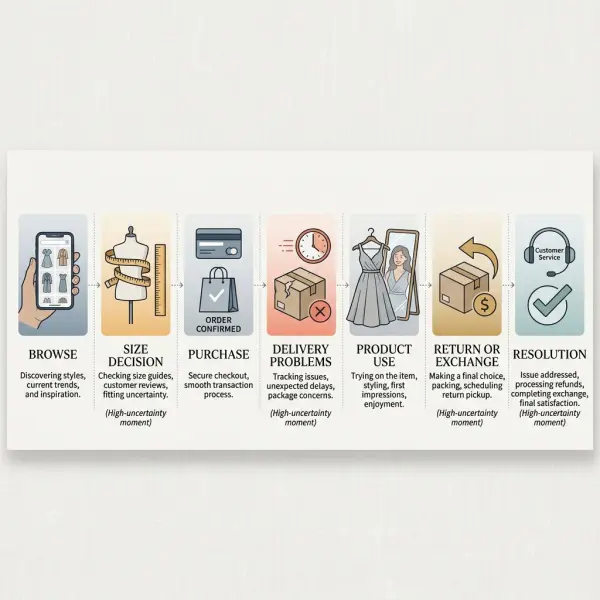
Fashion brands should therefore identify high-uncertainty moments where customers are particularly dependent on the company's information or judgment.
These commonly include sizing before purchase, payment problems, order cancellation, expensive or occasion-specific purchases, delayed deliveries, lost parcels, damaged garments, rejected returns, suspected defects, and refund delays.
Customers entering these situations face a higher perceived risk of losing money, time, or an important product. Service quality becomes more consequential because the interaction provides evidence about whether the company can be trusted under pressure.
This is why a single company-wide response-time average can hide important performance differences. Answering dozens of easy product questions quickly does not compensate for unresolved high-value return disputes.
What Happens When Service Quality Is Inconsistent?
Inconsistent service creates a different problem from consistently slow or restrictive service: customers cannot predict the rules.
Suppose one shopper receives a free exchange for a sizing issue while another with an apparently similar case is told to pay return shipping. There may be a legitimate reason, such as different countries, product conditions, promotions, or purchase channels. If that reason is not visible, the difference can feel arbitrary.
Inconsistency also emerges when social media agents promise exceptions that the returns team will not honor, or when store staff interpret an online promotion differently from the ecommerce team. Customers experience the contradiction as one brand failing to coordinate itself.
Trust is particularly vulnerable to this type of friction because predictability is part of what trust provides. Customers do not necessarily expect every request to be approved. They do expect policies and decisions to make sense.
For a growing fashion company, process documentation and staff decision boundaries may therefore improve trust more than increasingly elaborate customer-service scripts.
Does Fast Customer Service Increase Repeat Sales?
Fast service can support repeat purchasing when speed reduces meaningful customer effort or uncertainty. It is especially valuable for time-sensitive situations such as address corrections, order cancellations, delivery problems, store stock checks, or questions affecting an immediate purchase decision.
Speed alone is not enough. An instant response that does not solve the problem can produce multiple contacts and greater frustration. Qualtrics' global contact-center research notes that fewer than two-thirds of issues in its study were resolved on the first call, while waiting time was among the areas consumers were least satisfied with. The broader implication is that businesses should examine speed together with resolution.
A fashion retailer should therefore resist optimizing first-response time in isolation. A better service dashboard may separate urgent from non-urgent cases and examine whether customers are forced to return repeatedly for the same issue.
For example, a size-chart question answered accurately in four hours may create a better outcome than a response delivered in four minutes that simply copies information the customer already saw on the product page.
Can Good Customer Service Save a Bad Product Experience?
Sometimes, but not reliably.
Service can correct an order, facilitate a return, explain a misunderstanding, or provide an appropriate remedy. It cannot make a poorly constructed garment durable, make misleading photography accurate after the fact, or turn persistent fit inconsistencies into a sustainable customer proposition.
This distinction is essential for managers reviewing negative feedback. If complaints about the same seam failure repeatedly appear across products from one production run, treating each case as an isolated customer-service ticket misses the larger problem. Quality control or production investigation is required.
Likewise, repeated customer confusion about the same garment measurement may indicate a merchandising or product-information failure. Customer service can resolve individual cases, but the business should remove the source of confusion.
The third article in this cluster examines these structural problems more deeply: common customer service gaps that hurt fashion businesses.
How Should Fashion Brands Measure the Business Effect of Service Quality?
The easiest mistake is to assume that a high customer satisfaction score automatically means service is generating repeat sales. Satisfaction is useful, but businesses need behavioral evidence as well.
A stronger measurement system connects service data with subsequent customer behavior where privacy rules, consent, and system architecture allow it.
|
Measurement |
What It Helps Answer |
Important Limitation |
|
Customer satisfaction after service |
Did customers perceive the interaction positively? |
Survey responders may differ from non-responders |
|
First-contact resolution |
Was the issue solved without repeated contact? |
Definition of "resolved" must be consistent |
|
Recontact rate |
Are customers returning with the same problem? |
Some complex cases legitimately require several interactions |
|
Review sentiment |
What themes appear in public customer feedback? |
Reviews are self-selected |
|
Complaint category |
Which failures generate service demand? |
Classification quality determines usefulness |
|
Repeat purchase rate |
Do customers buy again? |
Cannot attribute behavior to service alone |
|
Time to next purchase |
Does purchasing resume after an interaction? |
Product cycle and seasonality may affect timing |
|
Return rate |
Are customers sending products back? |
Low returns are not always evidence of high satisfaction |
|
Customer lifetime value |
What is the longer-term commercial relationship? |
Many non-service factors influence the result |
PwC's 2025 U.S. Customer Experience Survey illustrates why behavioral measures matter. Among 5,511 consumers surveyed, 29% reported that they had stopped using or buying from a brand because of poor online or in-person customer experience, while 52% reported stopping because of a bad product or service experience more broadly. These are cross-industry U.S. findings rather than fashion-specific causal estimates, but they demonstrate that experience failures can coincide with real customer exit rather than merely lower satisfaction scores.
Fashion businesses should therefore connect customer-service indicators to actual retention patterns instead of assuming that sentiment and commercial behavior are interchangeable.
A Practical Framework: Service Quality → Confidence → Behavior
A useful way to understand the relationship is as a chain rather than a single direct effect.
Service experience → interpretation → confidence or dissatisfaction → customer behavior
Suppose a shopper asks whether a linen-blend dress is lined. The agent provides an accurate answer before purchase. The customer receives what they expected, reducing one source of uncertainty. That does not guarantee a repeat purchase, but the service interaction supports confidence in the brand's product information.
Now consider a more difficult case. A customer receives damaged trousers. The brand replies quickly but requires the customer to send the same photographs three times because internal teams do not share case information. A refund eventually arrives. Operationally, the company "solved" the problem. Experientially, the customer may conclude that the company is difficult to deal with.
The difference demonstrates why service metrics and customer interpretation are not always identical.
How Can Fashion Brands Improve Service Without Manipulating Reviews?
Improving review performance should begin with improving the underlying customer experience, not engineering positive feedback.
Brands can legitimately make it easy for customers to share honest feedback after a transaction. They should avoid practices that selectively suppress negative experiences, fabricate reviews, or condition incentives on positive sentiment. Rules vary by jurisdiction and platform, so review-request programs should be checked against applicable consumer-protection law and platform policies.
The United States, for example, has strengthened rules addressing fake and deceptive reviews. The precise legal framework differs internationally, making country-specific compliance important for global brands.
Operationally, the better approach is straightforward: ask broadly, respond respectfully, investigate repeated themes, and correct underlying problems where evidence supports doing so.
A review program built around authentic experiences is slower to manipulate but more useful to the business. Negative feedback can reveal sizing information that needs improvement, shipping promises that are unrealistic, unclear final-sale policies, or products that require quality investigation.
What Should Brands Do With Negative Reviews?
The first step is to determine whether the review describes a genuine unresolved issue, a misunderstanding, an opinion about the product, or information that cannot be verified from the public post alone.
Public replies should avoid disclosing order details or personal information. They should acknowledge the concern, clarify factual information where appropriate, and provide a reasonable path for resolution. If the company made an error, evasive language can make the response appear defensive.
Not every negative review should be argued with. Fashion is subjective, and a customer can legitimately dislike a garment even when the product matches its specification. A statement such as "the fabric felt too heavy for me" does not necessarily indicate that the garment is defective or the customer is wrong.
The more valuable management question is whether similar feedback appears repeatedly. One complaint may represent individual preference. Fifty similar comments about a zipper failure, unexpected transparency, or misleading measurements warrant a different level of attention.
When Service Recovery Can Protect Trust
Service recovery is most useful when it addresses the customer's actual loss or uncertainty.
If a parcel is delayed, a generic apology without tracking information may have little value. If the wrong product was shipped, a discount on the customer's next purchase does not necessarily solve the immediate need. If a formalwear order arrives damaged days before an event, ordinary replacement timelines may be operationally inadequate.
The resolution should therefore match the failure as closely as practical.
This does not mean customers should receive every remedy they request. Fraud controls, return conditions, operational constraints, and legal requirements still matter. Fair service is not the same as unlimited concessions.
Trust is more likely to survive when customers can understand what the business has decided, why it made that decision, and what will happen next.
Common Mistakes When Connecting Service Quality With Loyalty
Assuming every satisfied customer is loyal
Satisfaction describes an evaluation of an experience. Loyalty involves future preference or behavior. A customer can be satisfied with a transaction and still switch because another brand offers a preferred design, lower price, faster shipping, or better availability. Fashion businesses should therefore avoid treating customer satisfaction as a direct substitute for retention data.
Blaming customer service for every negative review
A negative review may originate in design, manufacturing, quality control, fulfillment, marketing, sizing, or product expectations. Service can influence the final experience, but it does not own every underlying failure. Root-cause analysis should separate the complaint source from the quality of the response.
Rewarding speed while ignoring resolution
Agents who are measured primarily on rapid handling may close cases too early, transfer difficult customers, or rely heavily on generic templates. A service operation should balance efficiency with accuracy, customer effort, and resolution quality.
Trying to remove every negative review
A completely positive review profile is not necessarily more credible, and legitimate criticism can contain valuable information. Brands should focus on inaccurate, fraudulent, or policy-violating content through appropriate platform procedures while responding constructively to genuine customer experiences.
Using discounts as the primary recovery strategy
Compensation can be appropriate, but repeated discounts may hide unresolved operational problems. A customer waiting for a refund generally needs the refund process fixed more than another promotional code. The remedy should address the problem rather than merely encourage another transaction.
What Brands Should Verify Before Acting on Customer Feedback
Reviews and service data are valuable, but both can be misinterpreted when examined without context.
A rise in complaints does not necessarily mean service quality has deteriorated if order volume has grown even faster. A decline in returns may look positive but could reflect a restrictive returns policy that discourages customers from shopping again. High satisfaction scores may come from a small survey response rate. A vocal social media complaint may be important without representing the majority of customers.
Brands should therefore compare service indicators with relevant denominators and operational data. Complaint counts are more meaningful relative to orders or units sold. Product-level return reasons become more useful when compared with product volume. Review trends should be examined alongside product changes, shipping performance, campaign activity, and customer-service staffing.
The objective is not to reduce every customer signal to a dashboard. It is to avoid confusing visibility with representativeness.
FAQ: Service Quality, Reviews, Repeat Sales, and Trust
Does better customer service always increase repeat purchases?
No. Better service can reduce friction and strengthen confidence, but repeat purchasing also depends on product quality, fit, style relevance, price, availability, delivery, and the customer's changing needs. Research supports relationships between service quality, satisfaction, trust, and repurchase intention, but brands should not interpret these relationships as proof that service alone determines loyalty. The most useful approach is to measure repeat behavior alongside service interactions and investigate where service appears to influence the customer's decision to stay or leave.
Can a negative customer experience permanently damage trust?
It can, but the outcome depends on the seriousness of the failure, the customer's prior relationship with the brand, and how the problem is handled. A minor error corrected quickly may have little long-term effect. Repeated failures, misleading communication, unresolved financial issues, or inconsistent policies can be more damaging because they suggest future interactions may also be unreliable. Brands should prioritize preventing recurring failures rather than assuming every damaged relationship can be restored through service recovery.
Do customers trust brands more when they respond to reviews?
Review responses can provide evidence that a company listens and engages with customer feedback, but the effect depends on the quality and credibility of the response. Broader consumer research indicates that many shoppers pay attention to business responses, while generic replies can be perceived negatively. Those findings vary by market and platform. A fashion brand should therefore respond to genuine concerns constructively rather than treating review responses as a formula for manufacturing trust.
Are reviews a reliable measure of customer satisfaction?
Reviews are useful but incomplete. People who choose to post reviews may differ from the wider customer population, and different platforms attract different users. Review volume can also be affected by whether a company actively requests feedback. Brands should analyze review themes alongside customer satisfaction surveys, returns, complaint rates, repeat purchases, product data, and direct feedback. Reviews are strongest as qualitative evidence of recurring experiences rather than as a complete census of customer opinion.
What matters more for loyalty: product quality or service quality?
There is no universal answer because the two interact. A customer may leave despite excellent service if products repeatedly fail expectations, while strong products can also lose customers when delivery, returns, or complaints are difficult. For fashion businesses, product quality usually forms part of the fundamental value proposition, while service quality affects how easily customers can evaluate, purchase, receive, and resolve issues around that product. Management should therefore avoid treating them as competing priorities.
Can good service turn an unhappy customer into a loyal customer?
It can improve the probability of retaining some customers, but loyalty should never be assumed. Effective recovery can restore confidence when the company acknowledges the issue and provides an appropriate solution. Some customers will still leave because the original failure was too serious, the product no longer meets their needs, or an alternative brand is preferable. Service recovery should therefore be judged by whether it fairly resolves the problem, not by expecting every dissatisfied shopper to become an advocate.
Should fashion brands ask customers for reviews after customer service interactions?
They can, provided the request follows applicable platform rules and consumer-protection requirements and does not pressure customers to leave positive feedback. Timing matters. Asking for a product review before a return, refund, or complaint is resolved may feel inappropriate. Brands may also distinguish between feedback about the service interaction and feedback about the product so that the resulting data can be interpreted accurately.
Conclusion
Service quality influences fashion reviews, repeat sales, and trust primarily by shaping what customers learn about the brand when information is needed or expectations are tested. Accurate guidance creates confidence. Consistent policies create predictability. Effective recovery shows that the business can handle mistakes. Poor communication, contradictory decisions, and unresolved problems provide evidence in the opposite direction.
The commercial effects should not be exaggerated. Customers do not repurchase solely because an agent was helpful, and a negative review cannot automatically be traced to customer service. Product quality, fit, pricing, availability, delivery, merchandising, and personal preference all contribute to the final outcome.
What service quality can do is influence the risk customers associate with continuing the relationship. A fashion brand that repeatedly demonstrates accuracy, fairness, and competent resolution gives customers fewer reasons to hesitate before buying again.
For managers, the most useful shift is therefore from asking, "Are customers happy with support?" to asking a broader question: What does the service experience teach customers about whether this brand is reliable enough to choose again?
That question connects customer service to reviews, trust, and retention without pretending that any one metric tells the whole story.





Comments 0
Leave a CommentSend Comment
Anda harus Login terlebih dahulu untuk dapat memberikan komentar.