
How Fashion Businesses Can Build Online Visibility in the Age of AI Search
Quick Answer
Fashion businesses can build online visibility in the age of AI search by making their brand, products, expertise, location, services, and proof points easier for both people and machines to understand. This means combining strong traditional SEO with answer-ready content, structured business information, optimized product pages, credible third-party signals, complete business profiles, and consistent brand entity data across the web.
AI search does not replace SEO. Google states that its AI features in Search, including AI Overviews and AI Mode, still rely on foundational SEO best practices, and pages must be indexed and eligible for snippets to appear as supporting links in those experiences; see Google’s AI features guidance.
For fashion companies, the practical goal is no longer only “rank for keywords.” A brand also needs to become a recognizable entity: a clear business with defined categories, products, materials, locations, audience, expertise, reviews, and trustworthy information. The stronger and more consistent that digital footprint is, the easier it becomes for search engines, AI assistants, customers, buyers, stylists, journalists, and retail partners to understand what the business does.

What Online Visibility Means for Fashion Businesses Now
Online visibility is the ability of a fashion business to be discovered, understood, trusted, and selected across digital environments where customers and business partners search for information. In the AI search era, this includes Google Search, Google Maps, Google Business Profile, AI assistants, social platforms, marketplace listings, product feeds, editorial mentions, review platforms, and brand-owned websites.
That definition matters because fashion discovery is fragmented. A customer may discover a local tailor through Google Maps, compare a fashion brand through Instagram and TikTok, ask an AI assistant for “affordable linen clothing brands,” search Google for “best garment manufacturers for small fashion brands,” or check a business profile before visiting a boutique. A sourcing manager may look for factory capabilities, minimum order quantities, certifications, sample development services, or export experience before contacting a supplier.
For years, many fashion businesses treated visibility as a content problem: publish more articles, post more products, add more keywords. That is no longer enough. Visibility now depends on how clearly the business presents itself as an entity. Is it a womenswear brand, a garment manufacturer, a fabric supplier, a fashion school, a local boutique, a pattern-making studio, or a private-label production partner? Does the internet understand that clearly? Do product names, categories, services, locations, reviews, and content support the same identity?
That is the work.
Why AI Search Changes the Visibility Game
AI search changes visibility because users are increasingly asking full questions instead of typing short keywords. They may ask, “Which fashion brands make modest workwear for humid climates?” or “How do I find a reliable garment manufacturer for a small clothing line?” Instead of showing only a list of links, AI-powered search experiences may summarize, compare, and recommend sources.
Google says AI Overviews and AI Mode may use a “query fan-out” technique, meaning the system can issue multiple related searches across subtopics and data sources to build a response; see Google AI features and query fan-out. For fashion businesses, this means a single customer question may touch many pieces of information at once: product category, fabric type, size range, shipping region, price positioning, sustainability claim, review sentiment, and brand credibility.
ChatGPT Search also reflects this shift. OpenAI describes ChatGPT Search as a way to get timely answers with links to relevant web sources, blending a natural language interface with current web information; see OpenAI’s introduction to ChatGPT Search. The implication is straightforward: a business that is unclear, thinly described, or inconsistent across the web is harder to retrieve, summarize, and cite accurately.
For fashion, this is especially important because product and business details are often nuanced. “Sustainable fashion brand” is too broad. A stronger digital footprint explains whether the business uses deadstock fabric, made-to-order production, repair services, natural fibers, recycled synthetics, local production, low-waste cutting, supplier audits, or resale programs. Each claim has a different meaning, cost structure, and proof requirement.
AI search rewards clarity more than vague positioning.
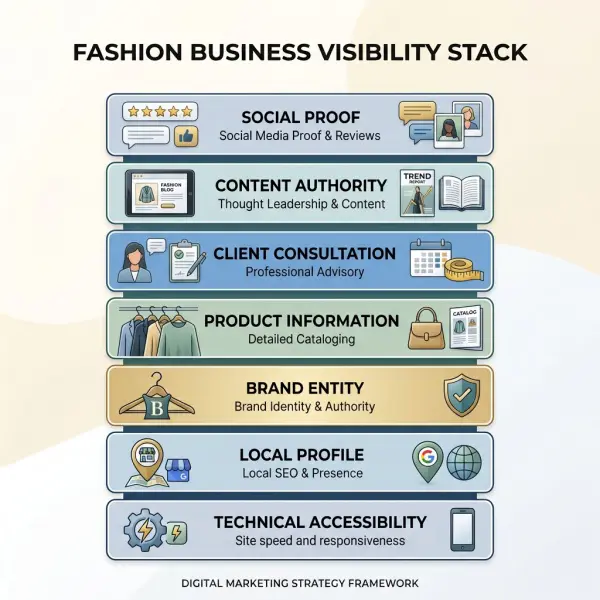
The New Visibility Stack for Fashion Businesses
A fashion business should think of visibility as a stack, not a single channel. Search engines and AI systems draw signals from multiple layers, while customers use those layers to decide whether the business feels credible.
|
Visibility Layer |
What It Means |
Fashion Business Example |
|
Brand entity |
Clear identity of the business |
A premium linen resortwear brand based in Bali, not simply “fashion brand” |
|
Product information |
Structured details about items |
Fabric composition, fit, size range, care instructions, availability |
|
Service information |
Clear explanation of what the business offers |
Private-label garment manufacturing, sampling, pattern making, sourcing support |
|
Location presence |
Complete local business visibility |
Boutique address, opening hours, photos, reviews, product availability |
|
Content authority |
Useful explanations around the business category |
Guides on garment sampling, fabric choice, styling, production planning |
|
Social proof |
Signals from customers and third parties |
Reviews, press mentions, buyer testimonials, creator content |
|
Technical accessibility |
Search engines can crawl and understand the site |
Indexable pages, clean internal links, structured data, image alt text |
The stack is useful because fashion businesses often overinvest in one layer while neglecting another. A boutique may have excellent Instagram visuals but an incomplete business profile. A manufacturer may have good production capability but weak service pages. A fashion brand may have beautiful product photography but thin product descriptions that do not explain fit, fabric, or use case.
Visibility improves when these layers reinforce each other.
Build a Clear Brand Entity Before Chasing AI Visibility
A brand entity is the machine-readable and human-understandable identity of a business. It connects the brand name, category, location, products, services, audience, founder or team, website, social profiles, business profile, and mentions across the internet.
In practice, this begins with consistency. The business name should be written consistently across the website, Google Business Profile, marketplace pages, social profiles, press mentions, and directory listings. Categories should be specific. A “fashion business” could mean almost anything. A “women’s tailoring studio specializing in custom occasionwear” gives search systems and customers a much clearer reference point.
For a fashion brand, entity clarity may include:
- Official brand name and alternate names if commonly used.
- Core category, such as womenswear, activewear, modest fashion, bridalwear, kidswear, textile supplier, or garment manufacturer.
- Product and service scope.
- Geographic relevance, especially for boutiques, studios, factories, and local retailers.
- Founder, designer, manufacturer, or editorial team information where relevant.
- Official website and social channels.
- Consistent logo, imagery, and brand description.
- Public proof, such as reviews, case studies, stockists, media coverage, or partner mentions.
This is not just a technical exercise. Fashion is highly visual and trust-based. Buyers want to know whether a manufacturer can handle small-batch production. Customers want to know whether a dress fits petite bodies, humid weather, modest styling, office use, or travel. Retail partners want to know whether the brand has a coherent assortment, reliable supply, and market positioning.
A weak entity forces people and AI systems to guess. A strong entity reduces ambiguity.
Make Product and Service Pages Answer-Ready
Answer-ready content gives a direct, self-contained answer to the questions people are likely to ask before making a decision. For fashion businesses, this is not limited to blog posts. Product pages, category pages, service pages, size guides, care guides, factory capability pages, and business profile descriptions all need answer clarity.
A product page should not only say “relaxed linen shirt.” It should help the reader understand the garment: fabric composition, weight or feel if available, fit, styling use, climate suitability, care instructions, sizing logic, production approach, and return considerations. A service page for garment manufacturing should explain minimum order quantity, sample development, pattern support, fabric sourcing, quality control, lead time range, and what the client needs to prepare before inquiry.
This matters because AI systems summarize content. If a page gives vague claims, the summary may be vague. If a page gives precise, useful information, it is more likely to be interpreted correctly.
A practical answer-ready format might look like this:
|
Customer Question |
Better Page Content |
|
Is this suitable for hot weather? |
Explain fabric, weight, breathability, lining, fit, and care limitations. |
|
Can this manufacturer handle small brands? |
State MOQ, sampling process, production category, and client readiness requirements. |
|
Is this brand sustainable? |
Explain specific practices, evidence, limitations, and what is not claimed. |
|
Where can I visit or buy? |
Provide store location, hours, stockist links, appointment rules, or shipping areas. |
|
What makes this product different? |
Explain construction, material choice, fit logic, design purpose, and use case. |
The best fashion content is not stuffed with keywords. It is specific enough to help a buyer decide.
Use Structured Data Carefully, Not Decoratively
Structured data is standardized markup that helps search engines understand the entities and content on a page. For fashion businesses, relevant structured data may include Organization, LocalBusiness, Product, Article, BreadcrumbList, ImageObject, VideoObject, Review, FAQ content where appropriate, and other schema types depending on the page.
Google says it uses structured data to understand page content and enable richer search appearances, but it also makes clear that structured data does not guarantee a rich result; see Google structured data guidelines. This distinction is important. Schema is not a visibility shortcut. It is a clarity layer.
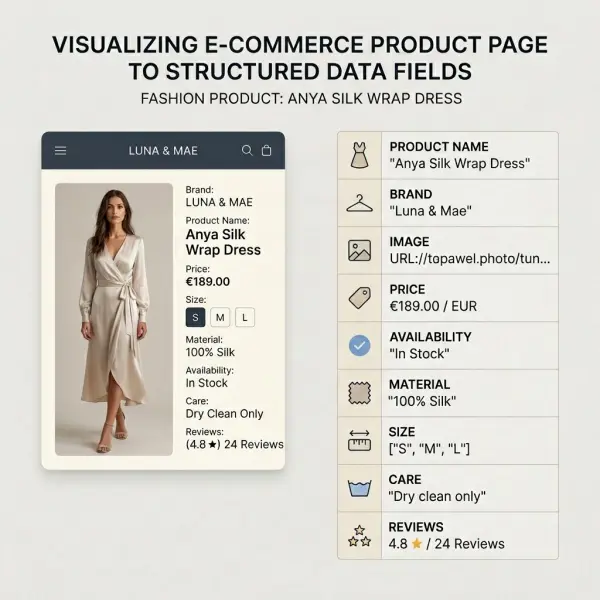
For fashion businesses, structured data should represent what is actually visible on the page. Product markup should match real product information. Article markup should describe the article. LocalBusiness markup should reflect accurate business details. Review markup should not be fabricated. Google’s structured data guidelines warn against misleading markup and require structured data to be representative of visible page content.
Useful schema opportunities for fashion businesses include:
- Product schema for e-commerce pages, including price, availability, image, brand, and relevant product details.
- Organization schema for official brand information.
- LocalBusiness schema for boutiques, studios, schools, showrooms, and service providers.
- Article schema for educational fashion business content.
- Breadcrumb schema to clarify site hierarchy.
- ImageObject or VideoObject where visual content is central to the page.
Google recommends JSON-LD as one supported format for structured data; see Google’s structured data format guidance. For most fashion websites, JSON-LD is usually easier to manage cleanly than embedding markup directly into every visible element.
Optimize Business Profiles as Visibility Assets
For boutiques, fashion schools, tailoring studios, textile shops, showrooms, and local fashion service businesses, a business profile is not just a map listing. It is often the first credibility check before a customer visits, calls, books, or compares alternatives.
Google says businesses with complete and accurate information are more likely to show up in local search results, and its local results are mainly based on relevance, distance, and popularity/prominence; see Google Business Profile local ranking guidance. That means a fashion business profile should clearly state what the business is, where it operates, what customers can expect, and why it is credible.
The deeper tactical discussion belongs in optimizing your fashion business profile for better visibility, but the principle belongs here: every fashion business profile should be treated as part of the brand’s visibility infrastructure.
A practical profile should include accurate categories, current opening hours, service descriptions, location details, high-quality photos, product or service examples, review responses, and links to the official website or booking page. Google specifically recommends keeping business information and hours updated, responding to reviews, and adding photos and videos.
For fashion, photos deserve special attention. A boutique with five outdated storefront images is sending a weak signal. A tailoring studio with clear photos of fittings, garment construction, finished pieces, and consultation spaces is easier to trust. A fabric store with visible textile categories, shelves, labels, and close-up material shots gives customers more context before they visit.
Create Content That Demonstrates Fashion-Specific Expertise
AI visibility depends heavily on whether a business has useful, specific content that explains what it knows. Generic content is easy to ignore because it adds little to the web. Fashion-specific expertise is different. It shows judgment.
A garment manufacturer can publish practical guides on sampling mistakes, production planning, fabric shrinkage, minimum order quantities, stitching quality, or buyer preparation. A boutique can publish styling guides based on climate, body proportion, occasion, or material. A fashion school can explain learning pathways, portfolio preparation, sewing fundamentals, and career outcomes. A textile supplier can clarify fiber differences, finishing, fabric weight, and garment applications.
Google’s guidance on helpful content emphasizes people-first content, first-hand expertise, a clear site purpose, and whether readers leave feeling they have learned enough to achieve their goal; see Google’s helpful content guidance. This aligns closely with what fashion readers actually need. They do not need another generic article saying “quality matters.” They need to know how seam strength, fabric behavior, fit grading, supplier communication, and customer expectations affect real business outcomes.
This is where AEO for fashion brands becomes highly relevant. AEO is not only about writing FAQ blocks. It is about structuring expertise so that answers are clear, specific, extractable, and trustworthy.

Connect Content, Products, and Commercial Intent
Visibility has limited value if it does not connect to commercial pathways. A blog article may attract readers, but the page should naturally guide them toward the next relevant action: browse products, request a quote, download a catalog, book a consultation, visit a store, join a class, or read a related guide.
This does not mean turning every article into a sales pitch. It means building internal pathways that match user intent. Someone reading about garment sampling may be interested in sample development services. Someone reading about linen fabric may want to browse linen garments or fabric suppliers. Someone reading about bridal trends may need a consultation, sizing guide, or custom dress inquiry form.
A fashion business should map content to commercial intent:
|
Content Type |
Likely Intent |
Practical Next Step |
|
Fabric guide |
Research and comparison |
Link to products, sourcing service, or material catalog |
|
Styling guide |
Inspiration and purchase consideration |
Link to product category or lookbook |
|
Manufacturing guide |
B2B evaluation |
Link to capability page or inquiry form |
|
Trend article |
Awareness and discovery |
Link to related products, newsletter, or buying guide |
|
Local service article |
Visit or booking intent |
Link to business profile, appointment page, or location page |
Internal linking should feel editorial, not forced. A reader should never feel pushed into an unrelated offer. The best links help the reader continue the decision journey.
For a broader business strategy view, this article should connect naturally to how fashion brands build stronger digital authority and fashion business visibility in AI search as supporting cluster pages.
Build Third-Party Proof Beyond Your Own Website
A fashion business can control its website, but trust also comes from external signals. Reviews, press mentions, stockist pages, supplier directories, marketplace profiles, creator content, interviews, awards, event participation, and partner pages help confirm that the business exists beyond its own claims.
This matters because fashion has many subjective and trust-sensitive decisions. A customer wants to know whether sizing is reliable. A buyer wants to know whether a manufacturer delivers consistently. A student wants to know whether a fashion course is credible. A retailer wants to know whether a brand has market traction.
Third-party proof does not need to be large-scale media coverage. For smaller fashion businesses, practical proof may include:
- Customer reviews that mention fit, fabric, service, delivery, or alteration experience.
- Stockist or retailer pages that list the brand accurately.
- Supplier or partner mentions from legitimate business relationships.
- Event listings for fashion shows, workshops, pop-ups, or trade events.
- Creator content that shows real product use.
- Case studies for B2B manufacturing or sourcing work.
- Local directory listings with consistent business details.
The key is consistency. If one profile says “custom tailoring,” another says “fashion boutique,” and another says “garment factory,” the digital identity becomes messy unless the business truly covers all those areas and explains them clearly.
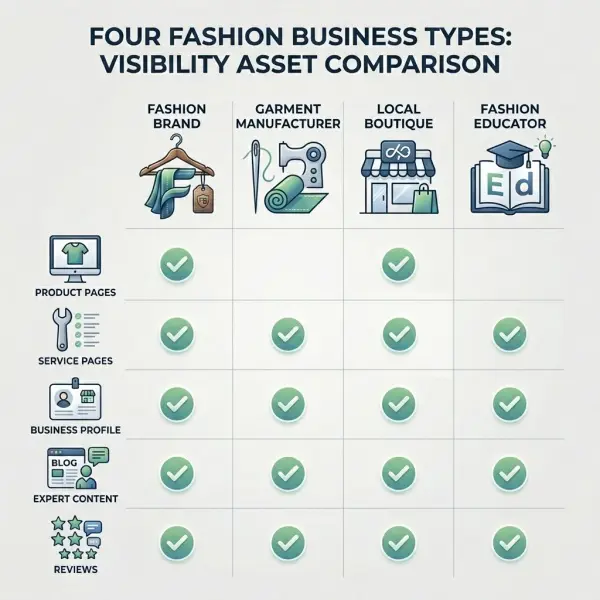
What This Means for Different Types of Fashion Businesses
Not every fashion business needs the same visibility strategy. A DTC fashion brand, a local tailor, a garment manufacturer, and a textile supplier have different discovery paths.
For Fashion Brands
A fashion brand should prioritize product clarity, category architecture, editorial content, product schema, visual consistency, and customer proof. The brand’s website should explain what the product is for, who it suits, how it fits, what materials are used, and how the brand differs from alternatives.
For example, “minimalist workwear” is a category. But “machine-washable minimalist workwear for women who travel frequently” is a more useful positioning if it is accurate. It helps content, product pages, email marketing, social proof, and search visibility align.
For Garment Manufacturers
Manufacturers should make capabilities easy to evaluate. Many factory websites fail because they say “high quality garment production” without explaining product categories, machinery, sample development, capacity range, quality control process, lead time expectations, client requirements, or compliance readiness.
A better approach is to create dedicated pages for services such as pattern making, sampling, small-batch production, private label, activewear production, denim manufacturing, or woven apparel production. Each page should answer real buyer questions.
For Boutiques and Local Fashion Retailers
Local fashion retailers should treat business profiles, store photos, product categories, reviews, and location pages as priority assets. A boutique may not need a 100-article blog before fixing its store hours, address, product photos, review responses, and category descriptions.
In local discovery, the question is often immediate: “Can I visit?” “Do they sell what I need?” “Does the store look credible?” “Are customers satisfied?” “Is the product style aligned with me?”
For Fashion Educators and Training Providers
Fashion schools, sewing studios, and online course providers should build visibility around learning outcomes, course structure, instructor credibility, skill level, portfolio examples, student work, and practical career use. AI search may summarize these details, but only if the information is available and clearly presented.
Common Mistakes Fashion Businesses Make With AI Visibility
Mistake 1: Treating AI visibility as a shortcut
Some businesses assume AI visibility can be achieved by adding a few phrases like “AI search optimized” or publishing large volumes of automated content. That is a weak approach. Google’s helpful content guidance specifically warns against content created primarily for search traffic or extensive automation across many topics without adding much value.
The better approach is to improve content usefulness, entity clarity, page structure, sourcing, proof, and user experience. AI systems are more likely to use content that is clear, specific, and credible than content that merely repeats trending phrases.
Mistake 2: Writing generic fashion content
Generic content is especially common in fashion because many topics sound familiar: sustainability, trends, quality, fit, style, comfort, and craftsmanship. The problem is not the topic. The problem is shallow treatment.
A useful article on fabric choice explains weight, drape, climate, construction, care, cost, and garment suitability. A useful article on production planning explains sampling, material lead time, capacity, quality inspection, rework, and delivery risk. A useful product page explains fit and use case, not just “premium design.”
Mistake 3: Ignoring local and business profile visibility
Many fashion companies focus on Instagram and ignore Google Business Profile, even when customers visit their physical location. This is a missed opportunity. Google Business Profile information can influence how customers discover and evaluate nearby businesses in Search and Maps, and Google recommends complete information, review responses, photos, videos, and updated hours.
For a boutique, tailor, sewing school, or showroom, profile visibility may matter as much as website traffic.
Mistake 4: Using structured data without content discipline
Schema markup cannot fix poor content. If product information is missing, unclear, or inconsistent, structured data only exposes the weakness. Worse, misleading markup can create compliance issues with search guidelines.
The safer rule is simple: write useful visible content first, then mark it up accurately.
Mistake 5: Measuring only traffic
AI search may reduce or change click behavior for some informational queries. A 2026 working paper studying Google AI Overviews and Wikipedia estimated a reduction in daily traffic for exposed English Wikipedia articles, although this finding is category-specific and should not be generalized to every website or commercial query; see AI Overviews and website traffic study.
Fashion businesses should still track traffic, but they should also monitor branded search, direct inquiries, business profile actions, assisted conversions, product page engagement, quote requests, appointment bookings, review growth, and mentions. Visibility is not always captured by pageviews alone.
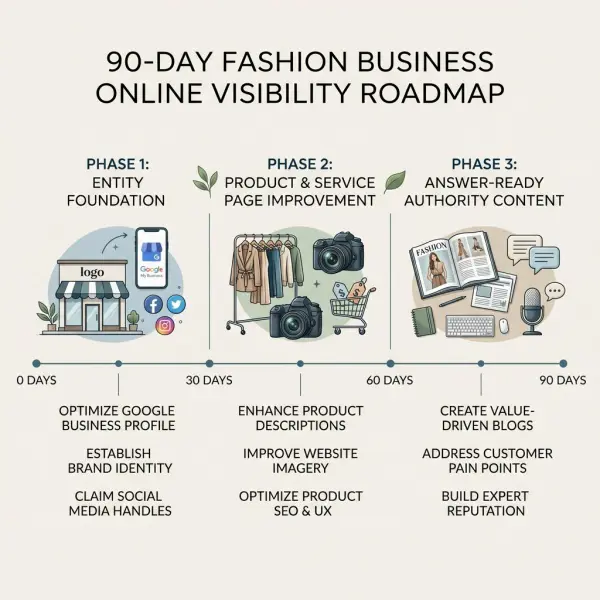
A Practical 90-Day Visibility Framework
A fashion business does not need to rebuild everything at once. The most realistic approach is to improve the foundations first, then expand into content authority and AI visibility.
Days 1–30: Fix the entity foundation
Start by auditing how the business appears across the internet. Check the official website, business profiles, social accounts, marketplace listings, directories, press mentions, and partner pages. The goal is to remove confusion.
Focus on:
- Consistent business name, category, and description.
- Clear homepage positioning.
- Updated contact information.
- Accurate location and opening hours if relevant.
- Complete About page with real business context.
- Consistent social profile links.
- Clear product or service categories.
- Basic Organization or LocalBusiness structured data where appropriate.
This stage may feel basic, but it often produces the biggest clarity improvement.
Days 31–60: Improve product, service, and category pages
Next, strengthen pages that directly support commercial intent. For a fashion brand, this means product and category pages. For a manufacturer, it means service and capability pages. For a boutique, it means location and product category pages. For a fashion school, it means course pages.
Each page should answer the questions a real customer or buyer would ask before contacting or purchasing. Avoid vague descriptions. Add material details, fit notes, service scope, process explanations, lead time ranges, photos, proof points, and internal links.
Days 61–90: Build answer-ready authority content
Once the commercial pages are clear, publish content that supports discovery and trust. Choose topics based on real customer questions, not only keyword volume. A garment factory might publish articles on sampling approval, production scheduling, and quality control. A boutique might publish guides on capsule wardrobes, fabric care, local occasion dressing, or seasonal styling. A fashion brand might explain material choices, fit philosophy, or product development decisions.
This is where SEO, GEO, and AEO begin to work together. The content helps search engines understand the business category, helps AI systems extract clear answers, and helps customers decide whether the business is relevant.
What Brands Should Verify Before Acting
Fashion businesses should be careful with visibility tactics that sound attractive but lack operational substance. Before investing in AI visibility, verify whether the business has the basics in place: crawlable pages, accurate business data, useful content, complete product information, strong internal links, credible proof, and clear conversion pathways.
Several points deserve special caution:
- AI search visibility is not guaranteed by schema, keyword usage, or FAQ formatting.
- Structured data must match visible page content.
- “Sustainable,” “ethical,” and “eco-friendly” claims require specific evidence and careful wording.
- Business profile optimization cannot override distance or all local ranking factors.
- AI-generated content should be reviewed by people with real fashion industry knowledge.
- Product claims should be checked against actual materials, supplier data, care tests, and customer experience.
- Trend content should distinguish between observed trends, brand interpretation, and forecast.
The businesses most likely to benefit are not necessarily those using the most advanced tools. They are often the ones with clearer information, better proof, more useful explanations, and stronger consistency across digital touchpoints.
FAQ
What is AI search visibility for fashion businesses?
AI search visibility is the ability of a fashion business to be discovered, understood, summarized, cited, or recommended in AI-powered search experiences and answer engines. It depends on clear brand identity, useful content, technical accessibility, structured product and business data, and credible external signals. For fashion businesses, this may include being surfaced for product questions, styling advice, local searches, manufacturing inquiries, fabric comparisons, or brand recommendations.
Is AI visibility different from SEO?
AI visibility overlaps with SEO, but it is not identical. SEO helps search engines crawl, understand, index, and rank content. AI visibility also requires content to be answer-ready, entity-clear, and easy to summarize accurately. Google states that foundational SEO best practices remain relevant for its AI features, so businesses should not abandon SEO; they should strengthen it with clearer answers, better structure, and stronger proof.
Do fashion brands need structured data?
Fashion brands should use structured data when it accurately represents visible page content and supports search understanding. Product pages, articles, breadcrumbs, organization information, and local business pages are common opportunities. However, structured data is not a guarantee of rich results or AI visibility. It is best treated as a clarity layer that supports already useful content, not as a replacement for product information, editorial quality, or technical SEO.
How can a small fashion business improve visibility without a large budget?
A small fashion business should start with high-impact basics: clarify its homepage positioning, complete its business profile, improve product or service descriptions, add useful photos, collect and respond to reviews, create a few strong answer-ready pages, and make internal links logical. This is often more valuable than publishing dozens of generic blog posts. Small businesses can compete when their niche, location, product use case, and proof are specific.
What kind of content helps fashion businesses appear in AI answers?
Content that directly answers real fashion business questions is more useful than broad promotional writing. Examples include fabric comparison guides, fit and sizing explanations, garment care instructions, sourcing guides, manufacturing process explainers, styling frameworks, product development insights, and local service pages. The content should include specific details, caveats, examples, and business implications. AI systems can summarize clearer content more accurately.
Can AI-generated content help fashion business visibility?
AI-assisted content can help with drafting, research organization, and formatting, but it should be reviewed by someone with real fashion knowledge. Fashion content often involves material behavior, fit, production, sustainability, consumer expectations, and commercial nuance. If AI-generated content is generic, inaccurate, or published at scale without original value, it can weaken trust. The safer approach is human-led content supported by AI, not unmanaged automation.
What should garment manufacturers prioritize for online visibility?
Garment manufacturers should prioritize service clarity, capability pages, production categories, sample development process, minimum order quantity guidance, quality control explanation, lead time expectations, factory photos, and buyer-readiness content. Many buyers are not looking for vague claims about quality; they want to know whether the factory can handle their product type, volume, timeline, and communication needs.
Conclusion
The age of AI search does not remove the fundamentals of fashion business visibility. It makes them more demanding. A fashion business must be clear enough for people to trust and structured enough for search systems to understand.
The strongest visibility strategy is not built from one tactic. It comes from a connected system: a clear brand entity, accurate business profile, useful product and service pages, credible content, structured data, third-party proof, and practical internal links. For fashion businesses, this system should reflect the real nature of the work—materials, fit, production, styling, retail experience, service quality, and commercial reliability.
AI search may change how customers discover information, but it does not eliminate the need for substance. In many cases, it raises the standard. Businesses that describe themselves vaguely will be easier to overlook. Businesses that explain what they do clearly, prove it consistently, and organize their digital presence intelligently will be easier to find, summarize, and trust.




Comments 0
Leave a CommentSend Comment
Anda harus Login terlebih dahulu untuk dapat memberikan komentar.