


Limits of AI Size Recommendations in Online Apparel Retail
AI size recommendation systems can help online shoppers narrow down their clothing choices, but they cannot remove all uncertainty from apparel fit.
A recommendation is an estimate based on the information available to the system. It is not a physical fitting session, a complete representation of the customer’s body, or a guarantee that a garment will feel comfortable and look as expected when worn.
This distinction matters because size recommendation interfaces often present a simple output—perhaps “Your recommended size is M”—after processing a much more complicated and imperfect relationship among customer data, product measurements, historical purchases, return reasons, garment construction, material behavior, and personal preference.
When those inputs are incomplete, inconsistent, or unrepresentative, the recommendation may still look precise while being less reliable than the interface suggests.
For fashion retailers, the central challenge is therefore not deciding whether AI is capable of recommending sizes. It clearly can. The harder task is determining when its recommendation is sufficiently reliable, for which customers and product categories, and how uncertainty should be communicated without creating false confidence.
Quick Answer
AI size recommendations are limited because garment fit cannot be predicted perfectly from size labels, body measurements, images, or purchase history alone. Two customers with similar measurements may have different body proportions and fit preferences, while two garments carrying the same size label may differ in pattern shape, ease, fabric stretch, construction, and manufacturing tolerance.
Recommendation models also face sparse data, new-product and new-customer conditions, inaccurate return reasons, shared customer accounts, incomplete size charts, and underrepresentation of certain body shapes or size ranges.
Image-based systems introduce additional uncertainty. Camera angle, distance, pose, clothing, lighting, and image quality can affect body-measurement estimates. A visually convincing virtual try-on image may also show appearance without accurately representing pressure, mobility, support, or physical comfort.
These limitations do not mean that AI sizing has no value. They mean that retailers should treat it as decision support rather than objective fit verification. Reliable implementation requires accurate garment data, category-specific logic, confidence thresholds, privacy controls, continuous testing, and an accessible alternative when the system cannot make a dependable recommendation.
What Are the Main Limits of AI Size Recommendations?
The main limitation is that an AI system does not observe the complete real-world fitting experience.
It works with representations: measurements, product attributes, order histories, images, reviews, return labels, and statistical similarities. Every representation leaves something out.
A recommendation can therefore be mathematically reasonable and still produce a disappointing result. The model may correctly infer that size M is the most plausible option among the sizes available, but the customer may dislike the shoulder position, fabric pressure, garment length, neckline, rise, sleeve shape, or overall silhouette.
This problem is not unique to one algorithm. It applies across rules-based systems, collaborative filtering, deep-learning models, computer-vision tools, and hybrid platforms.
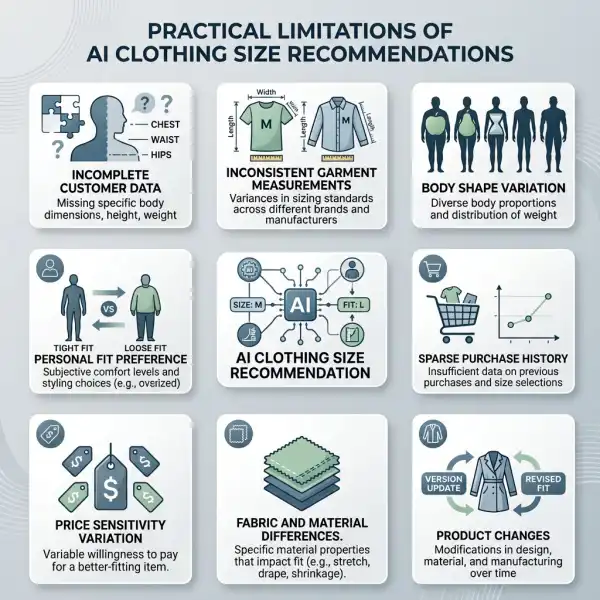
The limitations usually fall into several connected areas:
- Insufficient or sparse customer-product data.
- Inconsistent garment measurements and size systems.
- Noisy or misleading behavioral labels.
- Difficulty representing body shape accurately.
- Subjective and changing fit preferences.
- Category-specific garment behavior.
- Bias and uneven performance across customer groups.
- Product and model changes over time.
- Privacy and data-governance constraints.
- Overconfident or poorly explained recommendations.
These are not merely technical concerns. Each can affect conversion, returns, customer trust, product development, and the retailer’s legal or reputational exposure.
AI Cannot Determine a Universal Clothing Size
A customer does not have one universally correct clothing size.
The size that works depends on the product, brand, pattern block, material, intended silhouette, and the customer’s preferred way of wearing the garment. Someone may wear size S in a stretch T-shirt, M in a fitted woven blouse, L in a structured jacket, and a different numeric size in trousers.
International standards can help standardize how body measurements are defined and taken. ISO 8559-1, for example, provides anthropometric definitions for body measurement used in clothing size designation. The standard was reviewed and confirmed as current in 2026. ISO 8559-1 anthropometric definitions
Standardized measurement terminology does not make garment sizing uniform. Brands remain free to develop size charts and product dimensions suited to their target markets, pattern blocks, silhouettes, and commercial positioning.
An AI tool can normalize or compare those systems, but it cannot create genuine consistency where the underlying products remain inconsistent.
This is why the quality of garment measurements used in apparel production remains a primary constraint. The algorithm can only work with the product information made available to it.
Sparse Data Creates Uncertainty
Size recommendation is a customer-product interaction problem. In most retail datasets, only a tiny proportion of all possible customer and product combinations has ever occurred.
A shopper may have purchased three products from a catalog containing tens of thousands of styles. A newly launched product may have no order history at all. A returning customer may also be shopping in an unfamiliar category.
This creates data sparsity.
Traditional collaborative recommendation methods depend heavily on finding patterns among customers and products with similar histories. Size-and-fit research has identified extreme sparsity in customer-article order data as a central challenge. Hybrid methods attempt to compensate by adding customer and product attributes, but they do not make the missing interactions disappear. deep-learning research on size and fit prediction
The New-Customer Problem
A first-time shopper has no retained-purchase history with the retailer. The system may need to rely on:
- Height and weight.
- Self-reported body measurements.
- Usual size in another brand.
- Age or demographic proxies.
- Population-level patterns.
- Responses to fit-preference questions.
Each input introduces uncertainty. Height and weight do not fully represent body proportions. Self-measurements may be inaccurate. A reference brand may have changed its sizing, and population averages may not describe the individual customer well.
The New-Product Problem
A newly introduced garment has no return pattern, customer reviews, or retained-size history.
The model must depend more heavily on product specifications, category information, material characteristics, intended fit, supplier records, and similarities to existing styles.
This is one reason structured size specification sheets in garment development are operationally important. A retailer with strong technical product data can give the model useful evidence before large-scale sales history exists.
The New-Category Problem
A customer’s previous success with shirts may provide limited information about jeans, bras, footwear, tailored jackets, or compression garments.
Each category has different controlling measurements and fit expectations. A recommendation system that applies one customer embedding across all categories without adequate adaptation may produce recommendations that appear personalized but are only loosely relevant.
Research incorporating customer reviews into fit systems has similarly noted cold-start problems caused by sparse customer-product data. Additional information can improve predictive performance, but it does not fully remove the issue for genuinely new entities. research on reviews in size and fit recommendation
Purchase and Return Data Are Not Objective Fit Truth
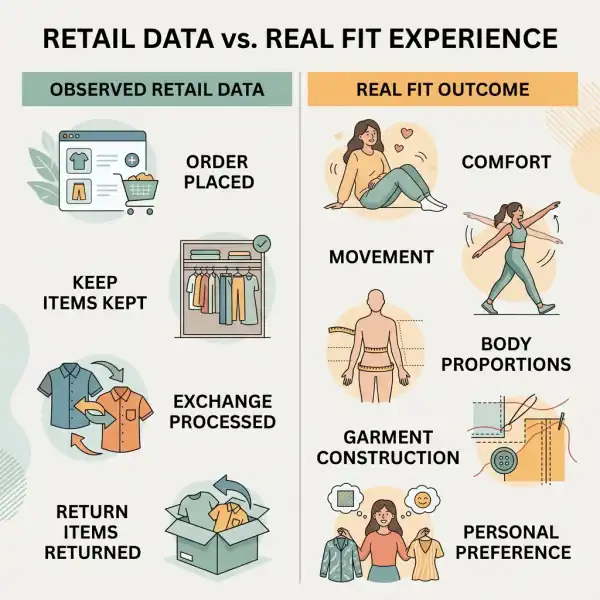
Retail systems often learn from what customers order, keep, exchange, or return. These behaviors are useful signals, but they are not direct measurements of perfect fit.
A retained garment may still be too long, slightly tight, or unsuitable in one area. The customer may keep it because it was discounted, the return process is inconvenient, or the garment can be altered.
A return does not necessarily mean that the recommendation was wrong. The customer may dislike the color, material, quality, styling, or delivery experience. The garment may also have been ordered for another person.
Even explicit return reasons can be noisy. A shopper selecting “too small” may mean:
- The entire garment is too small.
- The waist fits but the hips are tight.
- The shoulders are narrow.
- The neckline is uncomfortable.
- The fabric provides less stretch than expected.
- The customer expected an oversized silhouette.
- The delivered product differs from the stated measurements.
These outcomes require different corrective actions.
A generic label such as “did not fit” provides little information about whether the problem came from the body-garment relationship, the product description, the pattern, the material, the size chart, or the customer’s expectation.
Shared Accounts Distort Personalization
One ecommerce account may represent several wearers.
A parent may purchase for children, partners may share an account, or a shopper may regularly buy gifts. When the system treats the complete account history as one body profile, retained and returned sizes can become contradictory.
Some advanced models attempt to infer multiple purchasing intentions or wearer profiles behind one account. This may improve performance, but it adds another layer of inference rather than obtaining confirmed information about the intended wearer.
Historical Decisions May Include Previous Recommendation Errors
Models trained on past purchases can reproduce earlier customer mistakes.
A shopper may repeatedly order the same size out of habit, even though another size would work better. If the retailer optimizes only for the size most frequently purchased, the system may learn to predict customer behavior rather than successful fit.
The prediction target must therefore be defined carefully. “Most likely to be ordered,” “most likely to be retained,” and “most likely to produce the preferred fit” are not equivalent outcomes.
Garment Data Can Be Wrong or Incomplete
A size recommendation cannot be more physically accurate than the garment information supporting it.
Retail product records commonly contain several weaknesses:
- One generic size chart is reused across many products.
- Measurements describe the body rather than the finished garment, without saying so.
- Only the sample size was physically measured.
- Other sizes were calculated from grade rules but not verified.
- Measurements were taken using inconsistent points of measure.
- Product revisions were not reflected in the ecommerce record.
- Supplier tolerances were omitted.
- Material stretch was inferred from fiber content rather than tested.
- Different colorways or production batches vary.
- The stated intended fit does not match the finished product.
These issues are often invisible to the recommendation model.
Suppose an algorithm correctly calculates that a customer needs a garment chest circumference of approximately 104 centimetres for the intended ease. If the retailer’s database lists the size M garment at 106 centimetres but the delivered production averages 101 centimetres, the recommendation may fail despite correct mathematical logic.
The failure originates in product-data governance.
Manufacturing Tolerance Complicates Precision
Garment production permits some measurement variation. The acceptable tolerance depends on the product, point of measure, material, construction, and quality standard.
A recommendation system may operate as though every size M garment has one exact set of dimensions. Physical inventory is less uniform.
Stretch fabrics add further complexity. Stretch percentage, direction, force, recovery, finishing, panel orientation, seam construction, and wear conditions can all affect fit. The presence of elastane alone does not describe how the finished garment will behave on the body.
For most retailers, improving measurement discipline can create more reliable sizing outcomes than adding a more complex model to weak product data.
Body Measurements Do Not Fully Describe Body Shape
Body measurements reduce uncertainty, but they do not represent the complete three-dimensional form of the wearer.
Two people can share the same chest, waist, and hip circumferences while differing in:
- Shoulder slope and width.
- Bust position and projection.
- Torso length.
- Back curvature.
- Hip distribution.
- Seat shape.
- Thigh circumference.
- Rise requirements.
- Posture.
- Limb proportions.
- Asymmetry.
Garment patterns interact with those proportions in different ways. A jacket may fit the chest circumference while pulling across the upper back. Trousers may match the waist and hip measurements but feel uncomfortable because of the rise or seat shape.
Adding more measurements can improve the representation, but it also increases customer effort and the opportunity for measurement error.
The system must balance three competing goals:
- Collect enough information to improve the recommendation.
- Avoid creating an excessively difficult shopping process.
- Avoid collecting personal data that is not proportionate to the purpose.
Image-Based Body Estimation Has Practical Constraints
Computer-vision systems may estimate body dimensions or shape from photographs, video, depth sensors, or three-dimensional scans.
These methods can reduce the need for customers to use a measuring tape. They also introduce a different set of errors.
Research on estimating three-dimensional body shape from frontal and side-view images identifies challenges including limited realistic public datasets, differences in camera resolution, ambiguity in human shape, and barriers to practical industry adoption. research on body-shape and measurement estimation
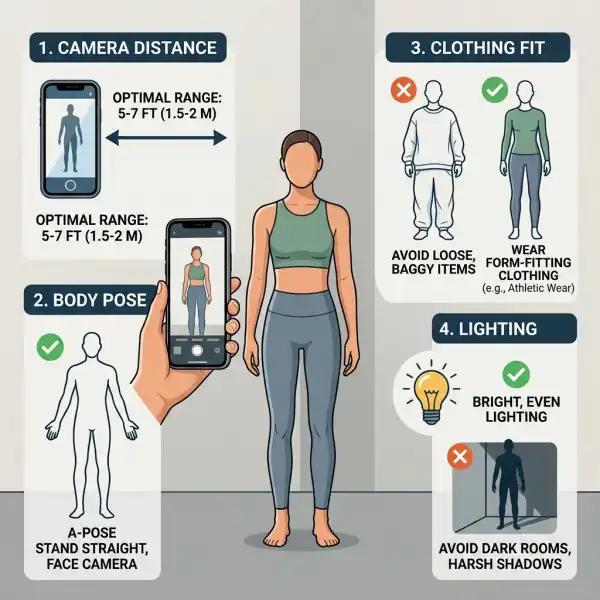
Factors that may affect the estimate include:
- Camera distance and lens characteristics.
- Camera height and angle.
- Customer pose.
- Loose or layered clothing.
- Hair covering body landmarks.
- Background contrast.
- Lighting and shadows.
- Image resolution.
- Partial occlusion.
- Incorrect height reference.
- Movement between images.
- Differences between training data and real users.
Controlled research has specifically examined the effects of gender grouping, pose, and camera distance on body-dimension estimation, confirming that capture conditions are material to model performance. study of pose and camera-distance effects
A Body Image Is Not a Physical Measurement
An image-based estimate is an inference, even when the output is displayed in centimetres.
The numerical format can make the result appear more objective than it is. Retailers should validate the error range for the actual capture process, devices, customer groups, clothing conditions, and measurements used in the recommendation.
A laboratory result using controlled images or synthetic bodies may not transfer directly to customers taking photographs in bedrooms, stores, or changing rooms.
More Images Do Not Automatically Solve the Problem
Frontal and side images can provide more information than one photograph, while depth sensors or body scans may provide richer geometry.
They also increase implementation friction, privacy exposure, storage requirements, and the number of opportunities for poor capture.
The business should verify whether the improvement in recommendation quality is large enough to justify the additional data collection.
Virtual Try-On Does Not Necessarily Predict Physical Fit
Virtual try-on and size recommendation are related but distinct technologies.
A virtual try-on system generally visualizes how a garment might appear on a person, avatar, or image. A size recommender predicts which available size is likely to be suitable.
Some virtual try-on systems historically rendered one garment appearance without properly modeling the relationship between the selected garment size and the user’s body size. Recent research has specifically attempted to introduce size-controllable visualization to address that limitation. size-controllable virtual try-on research
Even a size-aware visualization may not simulate:
- Fabric pressure.
- Stretch resistance.
- Garment weight.
- Support.
- Internal construction.
- Seam discomfort.
- Movement restriction.
- Breathability.
- How the garment changes after sitting or walking.
- How fabric relaxes during wear.
- Post-wash shrinkage or recovery.
A visually persuasive output should therefore not be treated as evidence of physical fit unless the system has been specifically validated for that purpose.
The risk is greatest when customers interpret photorealism as measurement accuracy. A generated image can look convincing while still representing an approximate or idealized drape.
Fit Preference Remains Subjective
A model can estimate physical compatibility more easily than personal satisfaction.
One customer may prefer a close-fitting shirt with minimal ease. Another with the same body dimensions may choose a larger size for movement, layering, modesty, styling, sensory comfort, or workplace requirements.
The meaning of “fits well” can also change across products:
- Compression wear is intentionally close.
- Tailored garments require controlled ease.
- Oversized fashion is designed to appear large.
- Protective or work clothing must support movement and layering.
- Maternity products must accommodate changing body dimensions.
- Adaptive clothing may prioritize dressing access and comfort.
- Cultural preferences may influence coverage and silhouette.
- Performance garments may need category-specific support or pressure.
A recommendation system should not silently define one preferred silhouette as correct for everyone.
Fit Preference Can Change Over Time
Customer preferences are not permanent.
A shopper may change how garments are styled, begin wearing additional layers, experience body changes, shift between work and casual clothing, or prefer a different silhouette from one season to the next.
Historical behavior should be treated as relevant evidence, not an unchangeable identity.
Retailers can reduce this limitation by allowing the shopper to specify the desired outcome—for example, close, regular, or relaxed—while explaining how those options relate to the particular garment.
One Algorithm Rarely Works Equally Well Across All Categories
Size recommendation should be category-specific because different garments fail in different ways.
|
Product category |
Important fit variables |
Why a general model may fail |
|
T-shirts |
Chest, shoulder, length, sleeve, intended ease |
Oversized and fitted products use different fit logic |
|
Trousers |
Waist, hip, rise, thigh, inseam, leg shape |
Matching waist alone may create hip or rise problems |
|
Dresses |
Bust, waist, hip, torso length, silhouette |
One area may fit while another does not |
|
Bras |
Band, cup volume, cup shape, support, construction |
Similar labels can behave differently across styles |
|
Footwear |
Length, width, volume, toe shape, construction |
Foot length does not fully describe shoe compatibility |
|
Jackets |
Shoulder, chest, back, sleeve, armhole, layering ease |
Circumference alone cannot represent upper-body mobility |
|
Stretch activewear |
Body dimensions, stretch, recovery, compression target |
Material performance changes the intended size relationship |
|
Childrenswear |
Height, age, growth allowance, body proportions |
Age labels are only rough indicators |
A shared platform may support all these categories, but it should use different features, rules, confidence thresholds, and evaluation methods where necessary.
This is also why the performance described in how fit algorithms help reduce fashion return rates should not be generalized automatically from one category to another.
AI Performance May Be Uneven Across Customer Groups
A recommendation model learns primarily from the customers, body profiles, sizes, products, and behaviors represented in its data.
If some groups appear less frequently, the system may have less evidence for them. Potential gaps may involve:
- Extended or less frequently stocked sizes.
- Uncommon body proportions.
- Petite or tall customers.
- Older customers.
- People with disabilities or posture differences.
- Maternity and postpartum bodies.
- Regional populations not represented in the training data.
- Non-binary customers when the system forces binary categories.
- Customers purchasing adaptive clothing.
- Customers whose preferred fit differs from dominant patterns.
Low representation does not automatically prove that the model is unfair. It does mean that aggregate performance can hide weaker outcomes for smaller segments.
A system that reports 85% overall accuracy may perform considerably better for high-volume middle sizes than for customers at the edges of the available size range.
The NIST AI Risk Management Framework identifies validity, reliability, transparency, explainability, privacy enhancement, and management of harmful bias as connected characteristics of trustworthy AI. Its GOVERN, MAP, MEASURE, and MANAGE functions provide a useful general framework for evaluating risks beyond average model accuracy.
Availability Bias Can Be Mistaken for Fit Evidence
A retailer can only observe purchases in sizes it stocks.
If a product is unavailable above size XL, the dataset cannot show whether customers requiring larger sizes would have selected or retained the product. The absence of those purchases is not evidence that no demand exists.
Similarly, customers may leave the site without ordering when the size range or recommendation process does not work for them. Their unsuccessful experiences may never enter the return dataset.
This creates survivorship bias: the model learns mainly from people who were able and willing to complete the purchase.
Fairness Must Be Evaluated at Product and Segment Level
Retailers should compare coverage, recommendation acceptance, fit-related returns, exchanges, and low-confidence rates across meaningful groups.
The purpose is not to force identical outcomes in every segment. Categories and customer groups may behave differently for legitimate reasons. The purpose is to identify unexplained performance gaps and determine whether they originate from data availability, product coverage, measurement quality, interface design, or model behavior.
Model Confidence Can Be Misleading
AI recommendations are probabilistic, but interfaces often present them as definitive answers.
A model may estimate:
- Size M: 48% probability.
- Size L: 44% probability.
- Size S: 8% probability.
Displaying only “Recommended: M” hides the fact that two sizes are almost equally plausible.
This matters because customers who fall between sizes may need additional information about fit preference, body proportions, garment measurements, or intended ease.
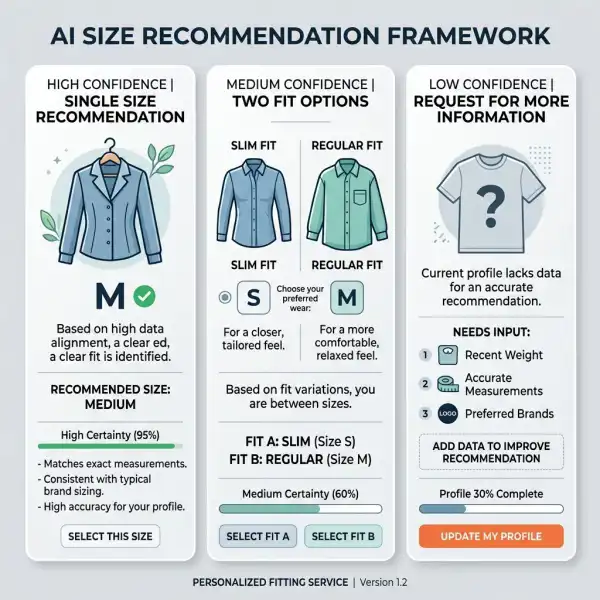
A responsible system should be able to:
- Abstain when evidence is insufficient.
- Present two plausible sizes.
- Explain the expected difference between options.
- Request another relevant input.
- Show the size chart or garment measurements.
- Warn when the recommended size is unavailable.
- Distinguish high-confidence from low-confidence results.
More recommendations are not always better. Increasing coverage by forcing low-confidence answers can raise the number of incorrect or misleading recommendations.
Technical Accuracy and Customer Understanding Are Different
An algorithm can be statistically well calibrated while its customer-facing explanation remains confusing.
Statements such as “87% fit confidence” raise several questions:
- What outcome is being predicted?
- Does confidence refer to the model or the customer?
- Was the percentage validated for this category?
- Does “fit” mean retained, not returned, or reported as comfortable?
- How should the shopper act on the remaining uncertainty?
Retailers should avoid numerical precision unless the figure has a clear definition and practical meaning.
Models Can Become Outdated
Recommendation performance may decline when products, customers, or business processes change.
This is known as model drift or data drift.
Possible causes include:
- A supplier changes.
- Pattern blocks are revised.
- Manufacturing tolerances shift.
- New materials are introduced.
- The retailer expands to another country.
- Customer demographics change.
- Size ranges are extended.
- Return policies change.
- The website changes how return reasons are collected.
- A new styling trend changes preferred ease.
- Product taxonomy is revised.
- Customers begin using the recommendation tool differently.
A model trained on earlier data may continue generating outputs without recognizing that the underlying relationships have changed.
Ongoing monitoring should therefore compare model performance by time period, category, supplier, product version, market, and customer segment.
A system should also retain product-version information. Feedback from an earlier production run should not automatically be applied to a revised garment that uses a new pattern or material.
Privacy and Data Protection Limit What Retailers Should Collect
Size recommendation can involve personal information such as purchase history, body measurements, photographs, video, inferred body shape, fit preference, and product interactions.
The more detailed the profile, the greater the potential privacy and security impact.
Under the European Union’s General Data Protection Regulation, information relating to an identified or identifiable person is personal data. Data-protection principles include purpose limitation, data minimization, accuracy, storage limitation, integrity, confidentiality, and transparency. General Data Protection Regulation
The European Data Protection Board also lists purchase histories and identifiable photographs among examples of personal data. Whether an image or body-derived representation is legally classified as biometric or special-category data depends on how it is processed and the applicable legal definition, particularly whether biometric processing is used for unique identification. EDPB data-protection guidance for businesses
Retailers should not assume that asking customers to upload images is harmless simply because the commercial purpose is apparel sizing.
Data Minimization Is a Product-Design Decision
The retailer should ask whether each input is genuinely necessary.
A rules-based recommendation using usual size and garment measurements may be less personalized than a full-body scan, but it may also be adequate for the product category and easier for customers to trust.
Relevant questions include:
- Can the recommendation work with fewer measurements?
- Does the image need to be stored after processing?
- Can processing occur on the customer’s device?
- Is the body profile linked to the customer’s identity?
- How long is the profile retained?
- Can the customer edit or delete it?
- Is the information reused for marketing or other purposes?
- Which technology providers receive the data?
- Is the data transferred across jurisdictions?
- What happens when the provider relationship ends?
Data collection should be proportionate to the benefit delivered.
Security Consequences Can Be Long Lasting
A password can be changed. A detailed body image or biometric template may be harder to replace after unauthorized disclosure.
This does not mean that all body-measurement tools are equally risky or that every body photograph is automatically processed as biometric identification data. It means that retailers should evaluate sensitivity, linkability, retention, access, encryption, and vendor controls before implementation.
AI Regulation Is Evolving
In the European Union, the AI Act broadly applies from 2 August 2026, with different rules and extended timelines applying to different systems and obligations. The European Commission began enforcing applicable AI Act rules and new transparency requirements on that date. Whether a particular apparel sizing tool falls under specific obligations depends on its functionality, provider-deployer relationship, market, and legal classification. European Commission AI Act enforcement update
Fashion businesses operating across markets should obtain current legal advice rather than assuming that one global privacy notice or vendor contract covers every jurisdiction.
What These Limitations Mean for Fashion Businesses
The limits of AI sizing affect more than recommendation accuracy.
Product Teams Still Own Physical Fit
Technology cannot replace pattern development, sample fitting, grading validation, material testing, and garment quality control.
When a product repeatedly receives the same fit complaint, the business should investigate the garment rather than continually adjusting the algorithm around it.
Ecommerce Teams Must Communicate Uncertainty
The size tool should work alongside:
- Product-specific measurements.
- Intended-fit descriptions.
- Model measurements and garment size.
- Material and stretch information.
- Length and proportion details.
- Customer reviews.
- Clear exchange and return policies.
Removing these resources because an AI recommender has been installed increases dependence on a system that may not have enough information for every customer.
Customer-Service Teams Need Escalation Paths
Customers should have a route to obtain help when:
- The recommendation contradicts the size chart.
- Two sizes appear equally plausible.
- The customer is buying for another person.
- The recommended size is unavailable.
- The customer’s body proportions are not captured by the questionnaire.
- The product has unusual construction.
- The customer needs adaptive or accessibility-related guidance.
A human support option is particularly valuable for complex categories and high-value products.
Data Teams Need More Than an Accuracy Dashboard
Performance monitoring should include:
- Recommendation coverage.
- Low-confidence rate.
- Acceptance and override behavior.
- Fit-related returns.
- Size exchanges.
- Multi-size ordering.
- Performance by category and size range.
- Performance for new customers and products.
- Customer complaints.
- Data-deletion or privacy requests.
- Product-level recurring errors.
An average accuracy score cannot reveal all these operational outcomes.
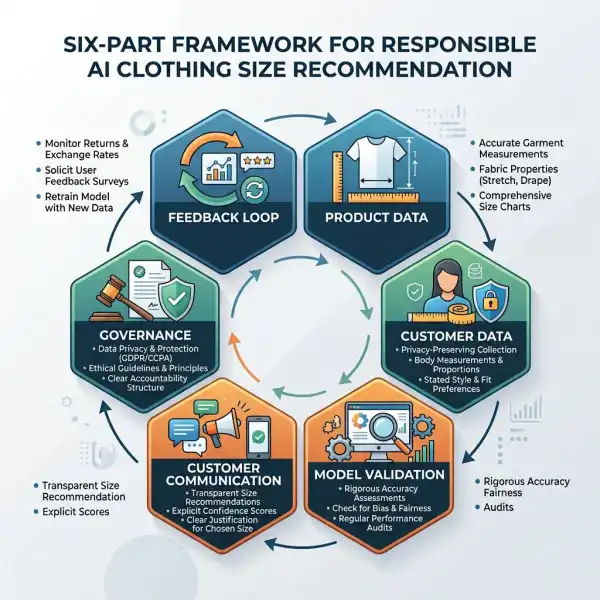
A Risk-Control Framework for AI Size Recommendation
A practical implementation can be organized around six control areas.
|
Control area |
Main question |
Practical action |
|
Product data |
Does the system understand the physical garment? |
Validate size charts, measurements, tolerances, fit attributes, and product versions |
|
Customer data |
Are inputs relevant and proportionate? |
Minimize collection, verify usability, and explain purpose |
|
Model performance |
Does it work for the intended categories and segments? |
Test coverage, accuracy, calibration, and subgroup outcomes |
|
Customer interface |
Is uncertainty communicated clearly? |
Use product-specific wording, confidence logic, and alternative guidance |
|
Governance |
Who owns errors and model changes? |
Define decision rights, vendor responsibilities, audits, and escalation |
|
Feedback loop |
Does learning improve products as well as predictions? |
Connect returns, customer service, quality control, and product development |
This framework helps prevent a common failure: treating AI sizing as a website plugin rather than a cross-functional retail system.
What Should Brands Verify Before Choosing a Provider?
Technology providers may describe their tools using terms such as AI-powered, body-aware, precision sizing, digital fitting, computer vision, or personalized fit.
Those terms do not establish how the system works or whether it suits the retailer’s catalog.
Brands should verify the following points.
Prediction Definition
Ask exactly what the output predicts:
- Most commonly ordered size?
- Most likely retained size?
- Lowest return-risk size?
- Body-to-garment measurement compatibility?
- Preferred silhouette?
- Visually plausible virtual try-on?
- Product-level “runs small” or “runs large” behavior?
A provider may call all these outputs “fit accuracy,” although they measure different outcomes.
Required Data
Confirm what the system needs from the retailer and customer:




Comments 0
Leave a CommentSend Comment
Anda harus Login terlebih dahulu untuk dapat memberikan komentar.