

Why Digital Color Accuracy Matters in Fashion Manufacturing
Quick Answer
Digital color accuracy matters in fashion manufacturing because it helps brands and suppliers reproduce intended colors more reliably, maintain consistent garment appearance, and reduce avoidable production problems caused by color variation.
In apparel manufacturing, small shade differences can affect how fabric panels, trims, and separate garments look when assembled or displayed together. These differences may lead to additional sampling, material segregation, production delays, corrective processing, or rejected merchandise when they exceed agreed quality requirements.
Digital color management supports better decisions by connecting approved color standards, measurement data, supplier communication, and production quality control.
Its commercial value extends beyond the dyeing process. More consistent color decisions can help sourcing teams coordinate materials, garment factories manage fabric lots, and fashion brands maintain recognizable product colors across collections and replenishment orders.
However, digital color accuracy is not simply about achieving the lowest possible numerical color difference. Appropriate tolerances, material properties, lighting conditions, and the intended visual relationship between garment components must also be considered.
The objective is commercially acceptable color consistency supported by reliable measurement and manufacturing control—not theoretical color perfection.
Introduction: When a Small Color Difference Becomes a Manufacturing Problem
Imagine a fashion brand preparing a collection of coordinated navy-blue clothing.
The collection includes tailored trousers, a lightweight jacket, and a knitted top. Each product uses different fabrics, and production is distributed across several suppliers.
The design team approves a specific navy shade intended to create a consistent visual identity across the collection. Yet when the finished samples arrive, the jacket appears slightly more purple than the trousers, while the knitted top has a noticeably lighter finish.
Individually, each product may look attractive. Together, the garments no longer communicate the coordinated appearance that the brand originally intended.
The problem becomes more difficult when production has already started. Fabric may have been dyed, trims purchased, and cutting schedules confirmed. Correcting a shade discrepancy at this stage can involve additional approvals, replacement materials, or changes to manufacturing plans.
Color differences are not always manufacturing defects. Some variation is unavoidable because fabrics interact with light differently, particularly when they have different fibers, constructions, and surface finishes.
The commercial challenge is deciding which differences are acceptable, which require correction, and how those decisions should be communicated before substantial production resources are committed.
Digital color accuracy provides a more structured basis for making those decisions.
By connecting measurable references with material specifications and quality requirements, fashion businesses can manage color as a controlled production characteristic rather than a subjective detail addressed only during final inspection.

What Does Digital Color Accuracy Mean in Fashion Manufacturing?
Digital color accuracy in fashion manufacturing refers to how closely the measured color of textile materials or finished garment components corresponds to an approved color target under specified measurement conditions.
It relies on numerical color information, established reference standards, and controlled evaluation procedures to support decisions throughout product development and production.
A textile's color can be measured using instruments such as spectrophotometers. Software then evaluates differences between samples and approved references using defined colorimetric calculations.
However, digital color accuracy should not be confused with the broader appearance of a material.
Two fabrics may have similar measured color coordinates but still look different because of surface gloss, texture, transparency, or directional reflection. A fabric can also match its initial color standard while failing separate requirements for colorfastness or other performance characteristics.
For fashion manufacturers, a useful color accuracy program therefore combines instrument-based measurements with controlled visual evaluation and appropriate material specifications.
Color Accuracy Versus Color Consistency
Color accuracy and color consistency are closely related, but they address different questions.
Color accuracy asks whether a sample is sufficiently close to the intended reference. Color consistency asks whether materials, production batches, or finished products maintain an acceptable relationship with one another.
A fabric lot may satisfy the brand's approved color tolerance while still looking noticeably different from another lot that also meets the tolerance. This is particularly relevant when fabric from multiple rolls is used to construct the same garment.
|
Evaluation |
Color Accuracy |
Color Consistency |
|
Main question |
Does the material match the approved target? |
Do materials and products match one another acceptably? |
|
Primary reference |
Approved color standard |
Approved standard and relevant production samples |
|
Typical application |
Lab dip approval and supplier submission |
Dye lot control, garment assembly, and replenishment |
|
Main risk |
Producing the wrong intended shade |
Visible variation between products or components |
|
Business objective |
Meet the specified color requirement |
Maintain a coherent appearance throughout production |
The distinction affects how quality tolerances should be applied.
A brand cannot assume that independent compliance with the same reference automatically guarantees visual harmony between adjacent garment panels. It may also need to control lot-to-lot variation and decide which materials can be used together.
Where Color Inaccuracy Creates Costs in Apparel Production
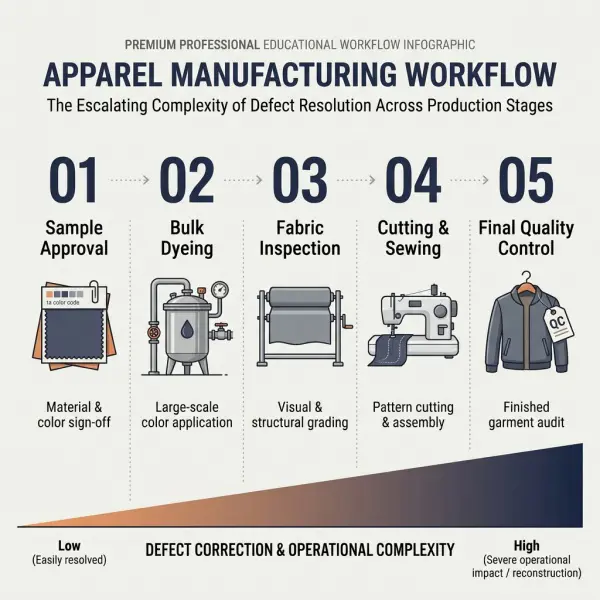
Color problems become progressively more difficult to resolve as materials move through the manufacturing process.
During early development, a correction may require another laboratory sample. After bulk dyeing, it may involve substantial material quantities. Once garments have been cut or assembled, the options for correction become more restricted.
This is why early color control has commercial value.
Product Development and Repeated Sample Approvals
Color development can involve multiple rounds of lab dips before a fabric is accepted.
Each additional submission may require laboratory processing, sample preparation, measurement, review, and communication between the dye house and brand.
When suppliers and buyers use inconsistent references or rely on subjective descriptions, it may take longer to establish why a sample was rejected and what should change.
Digital specifications can reduce ambiguity by identifying the approved target and the measured direction of any deviation.
A supplier can then respond to a specific color difference instead of attempting to interpret feedback such as "make it warmer" or "slightly less dull."
This does not guarantee first-time approval. Dye compatibility, fabric properties, production capabilities, and appearance requirements still influence the outcome.
Nevertheless, better-defined color decisions can help reduce avoidable iterations and make development schedules more predictable.

Bulk Dyeing and Material Reprocessing
A color discrepancy discovered after bulk dyeing creates a different level of commercial exposure.
The manufacturer may need to assess whether the material can be corrected, used for another purpose, accepted under a controlled concession, or rejected.
Reprocessing is not always technically suitable. Additional dyeing or finishing can influence material properties, and the outcome depends on the fiber, existing coloration, and production process.
Even when correction is possible, it may require additional production capacity, chemicals, energy, water, labor, and quality inspection.
Digital color monitoring can help identify deviations at defined production checkpoints. When used alongside stable manufacturing processes, it supports earlier intervention before more material proceeds downstream.
The business benefit depends on whether the system actually prevents unnecessary processing rather than merely documenting the problem after it occurs.
Fabric Cutting and Shade Variation
One of the most visible consequences of inconsistent color occurs when garment panels are cut from incompatible fabric lots.
For example, the front panel of a jacket may come from one roll while its sleeves come from another. If those rolls differ noticeably in shade, the assembled garment may appear uneven even though the materials were intended to be the same color.
This is why garment manufacturers use fabric inspection, shade identification, and controlled roll allocation.
Digital measurements can support shade grouping by identifying differences between rolls and helping production teams decide which materials may be used together.
However, numerical color compliance does not remove the need for sensible cutting-room controls.
A manufacturer should still maintain roll identification, traceability, and appropriate bundling procedures to reduce the risk of visible panel mismatch.
Finished Garment Rejection and Delivery Disruption
Color defects identified during finished garment inspection can be particularly expensive because significant production work has already been completed.
The affected garments may contain materials, trims, sewing labor, finishing, pressing, packaging, and inspection costs that cannot be fully recovered.
The manufacturer may face additional sorting, replacement production, customer negotiation, or delayed delivery.
For a fashion brand launching a coordinated collection, inconsistent shades can also complicate product presentation and inventory allocation.
Digital color control cannot eliminate every quality issue, but it can improve the likelihood that unacceptable deviations are identified before they reach expensive downstream operations.
Why Global Fashion Supply Chains Make Color Accuracy More Difficult
Modern apparel sourcing frequently separates product design, textile production, garment manufacturing, and retail operations.
A fashion brand may approve a color in one location while fabric is dyed elsewhere and the garments are assembled in a different country.
The challenge is maintaining a consistent interpretation of the approved color across these independent activities.
Different Suppliers May Interpret the Same Color Differently
Suppliers can use different instruments, lighting conditions, dyeing technologies, and approval procedures.
Even when they receive the same color name or visual reference, the resulting materials may not have identical appearance.
A digital color standard provides a common numerical target, but it must be supported by compatible measurement conditions and appropriate material-specific tolerances.
The AATCC EP6 instrumental color measurement procedure provides a technical reference for measuring color stimuli, including reflectance measurement and specimen handling considerations.
A brand managing multiple suppliers should ensure that the parties understand not only the reference color but also how compliance will be evaluated.
Without that agreement, apparently objective color measurements may still produce disputes.
Different Fibers Require Different Coloration Approaches
A coordinated garment collection may use cotton, polyester, nylon, viscose, or blended textiles.
These materials differ in their dyeing behavior, surface characteristics, and potential colorant systems.
A formulation suitable for cotton dyed with reactive dyes cannot simply be transferred unchanged to polyester dyed with disperse dyes.
Each supplier must develop a material-appropriate process while working toward the approved visual requirement.
This can create differences in spectral reflectance even when the calculated color coordinates are similar under a selected illuminant.
For fashion brands, the objective should be appropriate cross-material harmony rather than assuming every supplier can reproduce the exact same physical color response.
A Shared Digital Standard Needs Clear Ownership
A common operational weakness is the existence of several competing versions of a color reference.
Design teams may retain an early development swatch, suppliers may use a later approved lab dip, and quality control may compare production against a different sample.
Digital tools cannot resolve this problem unless the organization clearly identifies the authoritative reference.
Each color specification should have an identifiable version, approval status, applicable materials, and responsible decision-maker.
A shared color management system can help distribute this information, but its effectiveness depends on disciplined version control and supplier participation.

How Color Accuracy Affects Fashion Product Quality
The quality impact of color accuracy depends on the product and how its materials are used together.
A garment made from a single uniform fabric presents different risks from a technical jacket containing multiple materials, or a collection designed around coordinated colors.
Color requirements should reflect those differences rather than treating every garment as an identical measurement problem.
Matching Fabrics, Ribbing, Thread, and Trims
A sweatshirt may combine a knitted body fabric, ribbed cuffs, sewing thread, drawcords, and decorative embroidery.
Each component may be sourced separately and manufactured from different materials.
Even subtle color differences can become more visible when components sit directly beside one another.
For example, a ribbed cuff that appears slightly greener than the sweatshirt body may draw attention when the garment is examined as a complete product.
The brand must decide whether the components are intended to match closely or simply coordinate aesthetically.
Where close matching is required, digital color data and controlled visual assessment can help establish acceptable relationships between materials.
This is particularly relevant for uniforms, coordinated workwear, premium basics, and other products where visible consistency contributes to the intended design.
Managing Color Across Replenishment Orders
Repeat production introduces another challenge.
A garment manufactured several months after the original order may use a different fiber lot, dye batch, or production facility.
If the new batch differs visibly from existing inventory, the retailer may end up displaying nominally identical products in noticeably different shades.
This can be problematic for repeat-selling basics and coordinated product lines.
Maintaining authoritative color records helps suppliers reproduce an established target, but production teams should also consider how new merchandise will compare with existing stock.
Depending on the product, a brand may need to assess whether a small color difference is acceptable across separate production seasons or whether closer continuity is commercially necessary.
Signature Colors and Brand Recognition
Some fashion businesses use particular colors repeatedly across product categories or seasonal collections.
When a color forms part of the brand's recognizable design language, consistent reproduction becomes a brand management concern as well as a manufacturing requirement.
A distinctive black, cream, red, or seasonal accent color may appear across apparel, accessories, packaging, and marketing materials.
However, maintaining the same perceived color across different substrates is not always technically possible.
The appropriate strategy is to define product-specific targets and acceptable visual relationships while preserving the overall intended brand appearance.
Digital color records support this work by reducing dependence on informal color descriptions and individual staff memory.
The Commercial Benefits of Better Digital Color Control
Digital color accuracy can influence several business outcomes, although the benefits depend on the quality of implementation and the manufacturer's existing performance.
The following framework connects operational improvements with their potential commercial consequences.
|
Operational Area |
Potential Improvement |
Business Implication |
|
Color development |
Clearer feedback and fewer unnecessary lab dip revisions |
More predictable approval schedules |
|
Material sourcing |
Better alignment between suppliers |
Reduced risk of incompatible components |
|
Bulk dyeing |
Earlier detection of unacceptable shade variation |
Lower exposure to avoidable reprocessing |
|
Cutting and assembly |
Better allocation of compatible fabric lots |
Reduced risk of visible panel mismatch |
|
Product quality |
More consistent compliance with agreed color requirements |
Fewer color-related inspection disputes |
|
Retail replenishment |
Better continuity between production batches |
More coherent presentation of repeat products |
|
Management reporting |
Traceable color decisions and defect records |
Better supplier and process evaluation |
These are potential operational benefits rather than guaranteed financial returns.
Their commercial value should be assessed using actual production data, including color-related rejection, rework, approval delays, and the costs of corrective action.
More Predictable Production Scheduling
Color approvals can influence when raw materials are released into production.
If an approved shade is delayed, subsequent cutting and sewing operations may also be affected.
Clearer specifications and measurable approval criteria can reduce uncertainty in this process.
However, digital color management does not remove other scheduling risks such as material shortages, machine capacity constraints, or delays in receiving complete technical specifications.
Its value lies in making the color-related portion of the production workflow more predictable.
Better Supplier Performance Evaluation
When color-related decisions are documented consistently, brands can examine recurring issues by supplier, material, or product category.
A supplier that repeatedly submits out-of-tolerance samples may require additional technical support or process investigation.
Another supplier may demonstrate stable results across multiple production batches.
These records can inform sourcing decisions, but comparisons must account for differences in material difficulty, product requirements, and order complexity.
A supplier producing difficult fluorescent or highly textured fabrics should not automatically be judged by the same expectations as one producing uniform, opaque materials.
Meaningful performance evaluation requires comparable conditions and clear acceptance criteria.
Digital Color Accuracy and the Customer Experience
The customer does not see a textile spectrophotometer report or a laboratory color approval record.
What the customer sees is the garment, its components, and how its color compares with the product images or other merchandise.
This creates a connection between manufacturing color management and retail product presentation.
Consistency Between Online Images and Physical Products
A digitally approved fabric color is not automatically reproduced accurately in an ecommerce photograph.
Digital cameras, studio lighting, image editing, display color profiles, and consumer screens introduce additional variables.
An image can make a garment appear more saturated, brighter, or warmer than the physical product.
A 2026 study published in the Journal of Imaging, Assessing RGB Color Reliability via Simultaneous Comparison with Hyperspectral Data on Pantone Fabrics, examined the reliability of RGB-based color information against hyperspectral measurements and highlighted the importance of measurement conditions and reference-based evaluation.
This reinforces an important distinction for fashion businesses: accurate manufacturing color and accurate product photography require related but separate controls.
A practical retail photography process should use representative production samples, consistent lighting, appropriate color management, and controlled editing.
Even with these measures, brands cannot guarantee identical color appearance on every customer's device.
Product Expectations and Color-Related Returns
When delivered merchandise appears substantially different from its online representation, customers may be dissatisfied with the purchase.
Color discrepancies can also create problems when customers buy separate products expecting them to coordinate.
Better color management may help reduce these risks, particularly when brands connect production standards with their photography and product information processes.
However, color-related return rates depend on many factors, including customer expectations, product category, lighting, display characteristics, and the accuracy of the merchandise description.
Businesses should not assume that adopting spectrophotometers will automatically reduce returns by a specific percentage.
Instead, they can monitor returns attributed to color differences and investigate whether those complaints originate in manufacturing variation, photography, merchandising, or customer interpretation.

Can Better Digital Color Accuracy Reduce Waste?
Digital color management may support waste reduction when it helps manufacturers avoid unnecessary dye trials, repeat processing, rejected fabric, or preventable garment defects.
However, the environmental benefit depends on what changes operationally.
A dye house that improves first-time color development may avoid some additional sample dyeing and correction steps. Similarly, earlier detection of unacceptable production colors may prevent more material from entering downstream manufacturing.
These improvements can reduce resource consumption in particular circumstances.
But the presence of digital technology does not automatically demonstrate a lower environmental impact.
The relevant question is whether the system produces measurable changes in material use, chemical consumption, energy requirements, water use, or transportation.
Avoiding Unnecessary Sampling and Redyeing
Sample development consumes materials and processing resources.
Digital formulation and measurement tools can help technical teams select more appropriate color corrections, potentially reducing unnecessary trials.
If a supplier can make a reliable approval submission using shared spectral data, the workflow may also reduce certain physical sample shipments.
Yet some fabrics still require physical evaluation, and not all color formulations can be approved remotely.
Environmental claims should be based on documented reductions in actual activity rather than assuming every digital approval replaces a physical sample or prevents a dyeing cycle.
Preventing Waste After Fabric Cutting
Color problems identified after fabric cutting may create material losses that cannot easily be recovered.
A defective garment panel may require replacement fabric, additional cutting, or more sewing operations.
Checking fabric color consistency before cutting can help prevent some of these situations.
Nevertheless, material efficiency also depends on pattern layout, fabric utilization, defect management, and cutting-room procedures.
Digital color accuracy should therefore be regarded as one component of manufacturing waste prevention, not a complete sustainability solution.
How Fashion Businesses Can Build a Practical Digital Color Accuracy Strategy
A reliable color management program begins with defining business requirements rather than purchasing the most advanced available equipment.
The appropriate solution depends on whether the organization is primarily a fashion brand, textile mill, dye house, garment manufacturer, or sourcing intermediary.
A brand may need stronger supplier approval controls, while a dye house may benefit from improved formulation data and production monitoring.
The central requirement is that everyone works from the same approved standards and understands how decisions will be made.
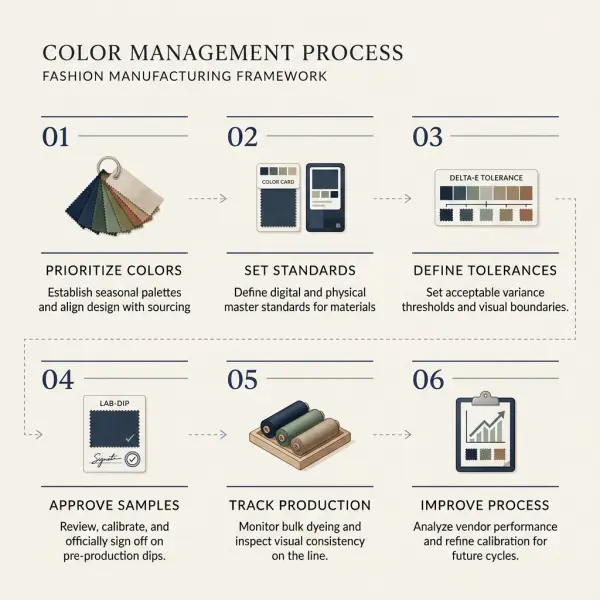
Step 1: Identify High-Risk Products and Colors
Not every colorway deserves the same level of inspection intensity.
A coordinated uniform program may require closer control than products sold individually with intentionally varied finishes.
Brands should examine where shade discrepancies would create the greatest production or commercial problems.
Relevant considerations include product positioning, color sensitivity, material combinations, order quantities, and the visibility of adjacent components.
The initial program can focus on high-risk products before expanding to the complete assortment.
Step 2: Establish Authoritative Color Standards
Each important color should have a clearly identified approved reference.
The reference may include a physical master sample, digital spectral data, and material-specific requirements.
Where digital measurements are used, the specification should identify the relevant evaluation conditions.
For example, the ISO 105-J03:2009 standard describes a method for calculating textile color differences using CMC, illustrating why the selected calculation method matters when defining tolerances.
A brand should not assume that numerical tolerances expressed using different methods are directly interchangeable.
Step 3: Agree on Material-Specific Acceptance Criteria
Different textile materials may require different evaluation approaches.
A smooth cotton fabric, glossy polyester, and velvet cannot always be assessed using identical practical assumptions.
The brand and supplier should agree on appropriate instrument measurements, visual inspection conditions, color tolerances, and any special handling requirements.
The AATCC EP9-2025 procedure for visual assessment of textile color differences provides a recognized reference for standardized visual comparison.
The objective is a combined system in which technical measurements and visual evaluation support the same quality requirements.
Step 4: Introduce Approval Checkpoints Before Expensive Operations
Color control should be applied at stages where an unacceptable result can still be addressed effectively.
Typical checkpoints may include initial lab dip approval, preproduction or first-bulk confirmation, finished fabric inspection, and verification before cutting.
For some products, additional component matching or finished garment checks may be justified.
The required frequency depends on production scale, material variability, and the consequences of failure.
Too few inspections increase the risk of late discovery, while excessive checks without clear decision rules can create unnecessary operational costs.
Step 5: Connect Color Data With Production Traceability
An approved color measurement becomes more useful when it can be linked to a specific material, supplier, and production lot.
Factories should record the reference used, the sample measured, the approval decision, and any corrective action taken.
Garment manufacturers should also maintain sufficient roll and lot information to support shade control during cutting.
This connection between laboratory data and physical material movement helps explain where color differences arise and which production units may be affected.
Without traceability, a factory may detect a problem but struggle to identify the materials involved.
Step 6: Review Results and Improve the Process
The final stage is using collected information to improve future performance.
If repeated color problems occur with one substrate or finishing process, the organization should investigate the technical cause.
If approvals are consistently delayed by unclear specifications, the problem may be procedural rather than manufacturing-related.
A digital system becomes more valuable when the data influences corrective actions, supplier discussions, and future product development decisions.
Technology should support continuous improvement instead of creating a large archive of measurements that no one uses.
Measuring the Business Value of Digital Color Accuracy
Digital color management should be evaluated through operational results rather than software features alone.
For fashion businesses, useful performance indicators show whether the system improves color approval, reduces production problems, and supports more consistent quality decisions.
A practical scorecard can include the following measures.
|
KPI |
Suggested Measurement |
What It Reveals |
|
First-pass lab dip approval rate |
First submissions approved ÷ first submissions evaluated × 100 |
Effectiveness of initial color development |
|
Average approval cycle time |
Average elapsed time from initial submission to final approval |
Speed and coordination of approvals |
|
Color-related fabric rejection rate |
Rejected fabric quantity due to color ÷ inspected fabric quantity × 100 |
Material losses associated with color requirements |
|
Shade-related rework rate |
Reworked production quantity due to shade problems ÷ relevant production quantity × 100 |
Operational burden of correction |
|
Color-related garment defect rate |
Garments with color defects ÷ garments inspected × 100 |
Impact on finished-product quality |
|
Supplier color compliance rate |
Accepted color submissions ÷ submissions evaluated × 100 |
Supplier performance against agreed criteria |
These measures should use consistent definitions, units, and reporting periods.
For example, a rejected fabric quantity could be expressed in meters, kilograms, or lots, but comparisons should not mix those units without an appropriate conversion.
The evaluation should also consider changes in production mix. A factory that begins producing more difficult colors or substrates may experience different approval outcomes even if its technical capability improves.
Establish a Baseline Before Claiming Savings
A manufacturer should record its performance before introducing a new digital color management process.
Useful baseline information includes the number of lab dip revisions, average approval duration, color-related rejection quantities, and resources consumed by corrective operations.
After implementation, the organization can compare results over an appropriate production period.
The analysis should account for changes in order volume, materials, suppliers, and product complexity.
Without this context, it is difficult to determine whether observed improvements were caused by the technology or by other operational changes.
Consider the Total Cost of Adoption
Digital color management may require investment in spectrophotometers, formulation or quality software, maintenance, staff training, and data integration.
Organizations may also need to improve sample handling procedures and supplier communication.
For smaller brands, a supplier-led color management program may be more practical than purchasing laboratory equipment.
A larger organization handling many colors and manufacturing partners may justify a centralized digital color governance system.
The most suitable investment depends on the scale of the existing problem and the level of control required—not simply the availability of advanced technology.
Common Mistakes That Undermine Digital Color Accuracy
Assuming Every Fabric Must Have Identical Numerical Color Values
A frequent misconception is that different fabrics should always produce identical color measurements.
In reality, substrate structure, texture, gloss, and dye chemistry can influence both measured color and visual appearance. Pursuing identical numerical coordinates may not produce the most visually harmonious result across different materials.
Brands should define material-appropriate standards and evaluate components together where necessary, rather than treating one numerical target as a universal solution.
Setting Color Tolerances Without Understanding Production Capability
An extremely narrow tolerance may appear desirable because it suggests greater precision.
However, requirements that do not reflect material properties, measurement uncertainty, and feasible production variation can cause unnecessary rejection and repeated sampling.
Conversely, tolerances that are too permissive may allow visibly inconsistent products.
The appropriate approach is to establish acceptance limits through technical evaluation, customer requirements, and an understanding of the intended end use.
Approving Fabric Without Considering Adjacent Components
A brand may approve the main fabric while leaving ribbing, thread, lining, and trims to separate supplier decisions.
When the completed garment is assembled, differences between those components can become more noticeable.
The better approach is to identify color-critical material combinations during product development and evaluate their visual relationship before releasing the full production order.
This is especially important for coordinated garments where components are intended to appear nearly identical.
Relying on Digital Measurements Without Visual Verification
Color measurements provide useful evidence, but they do not fully describe every visual property of a textile.
Glossy, textured, pile, and fluorescent materials may require additional evaluation under suitable lighting conditions.
A brand that removes visual assessment entirely may overlook appearance problems that matter to customers.
Instrumental and visual procedures should therefore be designed to complement one another.
Failing to Connect Color Approval With Cutting-Room Controls
A fabric may meet the approved color tolerance but still differ visibly from another accepted roll.
If the cutting department combines these materials without considering their shade relationship, the resulting garments may exhibit panel mismatch.
Measurement records need to be connected to physical roll identification and appropriate shade grouping.
Color quality is not fully controlled until the manufacturing process uses the approval information correctly.
Important Technical and Commercial Caveats
Digital color accuracy is valuable, but businesses should understand what it cannot establish.
The technology supports color specification and evaluation under defined conditions. It does not guarantee identical appearance under every light source, on every substrate, or on every consumer display.
A Low Delta E Does Not Guarantee Visual Perfection
Delta E expresses a calculated color difference under a selected formula.
Methods such as CIEDE2000, defined in ISO/CIE 11664-6:2022, support standardized numerical evaluation.
However, a single Delta E result does not fully characterize fabric texture, gloss, directional appearance, or every potential metameric effect.





Comments 0
Leave a CommentSend Comment
Anda harus Login terlebih dahulu untuk dapat memberikan komentar.