

Common Retail Operation Gaps That Hurt Customer Experience
Quick Answer
Retail operation gaps hurt customer experience when a brand’s promise is not supported by accurate data, available stock, clear ownership, executable policies, and reliable exception handling. Customers experience these gaps as false availability, inconsistent product information, unhelpful handoffs, promotion or payment surprises, cancelled orders, unclear delivery status, difficult returns, and complaints that receive an apology but no resolution.
The root cause is often not one careless employee. It is a break between teams, systems, policies, or physical processes. A website may accept an order before store stock is verified. Customer service may promise a refund without visibility into warehouse inspection. Store staff may follow one return rule while the website shows another.
Improvement starts by tracing the complete customer journey and identifying where the operational record diverges from reality or where responsibility becomes unclear. Retailers should prioritize gaps by customer harm, financial exposure, frequency, and recoverability. The best corrective action does more than close one case: it changes the underlying process, data, training, or control so the same failure is less likely to recur.

What Is a Retail Operation Gap?
A retail operation gap is a break between the customer promise and the people, data, systems, stock, policy, or partner capability needed to deliver it. The gap may be visible at one touchpoint but originate somewhere else. A cancelled online order appears to be a fulfillment failure, for example, while the actual cause may be an incorrect receipt, a delayed store transaction, an unrecorded fitting-room unit, or reservation logic that allowed two channels to promise the same product.
This definition separates a gap from ordinary variation. Not every delayed parcel means the retailer has a broken process; carriers, weather, addresses, and customs can create exceptions. The operational question is whether the retailer set a realistic promise, detected the exception, communicated it, offered an appropriate next step, and learned from repeated patterns.
The pillar article on fashion retail operations for store and online teams explains the full operating system. This article focuses on failure points within that system and how they reach the customer.
Symptoms, failures, and root causes are different
|
Level |
Example |
Why the distinction matters |
|
Customer symptom |
“The website said my size was available, but the order was cancelled.” |
Describes the experience and immediate harm |
|
Operational failure |
The allocated unit could not be found or passed inspection |
Identifies where execution stopped |
|
Root cause |
Stock movements were not recorded, reservations updated late, or damaged returns were restored to availability |
Points toward a corrective action that may prevent recurrence |
|
Control gap |
No cycle count, exception alert, ownership rule, or post-cancellation review detected the pattern |
Explains why the root cause continued unchecked |
Retailers often stop at the failure level. They refund the order, adjust the stock figure, and move on. The case is closed for reporting, but the mechanism that created it remains active.
Where Do Customer Experience Gaps Usually Appear?
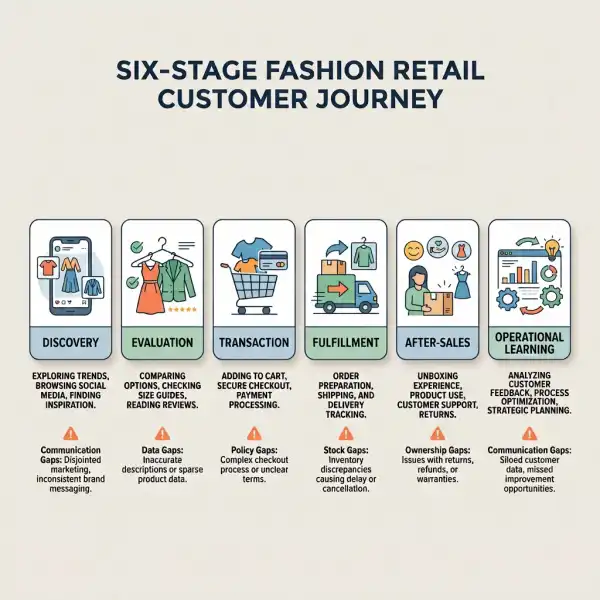
Gaps can appear before purchase, during a transaction, in fulfillment, or after the product reaches the customer. Cross-channel journeys create additional exposure because a promise made in one channel may depend on another location or team.
A useful map follows six moments:
- Discovery: Can the customer find and understand the relevant product?
- Evaluation: Are product facts, fit guidance, price, promotion, and availability dependable?
- Transaction: Can the customer complete payment or reservation under the stated terms?
- Fulfillment or handover: Is the correct product prepared, dispatched, collected, or delivered as promised?
- Use and after-sales: Can the customer obtain support, exchange, return, repair, or refund when eligible?
- Learning: Does the business use complaints, returns, cancellations, and service contacts to correct the system?
This sequence prevents teams from diagnosing only the touchpoint they own. A payment failure might come from an expired promotion configuration. A return complaint may begin with inaccurate measurement content. A customer-service backlog may be driven by unclear tracking messages rather than insufficient agent effort.
Gap 1: The Customer Promise Is Not Converted Into Operating Rules
A promise becomes operational only when the business defines its conditions, owner, timing, data source, and exception path. “Fast delivery,” “easy returns,” “available in store,” and “collect today” sound clear to customers but remain vague internally unless teams know the cut-off, eligible locations, stock buffer, inspection requirement, working days, and recovery process.
This gap often begins in marketing, merchandising, or channel expansion. A service is launched because competitors offer it, yet store labor, carrier collection, payment settlement, or inventory accuracy is not ready. Customers then receive a confident promise supported by an improvised workflow.
Retailers should document each high-impact promise as a service rule:
- what the customer is told;
- which products, locations, countries, and order types are eligible;
- which system or person confirms eligibility;
- who owns completion and communication;
- the service level and cut-off;
- expected exceptions; and
- the remedy or escalation when the promise cannot be met.
The document can be short. Its value is alignment. A promise that cannot be described operationally should not be scaled across channels.

Gap 2: Recorded Availability Does Not Match Selling Reality
Availability gaps occur when the system says a unit can be sold but the physical product is missing, reserved, damaged, incorrectly labeled, awaiting return inspection, or located where staff cannot retrieve it within the service window. The reverse also happens: sellable stock exists but remains unavailable online or invisible on the floor.
Fashion is especially sensitive because demand converts at size-and-color level. Ten units of one style do not help a customer if none matches the required size. Store fulfillment raises the risk further: a unit may be moved by a customer without a transaction, placed in a fitting room, or sold at the same time an online order attempts to reserve it.
The deeper relationship among stock display, staff workflow, replenishment, and sales is covered in the companion article. From a customer-experience perspective, the immediate controls are clear stock states, location-level records, proportionate counting, reservation rules, return inspection, and an honest availability message.
When a unit cannot be found, teams should capture a reason instead of using a generic cancellation code. “Physical variance,” “damaged,” “already reserved,” “wrong location,” and “label mismatch” lead to different corrective actions.
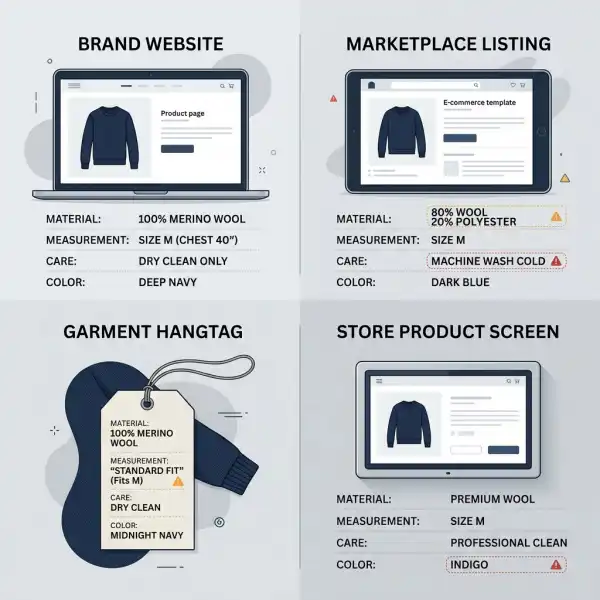
Gap 3: Product Information Changes Across Channels
Customers may encounter different material descriptions, measurements, care instructions, color names, images, prices, or return eligibility on the website, marketplace, social channel, hangtag, and store system. Even a small discrepancy can change the purchase decision. A skirt described as machine washable online but labeled dry-clean only creates more than editorial embarrassment; it can cause product misuse, returns, complaints, and potential compliance exposure.
Product-data quality depends on ownership and synchronization. A source record should identify approved facts, while channel transformations—short titles, local languages, marketplace attributes, or region-specific legal text—remain controlled. GS1 describes quality data in terms that include completeness, consistency, and regulatory compliance. Standards alone do not guarantee accuracy, but they offer a shared structure for product identification and information exchange.
Fit information needs particular discipline
Generic size labels are not enough for many online fashion decisions. Customers may need garment measurements, model context, fit notes, stretch information, rise, length, or category-specific dimensions. Those details must use defined measurement methods and units. The production foundation is explained in garment measurements for apparel production.
When data is uncertain, the retailer should not fill the gap with confident assumptions. “Color may vary by screen” is a reasonable caveat, but it does not excuse inconsistent photography or incorrect naming. “Fits true to size” should not be applied automatically across styles without an evidence-based fit standard.
Gap 4: Staff Handoffs Lose Context or Ownership
Customers experience an ownership gap when they must repeat the same issue to several people and each person can see only one fragment. A store associate may see the transaction but not the marketplace message. Customer service may see a tracking number but not the warehouse exception. Finance may control the refund but have no direct contact with the customer.
The answer is not unlimited access. Privacy, fraud control, segregation of duties, and partner restrictions may limit what each role should see or change. The operating design should instead provide the minimum context needed, a clear case owner, status definitions, and a route to the team with authority.
A strong handoff records:
- customer need and preferred contact channel;
- order, product, variant, location, and relevant dates;
- promise already made;
- evidence collected and verification completed;
- current status and blocking dependency;
- next action, owner, and deadline; and
- communication required if the deadline changes.
This prevents internal language such as “waiting on operations” from becoming a dead end. The customer does not need every internal detail, but should know what will happen next and when.
Gap 5: Promotions, Prices, and Payments Fail at the Point of Commitment
Promotional friction becomes most damaging when the customer has already invested time. A code may exclude the selected product without clear disclosure, a store price may differ from the website, a gift card may not work across channels, or a payment may be authorized although the order never completes.
These problems can originate in configuration, timing, tax logic, currency, marketplace rules, payment-provider response, or staff permissions. The operational control begins before launch: test eligible and ineligible products, minimum-spend thresholds, stacking rules, time zones, returns, partial cancellations, and channel differences. Staff and customer service need a plain-language explanation and controlled authority for correction.
Retailers should separate a declined payment from an unknown payment state. Automatically asking the customer to pay again when authorization status is unclear can create duplicate charges or unnecessary anxiety. Reconciliation and customer communication should follow the actual state rather than a generic error message.
Gap 6: Checkout and Digital Journeys Are Not Accessible or Recoverable
A functioning page is not necessarily a usable or accessible journey. Customers can be blocked by unlabeled controls, insufficient contrast, keyboard traps, confusing focus order, inaccessible error messages, timeouts, or forms that erase entered information after one mistake.
The W3C Web Content Accessibility Guidelines 2.2 provide testable, technology-neutral success criteria for making web content more accessible to people with disabilities. Legal obligations vary by jurisdiction, and conformance assessment requires more than running an automated scanner. Retailers should combine technical testing, assistive-technology testing, and human evaluation.
Accessibility is also operational. A customer who cannot complete a return form or collection booking needs a supported alternative that reaches the same outcome without unreasonable burden. Staff should know that route; otherwise, an accessible support statement exists only on paper.
Gap 7: Fulfillment Exceptions Are Detected Late or Communicated Poorly
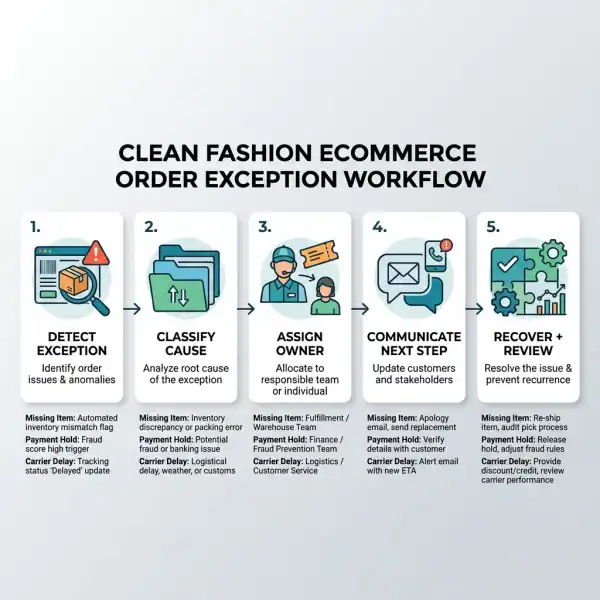
Most fulfillment networks produce exceptions: a unit fails inspection, an address cannot be validated, a parcel misses collection, a shipment is split, or customs delays delivery. The customer-experience gap is not the existence of every exception. It is the absence of early detection, ownership, accurate communication, and a proportionate remedy.
A useful exception workflow distinguishes statuses customers care about. “Processing” may hide a payment hold, a missing pick, a packaging delay, or carrier handover. Internally, each status should have an owner and threshold. Externally, the message should state what changed, what the retailer is doing, what action—if any—the customer must take, and when the next update will arrive.
Automation can amplify incorrect status data
Automated notifications reduce manual work when events are dependable. When they are not, the system can send “your order is on the way” before carrier acceptance or “delivered” when only part of a split order arrived. The notification logic should be tested against real carrier events, partial fulfillment, cancellation, reshipment, and failed delivery.
Gap 8: Returns and Refunds Are Designed as Separate Processes
Customers experience a return as one journey, but retailers may split it across authorization, transport, store acceptance, warehouse inspection, inventory disposition, refund approval, payment processing, and customer service. When those stages do not share status, the customer hears “we have not received it” after carrier delivery or “the refund was processed” without an expected settlement time.
Returns need eligibility rules, inspection standards, status events, evidence requirements, refund authority, and an exception route. They also need a stock decision. A returned garment may be saleable after basic recovery, require repair or markdown, go back to a supplier, or be written off. Restoring it to available inventory before inspection can create another failed order.
Complaints handling should support learning as well as case closure. ISO 10002:2018 provides guidelines for complaints handling and was confirmed as current in 2023. The standard is broader than fashion retail and does not replace local consumer law, but its process orientation is useful: complaints should be received, handled, monitored, and used for improvement.
Gap 9: Customer Feedback Is Collected but Not Connected to Operations
A retailer may collect reviews, return reasons, satisfaction scores, chat transcripts, and store comments while learning very little. The gap appears when feedback categories are too broad, teams cannot connect them to SKU, order, location, or process, or no owner reviews recurring patterns.
“Not as expected” can refer to color, fabric, fit, packaging, delivery, or misleading content. “Delivery issue” can mean late dispatch, carrier delay, damage, wrong address, or an inaccurate tracking message. More specific categories improve diagnosis, but excessive menus can slow staff and annoy customers. Use a manageable primary reason with optional detail and free text where appropriate.
Customer information should be governed carefully. CRM can connect service history with purchases and preferences, but access, retention, consent, and permitted use depend on applicable privacy rules. The wider role of fashion CRM for customer-focused brands should not be confused with unrestricted data collection.
Gap 10: Metrics Reward Closure Instead of Resolution
Operational metrics can push teams toward the wrong outcome. Closing contacts quickly may reduce handle time while increasing repeat contacts. Dispatching an order within target may look successful even when the wrong variant was packed. Approving refunds rapidly may conceal recurring product or content problems.
A balanced view connects speed, accuracy, customer outcome, cost, and recurrence. Depending on the process, that may include:
- first response and time to meaningful next action;
- order accuracy and cancellation reason;
- on-time dispatch and delivery exception rate;
- return-to-refund time by payment method;
- repeat contacts for the same issue;
- promise kept versus goodwill compensation issued;
- complaint recurrence by SKU, location, channel, or root cause; and
- completion of corrective action with post-change verification.
Metrics require definitions and context. A complex fraud case should not be compared directly with a simple address correction. Customer compensation can be appropriate, but a high volume of vouchers is not evidence that the underlying experience is improving.
How Can Retailers Diagnose and Prioritize Gaps?
The diagnostic process should begin with evidence from actual journeys, not a generic best-practice checklist. Select a high-impact scenario such as store pickup, marketplace return, failed delivery, or size-related exchange. Reconstruct what the customer saw and what each system and team recorded.
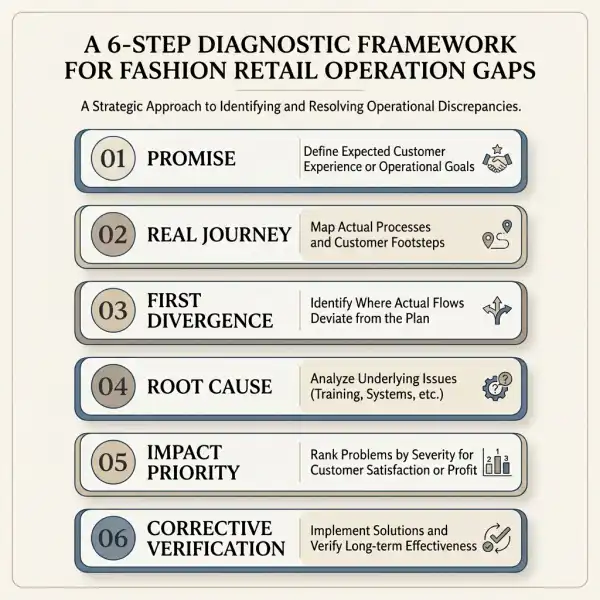
A six-step diagnostic method
- Define the promise and intended outcome. Capture the visible message, policy, service level, and eligibility conditions.
- Map the real journey. Include customer actions, team handoffs, system events, physical stock movement, and external partners.
- Locate the first divergence. Find where the record, product, policy, or action first stopped matching reality—not only where the customer complained.
- Classify the cause. Use categories such as data, process, capacity, training, system, partner, policy, control, or unclear ownership.
- Assess impact and recurrence. Consider customer harm, financial or compliance exposure, volume, affected segments, and recoverability.
- Correct and verify. Change the process or control, test it on real scenarios, and monitor whether the root-cause pattern declines.
A customer journey map without operational evidence can become decorative. The useful version includes timestamps, statuses, decisions, queues, and unresolved dependencies.
Prioritize by harm, exposure, frequency, and recoverability
The loudest complaint is not automatically the highest-priority gap. A rare inconvenience may be less urgent than a silent accessibility barrier, repeated incorrect refund, or product-data error affecting many customers. A practical scoring discussion can consider:
- severity of customer harm;
- revenue, margin, fraud, privacy, safety, or legal exposure;
- number and type of customers affected;
- frequency and trend;
- detectability before the customer is affected;
- ease of recovery once it occurs; and
- effort and risk of corrective action.
Scores support judgment; they do not replace it. A low-volume issue involving safety, discrimination, or regulatory exposure may require immediate escalation regardless of its average commercial impact.
Practical Actions for Small and Growing Fashion Retailers
Smaller teams do not need an enterprise platform to improve operational experience. They need visible ownership and disciplined records. Begin with the journeys that create the most contacts, cancellations, returns, or manual reconciliation.
A workable starting set is:
- one approved source for product facts and policy versions;
- explicit stock states for available, reserved, returned, damaged, and in transit;
- a shared exception log with owner and deadline;
- tested promotion, payment, fulfillment, and refund scenarios before major campaigns;
- specific but manageable cancellation and return reasons;
- a weekly review of recurring customer problems; and
- one verified corrective action rather than several unowned improvement ideas.
Technology becomes valuable when volume or complexity exceeds the control of this basic system. Even then, software should support a defined operating model. Integrating unclear statuses across channels creates a larger, faster version of the same ambiguity.
Common Mistakes When Fixing Customer Experience Gaps
Adding compensation without correcting the cause
A voucher may recover one relationship, but repeated compensation can hide an unresolved stock, product, or fulfillment failure. Record the remedy separately from the root-cause action.
Training staff around a broken workflow
Training is appropriate when knowledge or practice is the cause. It will not fix conflicting policies, missing permissions, delayed integrations, or a workload that exceeds capacity. Diagnose before assigning retraining.
Automating every exception
Rules and notifications can handle predictable cases, but ambiguous situations still require judgment. Automation should escalate uncertainty rather than force it into an incorrect status.
Treating all customers and channels as operationally identical
Service expectations, payment methods, accessibility needs, carrier capability, and consumer law vary across markets and channels. The customer promise can remain coherent without making every process identical.
Closing a project after the first improvement
A changed workflow may perform well during a pilot and fail under peak volume, staff turnover, or new channel conditions. Corrective action needs verification over a relevant period and ownership after launch.
What Should Brands Verify Before Acting?
Retailers should verify applicable consumer-protection, pricing, labeling, privacy, accessibility, payment, tax, employment, and product-safety requirements in each market. This article offers an operational framework, not legal advice. Global brands should not copy one policy across jurisdictions without review.
They should also test the evidence behind a proposed fix. A rise in complaints may reflect a genuine increase, a new feedback channel, better categorization, or more sales volume. A decline may reflect successful correction—or customers giving up. Use qualitative cases with normalized operational measures where possible.
Finally, preserve human review for high-impact and uncertain decisions. A risk score, chatbot, or routing rule can support triage, but incorrect automation may deny an eligible return, misclassify a vulnerable customer, or communicate certainty that the underlying data does not support.
Frequently Asked Questions
What is the most common retail operation gap?
There is no universal single gap, but unclear alignment among inventory, product data, order status, and ownership appears across many retail journeys. The visible symptom differs: a false stock message, cancelled order, repeated explanation, or delayed refund. Retailers should not assume the most frequent contact reason is the root cause. Begin with transaction and case evidence, identify the first divergence from the customer promise, then test whether the pattern is concentrated by SKU, location, channel, status, or partner. The priority should reflect harm and exposure as well as volume.
How is an operational gap different from poor customer service?
Poor customer service describes an unsatisfactory interaction, while an operational gap describes the system condition that made the outcome difficult or inconsistent. An associate may communicate poorly even when the process is sound. Conversely, an excellent associate may be unable to resolve a case because the refund permission, stock status, or partner information is missing. The distinction matters because coaching will not repair a system integration, and new software will not correct disrespectful behavior. Retailers should assess both interaction quality and the operating conditions surrounding it.
How can a retailer identify silent customer experience problems?
Look beyond complaints. Compare search behavior, zero-result queries, stockout exposure, checkout errors, order cancellations, failed deliveries, return reasons, repeated contacts, abandoned pickup orders, refund aging, and accessibility test findings. Observe real store and digital journeys, including customers who do not ask for help. Segment carefully to reveal issues affecting a size range, device type, disability-related need, location, payment method, or delivery region. Silence does not prove satisfaction; some customers leave, switch channels, or avoid a task rather than complain.
Who should own cross-channel customer problems?
One role should own the case outcome even when several teams own the underlying tasks. The case owner needs status visibility, authority to communicate, and a defined escalation route, but not unrestricted permission to change inventory, payments, or personal data. Process owners should separately correct recurring root causes in their domains. This two-level model prevents the customer from coordinating the retailer while preserving appropriate controls. Ownership should also continue when the issue moves from store to warehouse, marketplace, finance, or carrier partner.
Which customer experience metrics are most useful?
Useful metrics connect customer outcome with operational cause. Examples include promise-kept rate, order accuracy, cancellation reason, repeat contact, delivery exception, return-to-refund time, complaint recurrence, and verified corrective-action completion. Satisfaction or recommendation scores can add perspective but do not explain the process failure by themselves. Definitions, denominators, and segments must be consistent. Pair aggregate measures with case reviews because the same average can hide severe issues affecting a small group or one high-risk journey.
Can better technology eliminate retail operation gaps?
Technology can improve synchronization, visibility, routing, alerts, and audit trails, but it cannot eliminate gaps by itself. Systems still depend on accurate product data, recorded stock movement, realistic policies, maintained integrations, staff adoption, partner events, and exception ownership. A platform can also spread one incorrect status across every channel. Retailers should define the desired workflow, test normal and exceptional scenarios, assign data ownership, and monitor false alerts or unresolved queues. The goal is recoverable, observable operations—not merely more automation.
Conclusion
Customer experience in fashion retail is shaped by what happens behind the visible interaction. Product data, inventory status, promotion rules, staff handoffs, fulfillment events, return inspection, refund authority, and complaint learning all influence whether the brand keeps its promise.
The most damaging gaps are rarely solved by a single apology or dashboard. Retailers need to distinguish the customer symptom from the operational failure, root cause, and missing control. That distinction turns “order cancelled” into a specific investigation of availability, reservation, quality, or ownership—and turns a refund from the end of the case into evidence for prevention.
The practical approach is disciplined and selective. Map one important journey, find the first divergence, prioritize by harm and recurrence, correct the underlying process, and verify the result. When that habit becomes part of retail operations, customer experience improves through fewer contradictions, clearer recovery, and a business that learns from its failures rather than merely processing them.





Comments 0
Leave a CommentSend Comment
Anda harus Login terlebih dahulu untuk dapat memberikan komentar.