
Why Stretch Fabrics Matter in Modern Apparel Design
Quick Answer
Stretch fabrics matter in modern apparel design because they allow garments to move with the body while supporting better fit, comfort, recovery, and silhouette control. In many apparel categories, stretch is no longer treated as a technical extra. It has become part of how customers judge whether a garment feels wearable in real life.
For fashion brands, stretch fabrics influence more than material selection. They affect pattern making, grading, sizing tolerance, seam construction, product testing, production handling, retail claims, and return risk. A stretch fabric can make a close-fitting trouser more comfortable, help activewear recover after movement, give a fitted dress better mobility, or make denim more wearable during sitting and walking.
The important caveat is that stretch is not a single performance feature. Some fabrics stretch because of knit structure. Some use elastane or spandex. Some woven fabrics use mechanical stretch. Some stretch in one direction, while others stretch in both directions. Each option behaves differently in design and production.
The best apparel teams do not ask only, “Does this fabric stretch?” They ask, “How much does it stretch, in which direction, how well does it recover, and does that behavior match the garment’s purpose?”

What Are Stretch Fabrics?
Stretch fabrics are textile materials designed or constructed to extend under tension and return partly or substantially toward their original shape after movement. In apparel, this stretch can come from the fabric structure, the yarn, the fiber blend, or a combination of these factors.
A knitted fabric may stretch because of looped yarn construction even without elastane. A woven fabric may have mechanical stretch because of yarn crimp, weave structure, finishing, or textured yarns. A fabric containing spandex or elastane can stretch because the elastic fiber itself extends and recovers. BISFA describes several elastane-containing yarn constructions, including covered yarns, core-spun yarns, air-covered yarns, and core-textured yarns, which shows why stretch performance can vary even when two fabrics look similar on a composition label. BISFA terminology for elastane-containing yarns
This matters because fashion teams often discuss stretch as if it were one property. In reality, stretch has several dimensions: stretch percentage, stretch direction, recovery, modulus, growth, compression, opacity under tension, and behavior after washing. Two fabrics may both contain 5% elastane but perform very differently in leggings, dresses, denim, swimwear, or tailoring.
A practical definition for design teams is this: stretch fabric is a textile that extends during body movement to support fit, mobility, or shape retention, with final performance depending on construction, fiber blend, yarn engineering, garment pattern, sewing method, and care conditions.
This article focuses on why stretch fabrics matter in apparel design. For a material-level explanation of the elastic fiber itself, see spandex fabric properties, uses, and limitations. For blend-specific comfort and movement strategy, see how elastane blends improve comfort, fit, and movement.
Why Stretch Changed the Way Apparel Is Designed
Stretch fabric changed apparel design because it gave designers a different relationship between body, garment, and movement. Traditional non-stretch garments usually depend on ease, darts, pleats, panels, closures, and shaping to allow movement. Stretch fabrics can reduce some of that dependency, allowing garments to sit closer to the body while still accommodating motion.
This shift is visible across many categories. Jeans no longer need to feel rigid to look structured. Office trousers can look tailored while offering comfort during sitting. Dresses can be body-skimming without feeling restrictive. Sportswear can follow dynamic movement. Even casual basics now often rely on a small amount of stretch to keep necklines, cuffs, waistbands, and silhouettes looking cleaner after wear.
But stretch also changes the designer’s responsibility. A non-stretch woven garment can often be evaluated through static fit: bust, waist, hip, shoulder, length, and balance. A stretch garment must be evaluated through static fit and movement fit. What happens when the wearer sits, bends, reaches, walks, squats, drives, trains, or wears the garment for several hours?
The design process becomes less about the flat sketch and more about behavior. A stretch garment is not finished when it looks good on a mannequin. It needs to perform on a moving body.
Stretch Fabric Is Not Only About Comfort
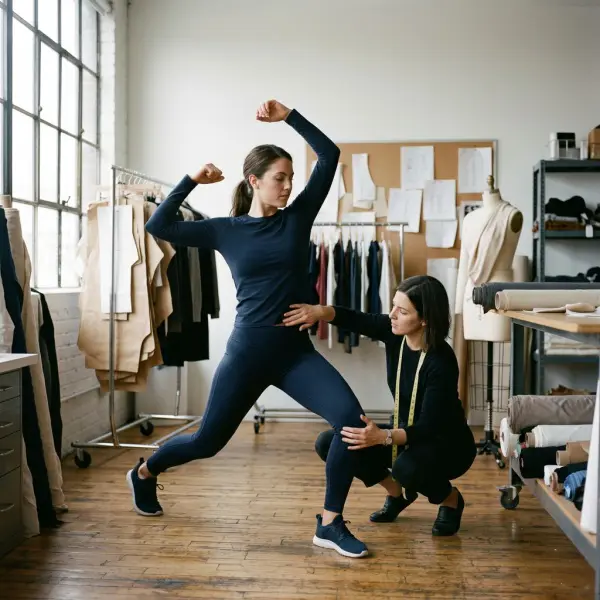
Stretch is often marketed as comfort, but that is only part of the story. In design terms, stretch is also a tool for shape, control, recovery, size flexibility, and customer satisfaction. A garment may feel comfortable because it stretches, but it may also look better because it recovers well after movement.
For example, stretch denim may make jeans easier to wear, but the real quality signal appears after several hours. Do the knees bag? Does the waistband roll? Does the seat area lose shape? A fitted knit dress may feel soft at first touch, but if the fabric grows during wear, the silhouette can lose its intended line. Activewear may feel good during the first try-on, but poor recovery can make the garment feel unsupportive after repeated use.
This is why apparel teams need to separate three ideas:
|
Design Question |
What It Really Means |
|
Does the fabric stretch? |
How much does it extend under movement or tension? |
|
Does the fabric recover? |
Does it return close to its original shape after stress? |
|
Does the garment stay comfortable? |
Do fabric, pattern, seams, fit, and care behavior work together? |
That distinction is commercially important. Customers rarely complain using technical language. They say the leggings became loose, the jeans lost shape, the dress stretched out, or the top felt tight across the arms. Behind those complaints are design and material decisions.
Stretch Direction: One-Way, Two-Way, and Four-Way Stretch
Stretch direction affects how a garment behaves on the body. One-way stretch usually extends mainly in one direction. Two-way stretch often refers to stretch across the width of the fabric, although terminology can vary by supplier. Four-way stretch is commonly used in apparel trade language to describe fabrics that stretch both widthwise and lengthwise.
The terminology is not always used consistently in the market, so brands should verify actual test data rather than relying only on supplier descriptions. A fabric described as “four-way stretch” may still have very different stretch percentages in length and width. That difference can affect pattern placement, garment fit, and customer movement.
For apparel design, stretch direction should match the body zone and product use. A waistband needs stretch and recovery around the body. A shoulder area may need stretch during reaching. Leggings need stretch across hips, thighs, knees, and seat areas. A swimwear fabric needs close body conformity in multiple directions. A woven stretch blazer may need more controlled give rather than high stretch.
A simple design rule is useful here: stretch should support the movement the garment is expected to experience, not simply make the fabric feel flexible in the hand.
How Stretch Fabrics Affect Pattern Making
Stretch fabrics change pattern making because the pattern must account for fabric extension, recovery, and the intended fit. A garment made from a stable woven fabric usually needs positive ease so the body can move inside it. A stretch garment may use reduced ease or negative ease, meaning the garment measurements can be smaller than the body measurements in selected areas.
Negative ease is common in leggings, swimwear, shapewear, fitted tops, and bodycon garments. But it must be used carefully. If the pattern is too small for the fabric’s stretch and recovery behavior, the garment may feel restrictive, become transparent, strain at seams, or distort on the body. If the pattern is too loose, the garment may fail to provide the intended hold, support, or clean silhouette.
Pattern makers usually need to consider:
- stretch percentage in length and width;
- recovery after repeated movement;
- fabric weight and opacity under tension;
- body zones that require movement allowance;
- seam placement in high-stress areas;
- garment category and intended fit level;
- size grading behavior across different body measurements.
This is why stretch garment development benefits from real fitting and wear trials. A flat measurement chart is necessary, but it cannot fully predict how stretch fabric behaves around a living, moving body.

Fit, Sizing, and Body Variation
Stretch fabrics can help garments accommodate movement and small variations in body shape, but they should not be used as a shortcut for weak sizing. A stretch garment still needs clear size architecture, good grading, realistic fit models, and market-specific body measurement understanding.
The ISO 8559-1 standard is designed to provide anthropometric definitions for body measurement and to support clothing product development teams and fit mannequin manufacturers in creating size and shape profiles. ISO 8559-1 size designation of clothes While a small brand may not work directly with ISO documents every day, the principle is relevant: good fit starts with understanding body measurements, not only choosing a stretchy fabric.
Stretch can improve fit tolerance, but it can also hide fit problems during development. A sample may “fit” because the fabric stretches over the body, yet still show pulling, strain, transparency, rolling, twisting, or discomfort during movement. In size-inclusive collections, this becomes even more important. Stretch percentage that works on one size may not scale cleanly across the full size range.
For brands, the practical question is not whether stretch can make sizing easier. It can, to some extent. The better question is whether the stretch behavior supports the intended customer, body zone, and size range without creating new fit problems.
Stretch Fabrics and Modern Silhouette Design
Stretch fabrics expanded the silhouettes available to modern apparel brands. They allow closer shapes, hybrid tailoring, soft structure, body-skimming dresses, slim denim, performance-inspired casualwear, and everyday garments that do not require the wearer to choose between form and mobility.
This is visible in several design directions. Athleisure depends heavily on stretch because it blends movement, comfort, and casual styling. Stretch tailoring uses controlled flexibility so blazers, trousers, and skirts can look polished while feeling less restrictive. Bodywear and base-layer dressing depend on fabrics that can sit close to the body without feeling stiff. Even modest fashion and relaxed silhouettes may use stretch discreetly in waistbands, cuffs, side panels, and underlayers.
The design opportunity is not only tight clothing. Stretch also improves functional areas in looser garments. A relaxed shirt may use stretch fabric to improve arm mobility. A wide-leg trouser may use a stretch waistband for comfort. A work uniform may use stretch panels in high-movement zones. A travel jacket may use stretch lining to reduce restriction.
This is where modern apparel design becomes more nuanced. Stretch is not a style by itself. It is a design capability.
Where Stretch Fabrics Matter Most by Product Category
Different apparel categories use stretch for different reasons. A leggings fabric and a stretch blazer fabric should never be evaluated with the same criteria, even if both contain elastane.
|
Product Category |
Why Stretch Matters |
What to Watch |
|
Activewear |
Mobility, support, recovery, sweat-related comfort |
Opacity, compression level, seam strength, wash durability |
|
Denim |
Comfort during sitting and walking, shape retention |
Knee bagging, waistband recovery, fabric growth |
|
Swimwear |
Body conformity, recovery in wet conditions |
Chlorine, sunscreen, UV, sagging, transparency |
|
Shapewear |
Controlled compression and body shaping |
Comfort, breathability, pressure points, rolling edges |
|
Tailoring |
Movement without losing structure |
Over-stretching, seam distortion, loss of crisp silhouette |
|
Dresses |
Fit, drape, movement, body-skimming shapes |
Growth, cling, transparency, hem distortion |
|
Uniforms |
Functional movement and durability |
Abrasion, repeated washing, seam stress |
|
Everyday basics |
Fit retention and comfort |
Neckline stretching, cuff recovery, pilling |
The common thread is that stretch should be judged against the garment’s job. A fabric that works beautifully for yoga leggings may be wrong for a structured trouser. A soft rib knit may be excellent for lounge tops but unstable for a body-hugging dress if it grows too much during wear.
Production Implications: Stretch Fabric Is Harder to Control Than It Looks
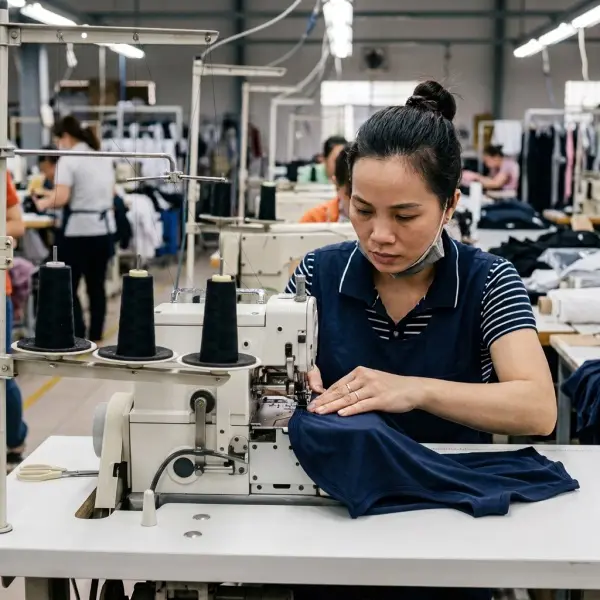
Stretch fabrics can make apparel more wearable, but they also make production more sensitive. During cutting, stretch fabric can shift, relax, curl, or distort. During sewing, it can create wavy seams, skipped stitches, seam cracking, or inconsistent measurements if tension is not controlled. During finishing, heat and handling can affect recovery and garment dimensions.
This is one reason factories with stretch fabric experience are valuable. Activewear, swimwear, underwear, stretch denim, and stretch tailoring all require different sewing knowledge. Needle type, stitch type, thread, seam allowance, tension, machine feed, elastic attachment, and pressing method can all affect the final garment.
For production teams, stretch fabrics require discipline in sample approval. The approved sample should not be judged only by appearance. It should be evaluated after movement, rest, washing, and measurement recovery. ASTM D2594/D2594M-21 is one example of a test method used to evaluate stretch properties of knitted fabrics, including fabric growth under prolonged stress, which is relevant to form-fitting apparel worn for long periods or during sitting. ASTM D2594 stretch properties of knitted fabrics
Stretch and Quality Control
Quality control for stretch apparel should include more than standard measurements. Measurements are still essential, but stretch garments need performance checks that reflect actual use. A garment can meet the spec sheet when laid flat and still fail when worn.
Key checks often include stretch percentage, recovery, growth after stress, shrinkage after laundering, opacity under stretch, seam elasticity, waistband recovery, pilling, abrasion, spirality, and colorfastness. For swimwear and performance apparel, exposure testing may also be needed depending on the product claim and use environment.
A practical quality control process may look like this:
|
QC Stage |
What to Check |
Why It Matters |
|
Fabric approval |
Weight, stretch, recovery, opacity, shrinkage |
Confirms material suitability before cutting |
|
Fit sample |
Movement, comfort, seam placement, negative ease |
Reveals real-body behavior |
|
Pre-production sample |
Sewing method, measurements, stress zones |
Confirms factory can execute the design |
|
Wash test |
Shrinkage, recovery, color, handfeel |
Predicts customer experience after care |
|
Bulk inspection |
Measurement consistency, seam quality, visible distortion |
Reduces return and complaint risk |
|
Wear trial |
Bagging, rolling, transparency, irritation |
Captures problems lab checks may miss |
The most valuable QC insight often comes from connecting fabric data with customer behavior. If customers wear leggings for gym activity, test for gym-like movement. If customers wear stretch trousers for office days, test sitting and standing over time. If customers wash basics frequently, test repeated washing rather than a single gentle cycle.
Retail and Customer Experience
Stretch fabrics affect how customers experience apparel before and after purchase. In store, stretch can make try-on easier and more forgiving. Online, stretch can reduce perceived fit risk when product pages explain it clearly. After purchase, stretch determines whether the garment keeps its promise during actual wear.
The retail challenge is communication. “Stretchy” is too vague. Customers want to know whether the garment feels soft, supportive, firm, flexible, sculpting, lightweight, compressive, breathable, or structured. These are different experiences. A waistband with gentle stretch is not the same as a high-compression legging. A stretch blazer is not the same as a knit cardigan.
Product copy should describe stretch in relation to use:
- “comfort stretch for easier movement”;
- “firm stretch with shape recovery”;
- “soft rib stretch for close layering”;
- “four-way stretch designed for active movement”;
- “structured stretch for tailored comfort”;
- “light support, not compression.”
This kind of language helps reduce mismatch between customer expectation and product reality. It also protects the brand from overclaiming performance that the garment has not been engineered to deliver.
Stretch Fabrics and Sustainability: A Careful View
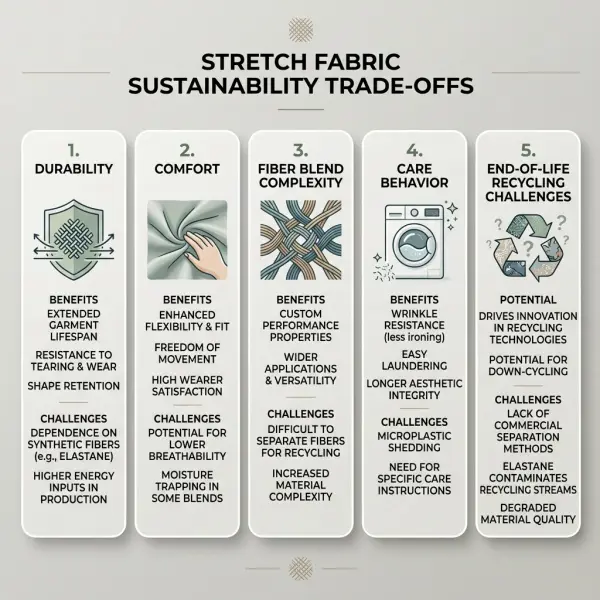
Stretch fabrics can support longer product use when they improve fit, comfort, and shape retention. A garment that remains wearable and keeps its shape may be less likely to be discarded early. That is a meaningful design objective.
But stretch fabrics also create sustainability challenges, especially when elastane is blended with other fibers. Textile Exchange notes that virgin synthetics are often fossil-based and commonly combined with other materials, making them difficult to recycle; it also states that elastane is hard to separate, so many mechanical and chemical recyclers struggle to process it. Textile Exchange on elastane and synthetic recycling challenges
This does not mean brands should avoid all stretch fabrics. It means sustainability claims need precision. A stretch garment may be durable, comfortable, and useful, but that does not automatically make it circular, recyclable, or low-impact. If a brand wants to make environmental claims, it should verify fiber origin, recycled content, chemical management, durability testing, care requirements, and end-of-life pathways.
The most credible approach is to design stretch garments for long use first, then be transparent about material trade-offs. A strong, honest claim is usually better than a broad green claim that cannot be supported.
What Brands Should Verify Before Choosing Stretch Fabric
Fashion businesses should verify stretch fabric through the lens of product use. The same fabric may be suitable for a casual top but unsuitable for leggings, swimwear, uniforms, or tailoring. A supplier swatch is only the beginning.
Before approving a stretch fabric, brands should clarify:
- What movement does the garment need to support?
- Does the fabric stretch in the correct direction?
- How well does it recover after repeated stress?
- Does it become sheer when stretched?
- Does it grow after sitting, bending, or wearing?
- Does it shrink, twist, or lose handfeel after washing?
- Can the factory sew it consistently?
- Does the fabric support the intended price point?
- Are fiber content and performance claims properly documented?
- Are sustainability claims specific and verifiable?
This verification process is especially important for small and growing brands. A poor stretch fabric decision may not show up immediately in product photos, but it can appear later through returns, reviews, sizing complaints, and repeat purchase decline.
Common Mistakes in Designing With Stretch Fabrics
Mistake 1: Choosing Stretch by Handfeel Alone
A soft, stretchy swatch can be persuasive in a sourcing meeting, but handfeel does not reveal recovery, opacity, growth, seam behavior, or wash durability. This mistake often leads to garments that feel promising at first but fail during actual wear.
A better approach is to combine handfeel review with structured testing. Designers can still care about touch and drape, but technical checks should confirm whether the fabric can perform in the intended garment.
Mistake 2: Assuming Stretch Solves Fit Problems
Stretch can make a garment more forgiving, but it does not replace fit development. Poor balance, incorrect grading, bad crotch shape, weak shoulder fit, or misplaced seams will still create discomfort and visual problems.
The better approach is to use stretch as part of fit engineering. Pattern, fabric, seam, and body measurement strategy must work together.
Mistake 3: Overstretching the Silhouette
Some brands push negative ease too far because the fabric can technically stretch. The garment may fit on the body, but it may feel restrictive, become transparent, distort prints, strain seams, or create customer discomfort.
A stretch garment should not be judged only by whether it can be worn. It should be judged by whether it can be worn comfortably and repeatedly in the intended context.
Mistake 4: Ignoring Recovery After Wear
Recovery is where many stretch garments succeed or fail. A garment that grows during wear can lose its shape even if it looked perfect at try-on. Denim knees, ribbed tops, leggings waistbands, and fitted dresses are common risk areas.
The better approach is to test recovery after realistic stress. Sitting, bending, stretching, washing, and resting should all be considered when approving the garment.
Mistake 5: Making Vague Performance Claims
Words like “supportive,” “sculpting,” “compression,” and “performance stretch” should be used carefully. If the garment has not been designed and tested for those qualities, the claim can create expectation risk.
Retail language should stay close to verified performance. “Comfort stretch” is different from “compression.” “Light support” is different from “body shaping.” Precision improves trust.
Practical Application for Fashion Businesses
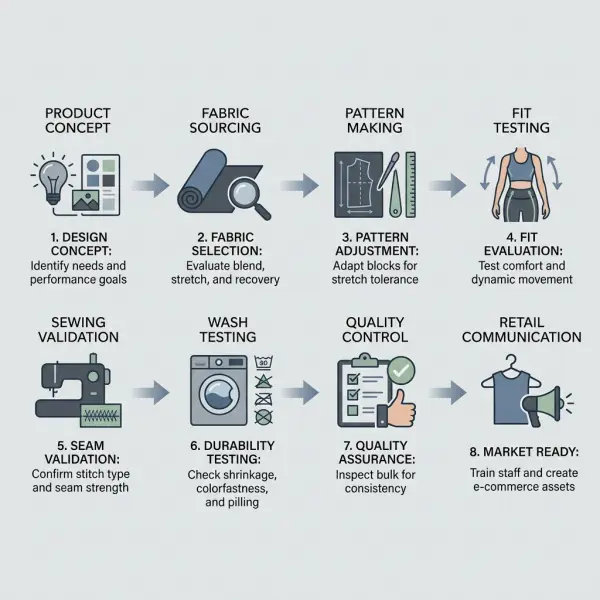
Stretch fabric strategy should begin during product concept, not after the sketch is approved. If the garment’s promise depends on movement, support, close fit, or shape retention, stretch behavior should be part of the design brief from the start.
For designers, this means sketching with fabric behavior in mind. A close silhouette needs stretch and recovery. A structured silhouette may need controlled stretch rather than high elasticity. A hybrid garment, such as a stretch blazer or travel trouser, may need enough give for comfort while preserving clean lines.
For sourcing teams, the material brief should specify end use, stretch direction, stretch percentage, recovery, fabric weight, opacity, wash performance, and sewing requirements. A supplier should understand whether the brand is developing activewear, denim, swimwear, dresses, uniforms, or casual basics.
For pattern makers, the key is balancing body measurement, garment measurement, stretch behavior, and fit intent. Negative ease should be calculated, tested, and adjusted. It should not be guessed.
For manufacturers, stretch fabric requires process control. Cutting, bundling, sewing, pressing, and inspection should avoid unnecessary distortion. Factories should test seam stretch and measurement stability before bulk approval.
For retail teams, stretch should be translated into customer language. The product page should explain what the stretch does: easier movement, close fit, firm hold, soft layering, structured comfort, or light support. Good communication reduces returns and improves customer confidence.
FAQ: Stretch Fabrics in Apparel Design
Why are stretch fabrics important in modern fashion?
Stretch fabrics are important because they help garments support real body movement while maintaining fit and silhouette. Modern customers often expect clothes to feel comfortable during sitting, walking, commuting, working, exercising, and daily movement. For brands, stretch fabrics can improve wearability, but only when fabric recovery, pattern making, seam construction, and care performance are properly managed.
What is the difference between stretch fabric and spandex fabric?
Stretch fabric is a broader category. It includes any fabric that extends under tension, whether the stretch comes from knit structure, mechanical construction, yarn engineering, or elastic fibers. Spandex fabric usually means a fabric that contains spandex or elastane fiber. In practice, many stretch fabrics contain elastane, but not all stretch fabrics depend on it.
Is four-way stretch always better than two-way stretch?
No. Four-way stretch is useful for garments that need multidirectional movement, such as leggings, swimwear, dancewear, and some activewear. But structured apparel may need controlled stretch rather than maximum stretch. A tailored trouser or blazer may perform better with moderate stretch that supports movement without weakening the garment’s shape.
How do stretch fabrics affect garment sizing?
Stretch fabrics can improve fit tolerance, but they do not eliminate the need for accurate sizing. Brands still need clear body measurements, fit models, grading rules, and movement testing. If stretch is used to compensate for poor sizing, the garment may pull, roll, become transparent, or lose shape during wear.
What is fabric recovery, and why does it matter?
Fabric recovery is the ability of a fabric to return toward its original shape after being stretched. It matters because garments are repeatedly stressed during wear. Poor recovery can lead to bagging, loose waistbands, distorted knees, stretched-out elbows, and weakened silhouettes. For many stretch garments, recovery is more important than stretch percentage alone.
Are stretch fabrics harder to sew?
Often, yes. Stretch fabrics can shift, curl, pucker, or distort if they are cut and sewn with the wrong process. Seam stretch, needle selection, thread, stitch type, tension, machine feed, and pressing all matter. Factories experienced with stretch apparel are usually better prepared to prevent wavy seams, seam cracking, and inconsistent measurements.
Can stretch fabrics be sustainable?
Stretch fabrics can support longer wear if they improve fit, durability, and shape retention, but sustainability claims need caution. Elastane blends can be difficult to recycle because elastane is hard to separate from other fibers. Brands should avoid broad claims like “eco-friendly stretch fabric” unless they have verified evidence for fiber origin, durability, chemical management, and end-of-life options.
Conclusion
Stretch fabrics matter because modern apparel is judged in motion. A garment must not only look good on a hanger, in a product photo, or during a first fitting. It must behave well when the customer sits, walks, bends, reaches, travels, works, trains, washes, and wears it repeatedly.
For fashion businesses, stretch is both an opportunity and a responsibility. It can improve comfort, fit, movement, recovery, and design flexibility. It can also create problems when used without proper testing, pattern engineering, factory capability, or honest product communication.
The best stretch fabric decisions are not based on softness alone. They are based on purpose: what the garment needs to do, how the body will move, how the fabric will recover, how the factory will produce it, and how the customer will understand it. That is why stretch fabrics are no longer a minor material detail. They are a core part of modern apparel design.




Comments 0
Leave a CommentSend Comment
Anda harus Login terlebih dahulu untuk dapat memberikan komentar.