

How Fabric, Labor, and Overhead Affect Apparel Costs
Quick Answer
Fabric, labor, and overhead affect apparel costs because they form the core cost structure behind most garments. Fabric influences cost through material price, consumption, width, shrinkage, cutting waste, defects, and minimum order quantities. Labor affects cost through sewing complexity, construction method, operator skill, production efficiency, finishing, inspection, and wage conditions. Overhead adds the hidden but necessary business costs that support production, including factory rent, utilities, supervision, equipment, compliance, sampling, administration, and brand-side operating expenses.
For fashion brands, these three cost drivers should not be analyzed separately. A cheaper fabric may increase waste or quality risk. A complex design may require more skilled labor. A small production run may increase overhead per unit because fixed costs are spread across fewer garments.
The practical takeaway is simple: apparel cost is not only about negotiating a lower supplier quote. It is about understanding how design, material, production method, order quantity, supplier capability, and business model work together. Brands that manage these cost drivers early can protect margin without weakening product quality.

Why These Three Cost Drivers Matter
Fabric, labor, and overhead matter because they explain why two garments that look similar can have very different production costs. A plain white shirt made from basic cotton poplin, sewn in a simple construction, and produced in a large order will not cost the same as a visually similar shirt made from premium long-staple cotton, with French seams, structured cuffs, specialty buttons, low-volume production, and strict quality inspection.
This is where many fashion brands misread cost. They compare finished products visually, then assume the cost gap should be small. In reality, apparel costing is shaped by what happens behind the garment: pattern efficiency, fabric behavior, cutting loss, sewing time, factory line setup, defect allowance, packaging standards, and the operational structure needed to produce consistently.
The previous article, garment costing explained for fashion brands, introduced the full garment costing framework. This article narrows the focus to the three cost drivers that usually create the biggest margin pressure: fabric, labor, and overhead.
Understanding these drivers helps a brand make sharper decisions before production begins. It can show whether a product should be simplified, repriced, moved to another supplier, produced in a larger batch, or removed from the range entirely.
Fabric Cost: More Than the Price Per Meter
Fabric cost is the total material cost created by the fabric used in a garment, not only the supplier’s quoted price per meter or yard. It includes how much fabric the garment consumes, how efficiently the pattern fits on the fabric width, how much waste occurs during cutting, whether the fabric shrinks, whether defects must be allowed for, and whether minimum purchase quantities create leftover stock.
For many garments, fabric is one of the most visible cost drivers because it directly affects handfeel, drape, structure, comfort, durability, and perceived value. But brands should be careful not to judge fabric only by price. A slightly more expensive fabric may produce better cutting yield, fewer defects, better customer satisfaction, or lower return risk. A cheaper fabric may look profitable on paper but become costly if it causes shade variation, seam slippage, poor recovery, shrinkage, or excessive cutting waste.
A fashion brand evaluating fabric cost should look at several connected variables:
- Fabric price per meter or yard
- Fabric width and usable width
- Garment consumption per size
- Marker efficiency during cutting
- Shrinkage allowance
- Cutting waste
- Defect allowance
- Dye lot or shade consistency
- Minimum order quantity
- Leftover fabric risk
- Testing, finishing, or compliance requirements
These variables matter because fabric cost is rarely linear. A fabric that costs less per meter can still produce a higher garment cost if it is narrow, unstable, difficult to cut, or requires extra allowance.
Fabric Consumption and Marker Efficiency
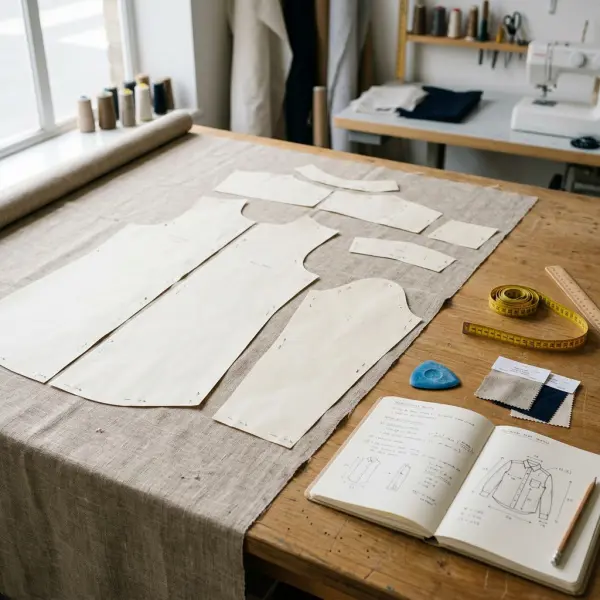
Fabric consumption is the amount of fabric required to make one garment. Marker efficiency describes how well pattern pieces are arranged on the fabric before cutting. Together, they can make a major difference to apparel cost.
A long dress, wide-leg trouser, oversized jacket, or bias-cut skirt naturally consumes more fabric than a fitted top or simple T-shirt. But even within the same garment category, fabric usage can vary because of size range, garment length, seam allowance, print direction, nap, stripe matching, check matching, or fabric width.
For example, a striped shirt may require extra fabric because the stripes need to align across front panels, sleeves, cuffs, and pocket placement. A velvet garment may also require directional cutting because the pile must face the same way. A printed dress with large motifs may need careful placement to avoid awkward print breaks. These details may not be obvious in a product photo, but they can affect cost immediately.
This is why accurate fabric costing should be based on pattern and marker calculation whenever possible, not only visual estimates.
Fabric Width, Shrinkage, and Waste
Fabric width affects how many pattern pieces can fit across the fabric. A wider fabric may reduce consumption if the pattern layout is efficient. A narrow fabric may increase consumption even if the price per meter is lower.
Shrinkage also matters. If fabric shrinks during washing, steaming, dyeing, or finishing, the brand may need to add allowance before cutting or require pre-shrinking. Without this, finished garments may come out smaller than specification, creating fit problems, rework, or rejected stock.
Waste is not always avoidable. Cutting leaves leftover spaces between pattern pieces. Defects may force the cutting team to avoid certain fabric areas. Matching checks, stripes, or prints can increase waste. The commercial question is not whether waste exists, but whether the costing sheet includes a realistic allowance for it.

Minimum Order Quantity and Leftover Fabric
Minimum order quantity can make fabric cost difficult for small brands. A mill may require 300, 500, 1,000, or more meters depending on fabric type, color, finishing, and supplier policy. If the brand only needs 180 meters for production, the leftover fabric still affects cash flow and inventory.
Some brands treat leftover fabric as a future asset. That can work if the fabric is versatile and likely to be reused. But deadstock can also become a hidden cost when color, season, trend, or category no longer fits the product range.
For emerging brands, the practical strategy is often to balance fabric ambition with production reality. Stock-supported fabrics, supplier-available color cards, or limited fabric libraries may reduce creative flexibility, but they can help control cash flow and reduce leftover material risk.
Labor Cost: The Cost of Skill, Time, and Production Flow
Labor cost in apparel is shaped by the time, skill, efficiency, and process discipline required to make a garment. It includes cutting, sewing, assembly, pressing, finishing, inspection, packing, and sometimes rework. In factory quotations, labor may appear as part of cut-make-trim cost, but the number is influenced by much more than sewing minutes alone.
A simple knit T-shirt may move quickly through production because the operations are familiar, machines are standard, and operators can repeat the process efficiently. A tailored blazer, lined dress, corset-style top, activewear legging, or garment with complex panels requires more operations, more handling, more quality checks, and often more skilled labor.
Labor cost is not only about wage level. It is also about productivity, line balance, operator experience, machine availability, supervision, training, quality standards, and factory efficiency. The International Labour Organization has documented employment, wage, and productivity trends in the Asian garment sector, including persistent decent work challenges; for brands, this is a reminder that labor cost should be understood within wider production and sourcing realities, not treated only as a negotiable line item.ILO analysis of employment, wages, and productivity in the Asian garment sector
Construction Complexity Drives Labor Time
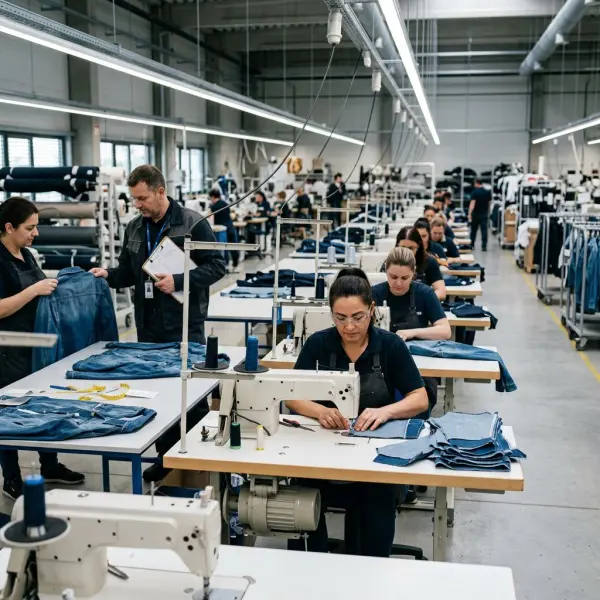
The more complex the garment construction, the more labor time it usually requires. A garment with lining, pleats, topstitching, binding, concealed zippers, curved seams, structured collars, multiple pockets, boning, embroidery placement, or hand-finishing will generally need more operations than a basic garment.
Each operation adds handling time. Some operations also require specialist machines or experienced operators. For instance, buttonholes, coverstitching, flatlock seams, welt pockets, fusing, quilting, and binding may require different equipment or higher precision. If the factory does not specialize in that construction type, production may slow down or defect rates may increase.
This is why design decisions should be costed early. A decorative detail may be visually valuable, but the brand should know whether it adds enough perceived value to justify the extra labor.
Efficiency Is Not the Same as Cutting Wages
Labor efficiency means producing consistent garments with less wasted time, fewer defects, better line balance, and smoother workflow. It should not be confused with simply pushing wages downward.
A factory can reduce labor cost per unit through better training, production planning, machine maintenance, workflow layout, and quality control. A poorly planned production line, by contrast, may create waiting time, bottlenecks, rework, and inconsistent output. The garment then becomes more expensive even if the quoted labor rate looks low.
For brands, the supplier question should not only be “How low is the CMT price?” It should also be “Can this supplier produce this garment consistently, at the required quality, within the required timeline?”
Rework Is a Hidden Labor Cost
Rework is one of the easiest labor costs to underestimate. It happens when garments need correction because of stitching defects, measurement issues, wrong trims, poor pressing, fabric damage, shade mismatch, or finishing problems.
Rework consumes time that could have been used for new production. It can delay delivery, increase inspection pressure, and reduce factory profitability. In some cases, rework also weakens garment quality. A seam that has been unpicked and resewn may not look as clean as a correctly sewn seam on the first attempt.
A brand that repeatedly changes specifications late or approves unclear samples may unintentionally increase rework. Good labor cost control therefore starts before the garment reaches the sewing line.
Overhead Cost: The Hidden Structure Behind Every Garment
Overhead cost is the indirect cost required to support production and business operations, even when it cannot be traced to one garment as easily as fabric or thread. In apparel, overhead may include factory rent, utilities, equipment depreciation, maintenance, production supervision, compliance systems, admin staff, sampling rooms, quality management, software, warehouse space, and brand-side expenses.
Overhead is often misunderstood because it feels less tangible than fabric or sewing. But no factory or fashion brand operates on direct costs alone. Someone maintains the machines. Someone manages payroll. Someone checks quality systems. Someone handles production planning, purchasing, communication, documentation, and logistics. These costs sit behind the garment even if they are not visible on the label.
For fashion brands, overhead matters because it affects true profitability. A garment may appear profitable if only material and factory cost are counted. But once product development, marketing, rent, salaries, warehousing, returns, photography, e-commerce platform fees, and administration are included, the margin may look very different.

Factory Overhead vs Brand Overhead
Factory overhead and brand overhead are related, but they are not the same.
Factory overhead supports manufacturing. It includes the indirect costs required to keep production running: rent, electricity, supervisors, mechanics, quality controllers, production planners, compliance staff, cutting room operations, and equipment maintenance.
Brand overhead supports the business that sells the product. It may include design salaries, sample development, photography, marketing, website maintenance, customer service, warehousing, returns handling, accounting, software, and office costs.
A supplier quote may include factory overhead inside its price, but it usually does not include the brand’s overhead. This is why a brand cannot treat supplier cost as the full cost of doing business. The brand still needs to recover its own operating expenses through margin.
Why Small Orders Carry Higher Overhead Per Unit
Small orders often carry higher overhead per unit because fixed costs are spread across fewer garments. A factory still needs to review the tech pack, set up production, prepare patterns, plan cutting, organize trims, manage quality, and handle documentation. Whether the order is 80 pieces or 800 pieces, some administrative and setup work still exists.
For small fashion brands, this creates a common tension. Small-batch production reduces inventory risk, but it can raise unit cost. Larger production may reduce unit cost, but it increases cash commitment and unsold stock risk.
The right decision depends on demand confidence. A brand testing a new silhouette may accept higher overhead per unit to avoid overproduction. A brand replenishing a proven bestseller may choose a larger run to improve cost efficiency.
How Fabric, Labor, and Overhead Interact
Fabric, labor, and overhead do not operate in isolation. They interact throughout product development and production. A material choice can change labor needs. A labor-intensive garment can increase overhead pressure. A small production run can make both fabric purchasing and overhead allocation more expensive per unit.
Consider a fashion brand developing a structured women’s jacket. The fabric is medium-weight wool blend, the garment includes lining, shoulder pads, fusing, welt pockets, buttonholes, pressing, and strict measurement control. Fabric cost is significant, but labor cost is also high because the construction is complex. Overhead increases because sampling, fitting, pressing equipment, quality control, and production supervision are more involved.
Now compare that with a simple oversized jersey T-shirt. Fabric still matters, but construction is simpler. Labor time is lower. Overhead per unit may also be lower if the order quantity is larger and the factory is set up for knit basics.
The interaction can be summarized this way:
|
Decision |
Fabric Impact |
Labor Impact |
Overhead Impact |
|
Choosing a delicate fabric |
May increase defect allowance |
May require careful handling |
May increase inspection and development time |
|
Adding lining |
Increases material use |
Adds sewing operations |
May require more sampling and QC |
|
Producing small batches |
May trigger higher fabric MOQ pressure |
Reduces line efficiency |
Raises overhead per unit |
|
Using complex trims |
Adds trim cost |
Adds attachment time |
Increases sourcing and approval work |
|
Tightening quality tolerance |
May increase rejection allowance |
Adds inspection and rework time |
Requires stronger QC systems |
|
Changing design late |
May waste fabric or trims |
May disrupt sewing plan |
Adds admin, sampling, and scheduling cost |
The lesson is practical: cost decisions should be made as a system. Reducing one cost line may increase another. A cheaper fabric may raise labor time. A lower CMT quote may increase quality risk. Smaller production may protect cash but reduce cost efficiency.
Landed Cost and International Sourcing
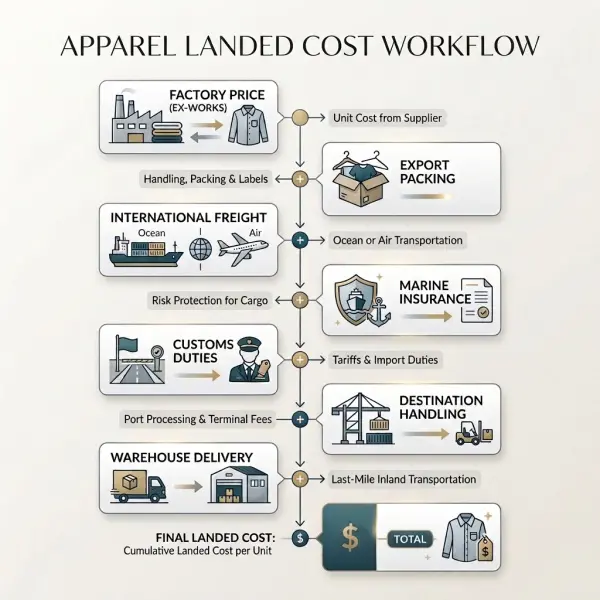
For international sourcing, apparel cost should be evaluated beyond the factory gate. Landed cost includes the cost of bringing the garment to the destination where it can be sold or distributed. This may include product cost, freight, insurance, customs duties, taxes, destination handling, and local delivery.
Delivery terms matter. The International Chamber of Commerce’s Incoterms® 2020 rules explain how responsibilities for freight, insurance, risk, and delivery obligations are allocated between buyer and seller in international trade. A FOB quote and a delivered warehouse cost are not the same commercial number.
Rules of origin can also influence cost in cross-border apparel trade. The World Trade Organization explains that rules of origin are criteria used to determine the national source of a product, and that duties and restrictions may depend on that source. For apparel brands using fabric from one country, sewing in another, and selling in a third market, this can be commercially important.
This is why supplier quotes should be compared on the same basis. A lower ex-factory price may not remain lower after freight, duty, documentation, customs handling, and lead-time risk are included.
How These Cost Drivers Affect Pricing and Margin
Fabric, labor, and overhead affect pricing because they define the cost base from which margin must be earned. If the cost base is incomplete, the selling price may look attractive but fail commercially.
A direct-to-consumer brand may need margin to cover marketing, photography, payment fees, warehousing, returns, customer service, and unsold stock. A wholesale brand must price low enough for retailers to apply their own markup, while still protecting the brand’s production margin. A made-to-order brand may avoid inventory risk but needs to account for higher labor handling and customization time.
This means the same garment cost can produce different pricing decisions depending on the business model. A $20 landed cost may be acceptable for one brand but too high for another if the second brand sells through wholesale, depends heavily on paid advertising, or experiences high returns.
The practical pricing question is not only “What markup should we use?” A better question is: “After fabric, labor, overhead, channel costs, markdown risk, and return allowance, does this product still support the business model?”
Practical Ways to Manage Fabric Cost
Fashion brands can manage fabric cost without simply downgrading material quality. The goal is to improve material decisions in ways that preserve product value.
One useful approach is to build a fabric library by category. Instead of sourcing a new fabric for every style, a brand can identify reliable core fabrics for shirts, dresses, trousers, jackets, or knitwear. This can improve supplier relationships, simplify testing, support repeat orders, and reduce leftover fabric risk.
Brands can also improve fabric cost control through better development discipline:
- Confirm fabric width before estimating consumption.
- Use pattern-based consumption rather than rough visual estimates.
- Check shrinkage and finishing behavior before bulk production.
- Review cutting efficiency for styles with large panels or directional prints.
- Avoid too many colorways unless demand justifies the fabric purchase.
- Reuse proven fabrics across multiple styles where appropriate.
- Track leftover fabric and plan realistic use, not wishful use.
This does not mean every brand should simplify its fabric strategy. Premium and designer brands may need distinctive fabrics to support positioning. The point is to make fabric choices intentionally, with clear understanding of their cost effect.
Practical Ways to Manage Labor Cost
Labor cost can be managed through better design clarity, supplier matching, and production preparation. It should not be managed only by pressuring factories for lower sewing prices.
A garment should be matched to a supplier that understands the category. A factory strong in basic knits may not be the best option for tailored jackets. A factory experienced in activewear may understand stretch handling, elastic insertion, coverstitching, and fit recovery better than a general woven factory. Supplier mismatch can increase labor time, rework, and quality risk.
Brands can reduce unnecessary labor pressure by improving technical preparation:
- Provide complete tech packs and construction details.
- Approve trims and fabric before production deadlines become tight.
- Avoid late design changes after costing approval.
- Use fit samples to solve construction issues before bulk production.
- Simplify details that customers do not value enough to justify the added cost.
- Build repeat styles where factories can improve efficiency over time.
- Review defect reports to identify recurring labor or construction problems.
Labor cost improves when the production process becomes clearer and more repeatable. A brand that constantly changes specifications, approves vague samples, or rushes production may create its own cost problem.
Practical Ways to Manage Overhead
Overhead is managed through scale, process discipline, and better allocation. For small brands, the first step is simply acknowledging overhead exists. Many early-stage brands count garment production cost but ignore product development, marketing, warehousing, admin, software, returns, and team time.
A practical overhead allocation does not need to be perfect, but it should be reasonable. A brand might allocate overhead by product category, collection, sales channel, or expected unit volume. The goal is not accounting perfection. The goal is to avoid pricing products as if the business has no operating costs.
Brands can manage overhead more effectively by:
- Reducing unnecessary SKU complexity.
- Limiting colorways that do not create meaningful sales.
- Reusing patterns or blocks where fit consistency supports the brand.
- Planning production calendars earlier to avoid rush charges.
- Consolidating suppliers when appropriate.
- Improving inventory forecasting.
- Tracking returns, repairs, and customer service cost by product type.
- Reviewing profitability after markdowns, not only at launch price.
Overhead often exposes whether a product range is too complicated for the size of the business. A small brand with too many styles, colors, suppliers, and launches may look active but operate inefficiently.
Responsible Cost Management
Managing apparel cost responsibly means understanding how cost reductions are achieved. A lower price may come from better efficiency, simpler design, improved planning, or smarter sourcing. But it may also come from reduced quality control, unrealistic lead times, excluded charges, or labor pressure.
The OECD’s Due Diligence Guidance for Responsible Supply Chains in the Garment and Footwear Sector encourages companies to identify, prevent, mitigate, and account for potential adverse impacts in garment and footwear supply chains. Costing is not the same as due diligence, but it can help brands ask better questions when a price looks unusually low.
A brand should be cautious when a supplier quote sits far below comparable offers. The reason may be legitimate efficiency, but it should be verified. Are materials equivalent? Are trims included? Is packaging included? Is production subcontracted? Are quality standards clear? Are compliance requirements understood?
Responsible cost management protects both margin and business continuity. A supplier pushed below realistic cost may become unreliable, reduce quality, delay orders, or exit the relationship.
Cost Driver Mistakes to Watch
This article focuses on how fabric, labor, and overhead affect apparel costs. The next article, common costing errors that reduce fashion profitability, will go deeper into costing mistakes. Still, a few cost-driver issues are worth flagging here because they appear frequently in product development.
The first mistake is treating fabric price as fabric cost. Fabric cost includes consumption, width, shrinkage, waste, defects, and leftover inventory. Looking only at the price per meter can make a material seem cheaper than it really is.
The second mistake is treating labor as a flat sewing charge. Labor cost changes with construction complexity, supplier specialization, quality tolerance, line efficiency, and rework. A low CMT quote may not be low if it creates defects or delays.
The third mistake is ignoring overhead until the end. Overhead does not disappear because it is difficult to assign. If a brand does not include overhead in pricing logic, the business may sell products that appear profitable but do not cover operating costs.
The fourth mistake is comparing supplier quotes without standardizing scope. A quote that includes fabric, trims, packing, and FOB delivery cannot be compared directly with a quote that only includes sewing. The comparison must be normalized before a decision is made.
What Brands Should Verify Before Approving Apparel Cost
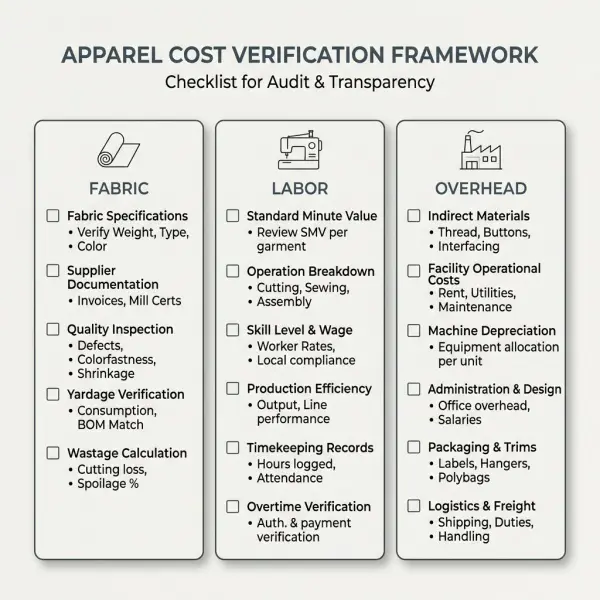
Before approving a cost, brands should verify the assumptions behind fabric, labor, and overhead. A cost sheet is only useful if the inputs are reliable.
A practical verification process should include:
- Is fabric consumption based on final pattern and size range?
- Has fabric shrinkage been tested or allowed for?
- Are cutting waste and defect allowance included?
- Are trims, labels, thread, fusing, lining, and packaging included?
- Does the labor cost reflect the approved construction?
- Are finishing, pressing, inspection, and rework assumptions clear?
- Is the factory experienced with this garment category?
- Is overhead included in the brand’s pricing calculation?
- Are freight, duty, and delivery terms clearly defined?
- Does the cost depend on an order quantity the brand can realistically place?
This verification step is especially important before production approval. Once fabric is purchased and production is scheduled, cost corrections become more difficult.
FAQ
What affects fabric cost in apparel production?
Fabric cost is affected by price per meter or yard, fabric width, garment consumption, marker efficiency, shrinkage, cutting waste, defect allowance, minimum order quantity, and leftover stock. Fabric performance also matters. A fabric that is cheaper upfront may become expensive if it causes high shrinkage, poor cutting yield, color inconsistency, or customer returns. For accurate costing, brands should calculate fabric cost from actual pattern consumption and production assumptions, not only from supplier price.
Why does labor cost vary between similar garments?
Labor cost varies because similar-looking garments can require different sewing operations, machine types, skill levels, handling time, finishing, pressing, and inspection. A simple blouse and a structured blouse may look close in photos but differ in collar construction, seam finishing, button placement, lining, or fit tolerance. Factory specialization also matters. A supplier experienced in the category may produce more efficiently than one learning the garment for the first time.
What is overhead in garment costing?
Overhead in garment costing refers to indirect costs that support production or business operations but are not tied to one material item. Factory overhead may include rent, utilities, supervisors, mechanics, quality systems, equipment, and administration. Brand overhead may include design, sampling, marketing, warehousing, customer service, returns handling, software, and office expenses. If overhead is ignored, a product may look profitable on paper but fail to support the real cost of running the business.
How can small fashion brands reduce apparel costs without lowering quality?
Small fashion brands can reduce apparel costs by improving planning rather than simply downgrading materials. They can reuse proven fabrics, limit unnecessary colorways, improve tech packs, choose suppliers matched to the product category, avoid late design changes, standardize trims, review fabric consumption, and build repeatable fits. Better planning can reduce waste, rework, rush charges, and sampling cost. Quality should be protected where it affects fit, durability, comfort, and brand credibility.
Why do small production runs cost more per unit?
Small production runs often cost more per unit because setup work, sampling, pattern preparation, cutting, trim sourcing, production planning, quality control, and administration are spread across fewer garments. Fabric and trim minimums can also create leftover stock. Small runs may still be strategically useful for testing demand, limited drops, or cash-flow control, but brands should understand that lower inventory risk often comes with higher unit cost.
Is cut-make-trim the same as labor cost?
Cut-make-trim, often called CMT, usually includes the factory charge for cutting, sewing, and basic garment assembly, but it may include more than direct labor. Depending on the supplier, CMT can also reflect factory overhead, production management, machine use, finishing, and margin. Brands should clarify exactly what is included. A CMT quote that excludes pressing, inspection, packing, or special operations may not represent the full manufacturing cost.
How do fabric, labor, and overhead affect retail price?
Fabric, labor, and overhead define the cost base that a retail price must cover. If these costs are high, the brand either needs a higher selling price, better perceived value, stronger margin strategy, or a redesigned product. Retail price also depends on channel costs, marketing, returns, markdowns, and brand positioning. A product should not be priced only by multiplying factory cost; it should be evaluated against the full commercial structure.
Should brands choose the cheapest supplier to reduce cost?
Brands should not choose a supplier based only on the cheapest quote. A low quote may be useful if the supplier is efficient and transparent, but it may be risky if it excludes key cost items, uses lower-quality materials, lacks category experience, or creates quality problems. A better approach is to compare quotes on the same scope, verify assumptions, review supplier capability, and consider quality, lead time, communication, and compliance alongside price.
Conclusion
Fabric, labor, and overhead are not just accounting categories. They are the practical forces that shape apparel cost from the first product idea to final delivery. Fabric determines material value and consumption. Labor reflects construction skill, production time, and factory efficiency. Overhead reveals the support system required to make and sell the garment.
For fashion brands, the strongest costing decisions happen before production begins. A fabric choice, design detail, supplier match, order quantity, or packaging standard can shift cost long before the product reaches the customer. When these decisions are made with clear cost visibility, brands can protect margin without weakening the product.
Better cost management is not about making every garment cheaper. It is about understanding what each garment truly requires, what customers are willing to pay for, and which costs support long-term brand value.





Comments 0
Leave a CommentSend Comment
Anda harus Login terlebih dahulu untuk dapat memberikan komentar.