

Why Profitable Fashion Brands Can Still Run Out of Cash
Quick Answer
A fashion brand can be profitable and still run out of cash because profit measures economic performance over an accounting period, while cash reflects money actually available to pay obligations at a particular moment.
The gap can become especially large in fashion because brands often pay for fabric, manufacturing, freight, inventory, marketing, and product development before the related sales produce usable cash. Wholesale customers may also pay weeks after delivery, while rapid growth can require another production order before cash from the previous one has fully returned.
Inventory creates another important difference. Cash may leave the bank when garments are produced, but inventory cost is generally recognized as an expense when the goods are sold rather than simply when they are purchased or manufactured. Capital expenditure, debt principal repayments, taxes, and other payments can create additional differences between reported profit and available cash.
A profitable fashion business therefore needs both healthy unit economics and sufficient liquidity. Profit answers whether the business model creates value; cash flow determines whether the company can continue funding operations while that value is being realized.

How Can a Profitable Fashion Brand Run Out of Cash?
A profitable fashion brand can run short of cash when the timing of its cash inflows does not match the timing of its cash obligations.
That sounds contradictory only if profit and cash are treated as the same thing.
They are not.
Accounting profit measures revenue against expenses recognized during a period. Cash flow measures actual receipts and payments. Under IAS 7 Statement of Cash Flows, operating cash flow reported using the indirect method begins with profit or loss and adjusts for non-cash transactions as well as accruals and deferrals of operating cash receipts and payments. That accounting structure itself demonstrates that reported profit and cash generated during a period are not identical.
For a fashion company, the difference becomes tangible very quickly.
A brand might have:
- profitable products;
- healthy gross margins;
- growing sales;
- strong wholesale orders;
- positive accounting profit;
and still struggle to pay the next factory deposit.
The underlying issue is usually not one single transaction. It is the accumulation of cash trapped in inventory, receivables, production commitments, growth, or other assets while bills continue to fall due.
Profitability and Liquidity Answer Different Questions
Profitability asks whether revenue exceeds the costs and expenses attributed to earning it. Liquidity asks whether the business has enough accessible cash to meet obligations when they become due.
A company needs both.
A fashion brand can temporarily survive while making losses if it has sufficient cash reserves or financing. Conversely, it can report profits and still face severe financial pressure if those profits have not converted into cash.
Consider a wholesale brand that sells $100,000 of garments during a season.
Suppose its recognized costs and operating expenses associated with those sales total $80,000. In simplified terms, the brand appears to have made a $20,000 profit.
That does not tell us:
- whether the retailer has already paid the $100,000;
- how much inventory had to be purchased in advance;
- whether another production run is already due;
- whether loan principal must be repaid;
- whether equipment was purchased;
- whether tax payments are approaching;
- how much cash remains in the bank.
Those are liquidity questions.
They can produce a very different picture.
The Accounting Timing Behind the Profit-Cash Gap
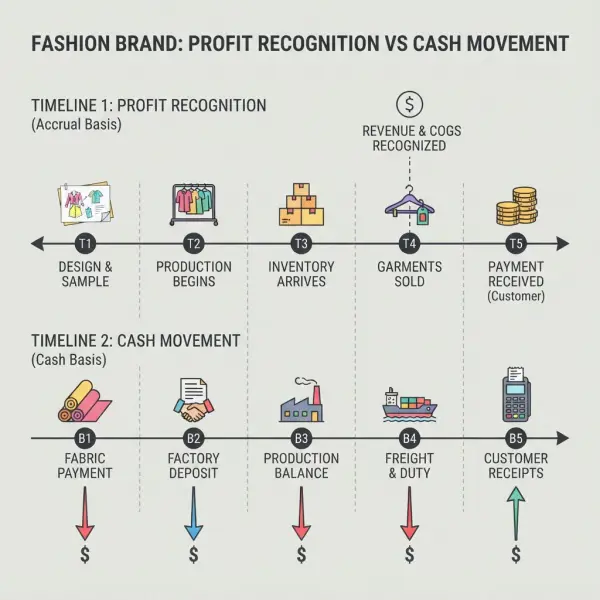
The easiest way to understand the problem is to follow when a fashion transaction affects the income statement compared with when it affects cash.
Take inventory.
Under IAS 2 Inventories, inventory includes goods held for sale, work in progress, and materials or supplies used in production. When inventory is sold, its carrying amount is recognized as an expense in the period in which the related revenue is recognized.
Cash can leave much earlier.
A brand may pay a fabric mill in February, a factory deposit in March, and a production balance in May. The finished garment might not sell until August.
The cash has already gone.
Yet the related inventory cost may remain on the balance sheet until the merchandise is sold.
This is one of the central reasons a growing apparel business can appear financially healthy in its profit-and-loss statement while its bank account becomes progressively tighter.
Seven Reasons a Profitable Fashion Brand Can Become Cash-Poor
There are many possible causes, but several are particularly relevant to product businesses.
1. Too Much Cash Is Tied Up in Inventory
Inventory may be an asset, but it is not available cash.
Imagine a fashion company with:
- $150,000 of inventory;
- $40,000 of receivables;
- $12,000 of bank cash.
The balance sheet may show substantial assets. Yet if payroll of $10,000 and a factory deposit of $18,000 are due next week, having $150,000 of garments in the warehouse does not solve the immediate payment problem.
Those garments first have to be sold and converted into customer receipts.
This distinction is particularly important in fashion because inventory risk is uneven. A core black T-shirt with stable demand is not economically equivalent to a highly seasonal occasion dress available in six sizes and four colors.
Both may carry the same accounting classification.
Their likelihood of converting quickly into cash can be very different.
IAS 2 also requires inventories within its scope to be measured at the lower of cost and net realisable value. Inventory may need to be written down when, for example, it becomes obsolete, damaged, or its expected recoverable selling value falls sufficiently.
For fashion operators, that accounting principle reflects a practical reality: the amount invested in stock is not necessarily the amount of cash that stock will ultimately return.
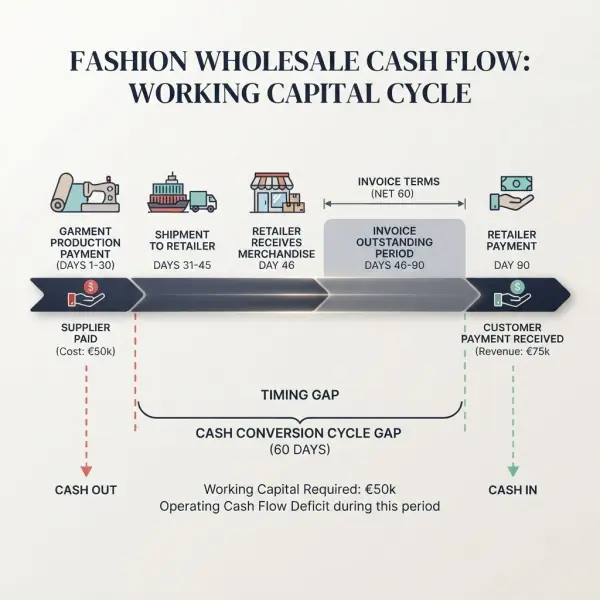
2. Wholesale Revenue Can Appear Before the Cash Arrives
Wholesale can amplify the difference between reported sales and available cash.
A brand may deliver a profitable order to a department store or boutique but allow the retailer 30, 60, or another agreed number of days to pay.
The goods have left.
Revenue may have been recognized under the applicable accounting rules.
The receivable exists.
But the bank account has not yet received the money.
IFRS 15 Revenue from Contracts with Customers distinguishes revenue recognition from the timing of customer payment and provides for receivables, contract assets, and contract liabilities according to the relevant circumstances.
For a small label, the practical consequence can be severe.
The factory that produced the order may require payment before shipment, while the retailer pays the brand much later.
The order can therefore be profitable and still consume cash for weeks or months.
3. Growth Can Consume Cash Faster Than It Generates It
Fast growth is often assumed to improve financial safety.
That is not necessarily true.
Growth can create additional working-capital requirements before the financial benefit of that growth reaches the bank.
Suppose a brand sells out much of its first collection and immediately wants to double production.
That sounds positive.
But doubling production can mean paying for:
- twice as much fabric;
- larger factory deposits;
- additional trims and packaging;
- greater freight volume;
- larger warehouse requirements;
- more marketing;
- potentially more staff.
If the cash generated from the previous collection is not enough to fund those commitments, the brand can become more cash-constrained precisely because demand is increasing.
This is sometimes described as overtrading: a business grows activity faster than its available working capital can support.
The underlying mechanics can be viewed through the cash operating cycle. ACCA defines this cycle as the time between paying suppliers and receiving cash from sales and expresses it as:
Inventory days + Receivables days − Payables days
A longer cycle generally means more resources are tied up in working capital. (ACCA working capital management guidance)
Growth is therefore not automatically cash-generative.
It depends on how quickly additional sales convert back into usable cash compared with how quickly the business must fund the growth.
4. The Next Collection Needs Funding Before the Previous One Has Fully Paid Back
Fashion rarely operates as one clean production cycle at a time.
While Spring/Summer stock is still selling, product development for the next range may already have started. Samples may be in progress. Materials may need reserving. Production deposits may soon be due.
This creates overlapping cash cycles.
A profitable first collection can therefore fund only part of the second.
The second may have to fund part of the third.
As assortment breadth increases, so can the amount of money simultaneously sitting in:
- raw materials;
- work in progress;
- finished goods;
- goods in transit;
- retail inventory;
- wholesale receivables.
This is where financial pressure can accelerate without any obvious collapse in sales.
The detailed interaction between production lead times, inventory purchasing, and customer pre-orders is covered separately in how pre-orders, inventory, and production cycles affect cash flow.
5. Capital Expenditure Uses Cash Without Becoming an Immediate Expense
Suppose a growing apparel business buys cutting equipment, computers, retail fixtures, warehouse systems, or other qualifying long-term assets.
The cash payment may occur immediately.
The accounting expense may not.
Under IAS 16 Property, Plant and Equipment, qualifying property, plant, and equipment is recognized as an asset, with its depreciable amount generally allocated systematically over its useful life rather than treated entirely as an immediate expense.
Imagine a brand pays $40,000 cash for equipment.
The bank balance falls by $40,000 now.
The income statement does not necessarily show a $40,000 expense in the same period.
This means a profitable company can make sensible long-term investments and still experience significant short-term cash depletion.
That does not make the investment wrong.
It means investment decisions need a liquidity test as well as a profitability case.
6. Debt Repayment Can Reduce Cash Differently From Profit
Borrowing can help bridge working-capital gaps, but repayment creates another distinction between cash and profit.
Under IAS 7, financing activities include transactions that change the size and composition of borrowings and contributed equity. Cash repayment of loan principal is therefore fundamentally a financing cash movement rather than simply the same thing as an operating expense.
For management purposes, the implication is straightforward.
A company can report positive profit while substantial principal repayments reduce bank cash.
This often matters when financing is used to fund inventory expansion.
The business may have:
- borrowed to finance stock;
- sold that stock profitably;
- generated an accounting profit;
- still need to return a substantial amount of borrowed cash.
Looking at profit without reviewing the debt repayment schedule gives management only part of the picture.
7. Tax, Returns, Refunds, and Other Timing Items Still Need Cash
A strong sales month can create the appearance of abundant liquidity.
Some of that money may effectively already have another destination.
Depending on jurisdiction and business structure, a company may have sales-related taxes, corporate tax obligations, payroll obligations, or similar amounts to settle later. Customer returns and refunds can also reverse part of earlier cash receipts.
The exact tax treatment varies considerably between countries, so there is no universal percentage that every fashion business should reserve.
The principle is more general:
Cash in the bank is not the same as cash available for discretionary spending.
A useful internal cash view distinguishes unrestricted liquidity from amounts effectively reserved for known obligations.
A Fashion Brand Can Be Profitable and Still Have Negative Operating Cash Flow
This is one of the clearest warning signals management should understand.
Accounting profit can remain positive even when operating activities consume cash during a period.
For example:
|
Business development |
Effect on profit |
Effect on cash |
|
Profitable wholesale sale on credit |
Can increase profit |
Cash may not yet arrive |
|
Large inventory build |
Limited immediate P&L impact until goods sell |
Cash decreases |
|
Increase in customer receivables |
Revenue may already be recognized |
Cash remains outstanding |
|
Longer supplier terms |
Little direct effect on profit |
Can temporarily preserve cash |
|
Equipment purchase |
Usually not fully expensed immediately |
Cash may leave immediately |
|
Loan principal repayment |
Not equivalent to an operating expense |
Cash decreases |
|
Depreciation |
Reduces accounting profit |
No current-period cash payment for depreciation itself |
This is why the cash flow statement exists as a separate financial statement rather than being inferred from the income statement.
IAS 7 specifically separates operating, investing, and financing cash flows to help users understand how cash and cash equivalents changed during a period.
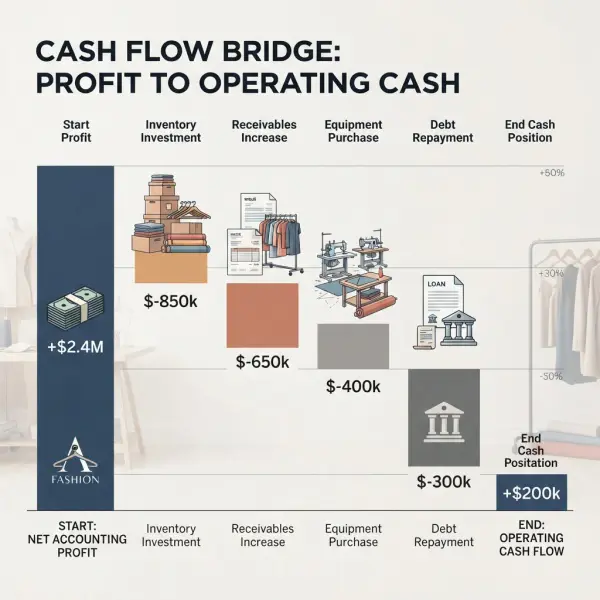
A Simple Example: A Profitable Brand With Almost No Cash
Consider a simplified fashion company starting the quarter with $60,000 cash.
During the quarter it sells enough merchandise to record:
- Revenue: $150,000
- Cost of goods sold: $75,000
- Operating expenses: $50,000
- Accounting profit before other relevant items: $25,000
At first glance, the business appears healthy.
Now look at what happens to cash.
The company also:
- spends $45,000 building inventory for the next collection;
- has $35,000 of the current quarter's customer sales still outstanding as wholesale receivables;
- pays $12,000 toward loan principal;
- spends $10,000 on qualifying studio equipment.
This example is deliberately simplified, but it shows the mechanism.
The $25,000 profit does not mean the company added $25,000 to its bank balance.
Substantial money has moved into inventory, receivables, asset purchases, and debt repayment.
The business can therefore end the period with a materially weaker cash position even though its income statement still shows a profit.
The conclusion is not that inventory, wholesale credit, equipment, or borrowing are inherently undesirable.
All four may support growth.
The problem appears when management evaluates them only through profitability without asking what they do to liquidity.
Why Gross Margin Can Give Fashion Founders False Comfort
Gross margin is essential, but it does not measure liquidity.
A product with a 65% gross margin can still place pressure on cash if the brand has to manufacture thousands of units months before they sell.
Likewise, a collection can achieve attractive margins while selling too slowly to fund the next buying cycle.
Consider two products.
Product A has a higher margin but requires a large minimum order quantity and takes eight months to sell.
Product B has a somewhat lower margin but can be reordered in small quantities and sells within six weeks.
Product A may still be more profitable.
Product B may be more cash-efficient.
Which is commercially preferable depends on demand stability, margin, inventory risk, supplier terms, replenishment capability, strategic importance, and the company's capital position.
This is why strong fashion finance should not optimize margin, inventory, or cash conversion independently.
The variables interact.
Why Direct-to-Consumer Brands Are Not Immune
Direct-to-consumer fashion can shorten the receivables cycle because customers frequently pay at or near the point of purchase.
That is an advantage.
It does not eliminate working-capital risk.
A DTC brand may still pay factories weeks or months before customers buy the finished goods. It may also fund photography, influencers, paid acquisition, fulfilment preparation, packaging, and inventory before launch.
Returns create another lag.
The brand may receive $100 from a customer today, spend part of it tomorrow, and then have to refund that customer later.
Rapid customer acquisition can compound the issue if growth requires continuously larger inventory positions.
So while DTC and wholesale models can have different cash profiles, neither is automatically protected from liquidity problems.
Why Growth Often Exposes Weak Cash Management
A slow-growing company can sometimes tolerate inefficient cash practices because each production cycle remains relatively small.
Growth magnifies them.
If inventory increases 10%, a weak forecasting process may be inconvenient.
If inventory doubles, the same weakness can become financially dangerous.
Growth can also produce a misleading psychological signal.
Sales dashboards rise.
New wholesale accounts arrive.
Website traffic improves.
Employees are hired.
Production volumes expand.
Management feels successful.
Yet each success may require another payment before the associated cash returns.
The business has not necessarily become weaker. It has become more capital-hungry.
This distinction matters because the appropriate response is different.
If the underlying economics are poor, the business may need to change pricing, cost structure, assortment, or strategy.
If the economics are sound but growth is consuming working capital, the solution may instead involve better production planning, payment terms, inventory discipline, retained cash, or appropriate financing.
Profit Problems and Cash Problems Should Not Be Diagnosed the Same Way
This is one of the most important management distinctions.
A chronically unprofitable business cannot usually solve its underlying problem simply by borrowing more money.
Likewise, a profitable business with a temporary working-capital gap does not necessarily need to reduce every expense.
Before reacting, determine which problem actually exists.
|
Situation |
Likely issue |
Management focus |
|
Products lose money after relevant costs |
Profitability |
Pricing, sourcing, cost structure, assortment |
|
Profitable sales but cash sits in inventory |
Working capital |
Buying depth, sell-through, replenishment |
|
Profitable wholesale sales but invoices remain unpaid |
Receivables |
Payment terms, collections, customer credit |
|
Growing sales require larger production commitments |
Growth financing |
Forecasting, working capital, financing structure |
|
Strong cash balance but recurring losses |
Temporary liquidity masking poor economics |
Restore sustainable profitability |
|
Profitable operations but large asset purchases consume cash |
Investment timing |
Capex planning and liquidity |
The distinction prevents a common strategic error: trying to fix a structural profitability problem with short-term cash or trying to solve a temporary cash timing problem by damaging a fundamentally healthy business.
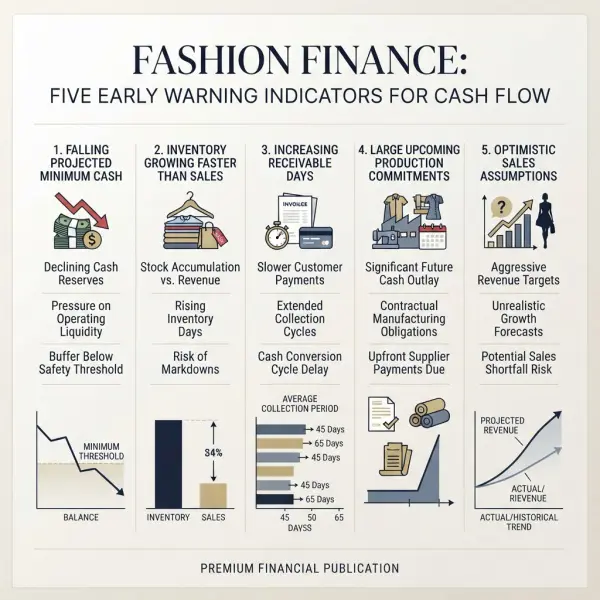
How Fashion Brands Can See a Cash Shortage Earlier
Cash shortages rarely become dangerous on the exact day the bank account becomes low.
Warning signs usually appear earlier.
Track the projected minimum cash balance
Month-end cash can hide problems inside the month.
A business expecting to finish June with $50,000 might fall to $3,000 on June 14 before a major retailer pays on June 28.
The lowest projected cash position is therefore often more informative than the final monthly balance.
Monitor inventory growth against sales growth
If inventory is consistently expanding faster than sales, investigate why.
The explanation might be reasonable—for example, preparation for a new channel or major seasonal launch.
But it may also reveal overbuying, weak sell-through, excessive SKU proliferation, or purchasing decisions built on optimistic forecasts.
Review receivables by due date
Total receivables alone are not enough.
Separate:
- invoices not yet due;
- invoices due soon;
- overdue invoices;
- disputed invoices;
- customers with repeated payment delays.
A $200,000 receivables balance is less reassuring if much of it is substantially overdue.
Include purchase commitments that have not yet hit the bank
Factories and material suppliers may have confirmed orders that will create payments next month even though the invoices are not yet due.
A useful cash forecast therefore looks beyond bills already sitting in accounts payable.
It includes contractual or commercially committed future obligations.
Stress-test sales assumptions
Management should know what happens if:
- launch sales are 20–30% below plan;
- inventory takes two months longer to sell;
- a retailer pays late;
- returns increase;
- the next production balance becomes due earlier than expected.
Scenario analysis converts cash management from observation into risk management.
How Should a Profitable Fashion Brand Respond to a Cash Squeeze?
The answer depends on why the cash squeeze exists.
There is no universal remedy.
If inventory is consuming the cash
Review buying depth, reorder strategy, SKU productivity, aged stock, and future purchase orders.
Cancelling everything may damage the business, but continuing to buy according to an outdated sales forecast can make the shortage worse.
The first objective is to identify which stock positions are likely to convert into cash and which are merely absorbing capital.
If receivables are the problem
Improve invoice discipline, monitor due dates, resolve disputes early, and reconsider customer payment terms where commercially possible.
A growing wholesale business should not measure account quality only by order volume.
Payment reliability matters too.
If growth is the problem
Build the incremental working-capital requirement into the growth plan.
A brand that plans to double sales cannot assume the same amount of cash will support twice the activity.
Model how much additional inventory, receivables, labour, freight, and marketing the target requires before approving the expansion.
If capital expenditure is creating pressure
Separate investments that are necessary now from investments that can be phased.
The expected return on an asset may be attractive while the purchase timing is still wrong.
If debt commitments are the problem
Map principal and interest payments against operating cash generation.
Refinancing or changing financing structures can have significant consequences and costs, so such decisions should be evaluated professionally rather than used as an automatic response to poor forecasting.
Common Mistakes When a Profitable Brand Starts Running Short of Cash
Mistake 1: Assuming profitability guarantees financial safety
It does not.
Profitability is essential for long-term viability, but businesses need liquidity to survive the period between spending and collecting.
A profitable company unable to meet obligations can still encounter severe financial distress.
Mistake 2: Looking only at the bank balance
A large balance can create false confidence if substantial supplier payments, taxes, payroll, refunds, or production deposits are imminent.
The better measure is available cash after considering near-term commitments.
Mistake 3: Using next season's cash to cover uncontrolled problems from this season
This can happen quietly.
New customer receipts are used to pay old supplier bills, while the production costs related to those new sales remain unfunded.
One timing mismatch begins funding another.
If repeated, the business can become dependent on continual sales acceleration merely to remain current.
Mistake 4: Increasing production because a style is profitable
Profitability alone does not determine the financially safe order quantity.
A reorder should also consider:
- sell-through velocity;
- replenishment lead time;
- cash available;
- supplier terms;
- stock already committed;
- downside demand scenario.
The most profitable theoretical quantity can still be too large for the company's liquidity capacity.
Mistake 5: Borrowing without fixing the underlying cash cycle
Financing can be appropriate when it bridges a well-understood timing gap.
It is much less effective when the underlying issue is persistent overbuying, poor margins, weak collections, or customers that do not pay.
New cash can delay the consequences of weak economics without correcting them.
A Practical Profit-to-Cash Review for Fashion Businesses
A useful management exercise is to start with reported or forecast profit and ask where the cash has gone.
The review does not need to replace a formal cash flow statement. It is a decision tool.
Ask:
1. Has inventory increased?
If yes, how much cash has been committed to raw materials, work in progress, finished goods, and goods in transit?
2. Have receivables increased?
Which profitable sales have not yet been collected?
3. Have supplier balances changed?
Has the business preserved cash because suppliers have not yet been paid, or has it paid suppliers faster than customers pay?
4. Has the company purchased long-term assets?
How much cash was invested in equipment, stores, systems, or other assets?
5. Has debt been repaid?
What principal repayments reduced cash?
6. Are significant obligations approaching?
Taxes, payroll, production deposits, freight, returns, and other commitments can change the near-term picture.
This review turns “We made money—where did it go?” into an answerable financial question.
What Brands Should Verify Before Concluding They Have a Cash-Flow Problem
Not every low bank balance means the same thing.
Before acting, verify:
- whether the business is genuinely profitable after all relevant costs;
- whether profit figures are actual or only forecast;
- inventory quantities and age;
- receivable aging and customer payment reliability;
- existing supplier commitments;
- actual production payment schedules;
- expected customer settlement dates;
- debt repayments;
- upcoming tax and payroll obligations;
- capital expenditure;
- return and refund exposure;
- unused but committed credit facilities, if any.
Accounting treatment should also be reviewed with an appropriately qualified accountant under the standards and regulations applicable to the business.
The accounting examples in this article illustrate general financial mechanisms. They do not establish how every transaction must be treated in every country, entity type, or reporting framework.
Profitability Still Matters—Cash Management Does Not Replace It
It can be tempting to conclude that cash is all that matters.
That would be equally misleading.
A company can improve short-term cash by delaying purchases, negotiating longer supplier terms, borrowing, raising equity, or reducing inventory.
None of those actions automatically makes an unprofitable product profitable.
Cash management cannot permanently rescue a business model that consistently sells products for less than their full economic cost.
Similarly, strong profits do not remove the need for working capital.
The two disciplines solve different parts of the same commercial problem:
Profitability determines whether value is being created.
Cash flow determines whether the company can finance the path required to create and collect that value.
Healthy fashion businesses need both.
Frequently Asked Questions
Can a fashion brand make a profit and still have negative cash flow?
Yes. Profit and cash flow measure different things. A profitable fashion company can have negative cash flow if it builds inventory, waits for wholesale customers to pay, buys equipment, repays debt principal, or makes other cash payments that do not correspond directly with expenses recognized in the same period. Negative cash flow is therefore not automatically proof that the company is unprofitable. Its cause, duration, funding source, and expected reversal need to be understood.
Is positive cash flow more important than profit?
Neither can replace the other. Positive cash flow helps a business meet immediate obligations, while sustainable profitability is necessary for creating economic value over time. A loss-making fashion company may temporarily show positive cash flow because it borrowed money, received investor capital, or reduced inventory. Conversely, a profitable company may temporarily consume cash while expanding. Management should therefore examine profitability, operating cash generation, working capital, financing, and investment together.
Why does buying inventory reduce cash but not immediately reduce profit?
Because unsold inventory is generally recorded as an asset rather than expensed in full immediately. Under IAS 2, when inventory is sold, its carrying amount is recognized as an expense in the period in which the related revenue is recognized. Cash, however, may have been paid much earlier to acquire or manufacture the inventory. This timing difference is particularly important for apparel brands that commit to production months before the product sells.
Why can rapid fashion brand growth create a cash shortage?
Growth often requires additional working capital before additional sales return as cash. A growing brand may need larger production deposits, more inventory, higher freight spending, increased marketing, and additional staff. Wholesale expansion may also increase receivables. If those requirements grow faster than retained cash or financing capacity, the company can become cash-constrained even while sales and profit are increasing.
Are wholesale fashion businesses more vulnerable to cash-flow gaps than DTC brands?
Wholesale often creates a larger receivables gap because retailers may pay after delivery, while suppliers may need to be paid earlier. Direct-to-consumer businesses frequently receive customer cash faster, but they can still face substantial inventory, marketing, return, and production commitments. Neither model is inherently cash-safe. Their working-capital structures are simply different, and actual risk depends on payment terms, inventory strategy, supplier arrangements, and growth rate.





Comments 0
Leave a CommentSend Comment
Anda harus Login terlebih dahulu untuk dapat memberikan komentar.