
Cottagecore, Gorpcore, and Balletcore: Why Micro-Aesthetics Spread Fast
Quick Answer
Micro-aesthetics such as cottagecore, gorpcore, and balletcore spread quickly because they compress a complex visual world into a simple, memorable label. Each gives consumers a recognizable combination of garments, colors, materials, activities, cultural references, and moods that can be understood almost immediately through images.
Their speed does not mean the underlying fashion ideas are new. Cottagecore draws on long-established pastoral and romantic imagery; gorpcore reframes functional outdoor clothing as fashion; balletcore repackages a much older relationship between ballet and dress. What changes is how these references are named, bundled, searched, shared, and remixed online.
Several characteristics make micro-aesthetics particularly portable: strong visual codes, relatively low barriers to participation, familiar products that can be restyled, creator-driven interpretation, and enough flexibility for users to make their own versions.
For fashion businesses, the useful question is therefore not simply whether an aesthetic is “trending.” It is which product attributes underneath the aesthetic are gaining genuine demand, how long those attributes may remain relevant, and whether they fit the brand's existing customer and design language.
What Are Fashion Micro-Aesthetics?
A fashion micro-aesthetic is a relatively narrow, recognizable visual concept that organizes clothing, styling, cultural references, and often lifestyle imagery around a memorable label.
The word “micro” can be misleading if it is taken to mean insignificant. Some aesthetics can generate widespread media attention, retail activity, and millions of pieces of social content. The term is more useful for describing their specificity compared with broader fashion categories such as minimalism, sportswear, romantic dressing, preppy style, or workwear.
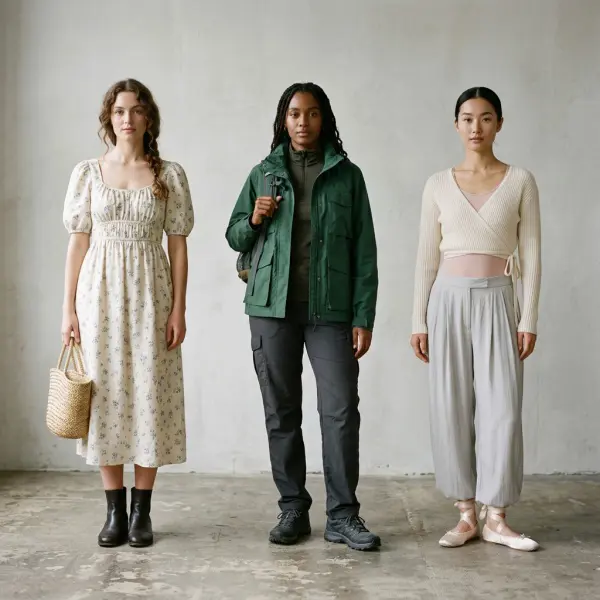
Cottagecore, for example, does not simply mean “feminine clothing.” It evokes pastoral landscapes, domestic crafts, floral dresses, natural materials, gardening, baking, vintage references, and an idealized form of rural life.
Gorpcore is not simply “sportswear.” Its visual language comes more specifically from hiking and performance outdoor clothing: technical shells, fleeces, utility trousers, trail shoes, backpacks, layered weather protection, and products associated with outdoor brands.
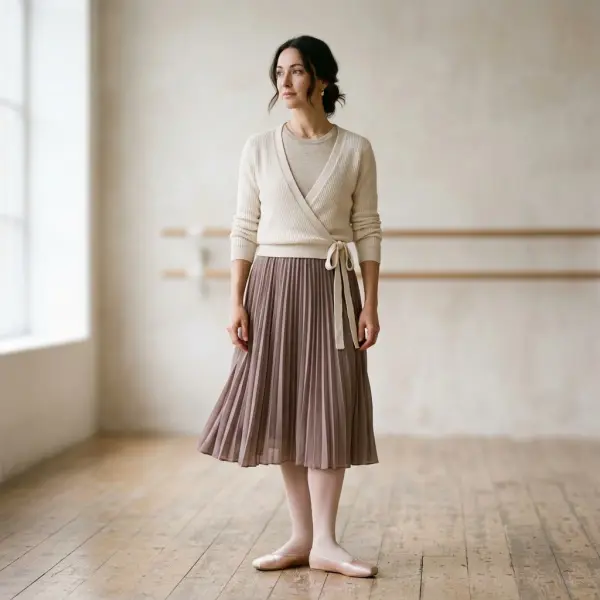
Balletcore does not mean every delicate or pink outfit. It draws specifically from the visual vocabulary surrounding ballet and dance practice: ballet flats, wrap knits, tights, leotard-like silhouettes, leg warmers, ribbons, tulle, and close-to-body layering.
These categories remain flexible rather than formally defined. Vogue has described many of these so-called microtrends more accurately as internet aesthetics—pre-packaged visual worlds that frequently reframe styles and products that already existed. Vogue analysis of internet aesthetics and microtrends
That distinction matters. A viral name can be new even when the garments underneath it are not.
Cottagecore: A New Label for a Much Older Pastoral Fantasy
Cottagecore became highly visible online in 2020, but neither floral dresses nor romanticized country life began with social media.
Its fashion codes draw from much older sources: pastoral imagery, prairie and peasant-inspired dress, historical costume references, folk clothing, handmade craft, vintage domestic aesthetics, romantic fashion, and idealized representations of rural living.
What the internet did was bundle those references into a particularly accessible visual identity.
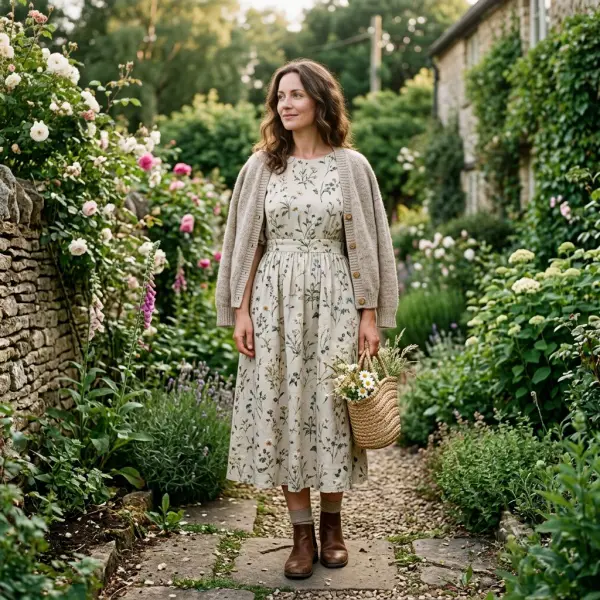
Typical cottagecore fashion may include:
- floral or botanical prints;
- cotton and linen-like textures;
- puff sleeves;
- gathered or tiered skirts;
- smocking;
- aprons or pinafore references;
- cardigans and hand-knit textures;
- lace, embroidery, and other craft-associated details;
- vintage-inspired dresses and accessories.
The aesthetic often extends beyond clothes into interiors, gardening, food preparation, crafts, nature, and rural photography. That broader lifestyle dimension helped make it especially easy to build rich visual narratives around the fashion.
Vogue documented cottagecore as one of the notable internet aesthetics that accelerated during the 2020 lockdown period, when home life, baking, gardening, outdoor spaces, and escapist rural imagery acquired particular cultural relevance. Vogue Business on cottagecore and the changing fashion trend funnel
The important nuance is that the pandemic helped accelerate its visibility; it did not create pastoral dressing from nothing.
Why cottagecore was highly shareable
Cottagecore had something that many product-level trends lack: a complete visual universe.
A particular shoe can generate product interest. Cottagecore could generate dresses, recipes, interiors, garden imagery, handmade crafts, books, picnics, photography, music references, and lifestyle content.
That gave creators many entry points.
Someone did not need to buy a full cottagecore wardrobe to participate. She could post a floral dress, bake bread in a rustic kitchen, photograph wildflowers, style a second-hand cardigan, or assemble a pastoral moodboard.
The aesthetic was therefore both distinctive and expandable.
This combination—clear enough to recognize, broad enough to reinterpret—is one of the recurring reasons micro-aesthetics travel quickly.
Gorpcore: When Performance Clothing Became Fashion Language
Gorpcore follows a very different visual logic.
Rather than romantic escape, it is built around the visual codes of outdoor utility.
The term gorpcore was coined in 2017 by writer Jason Chen at The Cut, according to later fashion coverage; “gorp” is commonly associated with the trail snack phrase “good ol' raisins and peanuts.” Financial Times discussion of gorpcore and its origin
The aesthetic draws from products originally designed—or visually associated—with hiking, climbing, trail running, camping, and other outdoor activities.
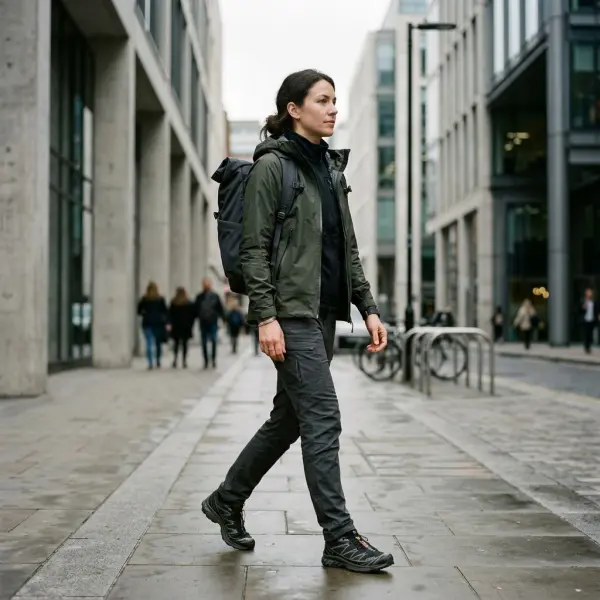
Recognizable elements can include technical shells, fleece jackets, padded outerwear, cargo or utility trousers, trail-running shoes, hiking footwear, caps, backpacks, adjustable cords, weather-resistant fabrics, and layered functional clothing.
At its strongest, gorpcore contains an interesting tension: products designed to solve practical outdoor problems are recontextualized within urban fashion.
Vogue Business has described gorpcore through products such as Arc'teryx waterproofs, The North Face outerwear, and Salomon trail footwear, while also documenting how the look evolved as technical clothing increasingly crossed between outdoor and city use. Vogue Business on the evolution of gorpcore and technical fashion
Gorpcore demonstrates how products can outlive a trend name
This is particularly useful for fashion businesses to understand.
A waterproof shell does not stop being useful if consumers stop saying “gorpcore.” Neither does a fleece, cargo trouser, or trail shoe.
Some items attached to an aesthetic have an independent reason to exist.
That gives gorpcore a different product foundation from aesthetics relying heavily on highly decorative trend signifiers. Function can provide additional durability because the consumer may continue using the garment for weather protection, walking, travel, commuting, or outdoor activity after the cultural label becomes less fashionable.
There is still a caveat.
Not everything that looks technical necessarily performs technically. A fashion garment inspired by a waterproof shell should not be presented as weatherproof unless its fabric, seam construction, closures, testing, and overall design support that claim.
Visual reference and functional performance are separate product questions.
Balletcore: Fashion Repackages the Visual Vocabulary of Dance
Balletcore provides perhaps the clearest example of an aesthetic whose apparent novelty can obscure a much longer fashion history.
Fashion has borrowed from ballet for decades.
Vogue's historical review of ballet-inspired fashion notes that the influence of ballet practice clothing—including leotards and tights—can be traced at least to the balletomania of the 1930s and 1940s. What changed in the early 2020s was the renewed visibility of these references under the conveniently searchable term “balletcore.” Vogue history of balletcore and ballet-inspired fashion
Contemporary balletcore commonly draws from:
- ballet flats and Mary Jane-like footwear;
- wrap cardigans;
- leg warmers;
- close-fitting knitwear;
- leotard or bodysuit references;
- tights;
- tulle;
- ribbon detailing;
- soft layering;
- blush, cream, black, grey, and other dancewear-associated palettes.
But professional ballet and balletcore should not be treated as identical.
Actual dancewear exists within a demanding technical discipline. Vogue's interviews with professional ballerinas highlighted the gap between the romanticized aesthetic and the practical reality of dancers' working clothing. professional ballerinas discussing balletcore
That gap is worth keeping visible. Balletcore borrows a fashion vocabulary from ballet; it does not reproduce the profession itself.
Why Do Micro-Aesthetics Spread So Fast?
The speed comes from several mechanisms working together.
It would be too simplistic to attribute everything to an algorithm. Algorithms influence distribution, but an aesthetic also has to be understandable and reproducible enough for people to use it.
1. A memorable label compresses many visual ideas
“Technical outdoor fashion with hiking references worn in urban environments” is descriptive but cumbersome.
“Gorpcore” is portable.
The same compression happens with cottagecore and balletcore. Once a visual category receives a short name, people can search it, tag it, discuss it, compare themselves with it, create shopping guides around it, and make new variations.
A label essentially becomes metadata for a visual idea.
That is particularly useful in environments where enormous volumes of fashion imagery compete for attention.
The deeper implications of this naming mechanism belong to why social media changes how fashion trends are named and adopted.
2. The aesthetic can be understood almost instantly
Micro-aesthetics tend to contain visually legible signals.
A tulle skirt with ballet flats communicates differently from a technical shell and trail shoes. A puff-sleeve floral dress photographed in a garden creates yet another immediate association.
That visual efficiency matters on image- and video-led platforms.
Users do not need to read a long cultural explanation before recognizing the general direction.
This does not mean every outfit is identical. It means the category contains enough repeated cues to become visually recognizable.
3. Participation can start with one or two objects
Aesthetic adoption is modular.
A consumer interested in balletcore can begin with ballet flats. Someone exploring gorpcore might add trail shoes or a technical jacket. Cottagecore can be expressed through a floral dress or vintage-inspired blouse.
This lowers the cost and effort of experimentation.
A micro-aesthetic that required an entirely new wardrobe would face greater adoption friction.
The fact that many aesthetics reuse products already in circulation—including vintage clothing, outdoor gear, basics, and established footwear categories—makes remixing even easier.
4. Existing fashion gets renamed rather than invented
This is one of the most overlooked reasons micro-aesthetics can appear to emerge suddenly.
Often, the audience has seen many of the garments before.
The new label does not need to build recognition from zero. It organizes existing pieces into a different narrative.
Vogue's review of internet aesthetics makes exactly this point: trends such as “stealth wealth” or “blokette” can repackage visual directions that previously would have been described with broader terms such as minimalism or sporty dressing.
This produces an apparent paradox.
The name can move very quickly because the visual ingredients are already familiar.
5. Creators continuously reinterpret the same concept
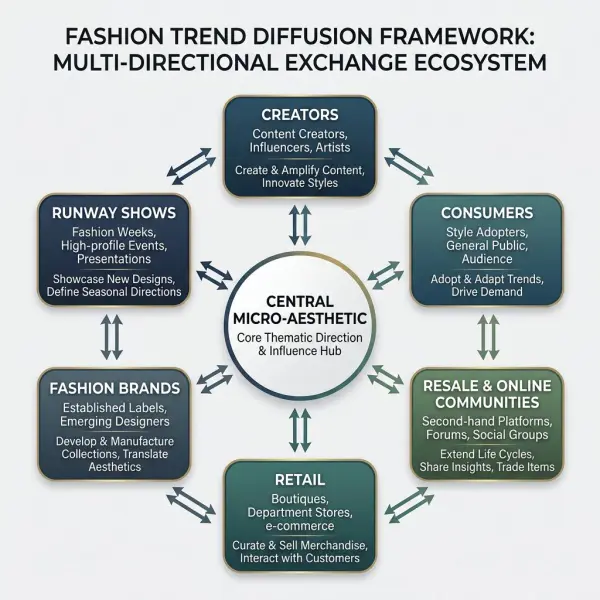
Traditional fashion communication often presented a relatively controlled message from designer to magazine to retailer to consumer.
Contemporary trend diffusion is less linear.
Creators, consumers, retailers, brands, celebrities, runway collections, resale marketplaces, and online communities can all participate in interpreting the same aesthetic.
A 2024 study published in Fashion and Textiles examined runway imagery, fashion influencer outfits, and best-selling online retail products and found meaningful relationships among these different sources. The authors concluded that contemporary fashion trend information is disseminated through multiple channels and that fashion influencers can reinforce or contribute to the popularity of certain items. research on diffusion of fashion trend information
This does not prove that influencers alone create trends.
It supports a more useful conclusion: modern fashion diffusion is multi-directional.
6. Micro-aesthetics carry a story, not only a product
Cottagecore offers pastoral escape.
Gorpcore suggests utility, outdoor competence, exploration, or functional dressing.
Balletcore invokes discipline, delicacy, dance, rehearsal, femininity, movement, or nostalgia depending on how it is interpreted.
These narratives give content creators more material than a simple product trend.
A red handbag is an item.
An aesthetic can produce a world.
That world can be translated into outfit videos, photography, playlists, shopping edits, home interiors, travel imagery, beauty references, celebrity styling, memes, and community conversation.
This storytelling capacity helps explain why aesthetics can generate disproportionate cultural visibility compared with individual garment trends.
7. Brands and retailers accelerate what communities already recognize
Once an aesthetic becomes legible, commercial actors can amplify it.
Retailers create edits. Publications explain it. Brands style existing products around it. Designers may incorporate related references. Collaborations connect functional or heritage products with fashion audiences.
The circulation becomes recursive:
community → creator → media → retailer → brand → consumer → new interpretation
There is rarely one point of origin controlling the whole process.
This differs from older simplified models in which a fashion direction was assumed to move mainly from runway to mass market.
Why Some Micro-Aesthetics Last Longer Than Others
Rapid spread and long-term relevance are different questions.
An aesthetic can become highly visible in weeks and still have limited commercial life. Another can lose its fashionable label while leaving several product categories stronger than before.
Three factors are particularly useful when assessing durability.
The underlying product has independent utility
Gorpcore benefits here.
Weather-resistant outerwear, fleece, utility trousers, and trail footwear can perform practical functions independently of the aesthetic.
Ballet flats also existed long before balletcore and can continue after the terminology changes.
A trend name therefore does not necessarily determine a product's entire lifecycle.
The visual idea connects with broader fashion cycles
An aesthetic may sit on top of larger movements.
Balletcore, for example, overlaps with renewed interest in flats, feminine detailing, fitted knits, and dancewear references.
Cottagecore intersects with romantic dressing, vintage fashion, craft, floral prints, and rural imagery.
If the underlying signals extend into several fashion narratives, the aesthetic has more paths through which to evolve.
Consumers can reinterpret rather than reproduce it literally
Rigid aesthetics can burn out quickly because their most recognizable combinations become repetitive.
Flexible ones survive by mutating.
Gorpcore can blend with tailoring. Ballet references can become darker or more minimal. Cottagecore can shift toward folk, prairie, vintage, or craft-oriented styling.
This helps explain why micro-aesthetics frequently produce hybrids.
They behave less like sealed categories and more like visual vocabularies.
What Micro-Aesthetics Mean for Fashion Businesses
For brands, the greatest strategic error is treating every viral aesthetic as a signal to create a new collection.
A better starting point is to identify what the aesthetic contains.
Consider the three examples:
|
Aesthetic |
Visible idea |
Potential underlying product signals |
|
Cottagecore |
Romantic pastoral life |
floral dresses, volume, natural-looking textures, craft details, vintage styling |
|
Gorpcore |
Outdoor utility as fashion |
technical outerwear, functional layering, utility pockets, trail footwear |
|
Balletcore |
Dancewear-inspired femininity |
flats, fitted knitwear, wrap shapes, tights, soft layering |
The label is culturally useful.
The product attributes are operationally useful.
Product teams can source fabrics, construct garments, cost trims, buy inventory, and assess returns based on specific product characteristics. They cannot operationalize “viral aesthetic” without translating it into those characteristics.
How Fashion Brands Can Respond Without Chasing Every Trend
1. Start with overlap, not virality
Ask which elements already make sense for your customer.
A contemporary womenswear brand selling soft knitwear and skirts may have a natural path into selected balletcore references.
A performance brand could participate in gorpcore without changing its technical DNA.
A minimalist tailoring brand might have much less reason to produce floral prairie dresses simply because cottagecore is gaining attention.
Relevance should come before reach.
2. Separate core products from trend signifiers
Some garments have long commercial lives.
Others are particularly recognizable markers of a moment.
Inventory planning should distinguish the two.
For example, a classic ballet flat may have broader styling potential than an extremely literal dance-inspired accessory. A versatile shell may remain useful longer than a decorative garment made merely to resemble technical outdoor clothing.
That distinction should influence buy depth.
3. Test through styling before manufacturing
A brand can often learn about aesthetic demand using existing inventory.
Try:
- styling edits;
- editorial landing pages;
- creator content;
- email merchandising;
- visual search collections;
- store displays;
- small capsules;
- product bundling.
If existing items perform better when placed inside the aesthetic story, the business gains evidence before committing to new development.
4. Watch the products, not only the hashtag
Hashtag visibility can tell a team that people are talking.
It cannot tell them exactly what people will buy.
Product-level signals are more actionable: search queries, product views, add-to-cart behavior, conversion, full-price sales, repeat purchase, store requests, resale activity, and returns.
This distinction is especially important for visually spectacular aesthetics that generate entertainment value.
Watching fashion and buying fashion are not the same behavior.
5. Build response speed appropriate to the opportunity
Traditional product development can take longer than the most volatile online fashion narratives.
Vogue Business has noted that brands with long internal approval cycles may struggle to respond credibly before a microtrend moves on. Vogue Business guidance on brand participation in microtrends
That does not justify reckless production.
It means different trend horizons need different tools.
A rapidly moving aesthetic may be best addressed through content and merchandising.
A more persistent product shift may justify sourcing and development.
Common Mistakes When Brands Follow Micro-Aesthetics
Mistake 1: Assuming every named aesthetic is genuinely new
Why it happens: a new label creates the appearance of novelty.
Operational consequence: teams may rush into development without checking whether they already sell relevant products.
Business impact: unnecessary sampling, duplicated assortment, and shallow trend positioning.
Better approach: map the aesthetic against existing silhouettes, fabrics, footwear, accessories, and customer styling before developing anything new.
Mistake 2: Copying the stereotype instead of understanding the customer
A literal checklist—florals for cottagecore, shell jacket for gorpcore, pink ribbon for balletcore—can quickly become superficial.
The strongest commercial interpretation often sits one layer deeper.
Perhaps customers respond to softer dresses rather than rural fantasy. Perhaps they want practical outerwear rather than hiking cosplay. Perhaps the important balletcore signal is a return to low-profile footwear, not tulle.
Better approach: identify the underlying need or product preference.
Mistake 3: Treating engagement as demand
Brands naturally notice highly visible content.
But aesthetic content may succeed because it is visually satisfying, nostalgic, humorous, aspirational, or easy to remix.
The result can be a large cultural footprint without equally large purchasing behavior.
Better approach: connect social listening with merchandising data.
Mistake 4: Entering after the audience has moved on
Once every retailer is describing the same aesthetic, the differentiation may already be shrinking.
Slow-moving brands are particularly vulnerable because product development can outlast the period when the label carries cultural novelty.
Better approach: decide whether the opportunity requires a product response at all.
Sometimes publishing a relevant styling story this week is more commercially sensible than producing a capsule six months later.
Mistake 5: Making unsupported functional claims
This is most relevant to gorpcore.
A garment can visually resemble performance equipment without delivering equivalent technical protection.
A fashion jacket with nylon fabric is not automatically waterproof. Outdoor-performance claims depend on measurable fabric properties, construction, seam treatment, closures, durability, and testing.
Better approach: separate styling language from technical specifications.
What Brands Should Verify Before Acting
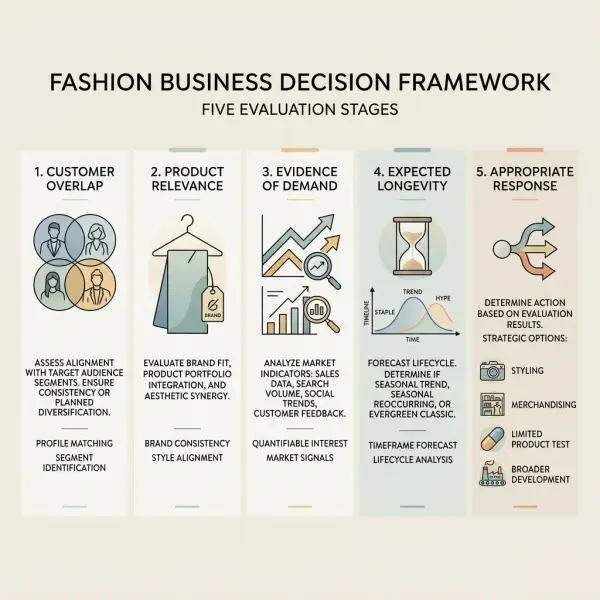
Before allocating meaningful budget to a micro-aesthetic, verify five things.
Origin and context. Understand where the aesthetic's references come from. Do not assume the internet label invented them.
Customer overlap. Determine whether your own audience is engaging with relevant garments or only whether the trend is globally visible.
Product evidence. Identify exactly which items, fits, colors, fabrics, and accessories show commercial traction.
Trend horizon. Decide whether the signal looks like a brief styling moment, a seasonal product trend, or part of a broader shift.
Execution capability. Compare likely trend duration with design, sourcing, manufacturing, delivery, and merchandising lead times.
These checks reduce a common problem in fashion planning: turning a cultural observation into an inventory commitment too quickly.
Micro-Aesthetics Are Fast Because They Are Designed for Reinterpretation
The success of cottagecore, gorpcore, and balletcore does not come from the same garments or the same cultural story.
Their structures are quite different.
Cottagecore packages an idealized pastoral world.
Gorpcore reframes outdoor utility.
Balletcore turns dance references into an accessible fashion vocabulary.
Yet they share an important architecture: each has a memorable name, identifiable visual cues, familiar products, room for personal interpretation, and enough narrative depth to produce continuing content.
That makes them highly compatible with contemporary digital fashion culture.
It also explains why understanding how fashion aesthetics shape modern personal style is more useful than assuming people permanently belong to one aesthetic. Consumers can enter and leave these visual worlds one garment at a time.
Frequently Asked Questions
What is a micro-aesthetic in fashion?
A fashion micro-aesthetic is a relatively specific visual concept that groups clothing, accessories, styling references, and sometimes lifestyle imagery under a recognizable name.
Examples include cottagecore, gorpcore, and balletcore. These labels are not official fashion classifications, and their boundaries can change as communities reinterpret them. Their practical value is that they make complex visual references easier to recognize, search, discuss, and reproduce.
For brands, the label itself is less useful operationally than the garments, silhouettes, colors, materials, and customer behaviors associated with it.
Why did cottagecore become popular?
Cottagecore became especially visible online during 2020, when lockdown conditions increased cultural interest in home activities, nature, baking, gardening, craft, and escapist rural imagery. Vogue Business documented cottagecore as part of the changing social-media-driven fashion trend funnel during that period.
However, its underlying references are much older. Floral dresses, pastoral imagery, folk details, prairie styling, craft, and romantic rural fantasies predate the cottagecore label by decades or centuries.
The internet primarily gave these references a particularly effective shared name and distribution system.
What is gorpcore fashion?
Gorpcore is a fashion aesthetic that incorporates clothing associated with hiking and outdoor performance into everyday or fashion-focused styling.
Typical products include technical shells, fleeces, utility trousers, trail shoes, padded outerwear, and outdoor accessories. The term was coined by Jason Chen in 2017 and later became widely associated with the crossover between outdoor brands, streetwear, and contemporary fashion.
Not every gorpcore-looking garment offers genuine outdoor performance. Technical claims should always be supported by actual product specifications.
What is balletcore?
Balletcore is a fashion aesthetic that draws from ballet and dancewear imagery, often using ballet flats, wrap knits, tights, fitted layering, tulle, ribbons, or leotard-like silhouettes.
The term is contemporary, but the relationship between ballet and fashion is much older. Vogue has documented ballet-inspired fashion references dating back many decades, including the influence of practice clothing during twentieth-century balletomania.
Balletcore should therefore be understood as a new packaging of established visual references rather than a wholly new clothing system.
Why do fashion aesthetics use names ending in “core”?
The “-core” naming convention has become a convenient internet shorthand for defining a recognizable visual world or subcultural style.
Its practical advantage is linguistic efficiency. A short label can connect images, outfits, products, creators, and conversations that would otherwise require a much longer explanation.
Not every “-core” term develops into a meaningful or lasting fashion movement. Some function primarily as jokes, temporary content formats, or media-friendly labels. The mechanisms through which social media encourages such naming are explored more deeply in why social media changes how fashion trends are named and adopted.
How long do micro-aesthetics last?
There is no standard lifecycle.
Some labels disappear quickly, while individual products associated with them remain commercially relevant for years. Others evolve into related aesthetics or merge with broader fashion directions.
The more useful business question is therefore not “How long will this hashtag last?” but “Which underlying product attributes have durable demand?”
A ballet flat, technical shell, or floral dress can continue selling after consumers stop using the aesthetic name that temporarily increased its visibility.
Should fashion brands launch micro-aesthetic collections?
Only when customer evidence, brand fit, timing, and product economics support the decision.
Many brands can participate more safely through styling, merchandising, creator content, existing inventory, or small-scale tests before developing dedicated products.
A full collection creates sourcing and inventory exposure that may be disproportionate to a short-lived cultural signal. Smaller brands in particular should distinguish between a content opportunity and a genuine assortment opportunity.
Conclusion
Cottagecore, gorpcore, and balletcore look very different, but the reasons they travel quickly are remarkably similar.
Each turns a complicated collection of visual references into a label that is easy to recognize and easy to share.
Cottagecore reorganizes pastoral romance and domestic craft into an internet-ready world. Gorpcore moves technical outdoor products into fashion context. Balletcore gives a contemporary name to a much older conversation between dance and clothing.
None was built entirely from new ingredients.
That is part of their power.
Consumers already understand many of the garments involved, so participation can begin through styling, one familiar product, a second-hand piece, or an item already in the wardrobe. Creators can then reinterpret the concept, retailers package it, brands amplify it, and communities modify it again.
For fashion businesses, this makes micro-aesthetics valuable cultural signals—but unreliable instructions when viewed in isolation.
The name may move fast.
The more important question is what remains underneath it: a silhouette, fabric, footwear category, function, styling habit, or emotional idea that customers may still care about after the next aesthetic receives a name.




Comments 0
Leave a CommentSend Comment
Anda harus Login terlebih dahulu untuk dapat memberikan komentar.