

How Layering Makes Outfits More Flexible and Practical
Quick Answer
Layering makes an outfit more flexible by dividing its functions across several compatible garments instead of asking one piece to handle every condition. A base layer manages direct contact with the body, a middle layer can add warmth or visual depth, and an outer layer can provide structure or protection. Not every outfit needs all three, and their exact roles change with climate, activity, and dress code.
The practical advantage is adjustability. A wearer can remove a cardigan when an office becomes warm, add an overshirt after sunset, or carry a compact shell for rain without changing the entire outfit. Layering can also extend the styling range of existing garments by changing proportion, color, texture, and formality.
Good layering depends on compatibility rather than quantity. Sleeve width, armhole shape, fabric friction, garment length, closures, breathability, and storage all affect whether the combination works in real life. Too many poorly coordinated layers can restrict movement, trap unwanted heat, distort the silhouette, and become inconvenient to carry. Effective layering therefore uses the fewest pieces needed to solve the conditions and activities the wearer is likely to encounter.

What Is Layering in Fashion?
Layering in fashion is the deliberate combination of two or more garments so that coverage, comfort, function, or appearance can be adjusted while the outfit remains wearable as a whole. It is both a practical dressing method and a design technique. The practical side helps the wearer respond to temperature and activity; the visual side creates depth through proportion, texture, color, and visible garment edges.
This definition is broader than the technical three-layer systems often used for cold-weather or outdoor clothing. Everyday layering might be as simple as a T-shirt under an open shirt, a blouse beneath a sleeveless dress, or a fine knit under an unlined blazer. In warm climates, layering may be used mainly to move between outdoor heat and air-conditioned interiors. In cold or wet conditions, insulation and protection become more important.
The number of garments is not the measure of success. An outfit with two well-chosen layers can be more useful than one with four pieces competing for space. The real test is whether each layer has a reason to be there and whether the outfit still works after one of them is removed.
How Does Layering Make an Outfit More Flexible?
Layering creates flexibility because it makes an outfit modular. Instead of treating the look as one fixed state, the wearer can move between several states using the same core pieces. A closed overshirt can function as the main top in the morning, remain open over a T-shirt at midday, and be removed indoors. The wardrobe does not change; the configuration does.
This modularity is useful across more than temperature changes. It can help an outfit move between casual and polished settings, provide additional coverage when required, protect a delicate garment during travel, or introduce color and texture without committing to a completely different silhouette.
In practice, layering can support several types of flexibility:
- Thermal flexibility: adding or removing insulation as temperature and activity change.
- Weather flexibility: carrying an outer layer for wind or rain while keeping the base outfit lightweight.
- Dress-code flexibility: using a jacket, cardigan, or overshirt to make a base look more formal or provide more coverage.
- Styling flexibility: changing the balance of color, texture, and proportion using the same garments.
- Use flexibility: allowing individual pieces to work in more outfit combinations and across a wider part of the year.
These benefits are conditional. A layer only improves flexibility when it is easy to wear, remove, and carry. A heavy jacket that cannot be stored, or a fitted blazer that crushes the sleeves underneath, may create a second problem while solving the first.
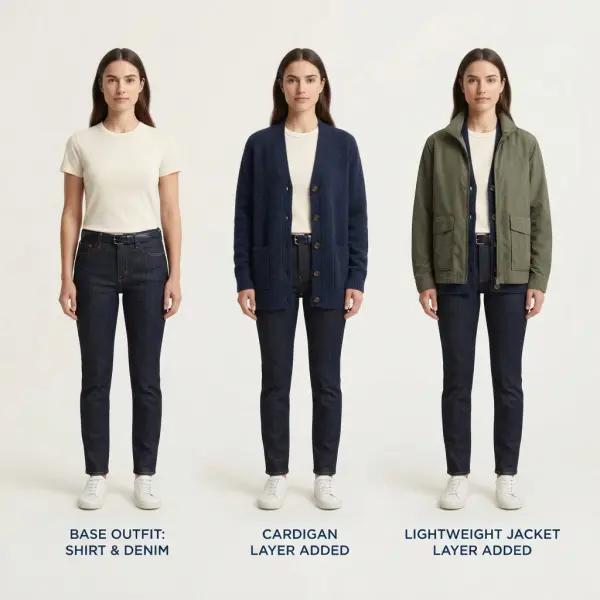
The Functional Roles of Different Layers
The familiar base, middle, and outer structure is useful because it assigns a job to each part of the outfit. It should be treated as a framework rather than a rule. A garment can perform different roles depending on its construction and the conditions in which it is worn.
The base layer manages the foundation
The base layer sits closest to the body and establishes comfort, coverage, and the visual foundation of the outfit. In everyday fashion, this could be a T-shirt, shirt, blouse, lightweight knit, camisole, or dress. Because the outer layers may be removed, the base should normally remain presentable and appropriate on its own.
Fit matters here. A base garment that is too loose may bunch beneath a fitted middle layer, while one that is very tight may not provide the comfort or coverage expected when worn alone. Seams, trims, buttons, and sleeve volume can also become pressure points beneath other garments.
For active or cold-weather use, moisture behavior becomes especially relevant. The U.S. Centers for Disease Control and Prevention guidance on cold-weather layering advises an inner layer that helps retain warmth without absorbing moisture readily, an insulating layer that traps air close to the body, and an outer layer that helps protect against wind and precipitation. This is safety guidance for cold conditions, not a universal fashion formula, but it demonstrates why layers should have distinct functions rather than simply adding thickness.

The middle layer adds warmth, depth, or structure
The middle layer is often the most versatile part of an everyday system. Cardigans, vests, fine knits, sweatshirts, overshirts, light quilted pieces, and unstructured jackets can all occupy this position. Some are chosen primarily for insulation; others create shape, color contrast, or a more polished appearance.
A useful middle layer should leave enough room at the armhole, shoulder, chest, and sleeve for the base garment. It must also fit under the intended outer piece. This double compatibility makes middle layers particularly demanding during product development. A chunky sleeve may look attractive over a slim shirt but become impossible beneath a narrow coat.
The outer layer handles exposure and presentation
An outer layer may protect against wind, light rain, or cold, but it can also provide the outfit's dominant shape and level of formality. Coats, trenches, shells, tailored jackets, blousons, and heavier overshirts all communicate differently even when worn over the same base.
Protection should not be inferred from appearance alone. A dense-looking coat may offer limited rain protection, while a very light shell may resist wind or precipitation but provide little insulation. Brands should describe tested performance accurately, and consumers should match the layer to the primary condition rather than assuming one outer garment will manage every type of weather.
Accessories can function as small, targeted layers
Scarves, wraps, detachable collars, arm warmers, hats, and even socks can change coverage or warmth without adding another full garment. These pieces are useful when the expected change is modest or localized. They are also easier to store than a second jacket.
Accessories should still be evaluated as part of the total outfit. A bulky scarf can compete with a hood or structured collar, and thick socks may make otherwise comfortable shoes feel tight. Small layers are not operationally invisible simply because they use less fabric.
Why Trapped Air, Moisture, and Fit Matter
Layering can support warmth partly because still air held within and between clothing components reduces heat transfer. The effect depends on fabric structure, garment fit, compression, wind, moisture, and movement. Adding more layers does not produce unlimited warmth. Tight or heavily compressed combinations can reduce the air space available for insulation, while open edges and wind exposure can allow warm air to escape.
Moisture complicates the system. Perspiration generated during walking, commuting, or physical work may make an outfit uncomfortable once activity slows. Some fibers and fabric structures absorb more moisture or dry more slowly than others, but performance cannot be predicted from fiber name alone. Fabric construction, weight, finishing, garment ventilation, environmental humidity, and care history all influence the result.
This is why removable layers are useful: they let the wearer adjust before overheating becomes a problem. Yet removability only works when closures are accessible and the removed item can be carried. A pullover trapped beneath a fitted jacket is less adjustable than an open-front cardigan, even if both provide similar warmth in a static styling photograph.
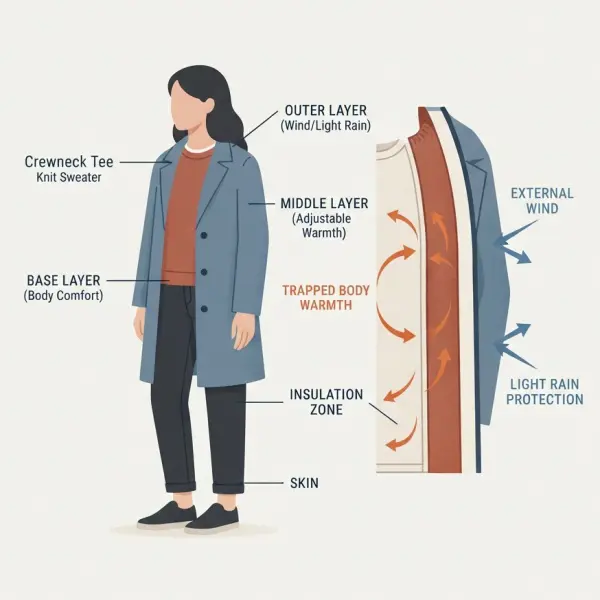
Layer Compatibility Matters More Than Layer Count
The most common layering failures are not caused by choosing the wrong number of garments. They come from combining pieces that were never designed to share the same physical space. Compatibility involves fit, surface behavior, proportion, and the sequence in which garments are worn.
Shoulder, armhole, and sleeve relationships
The inner garment needs enough room to move without gathering, while the outer garment needs enough capacity to accommodate what sits beneath it. Dropped shoulders, tailored shoulders, raglan sleeves, puff sleeves, and wide cuffs each create different interactions. A soft dropped-shoulder cardigan may sit comfortably over a shirt but distort the clean shoulder line of a fitted blazer placed above it.
Layered fit should be assessed during movement, not only while standing. Reaching forward, driving, carrying a bag, and lifting the arms can reveal pulling across the back, cuff congestion, or restrictive armholes that a front-view fitting misses.
Fabric friction and surface texture
Some fabrics slide easily against each other, while others grip. A brushed knit may catch against a textured shirt. Sequins, embroidery, hook-and-loop fasteners, or rough hardware may snag a delicate layer. Very smooth linings can make a fitted jacket easier to put on, but lining also changes weight, warmth, cost, and care.
For brands, these interactions should be reviewed during styling and wear trials. Recommending products together on an e-commerce page creates an implicit expectation that they work together physically, not merely that their colors coordinate.
Length and proportion
Visible hems can create depth, but accidental slivers of fabric often look unresolved. A long shirt beneath a cropped knit may be intentional; the same shirt extending unevenly beneath a fitted jacket may not be. Garment lengths should relate to the body, the other layers, and the desired silhouette.
Proportion also affects bulk distribution. Wearing volume on top may call for a cleaner lower silhouette, although this is a styling choice rather than a universal rule. The practical point is to check how the outfit looks in all intended states. If the jacket is removed, the remaining proportions should still feel deliberate.
Closures and access
Buttons, zippers, snaps, belts, and drawcords affect how quickly the outfit can be adjusted. Several high collars can feel crowded. Multiple front closures may stack uncomfortably. A belted coat worn over a long open cardigan can make the inner garment shift or bunch.
Pockets also matter. A phone placed in the pocket of a middle layer may become difficult to reach beneath a closed coat. Functional outfit planning considers access as well as appearance.
Layering Across Climates and Everyday Settings
The purpose and order of layers should change with the environment. Copying a cold-weather formula into a humid market can produce unnecessary heat and bulk, while a styling-led combination may provide insufficient protection in sustained cold or rain.
|
Setting |
Practical layering approach |
Main priority |
Frequent mistake |
|
Cool morning, mild afternoon |
Presentable base with one removable knit or light jacket |
Easy removal and carrying |
Choosing a bulky coat for a short cool period |
|
Hot outdoors, strong air conditioning |
Breathable base with a light overshirt, cardigan, or wrap |
Indoor coverage without outdoor burden |
Wearing a heavy layer throughout the commute |
|
Intermittent rain |
Comfortable base plus compact weather layer |
Rain protection and storage |
Treating ordinary fashion outerwear as waterproof |
|
Cold urban commute |
Base, insulating middle layer, and protective outerwear as conditions require |
Warmth, movement, and wind protection |
Compressing layers inside narrow sleeves |
|
Work-to-evening schedule |
Base outfit plus a structured removable layer or accessory |
Dress-code adjustment |
Making the base outfit unsuitable once the jacket is removed |
|
Travel between climates |
Reusable base pieces with one compact insulating layer and destination-specific outerwear |
Packability and outfit repetition |
Packing several pieces that perform the same function |
The table is a planning aid, not a prescription. Personal temperature tolerance, mobility, health needs, cultural clothing practices, garment materials, and time spent outdoors can all change the appropriate choice.
Layering is especially useful within the broader practice of transitional dressing for changing weather and daily life. The distinction is that transitional dressing defines the problem, while layering is one of several methods used to solve it.
How Layering Expands Styling Possibilities
Function is only half the value. Layers can make a small set of garments look and feel different by changing which colors, surfaces, and edges are visible. A crisp collar beneath a crew-neck knit creates a different impression from the same knit worn alone. A tonal overshirt can soften contrast, while a sharply colored jacket can make the base pieces recede.
Texture often creates richer results than adding more colors. Pairing a compact woven shirt with a soft knit and a matte outer layer produces depth because each surface handles light differently. The effect can remain subtle enough for workwear while still preventing the outfit from appearing flat.
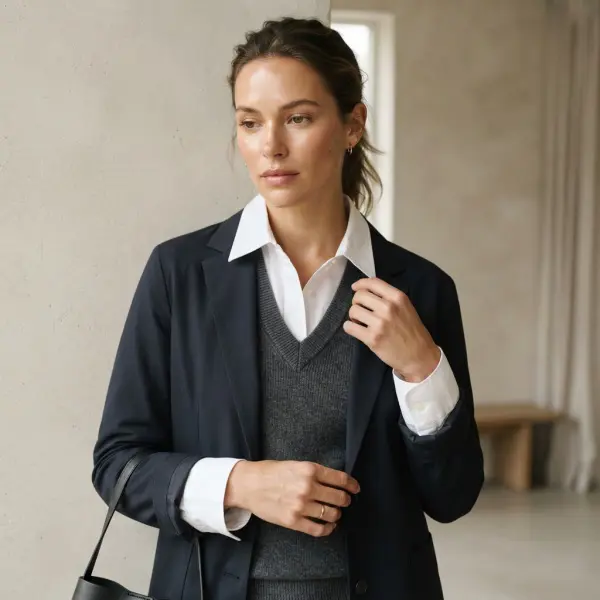
Layering can also adjust formality. An unlined blazer over a knitted top may make casual separates suitable for a client meeting. Removing it can return the look to a more relaxed state. A sleeveless dress over a fine shirt can add coverage and structure, while the same dress worn alone may suit a different setting.
These styling benefits depend on the individual pieces being credible outside the full composition. If a garment exists only to conceal poor fit, transparency, or an incomplete base look, the outfit loses much of its flexibility.
What Layering Means for Fashion Product Development
Design garments as part of a system
Product teams often develop styles individually and create outfits later. A more reliable approach is to identify intended layering relationships during range planning. If an overshirt is meant to cover a knit, its shoulder, chest, sleeve, and cuff dimensions should be tested with that knit. If a vest is intended over a shirt, neckline depth and armhole shape should reveal the base garment cleanly without pulling.
This does not mean every collection needs a rigid capsule. It means the range should contain enough physical compatibility for the merchandising story to be true. Color coordination alone cannot compensate for restricted movement or incompatible volume.
Use layered fit trials
Fit samples are commonly assessed over a standard foundation garment, but the actual use case may involve more volume. Teams should define the intended underlayers in the fit protocol and repeat movement tests with the complete combination.
Relevant checks include:
- shoulder and upper-back movement;
- armhole comfort and sleeve rotation;
- cuff and collar congestion;
- closure strain across the chest or waist;
- hem interaction while sitting and walking;
- pocket access beneath other garments;
- appearance after a layer is removed;
- whether the removed piece can be folded or carried as intended.
These checks can expose problems before bulk production and content creation. They may also influence size guidance. A customer who intends to wear a jacket over a substantial knit may need different fit information from one wearing it over a lightweight top.
Select materials for interaction, not isolation
Fabric evaluation should include contact with the intended neighboring layers. Teams need to consider friction, static, pilling risk at contact points, snagging, color transfer, lining behavior, and whether combined care instructions create an unrealistic outfit-maintenance burden.
No single fabric specification guarantees compatibility. Wear trials and appropriate laboratory testing, where performance claims or known risks justify it, provide stronger evidence than fiber content or supplier description alone.
How Retailers Can Communicate Layering More Usefully
Customers often see a polished multi-piece outfit without learning how it behaves. Retail content becomes more practical when it shows the sequence: the base look, one added layer, the complete look, and at least one adjusted state. This helps customers understand which garments are essential and which are optional.
Product pages can support better decisions by including garment measurements, fit notes, fabric weight or handfeel descriptions, lining information, closure details, and the size worn in each styled combination. If the model changes size between a base garment and outerwear, that information should be clear rather than hidden.
Store teams can merchandise compatible garments near each other and explain the purpose of the combination. The strongest recommendation is not necessarily the outfit with the most pieces. It is the one that solves the customer's schedule, climate, and comfort needs with minimal friction.

Common Layering Mistakes and Their Business Impact
Adding layers without assigning functions
This happens when a styling team builds visual complexity without considering comfort or adjustment. The customer receives an outfit with redundant pieces and no clear response to temperature, coverage, or dress code. A better approach gives every layer a job and removes any piece that does not improve function or appearance.
Treating the outer layer as permanently attached
Campaign images often rely on a jacket or coat to complete the silhouette, while the hidden base outfit receives less attention. Once the customer removes the outer garment, the look may feel unfinished or unsuitable. Brands should photograph and assess the outfit in its adjusted states, not only in the hero configuration.
Ignoring layered fit in size recommendations
A size recommendation based only on body measurements may not account for the intended underlayers. This can lead to pulling, restricted movement, or returns described simply as “too small.” Product pages should explain whether the fit allows a light top, fine knit, or bulkier middle layer and provide finished garment measurements where practical.
Assuming heavier means warmer or more practical
Garment weight is only one factor. Fabric structure, air space, wind exposure, moisture, fit, and activity all affect comfort. A heavy garment may be difficult to carry and still offer limited protection from wind or rain. Product claims should describe the actual function rather than using weight as a shortcut for performance.
Selling technical language without technical evidence
Terms such as breathable, thermal, windproof, or waterproof can influence purchase decisions. They should be supported by appropriate specifications or testing and explained in a way customers can understand. A garment can be useful for layering without making high-performance claims. Honest positioning is often more credible than presenting ordinary fashion construction as technical equipment.
What Brands Should Verify Before Promoting a Layering System
Before presenting several products as a coordinated system, brands should verify that the relationship works beyond the styling set. This requires product, fit, care, and communication teams to review the combination together.
The most important questions are practical:
- Can each visible layer be worn credibly when the outer garment is removed?
- Is there enough room for movement at the shoulders, back, armholes, and sleeves?
- Do collars, cuffs, closures, hems, and pockets remain functional together?
- Are the materials likely to snag, pill, create static, transfer color, or generate excessive friction?
- Can the wearer adjust the outfit quickly and carry removed pieces?
- Do performance and care claims apply to the finished garment rather than only to a component fabric?
- Does the styling reflect the climate, activity, and dress practices of the target customer?
- Are size and fit instructions clear about the intended underlayers?
The answers may differ across sizes. A proportion that works on one sample size may not grade cleanly throughout the range, particularly where sleeve volume, coat length, bust shaping, or armhole depth changes. Layered fit should therefore be considered in size-range validation rather than assumed from a single campaign sample.
Frequently Asked Questions
How many layers should an everyday outfit have?
There is no ideal number. Many everyday outfits need only a base garment and one removable layer. A third layer may be useful for cold, wind, rain, or a significant dress-code change. The right number depends on temperature, activity, time outdoors, personal comfort, and whether removed garments can be carried. More layers do not automatically create more flexibility. If several pieces restrict movement, duplicate the same function, or become burdensome after removal, the outfit is overbuilt for the situation.
What order should clothing layers follow?
The usual order is a comfortable base close to the body, an optional middle layer for warmth or visual depth, and an outer layer for exposure or structure. Everyday fashion can depart from this sequence—for example, a shirt may be worn open as a light outer layer, or a fitted dress may sit over a fine knit. The order should protect movement, prevent bunching, keep closures accessible, and let visible necklines, cuffs, and hems look intentional. Function and fit matter more than following a fixed formula.
Which fabrics work best for layering?
No single fabric is best for every layer. Lightweight, smooth, low-bulk fabrics often work well close to the body, while knits, brushed constructions, or quilted materials can provide warmth in the middle. Outer fabrics may prioritize structure, wind resistance, or rain protection. Performance depends on more than fiber content: weight, weave or knit construction, finishing, lining, fit, humidity, and activity all matter. Brands should test intended fabric combinations together because friction, static, snagging, and combined bulk may not be obvious from individual swatches.
How can layering work without making an outfit look bulky?
Control where volume is placed. Begin with a relatively low-bulk base, add one layer with enough ease for movement, and make sure the outer garment has space at the shoulders and sleeves. Varying garment lengths and leaving some vertical openings can also keep the silhouette visually clear, although the result depends on body proportions and design intent. Bulk is not always undesirable, but it should be deliberate. Trying on the complete outfit while sitting, walking, and lifting the arms gives a more reliable assessment than judging a static mirror pose.
Is layering suitable for hot or tropical climates?
Yes, when the layers address real temperature and coverage changes without trapping unnecessary heat. A breathable base with a lightweight overshirt, wrap, or cardigan may help someone move between humid outdoor conditions and strong indoor air conditioning. Compact rain protection can function as a separate outer layer during showers. Heavy insulating combinations copied from temperate autumn styling are usually less practical. Fabric weight, airflow, drying behavior, commute conditions, and the amount of time spent indoors should guide the system.
Can layering make a wardrobe more versatile?
It can increase the number of workable outfit combinations and extend when certain garments are useful, provided the pieces coordinate physically as well as visually. A shirt that works alone, under a vest, and beneath a jacket has several use states. This does not automatically make the wardrobe seasonless or more sustainable. Actual value depends on use frequency, garment quality, care, durability, climate, and whether the wearer genuinely adopts the combinations. The broader consumer appeal of this approach is explored in why seasonless wardrobes appeal to modern consumers.
What should online shoppers check before buying an outer layer?
Check finished garment measurements, fit description, lining, sleeve shape, armhole depth, closure placement, fabric weight, and the styling shown underneath. Compare these details with the garments you expect to wear as base or middle layers. A model wearing only a thin top does not demonstrate that the same jacket will fit comfortably over a substantial knit. Review care instructions and weather-performance claims as well. If measurements or intended layering guidance are missing, the product's compatibility may be difficult to confirm from imagery alone.
Conclusion
Layering makes outfits more practical when it distributes clear functions across a small number of compatible garments. It allows the wearer to adjust warmth, coverage, weather protection, formality, and visual interest without rebuilding the outfit from the beginning.
The method works only when the pieces cooperate. Fit, movement, fabric friction, proportion, closures, moisture, and carrying requirements are as important as color coordination. The most useful layered outfit is not the one with the greatest number of garments; it is the one that can move between realistic conditions with the least inconvenience.
For fashion businesses, that means designing and testing combinations as systems, giving customers meaningful fit information, and showing what an outfit looks like before and after adjustment. Layering then becomes more than a styling device. It becomes a credible way to help garments work harder in daily life without claiming that every piece can perform in every climate or situation.





Comments 0
Leave a CommentSend Comment
Anda harus Login terlebih dahulu untuk dapat memberikan komentar.