

RFID in Fashion Industry: Applications and Benefits
Quick Answer
RFID in the fashion industry is a product identification and tracking technology that uses radio waves to read information from tags attached to garments, cartons, accessories, or other supply chain assets. In apparel retail, RFID is most commonly used to improve inventory accuracy, speed up stock counts, support omnichannel fulfillment, reduce out-of-stocks, improve loss visibility, and connect physical products with digital systems.
The main advantage of RFID over traditional barcodes is that RFID tags do not always require direct line-of-sight scanning. A handheld or fixed RFID reader can read multiple tagged items at once, depending on the tag type, reader configuration, store environment, material interference, and implementation quality. This makes RFID particularly useful for fashion categories with many SKUs, sizes, colors, and store-level stock movements.
The important caveat is that RFID is not only a tagging project. It requires clean product data, correct tag encoding, supplier coordination, reader infrastructure, store training, system integration, and clear business objectives. For some fashion brands, barcodes may still be enough. RFID becomes more valuable when item-level visibility directly improves sales, inventory control, fulfillment, loss prevention, or product authentication.

What Is RFID in the Fashion Industry?
RFID, or radio-frequency identification, is a wireless identification technology that uses radio waves to capture data from a tag through a reader. In the fashion industry, RFID is usually used to identify and track products, cartons, samples, store inventory, warehouse stock, luxury goods, returns, and sometimes reusable assets such as garment bags, fixtures, or sample sets.
A basic RFID system has three parts: a tag, a reader, and software. The tag stores a product identifier or related encoded information. The reader captures the tag signal. The software connects that read event to inventory, warehouse, retail, supply chain, or customer-facing systems.
Fashion usually uses passive RFID tags for most retail and inventory applications. Passive tags do not have their own battery; they are powered by the reader’s signal. GS1 explains that its RFID standards focus on UHF and HF passive RFID tags, with UHF passive tags — also known as RAIN RFID tags — being the most broadly implemented in the industries GS1 supports.
This distinction matters because RFID is not one single technology. Low-frequency, high-frequency, ultra-high-frequency, passive, active, NFC, and RAIN RFID all serve different use cases. In fashion retail, when people talk about item-level RFID for garments, they are usually referring to passive UHF RAIN RFID used for scanning many products quickly across stores, stockrooms, and warehouses.
Why RFID Matters in Fashion Retail and Apparel Operations
RFID matters in fashion because apparel inventory is difficult to manage accurately. A single collection may include hundreds or thousands of combinations of style, color, size, fit, length, wash, and channel allocation. If the system says a size M black blazer is available in one store but it is actually missing, misplaced, stolen, returned incorrectly, or still in the stockroom, the business loses sales opportunities and damages customer trust.
Traditional inventory systems often depend on barcode scanning, manual stock counts, point-of-sale updates, and warehouse records. These methods can work, but they become fragile when stock moves frequently between stores, e-commerce, returns, alterations, marketplaces, consignment channels, and seasonal markdown cycles.
RFID improves fashion operations because it gives the business a faster way to connect physical goods with digital records. A store team can count racks more frequently. A warehouse can validate cartons more efficiently. A loss prevention team can understand which items disappeared. An omnichannel team can promise stock more confidently online.
Auburn University’s RFID Lab summarized a Dillard’s item-level apparel RFID initiative by noting improvements in inventory accuracy, out-of-stocks, cycle counting, and loss prevention. The summary also explains that faster and more accurate cycle counting can help keep inventory accuracy high rather than relying on large physical inventories only once or twice per year.
For fashion brands, that is the commercial point. RFID is not just a technical upgrade. It changes how often a company can trust its own stock data.
How RFID Works in Fashion Supply Chains
RFID works by giving each tagged item or unit a scannable identity that can be read by radio-frequency equipment. In apparel, this identity is typically linked to product data such as SKU, style, color, size, batch, purchase order, carton, or serial number, depending on how the brand designs its data model.
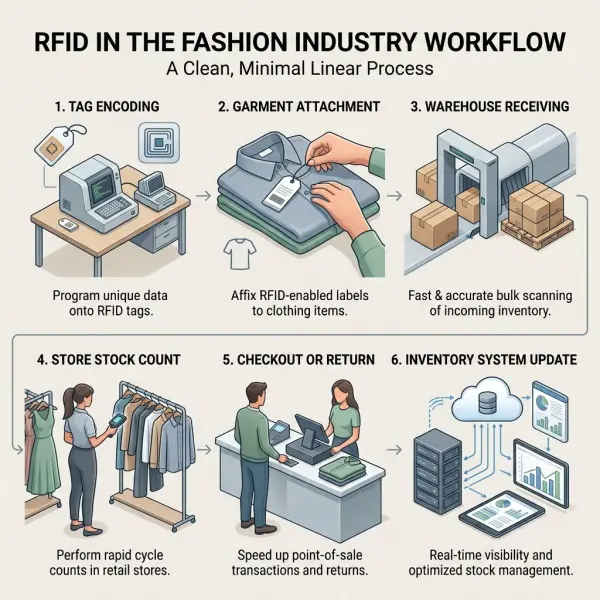
A simplified fashion RFID workflow looks like this:
- A product identifier is assigned to the garment, carton, or asset.
- An RFID tag is encoded and attached to the item, hangtag, care label, packaging, or carton.
- A reader captures the tag during production, warehouse receiving, store delivery, stock counting, checkout, return processing, or exit monitoring.
- The system records the read event and updates the connected inventory or operational platform.
- Teams use the data to improve replenishment, fulfillment, loss visibility, or product authentication.
In practice, the details matter. A tag placed near metal accessories, foil packaging, dense folded stacks, liquids, or the human body may behave differently from a tag on a hanging cotton shirt. A store with narrow aisles, mirrors, metal fixtures, and dense merchandising requires proper reader configuration. A warehouse scanning cartons may need a different setup from a boutique scanning high-value handbags.
RFID should therefore be treated as a physical-and-digital implementation. The tag must work on the product. The product identifier must be correct. The reader must capture data reliably. The software must interpret the read event accurately. The team must know what action to take when the system flags a mismatch.
RFID vs Barcode vs NFC: What Is the Difference?
RFID, barcodes, and NFC all help connect physical fashion products with digital information, but they are not interchangeable. The right choice depends on scanning speed, cost, use case, consumer interaction, security requirements, and operational environment.
|
Technology |
How It Is Usually Used in Fashion |
Main Advantage |
Main Limitation |
|
Barcode |
Price lookup, warehouse scanning, product identification, cartons, care labels, POS workflows |
Low cost, widely understood, easy to print |
Usually requires line-of-sight and one-by-one scanning |
|
RFID / RAIN RFID |
Item-level inventory, warehouse validation, store stock counts, loss visibility, omnichannel fulfillment |
Can scan multiple items quickly without direct line-of-sight in many setups |
Requires tags, readers, encoding, integration, and process discipline |
|
NFC |
Consumer tap experiences, authentication, care content, resale support, luxury products |
Can be read by many smartphones at very close range |
Short read range; not designed for fast bulk inventory scanning |
NFC is technically related to RFID but usually serves a different role in fashion. The NFC Forum defines NFC as a short-range wireless technology that enables secure communication between devices located only a few centimeters apart and operating at 13.56 MHz. That makes NFC useful for tap-based customer experiences, authentication, repair records, ownership transfer, or luxury storytelling. It is not usually the best tool for scanning hundreds of garments on a store rack.
Barcodes remain practical and cost-effective. RFID becomes compelling when the business needs speed, frequency, and item-level accuracy beyond what barcode workflows can realistically provide. NFC becomes compelling when the customer or product owner needs to interact with the item directly.

Main Applications of RFID in the Fashion Industry
RFID is most valuable when it solves specific operational problems. The strongest use cases usually appear where product movement is frequent, inventory mistakes are costly, and item-level data changes business decisions.
Inventory Accuracy and Cycle Counting
Inventory accuracy is the most common RFID use case in fashion retail. Apparel stores often have many products that look similar but differ by size, color, fit, length, or season. Manual counting is slow. Barcode counting is more structured but still requires scanning items one by one.
RFID allows store teams to perform cycle counts more frequently and with less disruption. A staff member can scan racks, shelves, backroom areas, or displays with a handheld reader and compare actual stock against system records. RAIN Alliance states that RAIN RFID can support inventory visibility and return processing in omnichannel retail, and its retail page lists results such as 98% inventory accuracy and 50% reduction in out-of-stocks, although individual outcomes depend on implementation context.
For a fashion retailer, more frequent counts can change daily decisions. If a dress is selling online but hidden in the store stockroom, RFID can help find it. If a size run is broken, replenishment can be triggered earlier. If stock is missing, the system can be corrected before the website promises unavailable inventory.
Omnichannel Fulfillment
RFID supports omnichannel retail by making store inventory more trustworthy. This matters for services such as buy online, pick up in store; ship from store; reserve in store; endless aisle; same-day delivery; and marketplace fulfillment.
Omnichannel retail fails when stock data is wrong. A customer orders a jacket online for pickup, but the store cannot find it. The system promises two remaining units, but both were misplaced. A fulfillment team cancels an order because the item was sold, stolen, or returned incorrectly. Each failure creates operational cost and customer frustration.
With RFID, retailers can update stock more frequently and locate products more efficiently. The gain is not only convenience. Better stock visibility can allow stores to function as fulfillment nodes, making inventory more productive across channels.
Loss Prevention and Shrink Visibility
RFID can help retailers understand what is missing, where it disappeared, and sometimes when it moved through a monitored point. This is different from simply knowing that inventory is short at the end of the season.
In apparel, shrink can come from theft, administrative errors, incorrect receiving, transfer mistakes, fraudulent returns, or checkout problems. RFID does not eliminate these issues, but it can make them more visible. Auburn’s summary of the Dillard’s RFID initiative notes that RFID can help identify exactly what was stolen, when it was stolen, and from where, allowing inventory counts to be adjusted and replenishment decisions to be made more accurately.
This benefit is especially relevant for categories with high resale value, limited drops, branded accessories, sneakers, premium denim, outerwear, handbags, and luxury items. The business value is not only reducing shrink. It is knowing which losses are happening and whether they are product-specific, location-specific, process-related, or fraud-related.
Warehouse Receiving and Shipment Verification
RFID can speed up warehouse receiving and shipment validation by reducing manual scanning work. Instead of opening cartons and checking each product individually, a warehouse may scan tagged cartons or tagged items to confirm shipment contents, depending on setup and accuracy requirements.
For fashion brands with seasonal launches, this can be valuable. A warehouse needs to receive goods, allocate stock, process e-commerce orders, replenish stores, and handle wholesale shipments quickly. Errors in receiving can cascade into out-of-stock displays, wrong customer shipments, and delayed retail launch dates.
RFID is not always necessary for every warehouse. A brand with simple volumes may manage well with barcodes and disciplined processes. But for large SKU counts, fast-moving inventory, and multi-channel fulfillment, RFID can reduce blind spots.
Store Operations and Product Location
RFID can help store teams locate products faster, especially when stockrooms are crowded or merchandising changes often. In fashion retail, the item may be technically “in store” but practically unavailable because no one can find it.
Some advanced systems attempt product location or fixture-level insights, although this is harder than basic stock counting. Research on RFID-based article-to-fixture prediction in real-world fashion stores found that stocktake read events could be used to assign articles to fixtures with more than 90% accuracy in the studied approach, while also noting practical integration challenges in day-to-day retail operations.
For most brands, the first priority should be reliable inventory accuracy. Fixture-level analytics may be useful later for merchandising, product interaction, or store planning, but it should not distract from basic operational gains.
Returns, Resale, Rental, and Circular Business Models
RFID can support returns and circular models by giving products a more reliable identity. This is useful when items move back into the system after purchase, rental, repair, resale, authentication, or recycling.
A rental fashion business, for example, needs to know whether a garment has been returned, cleaned, repaired, reallocated, retired, or lost. A resale platform may need authentication and item history for high-value goods. A brand offering repair services may need product identity linked to care records or material information.
RFID is not the only solution here. QR codes, NFC tags, digital product IDs, and serial numbers may all play a role. The best choice depends on whether the brand needs bulk operational scanning, customer tap interaction, authentication, or lifecycle data sharing.

Key Benefits of RFID for Fashion Brands
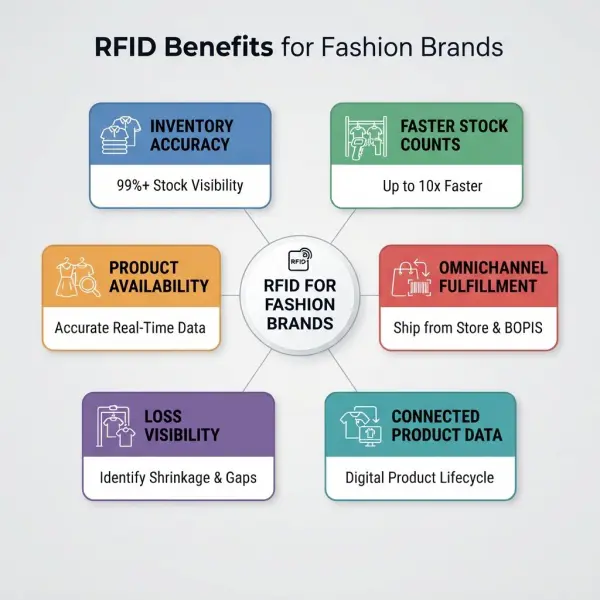
RFID benefits are strongest when they connect directly to measurable business problems. The technology is not valuable because it is modern. It is valuable when it improves stock accuracy, product availability, staff productivity, fulfillment reliability, and decision-making.
Better Inventory Accuracy
Better inventory accuracy is the foundation for most RFID value. Fashion retail depends heavily on size and color availability. A style can appear successful at the total SKU level while failing at the size level. If core sizes are missing, the customer experience suffers even when total stock looks acceptable.
RFID allows more frequent verification, which keeps system data closer to physical reality. The practical result may include fewer ghost stocks, fewer false out-of-stocks, better replenishment, and cleaner sell-through analysis.
Faster Stock Counts
RFID can reduce the time needed for stock counts because staff do not need to scan every barcode individually. This matters in stores where labor hours are limited and teams must balance selling, merchandising, fitting room support, customer service, returns, and stockroom tasks.
RAIN Alliance’s retail page lists a 96% time reduction with smart inventory and a 96% improvement in labor productivity among reported retail benefits. These figures should be treated as implementation-dependent rather than universal guarantees, but they point to the operational reason retailers adopt RFID: frequent counting becomes more realistic.
Improved Product Availability
Product availability is not only about having enough stock. It is about having the right item available in the right location at the right time. RFID helps brands identify broken size runs, misplaced items, inaccurate stock records, and location-level inventory gaps.
For fashion brands, availability directly affects conversion. A customer may love a product but leave if the correct size is unavailable, hidden, or inaccurately listed online. Better visibility helps retailers recover sales that would otherwise be lost through operational friction.
Stronger Omnichannel Reliability
RFID can make omnichannel promises more credible. Stores can fulfill online orders more confidently when their stock data is accurate. Customer service can give better answers. E-commerce teams can reduce order cancellations. Retail operations can use store inventory more flexibly.
This is especially useful for brands that do not want all stock sitting in a central warehouse. If store inventory can be trusted, stores become part of the fulfillment network. That can reduce delivery distance, improve sell-through, and make stock more productive.
Better Loss Visibility
RFID does not prevent every loss, but it can improve loss intelligence. Instead of discovering a vague inventory shortage during a quarterly count, the business can identify which products are missing and where discrepancies occur.
This matters because different causes require different responses. Theft may require store security changes. Receiving errors may require warehouse process fixes. Fraudulent returns may require policy changes. Transfer errors may require staff training. RFID helps separate these issues more clearly.
Foundation for Connected Product Strategies
RFID can also support broader connected product strategies, especially when combined with digital product identifiers, QR codes, NFC, product passports, and traceability systems. GS1 Digital Link, for example, is described as a standardized method for encoding identifiers such as GTINs, GLNs, SSCCs, batch numbers, serial numbers, and expiry dates into web-connected structures.
For fashion, this matters because physical products are increasingly expected to carry digital information for retail operations, compliance, resale, repair, care, circularity, and customer engagement. RFID is one part of that ecosystem, not the entire answer.
Where RFID Fits in the Fashion Technology Stack
RFID works best when it is connected to the rest of the fashion technology stack. A tag alone does not create business value. The value appears when RFID data updates inventory systems, warehouse systems, point-of-sale systems, ERP, e-commerce platforms, analytics dashboards, or product information systems.
In a mature setup, RFID may connect with:
- Product master data that defines style, color, size, SKU, GTIN, and serial information.
- PLM or product information systems that manage product specifications.
- ERP systems that connect stock, purchasing, finance, and operations.
- Warehouse management systems that process receiving, picking, packing, and dispatch.
- Point-of-sale systems that update store sales and returns.
- E-commerce platforms that display available stock.
- Loss prevention systems that monitor exits or exceptions.
- Analytics dashboards that identify stockouts, shrink, and replenishment opportunities.
The connection with the previous article in this cluster is clear: RFID is one way technology improves fashion supply chain visibility, especially at item level. But RFID should not be treated as a replacement for broader supply chain digitization. It is a powerful data capture layer, not a complete operating model.
The next article on supply chain digitization trends fashion brands should know can go further into AI forecasting, Digital Product Passports, supplier platforms, connected product data, automation, and analytics.
What Fashion Businesses Should Verify Before Implementing RFID
RFID implementation should begin with a business case, not a technology wish list. A brand should know which problem it wants to solve, what level of accuracy is required, and which workflows will change after RFID is introduced.
Before implementation, fashion businesses should verify several practical factors:
- Product categories: Does RFID work reliably on the garment types, accessories, footwear, or packaging involved?
- Tag placement: Will the tag be attached to a hangtag, care label, sewn label, carton, shoe box, or luxury authentication component?
- Data standards: Will the brand use GS1 identifiers, EPC encoding, serial numbers, or internal product IDs?
- Supplier readiness: Can suppliers encode and attach tags correctly before shipment?
- Reader setup: Will the business use handheld readers, fixed readers, tunnel readers, gates, POS readers, or a mixed setup?
- System integration: Will RFID data update inventory, ERP, POS, WMS, e-commerce, or analytics systems?
- Store process: Will staff actually scan regularly and respond to discrepancies?
- Privacy and security: What data is stored on the tag, and what happens after purchase?
This checklist may look operational, but it is strategic. Most RFID failures are not caused by the basic idea of RFID being weak. They are caused by unclear ownership, poor data structure, supplier inconsistency, weak training, or unrealistic expectations.
Common Mistakes in Fashion RFID Projects
Mistake 1: Treating RFID as a Tagging Exercise
A brand may assume that attaching RFID tags to garments is the main project. It is not. Tagging is only one part of a system that includes encoding, data governance, reader infrastructure, workflow design, and software integration.
The consequence is often disappointing performance. Teams scan products but do not trust the results. Inventory updates do not flow into e-commerce. Suppliers attach tags inconsistently. Staff treat RFID as an extra task rather than a core operating process.
The better approach is to design RFID around decisions. What will change when the scan result appears? Who acts on discrepancies? How often will counts happen? Which system becomes the source of truth?
Mistake 2: Ignoring Product and Material Interference
RFID performance depends on physical conditions. Metal accessories, dense stacks, liquids, body proximity, packaging, store fixtures, and tag orientation can affect read performance. A tag that works well on a cotton T-shirt may not perform the same way on a metallic handbag, foil-lined packaging, or stacked shoe boxes.
Fashion teams should test RFID on real products, not only sample tags in a clean office. The test should include actual store fixtures, warehouse cartons, folded goods, hanging goods, checkout areas, and return workflows.
Mistake 3: Overestimating Customer-Facing Value
RFID is often strongest behind the scenes. It improves inventory, operations, and fulfillment. But customers usually do not care that a product has RFID unless it leads to visible benefits: fewer cancellations, better size availability, faster pickup, easier returns, authentication, repair history, or better product information.
Brands should avoid promoting RFID as a consumer benefit unless the customer experience is clearly improved. In many cases, the business case is operational first and customer-facing second.
Mistake 4: Failing to Maintain Data Quality After Launch
RFID can expose data problems, but it cannot fix all of them automatically. If the product master is wrong, the tag may faithfully report wrong information. If returns are processed incorrectly, the system may remain inaccurate. If staff skip exception handling, stock discrepancies continue.
The best RFID programs have routines: regular cycle counts, discrepancy workflows, supplier checks, tag quality audits, and dashboard reviews. RFID creates visibility, but teams still need discipline.
Important Technical Caveats
RFID can scan many items quickly, but it is not magic. Read rates depend on tag quality, reader power, antenna design, tag orientation, distance, product material, environmental interference, and software filtering. A system may capture too few reads, duplicate reads, or unintended nearby reads if it is poorly configured.
Privacy is another caveat. RFID tags can sometimes be read without direct visual contact, which creates privacy and security questions. Brands should avoid storing sensitive customer information on product tags. In most apparel use cases, the tag should carry a product identifier, while sensitive business or customer data remains in secure backend systems.
Cost also matters. RFID requires tags, encoding, readers, middleware, integration, training, and process redesign. For low-margin products, the business case must be carefully calculated. For higher-value products, complex SKU environments, omnichannel fulfillment, or frequent stock inaccuracies, the investment may be easier to justify.
Finally, RFID does not replace traceability evidence. It can identify and track an item, but it does not automatically prove fiber origin, labor conditions, recycled content, chemical compliance, or environmental impact. Those claims require supplier data, documentation, verification, and governance.

How to Decide Whether RFID Is Right for a Fashion Brand
RFID is worth considering when inventory inaccuracy is causing measurable business pain. This may include frequent stockouts, cancelled online orders, store stock discrepancies, slow cycle counts, high shrink, warehouse receiving errors, or poor visibility across stores and e-commerce.
For a small brand with limited SKUs, one warehouse, and simple sales channels, RFID may not be the first priority. Clean barcodes, disciplined inventory processes, and a reliable warehouse or e-commerce system may create enough visibility at lower cost.
For a multi-store retailer, marketplace seller, premium fashion brand, rental platform, resale operator, or omnichannel apparel business, RFID can become more attractive. The stronger the need for item-level accuracy, the stronger the business case.
A simple decision framework can help:
|
Business Situation |
RFID Priority |
|
Few SKUs, low inventory movement, simple channels |
Usually low priority; improve barcode and inventory discipline first |
|
Many sizes, colors, stores, and stock transfers |
Medium to high priority if inventory errors affect sales |
|
Omnichannel fulfillment from stores |
High priority when stock accuracy determines customer promise reliability |
|
High-value fashion, luxury, sneakers, handbags, or limited drops |
High priority for loss visibility and authentication support |
|
Rental, resale, repair, or circular fashion model |
Potentially high priority when item history matters |
|
Sustainability claims without strong supplier data |
RFID alone is not enough; traceability and verification are also needed |
The decision should be financial, operational, and strategic. RFID is strongest when the brand knows exactly how improved item-level visibility will reduce cost, recover sales, support fulfillment, or protect product value.
FAQ
What does RFID mean in fashion?
RFID in fashion means using radio-frequency identification tags to identify and track garments, accessories, cartons, or assets across retail, warehouse, supply chain, or product lifecycle workflows. It helps connect physical products with digital systems so brands can improve stock accuracy, cycle counting, fulfillment, loss visibility, and sometimes authentication. In apparel retail, RFID is most often used at item level, meaning each garment or product unit has its own tag or unique identifier.
How is RFID used in clothing stores?
RFID is used in clothing stores to count inventory, locate items, validate stockroom quantities, support click-and-collect orders, process returns, reduce out-of-stocks, and improve loss visibility. Store staff may use handheld readers to scan racks and backrooms more quickly than barcode-based counting. Some retailers also use fixed readers at exits, stockroom doors, or checkout areas. The practical benefit is that the store can keep its digital stock record closer to physical reality.
Is RFID better than barcodes for fashion inventory?
RFID can be better than barcodes when a fashion business needs fast item-level scanning across many SKUs, sizes, and locations. Unlike barcodes, RFID does not always require scanning each item one by one with direct line of sight. However, barcodes are cheaper, widely used, and often sufficient for simpler operations. RFID is not universally better; it becomes more useful when inventory inaccuracy, labor time, omnichannel fulfillment, or shrink creates enough business value to justify the cost.
Can RFID prevent theft in fashion retail?
RFID can support loss prevention, but it does not fully prevent theft by itself. Its main value is improving loss visibility: identifying which items are missing, where discrepancies occur, and how inventory should be adjusted afterward. RFID can be combined with electronic article surveillance, exit readers, exception reporting, and store procedures. For high-value fashion items, it may also support authentication and product identity. But theft prevention still requires store design, staff procedures, security measures, and fraud controls.
Does RFID work for all garments and accessories?
RFID can work for many garments and accessories, but performance depends on tag type, placement, product material, packaging, reader setup, and environment. A tag on a cotton shirt may be easier to read than a tag near metal hardware, foil packaging, or dense stacked items. Fashion businesses should test RFID on actual products before full rollout. Tag placement should be designed around real store, warehouse, checkout, and return workflows.
Is RFID useful for small fashion brands?
RFID can be useful for small fashion brands, but it is not always the first investment. If the brand has a small SKU count, one storage location, and simple online sales, barcode-based inventory discipline may be enough. RFID becomes more relevant when the brand has frequent stock errors, multiple locations, high-value products, rental or resale workflows, or omnichannel fulfillment needs. Small brands should calculate whether the recovered sales, labor savings, or loss reduction justify implementation cost.
Can RFID support sustainable fashion?
RFID can support sustainable fashion indirectly by improving inventory accuracy, reducing unnecessary overstock, supporting returns, enabling repair or resale workflows, and connecting products to lifecycle data. But RFID does not automatically make a product sustainable. It does not prove ethical sourcing, recycled content, lower emissions, or circularity by itself. Sustainability claims still need reliable supplier data, documentation, verification, and responsible business decisions.
Conclusion
RFID has become one of the most practical technologies for improving item-level visibility in fashion. Its strongest value is not futuristic. It is operational: knowing what stock exists, where it is, how quickly it can be counted, whether it can be fulfilled, and where discrepancies appear.
For fashion brands and retailers, RFID can improve inventory accuracy, stock availability, store productivity, omnichannel fulfillment, warehouse validation, returns management, and loss visibility. It can also support connected product strategies when combined with digital identifiers, NFC, QR codes, traceability systems, and product data platforms.
But RFID should be implemented with discipline. The business needs clean product data, correct tag encoding, realistic testing, supplier coordination, staff training, and strong system integration. Without that foundation, RFID may create more data without better decisions.
The best question is not whether RFID is impressive. The better question is whether item-level visibility will solve a real commercial problem. When the answer is yes, RFID can become one of the most useful technology investments in modern fashion operations.





Comments 0
Leave a CommentSend Comment
Anda harus Login terlebih dahulu untuk dapat memberikan komentar.