

How Product Lifecycle Management Improves Fashion Team Collaboration
Quick Answer
Product Lifecycle Management improves fashion team collaboration by giving designers, merchandisers, technical developers, sourcing teams, suppliers, and production personnel access to a shared, controlled product record. Instead of coordinating styles through disconnected spreadsheets, email attachments, chat messages, and local files, teams can connect specifications, materials, costs, samples, comments, approvals, and deadlines to the relevant product.
The main benefit is not simply faster communication. It is more precise communication. A fabric change can be linked to the affected colorways, Bill of Materials, cost estimate, sample status, and supplier instruction. A fit comment can be connected to the correct garment size, measurement point, sample round, and specification version.
PLM does not automatically create cooperation or eliminate disagreement. Teams still need clear responsibilities, reliable data, practical workflows, and timely decision-making. When those foundations exist, PLM can reduce version confusion, make responsibilities more visible, support collaboration across locations, and help teams identify product-development risks before they become production problems.

What Does Collaboration Mean in Fashion PLM?
Collaboration in fashion PLM is the coordinated creation, review, approval, and use of product information through a shared system. It connects people to the same style records, materials, specifications, workflows, deadlines, and decision history so that each function can work from information appropriate to its role.
This is broader than giving employees access to a common folder. A folder may contain several versions of a technical sketch, costing sheet, fit report, and supplier quotation without making clear which version is current or how the documents relate to one another.
A PLM system adds structure. It may identify:
- Which style, colorway, and season the information belongs to
- Who created or changed a record
- Which specification is current
- What still requires approval
- Which teams are affected by a proposed change
- When a development milestone is due
- What information a supplier is permitted to view
- How the latest decision differs from the previous one
Product Lifecycle Management is generally defined as an approach that integrates people, data, processes, and business systems across the product lifecycle. IBM describes PLM as an information backbone that centralizes product data and supports collaboration across teams. IBM’s explanation of Product Lifecycle Management
For apparel companies, that backbone is adapted to fashion-specific entities such as styles, colorways, size ranges, materials, trims, technical drawings, Bills of Materials, sample rounds, fit comments, cost estimates, supplier quotations, and production approvals.
Readers who need a broader introduction to the platform itself can begin with fashion PLM software explained for apparel businesses. This article focuses more narrowly on how PLM changes the way fashion teams coordinate their work.
Why Fashion Collaboration Becomes Difficult So Quickly
Fashion product development combines creative judgment with technical, financial, and operational constraints. A designer may focus on silhouette, proportion, color, and material expression. A merchandiser may assess price architecture, range balance, and market relevance. A technical developer may be concerned with fit, measurements, construction, and manufacturability. A sourcing manager must consider cost, lead time, supplier capability, and minimum order quantities.
These perspectives are not competing by default. They are different views of the same product.
The problem emerges when each function works from a different representation of that product. Design may have the latest sketch, while sourcing has the latest material price. The factory may be using a previous measurement chart, while the technical team assumes that a revised specification has already been issued. Merchandising may remove a colorway from the range, but packaging and label requirements may still include it.
The more styles, colorways, suppliers, and markets a business manages, the more relationships must be coordinated. A single jacket can involve:
- Several shell-fabric colors
- Different lining or trim combinations
- A size range with graded measurements
- Country-specific labels
- Multiple sample rounds
- Alternative factories
- Revised material consumption
- Cost negotiations
- Testing documents
- Packaging requirements
- Delivery milestones
A communication tool alone does not solve this complexity. Teams need a reliable way to connect every discussion and decision to the correct product context.
That is where PLM can add value.
How PLM Changes the Structure of Fashion Teamwork
It Gives Teams a Shared Product Record
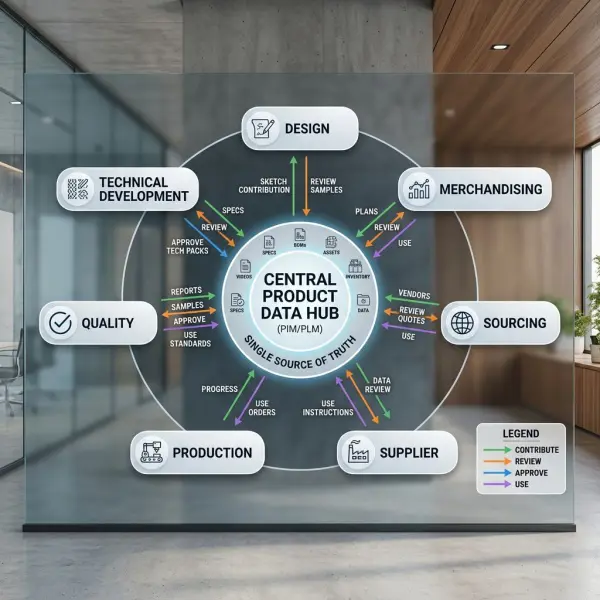
The most important collaboration function of PLM is the shared product record. Instead of each department maintaining an independent description of the style, the system links relevant information to a controlled central record.
SAP describes PLM collaboration as working through a common record of enterprise product data, including material requirements, workflows, regulations, and product changes. It also emphasizes secure access, preservation of product-definition integrity, and management of the processes through which information is created and shared. SAP’s overview of PLM collaboration and product data
In fashion, that common record may allow a designer to view approved fabrics, a technical developer to update measurements, a merchandiser to examine target price, and a sourcing manager to review supplier quotations without creating four unrelated versions of the product.
The information does not necessarily need to appear identically for every user. Role-specific interfaces may show each function the fields and tasks most relevant to its responsibilities. What matters is that the information remains connected.
It Replaces Detached Messages with Contextual Communication
Email and messaging platforms are useful for discussion, but they often separate communication from the product data being discussed.
A message reading “please change the pocket position” is incomplete unless the recipient can determine:
- Which style is affected
- Which garment side is being discussed
- Which sample round revealed the issue
- What the current measurement is
- What the new measurement should be
- Whether the change applies to every size
- Whether the sketch and specification have been updated
- Who must approve the revision
In a PLM workflow, the comment can be attached to the relevant style, sample, construction detail, or point of measurement. Images, annotations, due dates, and approval status can be included in the same context.
The system does not make the comment technically correct. It makes the comment easier to interpret, trace, and act upon.

It Creates Visibility Around Responsibility
Fashion development often slows down not because nobody is working, but because ownership is unclear.
A style may be waiting for fabric approval, yet the sourcing team believes design must choose the final color. Design may be waiting for a supplier strike-off, while the supplier is waiting for a confirmed color reference. The calendar shows delay, but the organization cannot identify the next required decision.
PLM workflows can assign:
- Task owner
- Reviewer
- Approver
- Due date
- Dependency
- Current status
- Required evidence
- Escalation path
This makes responsibility more visible. It can also reveal whether the delay comes from one employee, an unrealistic calendar, incomplete data, or a dependency outside the team’s control.
Visibility should not be used merely to monitor individuals. Its greater value is identifying where the process itself is poorly designed.
It Connects Changes to Their Operational Consequences
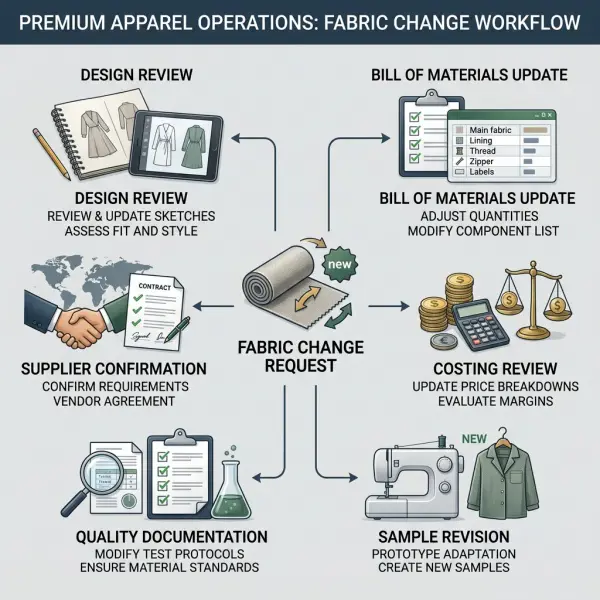
Fashion products change repeatedly during development. A new fabric may alter drape, cost, minimum order quantity, color availability, care instructions, lead time, testing requirements, and garment measurements.
Without structured change control, one department may accept the change without realizing what else must be updated.
PLM can create a defined route for proposing, reviewing, and approving a revision. IBM’s PLM overview identifies version control, user permissions, structured change approval, and audit trails as common PLM capabilities. These functions allow stakeholders to understand who requested a change, who approved it, and what was modified.
In apparel development, that might mean a material change automatically prompts reviews from technical design, costing, sourcing, and quality rather than being treated as a private agreement between a designer and supplier.
It Supports Asynchronous Collaboration Across Locations
Fashion businesses frequently work across offices, factories, suppliers, agents, and time zones. Real-time meetings are not always practical, especially when a European brand coordinates with an Asian sourcing office and several manufacturing partners.
PLM supports asynchronous collaboration by preserving current product information, comments, assignments, and decision history. A supplier can respond to a request in its own working hours, while the brand team can review that response later without depending entirely on a live meeting.
This is valuable only when records are updated consistently. If employees discuss critical decisions through private channels and fail to record them in the system, remote teams will still lack the full context.
It Gives Management a Cross-Functional View
Senior managers often receive separate updates from design, merchandising, sourcing, and technical teams. Each report may be accurate within its own function but provide no integrated view of product risk.
PLM dashboards can bring together indicators such as:
- Styles with incomplete specifications
- Materials awaiting approval
- Cost targets that have not been met
- Samples overdue from suppliers
- Fit approvals behind schedule
- Missing compliance documents
- Styles approaching production release
- Tasks blocking multiple downstream activities
The dashboard is not a substitute for discussion. It gives the discussion a more reliable starting point.
How PLM Supports Different Fashion Teams
Design Teams: Protecting Creative Intent While Adding Structure
Designers often resist systems that feel too administrative. The concern is understandable. Creative work does not always develop in a linear sequence, and excessive form-filling can interrupt exploration.
A well-configured PLM system should not force every early idea into production-level detail. Instead, it can create a controlled transition between creative concept and product definition.
Design teams may use PLM to:
- Associate sketches with the correct style and season
- Select materials and colors from shared libraries
- Communicate construction intent
- Review whether requested changes affect the design
- See commercial constraints earlier
- Confirm which creative version has been approved
The practical benefit is not that PLM designs the garment. It reduces the likelihood that creative intent becomes diluted through undocumented revisions.
For example, a designer may specify a soft dropped shoulder created through a particular sleeve shape. If the factory changes the construction to simplify sewing without a clearly recorded review, the visual result can shift. PLM can help preserve the relationship between sketch, specification, sample comment, and final approval.
Merchandising Teams: Connecting Product Direction with Commercial Logic
Merchandisers often bridge creative, financial, and market considerations. They may assess whether the collection has the correct balance of categories, price points, colors, delivery periods, and intended customer segments.
PLM can support that role by connecting commercial attributes to the developing product. A merchandiser may be able to compare target cost, quoted cost, product status, colorway count, and planned delivery without requesting separate files from each function.
This allows earlier commercial conversations. If a style exceeds its target cost, the team can evaluate options before the product is fully developed. If too many similar products are entering the same delivery window, the collection can be adjusted before purchase quantities are committed.
The deeper relationship between PLM and collection-level control belongs in why PLM systems help brands manage collections more efficiently. At the collaboration level, the central issue is that merchandising decisions become visible to the teams expected to implement them.
Product Development and Technical Teams: Controlling Specifications
Product developers and technical designers manage the transition from concept to a product that can be manufactured consistently.
They need access to current information on:
- Construction
- Materials
- Measurements
- Grading
- Fit comments
- Sample history
- Artwork
- Labels
- Packaging
- Approval status
PLM can make those elements easier to coordinate because they remain linked to the same style record.
Consider a fit sample that measures two centimetres wider than specification at the chest. The technical team may decide that one centimetre of the difference improves the silhouette, while the remaining centimetre should be corrected. That decision affects the measurement chart, fit comments, pattern, and next sample request.
When the rationale and revision are recorded in PLM, the factory receives a clearer instruction than it would from a comment that simply says “reduce chest.”
Sourcing Teams: Connecting Supplier Reality with Product Decisions
Sourcing teams understand constraints that may not be visible during initial design. A requested fabric may be unavailable in the required color, have an unsuitable minimum order quantity, exceed the cost target, or require a lead time that conflicts with the launch calendar.
PLM allows sourcing information to be connected directly to the product rather than delivered as a separate commercial report.
This supports more informed trade-offs. A designer may accept an alternative fabric when the system shows that it preserves the desired weight and appearance while improving availability. A merchandiser may reduce the number of colorways when the total material commitment becomes commercially unrealistic.
The benefit is not that PLM makes the choice. It makes the relevant constraints visible to the people making it.
Suppliers and Factories: Receiving More Controlled Instructions
Supplier collaboration becomes difficult when factories receive specifications through multiple channels. A technical package may arrive by email, while color comments are sent through chat and a revised label file comes from another employee.
The factory may not know whether the later message overrides the original document.
A supplier portal or controlled PLM access can provide a clearer route for:
- Viewing approved specifications
- Receiving sample requests
- Responding to comments
- Submitting quotations
- Uploading test or compliance documents
- Confirming material availability
- Recording delivery estimates
- Acknowledging changes
Fashion-focused PLM platforms commonly position supplier and cross-team collaboration as part of their apparel workflows, including product development, sourcing, manufacturing, quality, and compliance. These are vendor-described capabilities and should be verified against the actual configuration and licensing of the platform being evaluated. Centric Software’s fashion and apparel PLM overview
Supplier access must be permission-based. A factory should not automatically see other suppliers’ quotations, confidential margin targets, unreleased collections, or unrelated product categories.

Quality and Compliance Teams: Reviewing Evidence Earlier
Quality and compliance work is often introduced too late. A material, trim, print, or label may already be approved commercially before the relevant testing or documentation has been reviewed.
PLM can make quality requirements part of the development workflow rather than a final administrative check. Teams may attach test reports, certificate details, restricted-substance declarations, inspection records, or approval status to the relevant material or product.
This does not prove that every claim is valid. A document may be expired, incomplete, issued for a different material, or irrelevant to the target market. Quality and compliance specialists must still evaluate the evidence.
The collaborative benefit is earlier visibility. Teams can see that documentation is missing before production release rather than discovering the problem after goods are made.
Production and Operations Teams: Receiving a More Stable Handoff
Production teams need a clearly released product definition. They should not have to reconstruct final instructions from development emails.
PLM can support handoff by identifying:
- Approved BOM
- Final measurements
- Current construction details
- Accepted sample status
- Approved colors and materials
- Packaging requirements
- Testing or compliance status
- Effective revision
- Remaining open issues
When PLM is integrated with Enterprise Resource Planning or production systems, selected approved data may move downstream without being manually recreated.
Integration still requires governance. The company must decide which system owns style data, supplier data, cost, purchase orders, inventory, and production transactions.
A Practical Example: One Material Change, Several Teams
Imagine a fashion brand developing a women’s woven blouse. The approved shell fabric is no longer available in one of the planned colors. The supplier proposes a visually similar substitute.
Without a shared system, the conversation may unfold like this:
- The supplier emails sourcing.
- Sourcing forwards the option to design.
- Design approves the color visually.
- The technical developer is not informed that the fabric weight changed.
- Costing continues to use the original fabric price.
- Quality assumes the original test report is still valid.
- The factory starts a revised sample using the substitute.
- Merchandising discovers the cost increase after the line review.
Every participant may have acted reasonably, yet the total process remains uncontrolled.
In a PLM-supported workflow, the proposed substitute can be associated with the style and affected colorway. The change may trigger reviews for:
|
Team |
Review required |
|
Design |
Does the substitute preserve color, surface, and drape? |
|
Technical development |
Does weight or construction affect measurements and fit? |
|
Sourcing |
Is the material available at the required quantity and lead time? |
|
Costing |
How does price and consumption affect product cost? |
|
Quality |
Are testing and compliance documents valid for this material? |
|
Merchandising |
Does the revised cost still fit the price architecture? |
|
Supplier |
Has the factory received the final approved material reference? |
The outcome may still be rejection. PLM improves the route by which the decision is evaluated and communicated.
That distinction matters. Collaboration is not agreement. It is a controlled way of reaching and applying a decision.
Before and After PLM: What Changes in Daily Collaboration?
|
Collaboration issue |
Fragmented workflow |
PLM-supported workflow |
|
Latest specification |
Users search email or shared folders |
Current approved version is linked to the style |
|
Fit comments |
Stored in separate reports or messages |
Connected to sample round and measurement data |
|
Material change |
Communicated informally to selected people |
Routed to affected functions for review |
|
Task ownership |
Assumed or discussed in meetings |
Assigned with status and due date |
|
Supplier instruction |
Sent through several channels |
Released through controlled access or export |
|
Approval history |
Difficult to reconstruct |
Decision and revision history retained |
|
Collection status |
Compiled manually from departments |
Aggregated from product and workflow data |
|
Remote collaboration |
Depends heavily on meetings |
Supported through persistent records and tasks |
|
Handoff to operations |
Data re-entered from development files |
Approved information can be transferred systematically |
The table shows the intended operating difference, not a guaranteed outcome. A poorly configured or inconsistently used PLM system can still contain duplicate, incomplete, or outdated information.
How PLM Can Improve Decision-Making Between Teams
Better collaboration is not measured by the number of comments entered into a platform. It is measured by whether the right people receive sufficient information to make a decision at the right stage.
PLM can support that process in several ways.
Decisions Can Be Made Closer to the Source of the Issue
When a supplier reports that a trim cannot meet the delivery date, the sourcing team can attach the issue to the affected product and route it to design, merchandising, and technical development.
The discussion is no longer detached from the relevant style, cost, and calendar. This reduces the need to reconstruct context before a decision can be made.
Trade-Offs Become More Visible
Fashion development involves trade-offs rather than perfect solutions. A material may have the desired appearance but exceed the cost target. A construction detail may improve the design but complicate sewing. A broader size range may require additional fit development and pattern work.
PLM can place related information together so that the decision is not made from one function’s perspective alone.
It cannot calculate every qualitative judgment. Brand identity, customer expectations, and design priorities still require human interpretation.
Rejected Options Remain Traceable
Teams often revisit ideas that were previously rejected because the reason for rejection has been forgotten.
A material may have been dropped because of minimum order requirements, poor recovery, failed testing, or color inconsistency. If the reason is recorded, future teams can distinguish between a permanent technical issue and a temporary commercial limitation.
This contributes to organizational memory, particularly when employees change roles or leave the company.
What PLM Does Not Fix About Team Collaboration
PLM can make collaboration more structured, but several problems sit outside the software.
It Does Not Resolve Unclear Decision Authority
If design, merchandising, and sourcing all believe they have final authority over a material decision, the workflow will stall regardless of the platform.
The business must define who recommends, who reviews, who approves, and who must be informed.
It Does Not Make Incomplete Information Reliable
A shared material record is not useful when composition, width, cost, lead time, or supplier reference is missing.
Centralization increases access to the data. It does not guarantee the data is correct.
It Does Not Replace Technical Expertise
PLM may show a proposed measurement change, but it cannot determine whether that change produces the intended fit unless the user or integrated tool has the required knowledge.
The same applies to fabric behavior, grading, garment construction, quality, costing, and compliance.
It Does Not Eliminate Necessary Meetings
Some decisions require discussion, negotiation, physical sample review, or creative judgment.
The purpose of PLM is not to remove all meetings. It can make meetings more productive by ensuring participants begin with current information and leave with documented decisions.
It Does Not Repair Weak Supplier Relationships
A portal cannot compensate for unrealistic deadlines, inconsistent payments, inadequate technical support, or poor commercial communication.
Supplier collaboration depends on both system design and relationship quality.
It Does Not Guarantee Faster Product Development
A PLM system may reveal delays and reduce avoidable rework, but faster development depends on process design, supplier responsiveness, decision speed, material availability, staffing, and implementation quality.
Claims about speed should therefore be evaluated against the company’s own baseline.
How Fashion Businesses Can Apply PLM Collaboration Strategically
Start with High-Friction Interactions
The first collaboration workflows should address recurring operational pain rather than attempting to digitize every activity.
Good starting points may include:
- Fit-sample comments
- BOM approvals
- Material substitutions
- Cost reviews
- Supplier quotations
- Product-development calendars
- Production-release approvals
These workflows involve several teams and produce measurable errors or delays when managed poorly.
Define a Product Data Owner
Every important field should have a responsible owner. Design may own creative attributes, technical development may own measurements, sourcing may own supplier quotations, and merchandising may own target retail price.
Ownership does not mean that only one person may view the data. It means someone is accountable for its accuracy and status.
Separate Contributors, Reviewers, and Approvers
Many systems become confusing because everyone is given broad editing rights.
A stronger structure distinguishes between:
- Contributors who enter or propose information
- Reviewers who assess its impact
- Approvers who authorize use
- Observers who need visibility but should not edit
This reduces accidental changes and clarifies accountability.
Keep Communication Attached to the Product
Teams should avoid making final decisions only through private messages. The relevant conclusion, evidence, and approval should be recorded with the product or workflow.
This does not require copying every conversation into PLM. It requires preserving the decision that downstream teams must understand.
Design Supplier Access Deliberately
Supplier collaboration should begin with a clear access model. A factory may need the latest tech pack and sample comments but not the brand’s margin analysis or other suppliers’ quotations.
Access should be reviewed when supplier relationships, employees, or projects change.
Build Escalation into the Workflow
Not every overdue task deserves the same response. A delayed inspiration image is different from an unapproved material that blocks a production booking.
Escalation rules should reflect business impact, dependency, and proximity to commitment.
Remove Redundant Channels
If employees must update PLM, a spreadsheet, a weekly presentation, and a project-management tool with the same status, adoption will weaken.
Implementation should remove duplicate reporting where possible. Otherwise PLM becomes an additional task rather than the working system.
Collaboration Metrics Fashion Businesses Can Track
Collaboration quality is difficult to measure directly. Teams should avoid relying only on login counts or comments posted, as these indicate system activity rather than operational improvement.
More useful indicators connect collaboration to product-development outcomes.
Decision Cycle Time
Measure the time between a request for review and a documented approval or rejection. This can be applied to materials, samples, costs, artwork, or production release.
A long cycle may indicate unclear authority, insufficient information, overloaded approvers, or unrealistic workflow design.
First-Pass Information Completeness
Track the percentage of submissions that contain the required information when first reviewed. Examples include BOMs, sample requests, quotations, or compliance documents.
Repeatedly returning incomplete submissions creates invisible rework across teams.
Number of Conflicting Versions
Record incidents where different users or suppliers act from inconsistent specifications, drawings, or material references.
The goal is not necessarily zero immediately. A declining trend suggests that version control and release discipline are improving.
Sample Comment Turnaround
Measure how quickly samples are reviewed, comments are issued, and the next action is confirmed.
This should be interpreted alongside sample complexity. A tailored jacket may legitimately require more review than a basic jersey top.
Late Changes After Production Commitment
Track changes introduced after material booking, purchase order, pre-production approval, or another defined commitment point.
Late changes may indicate weak early collaboration or unavoidable external circumstances. The reason should be categorized rather than treated as one generic metric.
Time Spent Preparing Status Reports
When teams trust the PLM data, manual consolidation for weekly meetings may decrease.
A reduction is valuable only if the automated view remains accurate and sufficiently detailed.
Common Mistakes When Using PLM for Collaboration
Assuming Shared Access Equals Shared Understanding
Giving several teams access to the same system does not mean they interpret fields, statuses, or responsibilities consistently.
A status such as “approved” may mean design-approved to one team and fully production-approved to another. Status definitions must be explicit.
Creating Too Many Notifications
Implementations sometimes notify every stakeholder about every change. Users become overwhelmed and begin ignoring alerts.
Notifications should be based on responsibility, risk, and dependency. A packaging designer does not need an alert for every internal fit comment unless that change affects packaging information.
Keeping Informal Decisions Outside the System
Teams may use PLM for formal documentation but continue making actual decisions through private messages. This creates a gap between the system record and operational reality.
The better approach is to record the final decision and its practical consequence, even when the discussion happened elsewhere.
Inviting Suppliers Without Preparing Them
A supplier portal may fail when factories receive login credentials but no explanation of required tasks, turnaround expectations, document standards, or support channels.
Supplier onboarding should include role-based training and realistic sample transactions.
Using Workflow to Enforce an Impractical Process
A rigid workflow can slow work when it includes unnecessary approvals or assumes every product follows the same path.
Basic carryover products, highly technical garments, and experimental capsules may require different controls. Configuration should recognize meaningful differences without creating unlimited exceptions.
Treating Transparency as Employee Surveillance
PLM makes work status more visible. If management uses that visibility primarily to blame individuals, employees may avoid documenting uncertainty or risk.
A healthier approach uses transparency to identify bottlenecks, workload imbalance, missing information, and process weaknesses.
Measuring Activity Instead of Outcomes
A high number of tasks completed does not prove that collaboration improved. The organization should examine whether information became more reliable, decisions occurred earlier, and avoidable rework declined.
Important Caveats Before Expecting Better Collaboration
The Platform Must Match the Product Model
A fashion PLM system should represent the company’s actual relationships between collection, style, colorway, size, material, supplier, sample, and market.
If the data model is poorly matched, teams may create workarounds that fragment collaboration again.
Integration Boundaries Must Be Clear
PLM may coexist with ERP, Product Information Management, Digital Asset Management, CAD, planning, quality, and e-commerce platforms.
The company should define which system owns each field. Otherwise teams may update different applications and create conflicting records.
Role-Based Access Requires Continuous Administration
Permissions are not a one-time configuration. Employees change roles, suppliers complete projects, and external partners may no longer need access.
Inactive accounts and unnecessary visibility create confidentiality and security risk.
Cloud Access Does Not Remove Connectivity Constraints
Cloud PLM can support distributed teams, but suppliers or remote offices may still face limited bandwidth, device restrictions, or inconsistent connectivity.
The implementation should test real working conditions rather than assuming every participant has the same infrastructure.
Vendor Claims Need Company-Specific Validation
Software providers may describe improvements in collaboration, time to market, accuracy, or productivity. These claims may reflect particular customers, configurations, or implementation conditions.
A buyer should establish its own baseline and define how success will be measured during a pilot.
Collaboration Depends on Organizational Culture
PLM can support openness, traceability, and cross-functional decision-making. It cannot force teams to share concerns early, challenge unrealistic assumptions, or respect agreed responsibilities.
Technology strengthens the collaboration model that the organization is willing to operate.
Frequently Asked Questions
How does PLM improve communication between fashion teams?
PLM improves communication by connecting messages, comments, changes, and approvals to the relevant product data. Instead of discussing a garment through detached emails, teams can refer to the same style, colorway, sample round, material, specification, or cost record.
This reduces ambiguity and makes the outcome of a discussion easier to trace. The improvement depends on employees recording final decisions consistently and using agreed terminology. PLM cannot make vague instructions precise unless users provide the necessary technical and commercial context.
Can PLM replace email and messaging platforms?
No. Email, chat, and video meetings remain useful for discussion, negotiation, and urgent communication. PLM is better suited to preserving structured product information, task ownership, approval status, and decision history.
A practical model allows informal discussion in communication tools while requiring final product decisions to be recorded in PLM. This keeps the system authoritative without forcing every conversation into a formal workflow.
How does PLM support collaboration with garment factories?
PLM can give factories controlled access to technical packages, BOMs, sample requests, comments, quotations, documents, and revision status. It may also provide a more reliable method for confirming that the supplier has received the current instruction.





Comments 0
Leave a CommentSend Comment
Anda harus Login terlebih dahulu untuk dapat memberikan komentar.