
Fashion Size Recommendation Technology Explained
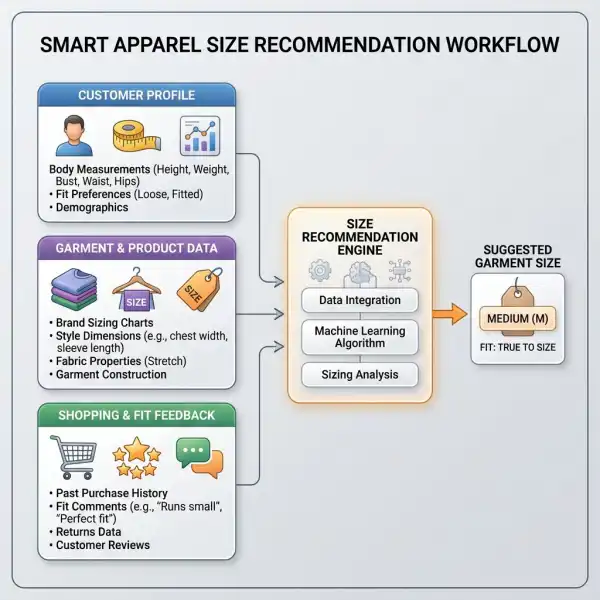
Fashion size recommendation technology helps online shoppers select the garment size most likely to match their body, fit preference, and a specific product’s sizing characteristics. Instead of asking customers to interpret a generic size chart alone, the system combines information about the shopper, the garment, the brand, and previous fit outcomes to produce a personalized recommendation.
The technology may rely on simple decision rules, statistical models, machine learning, computer vision, or a combination of these methods. More advanced does not automatically mean more accurate. Recommendation quality still depends heavily on reliable product measurements, consistent sizing data, sufficient customer interaction history, and clear definitions of what “good fit” means for each garment category.
For fashion businesses, size recommendation is therefore not merely a website feature. It is a data and merchandising system connecting product development, garment specifications, ecommerce operations, customer feedback, returns analysis, and digital experience design.
Quick Answer
Fashion size recommendation technology is a digital system that predicts which available garment size is most suitable for an individual shopper. It typically compares customer information—such as height, weight, body measurements, usual brand size, fit preference, or purchase history—with product information such as garment measurements, size charts, material stretch, silhouette, brand sizing, and previous customer fit feedback.
A basic system may use fixed rules: for example, matching a waist measurement to a trouser size chart. More sophisticated systems can learn patterns from orders, kept items, returns, fit surveys, product attributes, and customer behavior. Hybrid models combine both approaches.
The recommendation is usually expressed as a suggested size, sometimes with an explanation such as “recommended for a regular fit” or “choose one size larger for a relaxed fit.”
This technology can make size selection easier, but it does not physically guarantee fit. Garment construction, fabric behavior, personal comfort, inaccurate data, and inconsistent sizing can all influence the result. It should support—not replace—accurate product specifications and transparent fit information.
What Is Fashion Size Recommendation Technology?
Fashion size recommendation technology is a retail decision-support system that matches a customer profile with the available sizes of a specific fashion product in order to estimate the most appropriate size and fit outcome.
The term covers a broad range of systems. Some are essentially interactive size charts. Others use recommendation algorithms that learn from customer-product interactions. More complex platforms may incorporate body-measurement estimation, product-level fit data, computer vision, three-dimensional body models, or probabilistic predictions.
The underlying problem is more complicated than matching a customer’s chest or waist circumference to a labeled size. A size label such as S, M, 10, 42, or 30 does not describe the complete shape of either the customer or the garment. It also does not consistently represent the same dimensions across brands, categories, regions, or even products within the same brand.
International standards can provide common terminology for anthropometric measurements. For example, ISO 8559-1 definitions for body measurement establish standardized anthropometric concepts used in clothing size designation. However, standards do not force every retailer to manufacture garments with identical dimensions under the same size label.
A useful recommendation system must therefore answer a product-specific question:
Which available size of this particular garment is most likely to produce the fit this particular customer expects?
That is different from determining the customer’s universal clothing size. In practice, no reliable universal size applies equally across fitted dresses, oversized shirts, stretch leggings, structured jackets, denim jeans, sports bras, and footwear.

Why Is Clothing Size So Difficult to Recommend?
Clothing fit is a relationship between the body, the garment, and the wearer’s expectation. Each of those elements contains variation.
Two customers with the same height and weight may have different shoulder widths, bust-to-waist proportions, hip shapes, torso lengths, leg lengths, posture, and preferred ease. Two garments labeled size M may also differ because of their pattern blocks, target customer, material, intended silhouette, manufacturing tolerances, and brand positioning.
This is why accurate garment measurements for apparel production remain fundamental. A recommendation algorithm cannot reliably compensate for product data that is missing, outdated, incorrectly mapped, or inconsistent with the finished garment.
Body Measurements and Garment Measurements Are Not Interchangeable
Body measurements describe the wearer. Garment measurements describe the finished product or, at an earlier stage, the intended product specification.
A customer with a 90-centimetre chest does not necessarily need a garment with a 90-centimetre chest circumference. The garment requires ease, and the appropriate amount depends on the category, pattern, material, movement requirements, and intended look.
A fitted stretch top may have garment dimensions close to or smaller than the corresponding body measurement because the fabric is designed to extend during wear. A woven overshirt may include considerable positive ease. A structured blazer may require carefully distributed ease across the chest, back, armhole, sleeve, and shoulder rather than a simple circumference difference.
Body dimensions are therefore only one input. NIST’s work on body dimensions for apparel emphasizes that body-measurement definitions, techniques, target populations, and body-shape classifications all matter when sizing clothing.
Labeled Sizes Require Normalization
Size normalization converts different brand and product size systems into a form that can be compared or modeled consistently.
A retailer carrying hundreds of brands may encounter:
- Alpha sizes such as XS to XXL.
- Numeric systems such as 0–20, 32–54, or 26–40.
- Regional systems that use similar numbers differently.
- Dual or combined sizes such as S/M.
- Category-specific sizing for bras, shoes, tailoring, or childrenswear.
- Products intentionally designed as petite, tall, oversized, maternity, compression, or unisex fits.
Researchers have described size normalization as a prerequisite for scalable fit prediction because raw labels alone do not provide a consistent representation of actual product size. Automated approaches can use transactional data to infer mappings, although those mappings still require validation against product and fit information. Research on automated fashion size normalization demonstrates how sales data can support this process.
For fashion teams, normalization should complement—not replace—well-maintained size specification sheets in garment development.
Fit Is Partly Subjective
A technically wearable garment may still feel wrong to the customer.
One shopper may want jeans to sit closely at the waist. Another may prefer room through the seat and thigh. A customer buying a performance base layer may expect compression, while a customer buying a casual T-shirt may consider the same close fit uncomfortable.
A recommendation engine must therefore distinguish among at least three concepts:
- Physical compatibility: whether the customer is likely to be able to wear the garment.
- Intended product fit: how the garment was designed to sit on the body.
- Personal fit preference: how closely or loosely the customer wants to wear it.
Many disappointing recommendations occur because a system estimates only the first concept while the shopper assumes it has considered all three.
What Data Does a Size Recommendation System Use?
Most recommendation systems combine some form of customer data, product data, and interaction data. The exact combination depends on the retailer’s catalog, customer base, available technology, and privacy model.
Customer Information
Customer inputs may include:
- Height and weight.
- Chest, bust, waist, hip, inseam, foot length, or other measurements.
- Age range or gender category when relevant to the retailer’s sizing model.
- Usual size in a known brand or product.
- Preferred fit, such as slim, regular, or relaxed.
- Previously purchased and retained sizes.
- Fit feedback from previous orders.
- Images or body scans, where explicitly supported and appropriately handled.
Not every system needs every input. Asking too many questions can reduce completion rates, while asking too few may weaken the recommendation. The appropriate balance depends on how much information the model can infer from catalog and transaction data.
Product and Garment Information
Product-side data may include:
- Available size labels.
- Garment measurements by size.
- Grade rules between sizes.
- Product category and subcategory.
- Intended fit or silhouette.
- Fabric composition and stretch characteristics.
- Pattern block or fit family.
- Brand and collection.
- Rise, length, cup, width, or other category-specific dimensions.
- Fit feedback from customers and merchandising teams.
- Manufacturing or supplier information when it explains systematic variation.
Material stretch should be handled carefully. A fabric containing elastane is not automatically equally stretchable in every direction, and its effective recovery depends on construction, percentage, yarn arrangement, finishing, and garment design. Product data should describe observed or specified performance rather than making assumptions from fiber composition alone.
Customer-Product Interaction Data
Machine-learning systems may learn from signals such as:
- Products viewed or added to a basket.
- Sizes selected.
- Orders placed.
- Items retained.
- Items exchanged for another size.
- Return reasons.
- Customer fit surveys.
- Review language describing fit.
- Repeat purchases of similar products.
Research systems have combined customer and product attributes with interaction histories to address the sparsity found in fashion purchase data. A 2019 deep-learning approach, for example, used both content features and collaborative signals rather than relying only on prior customer-item interactions. Deep learning research on size and fit prediction explains this content-collaborative structure.
Interaction data must still be interpreted carefully. A kept item is not proof of perfect fit, just as a returned item is not automatically evidence of poor sizing. Customers return products for many reasons, and some purchases may be gifts or orders for multiple people using one account.
How Does Fashion Size Recommendation Technology Work?
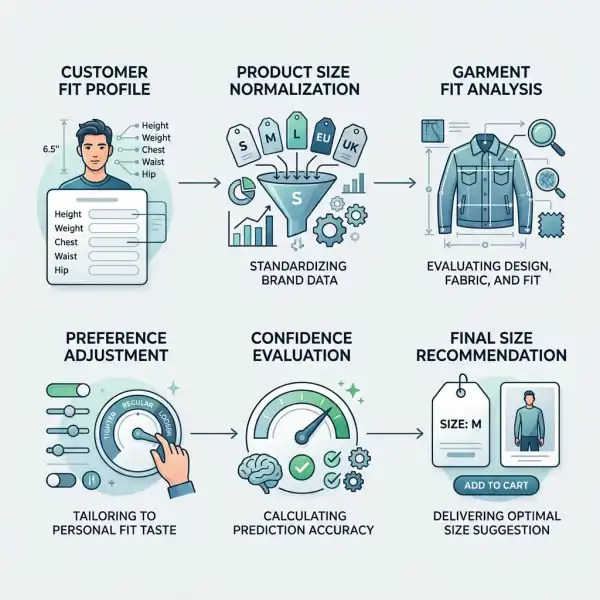
Although platforms differ technically, most systems follow a recognizable operational sequence.
1. The System Creates a Customer Fit Profile
The process begins by representing what is known about the customer. A new shopper may provide height, weight, usual size, body measurements, or a reference garment that fits well. A returning customer may already have a fit profile based on previous purchases and feedback.
The profile may be a transparent set of measurements or a mathematical representation known as an embedding or latent profile. In the latter case, the model learns patterns associated with the customer without reducing the profile to one conventional size.
2. Product Sizes Are Structured and Normalized
The retailer’s size labels, measurements, categories, and fit attributes must be translated into a consistent product representation.
This stage is often underestimated. Before an algorithm can compare size 10 from one brand with M from another, the system needs evidence about what those labels represent for the relevant product categories. Incorrect product mapping can produce confident but systematically wrong recommendations.
3. The Engine Estimates Size Compatibility
The engine evaluates the relationship between the customer profile and each available product size.
Depending on the system, it may calculate:
- Whether key body dimensions fall within defined size ranges.
- Expected ease between the body and garment.
- Similarity to customers who kept or returned the same product.
- Similarity to garments the customer previously wore successfully.
- Probability that each size will be too small, suitable, or too large.
- Probability that the customer will select or retain a particular size.
These are related but not identical prediction targets. A model optimized to predict the size a customer will order may behave differently from one optimized to predict reported fit satisfaction.
4. Context and Fit Preferences Modify the Result
A recommendation may be adjusted according to the product’s intended silhouette and the shopper’s stated preference.
For example, the same customer profile could produce:
- Size S for a standard fitted shirt.
- Size M for a relaxed personal preference.
- Size XS for an intentionally oversized garment.
- A warning that two sizes may be plausible because the customer falls between size ranges.
This contextual layer is essential. Without it, the system risks treating every garment as though it should fit with the same amount of ease.
5. The Recommendation Is Presented to the Shopper
The final output may include:
- One recommended size.
- A recommendation with a confidence level.
- Two possible sizes with different fit descriptions.
- A size plus a short explanation.
- A warning that insufficient information is available.
- A request for another measurement or previous-brand reference.
The most useful interface does not merely display a size. It explains enough for the shopper to make an informed decision without exposing unnecessary algorithmic complexity.
A result such as “M recommended for a regular fit; choose L for additional room through the chest” is often more actionable than an unexplained “Your size is M.”
Main Types of Size Recommendation Systems
Fashion retailers do not all need the same technical architecture. The most suitable model depends on catalog complexity, transaction volume, product-data quality, implementation cost, and the amount of historical fit information available.
|
System type |
How it works |
Most suitable context |
Main operational requirement |
|
Rules-based matching |
Maps customer inputs to predefined measurement or size ranges |
Small catalogs, consistent sizing, early-stage implementation |
Accurate charts and clearly defined rules |
|
Reference-size comparison |
Uses a size or garment the customer already knows fits |
Multi-brand retail and customers reluctant to measure themselves |
Reliable brand and product mappings |
|
Collaborative filtering |
Learns from size choices and outcomes of similar customers |
Retailers with substantial transaction histories |
Sufficient clean customer-product interaction data |
|
Content-based model |
Compares customer attributes with product and garment attributes |
New products or catalogs with detailed structured data |
Complete product features and measurements |
|
Hybrid recommendation |
Combines rules, product attributes, and behavioral patterns |
Larger retailers with mixed data maturity |
Integrated data infrastructure and model governance |
|
Image or scan-assisted system |
Estimates measurements or body shape from visual inputs |
Use cases where detailed body estimation adds clear value |
Strong technical validation, privacy controls, and user guidance |
Rules-based systems are sometimes dismissed as unsophisticated, but they can be commercially useful when product measurements are reliable and the catalog is controlled. Conversely, a complex machine-learning model can underperform when its training data contains inconsistent size mappings or ambiguous return reasons.
How Is a Size Recommendation Different From a Size Chart or Virtual Try-On?
These tools address related but separate customer questions.
|
Tool |
Primary question answered |
Typical input |
Typical output |
|
Size chart |
What measurements correspond to each labeled size? |
Customer interprets measurements manually |
Measurement ranges by size |
|
Size recommendation |
Which available size is most suitable for me? |
Customer profile, product data, and possibly historical behavior |
Personalized suggested size |
|
Fit prediction |
How is a particular size likely to fit? |
Customer-product relationship |
Too small, suitable, too large, or category-specific fit |
|
Virtual try-on |
How might the garment look on a body or image? |
Photo, avatar, body model, or selected model |
Visual simulation |
|
Made-to-measure system |
What garment dimensions or pattern adjustments should be produced? |
Detailed body measurements and design rules |
Customized dimensions or pattern instructions |
A virtual try-on image should not automatically be interpreted as a precise size recommendation. Some systems focus on visual appearance, styling, or garment placement rather than the physical pressure, ease, mobility, and construction behavior that determine real-world fit.
Research into size-controllable virtual try-on continues to explore how visual representation and size selection can be connected, but the two functions remain technically distinct.
What Does the Technology Mean for Fashion Businesses?
The most visible outcome is a recommendation shown on the product page. The less visible impact is the need to connect teams and data that are often managed separately.
Product Development Becomes Part of the Digital Fit System
Pattern specifications, sample measurements, grading, fabric testing, and final quality control directly affect recommendation reliability.
When the digital catalog says a garment has a 108-centimetre chest but production batches consistently measure closer to 104 centimetres, the recommendation system is working with the wrong product. This is not primarily an algorithm problem. It is a specification and quality-data problem.
Brands may therefore need stronger links among:
- Technical design and pattern teams.
- Suppliers and garment manufacturers.
- Quality-control records.
- Product information management.
- Ecommerce catalog operations.
- Returns and customer-service data.
- Data science or technology providers.
Merchandising Taxonomy Must Become More Precise
A recommendation engine needs to understand whether a product is a fitted woven blouse, oversized sweatshirt, stretch bodycon dress, rigid denim jean, or performance compression top.
Broad labels such as “top” or “bottom” are rarely sufficient. Fit behavior changes by silhouette, construction, material, and intended use.
Merchandising teams may need to introduce structured attributes for fit family, stretch level, rise, length, shape, support, coverage, and intended ease. These attributes should be defined consistently rather than entered as unrestricted marketing language.
Customer Service Feedback Becomes Structured Data
Customer-service teams often hold valuable fit intelligence in unstructured form:
- “The shoulders run narrow.”
- “The waist is correct, but the hips are tight.”
- “The trousers are longer than expected.”
- “The material relaxes after several hours.”
- “Customers usually exchange this style for one size larger.”
Turning this information into usable data requires controlled fit-reason categories, product-level feedback workflows, and periodic review. Free-text comments remain useful, but they are harder to aggregate consistently.
Recommendation Quality Must Be Measured as a Business System
Click-through rate on the size tool is not enough. A retailer should examine a combination of adoption, coverage, accuracy proxies, customer behavior, and commercial outcomes.
Relevant measures may include:
- Percentage of eligible product views receiving a recommendation.
- Percentage of shoppers completing the input process.
- Recommendation acceptance rate.
- Size exchanges after following a recommendation.
- Fit-related return rate by product and customer segment.
- Customer-reported fit satisfaction.
- Performance for new customers and new products.
- Frequency of low-confidence or unavailable recommendations.
- Differences across categories, brands, regions, and body-size groups.
The deeper relationship between prediction quality and returns deserves separate analysis. See how fit algorithms may help reduce fashion return rates.
How Can Fashion Businesses Apply Size Recommendation Technology?
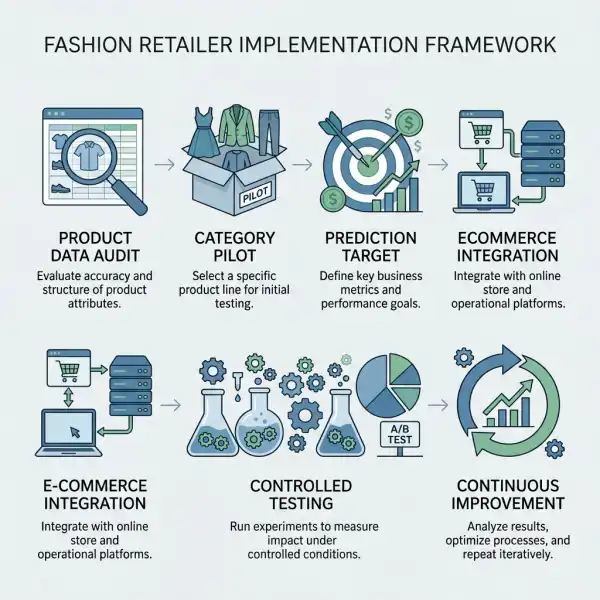
The most practical approach is to treat implementation as a staged data project rather than immediately purchasing the most complex system available.
Start With One Difficult but Measurable Category
A pilot works best when the category has:
- Meaningful fit variation.
- Sufficient sales volume.
- Identifiable size-related customer problems.
- Reliable product specifications.
- A manageable number of silhouettes or suppliers.
- Clear baseline performance data.
Denim, tailored trousers, fitted dresses, bras, footwear, or structured shirts may provide valuable learning, but each requires different fit attributes. A retailer should not assume that a model configured for footwear will transfer directly to womenswear or childrenswear.
Audit Product Data Before Selecting the Algorithm
The audit should compare ecommerce information with technical and physical product records.
Verify:
- Whether size charts are current.
- Whether measurements refer to bodies or finished garments.
- Whether the measurement method is consistent.
- Whether all sizes were measured or only calculated from grade rules.
- Whether stretch and fit descriptions are evidence-based.
- Whether supplier tolerances are reflected in the data.
- Whether different products incorrectly share one generic chart.
- Whether product revisions are version-controlled.
A brand that cannot answer these questions is not yet ready to evaluate advanced model performance fairly.
Define the Prediction Target
The business must decide what the system should predict.
Possible targets include:
- The most likely ordered size.
- The most likely retained size.
- The lowest probability of a fit-related return.
- The size most likely to produce a regular fit.
- The size aligned with an individual fit preference.
- A classification such as small, suitable, or large.
These targets can produce different outputs. The chosen metric should match the customer promise displayed on the product page.
Design for Uncertainty
A responsible system should be able to say that it does not have enough evidence.
For a new customer viewing a newly launched product with incomplete measurements, a low-confidence message may be more trustworthy than a forced recommendation. The interface can request another input, show the product chart, explain relevant fit details, or offer two plausible options.
Run Controlled Evaluation
Compare customer behavior and fit outcomes before and after implementation, while accounting for product mix, promotions, seasonality, category changes, and return-policy differences.
Production studies such as the SizeFlags research illustrate the value of combining experimentation, large-scale testing, and continuous model evaluation rather than relying only on offline accuracy. SizeFlags research on production fit prediction describes a probabilistic approach evaluated across multiple markets.
Common Mistakes When Implementing Size Recommendation Technology
Treating the Algorithm as a Substitute for Product Data
A retailer may expect machine learning to correct incomplete measurements, inconsistent product taxonomy, or inaccurate size charts automatically.
The model may find patterns in historical transactions, but those patterns can reflect old product errors, customer workarounds, or biased catalog coverage. Better results usually begin with stronger product data and measurement governance.
Using Returns as a Simple Fit Label
A returned item is not necessarily too small or too large. It may have arrived late, looked different from the photograph, felt uncomfortable, been ordered for comparison, or simply not suited the customer’s style.
Training data should distinguish explicit fit feedback from general return behavior wherever possible. Otherwise, the model may learn an incorrect relationship between size and outcome.
Ignoring Garment Category Differences
One size profile cannot describe every product category. Footwear requires length and width relationships. Bras involve band, cup, support, and construction. Trousers may depend on waist, hip, rise, thigh, and inseam. Jackets involve shoulder, chest, back width, sleeve, and layering allowance.
Recommendation logic should reflect the measurements that actually control fit in each category.
Asking Customers for Data Without Providing Value
Lengthy questionnaires create friction. Sensitive inputs, photographs, or scans require an especially clear reason, proportionate data collection, and appropriate privacy controls.
The shopper should understand what information is requested, how it improves the recommendation, and whether a less data-intensive option is available.
Displaying False Precision
Statements such as “98% guaranteed fit” can create unrealistic expectations unless the claim has been rigorously defined and validated for the relevant customers and products.
A recommendation is a probability-based decision aid. Its interface should communicate confidence honestly and preserve access to measurements, fit notes, and return information.
Important Technical Caveats
Fashion size recommendation technology should not be presented as an objective measurement of whether a garment will fit every person correctly.
Several constraints remain:
- Body measurements may be self-reported inaccurately.
- Height and weight do not fully represent body shape.
- Finished garments can vary within permitted manufacturing tolerances.
- Fabric behavior may change after washing, wear, or finishing.
- Customer accounts may contain purchases for several people.
- Retained purchases do not always indicate satisfaction.
- New customers and new products create cold-start conditions.
- Historical data may underrepresent some body shapes or size ranges.
- Visual body estimation can be affected by pose, clothing, lighting, camera position, and image quality.
- Personal comfort and styling preference cannot always be inferred from physical dimensions.
Research on image-based body estimation confirms that camera conditions, limited datasets, body-shape ambiguity, and implementation complexity remain relevant challenges.
These caveats do not make recommendation systems useless. They define the conditions under which their outputs should be interpreted. The broader constraints and risks are examined in the limits of AI size recommendations in online apparel retail.
A Practical Implementation Roadmap
A staged implementation can help a fashion business separate data problems from model problems.
Stage 1: Establish the baseline
Document current fit-related returns, size exchanges, customer questions, size-chart usage, and category-level issues.
Stage 2: Standardize measurements
Create consistent measurement definitions, product records, size mappings, and version control.
Stage 3: Structure fit attributes
Define intended silhouette, stretch behavior, length, rise, width, support, and other category-specific characteristics.
Stage 4: Select a pilot category
Choose a commercially meaningful category with adequate data and operational ownership.
Stage 5: Define customer inputs
Determine which information is necessary, optional, or too intrusive relative to the expected improvement.
Stage 6: Choose the recommendation approach
Select rules, reference sizing, machine learning, image estimation, or a hybrid system based on the available evidence—not on technology branding alone.
Stage 7: Integrate the customer experience
Place the tool at the correct point in the product journey and explain its recommendation clearly.
Stage 8: Validate across segments
Review performance for different categories, sizes, brands, regions, new customers, repeat customers, and low-confidence cases.
Stage 9: Create feedback loops
Connect exchanges, fit surveys, product reviews, customer service, and quality-control findings to ongoing improvement.
Stage 10: Expand selectively
Add categories only when the product attributes, measurement logic, and evaluation methods are suitable for them.
Frequently Asked Questions
Is fashion size recommendation technology the same as artificial intelligence?
No. Some size recommendation systems use artificial intelligence or machine learning, but others rely on fixed measurement rules, decision trees, or brand-to-brand size mappings.
A rules-based system may be sufficient for a small retailer with consistent products and reliable measurements. Machine learning becomes more useful when the business needs to model complex relationships across many customers, brands, products, and fit outcomes.
The important question is not whether a tool is labeled AI. It is whether the method is appropriate for the available data, catalog structure, prediction target, and customer experience.
Can a size recommendation system work without body measurements?
Yes. Some systems use height, weight, usual brand size, purchase history, retained products, and feedback from customers with similar profiles.
This approach can reduce the effort required from shoppers, but it may have less direct information about body proportions. Performance also depends on whether the retailer has sufficient comparable customer and product data.
A hybrid system may begin with a few low-friction questions and request detailed measurements only when the initial evidence is insufficient or the product category requires them.
Does a recommended size guarantee that a garment will fit?
No. A recommendation estimates the most suitable option from the sizes available, but it cannot guarantee comfort, appearance, mobility, or satisfaction.
Actual fit can be influenced by body shape, posture, garment construction, material behavior, manufacturing variation, intended silhouette, and personal preference. The system may also be working with incomplete or uncertain information.
Retailers should present recommendations alongside useful product measurements, model information, fit notes, material details, and a transparent return or exchange policy.
What is the cold-start problem in size recommendation?
The cold-start problem occurs when the system has little or no historical information about a new customer, new product, new brand, or newly introduced size.
A collaborative model cannot learn much from customer-product interactions that have not yet happened. Retailers can reduce this problem by using product attributes, garment measurements, brand mappings, customer questionnaires, expert fit assessments, and population-level patterns.
Recent research has also explored signals that appear before completed orders, such as products added to a basket, to increase customer coverage.
Should retailers ask customers to upload photographs or body scans?
Only when the additional information has a clear, validated purpose and the retailer can manage it responsibly.
Photographs and scans may support body-shape or measurement estimation, but they introduce technical, privacy, security, consent, retention, and customer-comfort considerations. Image quality, pose, camera distance, clothing, and lighting may also affect the output.
Businesses should collect only the information required for the stated function, explain how it will be used, comply with applicable data-protection requirements, and provide an alternative where practical.
Can one size recommendation model work across all apparel categories?
Usually not without category-specific logic.
Different garments have different controlling measurements and fit expectations. A T-shirt may depend heavily on chest, shoulder, length, and intended ease. Trousers may require waist, hip, rise, thigh, and inseam information. Footwear requires its own length, width, shape, and construction logic.
A shared technical platform can support several categories, but its features, rules, training data, evaluation metrics, and customer questions should be adapted to each product type.
What should a fashion brand verify before choosing a technology provider?
The brand should verify how the provider handles product measurements, size normalization, new products, new customers, category differences, fit preference, low-confidence cases, model monitoring, privacy, and data ownership.
It should also request evidence that matches the brand’s actual market. Results from a large multi-brand retailer may not transfer directly to a small label with limited transaction volume or highly distinctive silhouettes.
The evaluation should include integration effort, internal data readiness, reporting access, customer-interface flexibility, support requirements, and the method used to measure recommendation quality.
Conclusion
Fashion size recommendation technology translates complex relationships among bodies, garments, size systems, and customer preferences into a practical ecommerce decision.
Its visible output may be only one suggested size, but producing that answer reliably requires far more than an algorithm. It depends on consistent measurement practices, accurate size specifications, useful product attributes, interpretable customer feedback, clear prediction targets, and disciplined evaluation.
The strongest implementation is not necessarily the one collecting the most personal data or using the most advanced model. It is the one that matches its technical method to the retailer’s catalog, data maturity, customer expectations, and operational capacity.
For many fashion businesses, the first investment should therefore be better product and fit information. Once that foundation is dependable, recommendation technology can make the information easier to apply at scale—while still acknowledging that fit remains both physical and personal.




Comments 0
Leave a CommentSend Comment
Anda harus Login terlebih dahulu untuk dapat memberikan komentar.