
Fashion Brands Leading the Inclusive Fashion Movement
Quick Answer
Fashion brands leading the inclusive fashion movement are not only changing campaign images. They are improving product access through better sizing, adaptive clothing, modest sportswear, age-aware styling, clearer fit information, and more flexible retail experiences. In practical business terms, inclusive fashion means designing, producing, merchandising, and communicating apparel so more customers can find clothing that fits their body, lifestyle, comfort needs, and personal styling preferences.
Inclusive fashion is a product and retail approach that expands access to apparel by considering customers who are often underserved by standard fashion systems, including customers who need extended sizing, adaptive features, modest coverage, age-appropriate styling, easier dressing solutions, or clearer fit guidance.
For fashion businesses, the strongest lesson is simple: inclusion must be operational, not decorative. A brand cannot rely only on diverse imagery or broad messaging. It needs product development, size strategy, fit testing, supplier capability, customer service training, and retail clarity. The brands that lead this movement usually treat inclusion as part of product value, not a seasonal marketing theme.
What Inclusive Fashion Means for Modern Fashion Brands
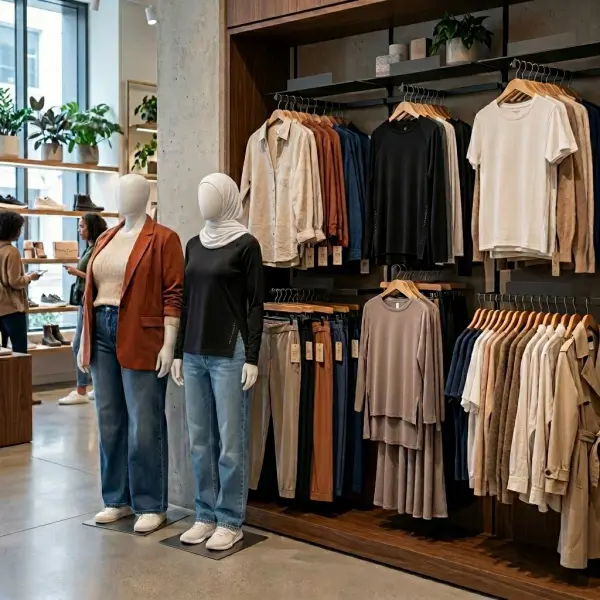
Inclusive fashion means making clothing more accessible and relevant to customers who may not be fully served by conventional fashion categories. This includes size inclusivity, adaptive clothing for people who need easier dressing solutions, modest fashion, age-inclusive styling, fit-based shopping, and product communication that helps customers make confident buying decisions.
The term is sometimes used broadly, but for fashion businesses it should be understood in practical terms. Inclusive fashion is not just about who appears in a campaign. It is about whether the product range, size chart, garment construction, retail navigation, and customer service experience actually support more customers.
A brand may look inclusive in photography but still fail customers if its size range is narrow, its trousers are difficult to fit, its product pages lack garment measurements, or its store staff cannot explain adaptive design features. The opposite can also happen: a brand with simple visuals may still be meaningfully inclusive if it offers reliable fit, broader sizing, easy-wear construction, and product information that reduces customer frustration.
This article builds on the previous cluster discussions: why unisex and gender-neutral fashion continues to expand globally and how consumer preferences are redefining fashion categories. The focus here is different. Instead of explaining why flexible categories are growing, this article looks at how brands can lead inclusion through product access, retail systems, and practical execution.
Why Inclusive Fashion Is Becoming a Business Priority
Inclusive fashion is becoming a business priority because customers increasingly expect brands to serve real bodies, real lifestyles, and real dressing needs. This expectation is not limited to one region or one consumer group. It appears in demand for broader size ranges, comfortable fit, modest coverage, easier dressing, adaptive features, practical workwear, and garments that can support different stages of life.
The commercial context matters. McKinsey’s State of Fashion 2026 notes that the global fashion industry faces continued pressure, including low single-digit growth expectations and value-conscious consumer behavior. In a market where customers are more selective, brands need stronger reasons for customers to trust, buy, and return. McKinsey State of Fashion 2026
Inclusive fashion can support that trust when it solves real product problems. A customer who finally finds trousers that fit consistently may return. A customer who finds modest sportswear that performs well may recommend it. A customer who needs adaptive closures may become loyal to a brand that understands ease of dressing. A customer who feels ignored by standard sizing may choose a brand that offers clearer garment measurements and more realistic fit imagery.
But inclusion only becomes a business advantage when it is specific. “Fashion for everyone” sounds attractive, but it is too broad to guide product decisions. The better question is: which customers are underserved, what product barriers do they face, and what can the brand realistically improve?
What Makes a Fashion Brand Inclusive?
A fashion brand becomes meaningfully inclusive when it removes practical barriers that prevent customers from finding, wearing, or enjoying apparel. These barriers may be related to size, mobility, comfort, coverage, age, climate, body shape, product information, or store navigation.
There is no single inclusive fashion formula. A sportswear brand may focus on modest performance clothing. A denim brand may focus on better size grading and fit options. A premium label may focus on age-aware styling and elegant comfort. A mass retailer may focus on accessible pricing, extended sizes, and easier online filters. An adaptive fashion brand may focus on magnetic closures, seated-wear comfort, easy-open seams, or dressing independence.
The most credible inclusive brands usually show progress in several areas:
- product range that reflects broader customer needs;
- fit and sizing systems that reduce guesswork;
- product development based on real user requirements;
- retail navigation that helps customers find relevant items quickly;
- visual communication that reflects practical use, not only aesthetics;
- customer service that can answer specific fit and function questions;
- long-term assortment commitment, not one-off campaigns.
This is where inclusion becomes operational. It moves from brand value to product discipline.
Size Inclusivity: The Most Visible Gap in Fashion
Size inclusivity is one of the clearest areas where fashion brands can improve access. Many customers still struggle to find clothing that fits well, especially when brands rely on narrow sample sizes, inconsistent grading, or limited extended-size options.
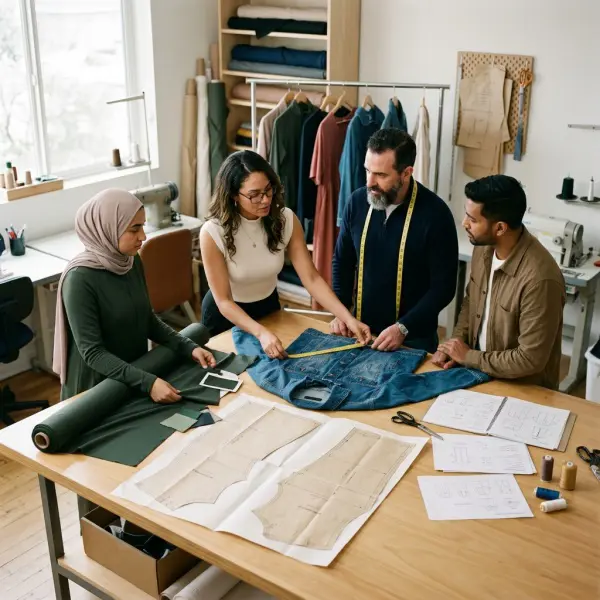
The challenge is not only offering larger sizes. A size-inclusive strategy needs proper pattern development, fit testing, grading rules, fabric behavior analysis, return monitoring, and clear product photography. Extending a size range without adjusting proportions can create poor fit. A dress graded upward without considering bust, waist, hip, armhole, sleeve, and garment length may technically exist in more sizes but still fail customers.
Universal Standard is often cited in size inclusivity discussions because its official positioning includes apparel across sizes 00 to 40. Universal Standard size-inclusive apparel Whether or not a business follows that exact model, the broader lesson is useful: size inclusion needs to be built into the product system, not added as a small side category.
Vogue Business has also reported that runway size representation remains limited. In its Spring/Summer 2026 size inclusivity report, Vogue Business recorded that most runway looks were still straight-size, with only small representation of mid-size and plus-size models. Vogue Business Spring/Summer 2026 size inclusivity report This shows that size inclusivity remains a gap even when public discussion around representation is already familiar.
For apparel businesses, the practical takeaway is this: size inclusivity is not only a communication issue. It is a technical product development issue.
What Size-Inclusive Brands Need to Get Right
A brand that wants to improve size inclusivity should avoid treating extended sizes as simple mathematical scaling. Bodies do not scale evenly in every direction. Pattern blocks, grading increments, fabric stretch, garment length, seam placement, and construction details all affect how larger or smaller sizes perform.
A practical size-inclusive process may include:
- developing fit blocks for different size ranges;
- testing garments on real fit models beyond the sample size;
- reviewing fabric stretch, recovery, and drape across sizes;
- publishing garment measurements, not only size labels;
- showing products on more than one body type where possible;
- tracking return reasons by size and product category;
- adjusting future patterns based on customer feedback.
This work takes time and cost. That is why many brands hesitate. But if a business wants to serve broader customers credibly, size inclusion cannot be handled only through marketing.
Adaptive Fashion: Designing for Easier Dressing
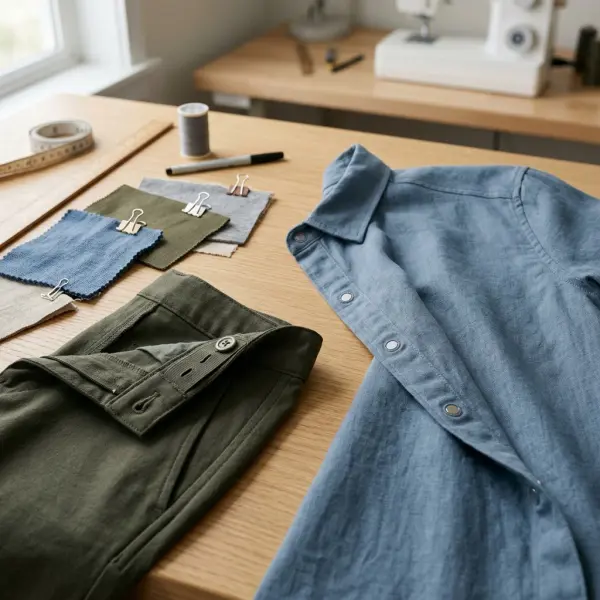
Adaptive fashion focuses on clothing that supports customers who need easier dressing, greater mobility comfort, or design details that work with different physical needs. This may include magnetic closures, one-handed zippers, seated-wear proportions, adjustable openings, flat seams, easy-access fastenings, or construction that works with prosthetics, braces, wheelchairs, or limited mobility.
Tommy Hilfiger Adaptive is a well-known mainstream example. The brand’s official adaptive line describes apparel for men, women, and kids designed for ease of movement and to help make dressing easier. Tommy Hilfiger Adaptive
The important lesson from adaptive fashion is that inclusion can be highly technical. It is not enough to make clothing look stylish. The product must solve a dressing problem. A shirt with magnetic closures may help some customers, but the magnets need to be safe, durable, and suitable for the intended wearer. A seated trouser may need a different rise, back length, waistband comfort, and pocket placement. A jacket designed for easier dressing may need wider openings, smoother lining, or simplified fastening systems.
Adaptive design requires close user understanding. It should not be guessed from a moodboard.
Modest Fashion and Performance Inclusion
Modest fashion is another important part of inclusive fashion because it responds to customers who prefer more coverage for cultural, religious, lifestyle, comfort, or personal styling reasons. In many markets, modest fashion is not niche. It influences activewear, swimwear, workwear, occasionwear, and everyday apparel.
Nike Pro Hijab is a useful example from sportswear. Nike states that the Pro Hijab was released in December 2017 and was designed to solve performance constraints of traditional hijabs in sport. The product page describes a soft mesh construction and sweat-wicking technology for breathability. Nike Pro Hijab release information
The business lesson is not only that modest sportswear exists. The lesson is that inclusion can create product innovation when brands understand a specific activity. A sports hijab needs to consider coverage, breathability, fit security, movement, heat, fabric comfort, and washing performance. A modest swimwear product needs different technical considerations: water retention, stretch recovery, opacity, sun exposure, and comfort when wet.
For fashion businesses in Indonesia and other Muslim-majority markets, this is especially relevant. Modest fashion can be discussed as a practical apparel category with strong product logic. It requires design skill, not just longer lengths or looser silhouettes.
Age-Inclusive Fashion: Serving Customers Beyond Youth-Centered Trends
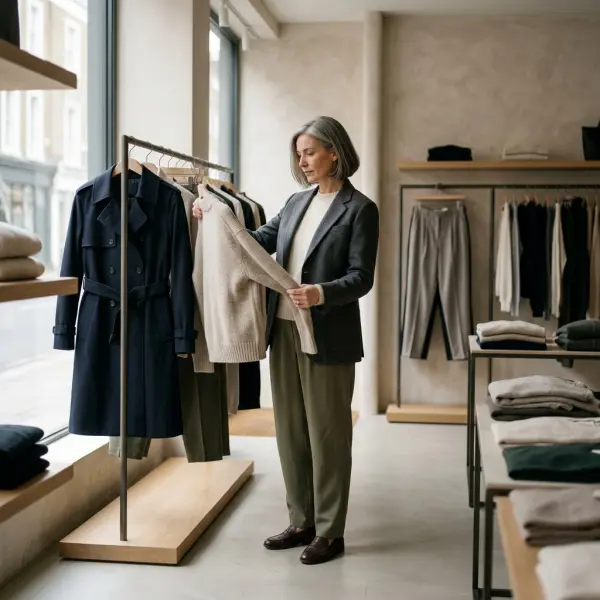
Age-inclusive fashion means designing and communicating apparel for customers across different life stages, not only young trend-driven shoppers. This does not mean making clothing look old-fashioned. It means recognizing that many adult customers want comfort, polish, quality, easy care, flattering proportions, and styling relevance without being forced into either overly youthful trends or outdated basics.
The fashion industry often focuses heavily on younger consumers because they drive cultural visibility and social media momentum. But older customers may have strong purchasing power, clearer quality expectations, and more stable wardrobe needs. They may value fabric handfeel, sleeve coverage, trouser rise, waist comfort, shoe support, and garments that look polished without requiring complicated styling.
Age-inclusive brands pay attention to practical details:
- waistbands that do not dig into the body;
- sleeves and necklines that feel comfortable and elegant;
- fabrics that drape well without clinging awkwardly;
- shoes that balance style and support;
- outerwear that is easy to layer;
- product photography that does not assume only one age group wears the brand.
Age inclusion is not about separating older customers into a dull category. It is about making good design accessible beyond youth-focused styling codes.
Inclusive Retail Is More Than Inclusive Products
A brand can have inclusive products but still create a weak customer experience if the retail system is difficult to navigate. Customers need to find the product, understand the fit, compare options, and feel confident before buying.
Inclusive retail involves product pages, size charts, filters, photography, store layout, staff training, customer service, return policies, and product education. For e-commerce brands, the most practical improvements often begin with product data. Customers benefit from garment measurements, model height, size worn, fabric behavior, stretch level, fit notes, and care instructions.
Vogue Business has reported that poor fit and inconsistent sizing are major deterrents for fashion shoppers, especially when product information fails to help customers understand what will work for them. Vogue Business analysis on sizing and shopping barriers
For inclusive retail, clear information is part of the product value. A brand that publishes accurate garment measurements may feel less glamorous than one with a large campaign, but it may help customers buy with more confidence. That confidence can reduce hesitation, returns, and dissatisfaction.
What Leading Brands Have in Common
Fashion brands that lead inclusive fashion usually have one thing in common: they connect inclusion to product function. They do not rely only on messaging. They build inclusion into design decisions, category strategy, sourcing requirements, retail information, and customer feedback loops.
Their approaches may look different:
|
Inclusion Area |
Brand Approach |
Business Lesson |
|
Size inclusivity |
Broader size ranges and stronger fit communication |
Inclusion requires pattern and grading discipline |
|
Adaptive fashion |
Easier closures, seated-wear comfort, mobility-aware details |
Product access can depend on technical construction |
|
Modest fashion |
Coverage, performance, movement, and comfort |
Cultural and lifestyle needs can drive design innovation |
|
Age-inclusive design |
Comfort, polish, proportion, and quality |
Customers beyond youth trends need modern product relevance |
|
Fit-based retail |
Clear measurements, model references, and filters |
Information reduces buying friction |
The strongest brands do not need to serve every inclusion area at once. In fact, trying to do everything can weaken execution. A focused brand can lead by serving one customer need exceptionally well.
How Smaller Fashion Brands Can Apply Inclusive Fashion
Small and mid-sized fashion brands do not need large corporate budgets to apply inclusive fashion. They need focus. The most practical starting point is to identify one access gap that matches the brand’s existing product strength.
A small shirt brand may improve inclusivity by offering clearer fit notes, longer size range, and more styling examples. A modest wear brand may improve fabric performance and movement comfort. A denim brand may focus on rise options and better size grading. A sportswear startup may design for coverage, breathability, or easier movement. A local boutique may improve product measurements and staff fit guidance.
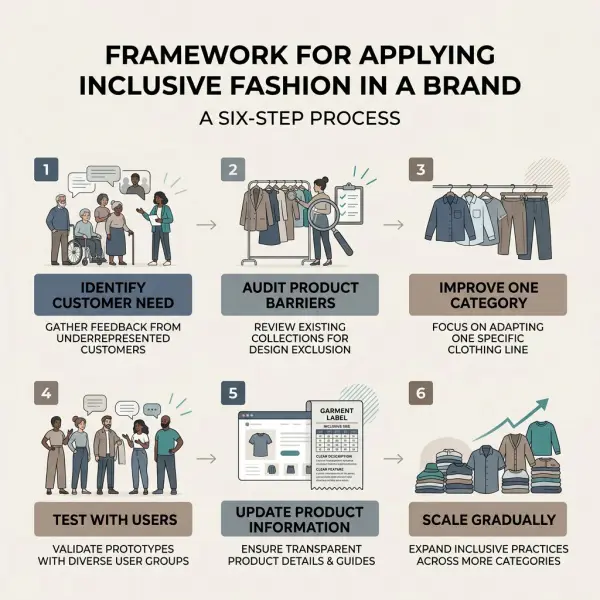
A realistic roadmap could look like this:
- Identify the underserved customer need.
Choose one area first: size, fit, modest coverage, adaptive features, age comfort, or retail clarity. - Audit current product barriers.
Review returns, complaints, customer questions, size gaps, and styling limitations. - Improve one product category.
Start with shirts, trousers, outerwear, activewear, dresses, or accessories rather than changing everything. - Test with real users.
Get feedback from customers who actually face the problem the brand is trying to solve. - Update product copy and imagery.
Explain fit, coverage, function, fabric, and styling use clearly. - Build slowly into the assortment.
Expand only when the brand can maintain quality and consistency.
This approach is more realistic than announcing a broad inclusive fashion strategy without the operational capacity to support it.
Common Mistakes Brands Make With Inclusive Fashion
One common mistake is using inclusive language without changing the product. A brand may describe itself as inclusive, but if the size range is narrow, the fit is inconsistent, or the product information is weak, customers will quickly see the gap. This can damage trust more than saying less and doing more.
Another mistake is treating inclusion as a special capsule instead of a product system. A one-time extended-size drop or adaptive capsule may attract attention, but customers need continuity. If the product disappears after one season, the brand has not truly solved the access problem.
Brands also make mistakes when they assume inclusion is only about adding more options. More SKUs can create inventory risk, higher sampling costs, more complex grading, and more complicated merchandising. Inclusion should be planned with operational discipline. Sometimes the best first step is not more products, but better fit information, better customer service, or better pattern correction.
The strongest approach is honest and specific. A brand should clearly state what it offers, what it is improving, and where the product is still limited.
What Inclusive Fashion Does Not Mean
Inclusive fashion does not mean every brand must serve every customer group. That would be unrealistic and commercially risky. A small brand cannot always offer every size, every adaptive feature, every modest option, every price point, and every styling category at once.
Inclusive fashion also does not mean removing brand identity. A luxury brand can be inclusive and still refined. A streetwear brand can be inclusive and still expressive. A modest brand can be inclusive and still trend-aware. A technical sportswear brand can be inclusive and still performance-focused.
The better standard is not “everything for everyone.” The better standard is reducing avoidable barriers within the brand’s realistic product scope. If a brand sells trousers, it should care about fit. If it sells sportswear, it should care about movement and comfort. If it sells modestwear, it should care about coverage and fabric performance. If it sells online, it should care about size clarity and product data.
That is a more useful version of inclusion for fashion businesses.
What Fashion Businesses Should Verify Before Claiming Inclusion
Before using inclusive fashion as a brand position, businesses should verify whether the claim is supported by product reality. This protects the brand from overpromising and helps customers understand what is genuinely available.
Important verification questions include:
- Does the brand offer enough size coverage for the claim it makes?
- Are garments tested beyond the standard sample size?
- Do product pages include clear measurements and fit notes?
- Are adaptive features tested with actual users?
- Does modestwear perform well during real movement, heat, and washing?
- Are customer service teams trained to answer fit and function questions?
- Can suppliers produce the required details consistently?
- Is the brand prepared to support the category beyond one campaign?
These questions help businesses avoid shallow inclusion. They also make inclusion measurable. Instead of asking whether the brand “looks inclusive,” the team can ask whether customers face fewer barriers than before.
FAQ: Inclusive Fashion
What is inclusive fashion?
Inclusive fashion is an approach to apparel design, production, merchandising, and retail that helps more customers access clothing that fits their body, lifestyle, comfort needs, and styling preferences. It may include extended sizing, adaptive clothing, modest fashion, age-inclusive design, better fit information, and more accessible shopping experiences. The key point is that inclusion should be supported by product reality, not only campaign language.
Is inclusive fashion only about size inclusivity?
No. Size inclusivity is important, but inclusive fashion is broader. It can also include adaptive clothing for easier dressing, modest fashion for customers who prefer more coverage, age-inclusive styling, accessible retail navigation, fit-based shopping, and clearer product information. A brand may start with one area depending on its product category and customer base. The safest approach is to choose one access problem and solve it well before expanding.
What brands are examples of inclusive fashion?
Examples depend on the area of inclusion. Universal Standard is often discussed in relation to size-inclusive apparel because it offers clothing across sizes 00 to 40. Tommy Hilfiger Adaptive is relevant for adaptive clothing because it focuses on easier dressing. Nike Pro Hijab is a sportswear example connected to modest performance needs. These examples do not mean every brand should copy the same model. The lesson is to connect inclusion to a specific product problem.
Why does adaptive fashion matter?
Adaptive fashion matters because many customers need clothing that is easier to put on, remove, adjust, or wear comfortably with mobility needs, medical devices, prosthetics, wheelchairs, or limited movement. Adaptive features may include magnetic closures, adjustable openings, seated-wear proportions, softer seams, and easy-access fastenings. For brands, adaptive fashion requires user testing and technical design accuracy. It should not be treated as a styling concept only.
How can modest fashion be part of inclusive fashion?
Modest fashion can be part of inclusive fashion because it serves customers who prefer more coverage for cultural, religious, lifestyle, comfort, or personal reasons. In sportswear, modest design may also require technical performance: breathable fabric, secure fit, moisture control, stretch, opacity, and comfort during movement. This makes modest fashion a serious product category, not just a styling preference.
Can small fashion brands practice inclusive fashion?
Yes. Small brands can practice inclusive fashion by starting with focused improvements. They may add clearer garment measurements, improve fit notes, expand one key size range, test products on more body types, design modest layering pieces, or improve customer service around sizing. A small but well-executed improvement is usually better than a broad inclusion claim that the business cannot support operationally.
What is the biggest risk in inclusive fashion?
The biggest risk is overclaiming. If a brand says it is inclusive but does not provide clear sizing, reliable fit, accessible product information, or meaningful product options, customers may see the claim as superficial. Inclusion should be specific, measurable, and connected to the product. Brands should say what they actually offer and continue improving from there.
Conclusion
Fashion brands leading the inclusive fashion movement are not simply using broader language. They are making clothing easier to find, easier to understand, easier to wear, and more relevant to customers who are often underserved by standard fashion systems.
The strongest examples show that inclusion can take many forms. Size-inclusive brands address fit and grading. Adaptive fashion brands address dressing ease and mobility comfort. Modest sportswear brands address coverage and performance. Age-inclusive brands address polish, comfort, and life-stage relevance. Retailers improve inclusion by making size charts, fit notes, product filters, and customer service more useful.
For fashion businesses, the most practical lesson is to start where the product barrier is clearest. Inclusion does not need to be loud to be meaningful. It needs to be accurate, useful, and supported by operational discipline. The brands that understand this will be better prepared to serve modern consumers with credibility, not just visibility.




Comments 0
Leave a CommentSend Comment
Anda harus Login terlebih dahulu untuk dapat memberikan komentar.