

Common Distribution Mistakes That Limit Fashion Brand Growth
Quick Answer
Common distribution mistakes that limit fashion brand growth include expanding into too many channels too soon, choosing retail partners that do not fit the brand, setting inconsistent prices across channels, failing to allocate inventory properly, accepting unclear distributor agreements, overpromising delivery timelines, ignoring sell-through data, and treating wholesale, direct-to-consumer, and marketplace sales as separate systems.
For a growing fashion brand, distribution is not only about “getting products into more places.” It is about placing the right products in the right channels, under the right terms, with enough operational control to protect margin, brand perception, inventory flow, and buyer relationships.
A fashion brand may look successful from the outside because it appears in many stores or marketplaces. But if those channels create discount conflict, late deliveries, weak reorder rates, cash flow pressure, or confused positioning, distribution can quietly weaken the business instead of scaling it.
Why Distribution Mistakes Hurt Growing Fashion Brands
Distribution mistakes hurt fashion brands because they multiply operational pressure. A design mistake may affect one product. A distribution mistake can affect pricing, inventory, retailer trust, customer perception, production timing, and cash flow at the same time.
A small brand can often survive informal selling when the operation is simple. The founder knows the customer. Inventory is visible. Orders are manageable. Communication is personal. But once the brand enters wholesale, marketplaces, department stores, pop-ups, distributors, or multi-region retail, distribution becomes a system.
That system needs rules.
Without clear distribution rules, the brand may sell the same product at different prices in different places, run out of stock for key wholesale buyers, overproduce for weak channels, accept retailers that discount too aggressively, or promise delivery dates that production cannot support. These problems rarely appear dramatic at first. They build slowly. Then the brand wonders why growth feels busy but not profitable.
Fashion distribution is especially sensitive because products are seasonal, trends move quickly, and retail windows are limited. A late shipment, wrong store placement, or uncontrolled markdown can reduce the commercial value of a collection even if the product itself is strong.

Mistake 1: Treating Distribution as “More Channels” Instead of Better Channel Fit
The most common distribution mistake is assuming that more channels automatically mean more growth. More channels can increase reach, but only when each channel fits the product, price point, customer, operational capacity, and brand direction.
A premium womenswear label may not benefit from appearing on a discount-heavy marketplace. A niche modest fashion brand may struggle in a boutique that does not understand the customer’s styling needs. A slow-made accessories brand may not be ready for a retailer that demands deep stock and fast replenishment. A young activewear brand may gain visibility from wholesale, but lose control if retail partners discount too early.
Distribution should begin with channel fit, not channel quantity.
A brand should evaluate every channel through practical questions:
- Does this channel reach the right customer?
- Does the retail price make sense in this environment?
- Will the brand look stronger or weaker here?
- Can the brand meet the channel’s delivery and inventory expectations?
- Does the channel support full-price selling or rely heavily on discounts?
- Does this partner create reorder potential or only one-time exposure?
- Will this channel conflict with existing wholesale or direct sales?
A good distribution channel makes the brand easier to understand and easier to buy. A weak channel may increase visibility while damaging positioning.
Mistake 2: Choosing Retail Partners Based Only on Order Size
A large order can be attractive, especially for a growing fashion brand managing cash flow and production targets. But order size alone is a poor way to judge retail partner quality.
The right retail partner should fit the brand’s customer, price level, merchandising style, delivery expectations, and long-term direction. A large order from a mismatched buyer can create more problems than a smaller order from a strong-fit boutique. If the retailer’s customer does not understand the product, sell-through may be weak. If the retailer discounts aggressively, the brand may lose pricing credibility. If the buyer expects terms the brand cannot support, the account may strain cash flow.
A better way to evaluate retail partners is to balance order size with strategic quality.
|
Partner Factor |
Good Signal |
Warning Sign |
|
Customer fit |
Their shoppers match the brand’s target audience |
The product feels out of place in the store |
|
Price alignment |
Current assortment supports the brand’s retail price |
The store usually sells much cheaper products |
|
Merchandising quality |
Products are presented with care and context |
Products are mixed randomly or discounted quickly |
|
Reorder potential |
Buyer understands continuity and replenishment |
Buyer only wants a one-time novelty order |
|
Payment reliability |
Terms are clear and realistic |
Payment expectations are vague or risky |
|
Brand positioning |
Store strengthens brand perception |
Store may dilute premium or niche identity |
A small order from the right retailer can become a long-term account. A large order from the wrong retailer can become a costly distraction.
Mistake 3: Creating Channel Conflict Through Inconsistent Pricing
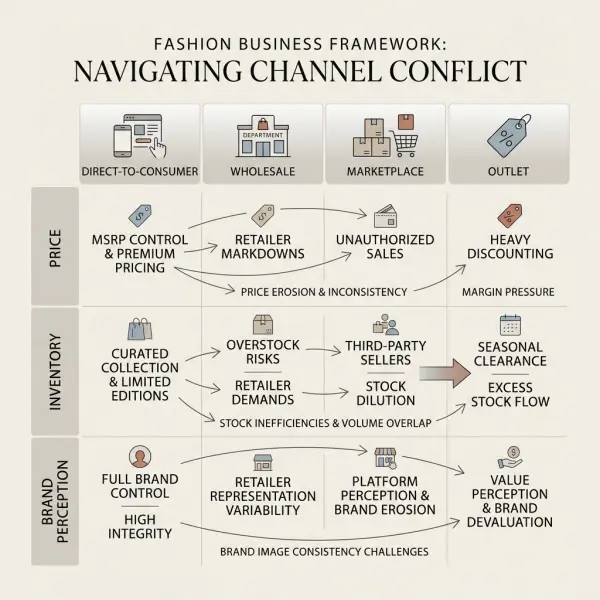
Channel conflict happens when one sales channel undermines another. In fashion, this often appears as inconsistent pricing, uncontrolled discounting, marketplace undercutting, or direct-to-consumer promotions that make retail partners look expensive.
For example, a brand may sell a dress to a boutique at wholesale price, recommend a retail price of $140, then run a 40% discount on its own website two weeks after the boutique receives stock. The boutique now has a problem. Its customers may see the lower price online and question the store. The buyer may hesitate to reorder. The relationship weakens.
This does not mean a brand can never run promotions. It means promotion strategy must be coordinated across channels.
Fashion brands should define pricing rules for:
- Recommended retail price
- Seasonal markdown timing
- Marketplace discount limits
- Direct-to-consumer promotion windows
- Outlet or clearance strategy
- Exclusive product drops
- Regional price differences
- Wholesale partner communication
The mistake is not discounting itself. The mistake is discounting without considering how it affects retail partners, brand perception, and future orders.
Mistake 4: Expanding Wholesale Before Production Is Stable
Wholesale growth can expose weak production systems quickly. A brand that can manage 50 direct orders may struggle when a buyer orders 500 units across sizes, colors, and delivery deadlines.
Production stability is not only about factory capacity. It includes material availability, pattern consistency, size grading, quality control, finishing, labeling, packing, documentation, and delivery coordination. If any part is weak, wholesale magnifies the problem.
A growing brand should be careful when buyers request volume beyond proven capacity. Accepting the order may feel like a breakthrough, but late delivery or inconsistent quality can damage the relationship more than declining or negotiating a smaller quantity.
Before expanding wholesale, verify:
- Can the factory produce the quantity without reducing quality?
- Are fabrics and trims available in time?
- Are patterns, grading, and size specs finalized?
- Is quality control defined before shipment?
- Are packing and labeling requirements clear?
- Is there a realistic buffer for delays?
- Can the brand communicate issues before they become urgent?
The strongest wholesale brands are often the ones that scale slightly slower but deliver consistently. Buyers remember reliability.
Mistake 5: Poor Inventory Allocation Across Channels
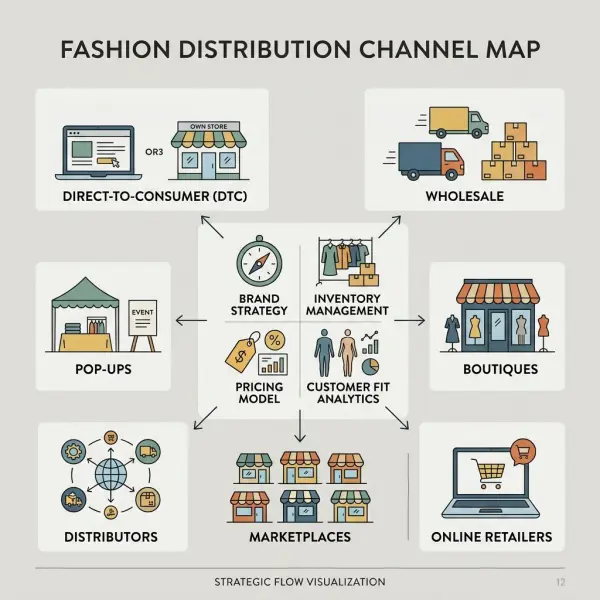
Poor inventory allocation happens when a brand does not decide how stock should be divided between wholesale, direct-to-consumer, marketplaces, pop-ups, distributors, and reorders.
This mistake is common because inventory feels like one pool until multiple channels start selling at once. Then the brand realizes that a bestselling size has sold out on its own website, a wholesale buyer is still waiting for shipment, a marketplace order has consumed reserved stock, and a pop-up event has taken units that were supposed to support reorders.
Inventory allocation should be decided before products go live.
A simple allocation plan may separate stock into:
|
Inventory Pool |
Purpose |
Risk If Not Managed |
|
Wholesale committed stock |
Units already ordered by buyers |
Late shipment or incomplete orders |
|
Direct-to-consumer stock |
Units for website, social commerce, or own store |
Lost full-margin sales if understocked |
|
Reorder reserve |
Units or material capacity for replenishment |
Missed repeat orders from good buyers |
|
Marketplace stock |
Units for platform sales |
Overselling or price conflict |
|
Pop-up or event stock |
Short-term physical selling |
Drains stock from higher-priority channels |
|
Defect or replacement buffer |
Units for quality issues or exchanges |
Customer service problems |
Allocation does not need to be complicated at the start. Even a basic spreadsheet is better than no rule at all. The key is knowing which stock is promised, which stock is available, and which stock should be protected.

Mistake 6: Ignoring Sell-Through Data After Shipment
A wholesale order is not complete when the products leave the brand’s warehouse. For growth, the more important question is what happens next: does the product actually sell to the retailer’s customers?
Sell-through data helps brands understand whether a distribution channel is working. It can reveal which styles, sizes, colors, price points, and store types perform best. Without this information, a brand may keep producing products that buyers like in theory but customers do not buy in practice.
Many small brands do not have formal sell-through reporting from every retailer. That is normal. But they can still ask simple, useful questions:
- Which styles sold first?
- Which sizes moved slowly?
- Were customers confused about fit or fabric?
- Did the retail price feel right?
- Did the product need discounting?
- Did shoppers ask for other colors or sizes?
- Would the buyer reorder?
- What should change next season?
A buyer may not share full data, but even partial feedback is useful. Reorder behavior itself is data. If buyers repeatedly reorder one trouser but never reorder the matching jacket, that says something about the commercial strength of the range.
Distribution strategy improves when the brand learns from real selling, not only from initial buying.
Mistake 7: Accepting Distributor Agreements Without Clear Boundaries
Distributors can help fashion brands enter new markets, especially when the brand lacks local knowledge, retail relationships, logistics capacity, or language support. But unclear distributor agreements can limit growth.
The risk is not distribution itself. The risk is giving away too much control without clear performance expectations.
A distributor agreement should define territory, channel rights, exclusivity, sales targets, payment terms, pricing rules, marketing responsibilities, reporting requirements, inventory ownership, return policies, contract duration, and termination conditions. Without those details, a brand may find itself locked out of a market, unable to work with better partners, or stuck with a distributor that does not actively sell.
Be especially careful with broad exclusivity. A distributor may ask for exclusive rights to a country, region, category, or channel. That may be reasonable if they commit to meaningful volume, marketing, and account development. It is risky if exclusivity is granted without targets.
A practical distributor review should ask:
|
Agreement Area |
What to Clarify |
|
Territory |
Which country, region, or channel is covered? |
|
Exclusivity |
Is it exclusive or non-exclusive? Under what conditions? |
|
Sales target |
What minimum order or revenue is expected? |
|
Pricing |
Who controls wholesale and retail pricing? |
|
Accounts |
Which retailers can the distributor approach? |
|
Marketing |
Who funds samples, campaigns, trade shows, or showroom activity? |
|
Reporting |
How often will sales and stock updates be shared? |
|
Exit terms |
What happens if targets are not met? |
A distributor should extend the brand’s reach. It should not quietly take control of the brand’s future options.

Mistake 8: Over-Relying on One Distribution Channel
A single strong channel can make a brand grow quickly. It can also make the brand vulnerable.
A fashion brand that depends too heavily on one retailer, one marketplace, one distributor, one social commerce platform, or one wholesale account may face sudden pressure if that channel changes terms, reduces orders, delays payment, increases fees, shifts customer focus, or begins discounting aggressively.
This does not mean every brand needs many channels immediately. Too many channels can create its own problems. The mistake is dependency without awareness.
A healthier approach is staged diversification. A brand may begin with direct-to-consumer, then add selected boutiques, then test a digital wholesale platform, then consider regional distributors only after the product and operations are proven. Each new channel should have a role.
The question is not “How many channels do we have?” The question is “What job does each channel do?”
For example:
- DTC may build brand community and capture full margin.
- Boutiques may provide curated visibility and regional trust.
- Department stores may offer scale but require operational maturity.
- Marketplaces may create reach but need price and inventory control.
- Distributors may support new territories but require clear agreements.
- Pop-ups may test demand and gather customer feedback.
Channel diversity is useful when it reduces risk and improves customer access. It becomes dangerous when it creates confusion.
Mistake 9: Using the Same Product Assortment Everywhere
Not every product belongs in every channel. A common distribution mistake is pushing the same assortment into boutiques, online stores, marketplaces, pop-ups, and wholesale accounts without adapting the product mix.
Different channels sell differently. A boutique may need a tightly curated selection that tells a clear story on the rack. An online retailer may need products that photograph well and have easy-to-explain fit. A marketplace may perform better with searchable basics or entry price items. A premium concept store may want distinctive pieces that support curation, not commodity products.
Assortment strategy should consider:
- Price point
- Product complexity
- Size risk
- Reorder potential
- Visual strength
- Fit consistency
- Shipping practicality
- Margin
- Customer education needed
- Brand positioning
A dramatic runway-inspired blouse may be useful for a concept store but difficult for a marketplace. A core trouser may be ideal for wholesale reorders but less exciting for a limited editorial drop. A low-margin accessory may work as an entry product on DTC but not through a distributor that needs additional margin.
Good distribution protects product role. It does not force every SKU into every channel.
Mistake 10: Underestimating Delivery and Logistics Risk
Distribution depends on timing. A collection that arrives late may miss the selling window even if the product is excellent.
The broader fashion supply chain environment makes delivery planning more important. Recent fashion industry coverage has highlighted how geopolitical instability, shipping chokepoints, freight cost pressure, raw material disruption, and limited visibility can affect delivery schedules and inventory planning. fashion supply chain stress test
For growing brands, the practical lesson is not to panic or overbuild the supply chain. It is to stop making delivery promises without visibility. If the brand does not know what fabric is confirmed, what is in production, what is ready to ship, and what is delayed, it cannot manage distribution professionally.
A realistic delivery plan should include:
- Material confirmation date
- Production start date
- Quality control date
- Packing deadline
- Shipping method
- Buffer time
- Buyer communication schedule
- Backup plan for partial delivery or delay
Buyers do not like delays, but they dislike surprise delays even more. Early communication can protect trust. Silence destroys it.
Mistake 11: Letting Markdown Strategy Damage Brand Positioning
Markdowns are a normal part of retail, especially for seasonal fashion. The mistake is allowing markdowns to become uncontrolled, too frequent, or inconsistent across channels.
If a brand’s products are always discounted somewhere, customers may stop trusting the full retail price. Retail buyers may become reluctant to reorder at regular wholesale terms. Direct customers may wait for sales. Marketplaces may train shoppers to compare only by price.
This is especially damaging for brands that claim premium quality, craftsmanship, sustainability, limited production, or design value. The brand story becomes weaker when the market constantly sees the product reduced.
A healthier markdown strategy defines:
- When markdowns can begin
- Which products can be discounted
- How deep discounts can go
- Whether wholesale partners need approval
- How outlet or archive stock is separated
- Whether DTC promotions align with retail partners
- How discounts are communicated
Markdowns should be used to manage inventory, not to replace weak distribution planning. If a product repeatedly needs deep discounting, the brand should review assortment, price, channel fit, production quantity, or buyer selection.
Mistake 12: Growing Distribution Without a Clear Brand Position
Distribution amplifies brand positioning. If the positioning is clear, the right channels can make it stronger. If the positioning is confused, wider distribution spreads the confusion.
A brand that sells as premium on its website, discounts heavily on marketplaces, appears in unrelated boutiques, and gives distributors inconsistent pricing is not building reach. It is building noise.
Before expanding distribution, a fashion brand should be able to explain:
- Who the brand is for
- What price level it belongs to
- Which product categories define the brand
- Which channels strengthen the brand
- Which channels should be avoided
- Which products are core and which are experimental
- What kind of retail environment matches the brand
This is where distribution connects closely with merchandising and assortment planning. A brand that understands its product hierarchy can decide which pieces belong in wholesale, which belong in DTC, which are suitable for pop-ups, and which should remain limited.
If the foundation is still unclear, distribution will not fix it. It will expose it.
What Fashion Brands Should Verify Before Expanding Distribution
Before expanding distribution, a fashion brand should verify whether its channels, pricing, inventory, production, logistics, and brand positioning can support growth without creating conflict.
This verification should happen before signing new retail accounts, entering marketplaces, appointing distributors, or accepting large wholesale orders.
|
Area to Verify |
Key Question |
Why It Matters |
|
Channel role |
What job does this channel perform? |
Prevents random expansion |
|
Customer fit |
Does the channel reach the right shopper? |
Protects sell-through and brand relevance |
|
Pricing control |
Will prices stay consistent and defensible? |
Reduces channel conflict |
|
Inventory allocation |
Can stock be reserved and tracked by channel? |
Prevents overselling and missed reorders |
|
Production capacity |
Can orders be fulfilled on time and at quality? |
Protects buyer trust |
|
Terms and agreements |
Are payment, exclusivity, returns, and responsibilities clear? |
Reduces legal and cash flow risk |
|
Markdown rules |
Can discounting be controlled? |
Protects brand positioning |
|
Data feedback |
Can the brand learn from sales and sell-through? |
Improves future assortment decisions |
A distribution channel should not only create sales. It should create useful, sustainable growth.
How to Build a Healthier Fashion Distribution Strategy
A healthier distribution strategy begins with focus. A growing brand should decide which channels matter now, which channels can wait, and which channels should be avoided.
Start with the brand’s strongest product categories and clearest customer segment. Then choose channels that support that reality. A brand with proven direct demand may add wholesale selectively. A brand with strong regional interest may test boutiques in specific cities. A brand with repeatable basics may build replenishment-focused wholesale. A brand with complex sizing may avoid channels where product education is weak.
A practical distribution strategy can follow this sequence:
- Define brand positioning and target customer.
- Identify the product categories that sell most consistently.
- Decide the role of each channel.
- Set pricing and markdown rules.
- Create inventory allocation rules.
- Build buyer and distributor criteria.
- Confirm production and delivery capacity.
- Track sell-through, reorder behavior, and channel profitability.
- Review channel performance each season.
- Expand only where the system is working.
This is not as exciting as announcing new stockists. But it is how distribution becomes scalable.
For brands still building the wholesale foundation, fashion wholesale business explained for growing brands provides the basic structure of pricing, MOQ, line sheets, and buyer expectations. For brands already approaching retailers, how fashion brands build relationships with retail buyers explains how to build trust before and after the first order.
FAQ: Fashion Distribution Mistakes
What is the biggest distribution mistake fashion brands make?
The biggest distribution mistake is expanding into more channels before the brand has clear rules for pricing, inventory, delivery, and channel fit. More stores or platforms may create visibility, but without operational control, they can also create stockouts, late shipments, discount conflict, weak sell-through, and confused brand positioning. Growth is healthier when each channel has a defined role and the brand can support it profitably.
How do fashion brands avoid channel conflict?
Fashion brands avoid channel conflict by setting consistent retail pricing, coordinating promotions, defining markdown rules, separating exclusive products where needed, and communicating clearly with wholesale partners. The brand should know when DTC discounts begin, how marketplace pricing is controlled, and whether retail buyers will be affected. Channel conflict usually appears when one channel undercuts another without a clear strategy.
Should fashion brands sell through marketplaces?
Marketplaces can be useful for reach, discovery, and volume, but they are not suitable for every brand. A marketplace may work well for searchable products, basics, accessories, or price-accessible categories. It may be risky for premium brands if discounting, presentation quality, or customer comparison weakens brand value. Before joining a marketplace, brands should verify pricing control, product content requirements, fees, stock allocation, return policies, and brand presentation.
How many distribution channels should a growing brand use?
A growing brand should use only as many channels as it can manage clearly and profitably. There is no universal number. A small brand may do better with DTC and five strong boutiques than with many weak accounts. A more mature brand may handle wholesale, DTC, marketplaces, and distributors if inventory, pricing, and operations are structured. The right number depends on production capacity, team capability, cash flow, product type, and brand strategy.
Why is sell-through important in fashion distribution?
Sell-through shows whether products actually sell to end customers after reaching a retail channel. Initial orders can be misleading because buyers may test products that shoppers later reject. Sell-through helps brands understand which styles, sizes, colors, prices, and channels are working. It also supports reorder planning and future assortment decisions. Without sell-through feedback, a brand may repeat weak products or expand into channels that do not truly perform.
What should a brand check before appointing a distributor?
Before appointing a distributor, a brand should check territory rights, exclusivity, sales targets, payment terms, pricing control, account responsibilities, marketing obligations, reporting frequency, inventory ownership, and exit clauses. The distributor should have relevant retail relationships and a realistic plan for the brand. Broad exclusivity without clear performance targets can limit future growth.
How can poor inventory allocation hurt a fashion brand?
Poor inventory allocation can cause overselling, late wholesale shipments, missed reorders, DTC stockouts, marketplace conflicts, and weak customer service. If all stock is treated as one shared pool, channels may compete against each other. A growing brand should reserve stock for confirmed wholesale orders, DTC sales, reorders, events, and replacement needs. Even a simple allocation system can prevent costly mistakes.
Is discounting always bad for fashion brands?
No. Discounting is not always bad. It can help clear seasonal inventory, improve cash flow, and make room for new products. The problem is uncontrolled or inconsistent discounting that damages full-price credibility, creates channel conflict, or trains customers to wait for sales. Brands should define markdown timing, depth, eligible products, and channel rules before discounts become urgent.
Conclusion
Distribution can help a fashion brand grow, but only when it is managed as a system. More channels, bigger orders, and wider visibility do not automatically create a stronger business. They can also create pricing conflict, operational pressure, inventory confusion, delivery failures, and brand dilution.
The brands that scale distribution well usually make careful choices. They know which channels fit their customer. They protect pricing. They allocate inventory before problems appear. They choose retail partners for strategic fit, not only order size. They use sell-through data to improve decisions. They avoid giving away control through unclear distributor agreements.
Fashion distribution is not just about where products are sold. It is about whether every channel supports the brand’s commercial direction. Growth becomes more sustainable when distribution is selective, disciplined, and connected to real operational capacity.




Comments 0
Leave a CommentSend Comment
Anda harus Login terlebih dahulu untuk dapat memberikan komentar.