

Fashion Intellectual Property Explained for Designers and Clothing Brands
A fashion brand may spend months developing a distinctive jacket, refining a textile print, creating its visual identity, and negotiating with manufacturers. Yet the moment those products reach the market, the business may discover that its creative work is not protected in quite the way it expected.
This is where fashion intellectual property becomes commercially significant. Clothing businesses operate at the intersection of creativity, manufacturing, branding, and retail, but each of these activities produces different types of intellectual assets. A recognizable brand name, an original fabric illustration, a distinctive handbag design, and a confidential production process may all have value, although the law does not protect them in the same way.
Understanding intellectual property is therefore not simply a legal exercise. For designers and clothing brands, it is part of deciding which creative investments deserve protection, how to work safely with external partners, and how to build a fashion business whose identity and original work can be commercially managed over time.
Quick Answer: What Is Fashion Intellectual Property?
Fashion intellectual property refers to the legal rights that may protect creative works, brand identifiers, product appearances, technical inventions, and commercially valuable confidential information developed or used within the fashion industry. These rights help designers and clothing brands control certain uses of their intellectual assets, subject to the requirements and limitations of applicable laws.
The principal forms include trademarks for brand identity, copyright for eligible original creative expression, industrial design rights for qualifying product appearances, patents for technical inventions, and trade secrets for protected confidential business information.
For a clothing brand, these protections may apply to different elements of the same collection. A label name may function as a trademark, an original textile illustration may qualify for copyright, and a distinctive bag shape may be eligible for design protection. However, an ordinary garment silhouette, a general fashion trend, or a design idea is not automatically protected merely because someone developed it first.
The World Intellectual Property Organization (WIPO) explains these overlapping roles in its overview of intellectual property in fashion. The practical challenge is identifying which rights apply, who owns them, where they are effective, and whether pursuing protection makes commercial sense.
What Is Intellectual Property in the Fashion Industry?
Intellectual property, commonly abbreviated as IP, is a category of legally recognized rights relating to creations of the mind and certain forms of commercially valuable information or identity. In fashion, it connects the creative work of designers with the commercial activities of brand owners, textile developers, manufacturers, photographers, distributors, and retailers.
Unlike physical assets, intellectual property is intangible. A fashion company can own hundreds of finished garments without necessarily owning the copyright to their printed artwork, the trademark attached to the label, or the rights to a design developed by an external studio. Ownership of a physical product and ownership of its associated intellectual property are separate questions.
This distinction becomes particularly important as brands expand. A small clothing business may initially rely on a founder to create designs, photograph products, and manage its logo. Once freelance illustrators, factories, agencies, and distributors become involved, the business needs clearer records of which rights it owns, which rights it has permission to use, and which assets require additional protection.
Intellectual Property Protects Specific Assets, Not General Fashion Ideas
Fashion draws heavily on shared visual references. Designers reinterpret familiar garment categories, construction techniques, historical styles, and seasonal aesthetics. Intellectual property law does not generally grant exclusive ownership over these broad ideas.
For example, developing a collection inspired by relaxed tailoring does not give a brand exclusive control over oversized blazers. A specific original surface illustration may be protectable, while a qualifying ornamental jacket design may receive protection under applicable design law. The underlying idea of relaxed tailoring remains available to other designers.
Copyright illustrates this distinction particularly well. WIPO's copyright protection guidance explains that copyright protects original expression rather than the ideas or concepts underlying it. This boundary helps preserve room for further creativity while recognizing eligible individual contributions.

Which Fashion Assets Can Intellectual Property Protect?
A clothing business rarely depends on just one type of intellectual property. Its commercial value may be distributed across brand identity, product design, original artwork, technical innovation, and specialized operational knowledge.
Recognizing these categories helps founders avoid treating every creative asset as though it needs the same legal solution.
|
Intellectual property type |
Fashion-related assets |
Primary protection purpose |
|
Trademark |
Brand names, logos, distinctive source-identifying signs |
Distinguishing goods or services from those of other businesses |
|
Copyright |
Original textile artwork, illustrations, photographs, campaign visuals |
Protecting eligible original creative expression |
|
Industrial design rights |
Qualifying garment appearances, bag shapes, footwear ornamentation |
Protecting specified visual or ornamental product features |
|
Patents |
Patentable textile technologies, manufacturing inventions, wearable technology |
Protecting qualifying technical inventions |
|
Trade secrets |
Confidential manufacturing know-how, formulas, commercially sensitive information |
Preventing certain unauthorized acquisition, use, or disclosure of protected secrets |
These categories can overlap. An original textile pattern might qualify for copyright protection and, where relevant requirements are met, design protection. A distinctive product feature could potentially function as a trademark if consumers recognize it as identifying a particular commercial source.
The central point is that different rights address different legal interests. A more detailed comparison is covered in Trademarks, Copyright, and Design Rights: Key Differences in Fashion.
Brand Identity and Recognition
A trademark helps distinguish the goods or services of one business from those of competitors. In the clothing industry, this commonly involves brand names, logos, and other qualifying identifiers displayed on labels, packaging, websites, and retail materials.
Consider an independent activewear brand developing a new name for its clothing line. The business may create an original logo and purchase a matching domain name, but neither step alone establishes that the trademark is available or registered. Existing rights held by other businesses may still prevent use or registration in a relevant market.
Fashion trademarks are commercially valuable because customers often identify products through brands rather than through garment construction alone. A company that develops a recognizable identity can potentially license its trademark, extend into complementary products, or establish distribution partnerships, subject to its rights and agreements.
Original Creative Content
Fashion businesses continuously produce creative material beyond the garments themselves. Textile artwork, original fashion illustrations, editorial photography, lookbooks, campaign videos, and other creative outputs may qualify for copyright protection.
The important qualification is originality and the applicable law's requirements. Copyright generally does not protect an abstract styling concept, but an eligible original photograph or drawing expressing that concept may be protected.
For fashion brands, the ownership of creative content matters in digital commerce. Product photographs are reused across ecommerce websites, social media campaigns, wholesale catalogs, and marketplaces. A company should not assume that paying a freelance photographer automatically transfers every relevant copyright or grants unrestricted usage rights.

Product Appearance and Industrial Design
Industrial design protection concerns the visual or aesthetic features of qualifying products. These may include particular shapes, configurations, patterns, lines, or ornamentation, depending on the legal system.
A handbag with a distinctive configuration, a shoe with a qualifying ornamental appearance, or an original decorative product design may be a candidate for protection. However, eligibility often depends on novelty, originality, individual character, or other applicable legal standards.
As explained in WIPO's guidance on industrial design protection, the requirements and registration procedures depend on the jurisdiction. Fashion brands should evaluate potentially valuable designs before public disclosure, rather than assuming every released design can be registered later.
Technical Innovation and Confidential Know-How
Fashion intellectual property also extends beyond visible aesthetics. A business developing an innovative textile structure, manufacturing technology, or wearable electronic component may consider patent protection if its invention satisfies the relevant legal requirements.
Patents are different from industrial design rights. Their primary function is to protect qualifying technical inventions rather than the external appearance of a fashion product. Merely improving the styling of an existing garment does not automatically create a patentable invention.
Trade secrets serve another purpose. A confidential finishing formula, specialized production method, or commercially sensitive supplier information may receive trade secret protection when it has commercial value because it remains secret and the business takes appropriate measures to preserve confidentiality.
Not every internal document qualifies as a trade secret. The information must meet the applicable legal requirements, and protection does not normally prevent lawful independent development of the same knowledge.
Why Does Intellectual Property Matter for Fashion Businesses?
The value of intellectual property becomes clearer when it is connected to ordinary business decisions: choosing a brand name, commissioning a textile print, working with a garment factory, or entering a new retail market.
A brand may have an attractive collection and a reliable manufacturer but still face commercial restrictions if it lacks the necessary rights to its identifying marks or original materials. Conversely, securing every possible registration without considering product demand and commercial priorities can become an unnecessary expense.
Effective IP management is therefore about allocating attention and resources to assets that genuinely matter to the business.
Protecting Investment in Product Development
Developing an original fashion product involves more than sketching a silhouette. Design teams may invest in material research, sampling, fit adjustments, surface design, prototype development, and visual presentation before production begins.
Where eligible IP rights exist and are enforceable, they may help a brand respond to certain unauthorized uses of protected material. This can be commercially meaningful for products that require substantial development investment or remain relevant beyond one season.
Legal rights do not guarantee that competitors will avoid similar designs. They do, however, provide a potential basis for licensing, negotiation, or enforcement when the disputed activity falls within the scope of protection.
Building Long-Term Brand Value
A seasonal clothing design may have a relatively short commercial lifespan, while a recognizable brand identity can remain relevant across many collections.
This is one reason why trademarks are frequently a priority for apparel businesses. A brand name may continue identifying products even as the company changes its materials, introduces new silhouettes, or expands from clothing into accessories.
For a growing business, consistent ownership and management of intellectual property can also make licensing and commercial partnerships more straightforward. WIPO identifies licensing, collaborations, and merchandising as important ways in which fashion businesses use intellectual property commercially.
Improving Collaboration with Suppliers and Creative Partners
Fashion production often involves several independent parties: design studios, pattern makers, textile printers, sample rooms, manufacturers, photographers, and marketing agencies.
Problems may emerge when those relationships operate without clear agreements. A manufacturer might believe it can reuse an independently developed pattern for another customer, while a brand might believe its purchase order gives it exclusive rights. The actual position depends on the contract, the applicable law, and the nature and ownership of the underlying work.
Clear arrangements can reduce these uncertainties. For example, a commissioned textile-print agreement can specify whether the brand receives full ownership of the relevant rights, an exclusive license, or permission to use the artwork only for a defined product range.

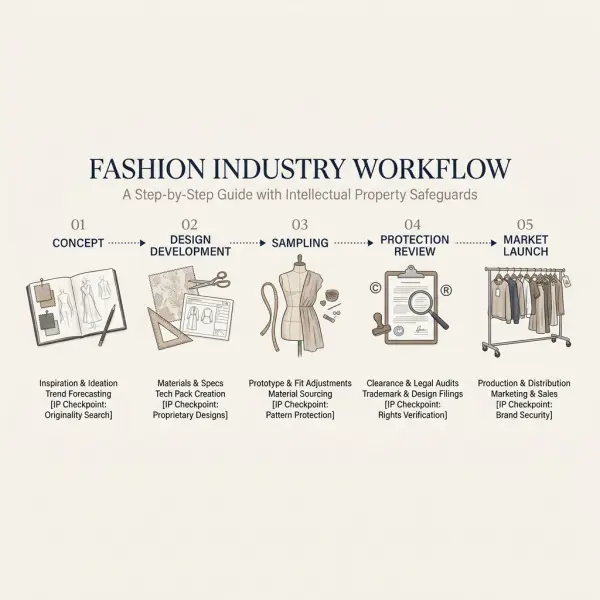
How Intellectual Property Fits Into the Fashion Product Lifecycle
Intellectual property decisions are most effective when they become part of the product development process rather than a separate activity performed after launch.
A fashion collection moves through several stages, and the relevant IP questions change along the way. Early development involves confidentiality and originality. Sampling introduces ownership and supplier-access questions. Commercial launch creates trademark, design-disclosure, marketing-rights, and enforcement considerations.
Concept Development: Identifying What Is Original
During collection planning, designers typically combine research, references, sketches, fabric exploration, and technical development. Some of these outputs may be protected, while others represent common fashion knowledge or material already available to the public.
The practical starting point is to document original contributions. Design teams can preserve dated sketches, concept revisions, textile artwork files, prototype photographs, and records identifying the people involved.
Documentation does not automatically create a legal monopoly over a design. However, reliable records can help establish development history, identify contributors, support ownership discussions, and provide evidence where creation dates or originality become relevant.
Sampling and Manufacturing: Clarifying Ownership
When prototypes are sent to an external factory, information moves outside the immediate control of the brand. Technical specification packages, patterns, original artwork, and proprietary construction details may be shared with production teams.
An apparel business should distinguish between ownership of physical production materials and ownership of the associated intellectual property. For example, a factory may manufacture a garment from a brand-supplied pattern without receiving permission to reproduce that pattern for unrelated customers.
The reverse situation also occurs. A manufacturer operating under an original design manufacturing arrangement may contribute its own designs or retain rights to certain production assets. The applicable contract should identify what is being supplied, developed, transferred, licensed, or kept confidential.
These distinctions are particularly relevant when choosing between OEM and ODM garment manufacturing arrangements, where responsibility for design development can differ substantially.
Launch and Distribution: Managing Public Exposure
The commercial launch of a collection can affect intellectual property strategy, especially where industrial design protection requires novelty.
Publishing detailed product photographs, displaying samples at trade shows, or introducing products into retail channels may constitute public disclosure under applicable design laws. Some jurisdictions provide grace periods, but these exceptions are not universal and may have different conditions.
For a potentially valuable original design, filing strategy should therefore be considered before the brand releases detailed images or sells the product.
Marketing also introduces copyright questions. Businesses should confirm that campaign photography, music, graphics, fonts, and other licensed materials can be used across the intended media, territories, and commercial channels.
Can Fashion Designers Protect Clothing Designs Themselves?
Fashion designers can protect certain clothing designs through applicable industrial design, copyright, or other legal rights, but not every original-looking garment qualifies. Protection depends on the nature of the design, the relevant jurisdiction, legal eligibility requirements, and whether the right has been established or obtained where required.
This is one of the most misunderstood aspects of fashion intellectual property. A designer may create a commercially successful silhouette that competitors can legally reinterpret, while a separately protectable textile illustration or ornamental design feature receives stronger legal recognition.
Why Ordinary Garments Are Difficult to Protect Broadly
Clothing combines aesthetics with practical functions. A jacket needs openings, a wearable fit, and appropriate structural features. Many garment details arise from functional requirements, familiar construction practices, or widely used design conventions.
In the United States, copyright treatment of clothing illustrates this challenge. The United States Copyright Office identifies clothing as a useful article and explains that copyright does not protect its utilitarian aspects. Eligible pictorial, graphic, or sculptural features may receive copyright protection when they can be identified separately from the article's utility and satisfy the relevant requirements.
Consequently, an original drawing of a dress does not automatically grant the artist exclusive rights to manufacture every dress matching the illustration. The U.S. Copyright Office guidance on useful articles makes this distinction clear.
Other jurisdictions may treat fashion designs differently. Eligible designs can receive protection under copyright, registered or unregistered design regimes, or overlapping systems, depending on national and regional law.
Registration Can Matter More for Certain Signature Products
Design registration may be especially worth considering for products built around a distinctive, commercially enduring appearance.
Imagine a handbag label developing a recognizable structural design intended to remain in its assortment for several years. Unlike a short-lived seasonal color variation, that product could justify evaluating design registration because the appearance is a continuing commercial asset.
The business would still need to consider the cost of filing, the legal scope of the design, competing prior designs, the duration of protection, and the countries where the bag will be sold.
By contrast, registering every minor seasonal modification may be inefficient for a small apparel company. The appropriate strategy is selective protection based on legal eligibility and commercial importance.
Similarity Does Not Automatically Mean Infringement
Two garments can look similar without necessarily creating an intellectual property violation. Fashion designers frequently draw from common garment categories, historical references, standard manufacturing methods, and publicly available design trends.
Whether similarity amounts to infringement depends on the particular protected right and its legal scope. Trademark analysis may concern consumer confusion, while copyright or design infringement requires different legal assessments.
Brands should therefore distinguish between commercially frustrating imitation and conduct that actually violates enforceable rights. That distinction matters when deciding whether to contact another business, request removal of an online listing, or pursue legal action.
How Can Clothing Brands Build a Practical IP Protection Strategy?
An effective intellectual property strategy begins with identifying business assets rather than immediately purchasing registrations. The goal is to develop a manageable process that matches the company's product range, growth plans, operating budget, and exposure to commercial risk.
For many emerging clothing brands, this means prioritizing brand-name clearance, clarifying ownership of commissioned creative work, documenting original designs, and evaluating registration for commercially important products.
The following framework connects those decisions to everyday fashion operations.
|
Business stage |
Recommended action |
Practical outcome |
|
Brand creation |
Research proposed names and relevant existing trademarks |
Reduce the risk of branding conflicts |
|
Design development |
Record original creative work and contributors |
Improve ownership and development documentation |
|
Product selection |
Identify distinctive designs with lasting commercial value |
Prioritize protection expenditure |
|
Supplier onboarding |
Clarify ownership, licensing, confidentiality, and authorized use |
Reduce contractual ambiguity |
|
Collection launch |
Review filing deadlines, disclosures, and marketing permissions |
Avoid preventable rights-management problems |
|
Commercial expansion |
Review protection in intended markets and maintain records |
Support licensing, distribution, and enforcement |
This framework can be implemented gradually. A founder launching a small capsule collection does not need the same IP-management infrastructure as a multinational apparel group, but both benefit from knowing what they own and what they have permission to commercialize.
Start With Brand Clearance and Ownership
Before investing heavily in labels, packaging, ecommerce development, and advertising, a business should investigate whether its proposed name conflicts with existing rights.
This involves more than checking for an identical name. Similar pronunciation, spelling, meaning, or overall commercial impression can matter, especially when the marks are used for related goods or services.
The United States Patent and Trademark Office (USPTO) recommends searching relevant trademark databases and other sources before applying for registration. Its trademark clearance guidance explains that checking only one database may be insufficient.
A brand should also establish who owns the proposed mark and any commissioned logo artwork. These are distinct assets, potentially governed by different legal rules.
Treat Creative Contracts as Part of Product Development
Fashion brands often work with freelance textile illustrators, graphic designers, photographers, and pattern makers. Written agreements can clarify intellectual property ownership before valuable assets are created.
For example, a textile studio might be commissioned to create an exclusive print for a resortwear collection. The brand should establish whether exclusivity covers the artwork itself, particular product categories, certain geographical markets, or a limited period.
A well-considered agreement may also address modification rights, permitted sublicensing, delivery of source files, and the use of pre-existing materials. The exact arrangements depend on the creative work and the applicable law.
The objective is not necessarily to obtain full ownership of everything. A clearly defined license may be commercially adequate when it allows the intended use without unnecessary restrictions.
Keep Confidential Information Under Control
Some valuable fashion business information is better managed through confidentiality than public registration.
A specialist finishing process, commercially sensitive sourcing method, or non-public production formula may have competitive value precisely because it is not widely known.
WIPO recommends practical measures including confidentiality agreements, restricted access, and identifying information that genuinely needs to remain secret. Its trade secret protection guidance also makes clear that qualifying information must be protected through reasonable secrecy measures.
This approach requires operational discipline. An agreement alone may be insufficient if sensitive files are routinely distributed without access controls or shared with suppliers who do not need the information.

Does Fashion Intellectual Property Protection Work Internationally?
Intellectual property protection is not automatically worldwide. Businesses operating across borders must consider the countries or regions where they create, manufacture, distribute, advertise, or sell products.
Trademark rights are generally territorial. Registering a mark in one country does not necessarily protect it in every export market, although certain regional and international filing systems simplify the process of seeking protection elsewhere.
The same general planning issue applies to industrial designs. Copyright receives international recognition through treaties and national legislation, but the precise scope of protection, ownership rules, exceptions, and enforcement mechanisms can still vary between jurisdictions.
International Trademark and Design Filing Systems
WIPO administers international filing systems that can help businesses manage protection across participating jurisdictions.
The Madrid System enables eligible trademark applicants to seek protection in multiple designated markets through a centralized international application process. It is not a single trademark right that guarantees protection everywhere; the designated intellectual property offices can examine and refuse protection under their applicable laws.
The Hague System provides a corresponding international filing framework for industrial designs. It enables eligible applicants to seek design protection in participating jurisdictions through a consolidated application, subject to the applicable examination and refusal processes.
For a fashion brand expanding into Europe, North America, or Asia, these systems may reduce administrative complexity. However, businesses must still verify eligibility, designated territories, fees, and substantive requirements.
Global Manufacturing Creates Additional Considerations
A clothing company may design products in one country, manufacture them in another, and sell them through international marketplaces. Each part of that arrangement raises different legal and operational questions.
The brand needs to confirm that its own products do not infringe relevant third-party rights in intended markets. It should also establish whether external manufacturing partners have permission to use the brand's designs, logos, and artwork only for authorized production.
An international distribution agreement might additionally define trademark use, approved sales channels, territory restrictions, and responsibility for responding to suspected counterfeits.
These issues become particularly important when a fashion business moves from direct-to-consumer sales into wholesale or licensing arrangements. Intellectual property planning needs to reflect the actual commercial model rather than assume that domestic registrations will cover every transaction.
What Are the Limitations of Fashion IP Protection?
Intellectual property provides legal tools for protecting eligible assets, but those tools do not eliminate competition, prevent every form of imitation, or guarantee that a brand can enforce its rights economically.
Fashion collections frequently combine original elements with standard construction techniques, common materials, and established aesthetic references. This makes identifying the boundaries of protection especially important.
Legal Protection Has Costs and Time Constraints
Trademark and industrial design registrations can involve official fees, professional services, examination procedures, renewals, and other expenses. Legal disputes may also require significant resources, particularly when they involve multiple countries.
The cost of protection should be considered alongside the expected commercial value of the asset. A long-term signature product may justify legal investment that would be disproportionate for a design produced in a small quantity for a single season.
Intellectual Property Rights Have Different Conditions
Some rights arise without a registration process, while others depend on filing, examination, or registration. For example, copyright protection generally arises automatically for qualifying works in countries applying the relevant international copyright principles, although local requirements and enforcement procedures vary.
Industrial design laws can be more sensitive to public disclosure. The European Union Intellectual Property Office (EUIPO), for instance, explains that the European Union has both registered and unregistered design protection. Its registered-design regime includes a one-year grace period for certain disclosures by the designer or successor in title, subject to applicable conditions. That rule should not be assumed to apply in other jurisdictions.
Enforcement Requires More Than Ownership
Having an intellectual property right does not automatically remove infringing products from the market. The rights holder may need to identify the relevant activity, collect evidence, establish its legal position, and use an appropriate enforcement procedure.
Online marketplaces may offer reporting mechanisms, while disputes involving manufacturers or distributors may require contractual remedies, negotiation, mediation, or litigation.
The practical response should be proportionate to the suspected violation, the strength of the evidence, and the business impact.
Common Intellectual Property Mistakes Fashion Brands Should Recognize
Several recurring misunderstandings can undermine a clothing company's ability to manage its creative assets. The most significant usually arise before a dispute: during brand selection, product development, outsourcing, or launch planning.
Assuming Originality Automatically Means Exclusive Rights
A designer may reasonably regard a garment as original because it was independently developed. However, originality alone does not establish that every aspect of the garment qualifies for exclusive protection. Brands should identify which specific features meet the legal requirements of the relevant rights rather than assume an entire clothing concept is protected.
Confusing Payment With Intellectual Property Ownership
Paying a designer, photographer, or manufacturer does not necessarily transfer all relevant IP rights. Ownership rules differ between jurisdictions and can depend on employment status, contractual provisions, and the type of work involved. Clarifying rights before commissioning creative assets is generally more reliable than resolving ownership after commercialization.
Publicly Revealing Designs Before Considering Registration
Fashion businesses often publish previews, prototype photographs, or launch announcements before evaluating design protection. In jurisdictions with novelty requirements, public disclosure can create registration difficulties, although some laws provide exceptions or grace periods. Brands should review filing requirements before revealing potentially valuable designs.
Assuming One Registration Covers Every Market
A trademark registered in one jurisdiction does not automatically grant equivalent rights throughout the world. Businesses entering additional markets should review relevant existing rights, registration options, and enforcement procedures before committing to large-scale distribution.
These examples introduce the main risks rather than exhaust them. Their commercial consequences and prevention methods are examined further in Common Intellectual Property Mistakes That Put Fashion Brands at Risk.
What Should Fashion Brands Verify Before Taking Action?
Before committing resources to intellectual property registration or enforcement, a clothing business should establish the legal and commercial facts surrounding the asset.
The most useful questions concern what is being protected, whether the business owns it, where protection is required, and what commercial outcome the investment is intended to achieve.
A practical review should address the following:
- Asset identification: What specific brand element, artwork, product appearance, invention, or confidential information requires protection?
- Ownership: Who created the asset, and what rights are held by the business, employees, contractors, or suppliers?
- Eligibility: Does the asset meet the legal requirements for the proposed type of protection?
- Territory: In which jurisdictions will the business manufacture, sell, license, or otherwise commercialize the asset?
- Timing: Have public disclosures or earlier filings affected available options?
- Commercial priority: Does the expected value justify registration, maintenance, monitoring, and potential enforcement costs?
An asset review does not necessarily require a complex corporate IP-management system. For smaller businesses, a well-maintained register identifying important assets, creators, ownership documents, relevant territories, and registration status can provide a useful operational foundation.
In August 2026, WIPO announced its fashion-specific IP Diagnostics tool to help designers, small businesses, and other fashion stakeholders identify potential intellectual property assets and related risks. The WIPO IP Diagnostics platform offers a structured self-assessment, although its guidance is not a substitute for jurisdiction-specific legal advice.
Frequently Asked Questions About Fashion Intellectual Property
1. Can a small fashion brand protect its designs without a large legal budget?
Yes, a small fashion brand can take meaningful intellectual property protection measures without maintaining a large legal department. Initial priorities may include researching brand-name availability, maintaining original design records, establishing clear creative contracts, and securing appropriate trademark or design protection for commercially significant assets.
The cost depends on the rights involved and the countries where protection is needed. Some rights may arise without registration, while others require filing fees and potentially professional assistance. A selective approach generally makes more sense than attempting to register every seasonal product.
2. Does copyright automatically protect every clothing design?
No. Copyright does not automatically protect every clothing design or all of its functional and visual features. The answer depends on the applicable copyright law and whether the relevant creative expression qualifies for protection.
Original textile illustrations, photographs, and other artistic materials may be protected, while ordinary garment shapes or functional construction details may fall outside copyright protection in certain jurisdictions.
For example, U.S. copyright law treats clothing as useful articles and limits protection of their utilitarian features. Other jurisdictions may offer different or overlapping forms of protection. Designers should examine the specific work rather than rely on the general statement that fashion designs are copyrighted.
3. Can fashion brands legally use inspiration from other designers?
Fashion brands can generally draw inspiration from trends, historical styles, common garment categories, and ideas that are not subject to exclusive legal protection. However, reproducing protected artwork, distinctive brand identifiers, or qualifying protected designs can create infringement risks.
The distinction depends on the actual material being reused and the applicable rights. Altering a few details does not automatically make a product legally safe, just as producing a similar garment does not automatically establish infringement.
Brands should also consider cultural attribution, licensing, and ethical sourcing of inspiration where relevant. These concerns may extend beyond the narrow question of whether intellectual property law prohibits a particular use.
4. Who owns a clothing design created by a freelance designer?
Ownership depends on the applicable law, the contractual relationship, and the rights involved. A freelance designer may retain certain intellectual property rights unless those rights have been validly transferred or licensed, but the default rules differ across jurisdictions.
For a fashion brand, the safest operational approach is to clarify ownership and permitted use in writing before the assignment begins. The agreement should identify the deliverables and specify whether the business obtains an assignment, an exclusive license, or a limited permission to use the work.
Additional issues may include modification rights, attribution, source files, and the use of pre-existing design elements.
5. Should clothing brands register every new collection?
Not necessarily. Registering every new clothing design may be expensive and commercially inefficient, especially for businesses producing frequently changing seasonal collections.
A more selective approach considers the expected product lifespan, originality, potential eligibility, market importance, geographical reach, and risk of unauthorized copying. Signature bags, distinctive footwear, or enduring product designs may present a different commercial case from temporary seasonal variations.
Brands should also remember that different legal systems provide different filing options and disclosure rules. Before deciding against registration, it can be worthwhile to assess whether potentially valuable rights could be lost through publication or missed deadlines.
6. What should a clothing brand do if another company copies its product?
The first step is to identify exactly what has been copied and determine whether an enforceable intellectual property right may have been infringed. Visual similarity alone may not establish a legal violation.
The brand should preserve relevant evidence, including product listings, images, purchase records, original creative files, and registration documents where applicable. It can then assess options such as contacting the other party, using a marketplace reporting process, negotiating a resolution, or obtaining legal advice about formal enforcement.
The appropriate response depends on the jurisdiction, evidence, type of right, potential remedies, and commercial impact. An aggressive infringement allegation made without sufficient legal grounds may create additional business risks.
Conclusion: Intellectual Property Is Part of Building a Sustainable Fashion Business
Fashion intellectual property is most useful when businesses understand what it can protect and, equally importantly, what it cannot.
The commercial objective is not to claim exclusive ownership over every aesthetic decision. Fashion depends on shared techniques, cultural references, recognizable garment categories, and continual reinterpretation. Effective intellectual property management respects those boundaries while protecting the brand identifiers, eligible creative works, distinctive designs, technical inventions, and confidential knowledge that contribute to a company's value.
For emerging designers, the foundation is relatively straightforward: choose brand identifiers carefully, document original work, clarify rights with creative and manufacturing partners, and evaluate protection before commercially important designs enter the public domain.
As a clothing business grows, the same principles can support more sophisticated decisions involving international distribution, licensing, collaboration, and enforcement.
The strongest approach is neither indiscriminate registration nor complete reliance on informal ownership assumptions. It is a deliberate strategy that connects legal protection to the way the fashion business actually develops products, creates value, and operates in the market.





Comments 0
Leave a CommentSend Comment
Anda harus Login terlebih dahulu untuk dapat memberikan komentar.