
Why Comfort, Safety, and Easy Care Matter in Children’s Clothing
A children's T-shirt may look appealing on a store rack, but its real value becomes apparent only after a child has worn it throughout an ordinary day. Does the neckline feel comfortable? Can the child move freely? Are the garment details appropriate for their age? Will the fabric retain its shape after repeated washing?
These questions matter because children's clothing is used under conditions that can be demanding. Everyday garments may encounter playground activities, food stains, frequent movement, changing temperatures, and regular laundering. A product that looks attractive during a photoshoot can become frustrating for families if it restricts movement, contains uncomfortable seams, or requires more maintenance than expected.
For fashion businesses, comfort, safety, and easy care are three distinct but closely connected elements of children's apparel quality. They influence material selection, pattern development, garment construction, testing, product descriptions, and customer expectations.
Understanding their relationship helps childrenswear brands create products that are not only visually appealing but also appropriate for their intended use, practical for families, and commercially viable to manufacture.
Quick Answer: Why Are Comfort, Safety, and Easy Care Important in Children's Clothing?
Comfort, safety, and easy care matter in children's clothing because they determine how suitable a garment is for everyday wear, how effectively its design addresses foreseeable hazards, and how easily families can maintain it. These qualities affect the experience of both children who wear the clothes and caregivers who purchase and wash them.
Comfort depends on more than fabric softness. Fit, breathability, moisture management, seam construction, and freedom of movement all influence how a garment feels during use.
Safety requires attention to garment details, material-related hazards, intended age groups, and applicable product regulations. Decorative cords, detachable components, and inappropriate construction can introduce risks that are not obvious from a product photograph.
Easy care involves realistic washing and drying requirements, dimensional stability, colorfastness, and the durability of garment components.
For fashion brands, these qualities should be considered during product development rather than treated as marketing claims added after production. A comfortable-looking design still needs appropriate fit evaluation, a safety-conscious design still requires relevant compliance checks, and a machine-washable garment must perform satisfactorily under its stated care conditions.
Understanding the Three Foundations of Practical Kidswear
Comfort, safety, and ease of maintenance are often discussed together, but they address different product questions.
A garment can feel exceptionally soft and still contain an unsuitable decorative cord. Another may meet applicable safety requirements but feel restrictive because of poor pattern proportions. A third may be comfortable and appropriately designed yet lose its shape after a few laundering cycles.
These distinctions matter during product development because each quality requires different evaluation methods.
|
Quality Dimension |
What It Means |
Main Product Considerations |
Business Implication |
|
Comfort |
How the garment feels and functions during wear |
Fabric handfeel, fit, movement, thermal comfort, seams |
Customer satisfaction and perceived product usability |
|
Safety |
How the product addresses foreseeable hazards and applicable requirements |
Cords, trims, flammability, chemical restrictions, component attachment |
Compliance, product liability, and risk management |
|
Easy care |
How practical it is to maintain the garment without unacceptable deterioration |
Washing, drying, shrinkage, colorfastness, print durability |
Caregiver convenience and consistency of product quality |
The table highlights an important principle: these qualities overlap, but they are not interchangeable.
For example, choosing a softer fabric may improve tactile comfort without resolving an unsafe fastening design. Similarly, switching to a more durable synthetic blend may improve certain laundering characteristics without automatically making the fabric more comfortable in every climate.
Brands need to evaluate the finished garment as a complete product rather than relying on a single favorable material characteristic.
What Makes Children's Clothing Comfortable?
Clothing comfort is the interaction between the wearer, garment, environment, and activity. In childrenswear, this includes how fabric feels against the skin, how the garment manages heat and moisture, and whether its construction permits ordinary movement.
A child sitting in a classroom, running outdoors, or resting at home may experience the same garment differently. Fabric behavior and garment fit therefore need to be assessed in relation to intended use.
Fabric Handfeel and Skin Contact
Fabric softness is an obvious consideration, particularly for garments worn directly against the body. However, softness is not a single technical property that can be inferred reliably from fiber content alone.
Cotton jersey, interlock knit, brushed fleece, and some regenerated-cellulose fabrics may provide a pleasant handfeel, depending on yarn quality, fabric construction, finishing, and laundering conditions.
A fabric that feels smooth in the showroom may behave differently after washing. Some finishes can change during maintenance, while certain textured materials may become rougher or develop surface pilling.
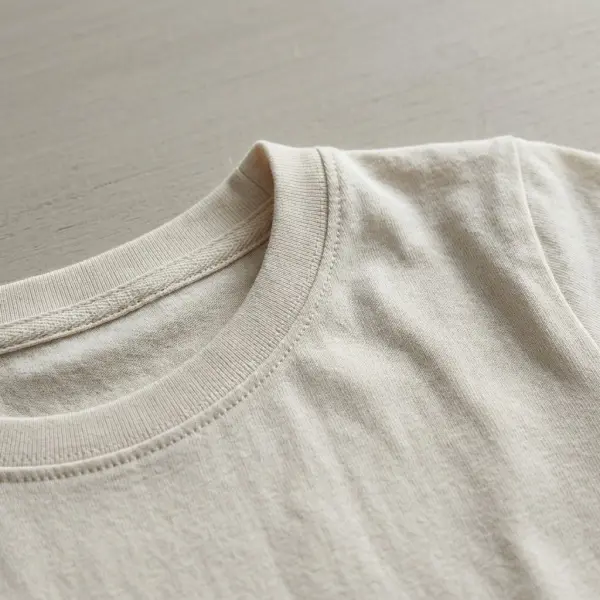
Comfort also depends on what touches the skin beyond the main fabric. Rough seam allowances, stiff embroidery backing, poorly positioned labels, and bulky stitching can create localized discomfort even when the base material feels soft.
A children's T-shirt made from a pleasant cotton knit, for example, may still irritate the wearer if the neck label has an abrasive edge or the shoulder seam is excessively bulky.
For product developers, fabric evaluation should therefore extend beyond the initial handfeel assessment to include washed samples, seam construction, and the completed garment.
Breathability, Moisture Management, and Thermal Comfort
Breathability is frequently used in children's clothing marketing, but the term can obscure several different properties.
Air permeability describes how readily air passes through fabric. Water vapor transmission relates to moisture vapor movement, while liquid moisture management concerns how fabric absorbs, spreads, or transports sweat. These characteristics can affect comfort differently.
A textile science review, Clothing Thermophysiological Comfort: A Textile Science Perspective, explains how fiber characteristics, fabric structures, and moisture behavior influence clothing comfort.
Cotton generally absorbs moisture readily, which can be useful in everyday clothing. However, moisture absorption does not necessarily mean rapid drying. Polyester absorbs relatively little moisture into the fiber itself, but appropriately engineered polyester fabrics can transport liquid moisture through their structures.
Neither fiber is universally more comfortable.
A lightweight, open-structured fabric may be suitable for warm conditions, while a denser knit can provide more coverage or warmth in cooler environments. Fabric thickness, porosity, finishing, and garment fit can substantially alter performance.
For brands producing children's summer clothing, selecting a material solely because it is labeled natural or breathable may lead to inconsistent results. Testing and realistic wear evaluation provide a stronger basis for fabric selection.
Fit and Freedom of Movement
Children frequently change posture and activity throughout the day. They may sit cross-legged, squat, climb, run, reach overhead, or move between indoor and outdoor environments.
Garment patterns need to accommodate these movements without creating unnecessary restriction or excessive loose fabric.
For example, narrow armholes can restrict reaching movements even when the body width appears generous. Trousers with insufficient rise or limited stretch may become uncomfortable when a child squats, while excessively long trouser legs may create a tripping concern.
Appropriate fit depends on the garment category and age group. A relaxed sweatshirt can allow more room than a fitted top, but it still needs suitable neck, sleeve, and body proportions.
Stretch fabrics can provide flexibility, although stretch percentage alone does not determine comfort. Recovery, fabric weight, seam elasticity, and pattern dimensions also matter.
Fit testing should therefore involve representative intended sizes and realistic movement, rather than judging the appearance of a garment on a stationary mannequin alone.
Age-Specific Dressing Needs
A toddler learning to dress independently may benefit from uncomplicated openings and easy-to-manage waistbands. An older child may place greater value on preferred silhouettes, personal styling, or practical features for school and recreation.
This creates different product development priorities across age groups.
A garment for a preschool child, for instance, may need a neckline that allows comfortable dressing without excessive stretching. A school-age child's trousers may require a waistband that remains comfortable while sitting and moving throughout the day.
Buttons, snaps, zippers, and other closures should be selected according to garment function, age suitability, attachment strength, and applicable safety requirements.
Comfort is also influenced by personal preference. Some children dislike particular textures, close-fitting collars, seams, or labels, while others have no difficulty wearing the same designs.
Brands cannot guarantee that one fabric will suit every child. They can, however, reduce predictable sources of discomfort through careful design, consistent specifications, and clear product information.

Why Children's Clothing Safety Requires More Than Soft Materials
Safety is a separate product development responsibility. A garment can use a soft textile and still contain features that create entanglement, flammability, attachment, or chemical compliance concerns.
The relevant risks depend on garment category, intended age group, product design, and the market where the clothing will be sold.
For fashion businesses, the safest approach is to incorporate risk assessment before finalizing patterns, trims, and production specifications.
Decorative Components and Attachment Security
Decorative buttons, beads, bows, appliqués, sequins, and other embellishments can create distinctive designs. Their suitability depends on placement, construction, wearer age, and how they behave during foreseeable use.
Loose or detachable components deserve particular attention in clothing intended for very young children. Attachment strength, accessibility, component shape, and the potential consequences of detachment should be reviewed.
Regulatory classification is important here. The U.S. Consumer Product Safety Commission explains that children's clothing and accessories, including buttons, are exempt from the specific federal small-parts ban under 16 CFR Part 1501. However, this exemption should not be interpreted as proof that loose attachments cannot create hazards or that every embellished garment is safe.
The distinction is documented in the CPSC Small Parts and Choking Hazard Labeling FAQ.
For manufacturers, a practical design review should consider whether each decorative element contributes enough value to justify its additional assembly and inspection requirements.
Embroidery may sometimes provide a more secure design alternative to certain attached ornaments, although embroidery backing, stitching, and surface texture still require evaluation.
Drawstrings and Entanglement Hazards
Drawstrings are a well-documented safety concern in children's clothing, particularly when positioned near the head, neck, or certain outerwear openings.
In the United States, the CPSC guidance on drawstrings in children's upper outerwear explains that hood and neck drawstrings on upper outerwear in sizes 2T through 12, or equivalent sizes, present a substantial product hazard.
For upper outerwear in sizes 2T through 16, or equivalent sizes, waist and bottom drawstrings are subject to specified limitations concerning length, attachments, and construction.
These requirements apply to defined garment categories and size ranges. They should not be generalized into the claim that every cord on every children's garment is prohibited.
European product safety practice also addresses cord and drawstring hazards through EN 14682, which specifies requirements for relevant children's clothing up to age 14. Brands should consult the applicable edition, product scope, and destination-market requirements.
The design implication is straightforward: decorative cords should not be retained merely because they appear fashionable. Where appropriate, alternative closures or integrated elastic constructions may achieve the intended fit without introducing unnecessary dangling components.
Flammability and Children's Sleepwear
Sleepwear requires particular attention because its regulatory requirements can differ from those applicable to ordinary daywear.
In the United States, children's sleepwear is addressed by 16 CFR Parts 1615 and 1616, with specific exemptions and alternative requirements for qualifying infant garments and tight-fitting sleepwear.
The CPSC children's sleepwear guidance explains the relevant categories, testing requirements, and distinctions.
Importantly, a garment marketed as loungewear is not automatically outside the sleepwear requirements. Intended use, design, and marketing claims may affect its regulatory classification.
This creates a practical issue for brands that sell matching casual sets, pajamas, and comfortable home clothing. Similar-looking products may require different compliance evaluations depending on how they are designed and presented.
Manufacturers should determine the regulatory category before choosing fabrics, confirming garment dimensions, and issuing care instructions. Relying on the product name alone is not sufficient.
Chemical Safety and Textile Certification
Textile dyes, prints, finishes, coatings, and accessories can introduce chemical compliance considerations. The relevant substances and restrictions depend on the material, product construction, and destination market.
Certification can help support certain claims, but its meaning needs to be accurately represented.
For example, OEKO-TEX STANDARD 100 concerns testing textiles and their components for harmful substances against specified criteria. Its Product Class I applies to products for babies and children up to three years of age and has the strictest requirements within the certification's product-class system.
However, this certification does not replace every applicable garment safety assessment. It should not be presented as comprehensive proof of mechanical safety, low environmental impact, or suitability for every child.
Brands should verify that certificates cover the relevant materials or finished products, are valid, and can be traced to the actual goods being purchased.
An impressive certification logo is useful only when the underlying claim is accurate.
Why Easy-Care Clothing Matters to Modern Families
Children's clothing is frequently exposed to ordinary household conditions such as spills, food stains, perspiration, outdoor dirt, and repeated laundering.
For many caregivers, a garment's usefulness depends partly on whether it can be cleaned without complicated procedures or unacceptable changes in appearance.
Easy care is therefore a practical product attribute, not simply an attractive phrase for product descriptions.
What Does Easy Care Actually Mean?
Easy-care clothing is designed to tolerate appropriate routine maintenance with manageable effort while retaining acceptable fit, appearance, and function.
That may include compatibility with household machine washing, suitable drying options, and resistance to excessive shrinkage, distortion, or color change.
However, machine washability alone does not guarantee easy maintenance.
A sweatshirt may be labeled machine washable but require special handling to protect a decorative print. A pair of trousers may wash successfully but develop noticeable shrinkage that changes the fit. A dark-colored garment may maintain its shape while transferring color to lighter fabrics under certain conditions.
Brands should therefore evaluate maintenance performance as a combination of characteristics rather than reducing it to a single care instruction.
Shrinkage and Dimensional Stability
Dimensional stability describes how well a textile or garment maintains its dimensions after processes such as washing and drying.
Some fabrics experience dimensional changes because of yarn relaxation, fabric structure, finishing conditions, or the mechanical and thermal stresses involved in laundering.
For children's clothing, these changes can be particularly noticeable when a garment already has a relatively narrow fit tolerance.
A T-shirt that becomes shorter after washing may no longer provide the intended coverage. A knitted waistband may change its fit, while a garment made from poorly balanced fabric may develop twisting or distortion.
International testing methods help manufacturers evaluate these issues. ISO 6330:2021 specifies domestic washing and drying procedures for textile testing, while ISO 5077:2007 provides a method for determining dimensional change following specified washing and drying procedures.
These standards establish testing methods, not universal acceptable shrinkage limits for all childrenswear. Brands still need product-specific acceptance criteria based on garment design, customer expectations, and contractual specifications.
Colorfastness and Print Durability
Children's clothing frequently uses bright colors, contrasting panels, and printed graphics. These elements may influence purchasing decisions, but their appearance also needs to survive appropriate care.
Colorfastness describes the resistance of textile coloration to change or transfer under specified conditions. Different tests evaluate different exposures, including laundering, rubbing, perspiration, and light.
For example, ISO 105-C06 provides methods for evaluating colorfastness to domestic and commercial laundering.
Colorfastness results should be interpreted according to the test method and intended use. A satisfactory laundering result does not automatically demonstrate equivalent resistance to rubbing or sunlight.
Printed designs also require separate consideration where appropriate. Cracking, peeling, excessive stiffness, and changes in handfeel can affect garment appearance and perceived quality.
For product development teams, a vivid graphic should be assessed not only for its initial visual impact but also for its behavior under realistic maintenance conditions.
Care Labels Must Reflect Real Product Performance
Care instructions communicate how a garment should be maintained. They also create expectations about the product's performance.
In the United States, the Federal Trade Commission's Care Labeling Rule guidance explains that covered manufacturers and importers must provide appropriate care instructions supported by a reasonable basis.
Instructions should not recommend procedures that cause substantial damage, and relevant warnings are necessary when otherwise expected treatment could harm the garment.
For example, if ironing would damage a decorative application, the care guidance should address that risk instead of leaving customers to make assumptions.
Care labels should therefore be finalized using confirmed fabric and garment performance rather than copied automatically from a previous collection.
This is especially relevant when a familiar garment design is produced using a different fabric, print process, or trim.
How Fabric Choices Affect Comfort, Safety, and Maintenance
Selecting the right material involves balancing several characteristics that may not improve together.
A fabric with an exceptionally soft surface may require more careful handling. A durable woven textile may resist abrasion but offer less flexibility than a knitted fabric. A garment with high stretch may provide movement comfort but require careful evaluation of elastic recovery and dimensional stability.
The appropriate choice depends on the intended garment.
|
Fabric or Construction |
Potential Advantages |
Important Limitations |
Common Kidswear Applications |
|
Cotton jersey |
Soft handfeel, moisture absorption, flexible knitted structure |
Shrinkage, drying time, and distortion depend on construction and finishing |
T-shirts, everyday tops, leggings |
|
Cotton-polyester blends |
Can balance selected cotton and polyester characteristics, depending on blend and construction |
Performance varies substantially with blend ratio, yarn, and finish |
Sweatshirts, casual sets, everyday separates |
|
Cotton interlock knit |
Smooth surfaces and relatively stable knitted structure |
Weight, stretch, and laundering behavior vary by specification |
Babywear, tops, soft casualwear |
|
Brushed fleece |
Soft raised surface and insulation potential |
Pilling, lint release, and thermal suitability need evaluation |
Sweatshirts, joggers, cool-weather clothing |
|
Lightweight woven cotton |
Can offer structure and a comfortable handfeel |
Less stretch than many knits; creasing and shrinkage vary |
Shirts, dresses, casual shorts |
|
Denim |
Distinctive appearance and potential resistance to everyday abrasion |
Weight, stiffness, finishing, and garment fit affect comfort |
Jeans, jackets, overalls |
These are typical material considerations rather than guaranteed performance rankings.
For example, cotton fleece and polyester fleece can both feel soft, but their moisture behavior, drying characteristics, pilling resistance, and thermal properties depend on the exact fabric.
Similarly, a high-quality knit with suitable construction may deliver better practical durability than a poorly developed woven fabric, even though woven structures are sometimes assumed to be inherently more robust.
The material decision should be supported by physical samples, fabric specifications, and appropriate testing, not fiber labels alone.
How Apparel Brands Can Build Comfort, Safety, and Easy Care Into Product Development
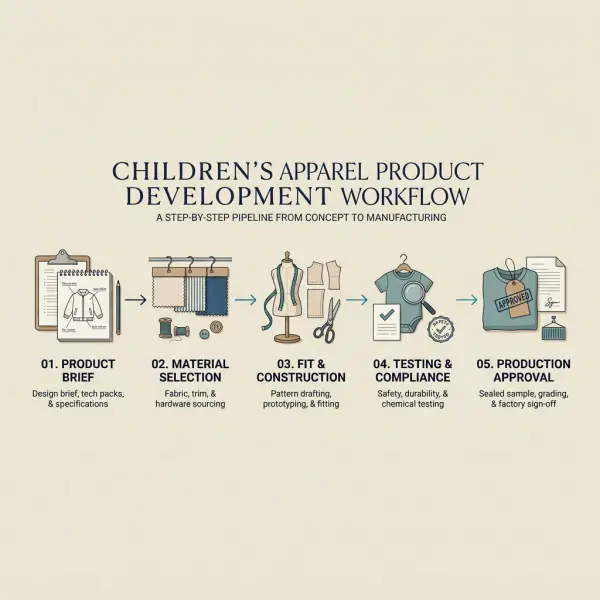
These qualities are easier to manage when they are addressed through a repeatable product development process.
A brand that evaluates comfort only after samples are sewn may discover fit problems late in development. Likewise, safety issues identified shortly before production can require changes to trims, patterns, or sourcing agreements.
A practical workflow integrates these considerations from the beginning.
Define the Garment's Intended Use
Before selecting materials, product developers should establish who the garment is for and where it will be worn.
A preschool everyday outfit, a lightweight outdoor jacket, and a children's pajama set may require different fit characteristics, material properties, and compliance evaluations.
The brief should identify the intended age and size range, climate, activities, retail market, care expectations, and target price.
Clear product requirements reduce the risk of selecting fabrics or decorative features that later prove unsuitable.
Develop Material and Construction Specifications
Once the intended use is defined, designers and technical teams can translate the concept into measurable garment requirements.
These may include fabric composition, weight, stretch and recovery, seam type, neckline construction, closure specifications, garment measurements, and tolerance limits.
A comfortable pattern also depends on how these characteristics work together.
For instance, a narrow neckline made from a fabric with limited stretch may make dressing difficult, while an inadequately stabilized neckline may lose its shape after repeated use.
Specifications should be based on the completed product rather than isolated fabric assumptions.
Evaluate Samples Through Relevant Testing
Testing should reflect foreseeable wear, cleaning, and safety requirements.
Depending on the garment and market, an evaluation program may include:
- Fit and movement checks: Assessing garment proportions, dressing convenience, and movement suitability.
- Fabric performance testing: Reviewing dimensional stability, colorfastness, pilling, and other relevant properties.
- Construction evaluation: Checking seams, openings, fasteners, and component attachment.
- Safety and compliance testing: Confirming applicable chemical, mechanical, flammability, and labeling requirements.
- Care validation: Evaluating garment behavior under the proposed washing and drying instructions.
These are potential testing categories, not a universal laboratory protocol. The exact methods and acceptance criteria must be chosen according to product requirements and applicable regulations.
For example, the American Association of Textile Chemists and Colorists describes AATCC TM135 and TM150 as methods addressing dimensional changes in fabrics and garments after home laundering, respectively.
The relevant test selection should reflect whether the business needs to assess fabric behavior, finished garment behavior, or both.
Establish Production Quality Controls
An approved sample does not guarantee that every production unit will match its performance.
Bulk production can introduce variation through fabric lots, cutting, stitching, finishing, or changes in supplied components.
Manufacturers should therefore define critical inspection points, production tolerances, traceability requirements, and procedures for handling nonconforming products.
For a children's sweatshirt, inspection priorities might include neckline dimensions, seam quality, print condition, closure construction, and consistency with the approved specification.
Safety-critical requirements should be identified separately from ordinary visual preferences. A slightly inconsistent decorative stitch and an unsafe fastening should not be treated as equivalent defects.
Use Post-Purchase Feedback to Improve Product Specifications
Customer feedback can reveal issues that controlled testing does not fully capture.
Repeated complaints about tight neck openings, twisting seams, fading graphics, or difficult maintenance may indicate weaknesses in design or production specifications.
Brands should review return reasons, customer-service reports, product reviews, and relevant warranty or quality claims.
The strongest feedback processes connect these observations to specific styles, sizes, material batches, and production periods.
This helps product development teams determine whether an issue is isolated, related to fit grading, or associated with a recurring manufacturing problem.
Why These Product Qualities Matter Commercially
Comfort, safety, and easy care influence more than product development. They affect how retailers communicate quality, how brands manage operational risk, and how customers evaluate the usefulness of a purchase.
However, commercial benefits should not be overstated. A garment with stronger technical specifications does not automatically achieve higher sales or customer loyalty. The benefits depend on whether the improvements address real customer needs at an acceptable price.
Reducing Avoidable Product Complaints and Returns
Inconsistent fit, unexpected shrinkage, damaged prints, and unclear care instructions can contribute to customer dissatisfaction.
For an online childrenswear retailer, customers cannot inspect the garment physically before ordering. This makes accurate product descriptions, photographs, measurements, and care guidance particularly valuable.
A brand that receives repeated complaints about trousers becoming shorter after washing should investigate garment measurements and dimensional stability rather than responding exclusively through customer service.
Similarly, a recurring issue with uncomfortable neck openings may require pattern revisions rather than simply recommending a larger size.
Quality data becomes commercially useful when it informs product improvement.
Pricing and Perceived Value
A higher retail price can sometimes be supported by meaningful improvements in materials, construction, testing, or product functionality. However, the value proposition must be understandable to customers.
For example, a durable everyday garment may justify a higher price within a particular market if customers recognize differences in fit consistency, fabric performance, and workmanship.
Yet additional specifications also introduce costs.
More extensive testing, specialized trims, stronger construction methods, or premium fabrics can affect sampling expenses, unit costs, and production lead times.
Brands need to decide which improvements are essential for safety and suitability, which enhance product quality, and which may be unnecessary for the intended price segment.
Applicable safety compliance is not an optional premium feature. It is a baseline requirement for selling the relevant product.
Building Credibility Through Accurate Product Communication
Marketing language should reflect verifiable characteristics.
Claims such as soft-touch cotton jersey, machine washable according to care instructions, or elastic waistband with adjustable fit can be meaningful when they accurately describe the garment.
By contrast, broad claims such as completely safe, allergy-proof, or guaranteed comfortable for every child are difficult to substantiate and may mislead customers.
Product pages should distinguish between material composition, laboratory-tested performance, certification status, and subjective comfort descriptions.
For fashion businesses, precise communication can help customers make better purchasing decisions while limiting the risk of unsupported claims.
Common Mistakes in Children's Clothing Product Development
Several recurring mistakes arise when brands rely too heavily on visual design, supplier descriptions, or assumptions about materials.
Assuming Natural Fibers Are Automatically Safer
Natural fibers can offer useful properties, but fiber origin alone does not establish product safety. Dyes, finishes, accessories, garment construction, and intended use can all affect safety requirements.
A cotton children's garment, for instance, may still require relevant evaluation for flammability, prints, trims, and other applicable obligations.
The better approach is to assess the complete product against the appropriate requirements rather than treating natural fiber content as a substitute for verification.
Evaluating Softness Without Testing Fit
A soft material may still produce an uncomfortable garment if the pattern restricts movement or the seams create pressure.
This mistake often occurs when fabric approval and garment fit approval are treated as unrelated processes. The finished garment may appear acceptable on a display form while performing poorly during sitting, reaching, or dressing.
Brands should evaluate material properties and fit together, using appropriately sized samples and realistic movement checks.
Adding Decorative Details Without a Risk Review
Extra cords, ornaments, buttons, and novelty attachments may make children's clothing visually distinctive, but each additional component introduces manufacturing and inspection considerations.
Without proper review, decorative choices may produce attachment problems, entanglement risks, or unnecessary maintenance difficulties.
Brands should assess whether these details are suitable for the intended age group and use, and redesign or eliminate features that create avoidable hazards.
Copying Care Labels From Previous Collections
A familiar garment silhouette does not guarantee identical maintenance requirements when the fabric, finish, or decoration changes.
Copying existing washing instructions without validation can lead to misleading guidance and unexpected garment deterioration.
Care instructions should be developed from relevant evidence for the actual product, including its fabrics, trims, prints, and construction.
Treating Supplier Certificates as Complete Product Approval
A supplier may provide an authentic textile certificate, but that document may cover only a particular material, component, batch, or testing scope.
It does not necessarily demonstrate compliance of the finished garment with every destination-market requirement.
Brands should review certificate validity, product identification, applicable standards, and whether additional finished-product assessments are necessary.
Traceability and documentation are part of quality assurance, not administrative details to be addressed only when problems occur.
Important Technical Caveats Before Choosing Kidswear Materials
Comfort, safety, and easy care cannot be reduced to one ideal fabric or universal garment specification.
Several technical distinctions are especially important:
- A soft fabric is not necessarily suitable for every skin-contact application or wearer.
- A breathable textile is not automatically quick-drying, and an absorbent fabric is not necessarily effective at transporting liquid moisture away from the skin.
- Machine washability does not establish acceptable shrinkage, colorfastness, or print durability without appropriate evaluation.
- Chemical testing certification does not replace all applicable mechanical, flammability, or finished-product safety requirements.
- Compliance requirements vary by product category, age group, and destination market.
Manufacturers also need to understand the limitations of laboratory testing. Standardized procedures support consistent comparisons, but they cannot reproduce every household washing machine, detergent, climate, or wearing condition.
The objective is not to promise that garments will perform perfectly under all circumstances. It is to establish realistic product specifications, evaluate foreseeable conditions, communicate limitations accurately, and comply with applicable rules.
Frequently Asked Questions About Comfort, Safety, and Easy Care in Children's Clothing
What Is the Most Comfortable Fabric for Children's Clothing?
There is no universally most comfortable fabric for every child, activity, and climate. Cotton jersey, interlock knit, and selected blends may be suitable for many everyday garments, but comfort depends on more than fiber content.
Fabric weight, knitted or woven structure, moisture management, finishing, seams, and garment fit all influence the result.
For warm-weather casualwear, a lightweight fabric with appropriate air permeability may be preferable to a thick, densely constructed textile. For cooler conditions, insulating layers may be more suitable.
Brands should evaluate actual samples and finished garments rather than declaring one material categorically superior.
Is 100% Cotton Better Than Polyester for Children's Clothing?
Not necessarily. Cotton and polyester have different fiber properties, and each can be appropriate for particular garments.
Cotton generally absorbs moisture readily, while polyester has comparatively low moisture absorption and can be engineered into fabrics with specific moisture-transport characteristics.
Cotton garments may offer a pleasant everyday handfeel, but their drying and dimensional behavior depend on the fabric. Polyester blends may provide desirable durability or maintenance properties, although their comfort varies with construction and finishing.
The right decision depends on climate, intended activity, garment type, performance requirements, and customer preferences.
A fabric's composition should be considered alongside testing data and finished-garment evaluation.
What Safety Features Should Parents Look for in Children's Clothing?
Parents and caregivers can look for appropriate fit, secure construction, suitable fastenings, and garment details that do not create obvious entanglement or attachment concerns.
Particular attention may be warranted for loose decorative components, dangling cords, damaged closures, and garments that are unsuitable for the child's age or activity.
Product labels and reliable manufacturer information can also help identify intended use and care requirements.
However, visual inspection cannot confirm every relevant safety property. Chemical compliance, flammability performance, and certain construction requirements may require technical testing or documentation.
Retailers and manufacturers remain responsible for meeting applicable product safety requirements; consumers should not be expected to verify regulatory compliance themselves.
Does OEKO-TEX STANDARD 100 Mean Children's Clothing Is Completely Safe?
No. OEKO-TEX STANDARD 100 indicates that certified textile products or components have been tested for harmful substances according to the certification's defined criteria.
It does not establish that the finished garment is free from every possible hazard.
Mechanical risks, drawstring design, component attachment, flammability requirements, garment fit, and intended use may need separate consideration.




Comments 0
Leave a CommentSend Comment
Anda harus Login terlebih dahulu untuk dapat memberikan komentar.