


What Fashion Brands Should Learn From Comfort-Led Consumers
Quick Answer
Fashion brands should learn that comfort-led consumers are not one demographic and do not all want loose, casual clothing. They are shoppers who give meaningful weight to how a garment feels, moves, fits into daily routines, performs in a particular climate, and remains wearable over time. One customer may prioritize a non-irritating waistband; another may need a polished jacket that works through commuting, sitting, and travel; another may value easy care more than softness at first touch.
The commercial lesson is to segment demand by the comfort problem being solved, not by age alone. Brands need to translate customer language into specific product requirements, validate those requirements through wear and care testing, and communicate the result with measurements, model context, movement imagery, and appropriately structured reviews. They should then connect product feedback with return reasons, repeat purchase, complaints, markdowns, and contribution margin.
Comfort can support differentiation and loyalty when it is consistent and recognizable, but it is not a substitute for style, quality, price value, or brand identity. Nor does a comfortable product automatically create a sustainability benefit. The strongest strategy treats comfort as a defined customer outcome with evidence behind it—not as a vague adjective applied across the entire collection.

Who Are Comfort-Led Consumers?
Comfort-led consumers are shoppers whose clothing decisions are materially influenced by physical ease, sensory experience, practical wearability, or reduced daily friction. The term describes a decision priority, not a fixed lifestyle tribe. A customer can be comfort-led when buying trousers for long workdays and appearance-led when buying a special-event dress.
Brands often mistake a product direction for a customer segment. “Oversized,” “stretch,” “soft,” and “athleisure” describe design cues; they do not reveal why a person buys, which compromise they accept, or whether they will wear the garment frequently.
The broader influence of comfort-first dressing on modern fashion helps explain why ease has become visible across categories. For a brand, however, the useful question is narrower: what kind of discomfort is the target customer trying to avoid, and what appearance, price, care, or performance requirements must the solution preserve?
Comfort is a job to be done, not a universal aesthetic
Two customers may buy the same black trouser but judge it differently. One wants less waistband pressure during seated work; the other wants a style that remains polished after a flight. Their comfort jobs—and the evidence they need—are different.
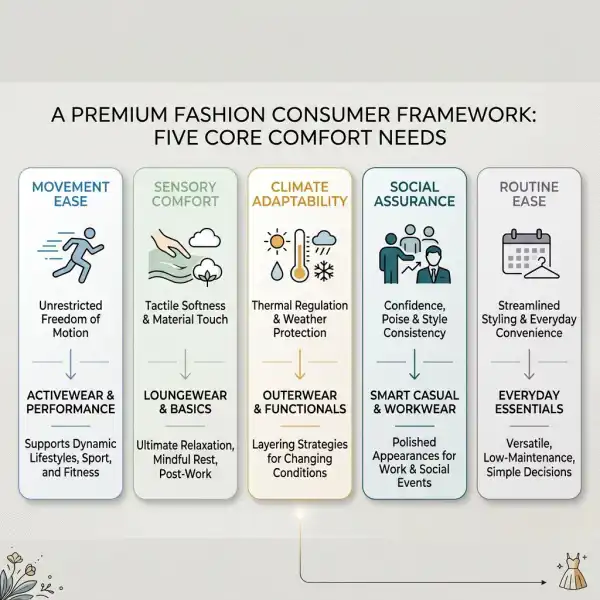
There are several recurring comfort jobs in apparel:
- Movement ease: the garment must accommodate walking, reaching, bending, sitting, or layering without binding or displacement.
- Sensory ease: skin-contact surfaces, seams, labels, finishes, and pressure points must feel acceptable to the wearer.
- Climate management: the product must be tolerable in the intended temperature, humidity, wind, or indoor-outdoor routine.
- Social ease: the wearer wants to feel appropriately dressed without constant adjustment or self-consciousness.
- Routine ease: laundering, drying, ironing, packing, fastening, and styling must fit the customer's available time and capability.
These jobs can conflict. A lining may slide easily over a shirt but feel too warm in humidity; an elastic waist may simplify dressing while adding pressure or reducing formality. Research should reveal which trade-off matters in the intended situation.
What Does Current Consumer Evidence Actually Show?
Current evidence supports the relevance of comfort, value, and well-being, but not a universal wardrobe shift. Surveys differ by geography, sample, wording, sponsor, and category, so brands still need customer-specific evidence.
A 2025 Global Lifestyle Monitor survey reported that respondents rated cotton clothing highly for comfort and softness. It is useful perception evidence, but is published by Cotton Incorporated and does not prove that fiber alone determines comfort: Global Lifestyle Monitor findings on clothing attributes. Fabric, finish, garment design, climate, and care still affect experience.
The Business of Fashion–McKinsey State of Fashion 2026 report describes consumers as seeking value and paying more attention to well-being, while identifying product quality and experience as important to brand elevation. It connects comfort with value perception, but does not make comfort the primary driver in every category.
McKinsey's 2026 research across five countries also describes persistent cost consciousness: State of the Consumer 2026. Comfort therefore competes with price, design, trust, and other spending priorities; the benefit must be clear before purchase and credible after use.
Consumer preference is not the same as product performance
A survey can show that comfort matters to respondents, but not whether a specific garment delivers it or justifies a higher price.
Brands need three levels of evidence:
- Market evidence indicates that a need exists within a broad population or category.
- Customer evidence identifies how the brand's target audience defines and prioritizes that need.
- Product evidence shows whether a particular garment delivers the promised outcome under relevant conditions.
Confusing these levels produces weak decisions. A global survey may justify investigation, but a repeatable product brief requires brand-specific research and garment-level validation.
Segment by Need and Context, Not Demographics Alone
Demographics remain useful, but do not explain comfort demand alone. People of the same age can have different commutes, climates, sensory preferences, dress codes, and care routines. Behavior-based segments are usually more actionable.
A brand might distinguish commute-ready polish, sensory basics, climate-appropriate coverage, easy-access clothing, and low-maintenance travel needs. These groups overlap; the purpose is to connect a situation with a product promise, not assign a permanent persona.
|
Comfort-led segment |
Primary need |
What may create value |
Common risk |
Useful evidence |
|
Movement-focused wearer |
Freedom during sitting, walking, reaching, or active work |
Deliberate mobility, stable fit, secure pockets |
Adding stretch without resolving pressure or displacement |
Task-based wear trial and movement feedback |
|
Sensory-sensitive wearer |
Reduced irritation, scratch, pressure, heat, or distracting details |
Considered skin-contact surfaces and adjustable pressure |
Calling a fabric “soft” while labels, seams, or trims irritate |
Extended skin-contact trial and complaint coding |
|
Climate-led wearer |
Tolerable wear in heat, humidity, cold, wind, or variable interiors |
Appropriate layering, permeability, coverage, and drying behavior |
Making universal breathability or temperature claims |
Climate-specific wear and material testing |
|
Polished-comfort seeker |
Ease without looking underdressed |
Controlled silhouette, versatile styling, consistent appearance |
Equating comfort with casualwear only |
Occasion interviews and styling observation |
|
Routine-efficiency seeker |
Less time spent styling, adjusting, laundering, or ironing |
Easy coordination, practical care, packability, dependable fit |
Promising easy care before repeated laundering |
Care trials, usage diary, and repeat purchase |
|
Access-oriented wearer |
Easier dressing and undressing or compatibility with mobility needs |
Functional closures, seated fit, reachable features |
Treating accessibility as a cosmetic add-on |
Co-design and trials with intended users |
The table is a hypothesis, not a global taxonomy. A modest-fashion customer in a hot climate may combine coverage, thermal, movement, and social needs; a traveller may accept firmer handfeel for recovery and easy care.
This is why comfort segmentation should begin with context: what the person is doing, how long the garment is worn, what it is worn with, and which failure would cause rejection.
Turn Customer Language Into Product and Merchandising Decisions
Customers rarely use technical apparel terms. They say a trouser “cuts in,” a shirt “rides up,” or a jacket looks “sloppy.” Brands should preserve that language while translating it into hypotheses that product and merchandising teams can investigate.
One comment can have several causes. “Too hot” may relate to fabric, lining, coverage, activity, or unrealistic expectations. “Too tight” may reflect size selection, local ease, recovery, or balance. One message cannot diagnose the product, but consistent context makes repeated signals visible.
|
Customer language |
Possible interpretation to investigate |
Decision it may inform |
Evidence needed before changing product |
|
“Soft at first, rough after washing” |
Finish loss, fibrillation, pilling, care interaction, or detergent sensitivity |
Material, finishing, care label, quality threshold |
Controlled care test plus used-product review |
|
“Waist is comfortable standing but tight sitting” |
Pressure distribution, rise, waistband extension, or size selection |
Fit brief, grading, product-page guidance |
Seated fit across relevant sizes and bodies |
|
“Relaxed but looks shapeless” |
Mismatch between desired ease and visual identity |
Assortment, styling, silhouette positioning |
Try-on interviews and styling comparison |
|
“Breathable but see-through” |
Permeability achieved with inadequate opacity for the use case |
Fabric, lining, color, communication |
Dynamic opacity and wear test |
|
“Easy to wear but difficult to wash” |
Product comfort conflicts with routine convenience |
Care method, trim, material, price-value story |
Repeated home-laundry simulation |
|
“Runs large” |
Size expectation differs from intended design volume |
Size advice, naming, grading, fit communication |
Garment data, return patterns, structured fit reviews |
The technical mechanics are covered in how soft structures and relaxed silhouettes shape everyday style. Here, the key is separating failure from preference mismatch. Disliking deliberate volume does not prove a defective pattern; repeated restriction in a defined movement is different.
Build a Better Comfort Insight System
A useful insight system combines what customers say, what they do, and what the product does. Interviews reveal motives but are affected by memory; sales show behavior but not causation; tests measure properties but cannot represent every wearer and context.
Start by connecting evidence that many businesses already collect in separate systems:
- product reviews and structured fit or feel questions;
- return and exchange reason codes;
- customer-service chats, emails, and store feedback;
- search terms, filters, wish lists, and product-page behavior;
- size, color, channel, market, and cohort-level sales;
- repeat purchase by style, block, material, or product family;
- wear trials, fitting notes, care tests, and quality inspections;
- markdown, defect, alteration, repair, and warranty records.
The work is creating consistent categories linked to product identifiers. If “too small,” “tight at waist,” and “restrictive” sit in unrelated fields, a repeated issue stays hidden; one catch-all code also erases useful distinctions.
Reviews should reduce uncertainty, not decorate the page
Baymard Institute's 2026 apparel research found that size accuracy and fit details were the most sought information in reviews among the shoppers it surveyed, at 48%, ahead of quality and durability over time at 43%: apparel review and fit research. The result applies to Baymard's sample and research design, but it illustrates why a generic star rating is too blunt for comfort-led products.
Structured prompts can ask about size accuracy, pressure, softness, temperature, movement, and care where relevant. Optional reviewer height, selected size, and fit context can add value when collected sensitively with appropriate privacy controls.
Review systems must preserve negative evidence. US Federal Trade Commission guidance warns against procuring, suppressing, boosting, organizing, or editing reviews in ways that distort consumer opinion: FTC's finalized 2023 Endorsement Guides update. Rules vary by jurisdiction, but manipulated praise also damages product learning.

Return data needs product-level interpretation
The National Retail Federation estimated that 19.3% of US online retail sales would be returned in 2025: NRF 2025 Retail Returns Landscape. This broad estimate shows economic relevance, but is not an apparel-specific comfort statistic or evidence about one brand's causes.
Compare return reasons by style, size, market, and cohort, then check promotions, channel, and first-time purchase. A spike in “too large” after a campaign may reflect audience mix or unclear communication rather than a production defect.
Customer comments should trigger investigation, not automatic redesign. Product change becomes more defensible when review themes, return codes, fitting evidence, and physical inspection converge.
Assortment Strategy: Do Not Make Every Product Solve the Same Problem
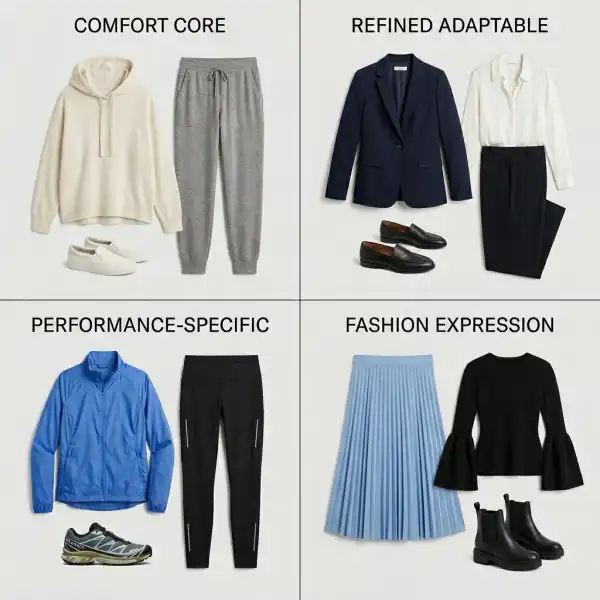
A comfort-led brand still needs assortment tension. If every item is soft, wide, and neutral, the range may lose occasion breadth and visual distinction. Comfort is more useful when expressed through a recognizable point of view across product roles.
One collection might combine replenishable sensory basics, adaptable work-to-weekend pieces, climate-specific layers, and a smaller number of more directional products. Each role carries a different demand risk and proof requirement.
|
Assortment role |
Main strength |
Main weakness |
Best use cases |
Business takeaway |
|
Comfort core |
Repeatable fit and familiar everyday utility |
Can become price-comparable or visually generic |
Tees, knit layers, trousers, underwear, simple dresses |
Protect consistency and availability; improve carefully |
|
Refined adaptable product |
Connects ease with polish and broader occasions |
Requires stronger design and communication |
Soft jackets, travel trousers, day-to-evening dresses |
Show how comfort coexists with appearance |
|
Performance-specific solution |
Solves a clear climate, movement, or access need |
Higher testing, sourcing, and claim burden |
Active commute, adaptive apparel, weather-led layers |
Define conditions and validate the claim |
|
Fashion expression piece |
Creates desire and collection identity |
Comfort may be secondary or more subjective |
Directional silhouettes, occasion pieces, statement knits |
Do not force a universal comfort promise |
This architecture prevents every style being judged with one metric. A core trouser may be assessed through replenishment and size exchanges; a fashion piece may sell less but create editorial interest. Comfort principles can remain without pretending every product serves the same situation.
Comfort Must Be Part of the Value Proposition, Not an Excuse for Price
Consumers do not pay for comfort in the abstract. They pay when benefits, appearance, quality, and price make sense together. Soft handfeel is easy to copy and may change after laundering; stronger value may come from consistent fit, durable recovery, dependable care, or an effective combination of polish and ease.
A premium proposition should explain its added value: perhaps a repeatedly tested fit block, lower-bulk skin-contact construction, better recovery, or tighter production consistency. The explanation should be specific without exposing confidential details.
Price testing should compare complete propositions, not isolated adjectives. Concept tests, preorder behavior, and controlled merchandising can distinguish stated interest from willingness to pay when the sample resembles the intended market.
More sizes, closure options, trials, specialized trims, or multiple-model photography can raise costs. Examine contribution after returns, discounts, service, and quality claims—not only full-price gross margin.
Communicate Comfort With Evidence Customers Can Use
“Comfortable,” “breathable,” “buttery soft,” and “moves with you” are common phrases because they are concise. They are also imprecise. A stronger product page explains what the customer can observe and under which conditions: a partial elastic back waist, a fabric with measured stretch and recovery, an unlined construction, a relaxed hip with garment measurements, or a care method tested on the finished item.
Content should answer four pre-purchase questions:
- Where does the garment sit close, and where is it deliberately relaxed?
- How does it look while standing, sitting, walking, and layering?
- What does the material feel and behave like before and after care?
- For which climate, activity, and dress context was it designed?
Baymard's apparel research found that model images help users judge scale, length, and fit, while styling that hides sleeves, hems, or shape obscures information: research on showing apparel on human models. Pair editorial styling with one clean view; movement clips should not replace measurements or front, side, and back images.
Reviews can add lived context by asking about duration, post-wash change, and activity. Publish limitations too: unlined, low-support, dry-clean only, indoor layering, or generous through the hip but fitted at the waist.
Precise caveats do not weaken the proposition. They help the right customer recognize it.
Comfort Consistency Can Support Loyalty, but It Does Not Guarantee It
Trust in a trouser block, knit handfeel, or size information reduces uncertainty and can support repeat purchase. Comfort alone does not guarantee loyalty; availability, price, newness, service, and competition still matter.
Ask which promise makes customers return rather than search again: dependable petite proportions, travel-ready workwear, or dignified adaptive features, for example.
Track behavior where the promise exists. Brand-wide repeat rate may hide strong trousers and weak tops; repeat by fit block, additional-color orders, and time to second purchase reveal more. Follow-up can test whether comfort, style, promotion, or availability drove the return.
A core can retain trusted fit while color, texture, and adjacent silhouettes evolve. Tell customers when a revision no longer fits like its predecessor.
A Practical Framework for Applying Comfort Insights
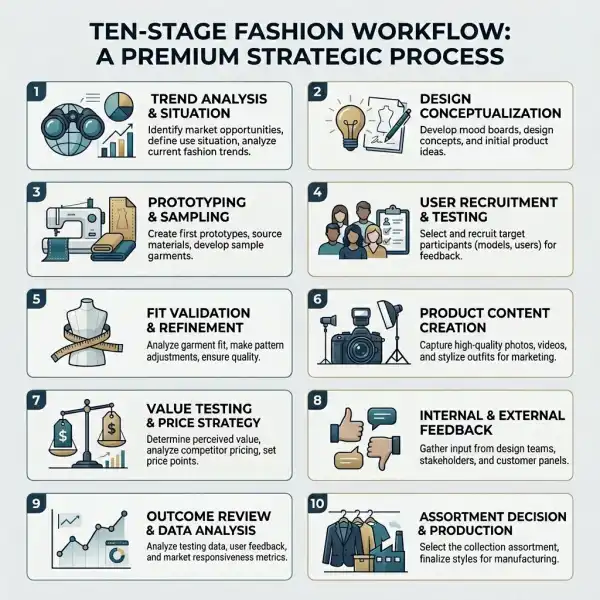
The following workflow keeps consumer evidence connected to commercial decisions without turning every request into a new product feature.
- Choose a priority use situation. Define the activity, duration, climate, layer, dress expectation, and current frustration.
- Recruit relevant participants. Include target customers and body or capability profiles affected by the problem; avoid relying only on employees.
- Map the trade-offs. Ask what customers will not sacrifice for comfort, such as polish, support, coverage, durability, price, or ease of care.
- Write an observable promise. Replace “all-day comfort” with specific outcomes that can be tested, such as reduced waist pressure while sitting or easier dressing with one hand.
- Develop and validate the product. Use fit sessions, wear trials, care tests, and relevant technical testing. The construction depth belongs in the product-development process, not in the marketing claim.
- Test the value proposition. Compare concepts, messages, visuals, and price levels with the intended audience before scaling inventory.
- Build decision-ready product content. Provide measurements, model context, unstyled views, movement evidence, care, material behavior, and limitations.
- Launch with tagged feedback. Connect reviews, service messages, returns, sales, and product data using consistent reason codes.
- Review commercial and wearer outcomes together. Evaluate conversion, returns, contribution margin, repeat purchase, complaints, and post-care experience.
- Decide whether to repeat, revise, reposition, or stop. Do not treat every weak result as a design failure; demand, price, visibility, and audience fit may be the cause.
For a small brand, well-selected wear testers, structured interviews, disciplined return codes, and post-wash checks may outperform a generic survey. Larger businesses can add experiments, cohort analysis, and formal testing.
Common Mistakes Brands Make With Comfort-Led Consumers
Treating “comfort” as a single segment
The word hides sensory, movement, climate, social, and care needs. Define the situation and failure before building a persona.
Designing by age stereotype
Young does not mean oversized; older does not mean conservative or adaptive. Use demographics after identifying the behavioral need.
Listening only to vocal customers
Reviews overrepresent motivated commenters. Combine them with repeat purchase, returns, observation, and targeted follow-up.
Changing a bestseller from a handful of comments
Investigate frequency, severity, affected size, batch, market, and context before revising a trusted block. A premature change can break established fit.
Measuring sales without measuring expectation accuracy
Advertising can sell once. Returns, complaints, post-care performance, and repeat behavior show whether the promise survived conversion.
Using softness as a proxy for quality
A soft finish can mask low recovery, pilling, or instability. Judge fitness for use through wear and care, not one sensory cue.
Making unsupported universal claims
“Breathable,” “temperature-regulating,” “pain-free,” and “all-day comfort” may imply objective performance. Define conditions and intended users; testimonials do not replace substantiation.
Comfort-washing the brand identity
Repeated comfort copy becomes generic. Connect ease to the brand's design vocabulary while allowing some products to prioritize other value.
What Brands Should Verify Before Acting
Before expanding a product, changing a fit block, or making a strong claim, verify:
- Who was studied: target customers, convenient respondents, employees, or a broad market sample.
- What was evaluated: a swatch, prototype, production garment, product page, or recalled experience.
- Under which conditions: duration, climate, activity, layers, care cycle, and body position.
- What comparison was used: previous version, competitor, control product, or no baseline.
- Which outcome changed: stated preference, conversion, return, repeat wear, physical measurement, or laboratory result.
- Whether the economics work: product cost, content cost, returns, markdown, support, and achievable price.
Sustainability requires separate proof. Frequent comfortable wear may support longer use, but does not establish lower environmental impact. Sourcing, processing, care, durability, repair, and end of life still matter. The European Commission has highlighted misleading textile claims and the need for evidence: EU guidance on sustainable-fashion claims. Cross-market sellers should obtain current advice for relevant jurisdictions.
Accessibility work needs direct participation. Magnetic closures, seated trousers, low-sensory interiors, and adjustable features should be evaluated with intended users; imagined benefit does not make a feature inclusive.
Frequently Asked Questions
What is a comfort-led consumer in fashion?
A comfort-led consumer is a shopper who gives significant weight to physical ease, sensory experience, climate suitability, practical care, or reduced dressing friction when choosing clothing. The label does not describe one age group or a permanent preference across every purchase. Someone may prioritize comfortable, polished trousers for work while accepting more restriction in an occasion garment. Brands should identify the use situation and the specific discomfort being avoided. This produces more actionable insight than treating “people who like comfortable clothes” as one broad lifestyle segment.
How can a fashion brand identify what comfort means to its customers?
Combine interviews and wear diaries with behavioral and product data. Ask customers what they were doing, how long they wore the garment, what they wore underneath, which climate they experienced, and what they adjusted or avoided. Then compare those accounts with reviews, return reasons, exchanges, repeat purchases, service messages, and garment testing. Avoid asking only “Was it comfortable?” because that produces a vague rating. Questions about pressure, irritation, heat, movement, care, and social appropriateness reveal which type of comfort matters and what trade-offs customers will accept.
Should brands create a separate comfortwear collection?
Only when the target need, brand identity, and assortment economics justify it. A separate capsule can make sense for travel, adaptive dressing, recovery, hybrid work, or climate-specific use because the proposition is easy to explain and test. In other cases, comfort is better integrated into existing categories such as tailoring, denim, dresses, or uniforms. A named collection can become restrictive if customers interpret it as loungewear or if the products lack a shared technical purpose. Test the concept, product roles, price, and expected occasions before committing substantial inventory.
Can comfort justify a premium price in apparel?
It can support a premium when the benefit is distinctive, consistent, durable, and difficult to reproduce cheaply. Examples include a dependable fit block, controlled recovery, specialized access features, refined low-bulk construction, or a garment that genuinely covers several occasions. Soft handfeel alone is a weak premium argument because finishes can be copied and may change after washing. Brands should test willingness to pay with the full proposition and examine contribution after returns and service costs. The premium also needs visible proof through product information, material behavior, workmanship, and credible customer experience.
Which metrics show whether a comfort-led product is working?
Use a balanced set rather than one headline measure. Relevant metrics include conversion at comparable traffic and price, size exchanges, coded return reasons, fit and feel review subscores, complaint rate, repeated purchases by style or fit block, purchases in additional colors, post-care feedback, markdown, and contribution margin after returns. Wear-trial results and quality tests provide pre-launch evidence. Sales alone cannot establish comfort because promotion, design, availability, and social exposure affect demand. Compare with an appropriate baseline and investigate differences by size, market, production batch, and customer cohort.
How should brands write comfort claims on product pages?
Describe observable features and conditions instead of relying on universal adjectives. State where the fit is relaxed, provide finished garment measurements, explain lining and stretch, identify the intended climate or activity, and show the product standing and moving. Claims such as “temperature-regulating,” “all-day comfort,” or “pain-free” may imply performance that requires stronger evidence and legal review. Testimonials should not be presented as proof that every wearer will have the same experience. Accurate limitations—such as low support, generous hip ease, or dry-clean care—help customers decide whether the product suits them.
Does serving comfort-led consumers make a fashion brand more sustainable?
Not automatically. A comfortable garment may be worn more often and retained longer, but the outcome depends on style relevance, fit, durability, care, repair, and the owner's behavior. Comfort says nothing by itself about fiber sourcing, chemicals, energy, labor, production waste, recyclability, or end of life. Brands should measure and substantiate environmental attributes separately. They can investigate whether a comfort-led product achieves higher wear frequency, lower replacement, or longer retention, but should not convert those possibilities into a broad sustainability claim without product-level and lifecycle evidence.
Conclusion
Comfort only becomes commercially useful when defined in the customer's context. It may mean less pressure, irritation, heat, restricted movement, difficult care, social unease, or dressing effort. A technically competent product built around the wrong interpretation can still miss its customer.
The response is not making every silhouette looser. Brands should identify comfort jobs, understand non-negotiable trade-offs, translate customer language into testable hypotheses, and give products distinct assortment roles. Communication should show measurements, material behavior, model context, movement, care, and limitations.
Reviews, returns, sales, tests, and interviews each reveal part of the picture. When they converge at product level, they can guide repetition or revision; when they conflict, investigate rather than choose the most convenient metric.
Comfort will not replace style, identity, novelty, status, or occasion. It raises expectations about how fashion should function in real life. Brands can answer that expectation without flattening creativity or losing the reason they exist.


Comments 0
Leave a CommentSend Comment
Anda harus Login terlebih dahulu untuk dapat memberikan komentar.