

Set-In Sleeve, Raglan Sleeve, and Dolman Sleeve: Key Differences
Quick Answer
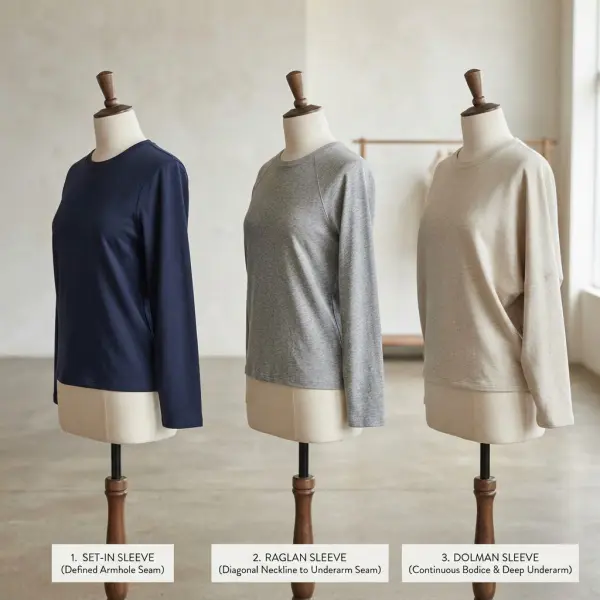
Set-in, raglan, and dolman sleeves differ mainly in where the sleeve connects to the garment body and how shoulder shaping is distributed through the pattern. A set-in sleeve is a separate sleeve inserted into a defined armhole, giving patternmakers precise control over shoulder shape and sleeve fit. A raglan sleeve extends toward the neckline and joins the bodice through diagonal seams running from the underarm toward the neck. A dolman sleeve is generally cut continuously with the bodice, eliminating a conventional armhole seam and creating a broader, often more relaxed underarm area.
None is universally better. Set-in sleeves work well when a garment needs a clearly defined shoulder and controlled sleeve shape. Raglan construction can create a softer shoulder line and distribute shaping differently around the upper body. Dolman construction works particularly well for relaxed, draped, or intentionally oversized silhouettes, although very deep cut-on sleeves can cause more of the garment body to move when the arm is raised.
For fashion brands, choosing among them affects not only appearance but also pattern development, fit, fabric consumption, seam construction, production workflow, grading, mobility, and quality-control criteria.
What Is the Main Difference Between Set-In, Raglan, and Dolman Sleeves?
The most important difference is pattern architecture. A set-in sleeve has a separate sleeve cap that is sewn around a conventional armhole. A raglan sleeve incorporates part of the shoulder area into the sleeve and creates seams that extend from the neckline toward the underarm. A dolman sleeve typically eliminates the separate armhole seam altogether because the bodice and sleeve are developed as a continuous pattern section.
These structural differences affect how the garment handles shoulder shaping. With a set-in sleeve, the shoulder seam remains primarily on the bodice while the sleeve cap shapes over the upper arm and shoulder edge. With a raglan sleeve, some of that shoulder territory becomes part of the sleeve pattern. With a dolman construction, the transition from bodice to sleeve is continuous, so shaping is controlled through the angle, width, underarm geometry, seams, darts, gussets, fabric drape, or combinations of these elements.
New Mexico State University's sleeve-construction guidance distinguishes the three systems in essentially these terms: the set-in sleeve is fitted into an armhole; the raglan uses seams running from the neckline toward the underarm; and a cut-on sleeve such as a kimono-style construction forms part of the bodice itself. New Mexico State University guide to sleeve construction
That construction difference matters more than the visual label alone. Two garments can both appear relaxed, for example, while one uses a low-cap set-in sleeve and another uses a dolman sleeve. Their production sequence, fitting behavior, grading logic, and seam placement remain fundamentally different.
Set-In Sleeves: The Most Defined Armhole Construction
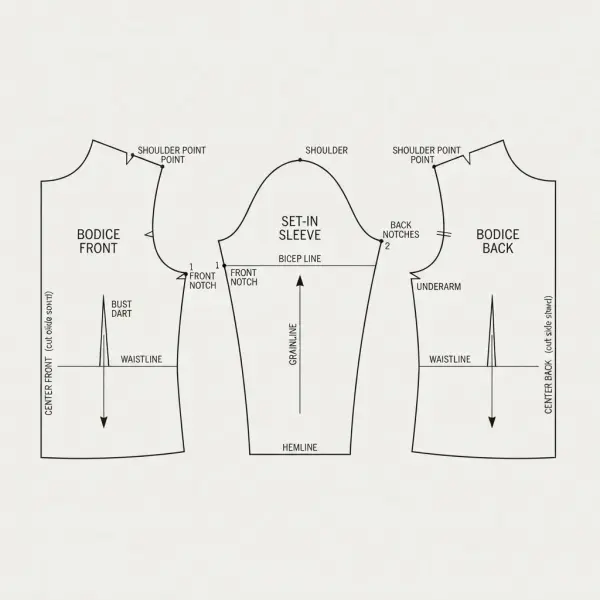
A set-in sleeve is a separate sleeve sewn into a clearly defined armhole or armscye. The sleeve cap forms the upper curved section of the sleeve and must correspond to the front and back armhole while creating the intended shape over the shoulder and upper arm. This architecture gives patternmakers relatively independent control over the bodice shoulder, armhole, sleeve cap, bicep width, and sleeve pitch.
New Mexico State University describes the plain set-in sleeve as a sleeve that is shaped and eased into the armhole so it fits smoothly over the end of the shoulder. It also distinguishes the shirt-style set-in sleeve, which generally has a shorter cap and can have a seam length close to that of the armhole.
This range is important. "Set-in sleeve" does not automatically mean a highly tailored sleeve. A fitted blazer, formal blouse, casual woven shirt, T-shirt, and basic sweatshirt can all use versions of set-in construction while having very different cap heights, armhole depths, ease relationships, and manufacturing sequences.
Why Set-In Sleeves Give More Shoulder Definition
The conventional armhole seam creates a visible structural boundary between bodice and sleeve. When the shoulder point, armhole, and sleeve cap are carefully developed, this makes it possible to create a clean transition around the anatomical shoulder rather than allowing the sleeve to flow continuously from the neckline or bodice.
That is one reason set-in construction is common in garments where shoulder positioning matters visually. Tailored jackets, fitted dresses, blouses, uniforms, shirts, and many structured outerwear products can use this construction because patternmakers can control the shoulder line without requiring the sleeve itself to extend to the neckline.
The trade-off is that greater control usually means a more interdependent pattern relationship. The sleeve cap, armhole, shoulder slope, bicep width, and pitch must work together. Readers who need the underlying fit mechanics can refer to how sleeve construction affects garment fit.
Set-In Sleeves Can Be Tailored or Production-Friendly
Traditional fitted set-in sleeves may require controlled cap easing before insertion. The sleeve-cap seam length can be longer than the corresponding armhole seam length, with the difference distributed without visible gathers. NMSU specifically describes ease stitching above the sleeve notches for a plain set-in sleeve.
That should not be generalized to every set-in sleeve. Shirt-style and many knit sleeves use flatter caps and may contain little or no positive cap ease. They can often be attached while the garment body remains open at the side seam, after which the sleeve underarm seam and bodice side seam are sewn in a continuous operation.
For manufacturing teams, these are significantly different processes even though both products technically have set-in sleeves.
Raglan Sleeves: Moving the Sleeve Seam Toward the Neckline
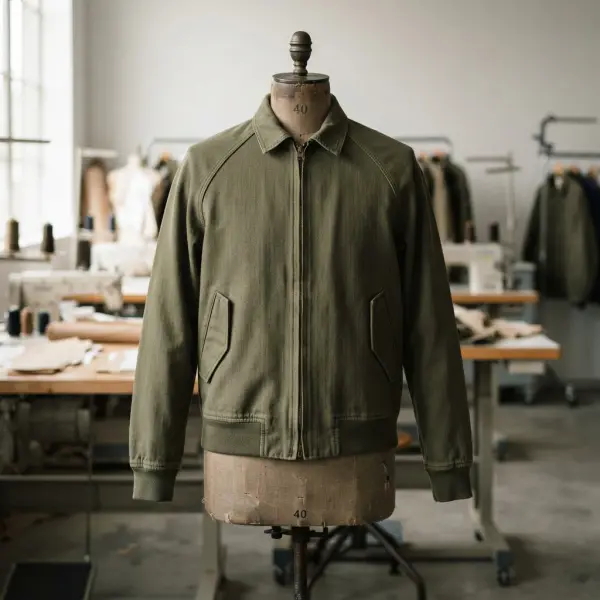
A raglan sleeve extends into the shoulder region and joins the bodice with seams that typically run diagonally from the neckline toward the underarm. Instead of ending at a conventional shoulder-edge armhole like a set-in sleeve, the raglan pattern carries the upper shoulder area into the sleeve itself.
Professional pattern-construction examples from M. Müller & Sohn show this clearly: sections around the original shoulder and armhole relationship are incorporated into the sleeve, after which new raglan seam lines are developed from the neckline toward the lower armhole. This is not simply a stylistic diagonal drawn over a normal sleeve. It is a redistribution of pattern shaping.
Because the raglan seam crosses an area that would otherwise contain the bodice shoulder and upper armhole, it can become an important design line. Contrasting sleeve fabrics, piping, topstitching, color blocking, and seam shaping can emphasize the raglan architecture rather than hide it.
How Raglan Construction Changes the Shoulder Line
With a set-in sleeve, the eye can usually identify the end of the bodice shoulder where the armhole seam begins. A raglan sleeve softens or removes that conventional boundary because the sleeve continues upward toward the neckline.
This can make raglan construction useful when designers want less emphasis on an exact anatomical shoulder point. Sportswear, knitwear, outerwear, sweatshirts, casual tops, and certain coats frequently use raglan-derived constructions, although the actual fit can range from close and shaped to deliberately oversized.
The raglan sleeve still requires shoulder shaping. Depending on the draft, that shaping may be handled through an upper sleeve seam, dart, curved raglan seams, fabric behavior, or other pattern manipulation. Pattern-Making.com's documented raglan foundations, for example, transfer portions of the shoulder region into the sleeve and use additional shaping around the sleeve top rather than simply eliminating shoulder geometry.
Does a Raglan Sleeve Automatically Give Better Mobility?
Raglan sleeves are commonly associated with comfortable movement, and NMSU describes raglan construction as comfortable to wear. But it is too simplistic to say that every raglan sleeve automatically provides more mobility than every set-in sleeve.
Movement depends on the complete pattern. Raglan seam position, underarm height, sleeve width, fabric stretch, shoulder shaping, bodice ease, and sleeve angle can all influence how the garment behaves. A poorly proportioned narrow raglan can still restrict movement, while a well-designed set-in sports garment can provide substantial mobility.
The more useful business conclusion is that raglan construction gives designers a different way to distribute shoulder and armhole shaping, not a guarantee of performance.
Dolman Sleeves: When the Sleeve Becomes Part of the Bodice
A dolman sleeve is generally a cut-on sleeve in which the sleeve and bodice form a continuous pattern area rather than being joined around a conventional armhole. Dolman styles typically have generous space beneath the arm and taper toward the lower sleeve, although the depth and volume can vary considerably.
The construction belongs to a broader family of cut-on sleeves. Terminology is not completely standardized across patternmaking traditions: "dolman," "batwing," and some uses of "kimono sleeve" can overlap, while individual drafting systems distinguish them more precisely. A useful practical distinction is that dolman commonly describes a relatively deep, loose underarm silhouette, whereas cut-on or kimono-style construction describes the broader structural principle of developing the sleeve continuously from the bodice.
NMSU notes that cut-on kimono-style sleeves are part of the bodice and that their slope and width affect both fit and movement. It also notes that a gusset can be used where additional underarm reinforcement or mobility is required. Recent patternmaking guidance from Minerva similarly describes dolman construction as part of the cut-on sleeve family, with sleeve angle affecting the balance between drape and mobility.
Why Dolman Sleeves Create More Underarm Volume
In conventional set-in construction, the armhole curves relatively close to the upper body and the sleeve emerges from that seam. A dolman pattern instead extends outward from the bodice, so the underarm line can begin substantially lower on the torso.
This creates the characteristic continuous line from body to sleeve. Depending on the draft and fabric, the area beneath the arm may form soft folds or pronounced batwing-like drape. That volume is part of the design rather than automatically a fitting defect.
The trade-off becomes particularly relevant when the sleeve is cut very low. Raising the arm can pull a larger section of the bodice upward because there is no high conventional armhole isolating sleeve movement from the garment body. A gusset or differently shaped underarm can improve certain close-fitting cut-on constructions, but the appropriate solution depends on the design.
Fabric Choice Is Especially Visible in Dolman Construction
A deep dolman sleeve creates enough uninterrupted fabric area that drape, thickness, and stiffness strongly affect the final silhouette. A soft knit or fluid woven can fall into controlled folds, while a rigid fabric may create stronger geometric volume around the underarm.
That does not make structured fabrics unsuitable by definition. Designers may deliberately use them to create architectural silhouettes. The point is that a fabric substitution can change the visual character of a dolman sleeve more dramatically than a specification sheet based only on circumference might suggest.
The continuous bodice-and-sleeve pattern can also become wide. That affects marker efficiency and usable fabric width, particularly for long sleeves or pronounced batwing shapes. Therefore, a visually simple garment with relatively few seam operations is not necessarily the most fabric-efficient option.

Set-In vs Raglan vs Dolman: A Practical Comparison
The three constructions can now be compared more precisely. The differences involve far more than visual styling.
|
Factor |
Set-In Sleeve |
Raglan Sleeve |
Dolman Sleeve |
|
Basic construction |
Separate sleeve inserted into conventional armhole |
Sleeve extends toward neckline through diagonal raglan seams |
Sleeve generally cut continuously with bodice |
|
Conventional armhole seam |
Yes |
Replaced by raglan seam system |
Generally no |
|
Shoulder definition |
Usually clearest |
Softer or redistributed |
Often visually continuous |
|
Pattern control |
High control of armhole, cap and shoulder separately |
Shoulder shaping incorporated partly into sleeve |
Bodice and sleeve geometry strongly interconnected |
|
Typical silhouette |
Fitted to relaxed |
Athletic, soft-shouldered, relaxed or shaped |
Relaxed, draped, oversized or sculptural |
|
Underarm volume |
Depends on armhole and sleeve draft |
Usually more conventional than deep dolman |
Often relatively generous |
|
Sleeve-cap easing |
Possible, especially fitted woven styles |
Different shaping system; conventional cap ease not used in the same way |
No conventional sleeve cap |
|
Fabric sensitivity |
High |
High |
Particularly visible through drape and volume |
|
Sewing operations |
Sleeve-to-armhole attachment required |
Raglan seams join sleeve to bodice |
Fewer conventional sleeve-attachment seams |
|
Fit evaluation |
Shoulder point, cap, pitch, bicep and armhole |
Raglan line, shoulder shaping, neckline relationship, underarm |
Underarm depth, sleeve angle, drape, garment lift |
|
Common product use |
Shirts, blouses, dresses, tailoring, uniforms |
Sportswear, sweatshirts, jackets, knitwear, coats |
Relaxed tops, dresses, knitwear, draped fashion |
|
Main design strength |
Precise shoulder and sleeve control |
Distinct seam line and redistributed shoulder shaping |
Continuous silhouette with fewer armhole seams |
These descriptions indicate tendencies rather than fixed rules. A high-fashion dolman can be sharply structured, a raglan coat can be highly tailored, and a set-in sweatshirt can be extremely relaxed. Pattern geometry, fabric, ease, and finishing still determine the actual garment.
Which Sleeve Provides the Best Mobility?
There is no universal winner because mobility depends on both sleeve type and pattern geometry. Sleeve construction determines where seams and shaping occur, but armhole height, underarm depth, sleeve circumference, fabric stretch, bodice ease, and intended movement determine how comfortably the final garment performs.
A well-designed set-in sleeve with a relatively high armhole can allow substantial movement because the sleeve joint sits closer to the body. A raglan can redistribute shaping around the shoulder and remove dependence on an exact shoulder endpoint. A deep dolman may feel spacious because of its generous underarm volume, yet raising the arm can also lift a greater portion of the garment.
This apparent contradiction is useful for product developers. Loose does not automatically mean unrestricted movement, and fitted does not automatically mean restrictive. Mobility must be assessed through a physical or reliable digital fit sample using movements that match the garment's intended use.
A fashion uniform intended for reaching and lifting, for example, should be tested differently from an evening blouse whose primary requirement is visual drape. Product context matters more than choosing a sleeve name associated with "comfort."
How Sleeve Type Changes the Garment Silhouette
Sleeves occupy a large visual area and influence how the eye reads the entire upper body. The seam position itself can change the apparent proportions of the shoulder and torso even before fabric volume is considered.
A set-in sleeve tends to provide the clearest visual separation between torso and arm. When the shoulder seam and sleeve head sit close to the anatomical shoulder, the garment can look precise and controlled. Moving that seam downward into a dropped-shoulder variation softens the effect while technically retaining a set-in-style sleeve relationship.
Raglan seams create diagonal movement from neck to underarm. Depending on contrast, curvature, and placement, those lines can become either discreet shaping seams or prominent design features. This is why raglan construction lends itself effectively to color-blocked sportswear, where the seam architecture is intentionally visible.
Dolman sleeves create the broadest uninterrupted transition. When combined with fluid fabric, the result can feel soft and draped; when cut in more structured material, the same basic architecture can produce strong volume. Designers therefore need to consider the sleeve as part of the garment's overall proportion rather than as an interchangeable finishing component.
How Fabric Choice Changes the Best Sleeve Construction
The same sleeve construction behaves differently across fabrics. Stretch, recovery, drape, thickness, compressibility, friction, stability, and bias response all influence whether a sleeve sits smoothly, forms attractive folds, or becomes difficult to manufacture.
Set-in sleeves in structured woven fabrics can support highly controlled shoulder shapes, but sleeve-cap easing and pressing may require greater precision. Stretch knits can accommodate flatter set-in geometries and simplified production because part of the required mobility comes from the textile itself.
Raglan construction works across both woven and knit materials, but its prominent seam length means seam stabilization and differential stretch can matter in elastic fabrics. If the sleeve and body use contrasting textiles—common in sportswear—the factory should confirm that their stretch and recovery are compatible enough to prevent the diagonal seam from distorting.
Dolman designs often expose drape differences most dramatically. Deep underarm volume in a fluid viscose-like woven may fall softly, whereas the same pattern in thick neoprene-like material can project away from the body. Neither is intrinsically wrong, but they are different products.

Which Sleeve Is Easier to Manufacture?
The answer depends on the garment and production system rather than simply the number of seams. A dolman sleeve may eliminate the conventional sleeve-setting operation, while a raglan replaces the circular armhole seam with longer diagonal joining seams. A set-in sleeve can require careful easing in tailored products but can be extremely efficient when designed as a flat-set shirt or knit sleeve.
This makes "fewer pattern pieces" an incomplete measure of manufacturing simplicity. A wide dolman piece may consume more fabric or require more difficult marker placement. A raglan with curved seam lines, piping, contrasting panels, or matching requirements can demand additional handling. A set-in knit sleeve designed for automated or highly standardized sewing can be routine for an experienced factory.
NMSU's construction standards also distinguish finishing requirements between set-in and kimono/raglan sleeve seams, reinforcing that different architectures require different seam-handling approaches rather than one universally simpler process.
For sourcing teams, the practical question should therefore be: Can this factory produce this particular sleeve construction consistently in this particular fabric at the required quality and volume? That is more useful than assuming one sleeve category will always cost less.
Fabric Consumption Can Change the Commercial Decision
Pattern-piece count and fabric consumption do not move in the same direction. Dolman construction illustrates this clearly. A garment may eliminate two separate sleeve pieces or reduce attachment operations, yet its combined bodice-sleeve piece can become substantially wider than a conventional bodice.
Whether this reduces marker efficiency depends on fabric width, garment size, sleeve length, symmetry, print direction, nap, grain requirements, and the ability to nest pieces around one another. A long-sleeved batwing shape can be particularly demanding because a large continuous pattern width must fit within the usable fabric.
Raglan and set-in constructions use separate sleeve pieces that can sometimes be rotated or nested more efficiently, subject to grain and fabric-direction restrictions. However, that advantage is product-specific and should be evaluated through actual marker planning rather than assumed from pattern geometry.
For brands working with expensive materials, this can shift the economics considerably. Saving one sewing operation has limited value if the design increases consumption by an amount that costs more than the labor saved.
Sleeve Construction Also Affects Grading and Size Consistency
Set-in sleeves require grading rules that preserve the relationship between shoulder, armhole, sleeve cap, bicep, and sleeve length. Problems can appear if those dimensions grow independently without maintaining the intended balance.
Raglan grading introduces a different challenge because the sleeve extends to the neckline. Changes in chest width, shoulder area, neck dimensions, and sleeve dimensions influence a pattern piece that spans several body regions. The diagonal raglan seam must continue to align correctly with the corresponding front and back bodice sections.
Dolman patterns combine even more body and sleeve geometry within a continuous piece. Increasing body width, arm circumference, sleeve length, or underarm depth can alter the shape of a comparatively large pattern component.
No construction is inherently impossible to grade well. The commercial issue is that grading rules should reflect the underlying architecture rather than treating sleeves as interchangeable attachments. Brands expanding into wider size ranges should physically validate selected graded sizes where the construction carries significant fit risk.
Common Mistakes When Choosing Between Sleeve Types
Choosing a Sleeve Only Because of Its Appearance
Design teams sometimes select a sleeve from visual references without considering the construction underneath. A relaxed photograph may appear achievable by simply substituting a dolman for a set-in sleeve, but changing sleeve architecture also changes armhole geometry, pattern-piece width, fabric behavior, production sequence, and movement.
The better approach is to define both the visual objective and the performance requirement. A similar-looking silhouette can sometimes be achieved through several constructions, and the best option depends on fabric, manufacturing capability, price point, and expected fit.
Assuming Raglan Automatically Means Sportswear
Raglan sleeves are strongly associated with sportswear, sweatshirts, and baseball-style tops, but the construction itself is not limited to casual products. Raglan-derived patterns are also used in coats, dresses, blouses, and more tailored garments.
Treating raglan as merely a styling cliché can cause designers to overlook its patternmaking possibilities. Seam curvature, shoulder shaping, sleeve width, fabric, and finishing can make the same basic architecture look technical, formal, minimalist, or soft.
Treating Dolman as a Shortcut to Easy Fit
The generous underarm volume of a dolman sleeve can accommodate body variation, but it does not eliminate fit considerations. Sleeve angle, garment width, underarm depth, neckline stability, fabric drape, and sleeve opening still determine how the garment behaves.
If the underarm is excessively deep for the intended use, the bodice may lift considerably when the wearer raises an arm. If it is made too close without appropriate shaping, strain can appear. A dolman is therefore a design system rather than simply an oversized rectangle.
Comparing All Three Sleeves Using the Same Wrinkle Standard
A fold that would indicate poor cap distribution in a fitted set-in sleeve might be completely normal in a relaxed dolman. Raglan seams also create their own directional relationships across the shoulder.
Quality-control teams should not use one generic "no wrinkles" instruction for every sleeve type. Defect criteria need to distinguish intentional drape from unintended pulling, twisting, puckering, or seam imbalance. A deeper diagnostic framework belongs in common sleeve problems and how to prevent pulling, twisting, and wrinkles.
Ignoring Factory and Fabric Constraints Until After Sampling
A design can be technically valid yet commercially awkward. A deep dolman may exceed efficient marker width, a tailored set-in sleeve may require pressing capabilities unavailable on a simple production line, or a raglan design using contrasting fabrics may expose differential stretch problems.
These issues are cheaper to identify during development than after sales samples have been approved. Pattern engineering, fabric sourcing, costing, and factory discussion should therefore happen together rather than sequentially.
What Should Brands Verify Before Choosing a Sleeve Construction?
The first question should be the product requirement rather than the sleeve name. A designer needs to know what the garment should look like, how much movement it requires, what fabric will be used, where it will be manufactured, and which costs matter most.
A practical evaluation should cover:
- Silhouette: Does the product need a defined shoulder, diagonal shoulder line, or continuous draped transition?
- Movement: What arm movements should the wearer reasonably perform?
- Fabric: Does the textile stretch, recover, compress, drape, or hold volume as the pattern expects?
- Construction: Can the factory control sleeve setting, raglan seams, or cut-on underarm shaping consistently?
- Marker efficiency: Will large or unusual pattern shapes increase material consumption?
- Grading: Can the construction remain balanced throughout the intended size range?
- Quality control: Are acceptable folds, ease, seam alignment, and movement clearly defined?
- Brand consistency: Does the sleeve support the visual language and fit expectations of the product category?
The final decision often involves trade-offs. A construction that gives the cleanest visual result may require more sewing control. Another may simplify sewing but use more material. A third may support a relaxed fit yet change how the whole bodice moves with the arm.
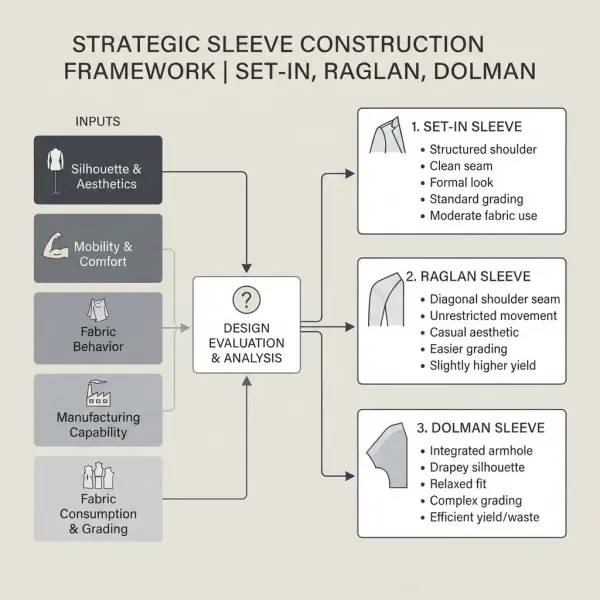
Which Sleeve Type Is Best for Different Garment Goals?
For a garment that requires a defined shoulder and precise control over sleeve shape, set-in construction is often the most direct starting point. It gives patternmakers distinct control over bodice shoulder geometry and sleeve geometry, although that control also demands careful coordination between them.
For a softer shoulder transition with an intentional diagonal seam, raglan construction can be useful. It can work particularly well when the seam itself contributes to styling, when the product benefits from shoulder shaping that does not depend on a conventional armhole, or when the designer wants to combine sleeve and shoulder areas visually.
For a continuous, relaxed or draped silhouette, dolman construction provides a very different design language. It can reduce conventional armhole seam operations and create generous volume, but product developers should pay attention to garment lift, pattern width, fabric behavior, and underarm geometry.
These are starting points rather than prescriptions. Product development should confirm the choice through pattern testing, fabric sampling, movement testing, costing, and production assessment.
Frequently Asked Questions About Set-In, Raglan, and Dolman Sleeves
What is the simplest difference between a set-in sleeve and a raglan sleeve?
A set-in sleeve ends at a conventional armhole around the shoulder, while a raglan sleeve extends upward toward the neckline and joins the bodice through diagonal seams. In a set-in garment, the bodice normally retains a conventional shoulder seam and separate armhole shape. In a raglan garment, part of the shoulder region becomes incorporated into the sleeve. This changes both the visual line and pattern architecture. Neither construction is automatically more fitted or more comfortable; those characteristics depend on cap or raglan geometry, underarm position, sleeve width, fabric, and overall garment ease.
Is a dolman sleeve the same as a kimono sleeve?
The terms overlap in Western patternmaking but are not used identically in every drafting system. Both commonly refer to cut-on constructions in which the sleeve is developed continuously with the bodice rather than inserted into a conventional armhole. "Dolman" often describes a deeper, more voluminous underarm shape that narrows toward the wrist, while "kimono sleeve" can be used more broadly for cut-on sleeves with varying angles and widths. It is better for technical teams to specify the actual pattern architecture rather than relying entirely on terminology, particularly when communicating with different factories or patternmakers.
Are raglan sleeves better for broad shoulders?
Raglan construction can reduce the visual dependence on a precisely positioned conventional shoulder seam because the sleeve extends to the neckline. That can make the silhouette more forgiving of some shoulder variation, but it does not guarantee better fit for every broad-shouldered wearer. Raglan seam placement, upper-body width, sleeve shaping, neckline, and fabric still need to match the intended body measurements. A poorly balanced raglan can pull just as a set-in sleeve can. Brands should therefore fit-test the garment rather than using raglan construction as an automatic solution for a particular body type.
Which sleeve type uses the least fabric?
There is no reliable answer based on sleeve type alone. A short set-in sleeve may use very little material, while a long or oversized version can require much more. Raglan sleeves extend into the shoulder and neckline area, changing marker geometry. Dolman sleeves may have fewer separate pieces but can produce very wide combined bodice-and-sleeve patterns that reduce marker efficiency. Fabric width, size, sleeve length, print direction, nap, grain restrictions, and piece nesting all matter. Brands concerned about material cost should compare actual production markers rather than assuming fewer seams or pattern pieces mean lower consumption.
Which sleeve type is easiest to sew?
A simple cut-on dolman can eliminate the conventional sleeve-setting operation, making assembly straightforward in some products. Raglan seams can also be easier to access than a tightly curved set-in armhole. However, a basic knit set-in sleeve inserted flat can be extremely efficient in industrial production. Fabric handling, seam curvature, easing requirements, topstitching, reinforcement, and factory specialization all change the answer. The most production-friendly sleeve is therefore the one engineered for the specific fabric and production line rather than the sleeve category with the fewest visible seams.
Which sleeve is best for an oversized garment?
All three can be used successfully. A dropped-shoulder set-in sleeve can create a familiar oversized shirt or sweatshirt silhouette, raglan construction can create a softer continuous upper-body shape, and dolman construction can produce much more integrated volume through the torso and sleeve. The right choice depends on where the designer wants that volume to originate. For commercial development, the brand should also consider how the construction grades across sizes, how much fabric it consumes, and whether the oversized silhouette still provides the intended movement rather than simply excess circumference.
Can a set-in sleeve be converted to raglan or dolman without changing the bodice?
Not reliably. Raglan construction redistributes part of the shoulder and armhole into the sleeve, while dolman construction integrates the sleeve directly into the bodice. Both therefore require changes to the bodice pattern as well as to the sleeve architecture. M. Müller & Sohn's raglan drafting example demonstrates this redistribution explicitly by modifying the bodice and transferring shoulder-related sections into the sleeve. A designer can use an existing set-in block as the development foundation, but the finished raglan or dolman should be treated as a newly engineered pattern relationship and tested accordingly.
Conclusion
Set-in, raglan, and dolman sleeves solve the connection between arm, shoulder, and garment body in three different ways. Set-in construction preserves a conventional armhole and gives precise control over the shoulder and sleeve cap. Raglan construction transfers part of the shoulder relationship into the sleeve and creates characteristic neckline-to-underarm seams. Dolman construction largely removes the conventional armhole by developing the bodice and sleeve as a continuous form.
Those differences influence much more than styling. They affect mobility, fabric behavior, cutting efficiency, sewing sequence, pressing, grading, quality standards, and how the garment responds when the wearer moves.
For fashion businesses, the most useful question is therefore not "Which sleeve is best?" It is "Which construction best delivers this garment's intended silhouette, movement, fabric behavior, production efficiency, and price point?"
Once sleeve construction is evaluated in that broader product-development context, the choice becomes less subjective. It becomes an engineering and commercial decision as well as a design decision.



Comments 0
Leave a CommentSend Comment
Anda harus Login terlebih dahulu untuk dapat memberikan komentar.